

A standard tank water heater installation through Home Depot usually averages $1,600 to $2,400, while tankless installation starts around $2,400 and can climb beyond $4,300 when upgrades are needed. If you're standing in a cold shower, staring at a leaking tank, the part that matters most is this: the shelf price is rarely the final price.
Most homeowners start in the same place. The hot water stops. Someone searches for a replacement, sees Home Depot, and assumes the job will be simple because the store can sell the heater and arrange the install. That path can work, but only if you understand what you're buying.
From a plumber's point of view, the issue isn't whether Home Depot can get a heater into your home. It's whether the quote reflects the full job. In Vancouver-area homes, the difference between a smooth same-day swap and an expensive surprise usually comes down to permits, venting, shutoffs, code items, access, and who takes responsibility when the old setup doesn't meet current requirements.
Table of Contents
- Your Hot Water Is Out Now What
- Deconstructing The Home Depot Installation Bill
- Hidden Costs That Inflate Your Final Price
- The Home Depot Installation Process What Is Included
- Home Depot vs A Local Vancouver Pro Like Encano
- How to Get an Accurate Quote and Make the Right Choice
Your Hot Water Is Out Now What
The usual call goes like this. A homeowner notices the garage floor is wet, or the utility room smells hot and metallic, or the water is warm for five minutes and then gone. They look up replacement options fast because nobody wants to spend even one night without hot water.
That urgency is why big-box installation feels attractive. You can see models, compare brands, and book installation in one place. If your first concern is speed, that makes sense. But the number you see beside the heater isn't the number that decides your budget.
A practical example. Say you have an older tank heater in the same location, with decent access, no venting problems, and no obvious piping issues. That job may stay fairly close to the standard installation range. If the installer arrives and finds an old shutoff that won't operate properly, missing earthquake restraint, questionable venting, or an expansion setup that needs attention, the project changes on the spot.
Most expensive water heater jobs don't become expensive because of the tank itself. They become expensive because the old installation wasn't as simple as it looked.
That's the part homeowners miss when they search for water heater installation Home Depot cost. You're not just buying a box with burners or elements inside. You're buying removal, setup, reconnection, compliance, and somebody willing to stand behind the final result.
If your current unit has stopped heating but you aren't sure whether replacement is the only answer, it's worth reviewing common reasons a water heater stops heating and what to check first. Sometimes the smartest move is replacement. Sometimes it isn't.
Why homeowners get caught off guard
The surprise usually comes from one assumption: "If the old one was there already, the new one should just hook up."
Sometimes that's true. Often it isn't.
Older homes around Vancouver can have tight mechanical rooms, dated venting, awkward drain routing, or shutoffs that technically work but shouldn't be reused. Even in a clean replacement, the installer still has to disconnect safely, drain the old tank, haul it out, set the new unit, reconnect everything, check for leaks, confirm combustion or electrical operation, and make sure the installation will pass inspection if one applies.
Deconstructing The Home Depot Installation Bill
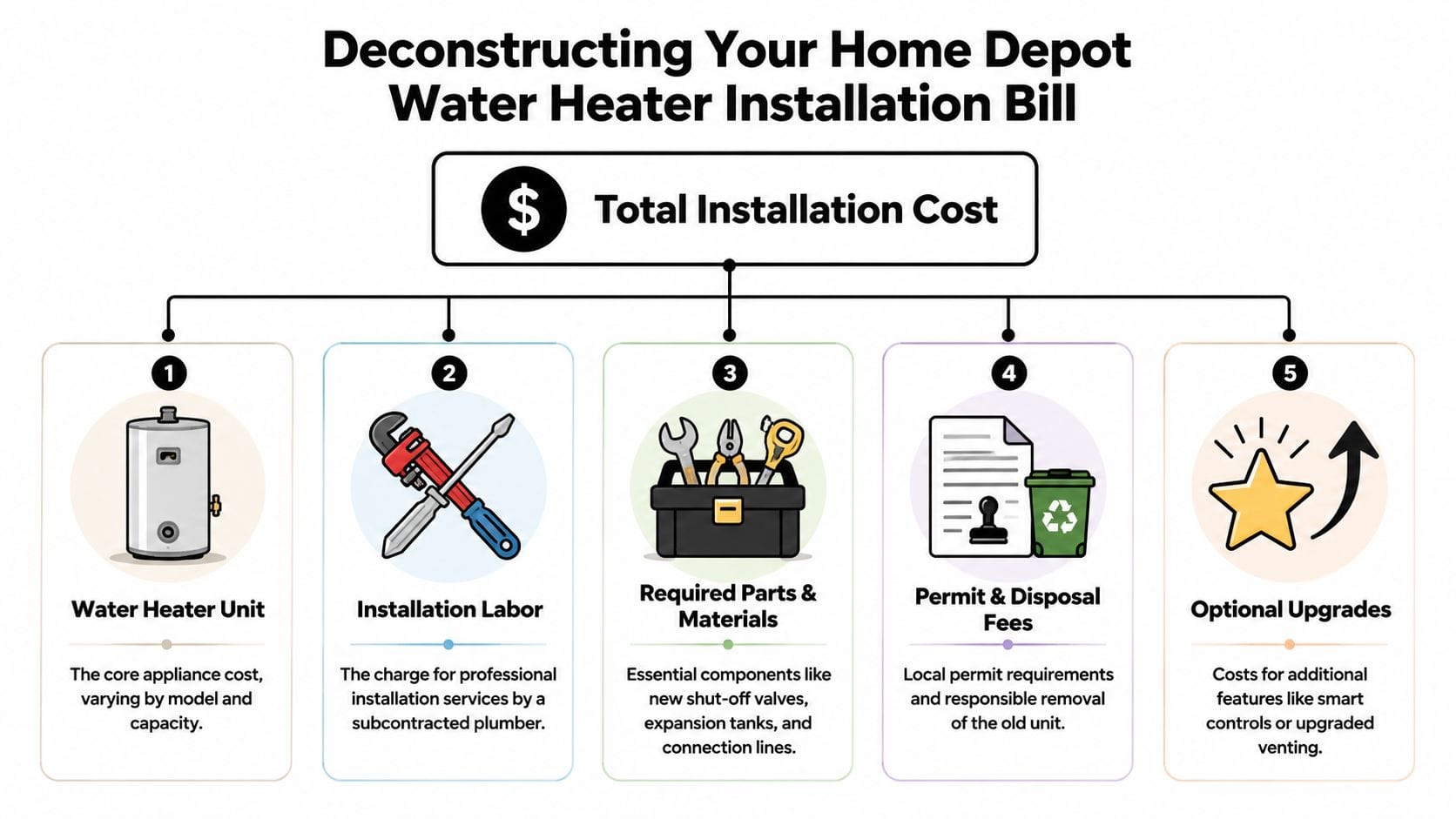
Home Depot's published guidance says standard tank replacement averages $1,600 to $2,400, while tankless installation starts at $2,400 and rises with configuration. The same pricing guidance, as cited in a 2026 consumer cost survey, lists $1,950 for tank installation and $4,300 for tankless installation, and notes that professional labour accounts for over half of total cost in many installs according to Home Depot water heater cost guidance.
What the headline price usually covers
An installation bill usually includes more than the appliance itself. In plain terms, the total often breaks into a few buckets:
- The heater itself. Tank and tankless units don't start from the same equipment cost.
- Labour to install it. This component often accounts for a large portion of the total bill.
- Materials used at the job. Connectors, fittings, valves, vent pieces, and other required parts add up quickly.
- Delivery and removal. Getting a new unit in and hauling the old one away is part of the actual project.
- Permit-related handling. Where permits apply, that process affects both cost and scheduling.
A lot of homeowners compare a retail heater price to a full installation quote and assume somebody is padding the bill. Usually, that's not what's happening. They're comparing a product to a completed plumbing job.
Why the appliance price misleads people
The heater on the store floor is only one line item. The installed job includes the work needed to make that heater operate safely in your home, with your existing gas, water, venting, electrical, and drain conditions.
A useful way to think about it is this. If a refrigerator arrives at your house, you plug it in. A water heater doesn't work that way. It has to be connected to systems that can leak water, leak gas, vent combustion, or fail inspection if handled poorly.
Practical rule: Ask for the installed scope in writing, not just the equipment selection.
If you're trying to understand how the overall cost stacks up beyond the sticker price, this breakdown of how much a hot water tank really costs installed is the right way to frame it.
Here's the practical difference between a clean quote and a confusing one:
| Bill element | What it means to a homeowner |
|---|---|
| Heater unit | The equipment you're choosing |
| Labour | The skilled work to disconnect, remove, install, test, and commission |
| Materials | The job-specific parts that make the connection legal and reliable |
| Disposal | Removal of the old tank |
| Permit handling | Coordination, compliance, and inspection-related steps where required |
A transparent quote tells you which of those are included and which might change after site review. A weak quote leaves everything in the phrase "basic installation" and sorts it out later.
Hidden Costs That Inflate Your Final Price
Some installs are routine. Others turn into a chain reaction once the old unit comes out. That's why two homeowners can both shop for a water heater and end up with very different final invoices.
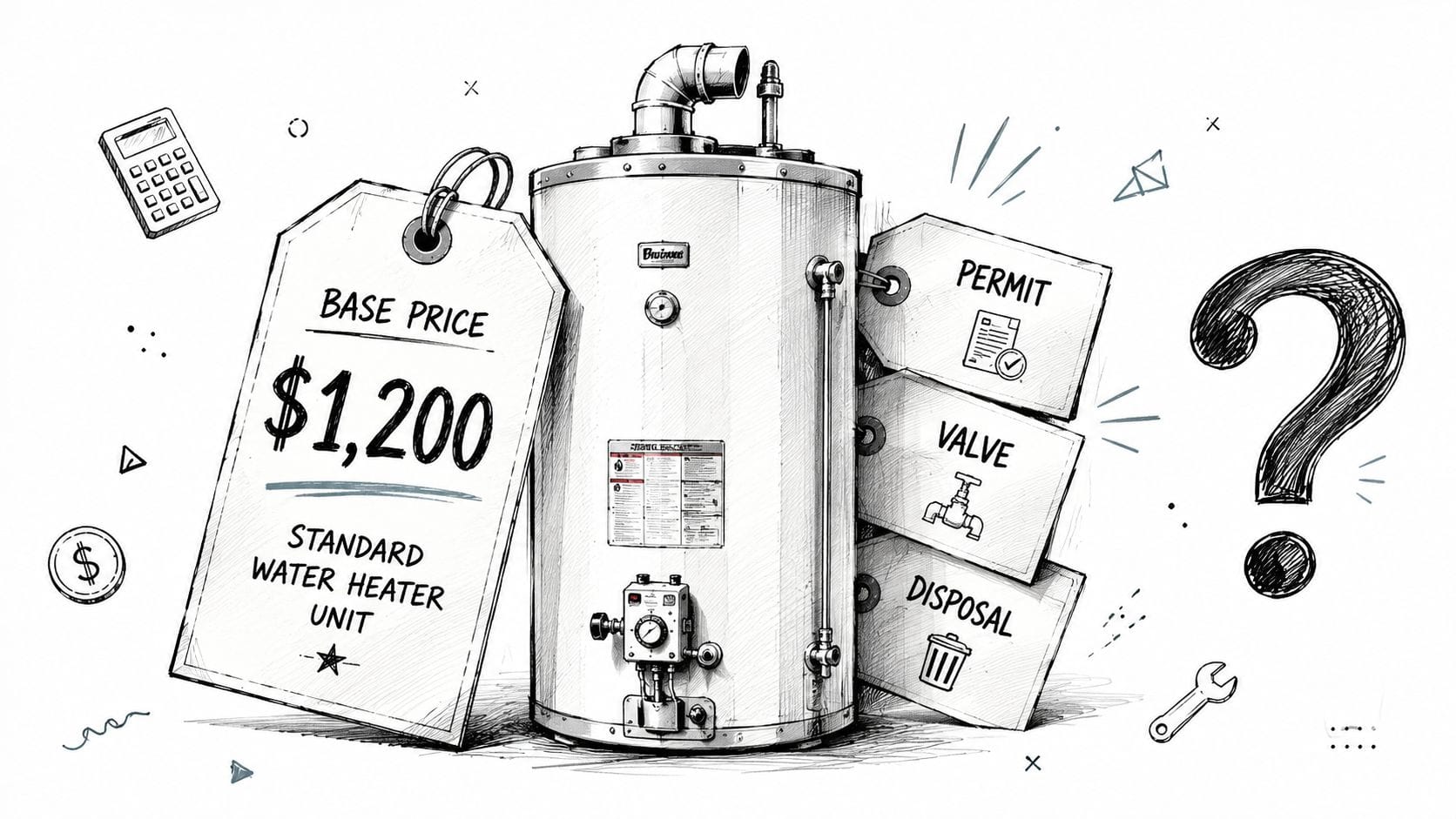
One documented example of all-in project pricing places installed water heater jobs in a broad $1,000 to $5,000 range depending on complexity, with the unit, labour, delivery, disposal, and permits all affecting the total, as reflected in this installed project range example. That spread makes sense in the field because a same-location replacement and a major upgrade are not remotely the same job.
A simple swap versus a complicated upgrade
Take two common scenarios.
Job one is a direct tank replacement. The old heater is in an open utility area. The new tank fits the same footprint. Existing services are in reasonable condition. Venting is straightforward. Access is easy. That's the kind of job that tends to stay under control.
Job two starts with a homeowner wanting to move from a tank to a tankless unit. Now the installer has to look harder at venting, gas capacity, electrical requirements, condensate handling if applicable, wall placement, and service clearances. The heater itself is only one piece of the decision.
Here are the hidden scope items that regularly push costs up:
- Venting changes because the new unit doesn't use the same vent arrangement as the old one.
- Gas work when supply piping or shutoffs need modification.
- Electrical adjustments if the unit or controls need a different connection.
- Seismic or restraint work when the setup has to meet current safety expectations.
- Access complications when the old tank can't be removed cleanly or the new one is harder to place.
- Old piping issues when corroded or improvised connections can't be reused.
If you're converting systems, assume the first quote is a starting conversation, not the final answer.
A short explainer can help you see why these jobs branch out in scope:
Questions that expose hidden scope
The fastest way to avoid surprise fees is to ask sharper questions before booking. Not generic ones. Specific ones.
Is this quote for same-location replacement only?
If the answer is yes, ask what happens if fittings, shutoffs, venting, or drain components need to change.Are haul-away and disposal already included?
Some homeowners assume they are. They shouldn't assume.What happens if the installer finds non-compliant work?
That's where many "cheap" installs stop looking cheap.Will the quote change if the new heater has a different profile or connection layout?
A taller tank, different flue position, or new venting path can alter labour and materials.
The goal isn't to turn a simple replacement into a complicated negotiation. It's to identify whether the quote is based on your actual home or on a best-case version of it.
The Home Depot Installation Process What Is Included
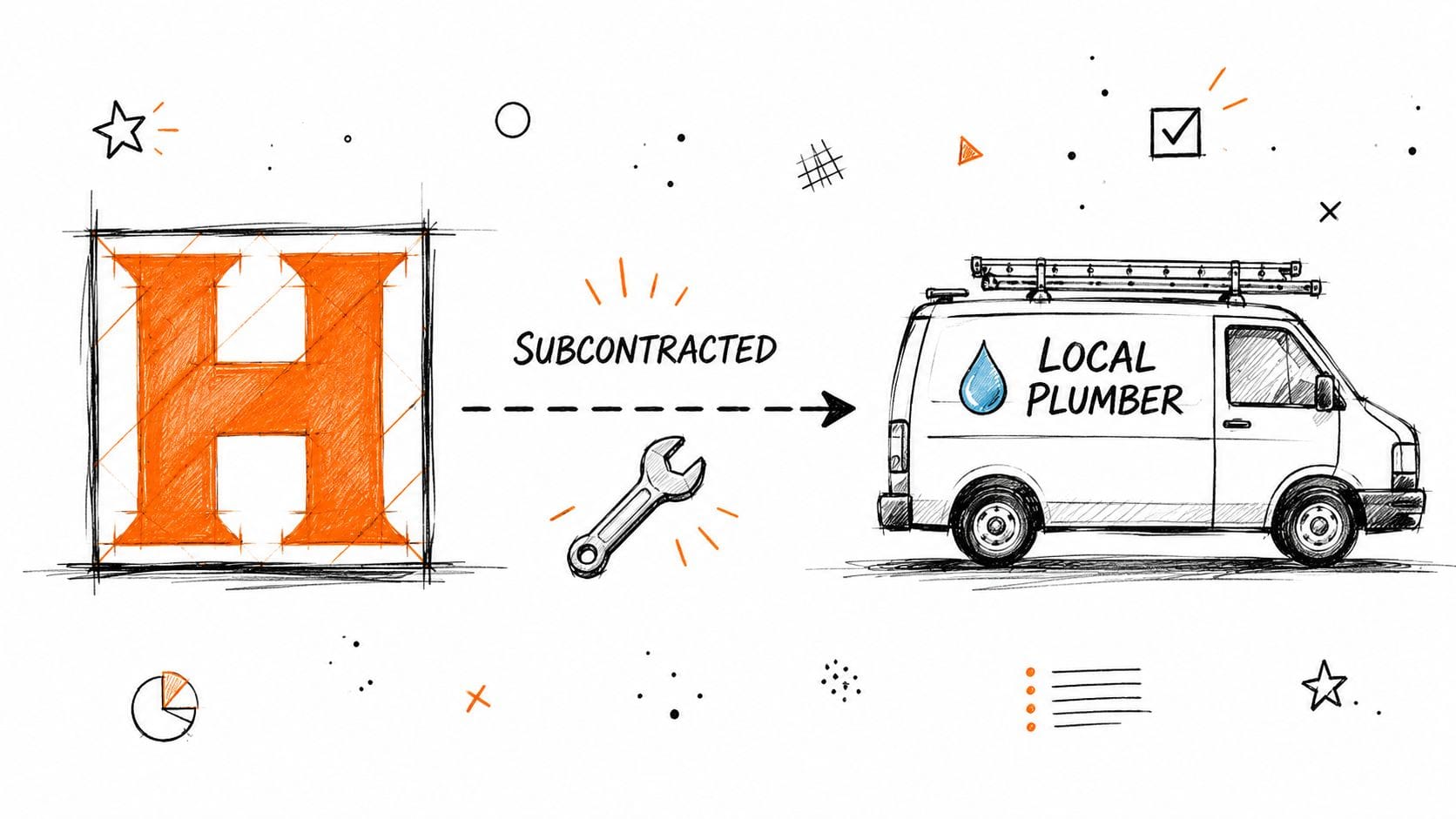
Home Depot offers installation through a contractor network rather than sending out a plumber directly employed by the retail store. For many homeowners, that's fine. The key is understanding where the handoff happens and what the base service usually means in practice.
What a standard install usually means
A standard install generally works best when the new heater replaces the old one in the same location and the surrounding connections are serviceable. In that situation, the work often includes disconnecting the old unit, placing the new one, making the required reconnections, testing operation, and removing the old heater.
That model is efficient when the home fits the template. It gives homeowners one place to start shopping and one process to book.
What often falls outside the base service
The trouble starts when the house doesn't fit the template. That's common in older properties, condos with access limitations, or upgrades where the homeowner wants something different from what was there before.
Work often falls outside the base scope when the installer runs into issues such as:
- Re-piping that goes beyond direct reconnection
- Gas line alterations
- Electrical modifications
- Venting changes
- Wall, cabinet, or finish repairs
- Inspection-related corrections after deficiencies are found
A "standard installation" is not the same thing as "everything needed in this room."
This is why some homeowners feel the process is smooth and others feel blindsided. The service isn't inherently bad. It just depends on whether your home matches the assumptions built into the quote.
The practical point is simple. Ask who handles the extras, who approves them, and whether the installer can complete all required corrective work without another trade stepping in. That answer tells you a lot about how disruptive the project may become.
Home Depot vs A Local Vancouver Pro Like Encano
For Vancouver-area homeowners, the biggest difference isn't just price. It's how the job is scoped, who owns the result, and how quickly decisions get made when something unexpected shows up.
Home Depot's own installation guidance says permits are required on most water heater replacements and that pricing varies by state, city, and municipality, which matters because permit-driven jobs can involve extra labour for shutoff, drain-down, seismic strapping checks, venting verification, and inspection scheduling according to Home Depot installation guidance on permits and municipal variation.
Where the experience differs in real life
A big-box channel is built for volume. That can be convenient when the job is simple and you want a familiar purchase path. A local plumbing company is usually better when the installation needs judgement, local code familiarity, and one accountable point of contact from quote to completion.
Here is where homeowners usually notice the difference:
Site-specific quoting
A local pro is more likely to look at venting, access, shutoffs, restraints, and connection condition at the start instead of treating them as later change items.Local permit familiarity
Municipal requirements aren't abstract. They affect how the job is planned and how long it takes.Speed when problems appear
If the installer opens the job and finds trouble, a direct contractor relationship usually resolves scope faster than a retail-contractor handoff.Clarity on exclusions
Better contractors tend to be blunt about what isn't included. That's useful, not rude.
If you're comparing options in Greater Vancouver, it's worth reviewing local water heater installation support in Vancouver so you can compare like with like.
Home Depot Installation vs. Local Pro Encano Plumbing
| Factor | Home Depot Installation | Local Pro (Encano Plumbing) |
|---|---|---|
| Point of contact | Retailer plus third-party installer | Direct contact with the plumbing company |
| Quote style | Often starts from standard install assumptions | More likely to reflect the actual site condition |
| Local code awareness | Depends on assigned contractor | Built around local service area experience |
| Permit coordination | Part of the process where applicable, but can feel less direct | Usually discussed as part of the job plan from the outset |
| Handling surprises | May require approvals, add-ons, or scope changes through the chain | Faster decisions on-site |
| Best fit | Straightforward replacement | Replacement, upgrade, or anything with complications |
This isn't about saying one path is always wrong. It's about matching the path to the job.
For a simple same-location replacement with no oddities, a big-box install may be perfectly serviceable. For older homes, conversions, limited access, venting concerns, or owners who want one company fully responsible, a local pro usually gives you better control over the final result.
The more your installation depends on local judgement, the less attractive a template-based process becomes.
How to Get an Accurate Quote and Make the Right Choice
A good quote should make you feel less uncertain, not more. If the estimate leaves basic questions unanswered, it isn't detailed enough yet.
Your quote checklist
Use this when comparing any installer:
Ask what is included in writing
You want the quote to state whether removal, disposal, connection materials, and testing are included.Ask what triggers extra charges
This is the single best way to expose risk before the work starts.Confirm permit responsibility
Don't assume somebody else is handling it.Ask about venting and connection changes
Especially if you're changing heater type or brand.Ask who performs the work
Retail booking and actual installation are not always the same party.Ask how warranty support works
If something leaks or fails after installation, you should know exactly who to call first.
Which option usually makes more sense
Choose the big-box route if your job is close to textbook. Same location. Same fuel type. Clean access. No signs of venting or piping issues. No need for design input.
Choose a local plumbing company if the job has unknowns, if the house is older, if you want tankless, or if you don't want to negotiate scope after the installer has already arrived. That's usually where transparency matters more than a neat-looking starting price.
The smartest approach is to compare quotes based on scope, not just totals. A lower number isn't cheaper if it excludes the work your home needs. A higher number isn't overpriced if it already includes the corrections that prevent callbacks, leaks, or failed inspection.
If you're researching water heater installation Home Depot cost, use Home Depot's published pricing as a benchmark, not as the only number that matters. The better decision is the one that reflects your actual installation conditions, your timeline, and who you trust to own the whole job.
If you're in Vancouver or the surrounding area and want a clear, site-specific estimate before committing, Encano Plumbing & Drainage Ltd. can review your setup, explain what the job really involves, and provide a transparent quote without the usual guesswork.