
You turn the heat up, wait ten minutes, and one bedroom still feels like a fridge. The living room is fine. The hallway is fine. But that one space stays cold, or the heater makes a clicking, gurgling, or dusty hot-metal smell that doesn't feel normal.
That's a common baseboard heater repair call in Vancouver homes and older strata buildings. Some fixes are simple. A blocked electric unit, a dead thermostat, or air trapped in a hydronic loop can all leave a room underheated without meaning the whole system is finished. The hard part is knowing which problems are safe to tackle yourself and which ones need a licensed technician before you create an electrical hazard or a leak.
Table of Contents
- Is Your Baseboard Heater Leaving You in the Cold
- Essential Tools and Safety First
- Troubleshooting Common Baseboard Heater Problems
- Step by Step Repair Guide for Common Fixes
- Pro Tips for Maintenance and Efficiency
- When to Call a Professional for Your Heater Repair
Is Your Baseboard Heater Leaving You in the Cold
A typical Vancouver scenario goes like this. The condo's heat is on, but the nursery over the parkade never gets comfortable. Or the back bedroom in an older east side house stays chilly even though the thermostat says everything should be working. In many homes, that doesn't point to a mystery. It points to a baseboard problem with a short list of likely causes.
Baseboards are everywhere in this region for a reason. In British Columbia, electric baseboard heaters account for roughly 30% of primary heating sources in single-family homes and garden homes, with an even higher share in older apartments and townhouses, and many are approaching or exceeding their typical 20 to 30 year service life, according to BC heating data cited here. That means a lot of Vancouver homeowners are dealing with aging electric units, older hydronic loops, or both in mixed retrofit buildings.
A practical example from an older strata
In an older Burnaby strata, one resident might report a silent, cold heater under the window. Another neighbour hears water gurgling in the baseboard but still gets uneven heat. Those sound like similar complaints, but they usually aren't the same repair.
An electric baseboard heats with an internal element powered by a dedicated circuit. If it's cold, the issue often starts with power, a thermostat, wiring, or the element itself.
A hydronic baseboard uses hot water moving through finned pipe. If it's noisy or partly warm, trapped air, a stuck valve, low flow, or poor balancing is often the problem.
Most cold-room complaints aren't solved by guessing. They're solved by identifying the heater type first, then matching the symptom to the system.
Before you touch anything, it's also worth ruling out heat loss. If the heater runs but the room still never catches up, the problem may be part heater and part building envelope. A quick house heat loss check can help you decide whether you're chasing a heater fault, a draft problem, or both.
Essential Tools and Safety First
Don't start with the screwdriver. Start with control. Good baseboard heater repair begins with knowing what you're opening, what can still be live, and what can still be hot even after the thermostat is turned down.
What to keep beside you
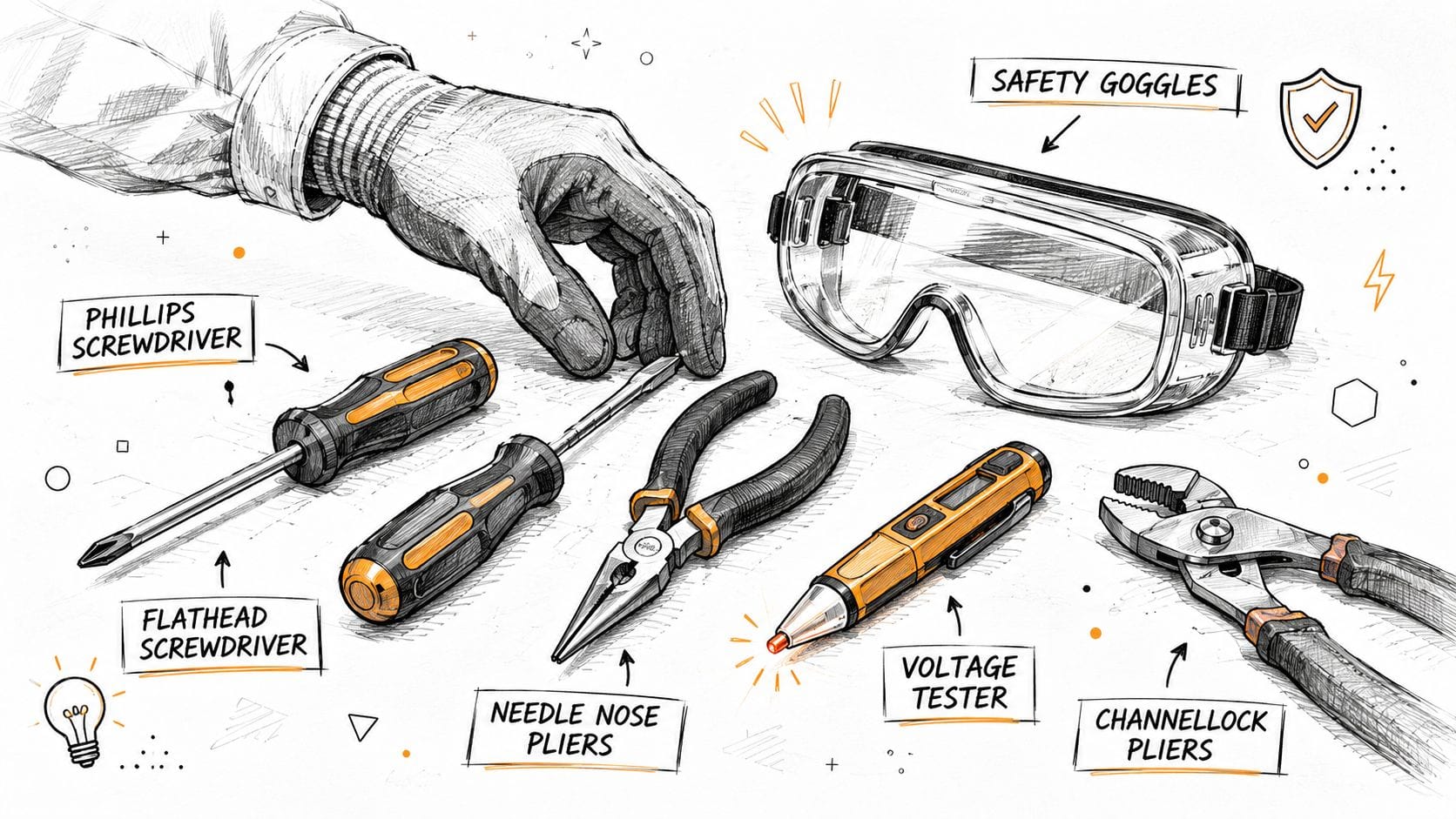
For electric baseboards, gather:
- Multimeter or voltage tester for confirming power is off and checking whether current is reaching the unit
- Insulated screwdrivers for cover plates, thermostat faces, and terminal screws
- Needle-nose pliers for small wire handling
- Safety glasses because covers and old dust can drop straight into your face
- Vacuum with brush attachment for cleaning fins and debris before reassembly
For hydronic baseboards, add:
- Bleed key or small wrench if the valve style requires it
- Bucket or shallow tray to catch discharge water
- Old towels because even a careful bleed can splash
- Work gloves since metal housings and pipe edges can be sharp
The non-negotiable shutdown steps
For an electric heater, turn the thermostat down first, then shut off the correct breaker. Don't assume the label in the panel is accurate, especially in older homes. Remove the access cover only after you've confirmed with a meter or voltage tester that the unit is de-energised.
For a hydronic heater, turn off the boiler or heating source and let the loop cool before opening any bleed point. If your building has central hydronic heating, don't assume you can isolate your section safely without checking the setup. In some strata buildings, one careless valve move can affect another suite.
Safety rule: Never trust a thermostat as a disconnect. Electric baseboards can still be live at the unit even when the room feels cold.
Know when to stop before damage starts
A few conditions mean you should close the panel and stop:
- Scorched insulation or melted wire jacket means electrical overheating, not a beginner fix.
- Seized bleed valves or corrosion around fittings can turn a simple purge into a leak.
- Unexpected shared piping in a multi-unit building can affect neighbouring units if opened blindly.
- Breaker trips during testing point to a fault that needs proper diagnosis, not repeated resets.
One practical example: if you remove an electric baseboard cover and find thick lint packed against the element, that's a reasonable DIY clean after power is confirmed off. If you remove the cover and see blackened terminal insulation, your job is done. That's a licensed repair.
Troubleshooting Common Baseboard Heater Problems
Most homeowners get further by following the symptom than by chasing parts. Start with what the heater is doing, or not doing, and narrow it down from there.
Know which heater you have first
An electric baseboard is usually quiet, dry, and fed by wiring only. A hydronic baseboard has pipe connections and may make water-related sounds. If you hear gurgling, that points strongly toward hydronic. If the unit is totally silent and stone cold, electric supply and thermostat issues move up the list.
A practical example: a Vancouver homeowner has a spare room with a silent electric baseboard that never warms. The first check is not the element. It's the breaker, then the thermostat setting, then whether voltage is reaching the unit. A different homeowner in Richmond hears a bubbling sound inside a long baseboard run and notices one end stays cool. That usually means air in the hydronic loop, not a bad heater body.
Quick symptom guide
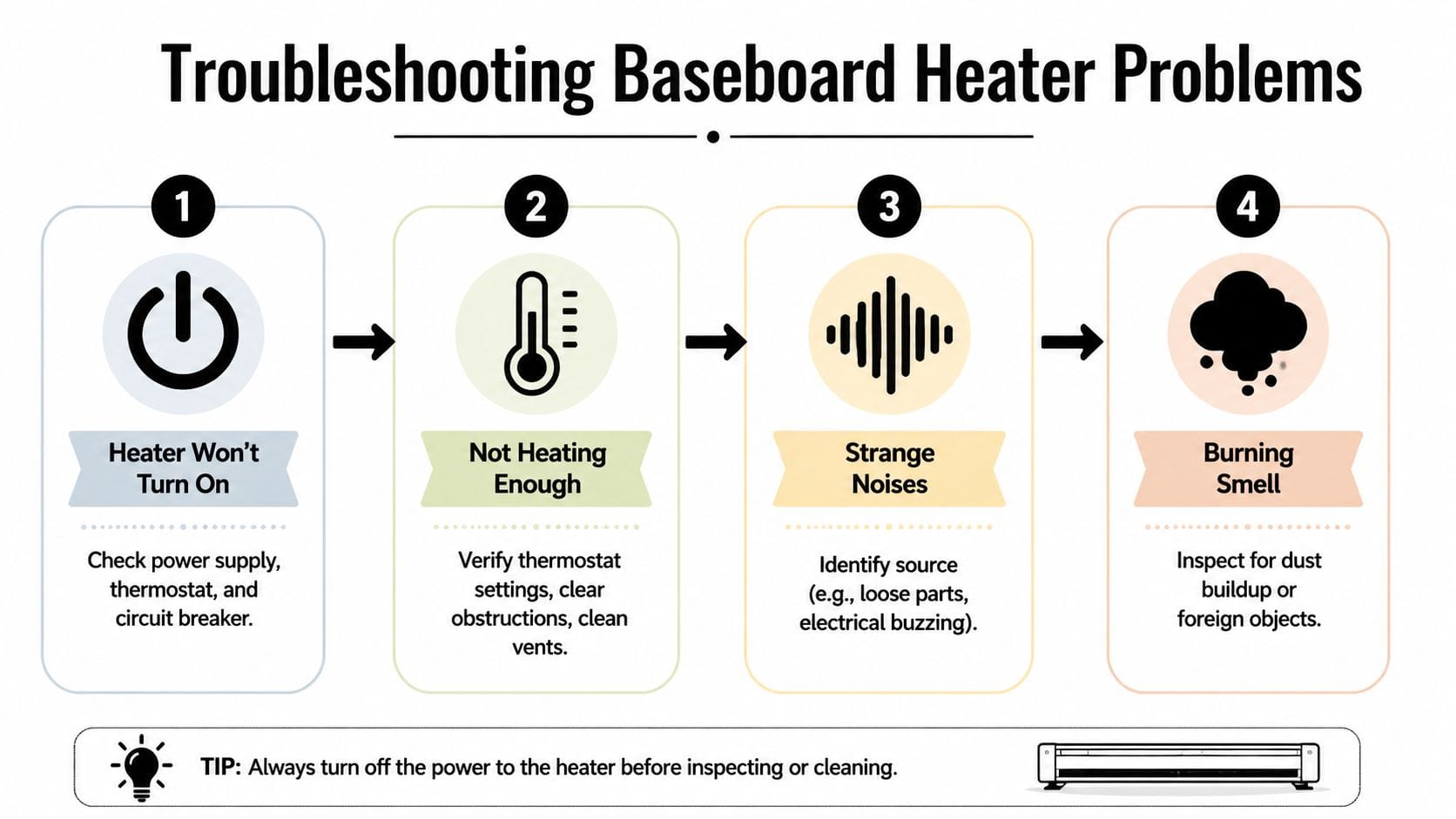
| Symptom | Possible Cause (Electric Heater) | Possible Cause (Hydronic Heater) |
|---|---|---|
| Heater won't turn on | Tripped breaker, failed thermostat, loose connection, failed element | Closed valve, no hot water flow, circulator issue, air lock |
| Heater isn't hot enough | Thermostat drift, dust-clogged fins, furniture blocking airflow, partial element failure | Air in line, poor balancing, blocked fin area, low flow |
| Strange noises | Expanding metal cover, loose internal part, electrical buzzing | Air in loop, pipe expansion, water movement, trapped air |
| Burning smell | Dust on element, debris inside cover, overheated wiring | Dust on cover, nearby material contacting hot housing |
If the heater won't turn on
For electric units, begin at the panel. A tripped breaker that resets once and holds may have been a one-off. A breaker that trips again needs diagnosis, not persistence. Next, verify the thermostat is calling for heat and that the unit receives power.
For hydronic units, no heat can mean the room valve is shut, the zone isn't being called, or hot water isn't circulating. In a detached home, you may be able to check accessible valves. In a strata building, the issue may sit at the zone control or central plant side.
A baseboard that won't heat at all often isn't the baseboard. It's the control or the supply feeding it.
If the heater isn't hot enough
Low heat complaints are where people lose time. They clean the cover, bend a few fins, and expect a cold room to fix itself. Sometimes the actual problem is simpler: a sofa pushed tight against the unit, drapes falling over the top discharge path, or years of dust packed into the fin channel.
With electric units, look for blocked airflow and thermostat inaccuracy. With hydronic units, feel the baseboard carefully after the system has been running. If one section is warm and another stays much cooler, trapped air or restricted flow is more likely than a failed enclosure.
If it clicks, gurgles, or bangs
Clicking from an electric baseboard can be ordinary expansion and contraction of the cover. Buzzing is different. Buzzing suggests an electrical issue and deserves caution.
Gurgling in a hydronic baseboard is the classic air-in-line complaint. Banging can also come from pipe movement as hot water enters the loop. If the noise is paired with a cold section of finned pipe, bleeding the system becomes the likely next step if the setup is safe and accessible.
Step by Step Repair Guide for Common Fixes
Some repairs are realistic for a careful homeowner. Two of the most common are replacing a simple electric wall thermostat and bleeding air from a hydronic baseboard loop.
Replacing an electric wall thermostat
If the breaker is on and stable, and the heater still doesn't respond properly, the thermostat is a common failure point. Wall stats for line-voltage baseboards are not the same as low-voltage furnace thermostats. Match the replacement to the heater type and voltage.
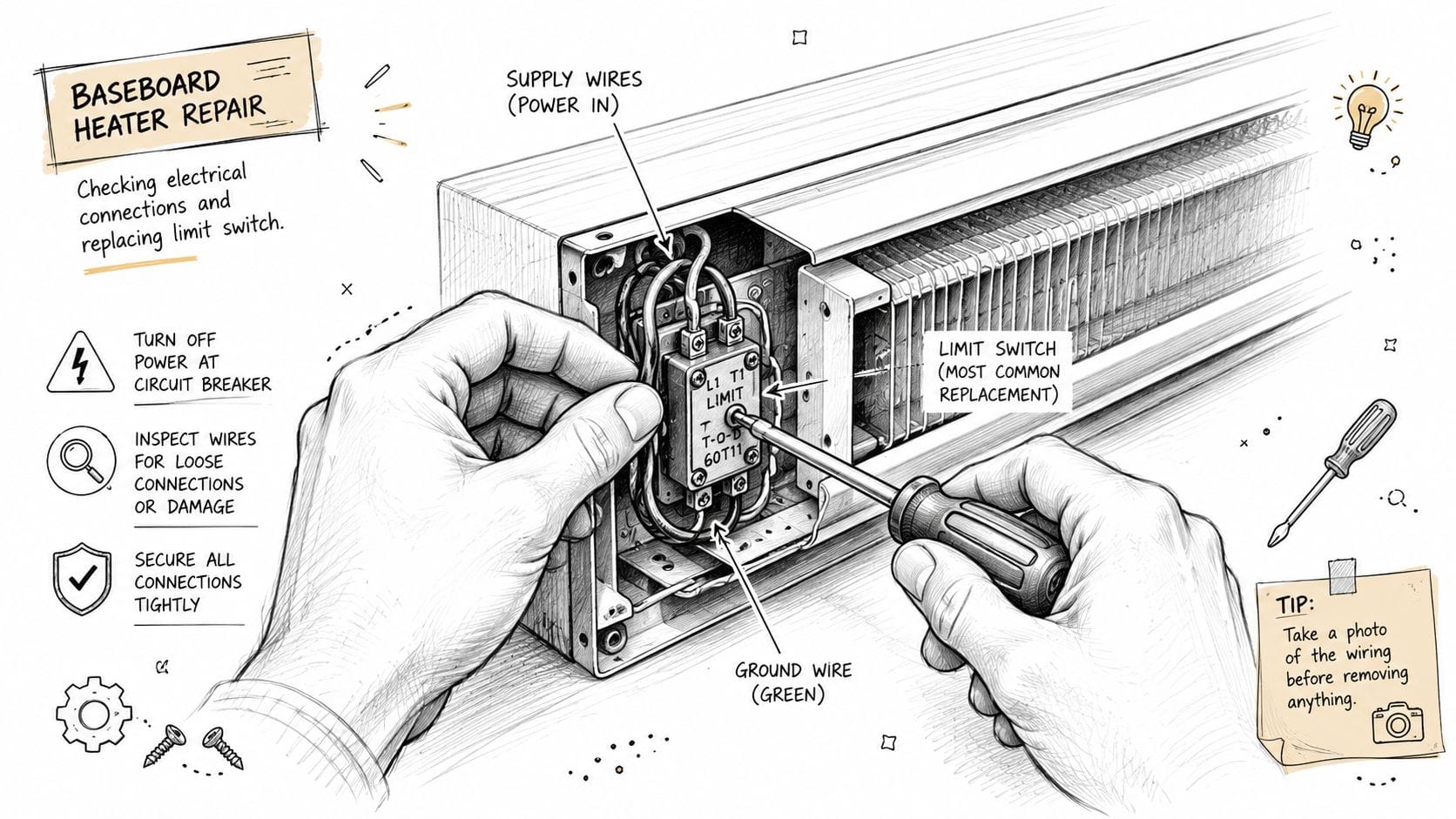
- Shut off the breaker and verify dead power. Use a multimeter or voltage tester at the thermostat box. Don't skip this.
- Remove the thermostat cover and mounting screws. Pull it forward carefully so you can inspect the wire connections.
- Take a photo before disconnecting anything. Old thermostat wiring is often straightforward, but your photo is your reference if colours don't mean what you expect.
- Check for obvious failure signs. Loose terminals, heat damage, or brittle insulation are clues the issue may go beyond the thermostat.
- Transfer wires to the new thermostat one at a time according to the manufacturer's diagram.
- Mount the new stat, restore the cover, and turn the breaker back on.
- Test operation by raising the setting and waiting for the heater to respond.
If the new thermostat still doesn't bring the heater on, stop there. The fault may be in the feed, the element, or the unit wiring.
Bleeding a hydronic baseboard properly
For hydronic baseboards, a proper bleed is one of the few DIY fixes that can make a noticeable difference when the problem is trapped air. One Burnaby strata resident might hear persistent gurgling in the living-room baseboard and notice the far end stays cool. A careful bleed can clear that, but only if the system is handled in sequence.
For hydronic baseboard systems, a standard bleed-and-purge protocol of shutting off the boiler, cooling the loop, then opening each unit's bleed valve in sequence improves loop efficiency by 15 to 20% in high-rise buildings, while over-bleeding at a single unit can introduce new air pockets elsewhere and increase callback rates by 20 to 25%, according to this hydronic troubleshooting reference.
The basic method
- Shut down the boiler or heat source and wait for the loop to cool.
- Place a towel and bucket under the bleed point before opening anything.
- Open the bleed valve slowly until air and sputtering water begin to escape.
- Wait for a steady stream of water with no gurgling or spitting.
- Close the valve firmly but gently. Don't force an old valve.
- Move in sequence if your system has multiple accessible bleed points.
That “in sequence” part matters. Randomly bleeding one unit over and over can shift the problem instead of solving it.
Here's a useful visual if you want to see the general process in action:
Mistakes that create more work
Don't keep bleeding just because the room is still cool. If you already have a solid water stream, the remaining issue may be balancing, flow, or heat loss.
Avoid these common errors:
- Bleeding a hot loop can be messy and unsafe.
- Forcing a seized valve can create a leak you can't stop cleanly.
- Ignoring system pressure or refill issues can leave the loop underperforming after the bleed.
- Using fin bending as the main fix can distract from the underlying circulation problem.
A successful DIY bleed usually leaves you with quieter operation and more even warmth. If the gurgling returns quickly, or several rooms are affected, that points past a simple air pocket.
Pro Tips for Maintenance and Efficiency
Good baseboard heater repair isn't only about fixing failures. It's also about reducing the small performance losses that add up over a heating season in damp coastal conditions.
What actually helps
Start with the basics that homeowners skip because they seem too simple:
- Vacuum the fins and housing: Dust, pet hair, and lint restrict airflow on electric units and insulate hydronic fins that should be shedding heat.
- Keep furniture clear: A dresser or sofa pushed against a baseboard can trap heat at the wall instead of moving it into the room.
- Check covers for proper fit: Bent covers can rattle, block discharge air, or sit against piping.
- Listen for change: A new buzz, repeated gurgle, or sudden cold section is often the first sign that maintenance is due.
In Vancouver, I'd pay extra attention to units below windows and along exterior walls. Those areas collect dust, condensation effects, and tenant damage more often than interior runs.
What gets overstated online
People love the fin-bending fix because it feels mechanical and visible. Open the cover, tweak the fins, and expect a dramatic improvement. In practice, that's rarely the whole answer.
BC-specific data shows that modest fin adjustments on hydronic baseboards can increase heat output by only 5 to 15% in practice, and online tutorials often overstate fin work as a fix for cold rooms, as noted in this BC-focused discussion of baseboard fin performance. That matters in older Vancouver homes where cold rooms may have air leakage, weak insulation, or an unbalanced hydronic loop.
Small fin corrections are fine-tuning. They aren't a substitute for proper flow, proper control, and a room that doesn't leak heat.
If you want a broader look at heating options beyond maintaining old baseboards, this overview of home heating and cooling systems is useful context. It helps frame whether you're maintaining a system for a few more seasons or planning a bigger upgrade.
When to Call a Professional for Your Heater Repair
There's a clean line between careful DIY and risky DIY. Once you cross into live electrical diagnosis, recurring breaker trips, leaking hydronic components, or whole-system imbalance, the smart move is to stop.
Red flags that end the DIY job
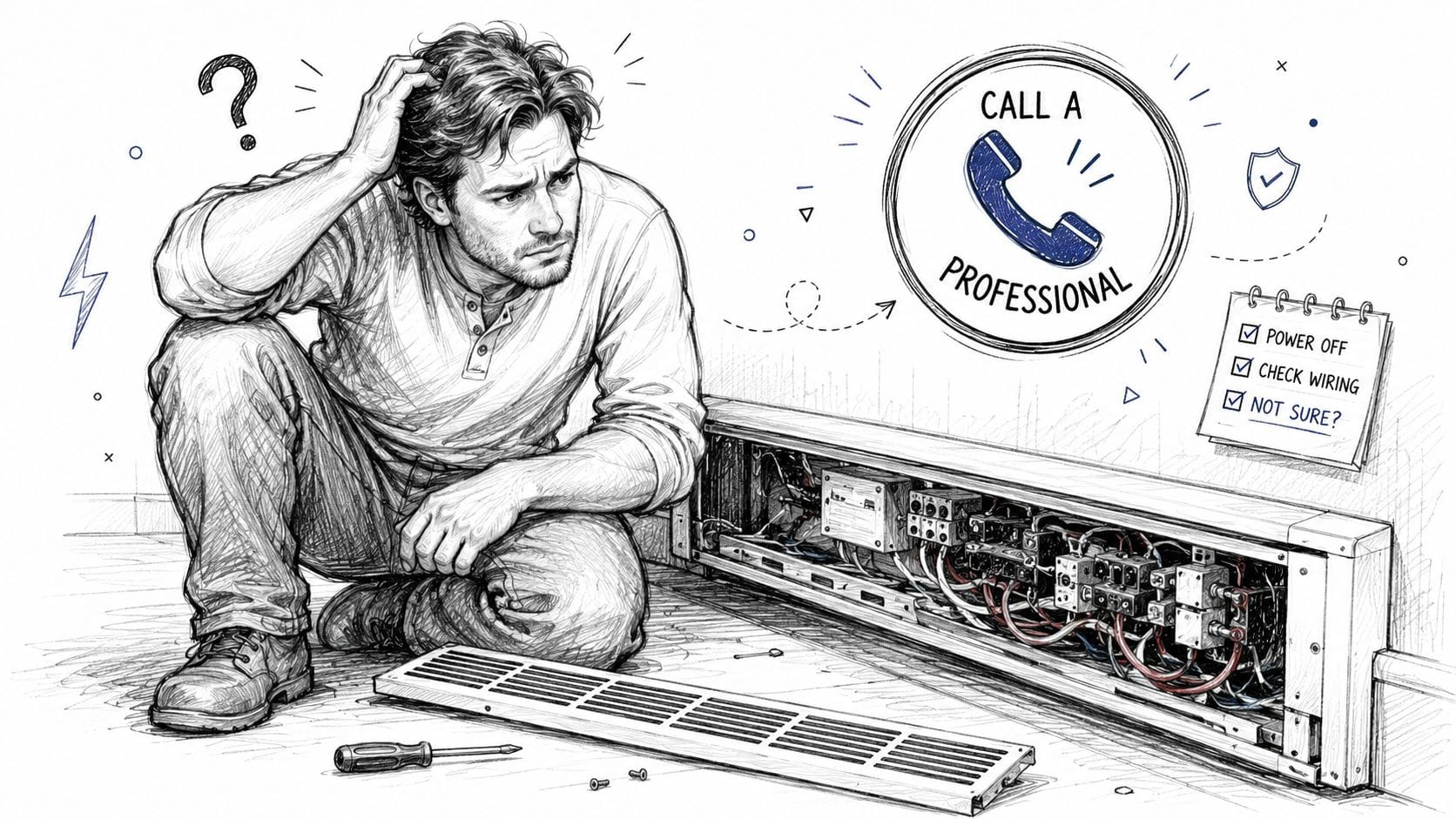
Call a licensed pro if you run into any of these:
- A breaker that won't stay set: That can indicate a short, overload, or failed element.
- Burning plastic or ozone smell: Dust is one thing. Electrical odour is another.
- Visible water leakage at a hydronic baseboard: A bad valve, fitting, or corroded section can escalate fast.
- Several heaters failing at once: That points to a control, circulation, or supply problem beyond a single room.
- Shared strata piping or uncertain shutoffs: One wrong move can affect other units or create building liability.
A practical example: if one electric heater in a detached home doesn't work after a thermostat replacement, that may still be a contained repair. If three suites in a strata stack have cold hydronic baseboards and repeated air problems, that's a building-level investigation.
Repair or replace
Some baseboards are worth repairing. Others are being kept alive out of habit. If the units are aging, the controls are inconsistent, and comfort is poor even after maintenance, replacement becomes a sensible discussion.
In BC, replacing inefficient baseboards with ductless mini-splits or modern hydronic panels can reduce space-heating demand by 30 to 50% in existing apartments, according to this article on hydronic baseboard troubleshooting and upgrade considerations. That doesn't mean every baseboard should be ripped out tomorrow. It means a repair decision should include long-term performance, not just whether one room can be patched for now.
If your home also relies on other older heating equipment, this guide to furnace repair in Vancouver can help you think through the wider system instead of treating every comfort problem as an isolated heater issue.
The right service call doesn't just fix today's cold room. It tells you whether the system still makes sense for the home you have now.
If you need help with baseboard heater repair, hydronic bleeding, thermostat issues, or deciding whether an older heating setup should be repaired or upgraded, Encano Plumbing & Drainage Ltd. serves Vancouver, Richmond, Burnaby, Surrey, and nearby communities with heating, plumbing, and diagnostic service for homes and strata properties.