

If you're standing at the sink scraping dinner scraps into a wet green bin and wondering whether there's a cleaner way to handle the mess, you're not alone. In Vancouver homes, especially condos and older detached houses with compact kitchens, food waste tends to create the same daily frustrations. Odour, drips in the cabinet, crowded bins, and drains that were never designed for careless cleanup.
A garbage disposal with installation can solve part of that problem, but only when the unit fits the sink, the drain layout works, and the electrical connection is safe. In this region, that decision also sits inside a larger waste picture. In British Columbia, organics made up 40% of Metro Vancouver's garbage stream by weight, according to Metro Vancouver's 2021 Waste Composition Study as cited here. That's one reason many homeowners and property managers now look at disposals during kitchen upgrades instead of treating them as an afterthought.
Table of Contents
- Is a Garbage Disposal Right for Your Vancouver Home?
- Choosing Your Garbage Disposal Types Power and Features
- The Professional Installation Process Explained
- Potential Complications and Hidden Installation Costs
- Why Hire Encano Plumbing for Your Installation
- FAQ on Garbage Disposal Use and Maintenance
Is a Garbage Disposal Right for Your Vancouver Home?
A disposal makes sense for some kitchens immediately. For others, it creates more problems than it solves. The right answer depends less on trends and more on how you cook, what your plumbing looks like, and whether you want convenience at the sink enough to justify a proper retrofit.
Where a disposal helps most
Homes that produce steady everyday food scraps usually benefit the most. Small vegetable trimmings, plate rinsing after meals, and the usual bits left from cooking are where a disposal feels useful day after day. You notice it in the little moments. Fewer scraps sitting in the sink strainer. Less residue collecting in the basket. Less mess when you're cleaning up after a rushed weeknight dinner.
In practical terms, a disposal is often a good fit when:
- You cook often: Frequent meal prep means frequent scraps.
- Your green bin setup is inconvenient: Detached homes with outdoor bins and condo kitchens with limited space both create friction.
- Your sink is the main cleanup station: If dishes, prep, and rinsing all happen in one basin, the unit can make that workflow feel much cleaner.
- You're already upgrading the kitchen: Sink, faucet, dishwasher, and drain work are the best time to evaluate a disposal.
Practical rule: A disposal works best as part of an organised sink system, not as a licence to grind everything.
Where it may not be the best fit
Some homeowners expect a disposal to replace food waste sorting entirely. It won't. It also won't fix a slow drain, a sagging trap arm, or an undersized sink cabinet. If your current plumbing already struggles, adding a motorized appliance below the basket can expose weak points fast.
A few situations deserve extra caution:
- Older homes with tight cabinets: The body of the unit can crowd existing drains, shutoff valves, or filtration systems.
- Homes with questionable wiring under the sink: Physical fit is only one part of the job.
- Households that put the wrong things down drains: Grease, fibrous peels, coffee grounds, and large scraps still cause trouble.
- Buildings with rules around alterations: Some strata properties want clarity on plumbing or electrical changes before work begins.
One practical example. In a Vancouver character home, the homeowner may want a disposal because the kitchen is small and the compost caddy fills fast. That's reasonable. But if the cabinet already holds an old trap layout, a dishwasher hose, and a water filter, the better first step is an inspection. Sometimes the answer is yes with minor rework. Sometimes the smarter answer is to improve the existing drain setup and skip the unit.
Choosing Your Garbage Disposal Types Power and Features
Buying the wrong model creates half the installation headaches. Before anyone loosens a slip nut or opens a wiring compartment, the unit has to match the household and the space under the sink.
Start with how the unit runs
The first choice is continuous-feed versus batch-feed.
A continuous-feed model runs when you switch it on. Most homeowners choose this style because it's simple. You rinse, feed small scraps gradually, and turn it off when you're done. It suits busy kitchens and people who don't want extra steps.
A batch-feed model runs only when the cover is in place. That extra action can appeal to families with young children or anyone who prefers a bit more control at the sink opening. It tends to feel slower in use, but some homeowners like that built-in pause before operation.
Here's a quick comparison.
| Feature | Best For | Consideration |
|---|---|---|
| Continuous-feed | Busy households, frequent cooking, fast cleanup | Requires good habits at the switch and sink |
| Batch-feed | Families wanting added operating control | Slower workflow during cleanup |
| Compact body design | Tight under-sink cabinets | May still need drain adjustments |
| Sound insulation | Open-concept kitchens | Usually adds cost and size |
| Stainless grinding components | Homeowners focused on durability | Worth checking if the model includes them |
Match power to your kitchen habits
Horsepower matters, but not in the way showroom labels often suggest. Bigger isn't automatically better. A unit that's oversized for the cabinet or unnecessary for your cooking habits doesn't help much.
Think in terms of use:
- Lighter daily use: A smaller household that mostly rinses plates and handles minor scraps doesn't need the most powerful unit available.
- Regular family cooking: If you're preparing vegetables daily and cleaning up after multiple people, a mid-range unit is usually the practical sweet spot.
- Heavy kitchen use: Larger families or serious home cooks often prefer a stronger motor with better jam resistance and quieter performance.
The best way to choose is to be honest about what goes down the sink. If most waste still belongs in the green bin, you don't need to buy based on maximum power. You need a dependable model that handles normal cleanup without straining the plumbing.
A common mistake is choosing by marketing language instead of cabinet space, discharge height, and real kitchen habits.
Features worth paying attention to
Some upgrades are worthwhile. Some are easy to skip.
Look closely at these features:
- Stainless steel grinding components: These are a good choice for homeowners who want better resistance to wear and moisture over time.
- Sound dampening: Useful in open kitchens where the sink sits near the living area.
- Reset access: A simple feature, but easier access matters when troubleshooting.
- Mounting compatibility: Not every replacement lines up the same way as the old unit.
- Body dimensions: This matters more than many people realise in Vancouver retrofits.
For the Greater Vancouver market, planning should account for model size and cabinet geometry before cutting the discharge tube, because manufacturers note that disposers are not uniform in dimensions and the discharge pipe often must be trimmed to fit the trap arm and outlet alignment. Major installation references also recommend tightening the mounting screws evenly so the sink flange seats uniformly, then filling the basin and testing before finalizing the setup, as outlined in this Home Depot installation guide.
A practical example. If you live in a Burnaby bungalow with a deeper double sink and an older trap arm set high in the wall, a taller disposal body can force the drain connection into an awkward angle. On paper the model looks fine. Under the sink, it becomes obvious that a shorter unit would have reduced rework.
The Professional Installation Process Explained
On installation day, the smoothest jobs usually start before any tool touches the sink. Clear out the cabinet, move cleaning bottles and bins, and make sure the area is accessible. If you've bought the unit already, keep the box, mounting hardware, and any paperwork nearby.
This is the basic journey most homeowners can expect.
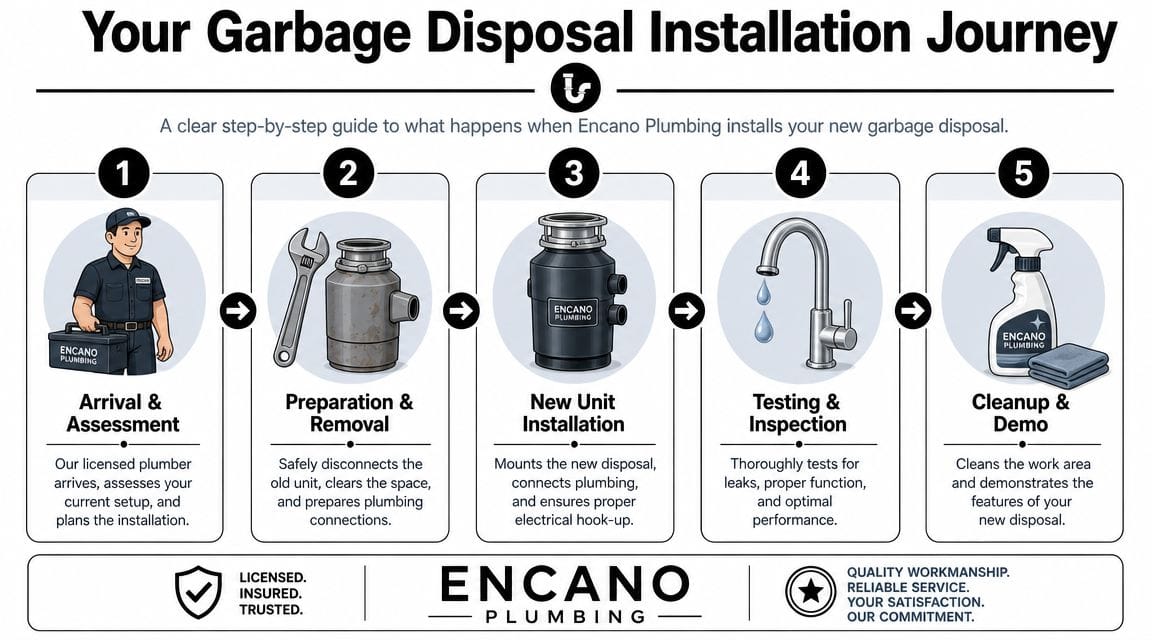
What happens before tools come out
The first step is assessment. The sink opening, flange condition, trap alignment, dishwasher connection, and electrical access all need a quick check. Many “simple replacements” cease to be simple at this point. A disposal that physically hangs from the sink still has to line up with the drain and connect safely to power.
In a standard installation, the work follows a clear sequence. A professional garbage disposal installation typically follows a seven-step workflow: shut off power, remove the old unit, clean the sink flange, apply plumber's putty, mount the new disposer, reconnect all plumbing, then restore power and test thoroughly for leaks, as described in Lowe's installation guide.
The core installation workflow
Once the setup is confirmed, the actual work is straightforward but precise.
- Power is shut off at the breaker. No guessing at the switch.
- The old unit and trap assembly come off. That may include the dishwasher branch if one is connected.
- The sink flange is cleaned. Old putty, corrosion, and residue have to go or the new seal won't sit correctly.
- Fresh plumber's putty is applied. This creates the watertight seal at the sink opening.
- The new mounting assembly is installed. Ring, gasket, and backup flange all need to sit evenly.
- The discharge tube and drain are connected. Precise cutting and alignment are essential for this step.
- Power is restored and the unit is tested. Water runs during the test so leaks show up right away.
A practical example. Say a homeowner in Richmond replaces an older compact unit with a newer body that's slightly wider and lower at the outlet. The physical mount may go on easily, but the discharge tube now lands short of the trap connection. A professional trims and reworks that section cleanly instead of forcing a crooked fit that will drip later.
A short visual walkthrough can help if you're trying to understand the overall sequence before booking work.
Final testing and handoff
The last part matters more than homeowners think. A proper test isn't just flipping the switch for two seconds. The basin should be filled and drained while connections are checked under load. The unit should run with water, the dishwasher branch should be inspected if present, and the cabinet should be checked for vibration or contact against nearby pipes.
What works: even tightening, clean alignment, and a full leak test with water in the basin.
What doesn't: hand-tightening everything “good enough” and hoping the first week goes smoothly.
Before leaving, a good installer should also explain daily use. Run cold water, feed scraps gradually, and don't treat the unit like a catch-all for the entire cutting board.
Potential Complications and Hidden Installation Costs
The biggest myth about disposal work is that every install is just a quick swap. In newer kitchens with the right outlet and a matching drain layout, sometimes it is. In older Vancouver-area homes, the hidden issues are usually what determine how smooth the job goes.
Older homes create most of the surprises
The most commonly missed issue is electrical compatibility. Many older homes in the region don't have a compliant, grounded outlet in the sink cabinet. In retrofit work, what looks like a basic replacement can require an electrician to run a safe connection, and that can become the main cost driver, as noted in this installation discussion on electrical compatibility.
That problem shows up alongside plumbing mismatches such as:
- High wall drain connections: The new disposal outlet may sit too low for the existing trap alignment.
- Aging metal piping: Old joints don't always adapt cleanly to newer fittings.
- Crowded cabinets: Shutoff valves, dishwasher hoses, filters, and cleaning systems compete for the same space.
- Non-standard previous work: DIY plumbing from years ago often creates the hardest retrofits.
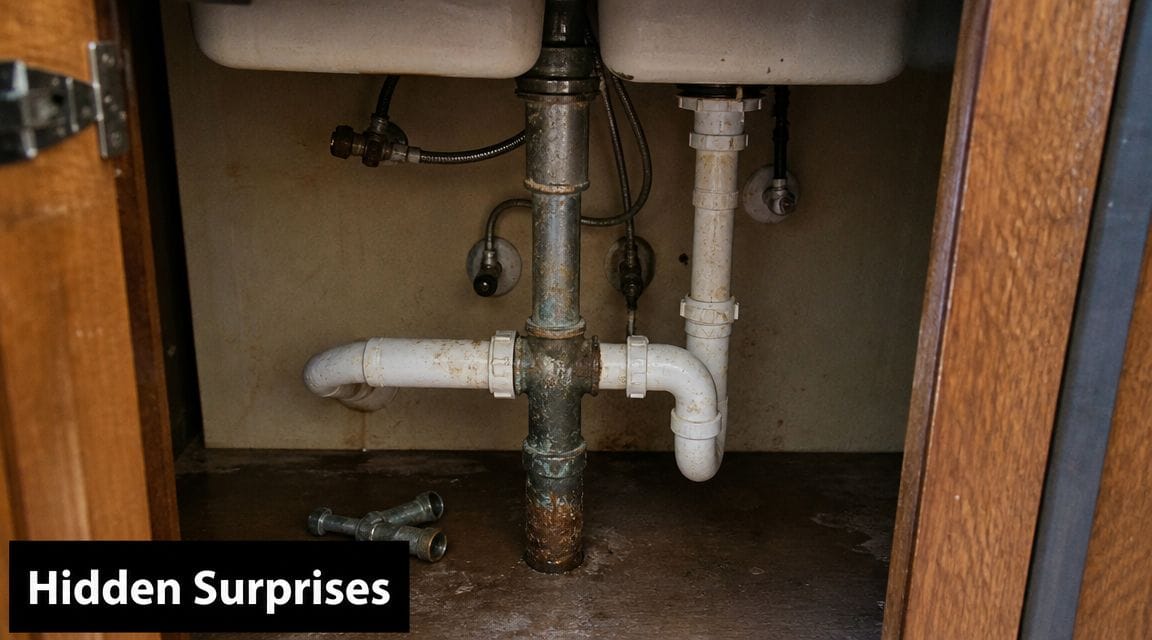
A practical example under a tight sink
A common real-world scenario is a narrow sink base in an older East Vancouver kitchen. The homeowner has a single-bowl sink, an aging trap, and a dishwasher tailpiece added later. On install day, the new disposal fits the sink opening, but the outlet lands in conflict with the trap and leaves almost no room to service the shutoff.
At that point, a proper fix may involve reworking the trap layout, adjusting the branch connection, and cleaning up old slip-joint fittings so the assembly drains correctly. That's not glamorous work, but it's the difference between a cabinet that stays dry and one that develops slow leaks and odour.
If your kitchen already drains slowly, sort that out before assuming the new unit will fix the problem. Existing blockage, grease buildup, or partial obstruction can still cause trouble after installation. If you're already dealing with backups, it's worth reading about what to do for a stubborn clogged sink in Vancouver before adding another appliance to the system.
Retrofit jobs succeed when the installer treats the cabinet like a whole system, not just a place to hang a machine.
Why Hire Encano Plumbing for Your Installation
A garbage disposal with installation sounds simple because the appliance itself is familiar. The work behind it isn't always simple. Safety, drain alignment, leak prevention, and local retrofit experience matter far more than most homeowners expect when they first shop for a unit.
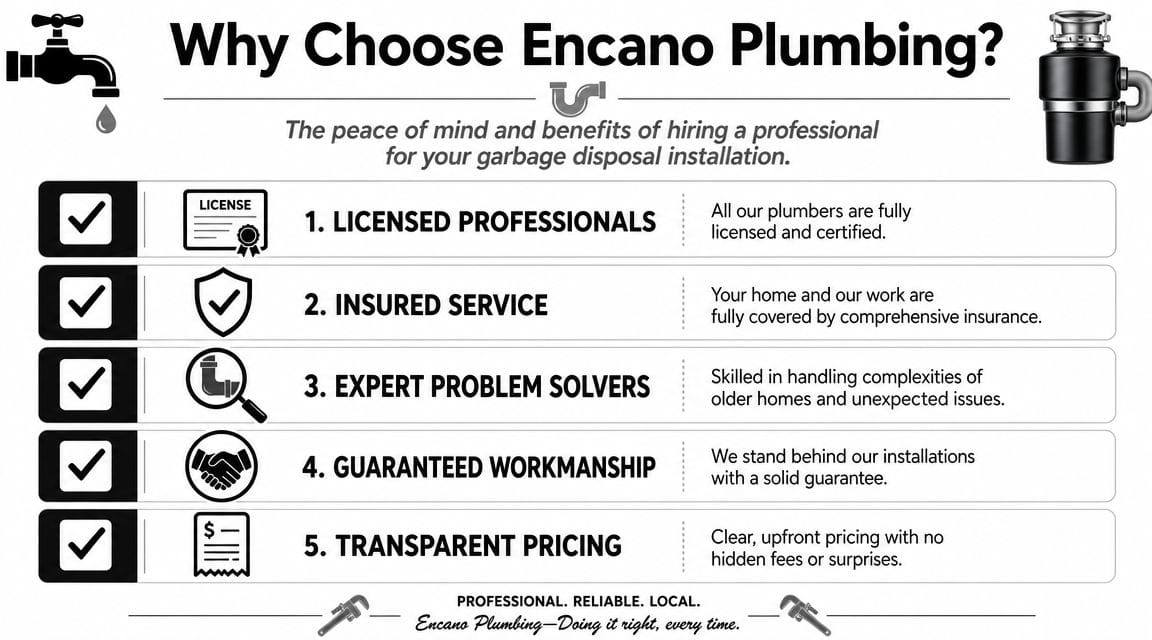
What professional installation changes
Hiring a licensed plumber removes guesswork from the parts of the job that usually go wrong. That starts with assessment. Before the sink flange is even removed, an experienced installer can spot whether the outlet location, cabinet depth, dishwasher connection, and trap layout are going to cooperate.
Professional installation also changes the quality of the finish:
- Cleaner sealing: The sink flange sits properly and doesn't weep into the cabinet.
- Better pipe alignment: Fewer stress points on fittings and less risk of drips later.
- Safer power planning: Electrical concerns are identified early instead of discovered halfway through.
- A proper final test: The system gets checked under realistic use, not just a quick spin.
Why local experience matters
Greater Vancouver homes aren't uniform. A newer condo in Richmond, a bungalow in Burnaby, and a character house in Vancouver each present different under-sink realities. The installer needs to know how older drain layouts behave, where hidden electrical limits tend to show up, and when a “replacement” is a retrofit.
That's why many homeowners look for plumbers who regularly handle kitchen drain work, fixture replacement, and garburator retrofits in the region. If you're comparing options, you can also review this local garburator replacement service page to see what a dedicated installation service typically involves.
A good install should leave you with three things. A unit that fits. A cabinet that stays dry. And confidence that you won't be revisiting the same problem after a few weeks of use.
FAQ on Garbage Disposal Use and Maintenance
A new disposal usually performs well right away. Keeping it that way comes down to habits. Most service calls after installation aren't caused by the unit being defective. They're caused by what went into it.
What should never go into the unit
Some materials are hard on the motor. Others are hard on the drain line.
Avoid putting these down the disposal:
- Grease and cooking fat: They cool inside the pipe and create buildup.
- Coffee grounds: They collect into dense sludge in traps and branch drains.
- Fibrous vegetables: Celery, corn husks, and similar scraps can wrap and jam.
- Large bones or hard pits: These can stall the unit or damage components.
- Expandable foods: Pasta, rice, and similar leftovers swell with water.
- Onion skins and similar thin peels: They tend to bunch rather than clear cleanly.
How to keep it working well
Basic care is simple, and it doesn't require special products.
- Run cold water during operation: This helps carry ground material through the drain.
- Feed gradually: Small amounts work better than shoving everything in at once.
- Let water run briefly after grinding: That helps clear the discharge path.
- Clean it lightly, not aggressively: Ice cubes and citrus peels are common homeowner methods for freshening and scouring the chamber.
- Watch the sink's overall drainage: If the basin empties slowly, deal with that early.
For ongoing prevention, these drain clog prevention tips for your home are worth following even if your disposal is working fine.
Aftercare note: A disposal helps with small food remnants. It doesn't replace smart drain habits.
Common homeowner questions
Should every scrap go into the disposal?
No. The unit is for manageable food remnants, not full plate waste or bulk prep debris.
Does a bad smell mean the unit is failing?
Not necessarily. Odour usually means residue is stuck inside the grinding chamber, splash guard, or nearby drain piping.
Can a disposal fix a sink that already clogs?
No. If the drain line is partially blocked, the disposal can make the symptom show up faster.
Is occasional maintenance normal?
Yes. Like any kitchen appliance that handles waste and water, it benefits from regular cleaning and sensible use.
What if the unit jams or hums?
Stop using it until the cause is checked. Continuing to run a struggling motor usually makes the problem worse.
If you want a safe, clean garbage disposal with installation done properly in Vancouver, Richmond, Burnaby, New Westminster, Surrey, Delta, or nearby areas, contact Encano Plumbing & Drainage Ltd.. Their team handles kitchen plumbing upgrades, drain adjustments, and retrofit issues in older homes, so you get an installation that fits your sink, works with your plumbing, and holds up in daily use.