
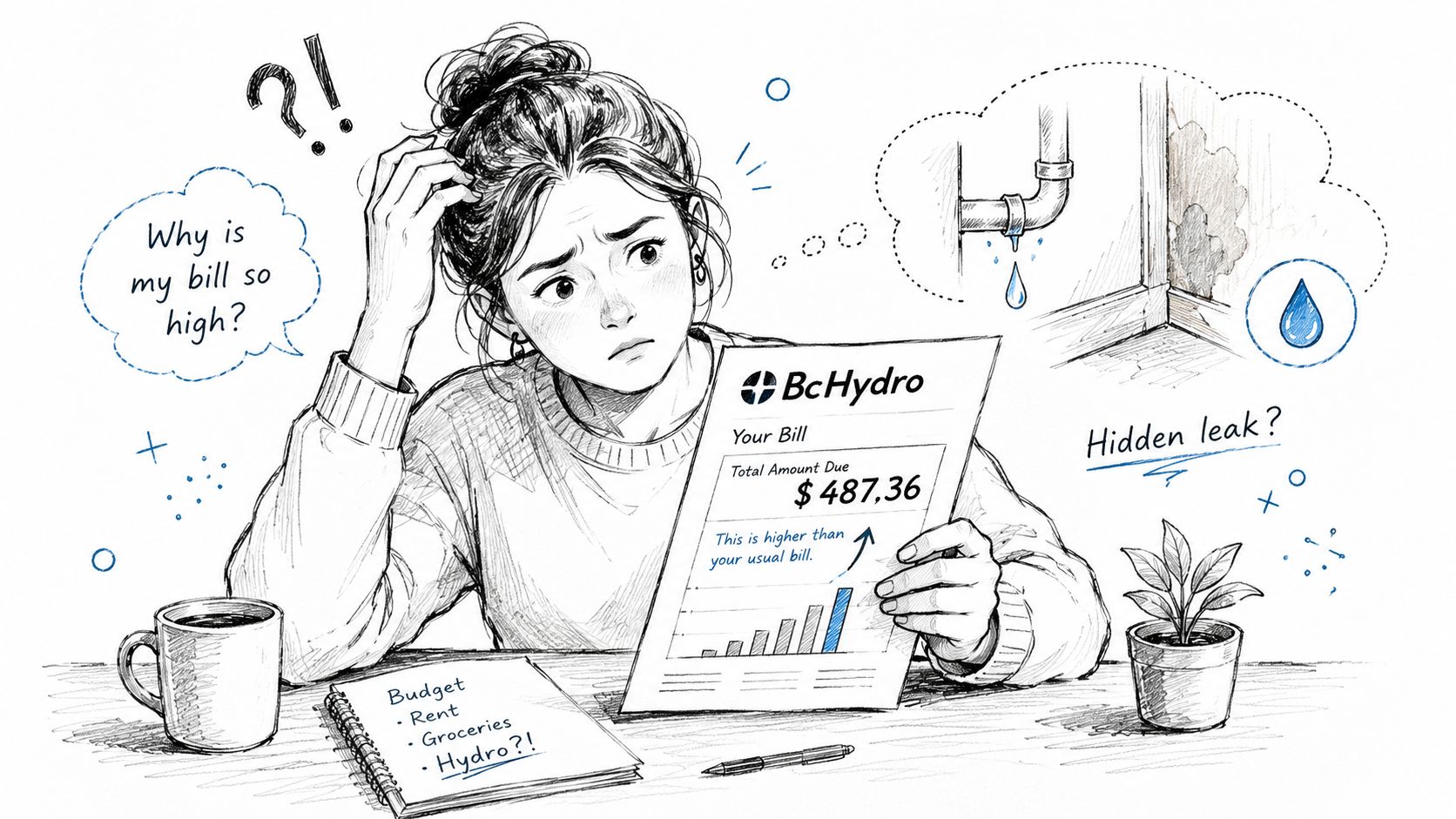
You're usually not looking into acoustic leak detection because you're curious about plumbing technology. You're looking because something feels off. A water bill jumps for no obvious reason. A ceiling stain appears below an upstairs bathroom. A tenant says they hear water running inside a wall when every tap is shut off. In older Vancouver and Burnaby buildings, that mix of uncertainty and urgency is common.
For strata managers, the problem is even more stressful. You need answers quickly, but you also need to avoid tearing into walls, concrete, or outdoor areas based on guesswork. That's where acoustic leak detection helps. Used properly, it lets a technician listen for the sound signature of water escaping a pressurised pipe and narrow the search before any opening or excavation starts. It's one of the most useful non-destructive tools we have in the Greater Vancouver area, but it isn't a magic wand for every leak. Knowing where it works well, and where it doesn't, is what separates a solid diagnosis from an expensive false start.
Table of Contents
- Signs You Have a Hidden Leak and Need Detection
- How Acoustic Leak Detection Works
- Key Benefits for Vancouver Properties
- Acoustic Detection vs Other Methods
- What to Expect During a Service Visit
- Limitations and When Other Methods Are Needed
- Vancouver-Specific FAQs on Acoustic Leak Detection
- Does acoustic leak detection work in concrete high-rises
- Will tenants or owners need to leave during the test
- What affects the cost of a leak detection visit
- Is a report useful for strata councils or insurance files
- Can acoustic leak detection find every hidden leak
- What should a strata manager do before booking
Signs You Have a Hidden Leak and Need Detection
A common call starts like this. The owner of a Richmond townhouse notices the monthly bill is higher than usual. Nothing dramatic has happened. No burst pipe. No flooded bathroom. Then they hear a faint hiss near the laundry wall late at night, and a small patch of flooring starts to cup. That's often what a hidden leak looks like at first. Quiet, indirect, and easy to dismiss.
Another practical example is a Burnaby condo where a resident spots a damp ring on the ceiling below an ensuite. The assumption is often grout, caulking, or a one-time shower splash. Then the stain grows, paint softens, and the unit below starts asking questions. By that point, the main job isn't just fixing the pipe. It's finding the source without opening half the suite.
Warning signs worth taking seriously
Some signs are obvious. Others are subtle enough that people wait too long.
- Unexpectedly high utility use. If water use rises without a clear reason, a concealed leak is one of the first things to rule out.
- Sound of running water. When fixtures are off but you still hear movement in a wall, floor, or ceiling cavity, that's a strong clue.
- Low or changing water pressure. A pressurised supply leak can affect flow at taps and showers.
- Damp finishes or mould odour. Staining, swelling, peeling paint, or a musty smell often appears before the leak itself is visible.
- Warm or cold spots where they shouldn't be. On some jobs, flooring temperature changes can hint at a hidden line issue.
If you're seeing those signs, it helps to start with a practical checklist for how to spot hidden plumbing leaks in your home.
Hidden leaks rarely announce themselves at the source. They show up where water finally escapes, not where the pipe actually failed.
Why people choose acoustic detection first
The big advantage is that it gives you a path forward without immediate demolition. Instead of cutting drywall in three possible places, a technician can test, listen, compare, and narrow the location. For homeowners, that means less mess. For strata managers, it means a better basis for deciding whether the issue is in a suite, a riser, or a branch line.
That shift matters. Once you move from suspicion to a targeted search, the whole job becomes more controlled.
How Acoustic Leak Detection Works
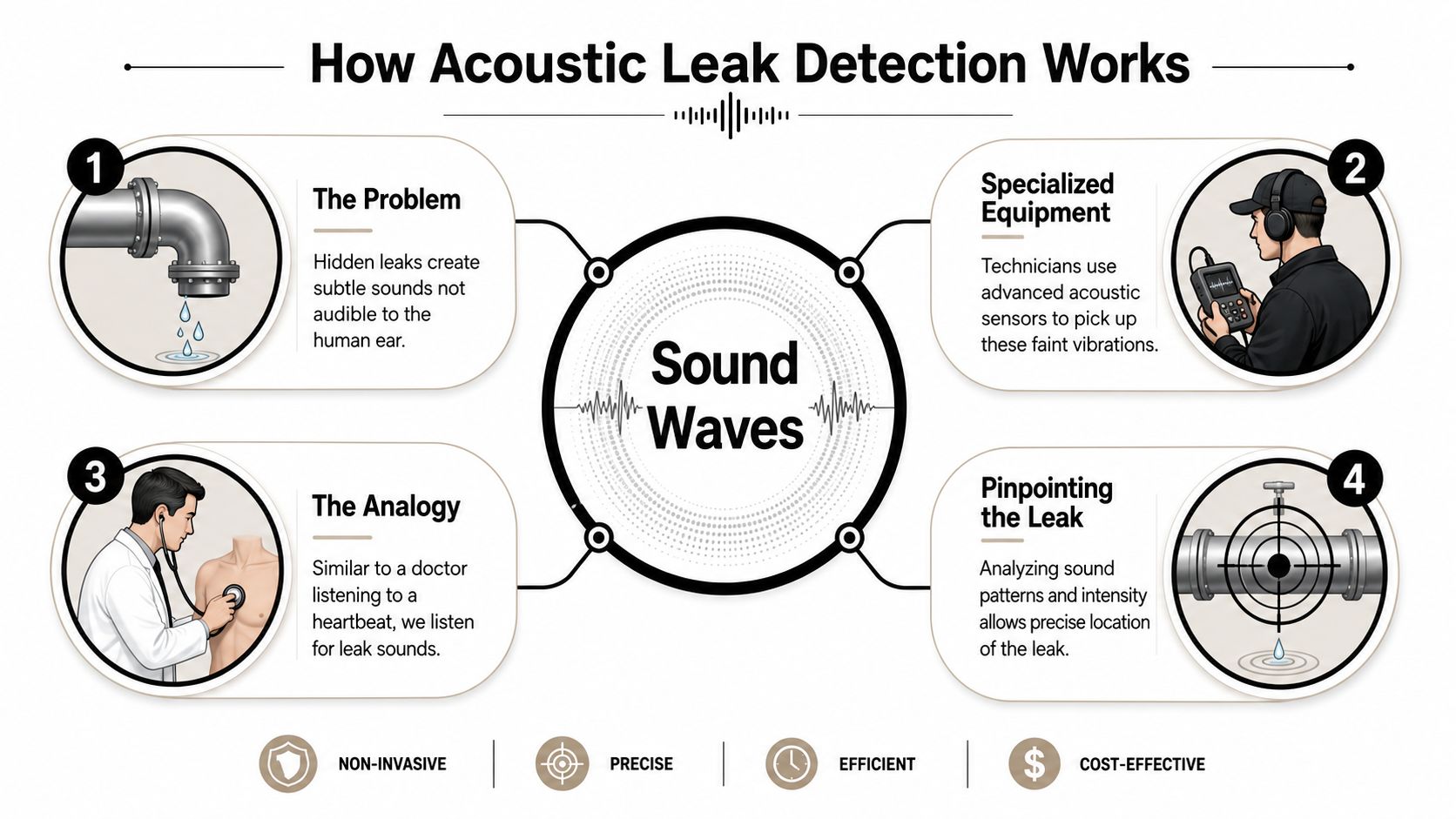
The simplest way to explain acoustic leak detection is this. It works like a doctor's stethoscope. A leak in a pressurised pipe creates vibration and sound as water escapes through a defect. That sound travels through the pipe, the surrounding structure, and sometimes the ground. The technician's job is to separate that leak noise from every other sound around it.
The basic idea behind the technology
A pinhole leak doesn't usually sound dramatic. It may be a faint hiss, a rushing tone, or a vibration pattern that changes from one test point to the next. Sensitive tools pick up those differences. On indoor work, that may involve listening discs, contact microphones, and headphones. On outdoor or buried services, technicians often use ground microphones and digital correlators to compare sound between two known points.
The process is part listening and part measurement. You're not just hearing “a noise”. You're judging where the sound is strongest, how it changes over distance, and whether it matches the behaviour of a supply-side leak.
The tools that do the work
A proper acoustic test usually involves more than one device.
- Listening equipment picks up vibration at valves, exposed piping, walls, floors, or slab surfaces.
- Headphones and filters help the technician isolate the leak signature from traffic, pumps, fans, and building noise.
- Digital correlators compare signals from two points and calculate the likely leak location between them.
- AI-enhanced acoustic loggers are used on larger systems to monitor and flag hidden leak activity over time.
If you want a broader look at the equipment side, this overview of the advanced technology behind modern leak detection gives useful context.
Why modern acoustic work is more precise than people think
Acoustic leak detection isn't new, but it has changed a lot. A documented regional milestone came in 2018, when Metro Vancouver Water District adopted AI-enhanced acoustic loggers. In hidden leak scenarios across 12,000 km of municipal piping, the system achieved a 94.4% detection rate, identified and repaired 847 previously undetected leaks within 18 months, and saved an estimated 4.2 million litres of water annually, as described in the Metro Vancouver Water District case study video.
That matters because the same principle applies on private property. Better sensors, cleaner filtering, and smarter comparison tools reduce guesswork. The technician still needs experience, but the hardware has become far more capable than the old image many people have of someone just pressing a rod to a pipe and listening.
Practical rule: Acoustic equipment is only as good as the operator's ability to test the right line, reduce background noise, and interpret what the signal is actually saying.
Key Benefits for Vancouver Properties
A typical Vancouver leak call is not about a bare basement with easy access. It is a finished condo bathroom, a heritage home with plaster walls, or a parkade slab where every exploratory cut creates cost, disruption, and questions from owners. That is where acoustic leak detection earns its keep on the right type of pipe.
Better targeting before any opening starts
The main benefit is control. Instead of opening multiple areas based on moisture staining or guesswork, acoustic testing helps narrow the search to a smaller zone before repair work begins.
For a strata manager, that often means fewer suites affected, fewer restoration trades involved, and a clearer plan for access. For an owner, it can mean one controlled opening instead of several investigative cuts that still do not reach the source.
It does not guarantee a no-cut repair. It gives you a better reason for where to cut.
Faster decisions in occupied buildings
Speed matters, but the true value is not speed by itself. It is getting enough confidence, early enough, to stop the leak, notify the right people, and schedule repair work before secondary damage spreads into adjacent units or common areas.
That matters in Greater Vancouver buildings where plumbing runs are often concealed and access can be tight. A good acoustic test can shorten the diagnostic stage and reduce the amount of trial-and-error work needed to confirm a pressurized supply leak.
A strong fit for the buildings we see here
This method suits many local properties because Vancouver has a lot of finished interiors, shared walls, suspended slabs, and older piping layouts that were not designed with easy access in mind. In those conditions, less destructive diagnosis is not a nice extra. It is often the difference between a manageable repair and a restoration project.
The practical advantages usually look like this:
- Detached homes: fewer exploratory openings behind tile, drywall, or millwork
- Condos and strata buildings: less disruption to neighbouring suites and common areas
- Commercial units: a better chance of diagnosing the issue without shutting down large sections of the space
- Outdoor areas with features: less unnecessary digging around walkways, gardens, and decorative hardscape
In a finished building, the cheapest cut is the one you did not have to make.
It also helps rule out the wrong approach
This is the part many articles skip. Acoustic testing is very useful for pressurized water lines. It is much less dependable on low-pressure waste lines, storm lines, or older non-pressurized drain systems found in many Vancouver buildings.
That distinction saves time and money. If the sound pattern does not match a pressurized leak, an experienced technician should say so and change methods instead of forcing an acoustic result. On older strata properties with cast iron drainage, for example, a drain camera inspection service for drain and sewer lines is often the better next step.
That honesty is part of the benefit. You get a narrower search area when acoustic is the right tool, and you avoid wasting another visit when it is not.
Acoustic Detection vs Other Methods
Acoustic leak detection is powerful, but it's only one diagnostic method. Good leak investigation depends on matching the tool to the kind of plumbing system involved. If someone treats acoustic testing as the answer to every leak, they're setting you up for delays.
Leak Detection Method Comparison
| Method | Best For | Limitations | Common Use Case |
|---|---|---|---|
| Acoustic detection | Pressurised water supply lines hidden behind walls, under slabs, or underground | Less reliable on low-pressure or non-pressurised lines, and harder in noisy environments | Locating a concealed domestic water leak in a wall, slab, or service line |
| Thermal imaging | Temperature-related anomalies, especially hot water lines or moisture spread patterns | Doesn't always show the actual leak point, and surface readings can mislead | Tracing a hot water line issue behind finishes |
| Video camera inspection | Drain, sewer, and other non-pressurised piping | Can't hear pressure leaks, and needs pipe access | Inspecting cast iron or PVC drain lines for cracks, offsets, or failures |
When acoustic is the right call
Acoustic testing shines when water is escaping from a pressurised supply pipe. That leak creates a usable sound signature. In a house, that may be a copper line in a wall or a service line between the meter and the building. In a strata property, it may be a branch line feeding a fixture group or an accessible section of riser.
It's especially useful when the repair area needs to be small and defensible. If you're authorising invasive work in a tenanted suite, “we think it's somewhere over here” isn't good enough.
When another method should come first
Thermal imaging helps when temperature contrast tells part of the story, especially on heated lines or moisture migration through building materials. Video inspection is the better choice when the concern is a drain or sewer line. If the leak is tied to a non-pressurised system, hearing it acoustically may not be realistic.
For drain-side concerns, a drain camera inspection service is often the more direct path because it lets the technician see cracks, separations, root intrusion, or standing water inside the line.
The practical way professionals combine methods
The best diagnostics are layered, not stubborn. A technician may start acoustically, confirm system behaviour through isolation, then switch to thermal or video if the evidence points away from a pressurised supply leak.
The right method isn't the fanciest tool. It's the one that matches the pipe, the pressure, and the failure you're actually dealing with.
That's the key comparison. Not which method is “best” in general, but which one fits the problem in front of you.
What to Expect During a Service Visit
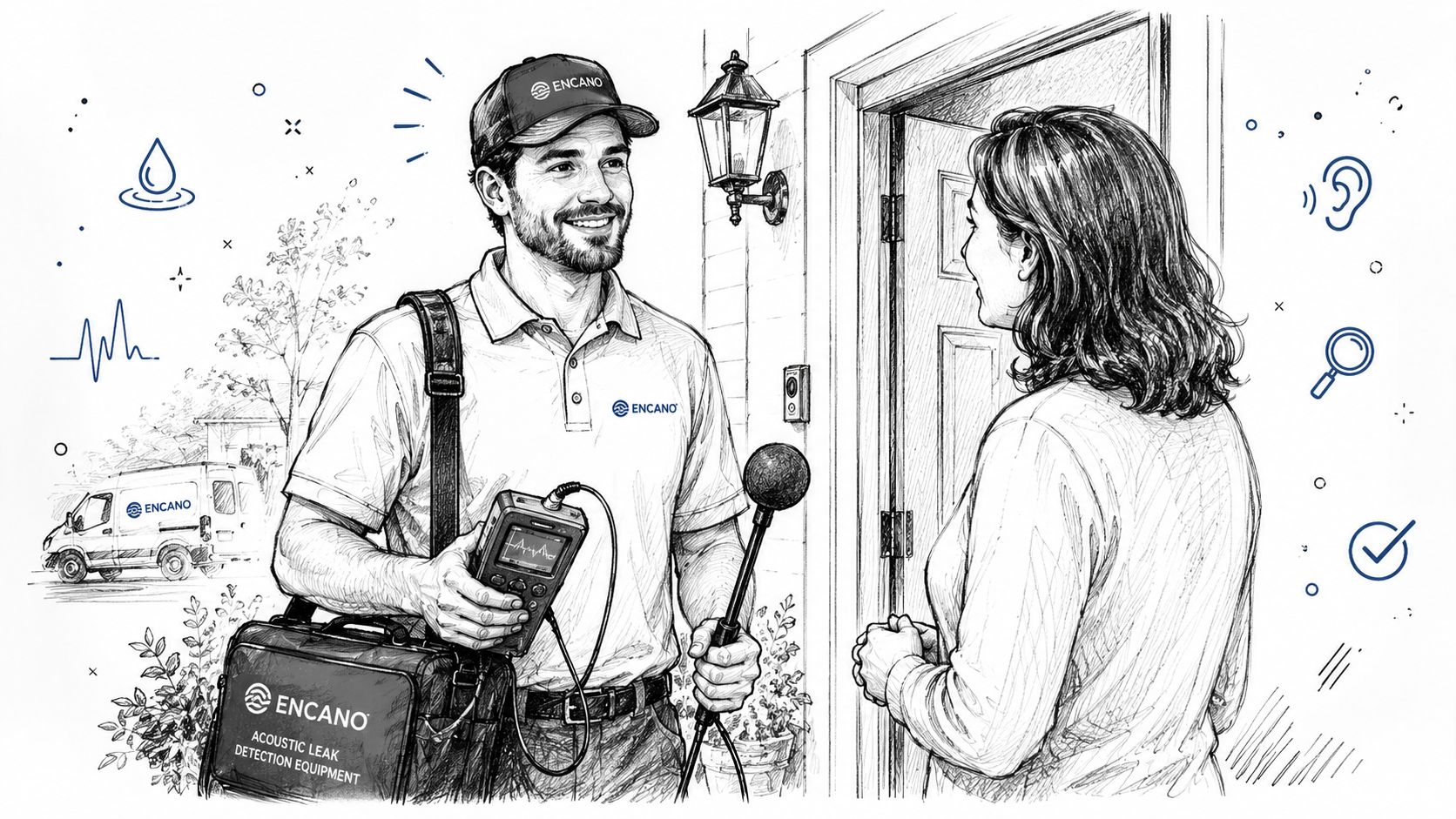
Clients often feel more at ease knowing what an appointment entails. A proper acoustic leak detection visit is methodical. It isn't a rushed walk-through with a gadget and a guess.
The first part of the visit
The technician usually starts by asking what you've noticed. Has the bill changed. Is there a sound at night. Does the stain appear after fixture use or all the time. In a strata building, they'll also want to know which units are affected and whether the line is believed to be domestic water, heating, or drainage.
Then the system gets narrowed down. Fixtures may be isolated. Occupants may be asked to stop using water temporarily. Background noise matters, so the quieter the building is during testing, the better the results tend to be.
Why pipe material matters in Greater Vancouver
Local conditions change how sound behaves. In the Greater Vancouver region, acoustic effectiveness depends heavily on pipe material and site conditions. According to the National Research Council Canada publication, sound travels at about 240 m/s in PVC and about 1450 m/s in cast iron, and technicians need to input that information for accuracy. The same source notes that the area's clay-rich soils and high water tables affect signal behaviour, and that night flow surveys between 2 and 4 AM are often necessary to reduce background noise and detect small leaks. Those details are outlined in the National Research Council Canada research on leak detection conditions.
That's why an experienced technician asks what the line is made of, how old the building is, and where the route likely runs. Those details aren't small talk. They influence how the equipment is set up and how the readings are interpreted.
A practical example from a multi-unit building
In a Vancouver low-rise, a resident may report intermittent water sounds behind the kitchen wall shared with a corridor riser. During the visit, the technician listens at accessible valves, compares sound intensity at several points, and checks whether the noise drops when certain fixtures or branches are isolated. If the signal grows stronger near one section and weaker moving away from it, the probable leak zone becomes much tighter.
From there, the recommendation is usually clear:
- If the signal is strong and consistent, open the most likely access point.
- If the signal is weak but suggestive, confirm with another non-destructive method first.
- If the signal doesn't match a supply leak, stop pushing acoustic testing and redirect the investigation.
That transparency is what makes the visit useful. Even when the answer isn't “cut here”, you leave with a more defensible next step.
Limitations and When Other Methods Are Needed
This is the part many articles skip. Acoustic leak detection does not work equally well on every plumbing system. If the problem is in a low-pressure or non-pressurised drain line, the technology may not give you a trustworthy answer.
Where acoustic detection struggles
A key weakness is its ineffectiveness in systems below 40 PSI or in non-pressurised drains, according to the background published at Mamba Drainage Services on leak detection limitations. That same source states that 60% of Greater Vancouver residential leaks occur in these kinds of systems. It also notes that drain-side failures often need confirmation with thermal imaging or video inspection.
That limitation makes sense in practice. Acoustic tools depend on a usable sound signature from escaping pressurised water. A cracked drain line under intermittent flow often doesn't produce the same reliable signal. In older Vancouver buildings with aging cast iron and PVC drainage, that matters a lot.
A common mistake in older buildings
A strata manager sees ceiling damage below a bathroom stack and assumes acoustic detection will pinpoint it immediately. If the failure is on the drain side, the test may be inconclusive. Pushing harder with the same tool won't solve that. It only burns time.
What works better is a change in approach:
- Thermal imaging can help show moisture spread or hot-line patterns.
- Video inspection can reveal cracks, separations, or deterioration inside the drain.
- Pressure isolation can help separate supply-side suspicion from drain-side suspicion.
If the line isn't pressurised, don't expect a pressurised-line tool to carry the whole diagnosis.
Why this honesty matters
For concerned owners and property managers, hearing that a tool has limits is reassuring. It means the diagnosis is being driven by the plumbing system, not by whatever device happens to be in the van. In real leak work, that's the difference between expertise and salesmanship.
Vancouver-Specific FAQs on Acoustic Leak Detection
Does acoustic leak detection work in concrete high-rises
Yes, it can, especially on pressurised supply piping. Concrete buildings add complexity because sound can reflect and travel unpredictably through structure, so technicians need good access to logical test points and a clear understanding of the piping layout. In high-rises, isolation and building quiet are often as important as the listening equipment itself.
Will tenants or owners need to leave during the test
Usually, no. Most acoustic testing is minimally disruptive. The main request is reduced water use during parts of the visit so the technician can listen without overlapping plumbing noise. In occupied strata buildings, coordination matters more than shutdown.
What affects the cost of a leak detection visit
Cost usually depends on the building type, access conditions, number of possible leak zones, whether the system needs isolation, and whether one method or several methods are required. A single-family home with a straightforward supply leak is different from a multi-unit building where several suites and common piping may be involved. The clarity of the piping map also affects labour time.
Is a report useful for strata councils or insurance files
Yes. A clear summary of what was tested, what was observed, and what area is recommended for access helps everyone involved. Strata councils need it for repair decisions. Owners may need it for restoration coordination. Insurance representatives often want to see how the probable source was identified before authorising further work.
Can acoustic leak detection find every hidden leak
No, and that's the right answer. It's highly effective for many pressurised leaks, but it isn't universal. If the issue sits in a drain, a low-pressure line, or a system with too much interfering noise, another method may be the better first move.
What should a strata manager do before booking
Have the basic facts ready. Note which units are affected, when the symptoms appear, whether the issue seems tied to fixture use, and whether the suspected line is supply or drainage. Photos of stains, moisture patterns, or access panels also help the technician plan the visit efficiently.
If you need a careful diagnosis instead of guesswork, Encano Plumbing & Drainage Ltd. serves Vancouver, Richmond, Burnaby, New Westminster, Delta, Surrey, and nearby communities with leak detection, plumbing, and drainage services. Their team uses practical, non-destructive tools and will tell you plainly when acoustic leak detection is the right method, and when another approach will get you to the answer faster.