
A lot of homeowners first look into trenchless sewer work after a miserable week. The basement drain backs up. The yard smells off. A plumber runs a camera and says the problem line sits under a patio, driveway, or decorative side yard. At that point, they aren't just worried about the pipe. They're worried about everything above it.
That's where cost confusion starts. The pipe repair itself is only part of the bill. In Greater Vancouver, the expensive surprise often comes from tearing out and rebuilding concrete, pavers, lawns, garden beds, or other hardscape after a traditional dig. That's why trenchless methods keep coming up in local quotes. In the Vancouver and Greater Vancouver market, trenchless sewer replacement can deliver total project savings of about 30% to 50% compared with open-trench work when avoided landscaping, driveway, and hardscape repairs are counted, even though trenchless CIPP lining can carry an upfront cost of $80 to $200 per linear foot versus $100 to $250 per linear foot for basic excavation on simple runs, according to NuFlow's Vancouver trenchless cost comparison.
Most readers want the same practical answers. What does trenchless sewer line replacement cost in Greater Vancouver? When does lining make sense? When is pipe bursting worth the extra money? What should a quote include before you sign? Those are the questions that matter when you're standing in the rain, looking at a driveway you don't want demolished.
Table of Contents
- Introduction to Trenchless Sewer Line Replacement Cost
- Understanding Trenchless Sewer Techniques
- Local Cost Breakdown for Trenchless Sewer Replacement
- Major Cost Drivers and Tradeoffs
- How Inspections and Diagnostics Affect Quotes
- Permits Timelines and Strata Considerations
- Sample Quote Checklist and Next Steps
- Frequently Asked Questions
Introduction to Trenchless Sewer Line Replacement Cost
A common Vancouver scenario goes like this. A homeowner notices sewage surfacing near a sinking section of driveway. The problem turns out to be a damaged lateral running from the house to the city connection. The bad news is the pipe needs serious work. The worse news, with a traditional dig, is that the repair path may cut straight through expensive surfaces you already paid to build.
That's why trenchless pricing can seem backwards at first glance. One quote may look higher for the pipe work itself, but lower for the whole project once surface restoration is counted. Another quote may look cheaper until you realise it doesn't include rebuilding concrete, relaying pavers, or repairing mature landscaping.
Practical rule: Don't judge sewer quotes by the pipe line item alone. Judge them by the full property impact.
In Greater Vancouver, this matters more than many homeowners expect because so many sewer laterals run beneath driveways, patios, walkways, retaining edges, and fenced side yards with tight access. A trenchless approach often reduces the amount of demolition needed to reach the pipe.
Here's the useful way to think about trenchless sewer line replacement cost. You're not only buying pipe repair. You're buying a repair method, a level of property disruption, a restoration burden, and a risk profile. The cheapest-looking quote on page one isn't always the lower final bill.
Many homeowners encounter a common pitfall. They compare “repair prices” without comparing what each contractor is repairing, replacing, cutting, restoring, permitting, or excluding. That's how two quotes for the same address can feel miles apart.
Understanding Trenchless Sewer Techniques
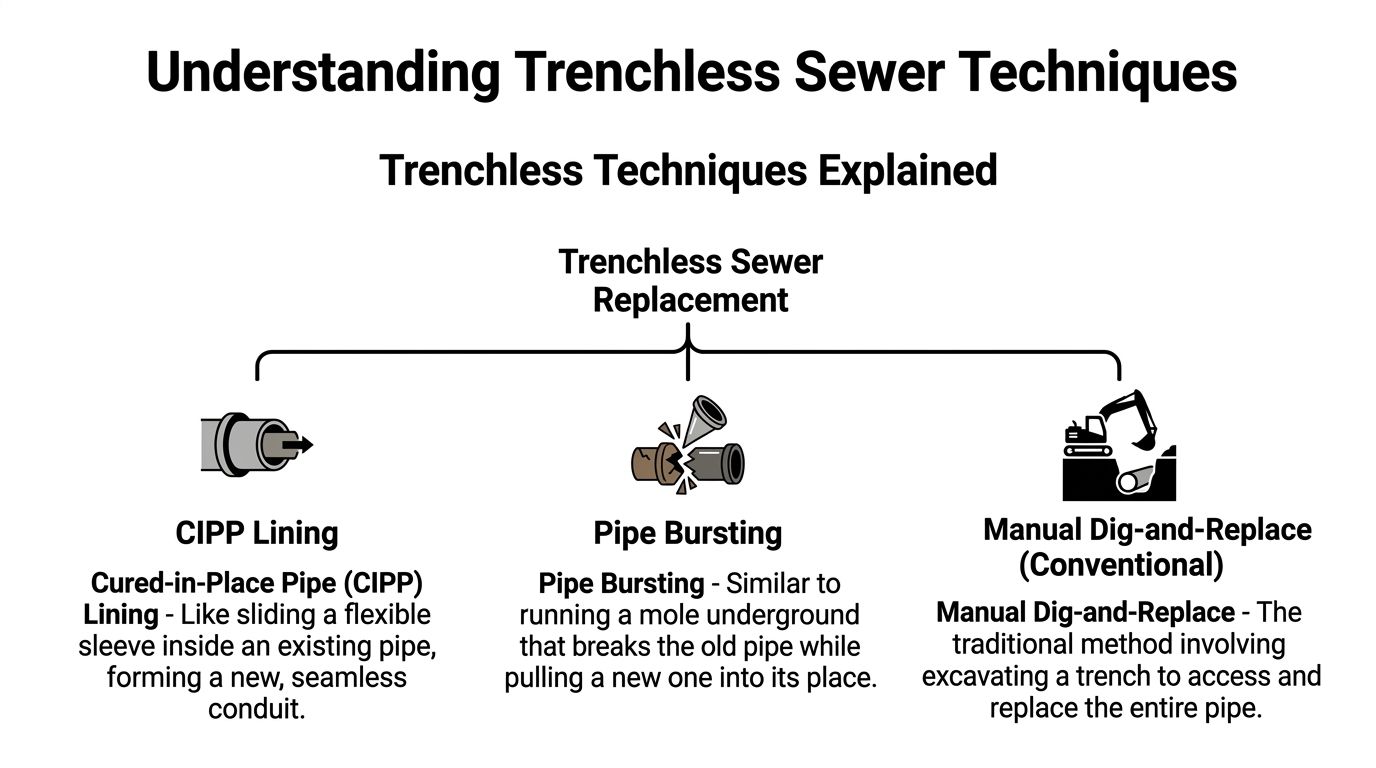
Some of the confusion around trenchless sewer line replacement cost comes from the fact that “trenchless” isn't one single method. It's a family of methods. The right one depends on what the existing pipe looks like underground.
For a broader homeowner overview of methods and decision points, this guide on what you need to know about trenchless sewer line repairs is a helpful companion.
How lining works
CIPP lining stands for cured-in-place pipe lining. The easiest way to picture it is a flexible sleeve being inserted into the old pipe, then cured so it forms a new inner pipe wall. If the host pipe still has a usable path, lining can be an elegant fix.
Lining usually fits situations where the pipe is cracked, leaking at joints, or suffering from root intrusion, but not completely crushed out of shape. The process is akin to reinforcing the inside of a worn tunnel without rebuilding the whole tunnel from scratch.
This method appeals to homeowners because it often limits surface disturbance. If your lateral runs under decorative stone, a narrow side yard, or a patio slab, keeping excavation small can be a major advantage.
When bursting is the better fit
Pipe bursting is more like underground replacement than underground patching. A bursting head breaks apart the old pipe while a new pipe is pulled into place behind it. The result is a continuous new line, which is why contractors often recommend it when the original pipe has severe collapse, misalignment, or material failure.
In plain language, lining needs a pipe that can still serve as a pathway. Bursting is what you use when that pathway has become too damaged to trust.
Traditional dig-and-replace still has a place. If access is simple and the pipe condition or layout makes trenchless methods impractical, open excavation may still be the right answer. It's the most direct approach technically, but it's also the one most likely to disturb the surface above the sewer route.
If the problem is mainly inside the pipe wall, lining often enters the discussion. If the pipe has lost its shape, replacement methods move to the front of the line.
That distinction matters because people often compare lining and bursting as if they're interchangeable. They're not. One restores. One replaces. A fair quote comparison starts there.
Local Cost Breakdown for Trenchless Sewer Replacement
Greater Vancouver homeowners usually want a clear local range before they start calling contractors. For a standard residential lateral in the region, that range is wide because access, pipe condition, depth, and surface conditions change the job quickly.
What Greater Vancouver homeowners usually see
In the Greater Vancouver region, including Richmond, Vancouver, Burnaby, and Delta, a full trenchless sewer line replacement typically ranges from $8,000 to $20,000+ for a standard 40 to 60 foot residential lateral, while trenchless spot repair ranges from $2,000 to $6,000, according to Hydro Pro Plumbing's Vancouver sewer replacement cost guide.
That spread is why one neighbour may talk about a manageable repair bill while another describes a major project. They may both be telling the truth. A short targeted repair is not the same as a full replacement under a difficult access route.
The local pricing conversation also gets distorted when homeowners compare pipe work only and ignore restoration. In urban and suburban properties, the expensive part of open-trench work often isn't just the digging. It's rebuilding what the digging destroyed.
A simple comparison table
| Technique | Cost Range |
|---|---|
| Trenchless spot repair | $2,000 to $6,000 |
| Full trenchless sewer line replacement for a standard 40 to 60 foot lateral | $8,000 to $20,000+ |
A practical way to read this table is to ask one question first. “Am I pricing a localised defect or a full lateral replacement?” If you don't separate those two scopes, the quote comparison becomes meaningless.
Here's a useful everyday example. A homeowner with a small isolated failure near the perimeter may be a candidate for spot repair. A homeowner with an older lateral showing widespread deterioration along most of its run is shopping in a completely different bracket. Same address type. Very different scope.
Major Cost Drivers and Tradeoffs
Once you know the repair type, the next step is understanding why one trenchless quote lands near the lower end and another climbs much higher. Sewer pricing changes with the physical conditions of the property, not just the length of the pipe.
What pushes a quote up
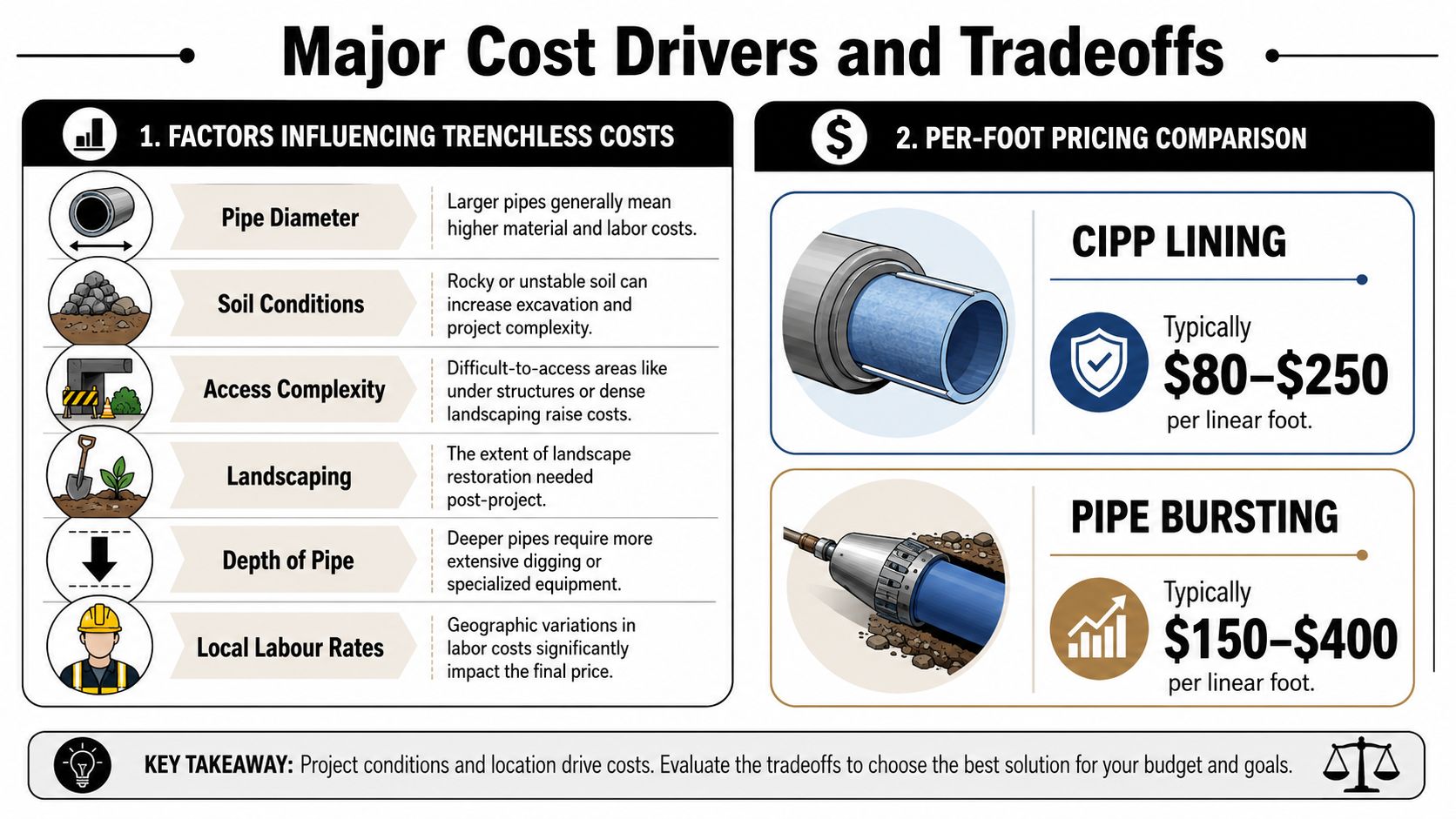
In the Vancouver area, pipe bursting ranges from $60 to $250 per foot, while pipe lining averages $80 to $250 per foot, with lower rates tied to smaller diameters and straightforward access, and higher rates reflecting deeper burial or tighter routing, according to A.P. Plumbing's trenchless pricing breakdown.
Several conditions move a quote upward:
- Pipe diameter: Bigger pipe means more material and more demanding equipment.
- Depth: A deeper sewer line often needs more setup and more labour around access points.
- Access complexity: Tight side yards, fencing, built structures, or routing under hardscape can complicate staging.
- Soil and routing conditions: Straightforward runs are easier than lines with awkward bends or difficult access points.
- Surface protection: Jobs under finished landscaping or concrete often favour methods that avoid broad demolition.
A quick visual can help you think through those variables:
Choosing between lower disruption and broader replacement
The tradeoff isn't just price. It's what the method accomplishes. Lining can be attractive when the host pipe is still structurally suitable for an internal liner. Bursting usually costs more in tougher situations because it's doing more. It replaces the old pipe rather than just rebuilding the interior.
That's why bursting often appears in quotes for collapsed or badly misaligned lines. Homeowners sometimes see the larger number and assume upselling. Sometimes that's true in any industry, but sometimes the diagnosis points to a method that matches the damage.
Cost reality: The method with the higher pipe price can still be the smarter total-project choice if it avoids heavy restoration or solves a more severe failure decisively.
If your line runs under a driveway, you're not just comparing repair methods. You're comparing ways of protecting the finished surface above the pipe. That's the hidden hardscape saving many Greater Vancouver owners miss on the first round of quotes.
How Inspections and Diagnostics Affect Quotes
The camera inspection is where the pricing stops being theoretical. Before that point, contractors are estimating from symptoms. After that point, they can see the actual line condition, the likely repair length, and whether the pipe can support lining or needs replacement.
What the inspection is really looking for
A proper diagnostic process usually answers a few practical questions. Is the problem local or spread across the line? Is the pipe cracked, offset, root-filled, sagging, or collapsed? Is there enough structural continuity for a liner, or has the pipe lost its shape?
That's why inspection quality matters. A vague quote without a clear finding often leads to scope changes later. A better starting point is a documented inspection, often with video footage, so the homeowner can match the proposed method to what's underground.
If you want to understand what contractors are checking before they recommend a method, this overview of drain camera inspection services explains the diagnostic side in homeowner-friendly language.
A practical example from Richmond and Surrey
A good local comparison shows why diagnosis matters so much. Small-scale trenchless pipe lining costs between $3,000 and $4,000 and is generally only viable for pipelines below 50 feet in total length. One Vancouver-area example is a 35-foot failed PVC segment in a Richmond townhouse rear yard repaired by small-scale lining for $3,500. By contrast, a 65-foot main lateral in a Surrey single-family home required full pipe bursting or lining and cost $11,500, according to No Dig's trenchless repair cost examples.
That's the practical lesson. The inspection doesn't just confirm damage. It defines scope. A short isolated failure can support a targeted, lower-cost fix. A longer main lateral with broader failure usually pushes the project into full replacement territory.
Homeowners often get confused here because both jobs may be described casually as “trenchless repair.” Technically, yes. Financially, they're very different projects.
Permits Timelines and Strata Considerations
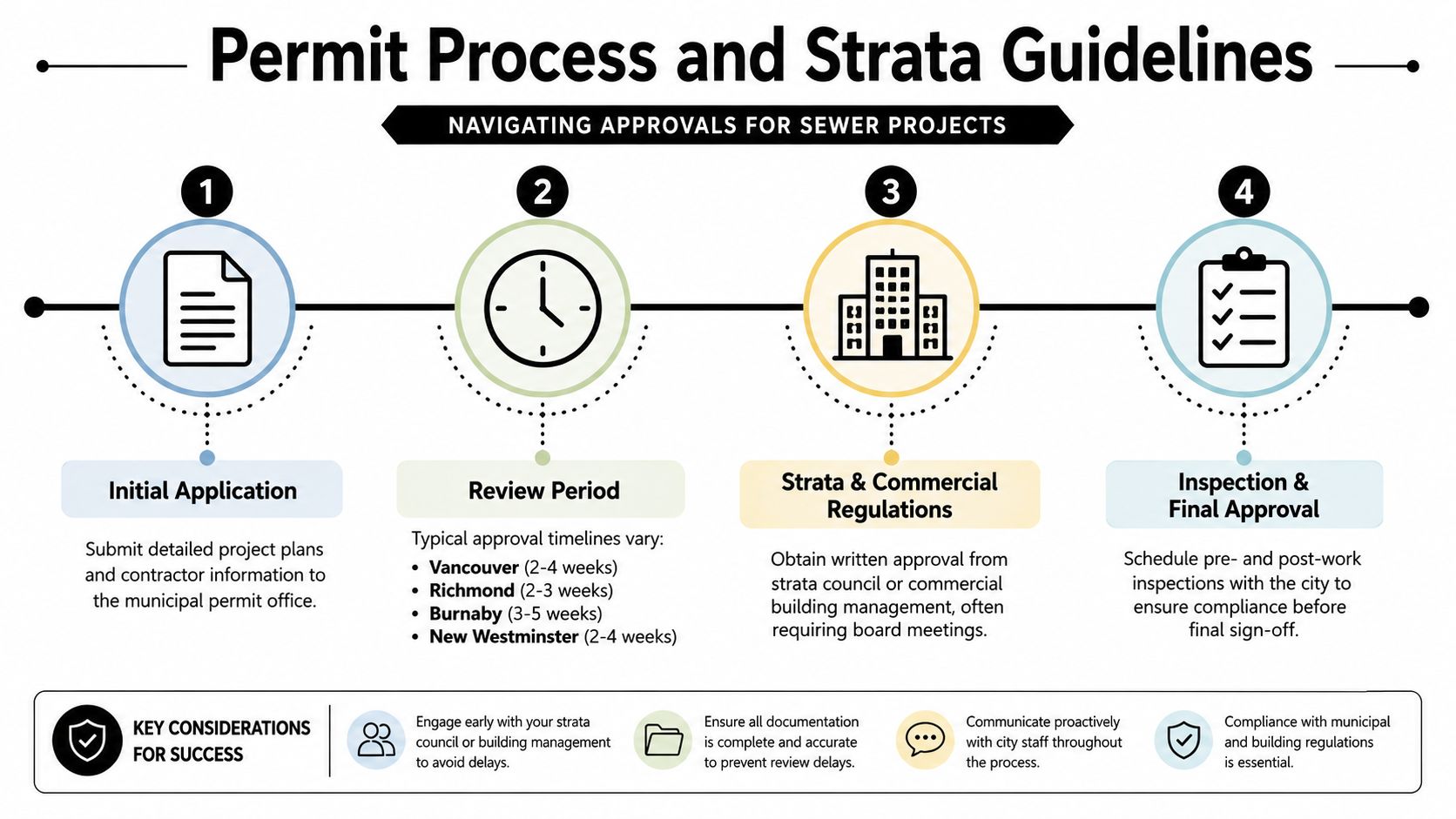
A sewer project can stall even after the repair method is chosen. On detached homes, the delays often come from municipal approvals or inspection scheduling. In strata and multi-unit settings, another layer gets added because building management or council approval may be required before work begins.
Why approvals slow some jobs down
The exact approval path varies by municipality and property type, so homeowners should expect local permit offices and inspection requirements to govern timing. For strata properties, timing often depends just as much on internal sign-off as city processing. Board meeting schedules, access permissions, notice requirements, and common-property questions can all slow a straightforward repair.
That's one reason trenchless methods are often attractive for denser properties. They can reduce disruption to common areas, paved access routes, or planted sections shared by multiple residents.
For multi-unit buildings in the CA region, trenchless pipe bursting ranges from CAD $5,000 to $9,000 for a 40 to 60 foot residential lateral, with a technical rate of CAD $150 to $190 per linear foot, and it's often chosen by strata corporations dealing with ageing mid-century cast iron pipes to avoid excavation under driveways or landscaping, according to Hydro Pro Plumbing's trenchless versus traditional repair guide.
What strata managers should verify early
Strata managers and owners should confirm these points before treating a quote as final:
- Authority to approve: Determine whether the repair falls under owner responsibility, common property responsibility, or a shared decision.
- Access permission: Confirm who can authorise entry to parking areas, rear lanes, common grounds, or utility rooms.
- Inspection coordination: Ask how municipal inspections will be booked and who needs to be present.
- Resident communication: Check whether notice must be given for temporary service interruptions or access restrictions.
For building-side context, this article on a strata repiping project example explained helps frame the approval and coordination issues that often appear in multi-unit work.
The fastest sewer job on paper can still sit idle if no one clarified who had approval authority.
Sample Quote Checklist and Next Steps
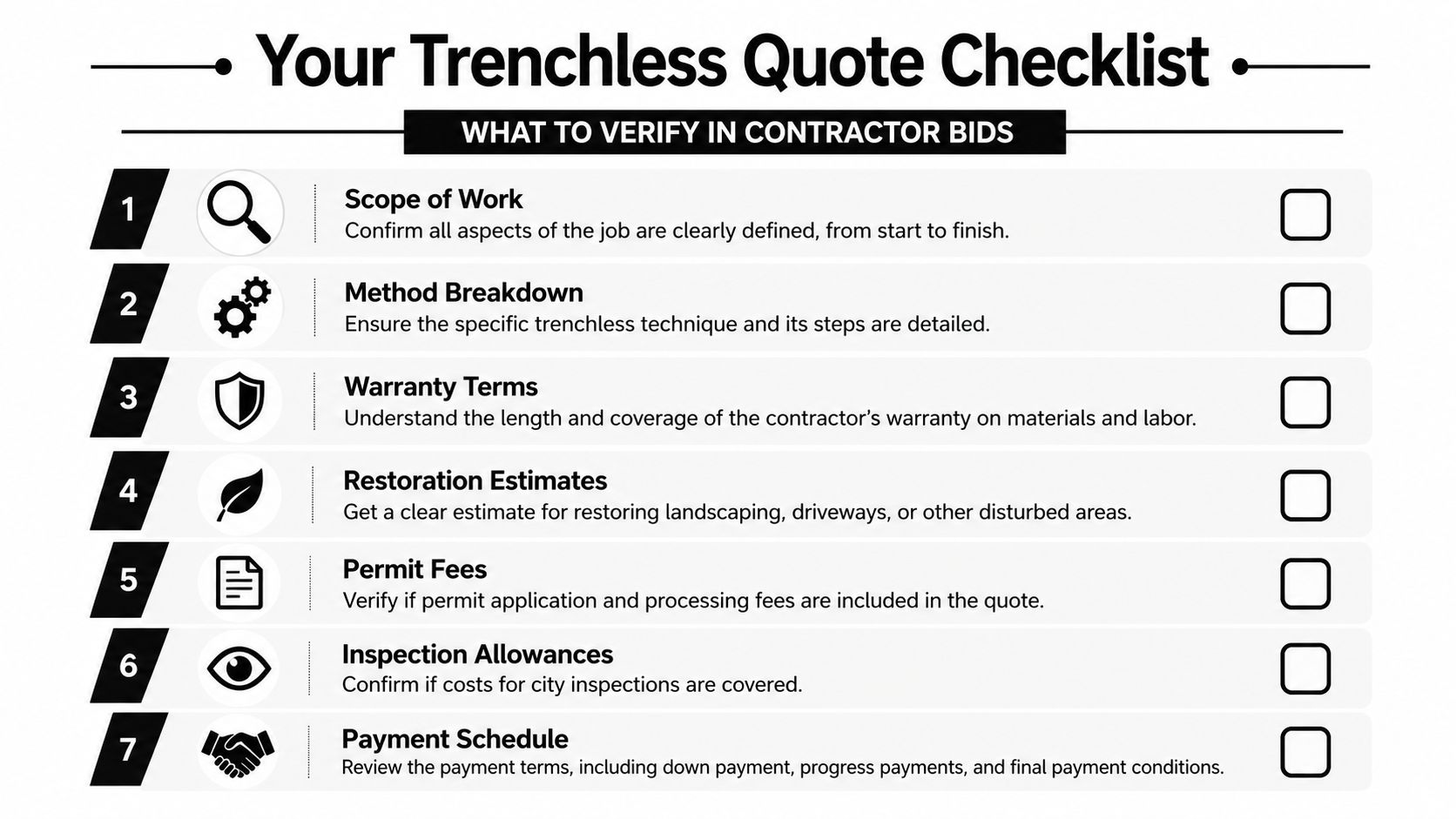
Most quote problems come from missing line items, not from the numbers that are shown clearly. When you compare contractors, ask for a written scope that leaves less room for assumptions.
What to ask for in writing
Use this checklist when reviewing trenchless sewer line replacement cost estimates:
- Scope of work: Does the quote state whether it's a spot repair, partial repair, or full lateral replacement?
- Method breakdown: Is the contractor proposing CIPP lining, pipe bursting, or excavation for part of the run?
- Inspection basis: Does the quote refer to camera findings or other diagnostics?
- Access plan: Where are entry pits, cleanout access points, or staging areas located?
- Restoration responsibility: What surface work is included, and what is excluded?
- Permit handling: Who applies, who books inspections, and what approvals are the owner's responsibility?
- Payment schedule: Are milestones tied to inspection, installation, and final completion?
How to compare quotes fairly
Don't compare one contractor's “all-in” price to another contractor's pipe-only price. That's how homeowners get trapped by incomplete estimates. Compare scope to scope. If one quote includes restoration planning and another excludes it, they are not pricing the same job.
A practical quote checklist also protects you from broad phrases like “repair as needed.” Those words can hide major scope changes later. Ask the contractor to spell out what triggers a method change. For example, what happens if the camera finds a collapse that lining can't cross?
The best quotes read like a work plan, not a guess.
Frequently Asked Questions
Will my insurance cover trenchless repair
Sometimes, but it depends on your policy and the cause of the damage. Homeowners should ask the insurer whether the policy covers sudden sewer damage, access costs, resulting property damage, or only parts of the claim. Don't assume the full trenchless sewer line replacement cost will be covered just because the line failed.
How long will the trenchless process disrupt my property
Disruption is usually lower than a broad excavation because trenchless work often limits surface opening to smaller access areas. The exact impact depends on access, municipal inspection timing, and whether the property is detached, tenanted, or part of a strata. Ask the contractor to describe disruption in practical terms, such as access loss, parking restrictions, water use limits, and surface protection.
Are trenchless methods suitable under driveways and patios
Often, yes. That's one of the main reasons homeowners consider them. If the pipe condition and layout allow it, trenchless methods can reduce the need to demolish finished surfaces above the sewer line. Suitability still depends on the camera inspection and the chosen method.
What warranties do local contractors provide
Warranty terms vary by contractor and by method. Ask for the warranty in writing and make sure it states what is covered. Some warranties focus on materials, some on workmanship, and some exclude conditions outside the repaired section. Read the exclusions, not just the headline.
If you need a clear second opinion on a sewer issue in Vancouver, Richmond, Burnaby, New Westminster, Delta, Surrey, or nearby communities, Encano Plumbing & Drainage Ltd. provides trenchless sewer inspections, repair planning, and 24/7 plumbing and drainage service. Their team handles residential, commercial, and strata work with modern diagnostic tools and transparent pricing, so you can compare options with confidence before committing to the job.