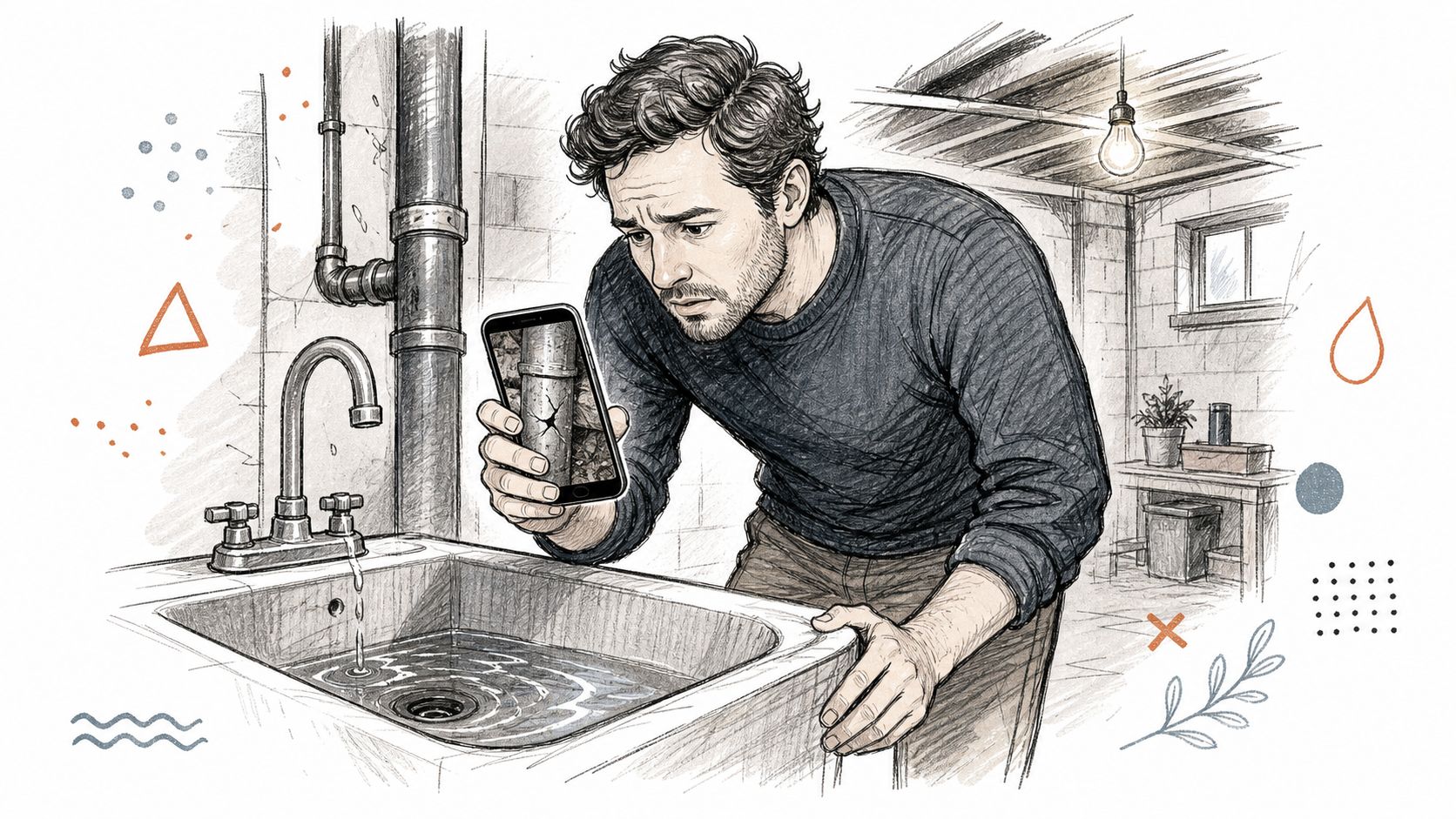
A homeowner in Richmond notices the kitchen sink draining slowly again. The bathroom gurgles when the washing machine empties, and every few weeks someone reaches for a plunger. The immediate question is whether this is an ordinary blockage or a damaged sewer line buried beneath the driveway.
That's where an inspection camera for plumbing earns its place. Instead of excavating first and asking questions later, a technician can send a waterproof camera through an existing cleanout or drain opening, watch the live footage, and inspect the inside of the line. In Metro Vancouver, this non-destructive diagnostic step is used to identify cracks, root intrusion, blockages, corrosion, separated joints, bellied pipes, and scale buildup before excavation or replacement is considered. Local video pipe inspection guidance describes the process and its role in diagnosing buried-line problems.
The camera doesn't fix a pipe, and it isn't an underground X-ray. It shows what the lens can reach and see. Used properly, though, it replaces a large amount of blind guessing with evidence.
Table of Contents
- Why Plumbing Inspection Cameras Changed the Game
- Types of Plumbing Inspection Cameras and Key Specs
- Common Plumbing Problems a Camera Can Reveal
- Cost Breakdown and Whether to Rent Buy or Hire
- What to Expect During a Professional Video Inspection
- When a Standard Camera Pass Is Not Enough
- Maintenance Safety and Local Tips for Greater Vancouver
- Your Next Steps for a Confident Plumbing Decision
Why Plumbing Inspection Cameras Changed the Game
A standard home inspection can assess visible fixtures, drainage symptoms, and accessible plumbing. It may leave the buried sewer service line beneath a yard, driveway, or slab unexamined. That gap matters in older Lower Mainland homes, where aging pipe materials, past repairs, mature tree roots, and settled sections can sit beyond anything visible indoors. Regional video inspection information describes video inspection as a specialised service for documenting residential and commercial pipe conditions.
The driveway excavation can wait
Consider that Richmond homeowner with recurring backups. A drain snake may restore flow temporarily, yet it cannot establish whether roots are entering through a joint, a section has settled, or the pipe has collapsed. Excavation based on a symptom alone can expose the wrong area, remove more pipe than necessary, or miss the actual cause.
A camera pass shows the interior condition within the reach of the equipment. The technician can record visible defects, assess changes as the camera travels, and use a locator when the system supports one to estimate the camera's underground position. That evidence can support a targeted repair instead of broad excavation.
It also has limits. A routine pass may take roughly 30 minutes to 1 hour, depending on pipe length and the problem, as described in the BC service information on video pipe inspections. Difficult access, heavy scale, standing water, tight bends, or a collapsed section can prevent the camera from reaching the suspected area. In those cases, a camera inspection may be only the first stage of diagnosis, followed by locating, cleaning, flow testing, or another investigation.
The useful result is more than a live image. A professional service may provide a written report and recorded video for a homeowner, buyer, strata council, or property manager to review before approving work. The record can help distinguish a maintenance blockage from a defect requiring structural repair.
Practical rule: If a proposed repair involves digging, ask what evidence identifies both the failure's location and its cause before excavation begins.
Types of Plumbing Inspection Cameras and Key Specs
The right camera depends on the pipe, access point, and inspection objective. A small indoor drain, a residential sewer lateral, and a large municipal main require different cable strength, lighting, steering control, and camera-head size. Equipment that works well in a Lower Mainland home may be unsuitable for an older Vancouver property with long clay laterals, tight bends, or limited cleanout access.
Push cameras for residential lines
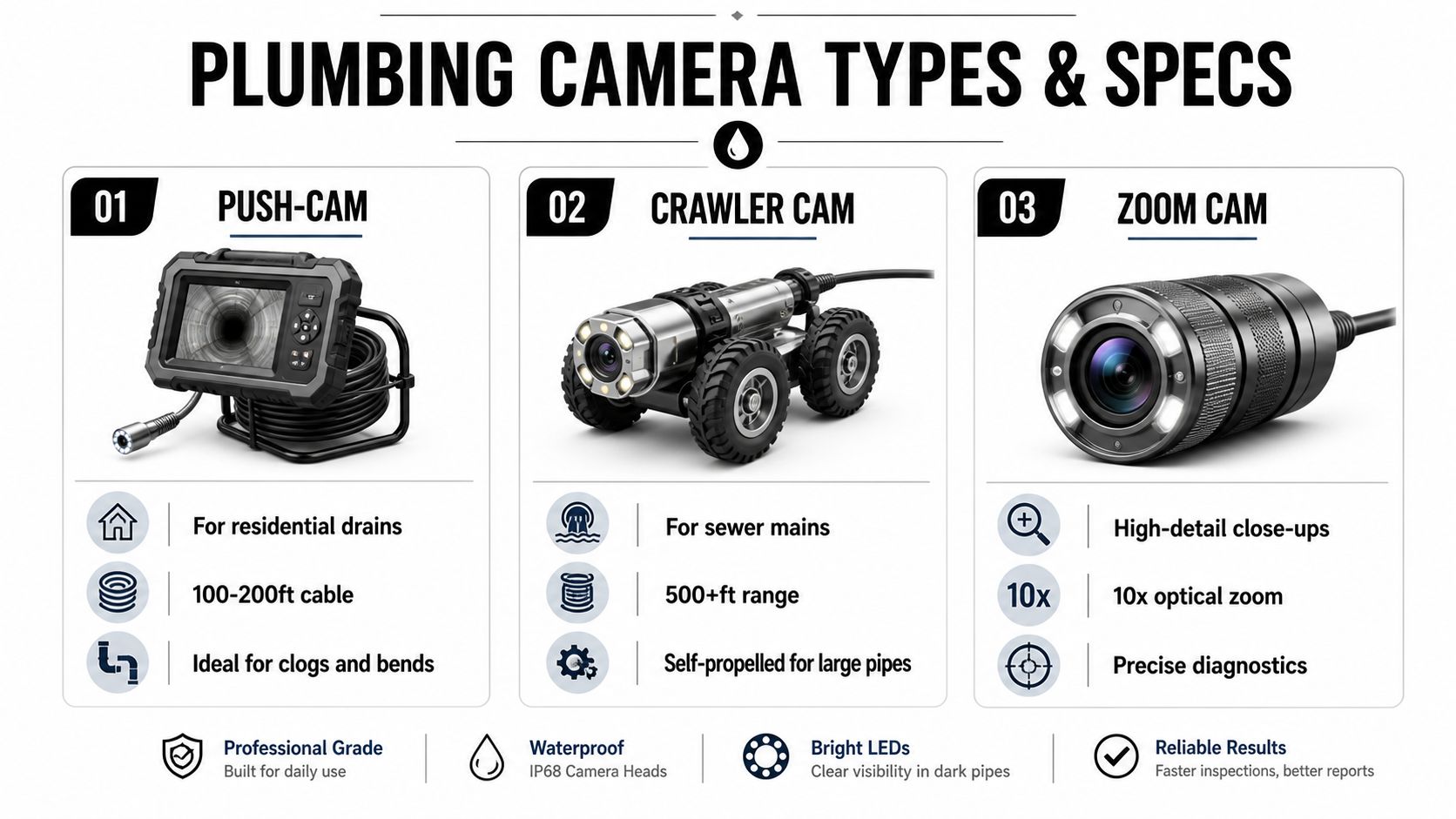
A push camera uses a waterproof camera head fixed to a flexible cable. The technician feeds it through a cleanout or drain opening and watches the image as it moves through the pipe. This remains the common option for residential laterals and many smaller commercial drains.
Camera-head size affects both access and image quality. A head that is too large may stop at a narrow opening or tight bend. A very small head may offer less lighting, durability, or stability in a rough line. The practical choice is the smallest camera that can provide a usable view and travel through the suspected section.
A locator sonde, built into or attached near the camera head, allows the technician to trace its approximate position and depth from above ground. That information can help identify where a break, root mass, or blockage sits beneath a yard. It does not prove the full extent of the defect, especially if the camera cannot pass beyond it.
Crawler cameras for larger infrastructure
Self-propelled crawler cameras use wheels or tracks to travel through larger sewer mains. They suit commercial, municipal, and substantial private-property lines where a manually pushed cable would be difficult to advance or control. A crawler also gives the operator steadier movement over longer distances, provided the pipe is large enough and access is suitable.
Canadian municipal requirements illustrate the controls expected for this work. A Halifax Water CCTV specification calls for cameras that are self-propelled, self-levelling, waterproof, capable of 360° pan and 270° tilt, and able to reach 300 m from one access point. Those capabilities matter when a short residential-style push cannot inspect the complete line.
Zoom and pan-and-tilt systems
A pan-and-tilt or zoom camera lets the operator examine a joint, crack, root intrusion, or connection more closely. Radial rotation and lateral tilt reveal more of the pipe wall than a centreline-only view. That distinction matters when a routine pass shows a suspicious area but does not establish whether it is buildup, a displaced joint, or structural damage.
Resolution and lighting determine how much confidence the footage deserves. Ottawa requirements call for colour cameras that operate in fully humid or submerged conditions, pass through a 75 mm pipe, and provide at least 350 TV-line resolution. Clear footage still depends on clean lenses, controlled movement, and water conditions. A camera can document what it reaches, not what remains beyond a blockage or outside the pipe wall.
Common Plumbing Problems a Camera Can Reveal
A camera turns a symptom into a visible condition, but the footage still needs interpretation. Slow drainage, recurring backups, and odours can come from several different defects, and the repair that works for grease won't solve a separated sewer joint.
Roots, grease, and scale
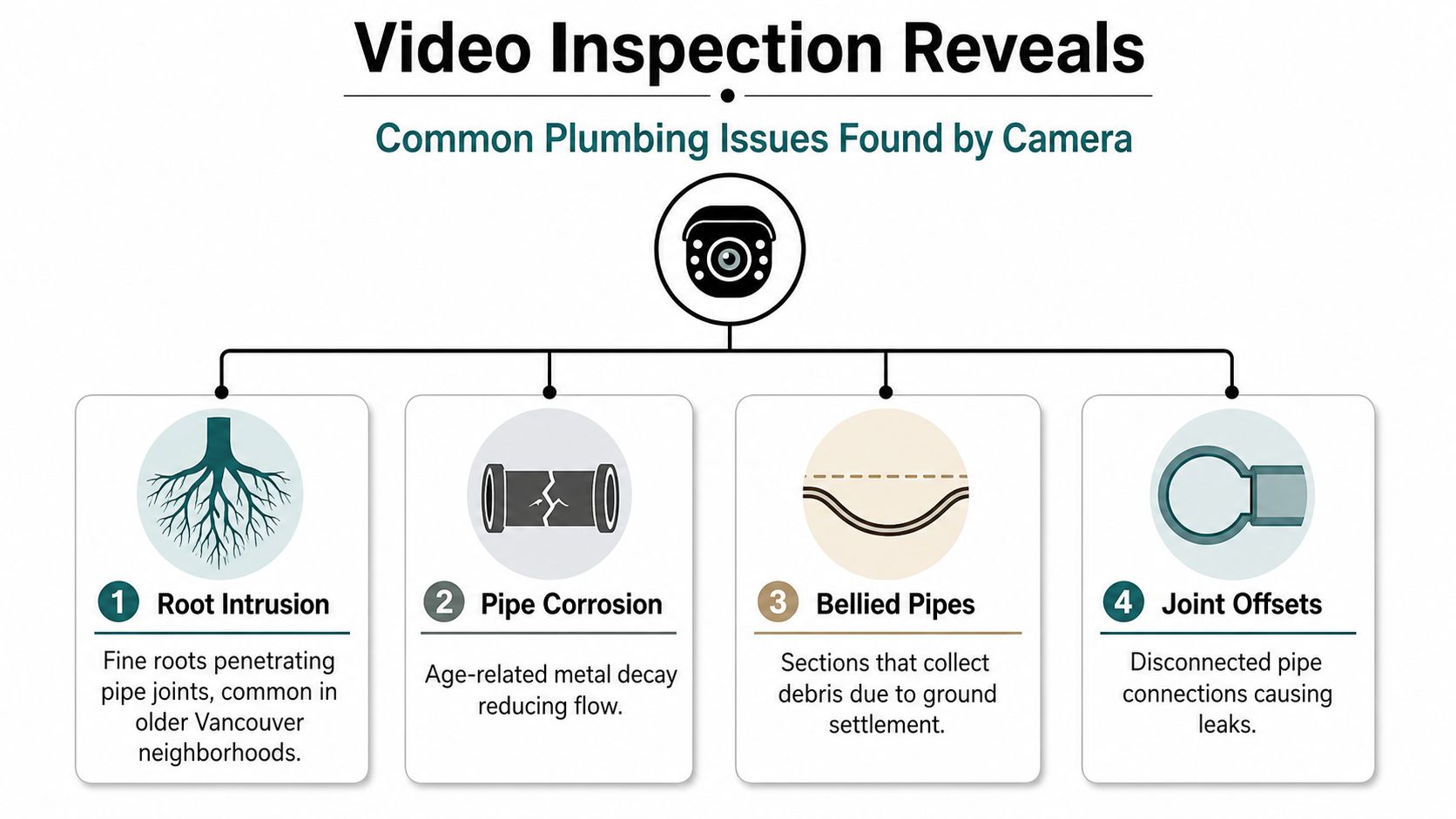
Root intrusion is common in established neighbourhoods with mature trees. Fine roots can enter through joints or damaged sections, catch paper and debris, and gradually restrict flow. A Burnaby homeowner may assume the recurring backup is caused by a bad cleanout or an isolated clog, then see roots filling a clay sewer lateral on the monitor.
Kitchen lines present a different pattern. Grease and scale cling to the pipe wall, narrowing the passage and creating a rough surface where additional debris collects. The camera can show whether the line contains a soft obstruction, heavy buildup, or a more serious crack behind the deposits. That distinction affects whether cleaning, hydro-jetting, or repair is appropriate.
Bellies and settled sections
A bellied pipe has a low section where water and solids can sit instead of moving cleanly toward the sewer connection. Ground settlement can create this condition, particularly where buried lines cross changing soil or poorly supported areas.
The footage may show the camera dipping into standing water or repeatedly struggling through a low spot. For a Surrey strata complex, that image could explain why multiple units experience recurring drainage problems even after individual suite drains are cleaned. A shared line may need a broader investigation than a single fixture-level repair.
Cracks, corrosion, and joint separation
Older homes can contain clay, cast iron, or other ageing pipe materials. The camera may reveal a longitudinal crack, a collapsed section, corrosion and scale on a metal pipe, or an offset where two pipe sections no longer align. A separated joint can also allow groundwater and surrounding soil into the line, increasing the amount of material carried downstream.
This sewer camera inspection resource provides additional context on using video to identify buried sewer conditions before unnecessary digging.
A useful recording shows more than the defect. It shows the pipe leading into the defect, the defect itself, and enough surrounding context to judge whether the finding is isolated or part of a wider failure.
Cost Breakdown and Whether to Rent Buy or Hire
A professional video inspection in BC is commonly listed at $150 to $500. The final fee depends on line length, access, documentation, location, and whether the visit includes other plumbing work. A BC sewer camera inspection listing gives that regional range and describes a flexible, waterproof camera entering through a cleanout or drain opening.
The lowest invoice is not always the lowest-cost choice. Rental equipment may produce usable footage, but someone still has to trace the pipe route, control the cable, interpret the image, and distinguish a collapse from standing water or poor lighting. Older Vancouver-area homes can add another complication, since access points, pipe materials, and altered drainage layouts are not always obvious. Buying suits a contractor or property team that will use the system regularly and can handle maintenance, training, and storage.
Inspection camera options compared
| Option | Typical Cost | Best For | Key Limitation |
|---|---|---|---|
| Rental camera | Varies by supplier and equipment | A straightforward, accessible line where the user understands the risks | Consumer systems may have limited lighting, locating, cable control, and reporting |
| Purchase | Varies widely by system and capability | Contractors or property teams with recurring inspection needs | Requires equipment knowledge, maintenance, training, and interpretation |
| Professional hire | $150 to $500 in a typical BC listing, depending on scope | Homeowners, buyers, strata managers, and commercial teams needing documented findings | The inspection fee doesn't automatically include repairs or difficult follow-up work |
What you're paying for
A professional service combines equipment, access planning, and judgement. The technician selects a workable entry point, matches the camera head to the pipe, advances the cable without damaging the line, interprets the footage, and connects the finding to repair planning.
The standard camera pass may fit a clear, accessible residential line. It may not answer the full question if the camera stops at roots, debris, a collapsed section, or a sharp bend. In that situation, cleaning, locating, or another inspection step may be needed before anyone can assess the remaining pipe. Paying for a second diagnostic step can be more sensible than approving excavation from incomplete footage.
Documentation has practical value. A written report and recorded video help a homeowner compare repair proposals, give a strata council evidence about a shared line, or support a buyer's decision before completing a transaction. They also show the limits of the inspection, including sections the camera could not reach.
For one residential concern, hiring generally offers better practical value than purchasing equipment for a single use. Renting can work when the line is accessible and the goal is narrow, but it cannot turn an unclear image into a dependable diagnosis.
What to Expect During a Professional Video Inspection
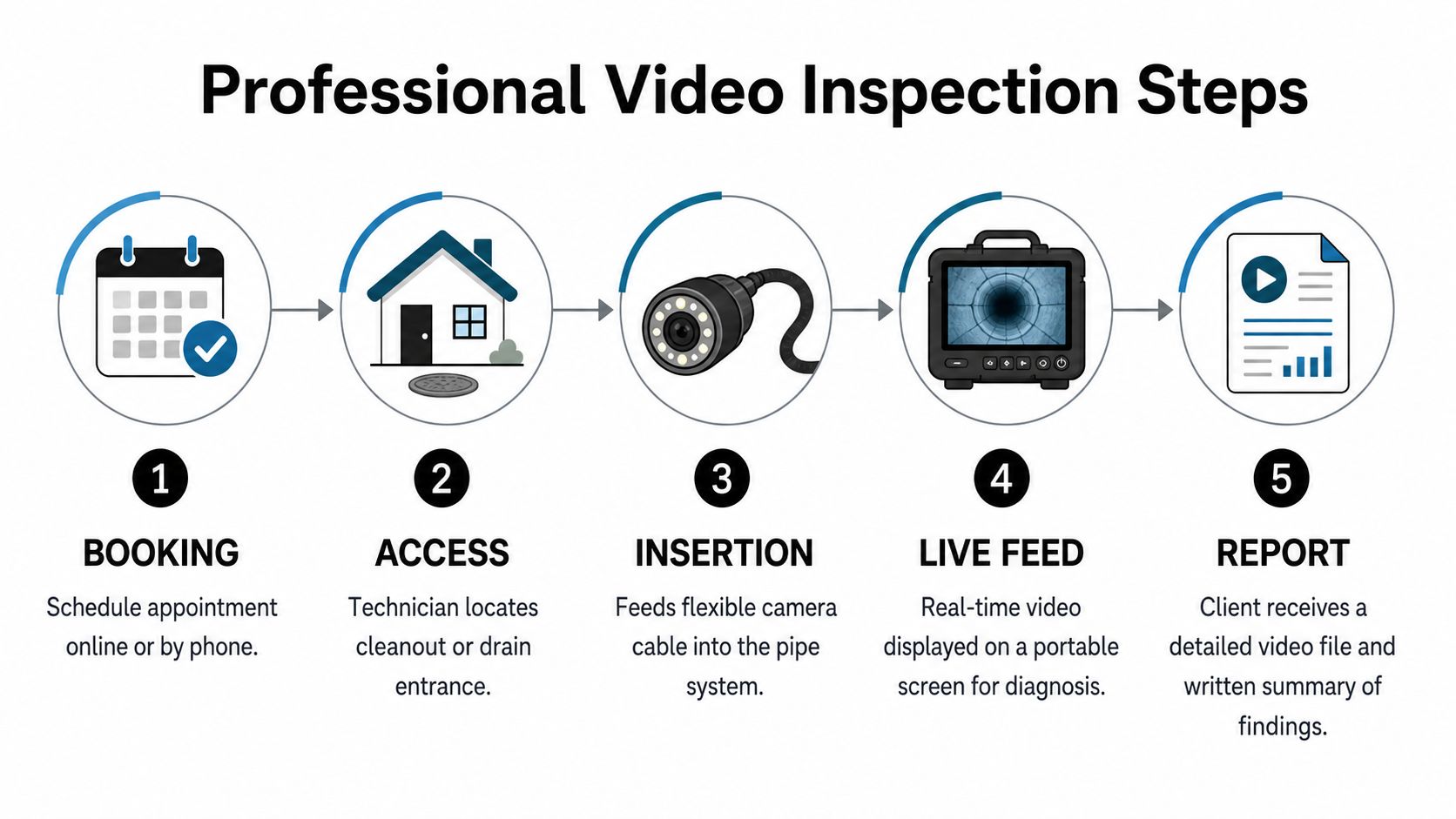
A recurring backup in a Richmond home often starts with a practical question: is the sewer line damaged, or does it need cleaning? A professional visit begins by finding a usable cleanout, drain opening, or other access point. The technician also considers the pipe route, the reported symptoms, and whether the opening reaches the section causing trouble.
Once the camera enters, the operator watches a live feed for changes in pipe shape, deposits, roots, cracks, separated joints, standing water, and obstructions. The camera can be paused, reversed, or repositioned so a finding receives closer examination rather than being passed at speed.
A Richmond example
Suppose the line is open but has root intrusion at a joint. That footage may support root cutting or cleaning instead of immediate replacement. The homeowner gets a more useful answer than a general statement that the drain is blocked.
A blockage can limit the result. The first pass may show that cleaning or further investigation is needed, but it cannot confirm the condition beyond the point the camera reached. A technician should record that inspection limit clearly.
A locator sonde can mark the camera's position and depth from the surface. That information helps when a defect appears below a driveway, planted area, or finished surface. Marking the likely location can narrow the repair area, although site conditions and the contractor's assessment still determine the excavation plan.
The records you should receive
A residential inspection commonly takes 30 to 60 minutes, depending on pipe length and the severity of the issue, as described in Greater Vancouver inspection service information. Confirm beforehand whether the fee includes recorded video, a written summary, and locator measurements.
The inspection uses an existing opening instead of opening the yard as the first step, but access may still require cleaning or minor preparation. Ask which sections were reached and which remained unseen.
A visual overview is available in a walkthrough of what a professional drain camera inspection entails.
When a Standard Camera Pass Is Not Enough
A 30 to 60 minute camera pass can answer an important question without showing every buried section. The practical time frame depends on pipe length, access, blockage, and the line's condition. A camera can document what it reaches, but it cannot confirm the unseen pipe beyond an obstruction.
Dense root intrusion may cover the lens. A collapsed section can stop the camera entirely. Offset joints can leave a sharp edge that a flexible cable cannot safely pass, while sludge or standing water may conceal the pipe wall. In these cases, clean footage is not the same as a complete inspection.
When the camera confirms the next step
Footage does not need to cover the entire line to support a repair decision. A visible collapse, substantial root mass, or severe joint separation may explain the symptom and justify cleaning, locating, or repair planning. The report should still identify how far the camera travelled and which portions remain unverified.
A blocked view often means the inspection needs another stage. Hydro-jetting can remove roots, sludge, and scale before a second camera pass. The technician may also need to use another cleanout or access point, approaching the obstruction from the opposite direction. That added work affects both the scope and the cost, so it should be explained before proceeding.
Older Lower Mainland homes need a wider view
Older Vancouver-area homes can have several problems in the same sewer line. Clay may show root intrusion and offset joints. Cast iron may contain corrosion and scale. Orangeburg can deform or lose structural integrity while still draining intermittently, which can make the underlying problem appear less urgent than it is.
A standalone camera check suits a line with good access, open flow, and a clearly defined question. A multi-step diagnostic workflow is more appropriate when the pipe is blocked, the route is uncertain, or the home's age raises concerns about material and structural condition. That workflow may include access preparation, cleaning, camera inspection, locating, and a follow-up review.
Ask whether the inspection can reach the full area of concern, whether locating is included, and what happens if the camera stops. The honest result may be incomplete footage. The technician should record what the camera saw, where it stopped, and what work is required before anyone makes a reliable statement about the rest of the line.
Maintenance Safety and Local Tips for Greater Vancouver
Mature street trees are part of the character of many Lower Mainland neighbourhoods, but their roots can affect nearby sewer laterals. Don't wait for a complete backup before paying attention to recurring slow drainage, gurgling, odours, or unexplained wet areas around a sewer route.
Seasonal changes can also alter how symptoms appear. Wet weather may make groundwater infiltration more noticeable through separated joints, while root-related restrictions can remain hidden until household flow and debris expose the weakness. A camera inspection is more useful when the technician knows the history, including previous snaking, jetting, backups, and repairs.
Advice for strata and property managers
Shared drain lines need clear responsibility. A strata manager should record which suites are affected, whether the symptoms occur at the same time, and whether the suspected line serves one unit or multiple areas. A camera report can give the council a common record for discussing maintenance or capital work instead of relying on separate descriptions from residents.
Keep the video and written findings with the property records. Those documents can support insurance discussions, real-estate due diligence, repair comparisons, and strata meeting decisions. They also give a future technician a starting point rather than forcing the next visit to begin with no history.
DIY safety matters
Consumer cameras can be useful for a short, accessible drain, but wet plumbing areas create electrical and contamination risks. Keep powered equipment away from standing water, use suitable protective equipment, and don't force a cable through a suspected collapse or sharp offset.
A homeowner may see a dark obstruction without knowing whether it's grease, roots, scale, or structural damage. If the camera can't pass, the line needs locating, or the footage may affect an excavation decision, call a qualified professional. Guidance on spotting hidden plumbing leaks can also help you distinguish visible warning signs from conditions that require a closer diagnostic visit.
Your Next Steps for a Confident Plumbing Decision
Use the symptom and the proposed repair to decide how much investigation makes sense.
- Schedule an inspection: Consider it when backups recur, several fixtures drain slowly, a property has an unknown sewer history, or someone proposes excavation.
- Ask about access: Confirm whether the technician will use a cleanout, what happens if the camera can't pass, and whether another access point may be needed.
- Request documentation: Ask for recorded footage, a written report, and locator information when a defect is found underground.
- Separate diagnosis from repair: Clarify whether cleaning, hydro-jetting, locating, or replacement is included in the quoted service.
- Judge the result: Clear footage can support a targeted repair. Incomplete footage should be treated as a reason for further investigation, not as proof that the unseen pipe is sound.
Video inspection is a relatively low-disruption way to gather evidence before opening a driveway or yard. It can identify a straightforward blockage, reveal structural damage, or show why the first camera pass needs support from cleaning or additional access.
Encano Plumbing & Drainage Ltd. serves Vancouver, Richmond, Burnaby, New Westminster, Delta, Surrey, and nearby communities with video inspection equipment for residential, commercial, and property-management needs. If recurring drainage symptoms or a proposed excavation has you uncertain, book an inspection or consultation and ask for a documented view of the line before choosing the repair.
Encano Plumbing & Drainage Ltd. offers sewer and drain camera inspections, drain cleaning, locating, and related plumbing and drainage services for homes, strata properties, and commercial buildings. Visit Encano Plumbing & Drainage Ltd. to request an inspection or consultation and make your next plumbing decision with clearer evidence.