
You've got the furnace running, the thermostat is set where it always is, and yet one room still feels cool while another feels stale or noisy. That's the kind of complaint that sends a lot of homeowners straight to the thermostat, the filter, or even the furnace itself, when the core issue is often airflow in a furnace. In Greater Vancouver homes, especially older houses, retrofits, and basement suites, weak airflow can hide behind comfort problems for a long time before anyone thinks to measure it.
The tricky part is that airflow problems don't always look like breakdowns. The system may still run, heat may still move, and the blower may still make noise. But if air can't return freely, pass through the furnace properly, and reach the rooms without too much resistance, the whole system starts to drift out of balance. That affects comfort first, then efficiency, and if it goes on long enough, it can create equipment stress too.
Table of Contents
- Why Furnace Airflow Is the Problem You Cannot See
- How Airflow in a Furnace Actually Works
- Why Correct Airflow Matters for Efficiency, Comfort, and Safety
- How Airflow Is Measured and What the Target Numbers Look Like
- Common Causes of Poor Furnace Airflow
- A Practical Example From a Richmond Home With a Pet and a Basement Suite
- Step-by-Step Troubleshooting and Maintenance You Can Do Yourself
- When to Call a Pro and What to Expect From a Furnace Technician in Vancouver
Why Furnace Airflow Is the Problem You Cannot See
A furnace can be running almost constantly and still fail to move heat where you want it. That's why a cold bedroom, a noisy vent, or a house that never quite feels even often points to airflow, not an obvious mechanical failure. In a Metro Vancouver home, the symptom usually shows up in the rooms before it shows up at the equipment.
The complaint is often the clue
A homeowner notices one upstairs room is chilly, the basement suite feels stuffy, and the thermostat keeps calling for heat. The instinct is to blame the thermostat or assume the furnace is “tired”, but the actual bottleneck may be in the return path, the supply path, or a filter that's adding too much resistance. That's why simple surface checks help, but they don't always solve the actual problem.
Practical rule: if the furnace is running and the room still feels wrong, think about how air is moving, not just whether heat is being made.
What makes airflow so easy to miss is that the furnace can still operate in a way that looks normal to a casual eye. The blower spins, the burners fire, and air comes out of vents. Yet if the system can't breathe in enough return air or push enough supply air through the ducts, the home gets uneven temperatures and the furnace works under strain.
For Vancouver homeowners, that gap matters because retrofits and basement suites often change how air moves through the house. A simple filter swap can be useful, but it won't fix a hidden return-air bottleneck or a duct layout that was never generous enough to begin with. For a related home-energy check, see how to test your house for heat loss, because airflow issues and heat-loss issues often get mixed up in the same complaint.
How Airflow in a Furnace Actually Works
Think of the furnace as the heart of the system. The ducts are the arteries and veins, and the air itself is what keeps everything circulating. If the circulation is weak or blocked, the rooms don't get what they need no matter how hard the furnace tries.
From room air to warm supply air
Air starts on the return side, where room air is pulled back through return grilles and return ducts. The blower then moves that air through the furnace and across the heat exchanger, where it warms up without mixing with combustion gases. After that, the heated air enters the supply plenum and travels through supply ducts to the vents in each room.
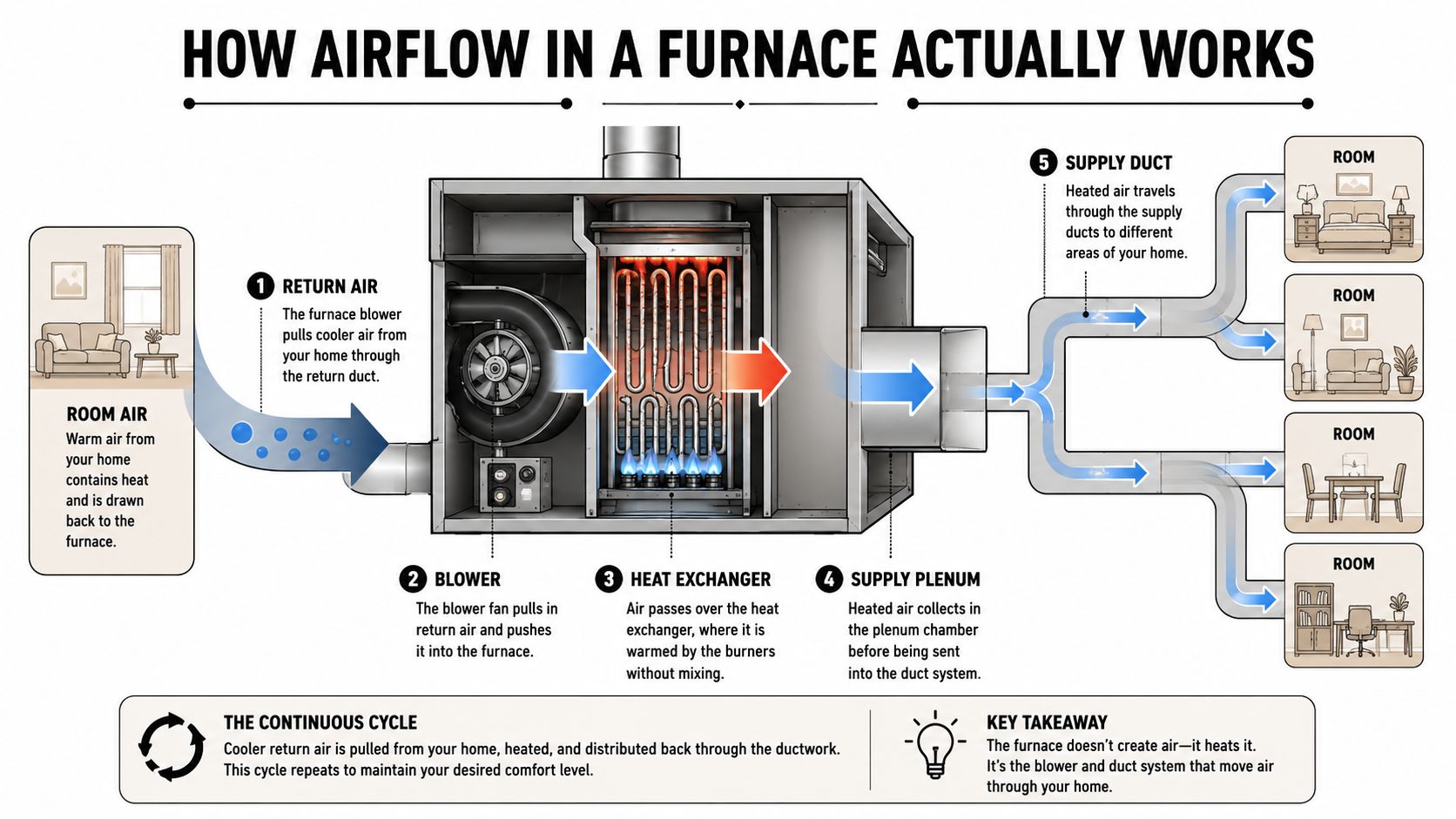
That path matters because every part has a job. Return air is the air going back to the furnace, supply air is the warm air leaving it, CFM means cubic feet per minute and describes how much air is moving, static pressure is the resistance the blower has to push against, and temperature rise is how much warmer the air gets as it passes through the furnace. The heat exchanger is the part that transfers heat from combustion to the air stream, so its condition depends on proper airflow.
Why the filter and ducts matter so much
The filter sits in the return path, so it protects the furnace and the blower from dust. But if the filter is installed backwards or too restrictive, it can make the blower work against higher resistance. The ducts matter for the same reason, because undersized, crushed, or disconnected ductwork changes how easily air can travel through the system.
Practical rule: a furnace that can't move air well is like a person trying to breathe through a narrow straw. The machine may still run, but not comfortably.
A useful way to read the system is to ask three questions. Can air get back to the furnace easily, can the blower move it through the heat exchanger without excessive resistance, and can the supply ducts deliver it to the rooms without major losses? If one of those answers is no, the whole house feels it.
Why Correct Airflow Matters for Efficiency, Comfort, and Safety
Airflow problems are not just about comfort. They affect how long the furnace runs, how evenly the house heats, and how hard the equipment has to push air through the system. Once airflow slips out of range, the furnace stops behaving like a balanced heating appliance and starts acting like a stressed one.
Efficiency and comfort suffer together
Restricted airflow makes the blower work against more resistance, and that usually means the system needs longer run times to satisfy the thermostat. Longer run times can waste fuel because the furnace has to keep operating to make up for poor delivery. At the same time, rooms at the far end of the ductwork may stay cool while rooms closer to the furnace warm up too quickly.
That is why homeowners often describe the problem as a comfort issue first. One floor feels different from another, bedrooms lag behind the living room, or vents hiss because air is being forced through tight openings. In split-level homes and basement suites, those complaints are especially common because the duct layout is already working harder to balance different zones of the house.
High resistance can create heat stress
The other part of the story is temperature rise. If airflow is too low, the air passing across the heat exchanger can get hotter than intended, and that pushes the furnace outside the range it was designed to run in. Technicians watch that closely because the nameplate range is there for a reason.
A furnace doesn't need to fail loudly to be in trouble. Sometimes it just runs hot, struggles quietly, and delivers the wrong amount of heat to the rooms.
Airflow also ties into safety because a furnace that runs under abnormal heat stress is not operating the way the manufacturer expected. That doesn't mean every airflow issue is an emergency, but it does mean repeated restriction is something you should take seriously. A room that stays cold might be telling you about a deeper system issue long before the equipment gives you a bigger warning.
How Airflow Is Measured and What the Target Numbers Look Like
The two measurements that matter most are temperature rise and total external static pressure. Those are the numbers a tech uses to separate “the house needs a simple fix” from “the system has a restriction or design problem”. A homeowner doesn't need to measure them every week, but understanding them helps you ask better questions during a service call.
Temperature rise and static pressure
A technician checks temperature rise by comparing the air temperature at the return and supply sides of the furnace. The result should fall within the nameplate range printed on the furnace. If it's outside that range, something about the airflow, the burner operation, or both needs attention.
Static pressure is measured with a manometer at the furnace. Practical guidance says to keep total external static pressure near 0.30 to 0.50 in. w.c., and readings noticeably higher point toward restriction in the return path, supply path, or filter. That can happen because of duct undersizing, restrictive filters, or added resistance, not just because the blower is “weak”. For a deeper technical explanation of this diagnostic approach, the airflow and static-pressure guidance at Pick HVAC is a useful reference.
Quick reference for target readings
| Measurement | Normal Range | Warning Sign | What It Suggests |
|---|---|---|---|
| Temperature Rise | Inside the furnace nameplate range | Outside the printed range | Airflow problem, burner issue, or both |
| Total External Static Pressure | Near 0.30 to 0.50 in. w.c. | Noticeably higher than that | Restriction in ducts, filter, or return/supply path |
A homeowner can also use these readings as a reality check when a service report sounds vague. If the tech says the furnace is “fine” but the rooms are still uneven, ask what the temperature rise and static pressure measured. Those two numbers tell a more complete story than “the blower seems okay”.
Common Causes of Poor Furnace Airflow
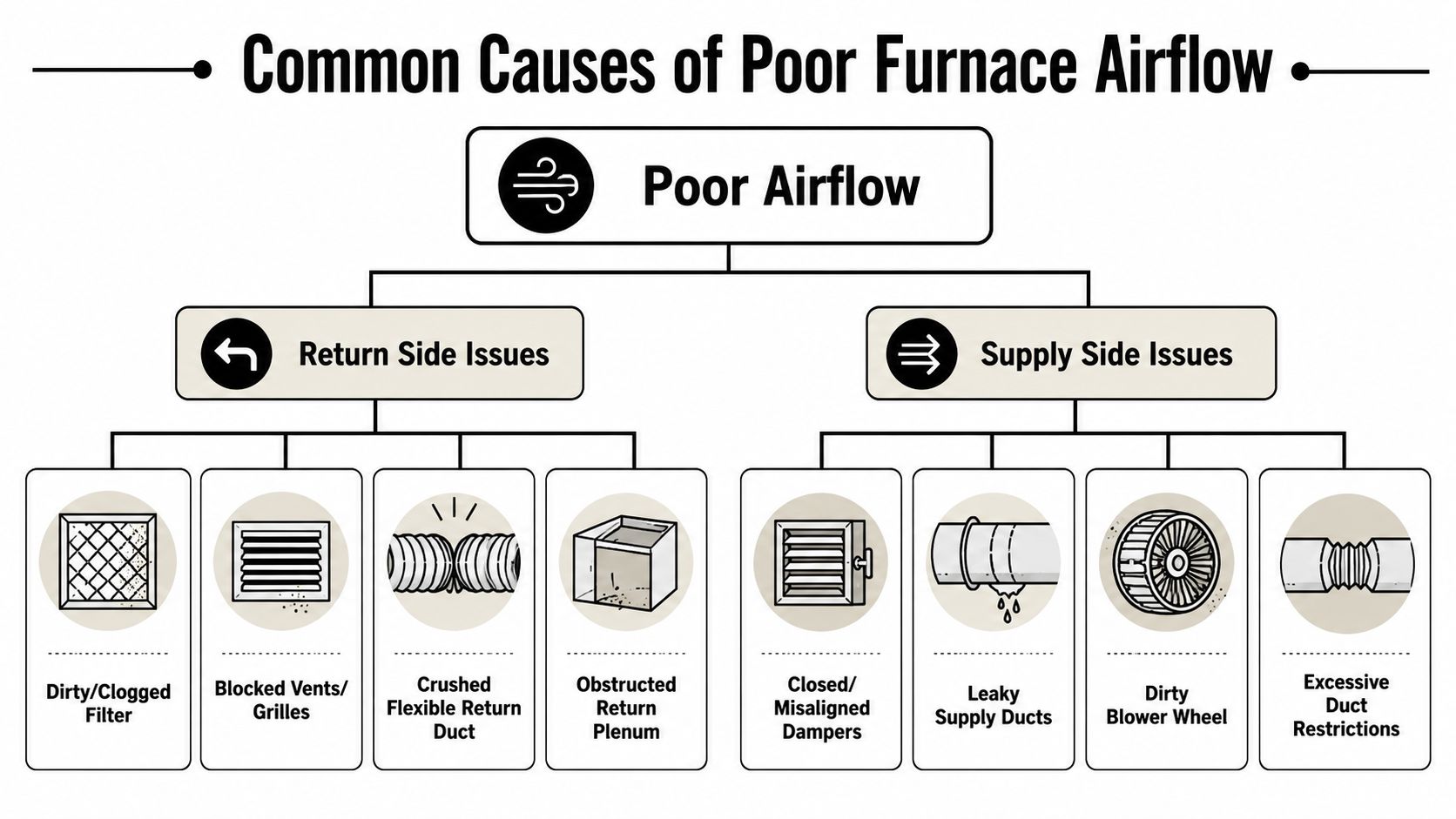
Poor airflow usually comes from one of three places, return side, supply side, or equipment side. The fastest way to narrow it down is to ask where the air is getting held back, because a cold room can come from very different problems. A blocked return grille and a failing blower can produce the same complaint, but they need very different fixes.
Return side problems
A dirty filter is the most common check, but a filter can also be installed backwards. The arrow on the filter must point toward the furnace or blower motor because that is the direction the air is moving through the system, and a backwards filter puts the pleated side and arrow in the wrong direction. A blocked return grille can also choke the system, especially when furniture, rugs, or shelving ends up in front of it.
Undersized return ducts are a bigger issue because they're hidden. That comes up often in retrofitted Vancouver homes and basement suites where the return path was never designed for the way the space is used now. In that situation, a fresh filter won't solve the bottleneck.
Supply side and equipment issues
On the supply side, closed or blocked registers can make one room feel neglected while the rest of the house gets too much air. Crushed flexible duct runs, disconnected joints, and leaky sections can also waste airflow before it reaches the room that needs it. If you can hear air rushing but the room still feels weak, the supply path deserves a look.
The equipment side includes a weak blower motor, a slipping blower belt on older units, or a dirty blower wheel. Those are less obvious to a homeowner because the parts are inside the furnace cabinet. A loud, rattly, or strained blower is a different kind of clue than a dusty filter.
- Return-side clue: if several rooms feel short on air at once, start by checking the filter, the return grilles, and any obvious bottlenecks.
- Supply-side clue: if one room or one floor is the problem, look for closed registers, crushed duct runs, or disconnected supply sections.
- Equipment clue: if the airflow is weak everywhere and the furnace sounds abnormal, the blower assembly needs a professional look.
A Practical Example From a Richmond Home With a Pet and a Basement Suite
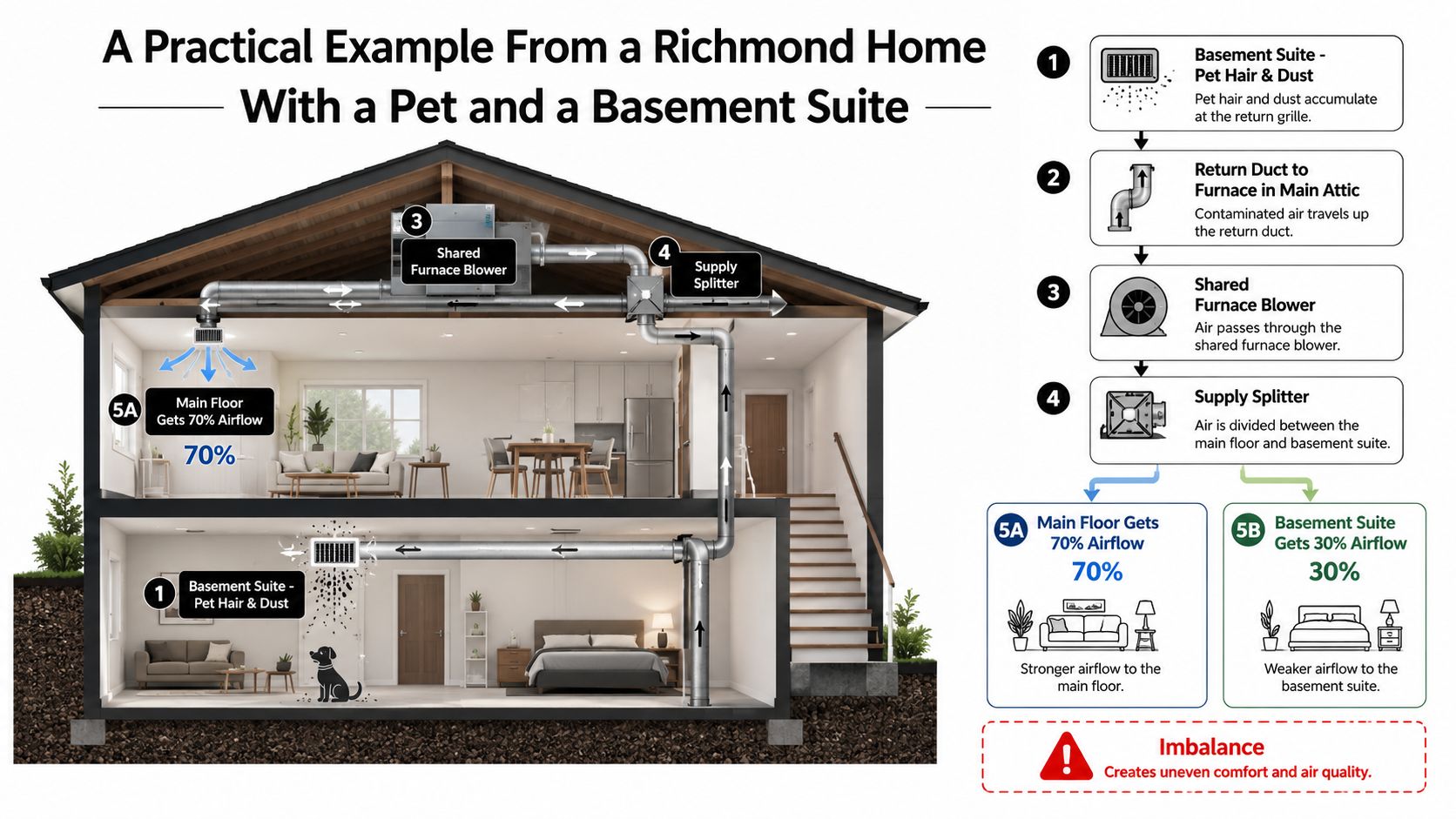
A Richmond homeowner with a pet notices a familiar pattern. The upstairs feels stuffy, the basement suite has a hard time warming up, and the furnace seems to run more than it should. The first thing they check is the filter, and they find it installed backwards, so the arrow is pointing the wrong way relative to the air path.
What changed in the house
They replace the filter with the arrow pointing toward the blower, as the airflow direction requires. Because the home has a pet, they keep the filter on a 30-day replacement cadence during the heating season instead of waiting for a longer seasonal interval. That matters because the heating-season schedule for homes with pets, allergies, asthma, or smokers is every 30 days Filterbuy.
Then they spot a return grille partly blocked by a bookshelf. Moving the furniture gives that grille room to breathe again. They also open two closed upstairs registers, which helps rebalance the air a little better between floors.
Practical insight: if the furnace is serving two levels, small return or supply blockages can show up as a comfort problem long before the equipment seems obviously wrong.
The change is not magic, and it doesn't turn every split-level into a perfectly balanced system. But it does show how a few simple airflow corrections can make a shared furnace behave more sensibly. The key lesson is that the same symptom, a cold room, can come from a backwards filter, a blocked return, or closed registers, and you often need to check all three.
Step-by-Step Troubleshooting and Maintenance You Can Do Yourself
Start with the checks a homeowner can do safely, because many airflow complaints come from simple restrictions. Confirm the filter arrow points toward the furnace or blower motor, then replace the filter if light does not pass through it easily. Open any closed supply registers, and make sure furniture, curtains, or boxes are not crowding return grilles. If the filter keeps loading up quickly or the home has a basement suite, the airflow path may be fighting extra resistance from a long duct run or a shared return setup.
Simple checks first
Once the obvious blockages are out of the way, listen to the blower when the furnace starts. A healthy blower should move air with a steady tone, not scraping, rattling, or straining. If the sound has changed recently, do not brush it off, because a dirty blower wheel or another equipment problem may be part of the airflow complaint. For more on common furnace issues, see our guide to gas furnace repair.
Take a quick look at any visible ductwork in a basement, utility room, or crawlspace if you can do it safely. Disconnected joints, sagging flex duct, or obvious gaps can leak air before it reaches the rooms that need it. In Metro Vancouver, this shows up often in retrofit homes and basement-suite layouts, where the supply path is longer and the pressure balance can be less forgiving.
Stop here if the furnace smells burned, sounds rough, or the rooms still heat unevenly after the basic checks.
The two measurements that separate a simple maintenance fix from a hidden airflow problem are temperature rise and static pressure. Temperature rise tells you whether the furnace is heating the air within the range listed on the nameplate, and static pressure shows how hard the blower is working to push that air through the filter, ductwork, and registers. A filter can look clean and still leave the system struggling if the ducts are undersized, kinked, or partly closed. That is why a clean filter helps, but it is not a substitute for measuring the system.
If the temperature rise sits outside the furnace nameplate range, static pressure reads high, or the blower noise is unusual, call a licensed HVAC technician. That is the point where measurements matter more than guesswork, and a service visit can show whether the restriction is in the ductwork, the filter setup, or the furnace itself.
When to Call a Pro and What to Expect From a Furnace Technician in Vancouver
A qualified technician starts with measurements, not assumptions. On an airflow-focused visit, they should check temperature rise, measure total external static pressure, inspect the heat exchanger, and look at the blower's condition. They may also check blower amp draw and compare airflow performance with the furnace nameplate so they can tell whether the system is moving the air it was designed to move.
Warning signs that need a faster response
Some signs deserve a quicker call. A burning smell, rapid cycling on and off, or visible rust around the burner area means the furnace needs a closer inspection. If the house keeps heating unevenly after you've handled the filter and register checks, that's also a strong signal that the problem is deeper than basic maintenance.
A good service call should feel methodical. The technician explains what they measured, where the restriction seems to be, and whether the fix is in the return path, the supply path, or the equipment itself. If they only talk about the thermostat and never mention static pressure or temperature rise, they probably haven't finished the job.
For local help, Encano Plumbing & Drainage Ltd. works in Vancouver, Richmond, Burnaby, New Westminster, Delta, Surrey, and nearby communities, with 24/7 emergency response and online or phone booking. The company lists heating among its services, and because it also handles plumbing, gas, and drainage, airflow and venting issues can be reviewed alongside the rest of the system instead of in isolation. That can matter when a furnace complaint overlaps with other mechanical concerns in the home.
If your furnace still feels out of balance after the basic checks, book a licensed technician, ask for temperature rise and static-pressure readings, and get the airflow problem diagnosed before it turns into a bigger comfort or equipment issue.
A CTA for Encano Plumbing & Drainage Ltd..