You're standing at the kitchen sink, watching cloudy water creep higher while the dishwasher hums in the background. The usual drain-cleaning advice says to grab a bottle of chemical opener or push a snake down the pipe, but that skips the question that matters most: is the blockage in this fixture, or is the drainage system backing up behind it?
That distinction changes the right tool, the safe technique, and the point at which DIY work should stop. In Vancouver and throughout Greater Vancouver, recurring drainage trouble can involve grease, roots, blocked property service connections, aging infrastructure, heavy rainfall, high tide, or high groundwater. A practical drain cleaning how-to guide must start with diagnosis, then move to clearing, then finish with prevention.
Table of Contents
- Diagnosing the Clog Before You Reach for a Tool
- The DIY Toolkit You Actually Need
- Clearing the Drain with a Plunger or Hand Auger
- Using Enzyme Cleaners and Skipping Harsh Chemicals
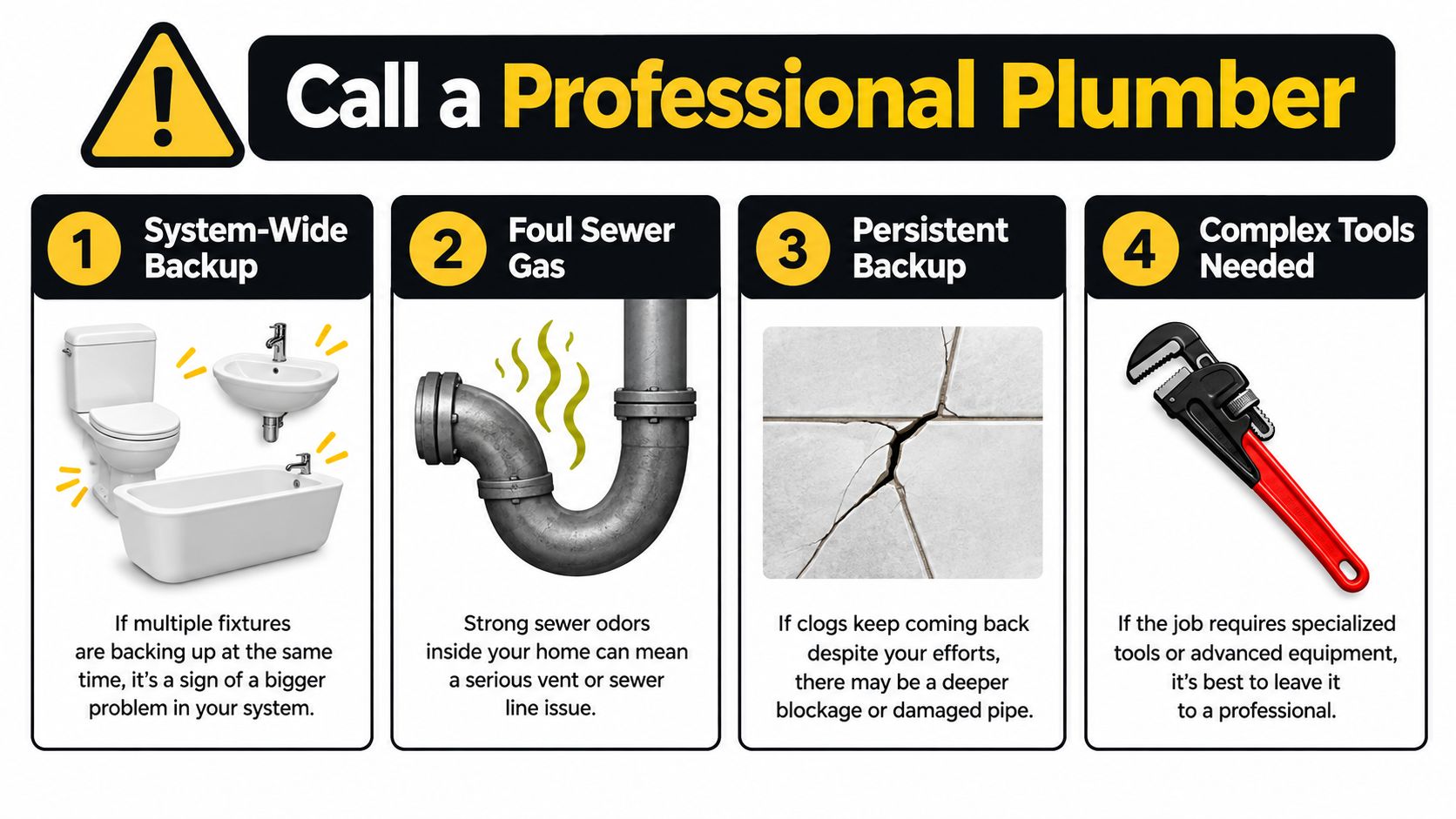
- Warning Signs You Need a Professional Plumber
- Preventing the Next Clog
Diagnosing the Clog Before You Reach for a Tool
Start with your senses, not the toolbox. The smell, water behaviour, and pattern across the home often tell you more than the first few turns of a drain snake.
A sour smell from a kitchen sink commonly suggests grease and food residue close to the fixture or inside the P-trap. A sewage odour is more concerning because it can indicate a blockage farther downstream in the branch line or building drain. Look into the opening with a flashlight. A visible hair mat near the surface is a very different problem from an empty drain that makes nearby toilets gurgle.
Next, run water at another fixture. If the shower backs up when the toilet flushes, or the basement floor drain rises when the washing machine empties, the fixtures are sharing a restricted section of pipe. One slow basin usually points to a local issue. Several slow fixtures suggest a branch or mainline problem.
Use the fixture pattern as your map
In older Vancouver neighbourhoods with mature trees, recurring backups and gurgling toilets deserve special attention. Roots can enter a service connection and create a blockage that a short hand auger may only pierce temporarily. Vancouver planning documents identify root intrusion, grease buildup, and service-connection blockages as important causes of sewer backups, while also noting that heavy rainfall, high tide, and high groundwater can contribute to system-level backup conditions. The City of Vancouver sewer-backup planning documentation records roughly 1,100 sewer-backup requests per year, so this isn't a rare edge case.
Practical rule: If another fixture changes the water level, stop treating the problem as a single clogged drain.

A practical example makes the difference clear. Suppose the kitchen sink drains slowly, but the bathroom works normally and no toilet gurgles. The likely starting points are the sink strainer, P-trap, or nearby branch line. If the kitchen sink, laundry standpipe, and basement floor drain all react together, plunging the sink repeatedly won't address the restriction farther down the system.
Spend a couple of minutes locating the pattern before you pick up a tool. That small pause prevents you from forcing the wrong cable into the wrong opening, loosening a trap unnecessarily, or adding chemicals to a line that may already be carrying sewage.
The DIY Toolkit You Actually Need
Most homeowners don't need a cabinet full of plumbing equipment. A compact kit works better because each item has a clear job and a clear limit.
Keep a flat-rim sink plunger for sinks, tubs, and showers. It creates the broad seal those openings need. A toilet requires a separate flange plunger, whose extended lip fits into the toilet outlet. Using the wrong plunger often produces a poor seal and a wet mess instead of useful pressure.
A hand auger, also called a drain snake, handles many local clogs. A 15 to 25 foot cable with a 1/4-inch head is suited to short fixture runs, while longer or deeper lines generally call for a powered drum machine and more experience. Don't mistake cable length for diagnostic reach. A longer snake can travel farther, but it can also pass through a damaged or poorly supported pipe and make the situation harder to understand.
Match the tool to the obstruction
A wet/dry shop vacuum can pull stubborn sink blockages when you can form a tight seal around the drain opening. It also has one advantage a snake doesn't: it can retrieve a small object, such as a bottle cap or toy, instead of pushing it deeper into the line.
Use enzyme or bacterial cleaner for maintenance on a slow but flowing drain, not as the primary response to a completely blocked pipe. These products are less useful when water can't carry them to the buildup.
Your safety kit matters just as much as the clearing tools:
- Nitrile gloves: Keep contaminated water and residue off your hands.
- Safety glasses: Protect your eyes when plunging or withdrawing a cable.
- Bucket: Catch trap water before removing any fitting.
- Old towels: Control spills around cabinets, flooring, and finished walls.
Skip harsh chemical openers as a default. Canadian public-health guidance from the Public Health Agency of Canada on household chemical safety warns that household chemicals can create hazards when mixed or used incorrectly. If someone has already poured drain opener into the line, don't add bleach or another cleaner. Mechanical clearing is safer for a simple clog, provided you protect yourself from the remaining liquid.
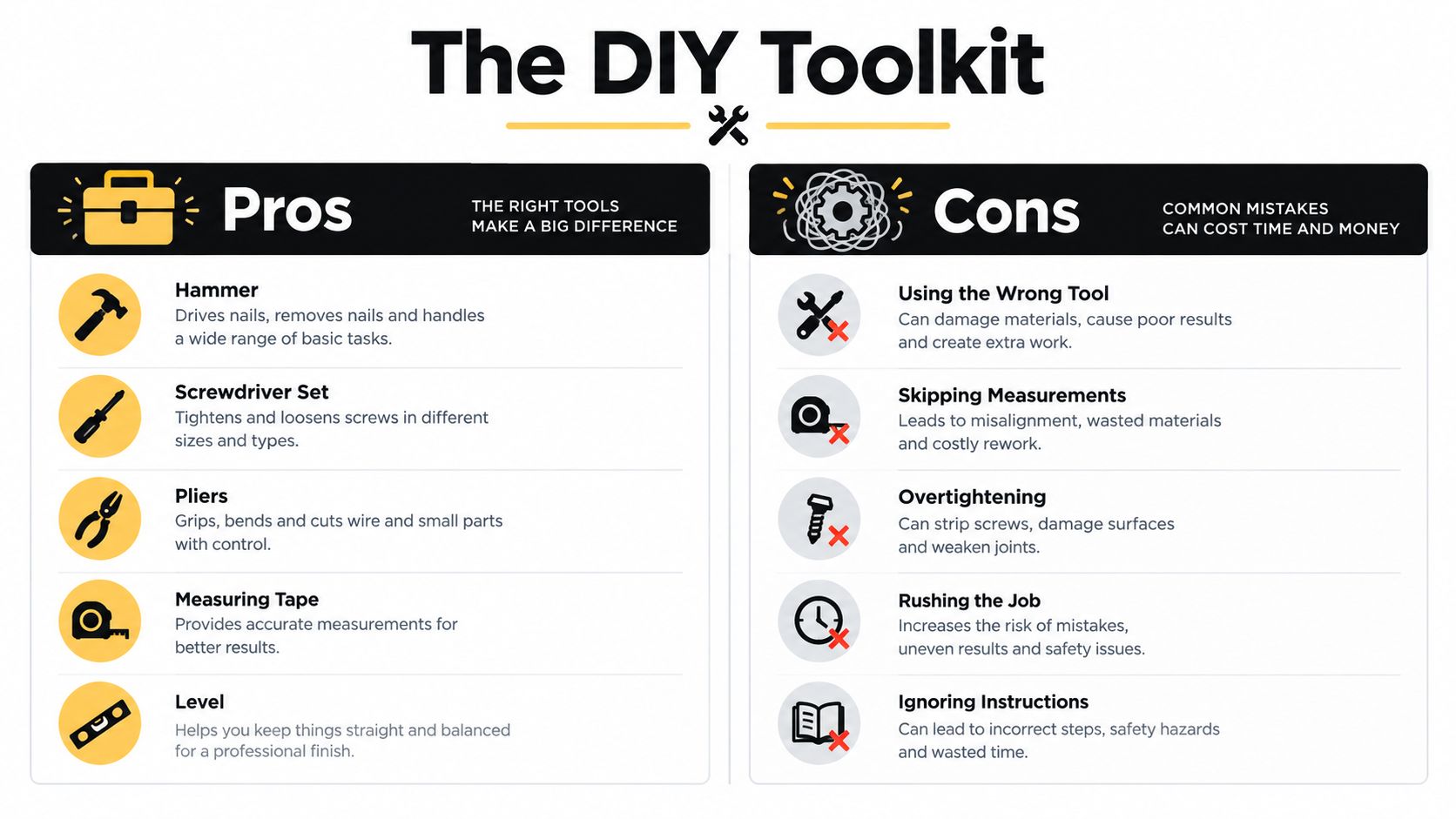
The right kit won't solve a root-intruded service connection or a collapsed pipe. It will, however, let you handle a straightforward hair, soap, food, or small-object blockage without reaching for a product that creates a second hazard.
Clearing the Drain with a Plunger or Hand Auger
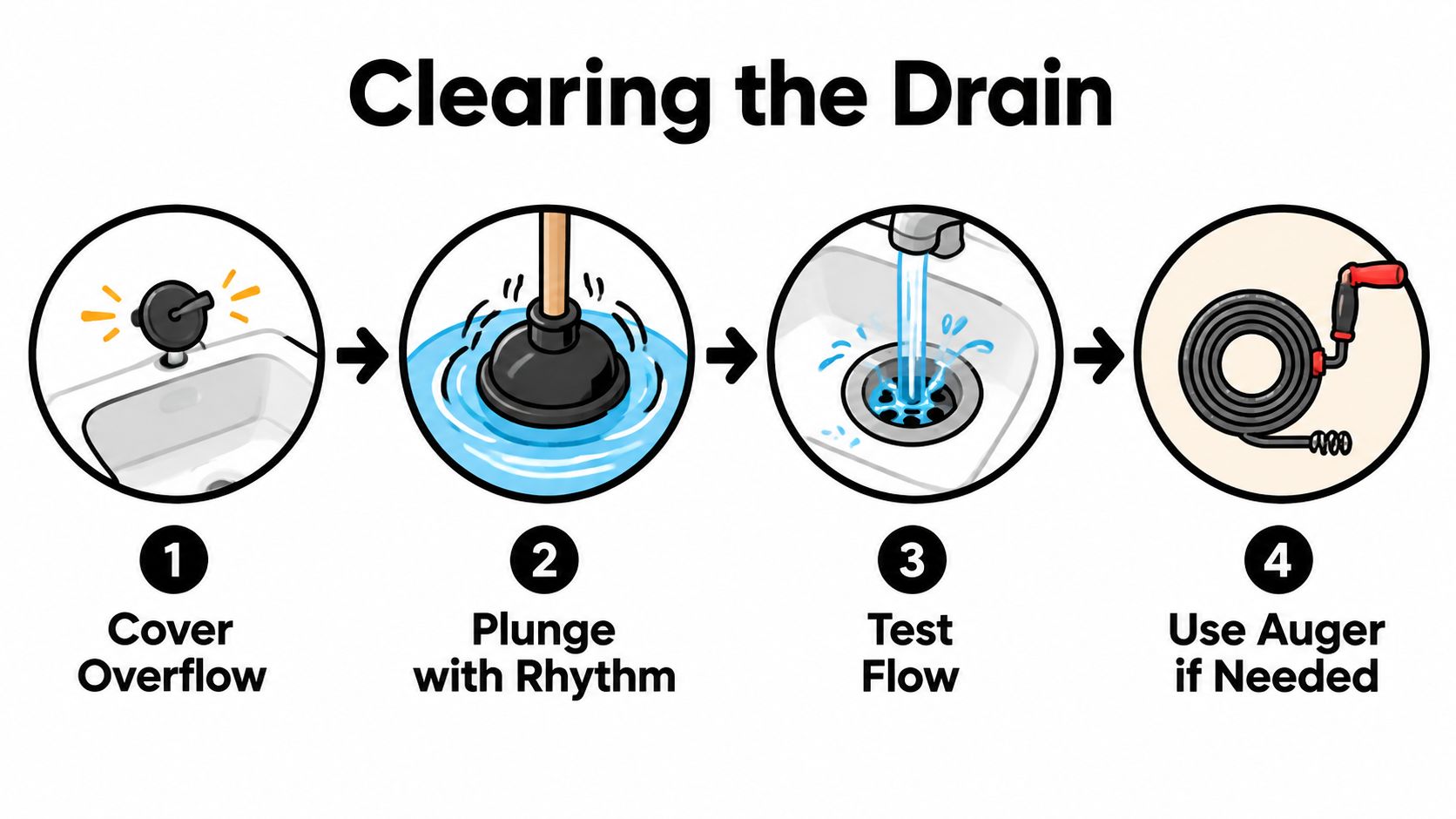
Treat plunging and augering as one workflow. The plunger tests whether pressure can move a nearby obstruction. The auger comes next when the water remains in place.
Start by blocking every alternate opening. On a double kitchen sink, seal the second basin with a wet rag or stopper. On a tub, close the overflow opening with a damp cloth. Without those openings sealed, the pressure escapes instead of pushing down the drain.
Add enough water to cover the plunger cup. A shallow layer is usually enough to form a seal, while too much water creates unnecessary splashing. Set the flat rim over the opening and begin with gentle push-pull movements. The first strokes compress air and establish the seal. Once the seal holds, use a steady rhythm for 15 to 20 firm strokes, keeping the cup flat against the fixture.
Read the result before changing tools
If the water swirls and drops, remove the plunger and test the fixture with running water. If it sits at the same level, don't keep plunging indefinitely. Move to the hand auger.
Feed the cable through the drain opening, or through an accessible cleanout if that is the correct entry point. Turn the handle clockwise while applying controlled forward pressure. Clockwise rotation helps the tip engage the obstruction. When the cable catches, work it gently rather than forcing it, then withdraw it and clean the head. Repeat until the cable travels more freely.
The British Columbia Plumbing Code provisions on accessible cleanouts require cleanouts and access covers to remain readily accessible for drain-cleaning purposes. That matters in a practical situation. If a basement line is blocked, use the accessible cleanout rather than opening a finished wall or floor.
The cable direction matters, too. The BC and National Plumbing Code cleanout guidance explains that cleanouts must allow the drainage system to be cleaned, including one-way or two-way rodding. If a cleanout is one-way, feed the manual auger in the direction the system was designed to accept, normally downstream with the flow.
Flush the line with hot, not boiling, water after the obstruction clears. Let it run long enough to carry loosened residue away, but stop if the drain begins to rise again. Hard resistance that won't release is a warning. You may be against a root mass, broken pipe, offset joint, or structural obstruction that needs camera inspection rather than more force.
Watch the technique here:
Using Enzyme Cleaners and Skipping Harsh Chemicals
Enzyme and bacterial cleaners belong in a maintenance routine, not in the emergency response to a fully blocked drain. They use biological activity to break down organic residue such as grease film, soap residue, and hair over several hours. That makes them useful for a slow bathroom or kitchen line that still drains, especially as an overnight treatment.
Apply the product after the final fixture use of the evening. Follow the label instructions, then use warm water if directed. Avoid boiling water, bleach, and caustic openers because excessive heat or chemical residue can damage the biological culture. Never combine cleaning products.
Harsh openers create a poor trade-off in many homes. Fumes can linger when Vancouver windows stay closed in winter. Caustic splashes can burn skin, damage older chrome finishes, and harm PVC traps. They may open a narrow channel through soft material, but they don't diagnose a service-connection blockage, root intrusion, or hydraulic backup. A chemical that fails also leaves dangerous liquid in the pipe for the person who later removes the trap or runs a cable.
| Factor | Enzyme/Bacterial Cleaner | Caustic Soda Opener | Acid-Based Opener |
|---|---|---|---|
| Best use | Preventive treatment for a slow, flowing line | Limited chemical treatment of organic residue | Specialist chemical application, not a routine household fix |
| Active blockage | Unlikely to clear a complete blockage alone | May soften some material without removing the cause | Can react aggressively without solving a downstream obstruction |
| Pipe and fixture risk | Generally gentler when used as labelled | Can damage finishes and create burn hazards | High burn and fume hazard, especially if misused |
| Mixing risk | Must not be mixed with bleach or openers | Dangerous when combined with other products | Dangerous reactions are possible with other cleaners |
| Practical choice | Use after mechanical clearing for maintenance | Avoid as a first response | Avoid for ordinary DIY drain work |
An enzyme treatment won't fix a clogged mainline or a drain that has stopped completely. Clear the physical obstruction first, then use maintenance products only when the line is flowing and the label permits that application.
Warning Signs You Need a Professional Plumber
The clearest boundary is multiple fixtures backing up together. A toilet that burps when the washing machine drains, a shower that gurgles when the kitchen sink empties, or a basin that rises when another fixture runs indicates a shared restriction. The problem is no longer confined to one trap.
A basement floor drain deserves immediate attention. Water rising there can indicate a blocked building drain or private lateral, and Vancouver's wet conditions can also expose the difference between a private-side blockage and a broader surcharge problem. The city's documentation notes that backups can be associated with heavy rainfall, high tide, and high groundwater, while blockages on property service-connection pipes are the most common backup event described in its planning material. A consumer hand auger can't reliably diagnose all of those possibilities.
Recurring symptoms point farther downstream
If the same fixture clears and then clogs again within 30 to 60 days, the visible opening isn't necessarily the core problem. A cable may create a temporary passage while leaving grease, roots, scale, or damaged-pipe debris behind. Repeatedly attacking the fixture can turn a diagnostic problem into a cycle of emergency clearing.
Gurgling after heavy rain is another reason to stop guessing. Rainfall can increase hydraulic loading, while roots or compromised joints at a service connection can restrict the property's ability to discharge. If the drain behaves differently during wet weather, record the timing and tell the plumber. That information can be as useful as the symptom itself.
Call for professional assessment when you notice:
- Sewage odour indoors: The smell may indicate downstream retention, a compromised trap, or sewer gas entering the building.
- Tub backup after a toilet flush: Water moving between fixtures shows that they share a restricted line.
- Basement floor-drain rise: This can precede a more serious sanitary backup and should not be tested repeatedly.
- Ceiling staining below a bathroom: The source may be a leaking drain connection rather than a clogged fixture.
- Hard cable resistance: A cable that stops at the same point can be meeting roots, a damaged pipe, or an inaccessible fitting.
- Repeated emergency clearing: Recurrence means the pipe condition needs investigation, not another temporary opening.
A snake restores a path. A camera shows why the path disappeared.
A professional visit may involve a CCTV camera inspection first, followed by mechanical root cutting or high-pressure jetting when the pipe condition allows it. For BC operations, practical guidance recommends inspecting first when roots, cross-bores, or unknown underground conditions are possible. If sludge makes the image unreadable, clearing with an auger before re-inspecting is a standard approach, and jetting may require several passes to remove debris fully.
Municipal-style BC maintenance programs commonly benchmark high-pressure jetting at up to 4,000 PSI and about 18 gallons per minute, followed by camera inspection to assess pipe condition and prioritise repairs, as described in this Canadian sewer-cleaning maintenance guidance. The same source describes a district-wide cycle of roughly five years, a target of about 1,000 linear feet per week or 15,000 linear feet per summer, and notes that UBC guidance limits flushing to a maximum of three high-pressure passes to make CCTV inspection possible. Residential jetting connected directly to a building houseline should include backflow protection, specifically an RPBA.
Encano Plumbing & Drainage Ltd. is one local option for drain cleaning, camera inspection, sewer-line work, and high-pressure jetting when a blockage has moved beyond a safe fixture-level repair. The point of professional equipment isn't to use more force. It's to see the pipe, choose a suitable method, and avoid excavation when cleaning or a targeted repair can address the actual fault.
Preventing the Next Clog
The cheapest drain-cleaning method is changing what enters the pipe. Grease, hair, lint, and unsuitable paper products build a restriction gradually, so a prevention routine needs to target those materials before they combine.
Grease discipline comes first. Let cooking fat cool, place it in a container, and dispose of it through the appropriate household-waste route. Don't pour it into the sink, even if hot water seems to carry it away. The grease cools on the pipe wall, catches food particles, and creates the sticky surface that later traps more debris.
For a flowing kitchen line, a monthly hot-water flush can help move soft film. Use a kettle of near-boiling water, then run cold water for about two minutes to move loosened residue through the trap and into the larger drain. This isn't a substitute for clearing a blocked pipe, and it shouldn't be used as a cure for a recurring backup.
Keep hair and laundry fibre out
A mesh hair catcher is inexpensive and worthwhile in showers and bathroom sinks. Mesh catches fine strands that can slip around the openings in perforated plastic stoppers. Those strands bind with soap residue and form a compact mat close to the fixture.
Laundry systems need similar attention. Keep lint in a filter or suitable waste container instead of allowing it into the standpipe. In the bathroom, only toilet paper and human waste belong in the toilet. Products labelled “flushable” can behave more like cloth in Vancouver sewer laterals, where they may contribute to blockages instead of breaking apart as homeowners expect.
Use biological maintenance selectively
Seasonal enzyme treatment can fit a household routine when every affected line still flows. Apply it at the start of fall after summer cooking and entertaining, and again at the start of spring if winter use has left a line sluggish. Use the product exactly as labelled, and don't combine it with bleach or caustic cleaners.
Homes older than 25 years or properties with mature trees near the line deserve a different prevention conversation. An annual camera inspection can identify root intrusion, damaged joints, or buildup before a complete backup. It won't stop roots from returning, but it can show whether cleaning, root cutting, repair, or replacement is the sensible next step.
California's long plumbing history illustrates why access matters. Its plumbing rules have treated accessible cleanouts as a core drainage standard since at least March 15, 1883, when Senate Bill No. 132 authorised local boards of health to regulate building plumbing and drainage. Modern California Plumbing Code adoptions continue that approach by requiring cleanouts near the building drain-to-building sewer connection, and some jurisdictions require at least a four-inch cleanout sized to the building drain, as summarised in the Uniform Plumbing Code history and requirements.
The maintenance lesson applies in Vancouver as well. Keep cleanouts accessible, label them when their location isn't obvious, and don't bury them behind permanent finishes. In California-focused wastewater reporting, 85% of SSOs were connected to FOG clogs, which is why grease control and preventive maintenance feature so prominently in drain guidance. The State Water Resources Control Board sewage-spill report also notes that overflow events concentrate in Regions 2 and 5, while Region 6 produces the largest average spill volume despite having the second-lowest number of events. The locations differ, but the practical message is familiar: prevention works best when it targets what is entering and restricting the pipe.
Encano Plumbing & Drainage Ltd. offers drain cleaning for sinks, showers, toilets, branch lines, and main sewer lines, with camera inspection and high-pressure jetting available when a recurring blockage needs diagnosis rather than another temporary opening. Visit Encano Plumbing & Drainage Ltd. to arrange scheduled service or request help with a Vancouver-area drainage problem before the next backup.