Water is rising in the sink. The toilet gurgled when nobody touched it. There's a smell you can't ignore, and now you're wondering if this is a simple clog or the start of a much bigger mess.
That's exactly when emergency drain cleaning is needed. In Vancouver and the Lower Mainland, the answer isn't always as simple as “snake the line and move on.” Heavy rain, older drains, shared laterals, basement floor drains, and municipal surcharge conditions can all change what the problem really is and what you should do next.
This guide is written for the moment you're in right now. It covers the signs that tell you it's urgent, the first steps to take before a plumber arrives, what a proper professional callout looks like, how to choose a 24/7 plumber without making a rushed mistake, and how to stop the same problem from coming back.
Table of Contents
- Your Guide to Emergency Drain Cleaning in Vancouver
- Signs You Need Emergency Drain Cleaning
- Your First Response to a Clogged Drain
- What Professional Drain Cleaning Involves
- Choosing a 24/7 Plumber in Metro Vancouver
- Preventing Future Drain Emergencies in Your Home
Your Guide to Emergency Drain Cleaning in Vancouver
Emergency drain cleaning is about protecting the home first and clearing the line second. If wastewater is backing up, every extra minute of sink use, toilet flushing, dishwasher discharge, or laundry drainage can make the cleanup worse.
In Vancouver, Richmond, Burnaby, Surrey, Delta, and nearby communities, the first job is figuring out whether you're looking at a local fixture clog, a main line blockage, or a rain-related backup condition. Those three problems can look similar at first. They don't get handled the same way.
A simple example. If one bathroom sink is draining slowly but everything else in the house works normally, that often points to a local blockage. If the toilet bubbles when the washing machine drains and water shows up at the basement floor drain, that usually points much farther downstream.
Practical rule: One fixture is a nuisance. Multiple fixtures acting up at once usually means you should treat it as an urgent drain problem.
The safest approach is to stop adding water to the system, contain any overflow, and pay attention to where the symptoms are showing up. That small bit of observation often tells a plumber whether to start with a branch line, a cleanout, or a camera inspection.
Homeowners usually want one straight answer: should you wait, or call now? If sewage odour, pooling, basement backup, or several fixtures are involved, it's time to move quickly. A proper emergency drain cleaning call is not just about restoring flow. It's about finding the cause so you don't get the same backup again the next weekend.
Signs You Need Emergency Drain Cleaning
Some drain issues are annoying. Others can damage floors, contaminate a bathroom, or signal a blocked main sewer line. The fastest way to judge the risk is to look at how many fixtures are affected, where the water is appearing, and whether weather may be involved.
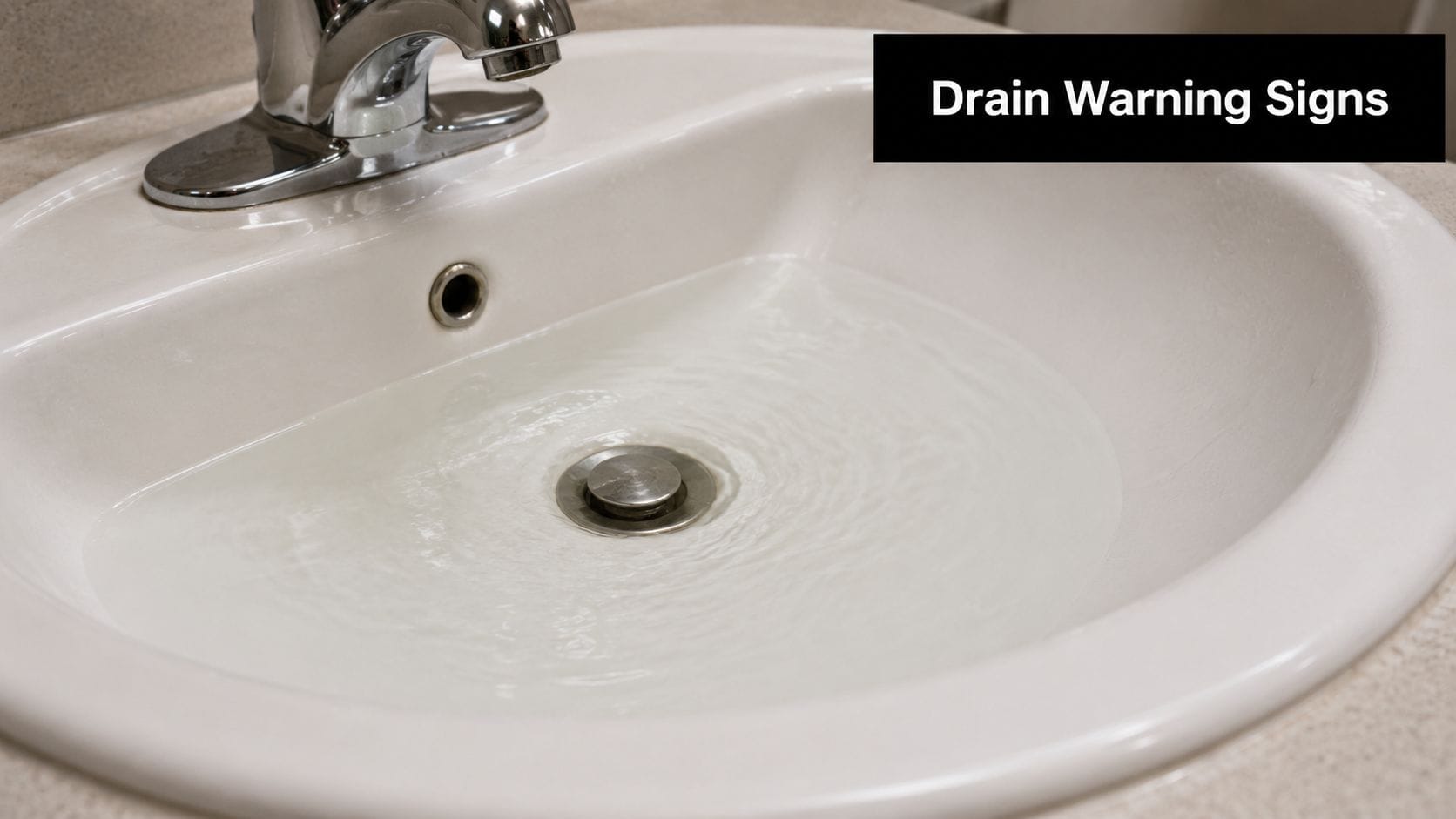
Concerning signs that can turn serious fast
A slow kitchen sink on its own isn't always an emergency, but it shouldn't be ignored if it keeps returning. The same goes for a tub that drains slowly, a toilet that gives an occasional bubble, or a floor drain that smells stronger than usual.
Watch for these early warnings:
- Slow drainage that's getting worse: If a sink or tub used to clear eventually and now holds water longer each day, buildup is likely getting thicker.
- Gurgling from another fixture: If you run one fixture and hear noise from a toilet or nearby drain, air is being displaced somewhere it shouldn't be.
- Persistent sewer odour: A temporary smell can happen. A smell that sticks around usually deserves a closer look.
- Repeat partial clogs: If you keep plunging the same line and it keeps coming back, the blockage may be farther down than you can reach.
A good local reference point is this guide on signs you need professional drain cleaning services, especially if you're deciding whether a “wait and see” approach is still reasonable.
Critical signs that usually point to a larger blockage
The pattern changes when more than one fixture starts acting up. That's where emergency drain cleaning becomes the right phrase, not routine plumbing.
The most serious signs include:
| Symptom | What it often suggests |
|---|---|
| Multiple fixtures backing up | A blockage farther down the system, often beyond one trap or branch |
| Water at a basement floor drain | A downstream restriction or backup path at the lowest opening |
| Toilet bubbles when a sink or washer drains | Pressure imbalance caused by restricted drainage |
| Wastewater backing into a tub or shower | A larger line issue, not just a simple sink clog |
A practical example from local service calls. Someone runs a load of laundry upstairs, then sees dirty water rise in the basement floor drain. That's rarely a single-fixture problem. The system is telling you it can't move water away fast enough.
What heavy rain can change in Metro Vancouver
In Metro Vancouver, weather matters. For homeowners in Richmond, Vancouver, Burnaby, Delta, and Surrey, emergency drain issues are often linked to storm events. During heavy rainfall, a basement backup may be a municipal sewer surcharge rather than a private-side clog, and the response and cost responsibility can be different, as noted in this local guidance on plumbing crises and sewer backup response.
If the problem starts during a major rain event and nearby homes are seeing similar basement issues, don't assume a private drain snake will solve it.
That distinction matters. A private blockage usually needs isolation, diagnosis, and clearing on your side. A surcharge condition may involve municipal infrastructure, backwater protection, and property management or strata coordination if you're in a multi-unit building.
Your First Response to a Clogged Drain
The first few minutes matter more than is commonly assumed. Good decisions right away can limit damage, reduce cleanup, and make the diagnosis much easier when the plumber arrives.
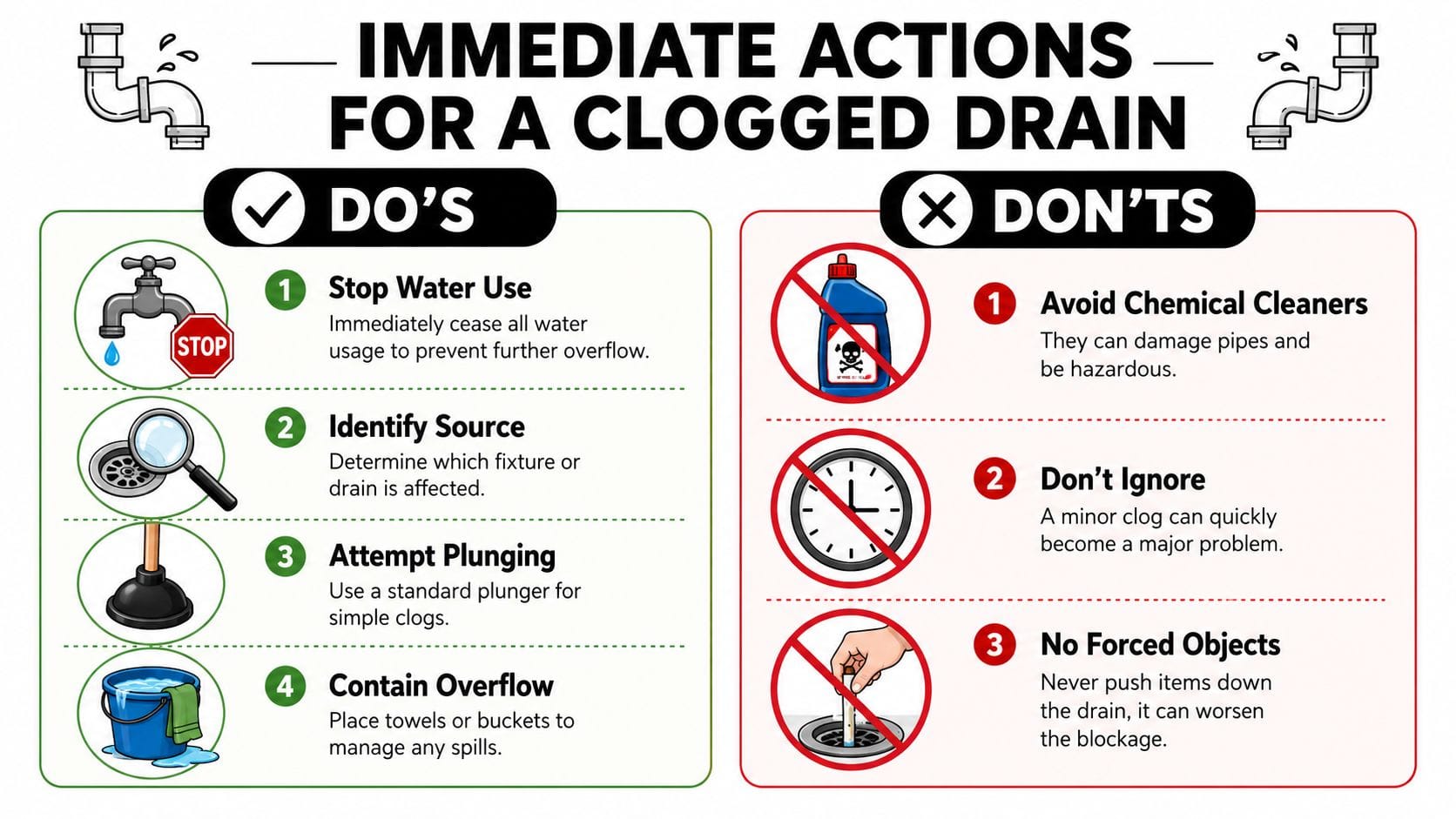
What to do in the first few minutes
Start with damage control, not tools.
Stop all water use
Don't run taps. Don't flush toilets. Don't start the dishwasher or washing machine. If the line is restricted, every bit of added water has to go somewhere.
Figure out which fixture is affected
Check the nearest sink, tub, toilet, and floor drain. You're trying to see whether this is isolated or shared.
Contain any overflow
Use towels, a shallow pan, or a bucket if water is already escaping. Move rugs, boxes, and anything absorbent away from the area.
Try a plunger only if it's clearly a single fixture
If one sink is clogged and nothing else is affected, a standard plunger can be reasonable. If several fixtures are involved, skip the DIY force. You can push the problem around without solving it.
For a broader local checklist, this page on common plumbing emergencies and how to handle them before help arrives is useful to keep bookmarked.
Later in the same response, a short visual reminder helps people stay focused on the basics instead of panicking.
What not to do
The biggest mistake is reaching for a harsh bottle from under the sink and hoping chemistry will fix a mechanical problem.
Chemical drain cleaners are often less effective than mechanical cleaning on hardened grease and can damage certain types of piping, which can turn a simple clog into a repair problem, according to this guidance on commercial drain cleaning solutions.
Avoid these moves:
- Don't keep testing the drain with more water: “Just one more flush” is how a manageable backup becomes a cleanup job.
- Don't feed random objects into the drain: Coat hangers, improvised rods, and stiff wires can scratch fixtures, get stuck, or compact the blockage.
- Don't assume all clogs are grease: Hair, wipes, scale, roots, and foreign objects all behave differently.
- Don't delay when sewage is involved: If wastewater is present, treat it as urgent from a health and property perspective.
A practical example. A kitchen sink that won't drain after a heavy meal often looks like a grease clog. Sometimes it is. But if the dishwasher also backs up into the same sink and the nearby bathroom starts gurgling, the problem may be farther downstream. That's the point where stopping water use helps more than another round of DIY attempts.
What Professional Drain Cleaning Involves
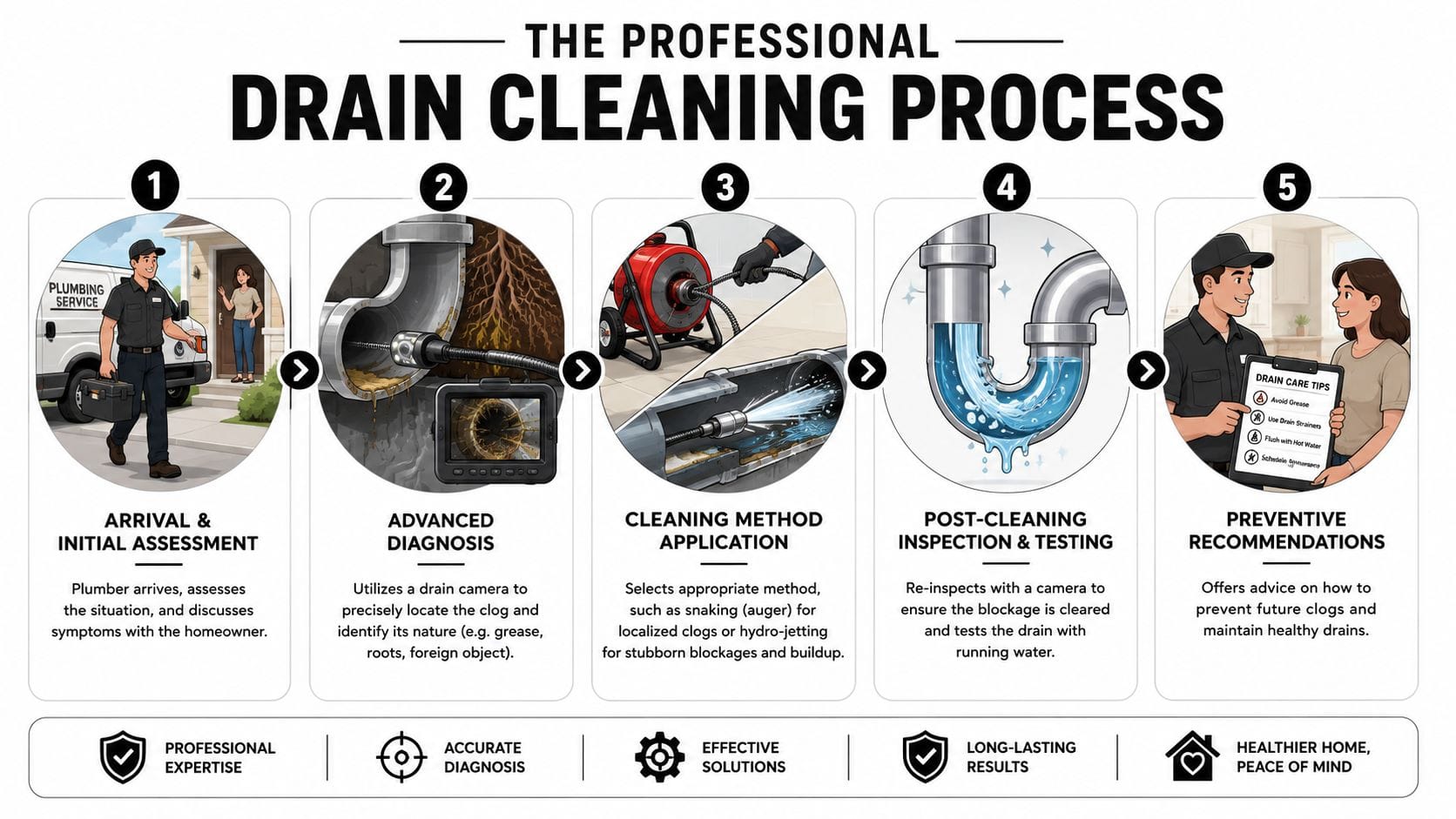
A proper emergency call shouldn't feel like guesswork. The best technicians follow a sequence. They isolate the problem, confirm what's in the line, clear it with the right tool, and then verify that the pipe is open.
What a proper service call looks like
The field sequence used by professionals is straightforward: isolate the issue, inspect with a camera, open the line mechanically, clean residual buildup with high-pressure jetting, and re-scope the pipe to confirm it's clear, as described in this guidance on the professional drain cleaning process.
In real terms, that means the plumber doesn't just arrive and start spinning a cable into the nearest opening. They ask where the symptoms started. They check whether the backup is local or downstream. If a cleanout is available, that often becomes the best access point.
Then comes the camera. On the monitor, a soft blockage looks different from a heavy grease line, and both look different from roots or damaged pipe. That matters because the tool choice changes.
Why snaking and jetting are not the same thing
A lot of homeowners hear “snake” and assume that means the drain is fully fixed. Sometimes it is. Often, it only means flow has been restored enough to get things moving again.
Think of the difference this way:
| Method | What it does well | What it can miss |
|---|---|---|
| Mechanical auger or cable | Opens a path through soft or compacted blockage | Residual grease, sludge, or scale on the pipe wall |
| High-pressure water jetting | Washes the inside of the pipe more thoroughly | Won't solve a collapsed or structurally failed pipe |
A practical example from kitchen lines. A cable can punch a hole through a grease clog, and the sink may drain right away. But if grease is still coating the pipe wall, the line is already set up for the next blockage. Jetting is what cleans that residue back much closer to full diameter.
That's why re-scoping matters. If the camera goes back in after cleaning and still shows roots, a broken section, or a heavy shelf of buildup, the technician can say so plainly. At that point, emergency drain cleaning has done its job by restoring use and identifying the next repair decision.
In Metro Vancouver, companies such as Encano Plumbing & Drainage Ltd. use tools like video inspection and high-pressure jetting for this kind of diagnostic-first drain work when a simple plunge or hand snake won't tell the full story.
Choosing a 24/7 Plumber in Metro Vancouver
When it's late, the floor drain is backing up, and the bathroom smells like sewer, people often book the first number that answers. That's understandable. It's also how homeowners end up with vague pricing, incomplete clearing, or a temporary fix that fails the next day.
A better approach is to use a short checklist and stay calm enough to ask a few direct questions.
The questions to ask before you book
Start with availability, then qualifications, then scope.
Ask things like:
- Are you available right now? Some companies advertise emergency service but only schedule a next-day visit.
- Are your technicians licensed and insured? You want accountability if work is done in a home or strata building.
- Will you diagnose first or just start clearing? For recurring or multi-fixture backups, a camera-first approach is often the smarter call.
- Can you explain what equipment you're likely to use? A professional should be able to say when a plunger, cable machine, cleanout access, camera, or jetting setup makes sense.
- Will I get pricing clarity before work starts? That should be a simple yes.
If you want a local emergency service reference while comparing options, this page on a 24/7 emergency plumber near you in Vancouver shows the type of round-the-clock availability homeowners should look for.
Ask what the plumber will do if the line opens temporarily but the camera still shows roots, scaling, or pipe damage. The answer tells you whether they're thinking beyond the first symptom.
Why pricing clarity matters
Emergency calls are stressful because the decision is fast and the stakes feel high. That's why clear quoting matters so much.
To set a benchmark, professional drain cleaning in Los Angeles averages $227, with a typical range of $110 to $345, according to Angi's Los Angeles drain cleaning cost guide. Vancouver pricing varies by access, timing, equipment, and whether the issue is a simple branch clog or a main line problem, but that benchmark shows why an upfront quote matters before the work starts.
A useful way to think about it is this:
- Simple local clog: usually less complex access and less diagnostic time
- Main line backup: higher urgency, more cleanup risk, and often more equipment
- Recurring problem: may need camera verification, not just clearing
- Rain-related backup: may require a different response path entirely
Choosing well isn't about finding the lowest number. It's about finding a plumber who can explain what they're seeing, what they're doing, and what still needs attention after the water starts flowing again.
Preventing Future Drain Emergencies in Your Home
Most emergency drain cleaning calls start long before the actual backup. The warning signs are usually there first. Slow draining. A toilet that talks back with a bubble. A kitchen line that needs too much plunging. A basement floor drain that smells stronger after wet weather.
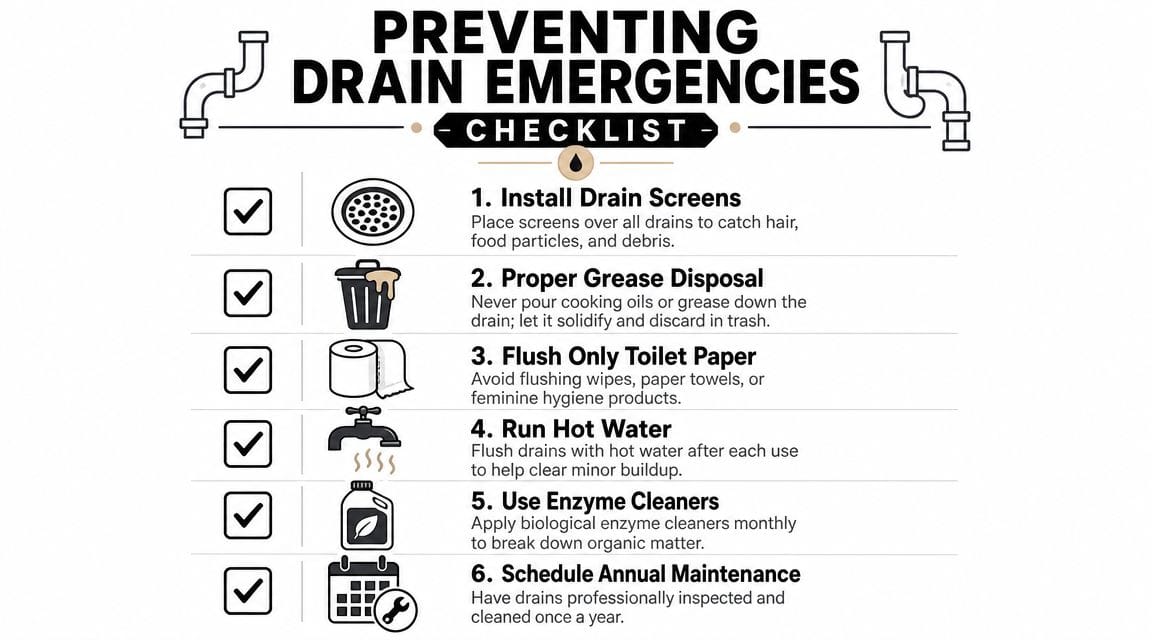
The good news is that prevention works when it's done consistently. Regular maintenance can prevent up to 90% of emergency blockages, and if you need emergency drain cleaning more than once or twice a year, that points to a deeper issue such as pipe damage or chronic buildup rather than a simple clog, as noted in the verified guidance provided for this article.
Daily habits that reduce drain trouble
The simplest habits are still the most useful:
- Use drain screens: Put them in showers, tubs, and bathroom sinks to catch hair before it enters the trap.
- Bin grease, don't pour it: Let cooking grease cool and throw it out instead of washing it down.
- Flush only what belongs there: Toilet paper only. Wipes cause far more trouble than people expect.
- Pay attention to small changes: A drain that starts slowing down is giving you a chance to act before a full backup.
A practical home example. In a busy household, one person pours pan grease into the sink, another uses “flushable” wipes, and nobody notices the tub draining slower each week. Then a rainy weekend hits, and the basement drain becomes the lowest exit point. The emergency feels sudden, but the system had been warning you for a while.
When repeat clogs mean the problem is deeper
If the same drain keeps failing, stop treating it like bad luck. Repeating symptoms usually mean one of two things. Either the pipe wall is never being cleaned properly, or there's a structural defect that basic clearing can't solve.
That's when a better maintenance plan helps:
| Situation | Smarter next step |
|---|---|
| One-off local clog | Basic clearing and observation |
| Kitchen line with recurring grease issues | More thorough wall cleaning and habit changes |
| Multiple backups over time | Camera inspection to check for defects or root intrusion |
| Older home before rainy season | Preventive inspection and maintenance planning |
Don't measure success only by whether water goes down today. Measure it by whether the line stays open.
For homes in Vancouver and Greater Vancouver, that usually means acting early, especially before the wet season, and taking repeat drain issues seriously instead of resetting the same temporary fix.
If you're dealing with an active backup, recurring clog, or a basement drain issue during heavy rain, contact Encano Plumbing & Drainage Ltd. for practical help in Vancouver and Greater Vancouver. A proper emergency drain cleaning call should identify whether the problem is local, in the main line, or tied to a storm-related surcharge condition, then give you a clear path to restore flow safely and reduce the chance of another emergency.