A lot of sewer line problems start the same way. The kitchen sink drains a bit slower than usual. A toilet gives off a short gurgle after you flush it. There's a stale, unpleasant odour near the basement floor drain, but nothing obvious is overflowing, so it's easy to hope it will pass.
In Vancouver and the Lower Mainland, that hesitation is common. Homes here deal with older underground piping, mature trees, tight property lines, laneways, wet soil, and long rainy stretches that can turn a small drainage defect into a bigger repair. What looks like a simple clog can be a cracked clay lateral, a root intrusion near the property line, or a sagging section that keeps collecting waste.
A good sewer line repair process takes the guesswork out of it. The right approach is simple. Confirm the symptoms, inspect the line properly, identify whether the problem is local or system-wide, then choose the repair that fits the pipe condition, the site, and the amount of disruption you can tolerate.
Table of Contents
- What to Do When Your Drains Signal a Deeper Problem
- Early Warning Signs of Sewer Line Failure
- How We Find the Exact Source of the Issue
- Comparing Trenchless vs Traditional Sewer Repair
- Budgeting for Your Sewer Line Repair in Metro Vancouver
- How to Hire a Reputable Sewer Repair Company
- Frequently Asked Questions About Sewer Line Repair
What to Do When Your Drains Signal a Deeper Problem
Most homeowners don't call about a sewer line on the first bad day. They call after a pattern shows up.
A common example is this. The upstairs bathroom seems normal enough, but when the washing machine drains, the main floor toilet bubbles. Then the basement shower starts holding water for a few extra minutes. A few days later, someone notices a sewer smell near the laundry room. At that point, people usually wonder whether they need a drain cleaning, a pipe repair, or a full sewer replacement.
The first move is not to panic and not to keep testing every fixture in the house. If multiple fixtures are reacting to each other, stop running excess water. Don't start the dishwasher, don't run a long shower, and don't keep flushing repeatedly to “see if it clears.” If the line is restricted, more water can turn a warning sign into an indoor backup.
Start with what the symptoms are telling you
One slow sink often points to a local clog. Several fixtures misbehaving together usually means the problem is farther downstream.
Watch for combinations like these:
- Toilet plus tub interaction: Flush a toilet and water moves in a nearby tub or shower.
- Laundry triggers backup: The washing machine discharge causes gurgling or standing water at a lower fixture.
- Odour with no visible leak: A persistent sewage smell indoors or just outside can mean wastewater isn't moving properly through the line.
- Recurring temporary fixes: Snaking one drain helps for a short time, but the same symptoms return.
What helps and what usually doesn't
A plunger can help with a single fixture blockage. It won't fix a cracked or root-filled building sewer. Chemical drain cleaners are even less useful in this situation. They can damage fixtures or piping and still leave the actual sewer restriction in place.
Practical rule: If more than one fixture is involved, treat it like a main line problem until a proper inspection proves otherwise.
The goal at this stage is clarity. Sewer line repair can range from a targeted spot repair to a trenchless liner to a full excavation. The right answer depends on where the defect is, what material the pipe is made from, how accessible it is, and whether the issue sits on your private line or beyond it. That's what the next steps are meant to sort out.
Early Warning Signs of Sewer Line Failure
Sewer lines rarely fail without warning. The trouble is that the warnings don't always look dramatic at first. They often look like plumbing annoyances that seem unrelated until you connect them.
Several drains are slow at the same time
If the kitchen sink is slow, that may be grease or food debris in that branch line. If the kitchen sink, a toilet, and a tub are all draining poorly, the odds shift toward a sewer problem.
What it looks like in a real house: someone runs the sink, then notices the toilet water level move or hears bubbling in another bathroom. That crossover between fixtures matters because it shows the system is struggling to move air and wastewater through a common path.
Water backs up at the lowest fixture
This is one of the clearest signs. When the main line is restricted, wastewater usually shows up at the lowest opening in the house.
That might be a basement shower, a floor drain, or a ground-floor tub. If flushing an upstairs toilet causes water to appear in a lower fixture, don't treat it like a small clog.
Toilets gurgle or bubble
A healthy drainage system moves water and air together. When a sewer line starts to block or collapse, air gets displaced in the wrong places. That's when toilets gurgle after a sink drains or when another fixture is used.
A short gurgle once may not mean much. Repeated gurgling, especially along with slow drainage, deserves attention.
Sewage odours inside or outside
Bad smells matter even before you see a backup. Sewer gas or wastewater odour near a crawlspace, basement, side yard, or front lawn can point to a break, poor flow, or a venting issue that needs a proper diagnosis.
If that's the symptom you're dealing with, this guide on why a sewer smell in the house can point to a deeper drainage issue helps separate minor causes from main line trouble.
Don't judge a sewer problem by one good day. A partially blocked line can behave normally for hours, then back up when the laundry, shower, and dishwasher all run close together.
Wet patches or unusually green areas in the yard
Outdoor signs are easy to miss in Vancouver because wet ground isn't unusual. Still, a patch that stays soggy when the surrounding soil dries out is worth noticing. So is a section of lawn that's unusually lush directly above the line path.
On older properties, I also tell homeowners to pay attention to slight depressions in the yard or along the route from the house to the city connection. Soil movement above the sewer path can signal a void forming around a damaged pipe.
Repeat blockages after cleaning
If the line has been snaked or jetted before and the same symptoms come back, that usually means the blockage wasn't the root problem. Roots, separated joints, corrosion, offset connections, and sagging sections all tend to create recurring trouble.
A practical example is a house where the main line gets cleared, works fine for a while, then starts backing up again during heavy use or wet weather. That pattern often means the line needs to be seen, not just cleaned again.
How We Find the Exact Source of the Issue
The most reliable way to diagnose a sewer problem is to look inside the pipe. Everything else is educated guessing.
A sewer camera inspection works a lot like an endoscopy for your home's plumbing. A waterproof camera travels through the line and sends back a live view of the pipe interior. That lets the technician identify where the problem is, what kind of problem it is, and whether the pipe is a candidate for repair, lining, bursting, or replacement.
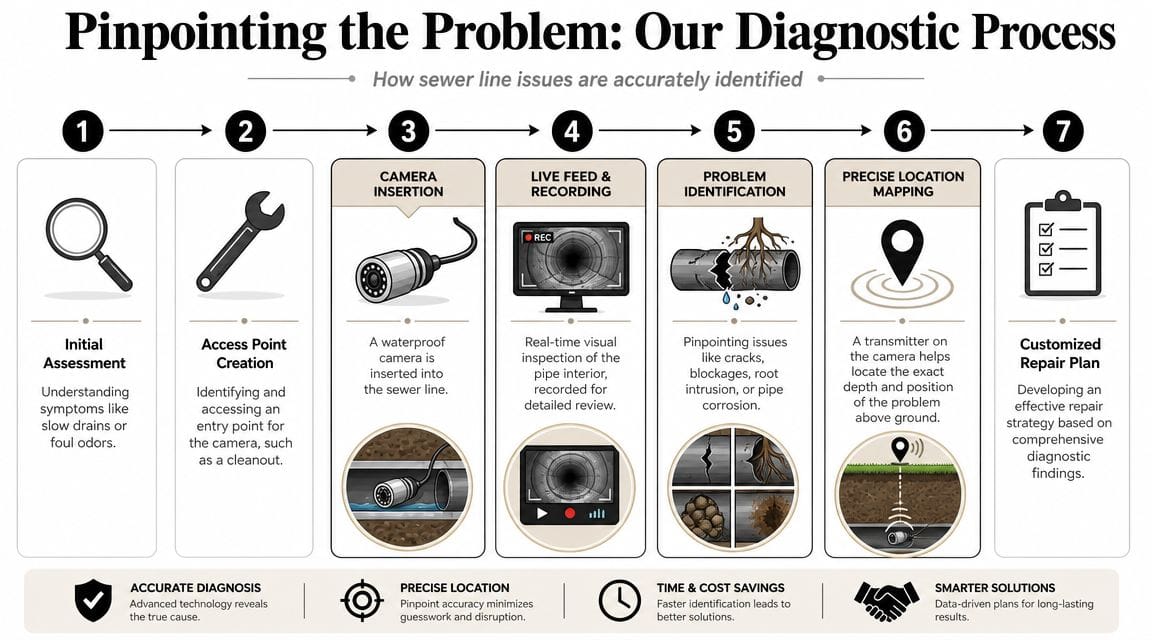
What we look for on the camera
The camera tells a very different story than a simple drain clearing. It can show:
- Root intrusion: Fine roots at a joint or a dense root mass catching paper and waste.
- Cracks and fractures: Common in older clay or brittle piping.
- Offset joints: One section has shifted and no longer lines up cleanly with the next.
- Corrosion or scaling: More common in aging metal piping.
- Bellies or sags: Low spots where water and solids collect.
- Full collapse or heavy deformation: The pipe has lost shape and flow is severely restricted.
A practical example. A homeowner may assume the whole front yard line needs replacing because backups keep happening. The camera sometimes shows a single defective joint near a tree root at one location. In that case, a targeted repair may solve the problem without tearing up the entire run.
How location changes the repair
The camera image matters, but so does exact location. Good inspection equipment includes a locator that tracks where the camera head is from above ground. That tells the crew the depth and approximate position of the defect.
That matters if the damage is under a lawn, beneath a walkway, beside a foundation wall, or near the property line. It also helps separate a private-lateral problem from something that may involve the municipal side.
For homeowners who want a closer look at the process, this page on drain camera inspection services gives a useful overview of what the equipment shows and why it matters before repair work begins.
On site, the camera often saves the yard before the repair even starts. Once you know the defect is six feet from the cleanout instead of under the whole driveway, the conversation changes.
Why guessing usually costs more
Without a camera, crews can end up treating symptoms instead of causes. The line gets cleared but not corrected. Or a homeowner gets told they need a full replacement when the pipe only has one isolated failure.
The inspection also helps identify when excavation is unavoidable. If the pipe has a severe belly, a major collapse, or alignment problems that a liner won't solve, it's better to know that before committing to the wrong method. Clear diagnosis is what makes sewer line repair efficient instead of reactive.
Comparing Trenchless vs Traditional Sewer Repair
Once the problem has been located, the next question is how to fix it. Most homeowners are choosing between traditional excavation and trenchless repair. Neither is automatically right. The right answer depends on pipe condition, access, soil, depth, and what sits above the line.
To make that easier to picture, here's a visual comparison.
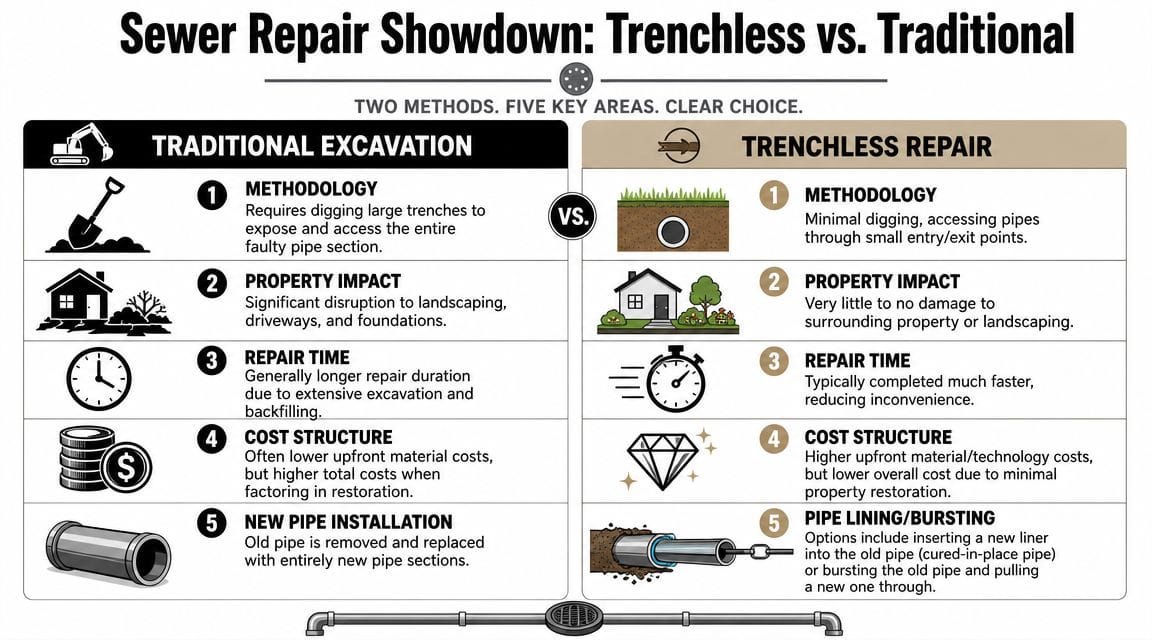
Traditional excavation is the old-school method. The crew digs down to expose the damaged pipe, removes the failed section or full run, and installs new piping. It's direct and still necessary in many situations.
Trenchless repair covers a few methods, but for homeowners the two most common ideas are pipe lining and pipe bursting. Lining creates a new interior pipe within the old one. Bursting breaks the old pipe apart while pulling a new one through its place.
Later in the decision process, it can help to compare your findings with a detailed overview of trenchless sewer line repair options, especially if the line runs under finished landscaping or hard surfaces.
When excavation still makes sense
Excavation is often the better option when the pipe has collapsed badly, when grade correction is needed, or when a section has to be physically reset because it has shifted too far out of alignment.
It can also be the practical choice if the damaged area is short, easy to access, and located in open ground. For example, if a single section in a backyard has failed and there's no patio, retaining wall, or mature garden above it, digging may be straightforward and sensible.
What excavation does well:
- Corrects structural problems: Crews can fully remove broken material and reset slope.
- Handles severe collapse: If the pipe can't pass tools or a liner properly, digging may be the only viable route.
- Allows direct visual confirmation: You can see the pipe, bedding, and surrounding soil conditions.
The trade-off is disruption. Excavation affects landscaping, driveways, walkways, and sometimes access to the property during the work. In dense Vancouver neighbourhoods, the repair itself may be only part of the cost. Surface restoration can become the bigger headache.
When trenchless methods are the better fit
Trenchless repair is often the cleaner choice when the line path runs beneath mature landscaping, concrete, a front entry, or a narrow side yard where open digging becomes awkward and expensive.
NASSCO describes point repairs as excavation-and-repair or internal CIPP repairs for damaged sections. For localized defects, that matters because excavated point repairs typically take 1 to 2 days, while most CIPP repairs can be completed in 2 to 3 hours including setup, according to NASSCO's point repair guidance. In Metro Vancouver conditions, that shorter window can mean less surface restoration, less traffic disruption, and less downtime for occupants.
That doesn't make trenchless a magic fix. Lining needs a pipe that is still structurally suitable for lining. Bursting needs enough access and enough continuity in the line path to pull a new pipe through. Wet soils, groundwater, and future drainage loads also matter. A repair that avoids digging today still has to make sense for the property over time.
A practical example helps. A house on a busy street with a line running under a front yard with existing features and public sidewalk may be an excellent trenchless candidate because restoring everything after excavation would be difficult. A house with a short failed section in open side-yard access may be better served by a direct dig and replacement.
Here's a short video that shows the general difference in approach between trenchless and conventional methods.
Sewer Repair Methods At a Glance
| Factor | Traditional Excavation | Trenchless (Pipe Lining/Bursting) |
|---|---|---|
| Access | Requires a trench to expose the pipe | Uses limited access points where conditions allow |
| Best use case | Collapsed pipe, grade correction, severe misalignment | Pipes with suitable alignment and enough structural continuity |
| Impact on property | Higher impact on lawns, hardscape, and surface finishes | Lower surface disruption in many layouts |
| Project tempo | Slower because digging and restoration are part of the work | Often faster on suitable jobs |
| Restoration needs | Usually more extensive | Usually more limited |
| Limits | More invasive | Not ideal for every collapse, sag, or alignment problem |
The strongest sewer line repair decisions are usually the least emotional ones. Ignore the sales language and ask one plain question: which method fixes the actual defect with the least long-term compromise for this property?
Budgeting for Your Sewer Line Repair in Metro Vancouver
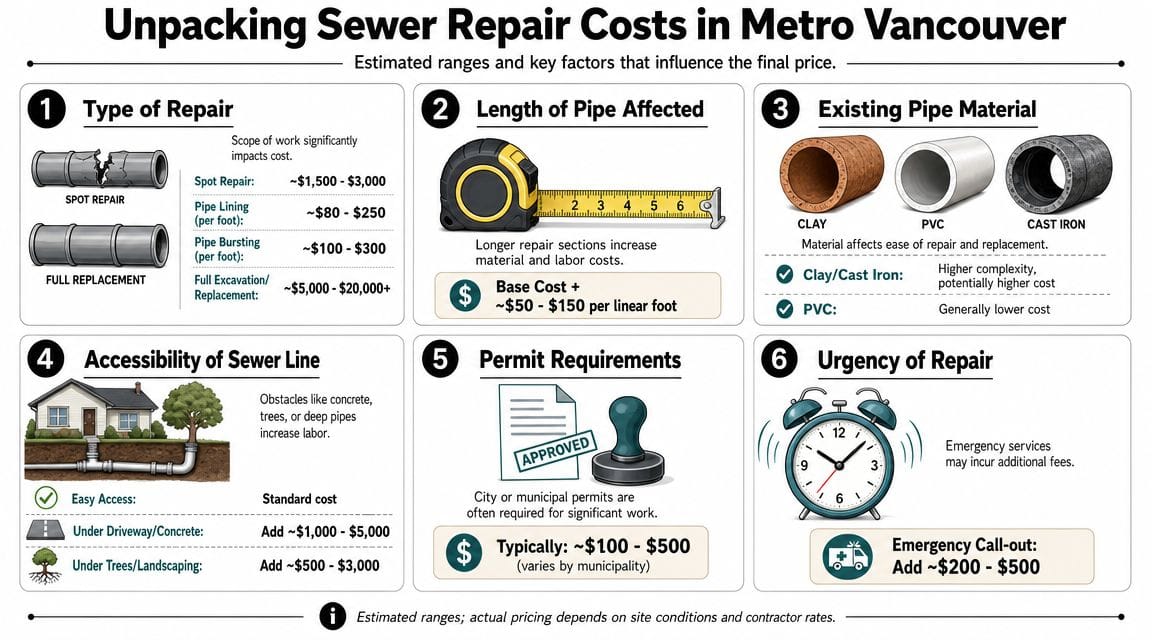
The hardest part of budgeting for sewer line repair is that the final price doesn't come from one factor. It comes from the repair method, the site, the pipe condition, and who owns the damaged section.
That's why broad online price lists usually frustrate homeowners. Two jobs can both be called “sewer repair” and still have completely different scopes. One may involve a short accessible point repair. Another may involve permits, traffic considerations, hard-surface restoration, and a deep line crossing the full front yard.
What actually moves the price
The first driver is method. A targeted repair, a trenchless liner, a burst replacement, and a full excavation all require different tools, labour, and restoration.
The second is access. A line under open soil is one thing. A line under concrete, mature roots, fences, stairs, or tight side-yard access is another. In Vancouver-area homes, access often decides whether a job stays simple or becomes logistically heavy.
The third is pipe condition. A line that can be cleaned, inspected, and repaired locally gives you more options than a line with multiple failures, poor slope, or a fully collapsed section. The fourth is depth and route. If the problem sits deeper or farther from the nearest practical access point, the work becomes more involved.
Here are the site questions worth asking before you request estimates:
- Where does the line run? Under lawn, patio, driveway, walkway, or near the foundation.
- How much of the line is affected? One localized defect or repeated issues along the run.
- What material is in the ground? Older clay, cast iron, or a newer replacement can lead to different repair paths.
- Will permits be needed? Many municipalities require permits and inspections for significant sewer work.
- Is this urgent? Emergency timing can narrow your options because you may need restoration and repair to happen immediately.
The cheapest quote on a sewer job is often the quote with the most assumptions. If the estimate doesn't clearly describe access, restoration, and permit responsibility, it isn't complete.
The ownership question that changes everything
This is one of the most misunderstood parts of sewer line repair. Many homeowners assume that if the backup seems “close to the street,” the city is responsible. That's often not the case.
A key question is how often sewer line problems are caused by the private service lateral versus the municipal main, especially in dense Metro Vancouver housing where homeowners often assume the city is responsible. In British Columbia, that distinction matters because it affects who pays when damage is on private property, and it touches the more than 500,000 connected properties served by Metro Vancouver's wastewater system, as noted in this discussion of private laterals and Metro Vancouver wastewater connections.
In practical terms, the private lateral usually runs from the home to the connection point defined by the municipality. If the defect is on your side, the repair cost is typically yours. If it is beyond that point, the city may need to investigate its own infrastructure. The exact boundary varies, which is why permit and ownership review matters before authorizing major work.
A practical example. A homeowner in a strata or duplex setting may think repeated backups must come from the city main because several units are affected. Sometimes the camera shows the actual issue is a shared private section before the municipal connection. That changes the responsibility and the planning immediately.
If you want a budget that holds up, don't ask only for a number. Ask for a scope.
How to Hire a Reputable Sewer Repair Company
Sewer work is one of those trades where the consequences of a bad hire show up late. The line gets patched, buried, and forgotten until the same problem returns or a permit issue appears during a sale, renovation, or insurance claim.
A good hiring process protects you from that. It also keeps the conversation focused on method, scope, and accountability instead of sales pressure.
Questions worth asking before you sign anything
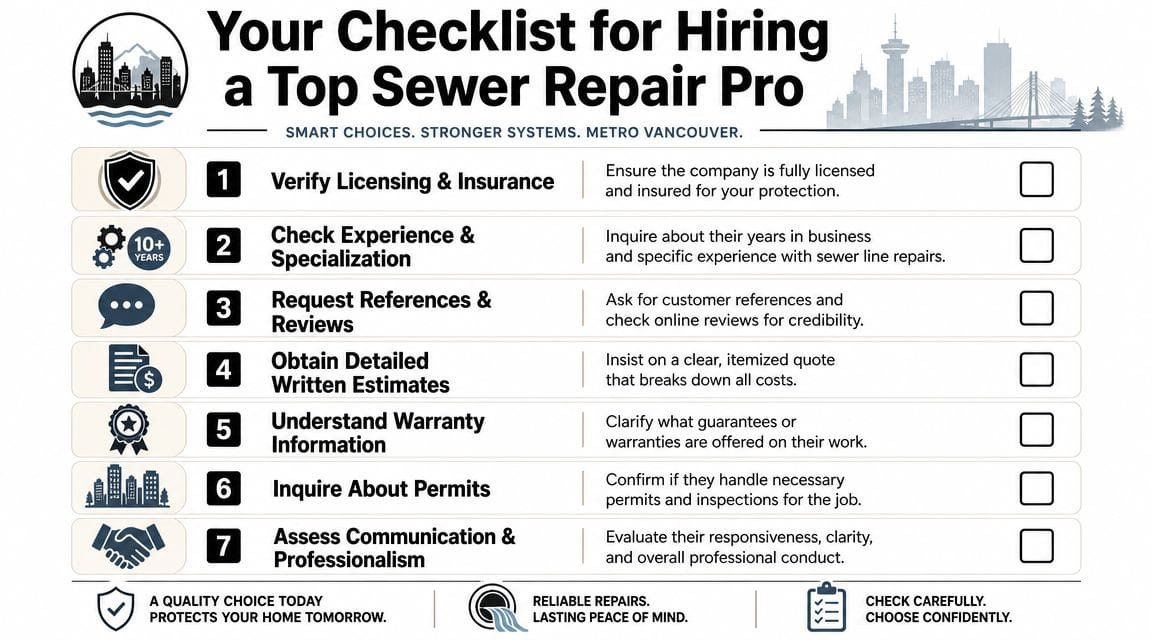
Start with licensing, insurance, and permit handling. Those aren't glamorous questions, but they tell you quickly whether a contractor is operating properly.
Ask questions like these:
- Are you licensed and insured for this type of work in British Columbia?
- Do you carry current WorkSafeBC coverage for your crew?
- Will you pull the required municipal permits and arrange inspections if needed?
- Will you provide the camera findings and explain why this repair method fits the pipe condition?
- What warranty applies to the workmanship and the material used?
- Have you handled similar properties in Vancouver, Richmond, Burnaby, or Surrey where access is tight or surface restoration matters?
You're listening for direct answers. If someone gets vague when the topic turns to permits, scope, or site conditions, that's a warning sign.
What a solid estimate should include
A proper estimate should describe more than “replace sewer line” or “trenchless repair.” It should explain what was found, where the defect is, what method is proposed, what surfaces may be affected, and what is excluded.
Look for detail such as:
| Item | What you want to see |
|---|---|
| Diagnosis | Camera findings and defect location |
| Repair method | Excavation, point repair, lining, or bursting |
| Site impact | Access points, digging areas, and restoration assumptions |
| Permits | Who handles them and whether inspections are expected |
| Cleanup | Disposal, backfill, and site reinstatement details |
| Warranty | Clear statement of what is covered |
A practical example. If one contractor recommends trenchless lining and another recommends excavation, don't just compare the totals. Ask each one what condition in the pipe led to that recommendation. A strong contractor should be able to point to the inspection findings and explain the trade-off clearly.
This is also where product and service fit matters. For example, Encano Plumbing & Drainage Ltd. provides drainage diagnostics and repair services that include tools such as video inspection and drain cleaning, which are useful when a homeowner needs to confirm whether a recurring blockage is a maintenance issue or a repair issue.
Hiring advice: Choose the contractor who can explain why a method fits your pipe, not the one who only tells you which method sounds least disruptive.
One more point matters in the Lower Mainland. Homeowners should ask whether trenchless is still the most economical choice on their site when soils stay wet and groundwater pressure is part of the problem. This discussion of trenchless repair trade-offs in high-rainfall conditions raises the right question: not just whether digging can be avoided, but which method is more resilient for the soil, pipe age, and flood exposure over the long run.
Frequently Asked Questions About Sewer Line Repair
Does home insurance cover sewer line repair
Sometimes, but you need to read the policy language carefully. Coverage often depends on the cause of the damage and whether the policy includes service line or sewer-related endorsements. Ask your insurer what is covered, what is excluded, and whether they require a camera report or contractor documentation.
Can I prevent future sewer line problems
You can reduce the risk, even if you can't eliminate it. Good habits help.
- Watch what goes down the drain: Grease, wipes, hygiene products, and heavy paper products create avoidable blockages.
- Manage roots early: If you know large trees sit along the sewer path, periodic inspection is smarter than waiting for a backup.
- Pay attention to recurring symptoms: Slow drains and gurgling rarely fix themselves.
- Book maintenance when needed: Cleaning and inspection are useful when the line is showing early warning signs but hasn't failed structurally.
Are flushable wipes actually safe
For most homes, no. Even when packaging says “flushable,” wipes don't behave like toilet paper in older drainage systems. They can catch on roots, rough pipe interiors, offsets, and partial blockages. In sewer line repair work, wipes often show up as part of the mass that turns a minor restriction into a full backup.
Is every sewer problem an emergency
No, but some are. If wastewater is backing up into tubs, showers, or floor drains, or if sewage is surfacing indoors, treat it as urgent. If you only have early symptoms such as slow drainage, gurgling, or odour, you usually have time to diagnose the issue properly and choose the best repair instead of reacting under pressure.
Should I choose trenchless whenever it's available
Not automatically. Trenchless is excellent in the right conditions, especially where protecting the yard, driveway, or sidewalk matters. But if the pipe has the wrong type of failure, poor alignment, or problems that require grade correction, excavation may still be the better repair.
If you're dealing with slow drains, sewer odours, recurring backups, or a line that's already been “fixed” more than once, Encano Plumbing & Drainage Ltd. can help assess the problem, inspect the line, and outline practical repair options for Vancouver-area properties without guesswork.