
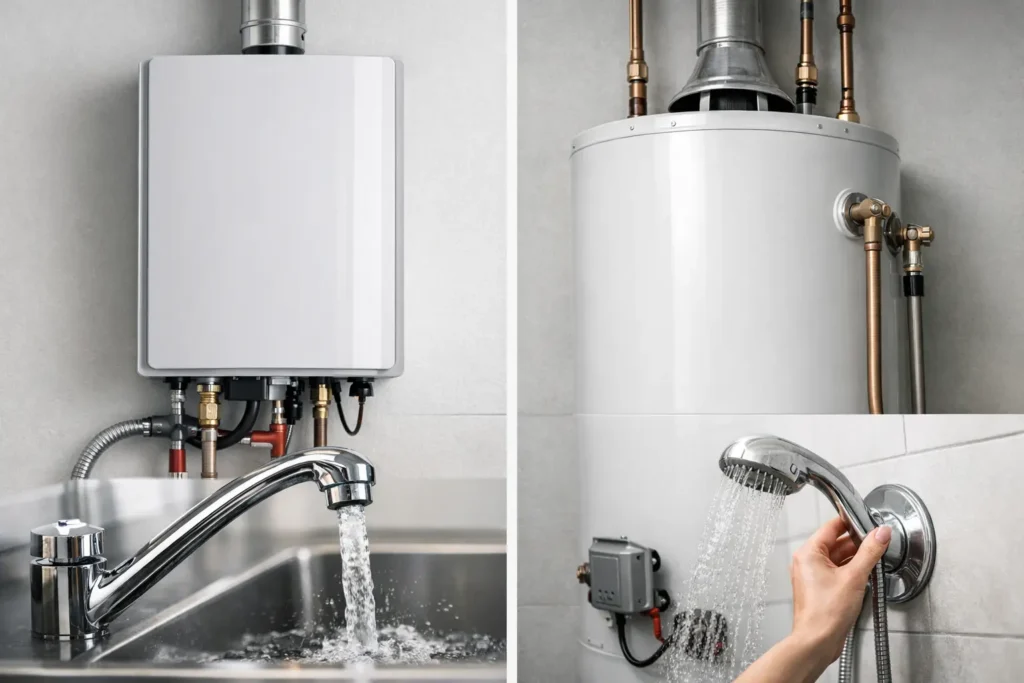
If your hot water has started running out halfway through a shower, or your current unit is getting close to the end of its life, the tankless vs tank water heater question becomes very real, very fast. Most property owners are not looking for a trendy upgrade. They want steady hot water, fair operating costs, and a system that fits their home, building, and budget without surprises.
The honest answer is that both systems can be excellent. The better choice depends on how much hot water you use, how your plumbing and gas or electrical setup is configured, and whether you care more about lower upfront cost or longer-term efficiency.
Tankless vs tank water heater: the basic difference
A traditional tank water heater stores and heats a set amount of water, usually between 40 and 75 gallons. It keeps that water hot throughout the day so it is ready when you turn on a tap. That makes it simple and familiar, but it also means the unit keeps using energy to maintain temperature even when no one is using hot water.
A tankless water heater works on demand. Instead of storing hot water, it heats water as it flows through the unit. When sized properly, it can provide a continuous supply of hot water without the usual “you used it all up” problem that happens with storage tanks.
That sounds like an easy win for tankless, but there is more to it than that. Continuous hot water is a major benefit, but installation cost, maintenance needs, and household demand all matter.
Upfront cost vs long-term value
For many homeowners and landlords, price is the first deciding factor.
A tank water heater usually costs less to purchase and install. If you are replacing an existing tank with a similar model, the job is often straightforward. That can make a storage tank the practical choice when you need hot water restored quickly and want to keep initial costs under control.
A tankless system usually costs more upfront. The unit itself is more expensive, and installation can involve upgrades to gas lines, venting, electrical service, or wall mounting. In some homes, those changes are minor. In others, they are a big part of the final bill.
Where tankless can make up ground is over time. Because it only heats water when needed, it can reduce energy waste. It also tends to last longer than a standard tank unit when it is installed correctly and maintained regularly. If you plan to stay in the property for years, that longer lifespan can matter.
Still, savings are not automatic. If your hot water use is modest, the difference on utility bills may not feel dramatic enough to justify a much higher install cost. That is why a good recommendation should be based on your actual usage, not a one-size-fits-all sales pitch.
Performance in real households
Hot water performance is where the tankless vs tank water heater comparison gets more personal.
A tank water heater can deliver strong flow to multiple fixtures at once, as long as there is enough stored hot water in the tank. In a busy household, that works well until the supply runs low. Once the tank is depleted, recovery takes time.
A tankless unit does not run out in the same way, but it has a flow rate limit. If several showers, appliances, and faucets are running at once, the system has to keep up with that demand in real time. If the unit is undersized, users may notice reduced performance or inconsistent temperatures.
This is one reason professional sizing matters so much. A family of five with back-to-back morning showers has very different needs from a condo owner living alone. The right unit is not just about square footage. It is about fixture count, usage habits, and peak demand.
For larger homes or buildings, sometimes the best solution is not choosing one category over the other. It may be choosing the right size tank, a high-recovery unit, or a properly designed tankless setup that matches the property.
Energy efficiency and monthly operating costs
Tankless water heaters generally win on efficiency. They avoid standby heat loss, which is the energy used to keep stored water hot around the clock. That can make them appealing for owners trying to reduce monthly utility costs.
Tank systems have improved over the years, and many modern models are far more efficient than older units. But they still store heated water, so some energy loss is built into the design.
That said, efficiency should be looked at realistically. If your home has very high hot water demand, or if the tankless system has to work hard across multiple fixtures for long periods, actual savings may be smaller than expected. Climate, incoming water temperature, fuel type, and household patterns all affect the bottom line.
For many customers in Vancouver-area homes, energy savings are part of the decision, but not the whole decision. Reliability, comfort, installation cost, and available utility connections often carry just as much weight.
Lifespan and maintenance
A traditional tank water heater often lasts around 8 to 12 years, depending on water quality, maintenance, and usage. Tankless systems can last 15 to 20 years or more in the right conditions.
That longer lifespan is attractive, but tankless units are not maintenance-free. In fact, regular servicing is especially important. Mineral buildup can reduce performance and shorten the life of the heat exchanger if the unit is not flushed as recommended.
Tank water heaters also need maintenance. Sediment can build up in the tank, affect efficiency, and increase wear. The difference is that many owners ignore tank maintenance until there is a leak or failure.
If you want the longest useful life from either system, routine inspection and maintenance make a real difference. This is especially true in multi-unit buildings or commercial spaces where downtime is more disruptive.
Space, noise, and installation factors
Tankless units are compact and wall-mounted, so they save floor space. That can be a major advantage in smaller utility rooms, condos, suites, or mechanical spaces where every foot counts.
Tank water heaters take up more room, but the installation is often simpler if the property is already set up for one. That simplicity can keep labor costs down and reduce the chance of major modifications.
Noise is another small but practical detail. Tankless units can make operational noise when they fire up, while tanks are generally quieter in day-to-day use. For most people this is not a deciding factor, but in tight mechanical rooms or smaller homes, it is worth mentioning.
Fuel source matters too. Not every property is an easy candidate for every type of system. Some tankless models place higher demands on gas supply or electrical capacity. Before choosing based on internet reviews alone, it is smart to have the site conditions checked.
Which option makes sense for your property?
When a tank water heater is often the better fit
A tank system is often the right call when upfront budget matters most, when you need a straightforward replacement, or when the home already supports a tank setup without extra work. It is also a strong choice for properties with predictable hot water use and owners who want a familiar, lower-cost installation.
For rentals and some multi-unit properties, the lower purchase price can be especially practical. If the existing layout is built around a tank and there is no strong reason to change, staying with a quality tank model can be the smarter investment.
When a tankless water heater is often worth it
Tankless is often a better fit for owners who plan to stay long term, want to maximize space, and value continuous hot water. It can also be a smart option for households that regularly run out of hot water with a standard tank.
In higher-demand homes, the key is proper sizing. A well-designed system can deliver excellent comfort and efficiency. A poorly sized one can create frustration fast.
For property managers and commercial operators, tankless may also make sense where long service life, space savings, and efficiency justify the higher initial cost. The numbers just need to be looked at honestly.
The best decision is the one that fits your building
There is no universal winner in the tankless vs tank water heater debate. The best choice is the one that matches your usage, your utility setup, and your budget now and over time.
A good plumber will not push one option on everyone. They will look at how many people use the space, how the building is laid out, what fuel source is available, and what kind of hot water performance you actually need. That is the approach we believe in at Encano Plumbing & Drainage Ltd. because the goal is not just to install a unit. It is to leave you with a system that works well for years.
If you are replacing an aging water heater, this is a good time to think beyond the sticker price. The right system should make daily life easier, not leave you managing trade-offs you did not expect.