
A Richmond homeowner calls after finding a leak beneath a freshly stamped concrete driveway. The waterline dates from the 1960s, the driveway is intact, and the old solution seems obvious: break the concrete, dig a trench, replace the pipe, then rebuild everything above it.
That solution still works. It just isn't automatically the sensible one.
Trenchless waterline replacement can preserve much of a driveway, lawn, sidewalk, or established garden, but it only saves time and money when the pipe, soil, route, and access conditions cooperate. A good recommendation starts with those facts, not with a promise that every waterline can be replaced without digging.
Table of Contents
- When a Yard Is Not a Dig Site Anymore
- The Two Trenchless Methods Homeowners Should Know
- Trenchless Versus Open Cut in Real Numbers
- Is Your Property Actually a Trenchless Candidate
- What a Trenchless Job Looks Like Day by Day
- What Really Drives the Cost of Trenchless Work
- Common Problems and How Crews Troubleshoot Them
- Choosing the Right Path for Your Waterline
When a Yard Is Not a Dig Site Anymore
The Richmond homeowner has three competing concerns. The failed waterline needs a dependable replacement, the stamped concrete may be difficult to match, and the garden beds along the driveway contain mature roots and irrigation that a full trench would disturb. The job isn't just about putting a new pipe in the ground. It's also about what sits above that pipe.
Greater Vancouver has many properties with the same conflict. Older neighbourhoods have settled into their finished form, with concrete driveways, pavers, retaining walls, mature landscaping, and additions built around underground services. Open excavation gives a crew direct access, but it also exposes the entire route from the meter or municipal connection to the house.
Before any digging, the route must be checked through BC One Call and other required utility-locating procedures. A locate identifies known underground services, but it doesn't turn a congested route into a simple one. Private irrigation, older service alterations, unrecorded lines, and connections near foundations still require careful field verification.
The responsibility line matters
In many Metro Vancouver properties, the water service from the meter to the house is private infrastructure, while the public-side main and related components fall under the local water authority or municipality. The exact responsibility depends on the district, the service arrangement, and the location of the failure, so a homeowner shouldn't assume the entire line belongs to either the city or the property owner.
San Francisco offers a useful regional comparison. Its water utility operates more than 1,200 miles of water pipelines, and about 20% of those mains are roughly 100 years old and need replacement or rehabilitation, according to California water-main rehabilitation guidance filed with the California Public Utilities Commission. The same guidance describes both open-cut and trenchless work, with trenchless selected when an existing main can be rehabilitated while limiting surface disruption.
That's the practical reason trenchless methods have gained attention in mature urban systems. The method protects valuable surfaces when the underground route is suitable. It doesn't eliminate excavation, permits, shutdowns, or restoration, but it can change a destructive full trench into controlled access points.
Practical rule: Protecting a driveway only matters if the proposed bore can be installed safely and connected properly at both ends.
For the Richmond homeowner, the next step isn't choosing trenchless because the driveway is expensive. It's confirming whether the old line still provides a workable route for bursting, boring, or lining.
The Two Trenchless Methods Homeowners Should Know
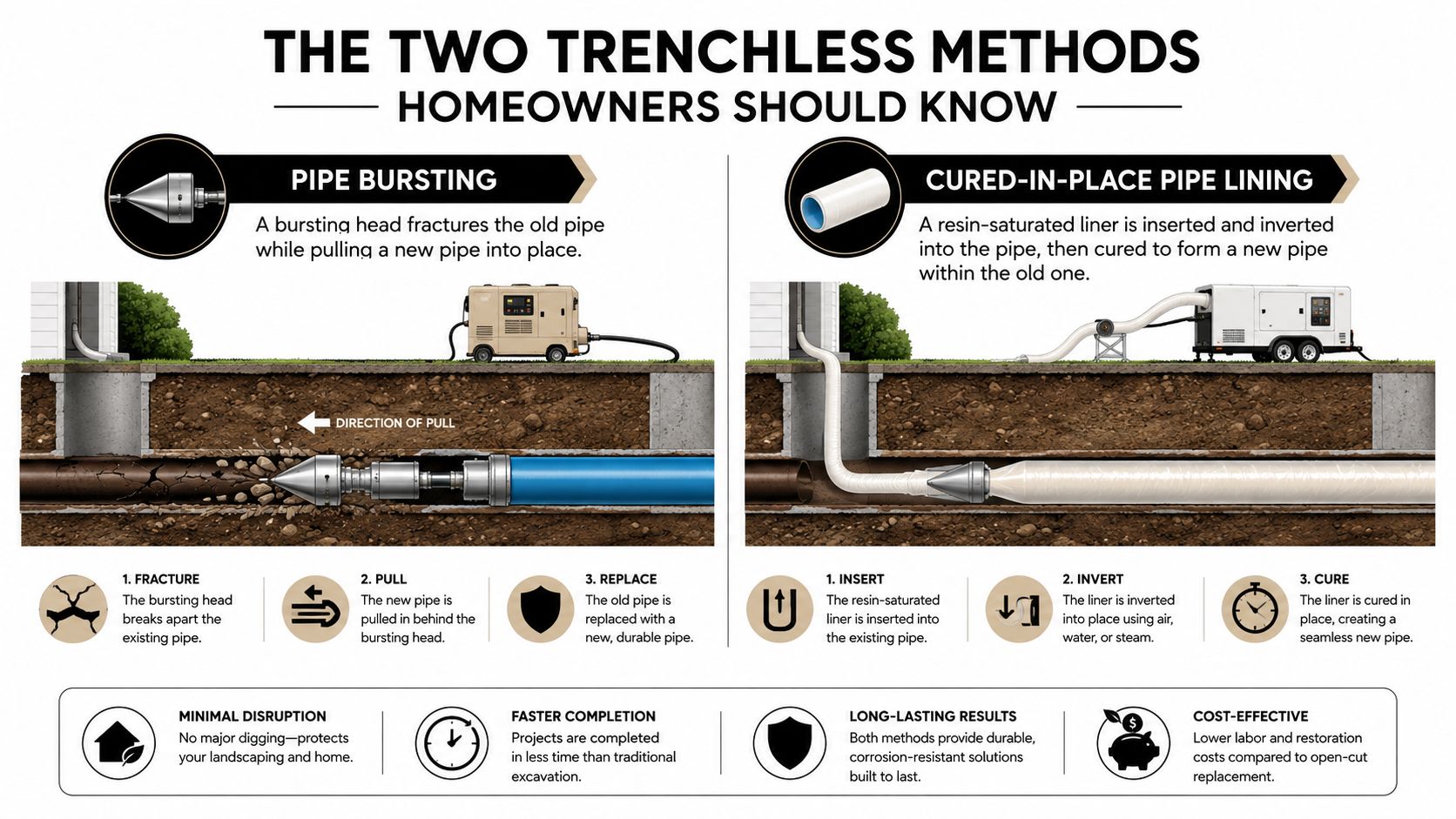
Homeowners usually hear about pipe bursting and cured-in-place pipe lining, or CIPP. They're different processes, and confusing them can lead to the wrong recommendation.
Pipe bursting replaces the old pipe
A bursting crew creates an entry pit and a receiving pit. A cable or rod pulls a cone-shaped bursting head through the existing alignment. The head fractures the old pipe outward while towing a new pipe, commonly HDPE, into the opened path.
The analogy is simple. Think of a steel cone moving through packed soil while pulling a flexible new hose behind it. The old pipe doesn't need to be removed piece by piece, but the crew still needs enough room for the head, the new pipe, the pulling equipment, and the final connections.
Pipe bursting is commonly considered when the old service is undersized, badly corroded, or no longer worth preserving. It can also increase the internal capacity if the route and surrounding ground allow the new pipe to be upsized. A fully collapsed section, however, may prevent the bursting head from following the intended path.
Residential services in Greater Vancouver are often small, commonly 3/4 inch to 2 inch, with the final size selected according to the property and design requirements. Caltrans guidance identifies HDD for pressure lines such as water across a typical diameter range of 2 to 48 inches, while jack-and-bore covers 8 to 60 inches for crossings, as described in trenchless waterline replacement method guidance. Those larger technical ranges don't replace site-specific design for a house service.
CIPP preserves the host pipe shape
CIPP uses a resin-saturated sleeve inserted into the existing pipe. The liner is positioned, inflated or inverted against the host pipe, and cured so it forms a continuous inner pipe. It's closer to installing a rigid sleeve inside the old line than replacing the surrounding soil.
That makes lining useful when the host pipe still holds its shape but leaks, has corrosion, or has defects that the liner can bridge. It isn't the right answer for every crushed, offset, or badly misaligned service. The existing bore must accept the liner, and fittings, valves, and service connections may require separate attention.
For a plain-language overview of how trenchless rehabilitation differs from excavation, see what to know about trenchless sewer line repairs. Although water and sewer projects have different technical requirements, the decision principle is the same: the pipe's remaining shape and the property's access conditions determine whether a no-dig method is realistic.
Trenchless Versus Open Cut in Real Numbers
On a finished Greater Vancouver property, the excavation itself may be only part of the open-cut bill. The larger cost can come from rebuilding concrete, asphalt, pavers, irrigation, lawns, and planting after the pipe is exposed.
California Public Utilities Commission rehabilitation guidance places a rehabilitated pipeline at 25% to 100% of conventional open-trench construction cost, depending on the project and method. It also gives a properly applied rehabilitation an expected service life similar to a new pipeline, approximately 50 to 100 years. The California pipeline rehabilitation benchmark provides that cost and service-life context.
| Factor | Trenchless | Open Cut |
|---|---|---|
| Surface disruption | Entry and receiving pits, plus connection excavations | Continuous trench along the service route |
| Installation approach | Bursting, lining, or controlled boring | Direct exposure of the entire pipe |
| Restoration | Usually concentrated at access points and tie-ins | Lawn, concrete, asphalt, pavers, irrigation, and planting may all be affected |
| Access requirements | Needs suitable equipment access and a workable bore path | Needs room to excavate and safely support the trench |
| Diagnosis during work | Some conditions remain underground until the method encounters them | The crew sees the full pipe and surrounding soil |
| Best fit | Longer routes beneath valuable surfaces with a stable alignment | Short, shallow, congested, collapsed, or easily accessible routes |
A Vancouver-area service provider reports that residential replacement is often completed in a single day when no major complications arise. Its explanation of pipe bursting also describes the old pipe being broken apart while a new pipe is pulled through the same alignment from two small holes. See the Vancouver trenchless waterline replacement information.
Open cut remains the more predictable choice for some properties. A short run may not justify specialised equipment. A shallow service beneath an unpaved side yard can be cheaper to expose directly. Severe collapse, congested utilities, or several difficult tie-ins can also favour excavation because the crew can see and correct each condition as it works.
The proper comparison is total project cost. Include permits, utility locating, equipment, labour, shutdown coordination, connection work, testing, and final restoration. Trenchless reduces surface disturbance only when the route, access, and pipe condition support the method.
For the cost factors that can change a trenchless quote, see these trenchless sewer line replacement cost considerations. Waterline pricing still depends on the property's route, soil, connections, and specifications.
Is Your Property Actually a Trenchless Candidate
A contractor should be able to explain why your property qualifies before recommending trenchless waterline replacement. A driveway alone isn't enough.
The first check is the existing pipe. Crews need to know its material, approximate size, route, condition, and connection points. A line that has lost wall thickness but still follows a stable alignment may behave differently from one with a collapsed section or a sharp offset at a joint.
Four field questions matter
- Does the pipe still have a usable route? A liner needs a host pipe with enough shape to accept it. A bursting head needs to move through the alignment without being stopped by a collapse.
- Can the crew reach both ends? Entry and receiving pits may be small, but equipment, spoil, pipe staging, and safe working space still need to fit on the property.
- What sits underground? BC One Call information is essential, but private utilities, irrigation, old repairs, and service crossings can complicate the pull.
- What sits above the route? Stamped concrete, pavers, mature trees, retaining structures, and shallow foundations make surface protection more valuable, provided the bore remains safe.
Soil changes quickly around the Lower Mainland. Vancouver till, Richmond delta silt, compacted fill, and mixed deposits don't respond the same way to a bursting head or guided bore. Stable clay or till can support a predictable route, while loose fill may move around the new pipe or complicate pit stability. Shallow rock can stop a method that looked straightforward from the surface.
A camera inspection is more common for sewer work than for a small pressurised water service, but the principle remains useful: diagnosis should precede method selection. Sewer camera inspection guidance explains why visual evidence can reveal collapse, roots, offsets, and deterioration that a surface symptom can't identify.
A homeowner can self-screen by asking whether the service runs in a reasonably direct line, whether both ends are accessible, whether the pipe is merely leaking or has collapsed, and whether the soil profile is known. If the contractor can't answer those questions, the quote is incomplete.
What a Trenchless Job Looks Like Day by Day
A smooth job is organised before the first pit is opened. The homeowner usually sees a few visible steps, while much of the risk control happens through records, utility coordination, and connection planning.
Before the crew arrives
The first call should establish the symptoms, water pressure history, known leaks, pipe material, meter location, house entry point, driveway or landscaping concerns, and any previous repairs. The contractor then reviews the likely route and identifies whether the public-side connection requires district coordination.
Utility locates commonly take two to five days, according to the local project planning experience described in the brief. That wait isn't dead time. It prevents a crew from beginning a bore without understanding what may cross the route.
Permits and municipal requirements vary by location. A water shutoff may also need to be arranged with the local water district, and that window can affect the installation date. A homeowner should ask who coordinates the shutdown and who confirms the line can be returned to service.
What happens on site
- Access preparation: The crew protects nearby surfaces, marks the working area, and excavates the entry and receiving pits. Tie-ins at the house and meter may require targeted digging.
- The installation: For bursting, the crew positions the head and pulls the new pipe. For lining, the host pipe is prepared and the resin liner is installed and cured.
- Connection and testing: The new line is connected, pressure tested, flushed or chlorinated as required by the project, and sampled where the authority requires it.
- Reinstatement: The pits are backfilled and the disturbed surfaces are restored according to the agreed scope.
Water may be shut off during critical connection and testing periods. The service descriptions from BC emphasise that trenchless work can reduce surface disruption and restoration compared with open excavation, but they also acknowledge that the method still creates access areas and doesn't remove every project impact. See regional trenchless water solutions for that balanced description.
This video gives homeowners a visual sense of the equipment and sequence:
A one-day installation doesn't mean the whole project is arranged in one day. Locates, permits, shutdown coordination, testing, and restoration planning come first.
What Really Drives the Cost of Trenchless Work
The pipe is only one part of the estimate. Cost changes most when crews face restricted access, uncertain ground, several connections, or public infrastructure.
A 30-foot replacement on a flat Vancouver lot can be less demanding than a 60-foot run through a Burnaby hillside with limited access, although both are residential services. Length affects material, setup, pulling distance, and labour. Slope and restricted access affect equipment placement, pit construction, spoil handling, and site safety.
| Cost Driver | Effect on Price | Why It Matters |
|---|---|---|
| Run length | Longer routes generally require more setup and installation work | The crew must manage more pipe, alignment, and pulling distance |
| Access | Restricted access can raise equipment and labour requirements | The rig, new pipe, spoil, and safety controls still need space |
| Depth | Greater depth increases excavation and pit complexity | Crews must maintain stable, safe access to the work area |
| Tie-ins | Multiple connections add labour and shutdown coordination | Each connection creates another point for testing and potential adjustment |
| Soil and rock | Variable ground can slow boring or require a method change | Till, clay, fill, silt, and shallow rock behave differently |
| Pipe selection | HDPE and fusible PVC have different installation and connection requirements | The material must suit pressure, route, fittings, and authority requirements |
| Restoration | A larger reinstatement scope increases the total | Concrete, asphalt, pavers, planting, and irrigation each need separate treatment |
The estimate must describe the finish line
A low bid may leave out final landscaping, concrete matching, utility locating, or difficult tie-ins. Those items can return as change orders after work begins.
Ask for two written scopes if the route is uncertain. The first should identify the proposed trenchless method and its assumptions. The second should explain what happens if the pipe collapses, the bore meets rock, access changes, or a short section requires open excavation.
The estimate should also identify who pays for testing, permits, shutdown coordination, spoil removal, and surface restoration. These details matter because a trenchless installation can reduce disruption without eliminating pits, tie-ins, or reinstatement work.
Rehabilitation can range from 25% to 100% of conventional open-trench construction, so site conditions determine whether trenchless work saves money on a particular property. The relevant comparison is the complete project cost, including access, restoration, labour, and the consequences of an unsuitable method.
A proper quote prices the uncertainty instead of hiding it.
Common Problems and How Crews Troubleshoot Them
Trenchless work is controlled, not magical. Experienced crews watch the equipment, the pits, the pull force, and the ground response together.
What the crew notices first
A dulled bladed roller meeting rock fragments in glacial till may produce chattering or a sudden change in pull behaviour. The response can be as simple as changing the blade or tool configuration, but the operator needs to recognise the warning before the head stalls.
A fused HDPE bead can snag during pull-back if the joint or alignment isn't moving cleanly. The crew may see a rising pull demand or a change in movement. Slowing the pull, checking the pipe path, and adjusting the setup can prevent damage to the new line.
A host pipe can fracture ahead of a bursting head and leave the replacement line bellied or off-route. A head stuck beneath a dense tree-root mass creates a similar problem. The practical responses may include switching to a static-burst head, enlarging the receiving pit, exposing a short section by open cut, or changing the rehabilitation approach where the pipe's shape allows it.
Tie-in problems deserve patience
A low-pressure surge on connection day can come from the line, the valve, the shutdown sequence, or a connection that needs adjustment. The correct response isn't to force the system back into service. The crew should pause, isolate the affected section, check the connection, and coordinate another shutdown window with the responsible water district if required.
Strata managers should insist on a written contingency plan because a shared service affects more than one household. Residents need clear notice about the shutdown, access restrictions, testing, and the conditions that could extend the work.
A good operator reads the rig before relying on a single gauge. Changes in sound, vibration, return water, pit movement, and pull behaviour often tell the story early. Homeowners don't need to diagnose those signs, but they should expect the contractor to explain what changed and why the proposed response is safe.
Choosing the Right Path for Your Waterline
The right method depends on the lot, not the label. A straight service beneath a stamped driveway presents a different problem from a short line running beside a foundation through congested fill.
Use the following decision test as a starting point:
- A longer, direct route: Trenchless becomes more attractive when a continuous trench would cross valuable hardscape or established landscaping.
- A stable soil profile: Clay or till may provide a more predictable path than loose, disturbed fill, though the actual ground still needs field assessment.
- A workable pipe condition: Bursting can suit an undersized or failing line when the old alignment remains passable. Lining needs a host pipe that retains its shape.
- Accessible endpoints: The crew needs practical entry and receiving areas, plus safe access to the house and meter connections.
- Limited underground conflict: Closely packed utilities, shallow rock, root masses, and unknown private services can make open cut more controllable.
Open cut may be the smarter call when the run is short, shallow, easy to expose, or already located in an unfinished area. It can also be preferable where the pipe has collapsed completely, the alignment is badly offset, or the route contains too many unknowns for a reliable bore.
The cheapest surface repair isn't useful if the new service can't be installed to a dependable line.
Before signing, request four things:
- Locate information: Ask how BC One Call and private utility checks will be handled.
- Two written scopes: Compare the proposed trenchless work with the fallback excavation plan.
- A soil and obstruction discussion: Ask whether the route includes till, clay, fill, silt, shallow rock, roots, or congested utilities.
- A permit and shutdown timeline: Confirm who coordinates the district, what the water-off window involves, and what testing must happen before service returns.
For municipalities, strata corporations, and homeowners, that checklist prevents a sales pitch from becoming the project plan. Greater Vancouver has plenty of properties where trenchless waterline replacement is the cleanest option, but there are just as many where a focused open-cut repair is more predictable.
Encano Plumbing & Drainage Ltd. can assess waterline and underground plumbing conditions, coordinate diagnostic work, and discuss trenchless or targeted excavation options for properties across Greater Vancouver. Visit Encano Plumbing & Drainage Ltd. to request an evaluation and a written scope that accounts for access, utilities, soil, connections, testing, and restoration.