
You're usually not reading about water line replacement on a calm Saturday with nothing wrong. More often, you've noticed weak pressure in the shower, a wet patch near the walkway, or a tenant has called twice this month about cloudy water. A strata manager may have a different version of the same problem. One building, several complaints, and no one is sure whether the issue belongs to the city, the building, or both.
A Richmond homeowner might see damp soil near the front lawn and assume it's just drainage. Then the kitchen tap starts running weaker than usual, and the problem stops feeling cosmetic. That's the point where homeowners realise they need more than a quick repair quote. They need a clear explanation of what pipe is failing, who owns it, what replacement involves, and how disruptive the work will be.
Table of Contents
- Introduction to Water Line Replacement in Greater Vancouver
- How Your Water Service Line Works and Why It Fails
- Signs You Need Water Line Replacement and How to Confirm Them
- Comparing Open Cut and Trenchless Water Line Replacement Methods
- Permits Codes and Inspections for Water Line Replacement
- Start by separating the city main from your private service line
- The permit usually comes before any digging or boring
- Trenchless can reduce surface disruption, but it does not remove permit and inspection steps
- Backflow devices bring their own testing schedule
- Inspections are easier when the contractor plans the whole sequence
- Timeline Costs and Pre and Post Work Steps to Plan For
- How to Choose a Qualified Contractor and Next Steps
Introduction to Water Line Replacement in Greater Vancouver
In Greater Vancouver, water line replacement usually means replacing the buried pipe that brings drinking water from the municipal main in the street to the house or building. That sounds simple until the questions start. Is the leak on the city side or the private side? Can the contractor avoid cutting the driveway? Will strata need a permit? If older materials show up during excavation, can they be patched or do they have to come out?
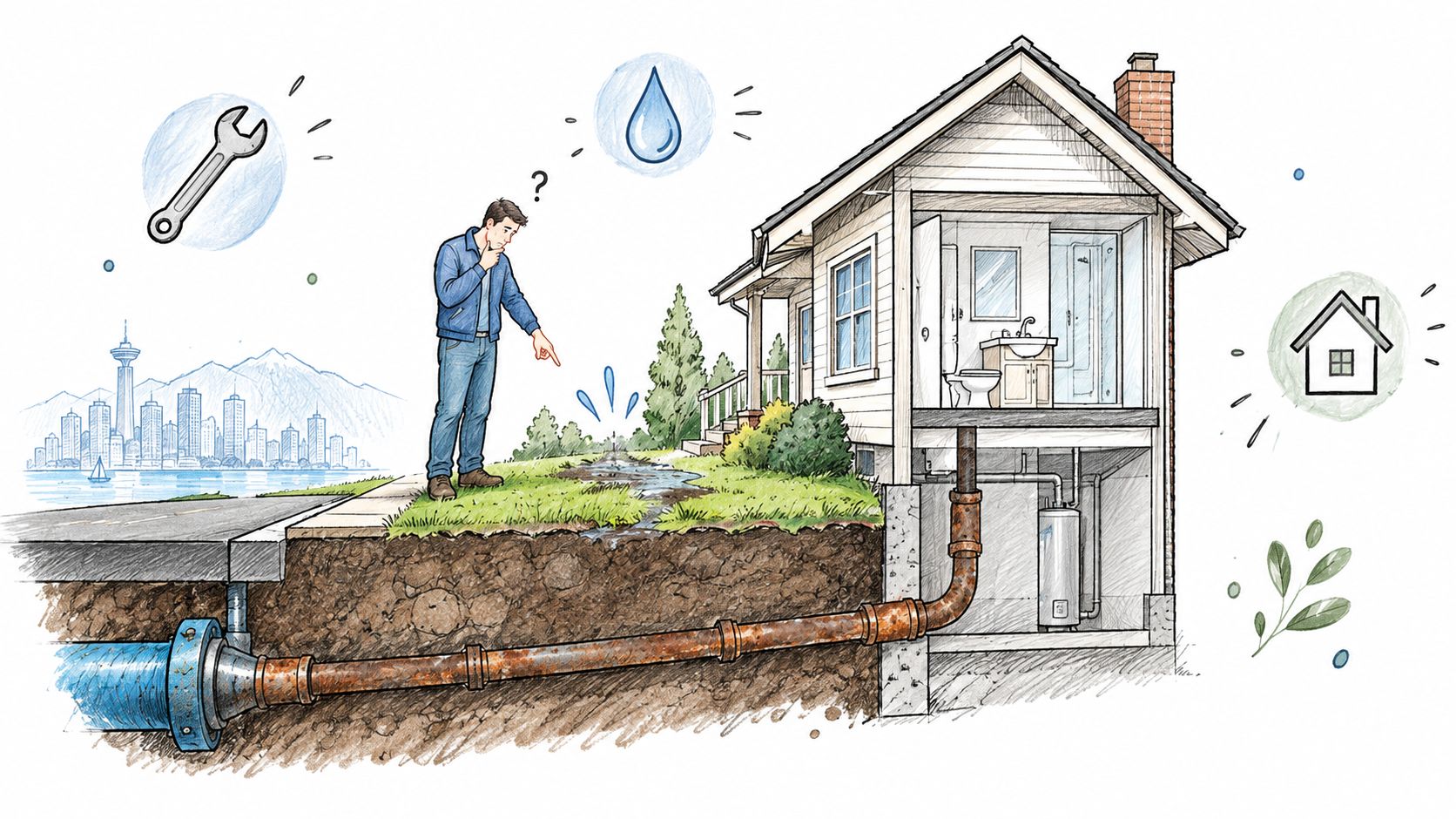
Dense lots change the job. A detached home in Richmond may have landscaping, paving stones, and a narrow side yard. A Vancouver commercial site may have limited parking, shared access, and other buried utilities close to the service path. In both cases, the pipe itself is only part of the decision. Access, restoration, permits, and testing often shape the project just as much as the excavation.
Emergency patching versus planned replacement
A small repair can make sense when a single damaged section is easy to reach and the rest of the line is in good condition. But repeated leaks usually tell a different story. Once a buried service line starts failing in more than one spot, owners often spend money reopening the same ground instead of solving the root problem.
Practical rule: If a line has become a repeat problem, treat it like a worn-out appliance cord, not a one-time puncture. The visible leak is often only the part you can see.
Why delay gets expensive
Delay doesn't just risk a bigger break. It can also expand the scope of restoration, affect tenant access, and force after-hours decisions. For homeowners, that often means paying for urgent work under pressure. For strata and small commercial sites, it can mean coordinating residents, tenants, irrigation, and building access on short notice.
A practical example. A Richmond owner notices low pressure at two fixtures and a constantly damp strip of grass between the sidewalk and foundation. The cheapest-looking option is a spot repair. But if the line is older and the leak sits under a finished walkway, a full replacement may be the cleaner long-term call. That's especially true when the property owner wants to avoid reopening the same surface later.
How Your Water Service Line Works and Why It Fails
On a Metro Vancouver property, water reaches your taps through two different systems that people often blend together. The city main is the larger public pipe in the street. The private water service line is the smaller buried pipe that branches off that main and runs to your house, strata building, or small commercial unit.
That ownership line matters. If the city replaces a water main on your street, that does not automatically mean your private service line gets replaced too. On tight lots in Vancouver, Burnaby, Richmond, and the North Shore, that distinction affects who pays, who permits the work, and which part of the site gets opened or drilled.
Your service line works like a pressurized drinking straw buried in the ground. Water leaves the municipal system, passes through the service connection, travels along your private line, and enters the building where it feeds the plumbing inside. If that buried pipe stays full-sized and watertight, pressure at the fixtures stays consistent. If the pipe cracks, scales up inside, or starts leaking at a joint, some of that water is lost before it reaches the building.
Where the trouble usually starts
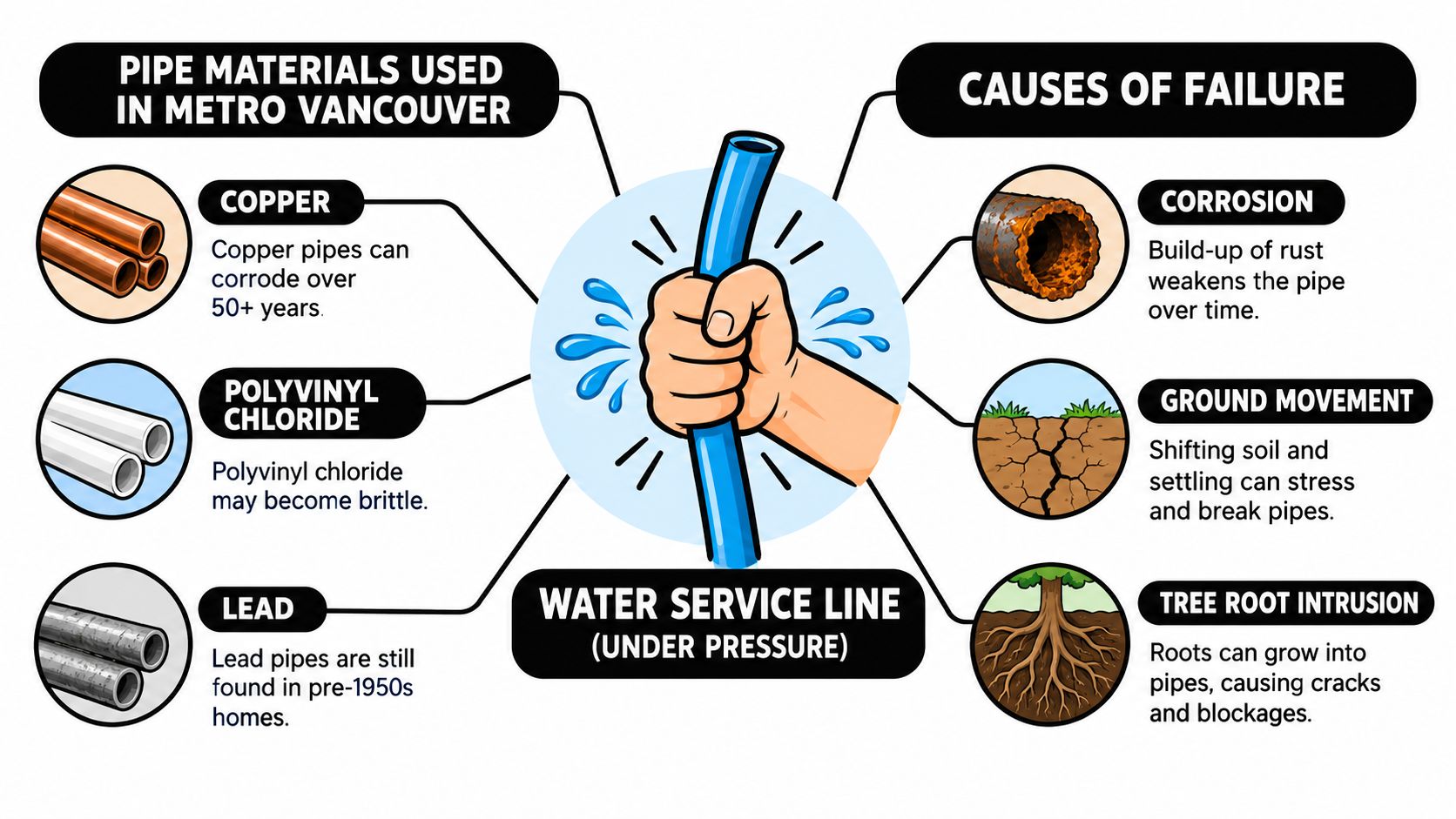
Buried water lines fail for a few repeat reasons, and each one behaves a little differently.
- Age and wear inside the pipe: Older metal lines can corrode or build up scale, much like a kettle that slowly closes in with mineral deposits.
- Ground movement: Soil expands, settles, and shifts. On sloped lots or sites with past excavation, that movement can stress joints and bends.
- Material breakdown: Some older pipes thin out. Others become brittle and crack under stress.
- Poor past repairs or mixed materials: A service line patched several times, or joined from old and new materials without a good transition, often becomes the next leak point.
A detached house and a three-storey strata can show the same symptom, low pressure, but for different reasons. In a house, the service line itself may be restricted. In a strata, the issue may start at the private service, then show up unevenly across multiple units because the building demand is higher. That is why diagnosis has to start with the route water takes from street to building, not just with the fixture that complains first.
Why this matters more on dense Metro Vancouver sites
On many local properties, the pipe route is not a straight shot across open lawn. It may pass under a front walk, retaining wall, planter, parking stall, or a narrow side yard shared with gas, power, telecom, and drainage. For strata and small commercial sites, the service may also cross common property before entering a mechanical room.
That layout affects failure risk. A mature tree root zone, old concrete, or repeated vehicle loading over a buried line can shorten the life of the pipe or make repairs less durable. It also affects the replacement decision later, because the best method is not only about the pipe material. It is also about access.
Here's a useful visual before going deeper:
What plumbers find once the ground is open
Records are often incomplete, especially on older homes and smaller multi-unit buildings. A property owner may believe the line is copper, then excavation reveals galvanized steel near the foundation, or an older branch connection that was never updated. That surprise changes the scope in practical ways. It can affect which fittings are allowed, how much pipe should be replaced, and whether a partial repair makes sense at all.
British Columbia plumbing rules support removing unsafe legacy components instead of leaving them tied into a new water service. The code update notes that lead waste pipe and fittings must not be used in a water system or as a building sewer. The plain-language takeaway is simple. If old lead-era or otherwise unsuitable piping is uncovered near the entry point, connecting brand-new pipe to that weak section usually means the job is only half solved.
A practical example. A Vancouver homeowner approves replacement because pressure has dropped throughout the house. Once excavation reaches the foundation wall, the crew finds an older undocumented branch segment near the building entry. Replacing only the visible failed stretch would leave the oldest and least reliable section in place, so extending the replacement to the proper connection point is usually the cleaner long-term repair.
Signs You Need Water Line Replacement and How to Confirm Them
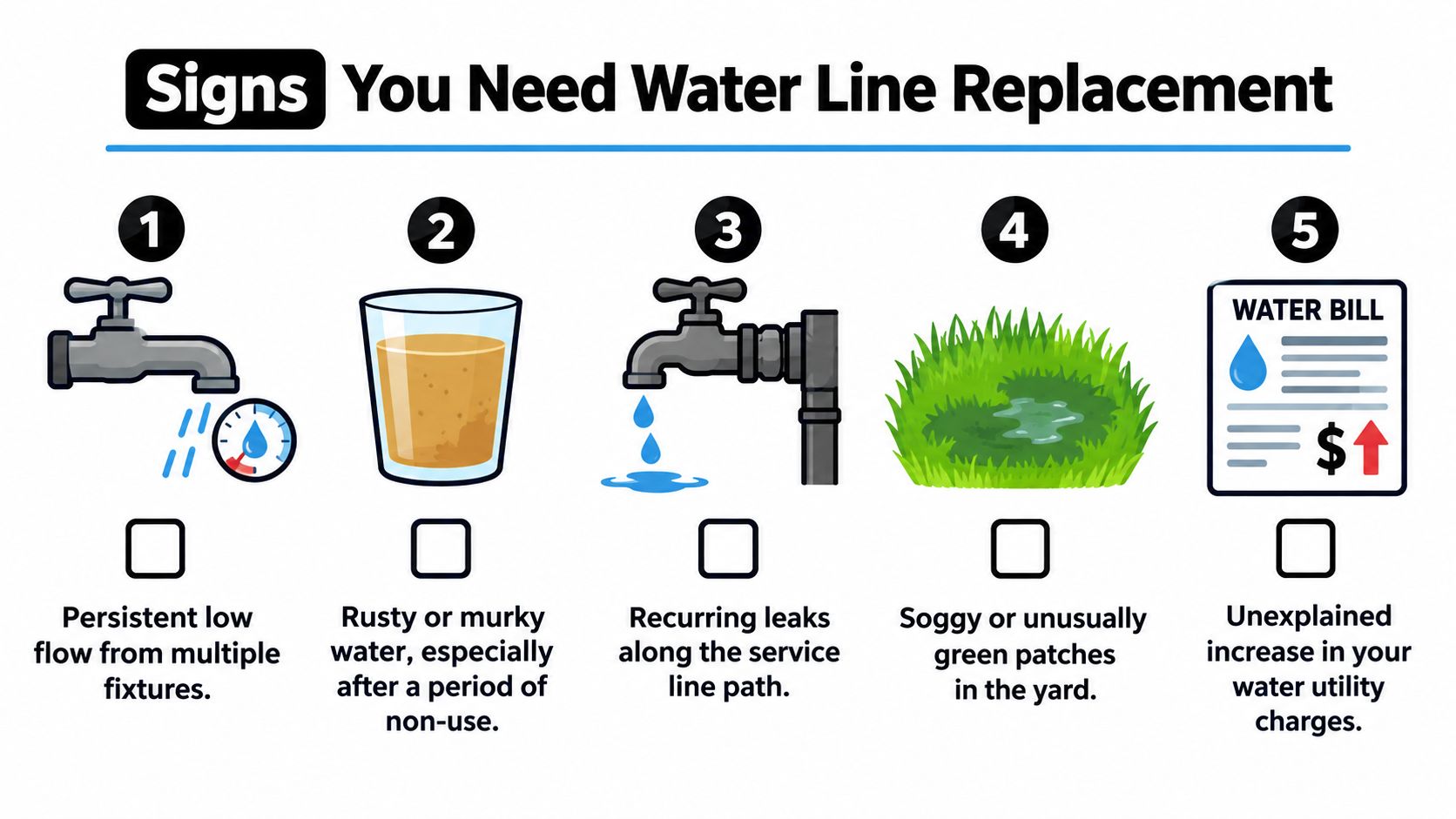
A buried water line usually gives warnings before it fails completely. The issue is that those warnings can look unrelated at first. One day it's low pressure. A week later it's discoloured water. Then the lawn stays wet even when it hasn't rained.
Symptoms that deserve attention
Watch for patterns, not just isolated annoyances:
- Low pressure across multiple fixtures: If the whole building feels weak, the problem may be upstream of indoor plumbing.
- Murky or rusty water: That can point to disturbance or deterioration in the service path.
- Recurring leaks: One repair is a repair. Several repairs start to look like replacement.
- Wet or unusually green patches: Buried leaks often show themselves through the soil first.
- Unexpected billing changes: A hidden leak can run for a long time before anyone sees surface water.
How plumbers confirm the problem
On pressurised water lines, diagnosis usually relies on outside testing rather than the type of camera inspection people know from drains. A plumber may use acoustic leak detection, pressure testing, and site tracing to narrow down where water is escaping and whether the line still makes economic sense to repair.
The bigger decision isn't only “where is the leak?” It's “what does this leak say about the rest of the line?” That's where repeated failure matters. Metro Vancouver planning gives a useful asset-management lens here. Metro Vancouver's water asset report states that the system requires approximately CAD 263 million in average annual renewal spending to maintain a minimum physical condition score of 3, or Fair, which shows that replacement planning is driven by renewal pressure, not only emergency failures in the Metro Vancouver asset benchmark referenced here.
When replacement is the sensible choice
Replacement often becomes defensible when:
| Situation | Repair may work | Replacement often makes more sense |
|---|---|---|
| Single accessible leak | Yes | Sometimes |
| Repeated breaks on same run | Less likely | Yes |
| Older material discovered | Sometimes | Often |
| Surface restoration is expensive | Maybe | Often, to avoid digging twice |
A service line doesn't have to be fully collapsed to justify replacement. Repeated failures and difficult access can make replacement the lower-risk option.
A practical example. A strata manager logs multiple service issues in one season. Residents report pressure swings, landscaping stays soggy near the same path, and the building has already paid for one excavation. At that point, the question isn't whether a plumber can patch another spot. The better question is whether the property should keep reopening the same area or replace the run once and restore it properly.
Comparing Open Cut and Trenchless Water Line Replacement Methods
A common Metro Vancouver scenario goes like this. The leak is on the private service line, not the city main, and the pipe crosses a narrow front yard, a driveway, or a shared access path. The replacement method matters because you are not just choosing how to install pipe. You are choosing how much of the site gets opened, how access will be managed, and how much restoration work follows.
Open cut and trenchless both replace the same private water service line. The difference is the route the crew takes to get there. Open cut is like opening the whole zipper so you can see the full length of the pipe. Trenchless works more like threading a new line through selected entry points when site conditions allow it.
What open cut means on a real property
Open-cut replacement uses excavation along most or all of the pipe route. That gives the crew direct sight of the line, the bedding beneath it, and the tie-in points at each end. On some properties, that visibility is a practical advantage, especially if the pipe route is uncertain, the line is shallow, or other buried services need to be exposed carefully.
It is often the simpler method to explain and inspect. You can see what was removed, what was installed, and what needs to be rebuilt above it.
The trade-off is surface restoration. On a detached house, that may mean a walkway, fencing, planting beds, or concrete removal. On a strata or small commercial lot, it can mean blocked stalls, rerouted pedestrians, bin access problems, or a temporary loss of service access to one side of the property.
What trenchless changes
Trenchless replacement limits continuous digging by working from smaller access pits or a bored path, depending on the approved method and the actual site conditions. On dense Vancouver-area lots, that can be useful where the line passes under a driveway, near retaining walls, beside mature trees, or across areas that are expensive to rebuild.
The appeal is easy to understand. Less surface opening usually means less restoration between the start and end points.
But trenchless is not magic. The crew still needs room for equipment, a workable entry and exit path, and enough certainty about the route to avoid conflicts with other underground services. If the line has sharp changes in direction, unknown obstructions, or difficult tie-in conditions at the building, open cut may still be the cleaner and lower-risk choice.
A Canadian cost guide notes that total water line replacement pricing varies widely by run length, access, and installation method, and that trenchless boring is commonly priced by the linear foot according to this Canadian water line replacement cost guide. On many Metro Vancouver lots, the comparison is not pipe versus pipe. It is excavation plus restoration versus specialized equipment plus reduced surface rebuilding.
Open Cut vs Trenchless for Vancouver Lots
| Factor | Open Cut | Trenchless |
|---|---|---|
| Surface disruption | Higher along the route | Lower between access points |
| Visual access to full trench | Excellent | Limited compared with full excavation |
| Driveway and yard restoration impact | Often significant | Often reduced |
| Fit for tight urban lots | Depends on access and dig area | Often useful where surface restoration is difficult |
| Cost drivers | Excavation, disposal, and restoration | Equipment, boring conditions, and access pits |
| Best fit | Open yards, short direct runs, uncertain routes, or planned surface work | Finished driveways, dense sites, strata, and small commercial access concerns |
Here is where owners often get tripped up. Trenchless can cost more as a line item for installation, yet still cost less overall if it avoids cutting and rebuilding concrete, disturbing shared access routes, or reopening finished site features. Open cut can be the better value if the route is clear, the surface is already slated for replacement, or the crew needs full exposure to deal with unknown conditions.
A practical example helps. A Surrey homeowner has a service line running under a finished driveway. If the private line can be replaced trenchlessly, the quote may look higher at first glance than a basic excavation price. Once concrete removal, hauling, and rebuilding are added to the open-cut option, the comparison often changes.
On a strata site, the same decision gets broader. If an open trench affects resident entry, visitor parking, waste pickup, or ground-floor commercial access, those operational costs belong in the decision too, even if they do not appear on the plumbing line of the estimate.
Permits Codes and Inspections for Water Line Replacement
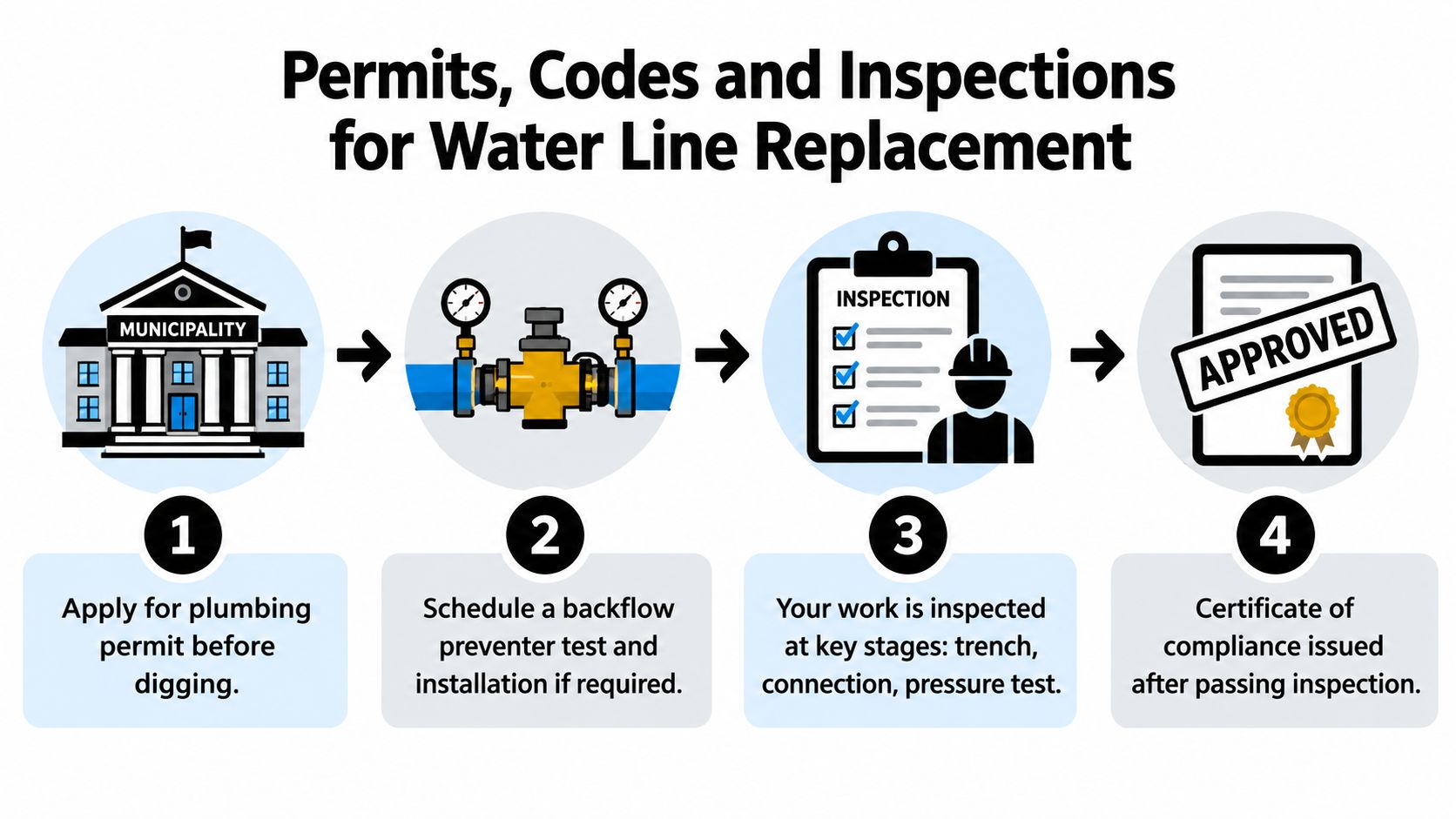
A water line replacement can be installed neatly and still stall at sign-off if the paperwork is wrong. On Metro Vancouver sites, that problem shows up fastest on tight lots, strata properties, and small commercial buildings where one missed permit or test can delay reoccupancy, irrigation use, tenant access, or final approval.
Start by separating the city main from your private service line
This distinction causes a lot of confusion.
The city water main is the public pipe in the street. Your water service line is the private pipe that branches off and carries water from that public system to the home, strata building, or commercial unit. If the municipality is replacing a main on your block, that does not automatically include the private section serving your property. Owners and strata councils often assume the whole route is covered because work is happening at the curb. In many cases, it is not.
That is why permit responsibility matters. Public-side work is handled through the municipality and its contractors. Private-side replacement usually needs the owner's contractor to pull the required permit and book inspections.
The permit usually comes before any digging or boring
In Burnaby, plumbing work on a water service line falls under permit requirements set out in the city's plumbing bylaw under Burnaby's plumbing bylaw requirements. In plain language, replacing an underground water service is still plumbing work, even if a large part of the job happens outside.
For a detached homeowner, the plumber or excavation contractor often handles the application. For a strata manager, the process is broader. Someone may also need to coordinate resident notices, access to mechanical rooms, shutoff timing, protection for shared walkways, and permission to work near parking or loading areas.
Dense Metro Vancouver sites add another layer. If the crew needs to open a sidewalk, occupy part of a lane, or work close to other buried utilities, the plumbing permit may be only one part of the approval package.
Trenchless can reduce surface disruption, but it does not remove permit and inspection steps
Owners sometimes hear “trenchless” and assume the administrative side gets simpler because there is less excavation. The surface impact may be smaller, but the job still has to meet code, utility clearance requirements, and inspection rules.
Open-cut replacement gives inspectors direct visibility because the pipe trench is exposed. Trenchless work can be a better fit for finished driveways, narrow side yards, and strata access routes, but the contractor still needs to document the route, connection points, depth, and materials clearly. On a crowded lot, that clarity matters because several trades and authorities may be looking at the same small area.
A good comparison is electrical work behind drywall. Fewer holes in the wall does not remove the need to verify what was installed.
Backflow devices bring their own testing schedule
If the replacement includes a backflow preventer, that device needs more than installation. It also needs field testing at the required times.
This comes up often on irrigation systems, fire protection connections, and some mixed-use or small commercial properties. The backflow assembly is there to stop water from reversing direction and carrying contaminants into the potable system. It works like a one-way gate, but that gate has to be tested to confirm it closes and seals correctly.
For owners, the practical point is simple. Do not treat backflow testing as separate from the replacement project. It should be planned, booked, and documented as part of closeout, then added to the property's ongoing maintenance calendar.
Inspections are easier when the contractor plans the whole sequence
Inspection delays usually come from timing, not from the pipe itself.
A typical private-side replacement may involve pre-work utility locates, permit issuance, municipal or third-party inspection points, pressure testing or other verification, backflow testing if applicable, and restoration approval where required. On a house lot, that sequence may be fairly straightforward. On a strata or small commercial site, access windows and shutoff notices often control the order of work just as much as the plumbing crew does.
A practical example helps. A Burnaby strata replaces a failing domestic service line that crosses a shared driveway and also serves an irrigation connection. The contractor confirms the work is on the private side, pulls the plumbing permit before installation, coordinates the building shutoff window, installs the new line, arranges the required test for the backflow assembly, and keeps the records for future annual testing. That sequence avoids a common problem, where the pipe is in the ground but the site cannot be fully signed off because one required test was left for later.
Good permitting is not glamorous. It is the part that keeps a water line replacement from turning into two jobs instead of one.
Timeline Costs and Pre and Post Work Steps to Plan For
A common Metro Vancouver scenario goes like this. A homeowner or strata council expects one day of digging, one new pipe, and then life returns to normal. The actual project often behaves more like a small sequence of jobs linked together. The pipe installation may be the shortest part.
On a detached lot, the schedule is usually shaped by permit timing, utility locates, site access, and the shutoff window. On a strata or small commercial site, add resident notices, driveway access, loading areas, and restoration approvals. Dense lots change the math. A trenchless job can shorten surface disruption, but it still needs launch and receiving points, room for equipment, and a clear path for the new line.
What usually sets the timeline
The easiest way to plan is to break the job into phases.
Before work starts, expect time for:
- Confirming the replacement limits: The contractor should identify where the private service line begins and where the city main or municipal connection responsibility ends.
- Locates and site review: Gas, hydro, telecom, irrigation, and drainage conflicts need to be checked before excavation or drilling.
- Permit approval: The permit is what allows the physical work to proceed. Booking the crew before approvals are in place often causes rescheduling.
- Method selection: Open cut may be faster on a simple lawn frontage. Trenchless may save a driveway, shared access route, or finished landscaping on a tight Vancouver lot.
- Shutoff planning: Houses need a practical outage window. Strata and commercial sites also need notices, access coordination, and sometimes staged water interruptions.
During installation, time is used on:
- access setup
- excavation or trenchless entry points
- old line isolation
- new line installation
- connection and pressure verification
- inspection steps where required
- temporary or final surface restoration
Here is the part many first-time owners miss. Two sites can need the same length of pipe replaced and still have very different schedules. A straight run across open soil is one kind of job. A line under a shared driveway, near trees, beside other utilities, or through a small commercial frontage is another.
How method choice affects the calendar
Open cut works like opening the full zipper on a jacket. You can see the whole path, but you disturb everything above it. On a larger or simpler lot, that can be the most direct route. On a dense site, open cut may add time for saw cutting, spoil removal, traffic or pedestrian management, and surface rebuilding.
Trenchless works more like replacing a cable through a conduit. Surface disruption is smaller, but setup and alignment matter more. If the line path is suitable and access pits can be placed well, trenchless can reduce restoration time. If the site is cramped or the alignment is poor, trenchless can lose that advantage quickly.
For Metro Vancouver strata and small commercial properties, the best method is often the one that reduces site conflict, not just the one that reduces digging.
Cost planning should include the pipe and the ripple effects
Owners usually ask for the pipe replacement price first. Fair question. But the full budget often includes several smaller items around the pipe itself.
Common cost drivers include:
- permit fees
- utility locates or private locate support
- access constraints on tight lots
- concrete, asphalt, paver, lawn, or planter restoration
- traffic or pedestrian control where needed
- after-hours shutoff coordination
- longer runs or difficult routing
- testing and documentation after installation
A practical example helps. A single-family home in East Vancouver may have a short service line but an expensive driveway crossing. A small Burnaby strata may have a moderate pipe run, yet the bigger cost issue is preserving shared access and coordinating notices for several units. The trenchless price can be higher at the installation stage and lower at the restoration stage. Open cut can be the reverse. That trade-off should be priced before work starts, not discovered after the trench is open.
Pre-work steps that prevent expensive surprises
Good preparation works like laying out tools before opening a wall. It saves time because the crew is not solving preventable problems mid-job.
Before replacement day, owners should ask for:
- A clear start and end point for the new line. “From the meter to the building entry” or “from the municipal tie-in at the property line to the mechanical room” is much better than “replace water line.”
- A shutoff plan. Include date, time window, who is notifying occupants, and what happens if the shutoff runs long.
- An access plan. Confirm gates, parking stalls, drive aisles, storage areas, and any surfaces that need protection.
- A restoration list. Soil and sod are different from broom-finished concrete, stamped concrete, asphalt, or unit pavers.
- A contingency note for hidden conditions. Buried concrete, abandoned lines, roots, and unmarked utilities are common reasons scope changes on older properties.
For strata managers, one more item matters. Decide in advance who signs off on field changes if the crew uncovers a routing problem. Waiting for a committee response while the water is off is rarely a good operating plan.
Post-work steps are part of the job, not an afterthought
The project is not finished when water starts flowing again.
After installation, plan for:
- System flushing: New work can stir up scale or sediment, especially in older buildings.
- Pressure and leak verification: This confirms the new service is holding as intended.
- Required sampling or follow-up testing where older materials are involved: Health Canada notes that full lead service line replacement is the most effective and permanent way to significantly reduce lead at the tap, and advises follow-up sampling after replacement, with continued monitoring until levels stabilize in Metro Vancouver's water asset report.
- Inspection sign-off and recordkeeping: Keep permits, test results, as-built notes if available, and restoration records.
- Early-use checks inside the building: Run fixtures, check pressure at busy periods, and confirm there is no debris at aerators, strainers, or fill valves.
That last step matters more on strata and small commercial sites than many guides admit. A new private service line can be installed correctly, yet one clogged fixture strainer or an untested downstream device can trigger callbacks and confusion. Closeout records help separate pipe work from unrelated fixture issues.
A simple planning rule
If you want a realistic timeline and budget, treat water line replacement as three linked phases. Preparation, installation, and closeout. Owners who plan for all three usually get fewer surprises, cleaner handoff records, and a much easier first week after the water comes back on.
How to Choose a Qualified Contractor and Next Steps
A good contractor does more than replace pipe. They help you confirm where the problem starts, who owns that section, which installation method fits the site, and what has to happen after the water is turned back on.
That matters a lot in Metro Vancouver. On a tight city lot, a strata driveway, or a small commercial frontage, the hardest part is often not the pipe itself. It is fitting the work around limited access, municipal rules, other buried services, tenants, and restoration.
Start with the ownership line
Before you compare quotes, ask one simple question. Is the problem on the city main, or on the private water service line that runs from the property line into the building?
Owners and strata councils get tripped up here all the time because contractors, residents, and even invoices sometimes use the wrong terms. “Water main,” “service line,” and “supply line” are not interchangeable in practice. The city main is the municipal pipe in the street. Your private service line works like the branch that feeds one building from that larger trunk. If the quote does not clearly state where the replacement begins and ends, you are not comparing prices on the same job.
What a qualified contractor should explain clearly
A qualified contractor should be able to walk you through the job in plain language, the way a good electrician explains a panel upgrade. You should leave that conversation knowing what failed, how they confirmed it, what method they recommend, and what loose ends remain after installation.
Ask about these points:
- Exact scope: Which section is being replaced, from which connection point to which entry point into the building.
- Private versus municipal boundary: Who is responsible for each segment, and whether any city coordination is needed at the property line or curb stop.
- Method choice: If trenchless is proposed, why it suits your site, what launch and receiving pits are needed, and when open-cut is the better choice.
- Site limits: How the crew will work around narrow side yards, retaining walls, parking areas, trees, or shared strata access.
- Diagnosis: How they confirmed the cause, such as leak location, pipe material, pressure loss, or an aging line that is failing in more than one spot.
- Permits and inspections: Who applies, who books inspections, and who coordinates shutoffs if required.
- Restoration: What is included for concrete, asphalt, pavers, landscaping, irrigation, and surface cleanup.
- Closeout steps: What post-work pressure testing, flushing, sampling, or backflow-related checks apply to your building.
One practical local example is Encano Plumbing & Drainage Ltd., which handles water supply line replacement, leak detection, and trenchless-related plumbing work in Greater Vancouver. The useful question is not just who can dig or pull pipe. It is who can define the private-side scope properly and finish the job with the right permit, inspection, and testing steps.
Red flags that usually lead to change orders or callbacks
Some warning signs show up before the work starts.
| Red flag | Why it matters |
|---|---|
| Uses “water main” and “service line” as if they mean the same thing | Ownership, permit scope, and responsibility may be unclear |
| Recommends trenchless without discussing access pits or site obstacles | The method may not actually fit the lot |
| Gives a low pipe price but says little about restoration | Total project cost may rise later |
| Avoids permit or inspection questions | Approval delays or compliance issues can land on the owner |
| Suggests partial replacement without explaining remaining old material | You may keep the weakest section in service and face another failure |
Here is a common real-world comparison. A strata manager receives two proposals for an older building with a leaking private service line under a shared driveway. One quote is shorter and cheaper, but it is vague about where the line starts and ends, says little about restoration, and does not explain why trenchless would work on that site. The second quote maps the private-side run, explains the trade-off between two small pits versus a longer open trench, lists permit handling, and includes post-work testing and closeout records. That second quote usually gives the owner fewer surprises because it prices the whole job, not just the pipe installation.
Next steps if you are deciding now
Keep the decision process simple.
First, confirm whether the issue is on the private service line or the municipal side.
Second, get a written diagnosis in plain language. You should be able to point to the failure location, the pipe material, and the reason replacement makes more sense than another spot repair.
Third, compare methods based on total site impact. On dense Metro Vancouver properties, the better choice is often the one that balances excavation, access limits, restoration, tenant disruption, and permit handling, not the one with the lowest excavation number on page one.
Fourth, ask what the handoff package includes after the install. For strata and small commercial sites, that should include permit sign-off information, test results where required, and clear notes on any remaining downstream plumbing issues that are outside the service line work.