
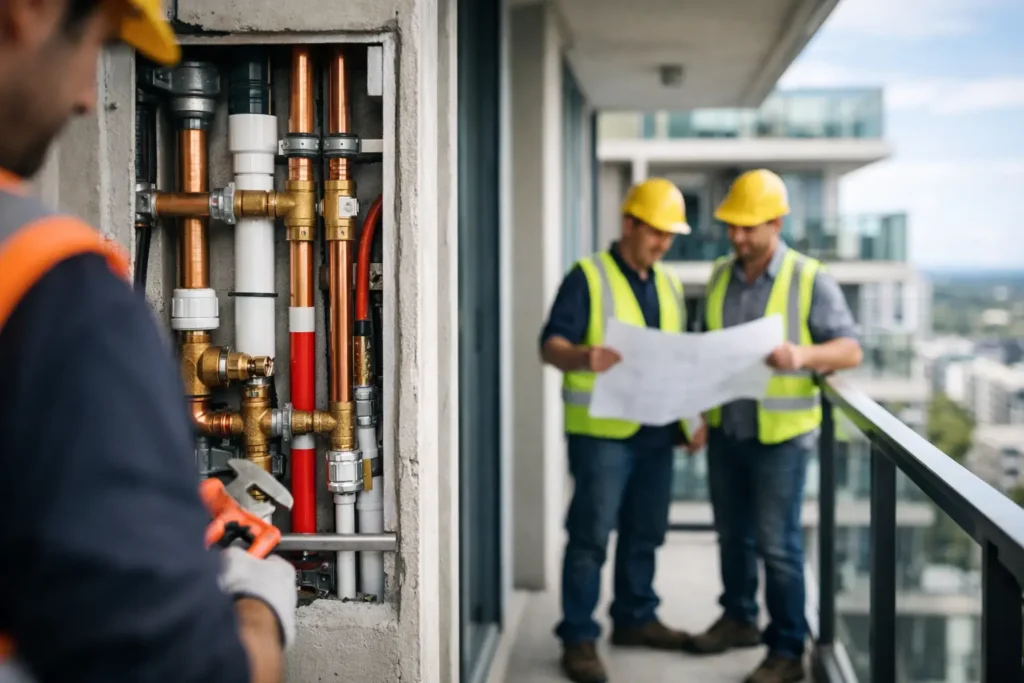
A leaking pipe behind one kitchen wall is annoying. The same problem repeated across dozens of units is a building issue, a budget issue, and a resident communication issue all at once. That is why a strata repiping project example is useful – it shows what the job actually looks like when an aging multi-unit building needs more than a patch.
For strata councils, property managers, and owners, repiping is rarely about one dramatic failure. More often, it starts with a pattern. Pinhole leaks show up in stacks. Water pressure becomes inconsistent. Shutoffs stop working properly. Insurance concerns start creeping into meetings. At that point, the question changes from, “Can we repair this one section?” to, “What would a full replacement involve, and how disruptive will it be?”
A realistic strata repiping project example
Imagine a 42-unit, three-story strata building built in the late 1980s. The domestic water piping is original copper, and over the past two years the property has dealt with recurring leaks in ceilings, mechanical spaces, and inside unit walls. Some repairs have been straightforward. Others have required drywall opening, emergency shutoffs, and restoration work that costs more than the plumbing itself.
The council brings in a plumbing contractor to assess the pattern, not just the latest leak. After reviewing repair history, visible corrosion, pipe age, and access points, the recommendation is full domestic water repiping in phases. The reason is simple: once leaks become frequent and show up in different areas, isolated repairs can turn into a costly cycle.
In this example, the building still has functional drainage lines, so the project is limited to hot and cold domestic water piping, shutoff upgrades, and fixture reconnections where needed. That matters because a full building repipe can mean very different things depending on whether water supply lines, drain lines, or both are being replaced.
What the initial assessment covers
A proper review usually starts with more than a quick look in one mechanical room. The contractor needs to understand pipe material, routing, access limitations, unit layouts, and the condition of valves and branch lines. In a strata setting, one of the biggest practical questions is how much of the work can be done with minimal wall opening and minimal resident disruption.
The assessment also helps identify trade-offs. For example, repiping through corridors and common spaces may simplify some sections but can mean visible restoration work. Routing through units may reduce some common-area opening but requires careful scheduling with occupants. There is no one-size-fits-all answer. The right plan depends on the building.
How the project is scoped
In this strata repiping project example, the final scope includes replacing vertical risers, horizontal distribution lines, in-suite branch lines to kitchens and bathrooms, and aging shutoff valves. New isolation valves are added where practical so future maintenance does not require shutting down the entire building.
This is also where material choice comes into play. Depending on the building, code requirements, budget, and installation path, the contractor may recommend copper or a modern alternative approved for the application. Cost matters, but so does long-term serviceability. A lower installation cost is not always the best value if access, durability, or future repair options are compromised.
The scope should also be clear about what is included and what is not. Plumbing work may involve opening walls and ceilings, but finishing work like drywall, tile, and paint is often handled separately or priced as an allowance. Councils and owners need clarity here early, because misunderstandings about restoration are one of the fastest ways for a project to feel off track.
Unit access and scheduling
For most strata repiping jobs, access planning is as important as pipe installation. In our example building, the contractor creates a phased schedule by stack and floor. Residents are notified well in advance, and each unit receives a window for pre-inspection, active plumbing work, water shutoff timing, and follow-up testing.
A good plan does not promise zero disruption, because that would not be realistic. Instead, it aims to control disruption. Water may be off for part of the day, certain bathrooms or kitchens may be temporarily unavailable, and occupants may need to clear cabinets or closets for access. Clear communication reduces frustration because people know what is happening and when normal use will return.
Property managers usually play a key role here. They help coordinate notices, resident questions, entry procedures, and special accommodations for elderly residents, families with young children, or people working from home.
Timeline for a multi-unit repiping job
A project like this might take six to ten weeks, depending on access, repairs uncovered during demolition, and how many crews are assigned. A small strata with open access and consistent layouts may move faster. An occupied building with customized units, limited mechanical access, and restoration coordination may take longer.
In our example, the project is broken into phases. Week one covers pre-construction review, material staging, resident notices, and access verification. The next several weeks handle risers and in-suite branches by stack. Final weeks cover testing, valve labeling, punch-list corrections, and coordination for wall closure and finish restoration.
The most common cause of delay is not usually the piping itself. It is access. Missed appointments, blocked work areas, after-the-fact resident concerns, and hidden building conditions can all affect the schedule. That is why experienced planning matters. The smoother the communication, the smoother the install.
Budget and cost variables
Every council wants a simple number, but repiping costs depend on several moving parts. Building size is obvious, but so are unit layout, number of wet walls, pipe routing complexity, material selection, after-hours requirements, and restoration scope. A building with straightforward access and repeated layouts is usually more efficient than one with multiple floorplan types and limited service shafts.
In this example, the budget also includes contingency funds. That is smart planning, not pessimism. Once walls are opened, contractors may discover damaged insulation, inaccessible valves, non-standard past repairs, or code-related updates that should be handled while the system is exposed.
A fair proposal should spell out allowances, exclusions, testing procedures, and change-order handling. Transparent pricing matters because strata projects involve many stakeholders. Owners want accountability. Councils want predictable planning. Property managers want fewer surprises.
What residents notice during the work
From a technical standpoint, repiping is about replacing old lines. From a resident standpoint, it is about how livable the process feels. People notice dust control, communication, punctuality, respectful access, and whether crews leave a unit safe and usable at the end of the day.
That is why the best plumbing contractors for strata work are not just good at pipe installation. They are good at occupied-building work. They protect floors, isolate work areas, coordinate shutoffs carefully, and explain what is happening in plain language. Those details build trust, especially when residents are already stressed about construction inside their homes.
Common issues that show up mid-project
Even well-planned jobs can reveal surprises. In older buildings, shutoff valves may fail when operated. Pipe routing may differ from original drawings. Some units may have past renovations that changed access paths behind walls or under sinks. None of that means the project is going badly, but it does mean the contractor needs to adapt without losing control of the schedule.
This is where experience really shows. A team that has handled multi-unit repiping before is more likely to spot issues early, communicate options clearly, and keep the project moving without cutting corners.
How to tell if your strata may be heading this way
Most buildings do not move to repiping after one leak. The warning signs are recurring leaks in different locations, visible pipe corrosion, declining water quality concerns, uneven pressure, failing valves, rising repair frequency, and insurance pressure tied to plumbing claims. If the same issue keeps returning, it is worth looking at the system as a whole.
For buildings in Vancouver and nearby areas, age, usage, and past maintenance history all play a role. A local contractor who understands multi-unit plumbing systems can help determine whether targeted replacement is enough or whether a full repipe would save money and disruption over time.
Encano Plumbing & Drainage Ltd. often works with the kind of practical concerns owners and property managers care about most – safety, schedule control, fair pricing, and keeping the building functional while repairs move forward.
A repiping project is never anyone’s favorite capital expense. Still, when it is planned properly, it can replace constant emergency calls with a system the building can rely on again. That peace of mind is usually what makes the project worth doing.