You turn on the shower in a Vancouver morning rush, wait for the usual burst of hot water, and get a stream that's cold, then warm, then cold again. Or nothing happens at all except a blinking code on the front of the unit. That's usually the moment a tankless system stops feeling sleek and efficient and starts feeling like a problem hanging on the wall.
Tankless heaters are a smart setup when they're maintained properly. They save space, deliver hot water on demand, and can last a long time. But when they act up, most homeowners aren't sure if they're dealing with a simple flow issue, a scale problem, a venting fault, or a repair that should never be touched without a licensed technician.
Around Greater Vancouver, I see the same pattern all the time. A homeowner assumes the unit has failed completely, when the actual issue is often narrower than that. Sometimes it's a clogged inlet screen. Sometimes it's mineral buildup. Sometimes it's an ignition or safety issue that needs proper testing right away. If you've got no hot water and need immediate help, start with emergency plumbing support and then work through the basics carefully.
Table of Contents
- Your Tankless Water Heater Is on the Fritz Now What
- Decoding the Signs Common Tankless Water Heater Problems
- Safe DIY Troubleshooting Steps Before You Call for Repair
- Safety First When to Call a Professional Plumber
- Understanding Tankless Water Heater Repair Costs in 2026
- How Annual Maintenance Prevents Costly Breakdowns
Your Tankless Water Heater Is on the Fritz Now What
Most calls start with one frustrating detail. The shower cuts out halfway through. The kitchen tap never gets hot. A tenant says the unit worked yesterday and now shows an error code. The first reaction is usually, “Do I need a whole new heater?” In many cases, no.
A tankless unit fails differently than a storage tank heater. It has sensors, airflow requirements, water filters, burners, safety devices, and narrow internal waterways that react quickly when something is off. That means tankless water heater repair is often more about diagnosis than guesswork.
Practical rule: Don't treat every shutdown like a dead appliance. Treat it like a system asking for the right test.
Here's a common local example. A homeowner in Burnaby gets lukewarm water from two fixtures but not a total loss of hot water. That points me away from “complete failure” and toward restricted flow, scale, or a dirty inlet screen. A different call in Vancouver might involve a unit that tries to fire, clicks, then stops. That pushes the diagnosis toward ignition, gas supply, venting, or a safety lockout.
Before anyone replaces parts, the right approach is to slow down and sort the symptoms. That matters even more in the Lower Mainland, where water quality, building age, vent layouts, and usage patterns vary from one neighbourhood to another. A detached home in Richmond can behave very differently from a strata unit in New Westminster.
Decoding the Signs Common Tankless Water Heater Problems
The biggest mistake homeowners make is lumping every issue into one category: “the heater is broken.” Tankless systems usually give clues before they fail fully. If you read those clues properly, you can often tell whether the problem is maintenance-driven, water-quality related, or a true component failure.
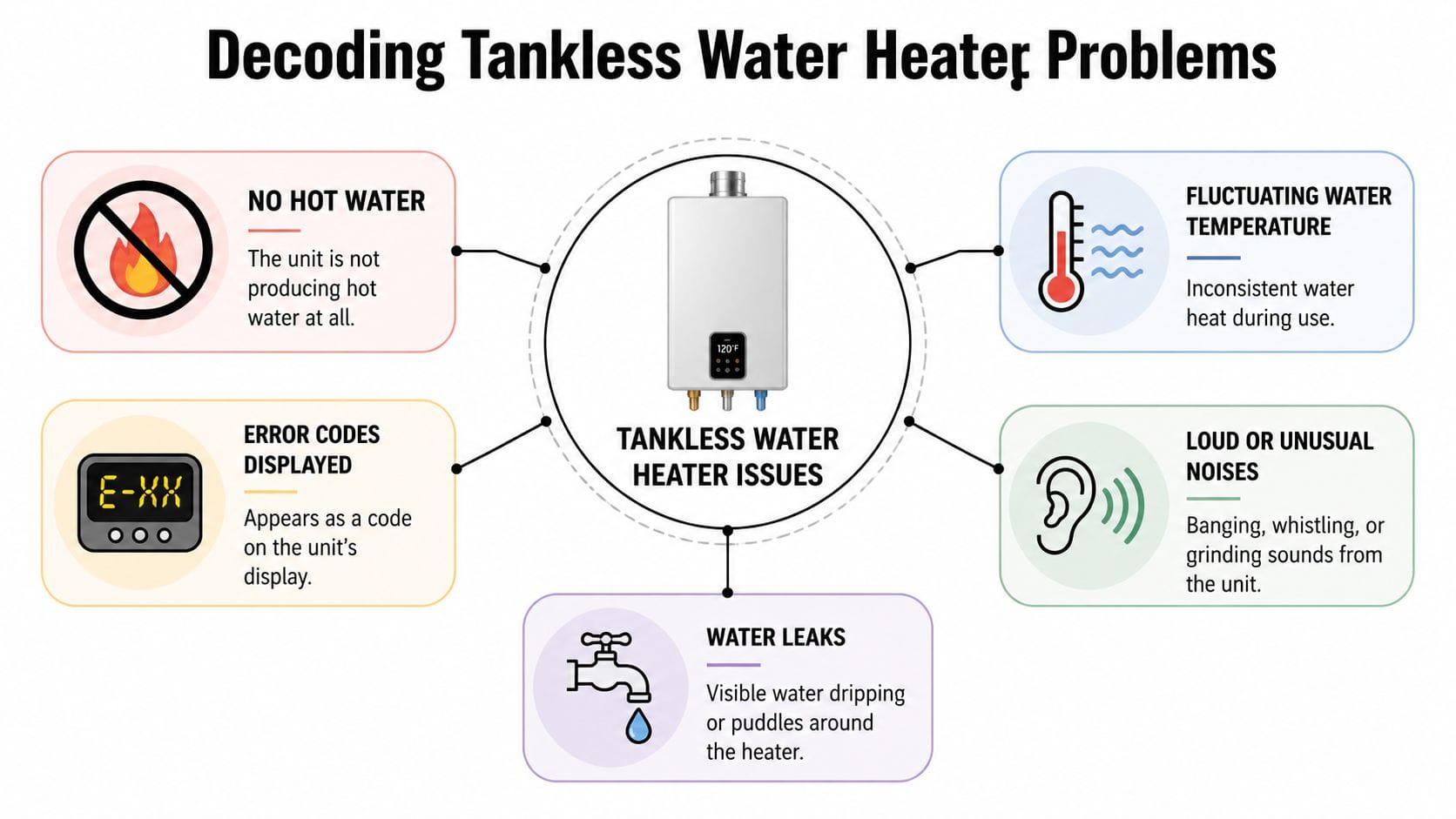
Industry guidance notes that many tankless “repairs” are often maintenance or water-quality problems, with common failures tied to scale buildup, ignition issues, and temperature fluctuations, and repair costs averaging around $600 according to Angi's overview of who fixes tankless water heaters. That's why it helps to think like a technician, not just a frustrated homeowner. If you want a parallel breakdown of heating failures, this guide on why a water heater may stop heating is also useful.
When the water goes hot and cold
Fluctuating temperature is one of the most common complaints. You're in the shower, it runs properly for a minute, then drops cool, comes back, then drifts again.
In practice, that often points to scale buildup inside the heat exchanger, unstable flow, or an early combustion problem. I explain scale to homeowners like plaque in a pipe. The water still gets through, but not the way the system was designed for. Heat transfer becomes uneven, sensors start reacting to bad information, and the unit struggles to keep output steady.
A practical example is a family home using multiple fixtures in the morning. If the unit already has mineral buildup, that extra demand can expose the problem fast. The heater isn't always “dead.” It's struggling.
When there is no hot water at all
No hot water is a different category. If the unit doesn't fire, the fault could be power-related, gas-related, ignition-related, or tied to a safety lockout. Sometimes the display shows an error code. Sometimes the only clue is silence.
Often, homeowners waste time replacing the wrong thing. A failed reset attempt doesn't tell you much by itself. You need to know whether the unit has power, whether water is moving properly, and whether the combustion side is safe.
A tankless heater that won't ignite isn't automatically a bad board or a failed burner. It can also be reacting to something outside the heater, including poor venting or supply issues.
When flow drops noise increases or leaks appear
Low hot-water flow often gets blamed on the municipal supply, but that's not always the actual cause. A dirty inlet filter screen or internal scale can reduce flow enough to affect performance. In a condo, a resident may report that one bathroom seems “fine enough” while another fixture barely warms up. That uneven symptom matters.
Noises matter too. Whistling, hissing, rattling, or odd combustion sounds tell you the unit is under strain or not burning cleanly. If burner flames aren't steady and blue, that can point toward air or venting trouble rather than a simple electronic fault, based on Bosch tankless maintenance guidance.
Leaks are the symptom that should end the DIY conversation quickly. A small drip might be a fitting issue, condensate issue, or relief-valve issue. It might also be a sign that the heater has a larger internal problem. Water around a gas appliance deserves a proper inspection, not guesswork.
Safe DIY Troubleshooting Steps Before You Call for Repair
You turn on the shower before work, the water goes hot for a minute, then turns lukewarm. The display on the heater lights up, maybe flashes a code, and now you are deciding whether this is a simple reset or a service call. That is the right place to slow down.
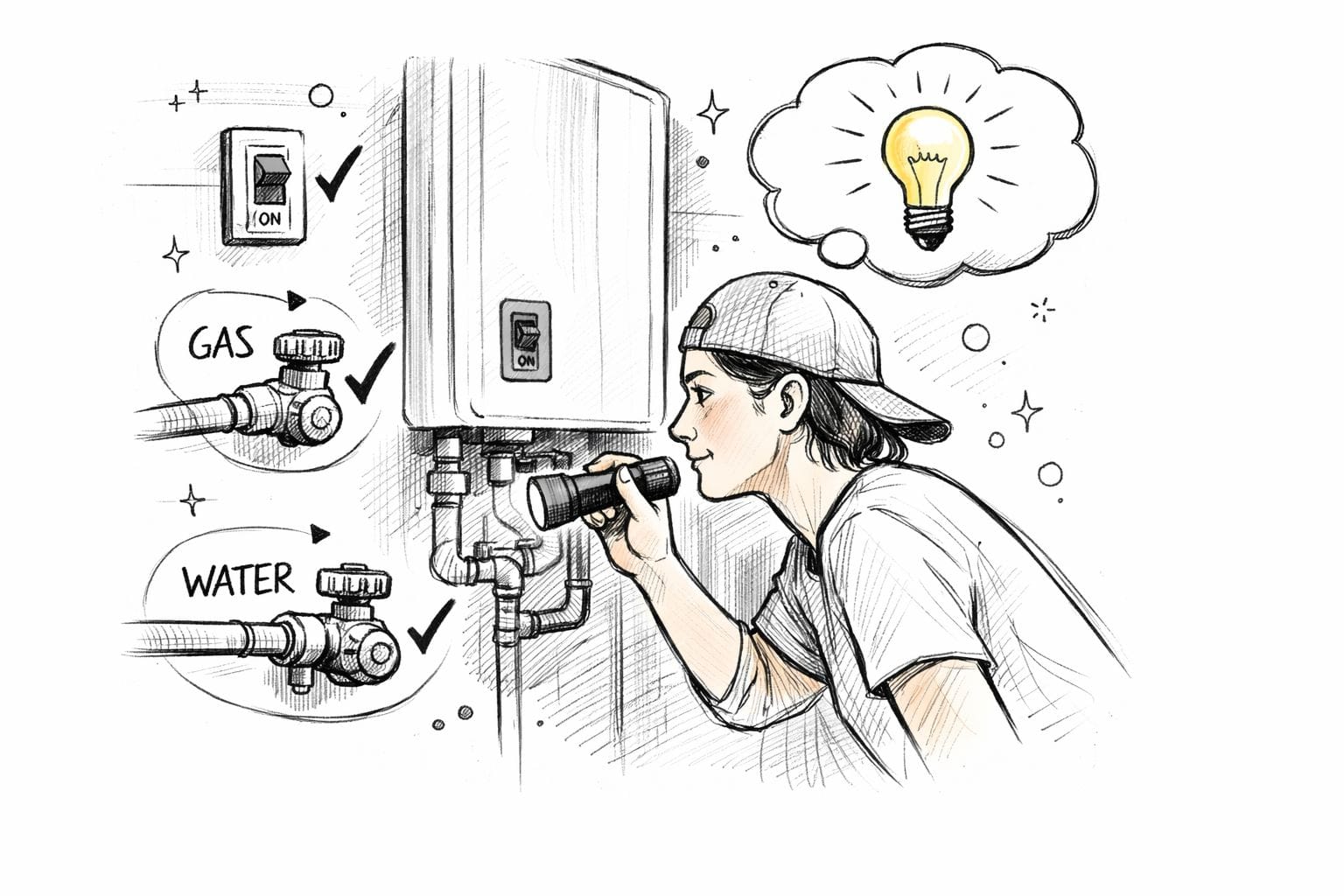
A homeowner can rule out a few outside causes safely. The goal is to confirm power, water flow, and obvious external issues without opening the unit or touching anything tied to gas, combustion, or internal wiring.
In Greater Vancouver, I also tell homeowners to keep local water conditions in mind. Hard water and mineral buildup are common enough to affect tankless performance, especially in homes that are overdue for descaling or have debris collecting at the inlet screen. That can look like a heater failure when the actual issue is restricted flow.
Start with checks outside the cabinet
Stay with simple, external checks first.
- Confirm the unit has power. Check the breaker. If the heater uses a plug, confirm the outlet has power.
- Read the display code carefully. Write down the exact code and match it to your manual. Brand and model matter.
- Check that the visible water valves are fully open. This matters if plumbing work was done recently.
- Confirm the gas shutoff is in the normal open position. If you smell gas at any point, leave the area and call the gas utility or a licensed plumber.
- Run one hot tap at a time. That helps you tell the difference between a whole-unit problem and a fixture-specific flow issue.
One useful clue is whether the problem changes with demand. If the kitchen sink gets hot but the upstairs shower cuts in and out, that points you toward flow, scale, or a fixture-side restriction instead of assuming the heater itself has failed.
What a careful homeowner can inspect
You can inspect around the unit as long as the covers stay on.
- Look at the vent termination outdoors. Check for leaves, nesting material, or other visible blockage.
- Check for recent changes nearby. Stored items, renovations, or exterior work sometimes interfere with airflow around intake or exhaust points.
- Clean the accessible inlet filter screen if your manual gives clear steps for your model. If the filter is hard to reach, stop there.
- Look underneath for moisture. Condensation, drips from nearby piping, or water at the base of the unit should be noted for the technician.
Around Vancouver, the inlet screen check is one of the few DIY steps that can effectively solve the immediate complaint. I have seen units recover after a screen cleaning because debris reduced flow enough that the burner could not keep up. It is still worth booking maintenance if that screen is dirty, because buildup usually has a cause.
DIY boundary: Stop if the task involves removing the front cover, resetting internal parts, disconnecting venting, handling gas fittings, or probing electrical components.
Here's a video that shows the kind of careful inspection mindset that helps before a service call:
Know when a simple check has done its job
A reset can be useful once. Repeated resets are a symptom, not a fix.
Use this quick filter:
- Reasonable to do yourself: checking the breaker, confirming valve positions, reading the error code, clearing visible debris, cleaning an easy-access filter if the manual permits it
- Time to stop and book service: the code returns, hot water fades during use, the unit short-cycles, or performance changes room to room
- Call right away: gas smell, scorching, burnt-wire odor, active leaking, or any sign the venting or combustion is not normal
If you do call for service, give the plumber the exact code, what fixtures were affected, and whether anything improved after your checks. That saves time on diagnosis and helps avoid guessing with parts. Encano Plumbing & Drainage Ltd. handles these calls across Greater Vancouver, and this same prep helps no matter which licensed company you bring in.
Safety First When to Call a Professional Plumber
Some tankless heater issues are inconvenient. Others are unsafe. Homeowners should know the difference.
Any work involving gas combustion, venting, pressure relief components, internal electrical parts, or leak testing belongs with a licensed professional. Manufacturer guidance requires a pressure relief valve rated for 150 psi, along with discharge piping, and recommends sediment traps, isolation valves, and leak testing on gas and water lines according to A. O. Smith's tankless installation guidance. A service visit that only clears a code without checking those connected systems is incomplete.
What crosses the line from homeowner check to licensed repair
The reason isn't just liability. It's because many apparent heater failures come from surrounding conditions. A partially restricted gas supply, trapped air in the water line, a venting fault, or a failing relief valve can mimic a bad internal component.
Here's the practical split.
| Task | DIY Difficulty | Professional Recommendation | Associated Risk |
|---|---|---|---|
| Check breaker or outlet power | Low | Reasonable for homeowners | Low if done externally |
| Confirm visible shutoff valves are open | Low | Reasonable for homeowners | Low |
| Read the display and manual | Low | Reasonable for homeowners | Low |
| Clean accessible inlet screen | Moderate | Acceptable only if the manual clearly allows it | Moderate if reassembled incorrectly |
| Reset the unit once | Low | Fine as a basic check | Low, but repeated resets can hide a bigger fault |
| Open the cabinet and inspect wiring | High | Licensed technician only | Electrical shock and misdiagnosis |
| Work on gas valve, burner, or igniter | High | Licensed technician only | Fire, gas leak, combustion hazard |
| Alter venting or combustion air setup | High | Licensed technician only | Carbon monoxide risk and shutdowns |
| Replace relief valve or test gas leaks | High | Licensed technician only | Pressure and gas safety risk |
| Diagnose heat exchanger faults | High | Licensed technician only | Expensive error and unsafe operation |
If the unit involves gas, flame, pressure, or sealed combustion, “close enough” is not safe enough.
A practical example: a homeowner sees an ignition error and assumes the igniter has failed. A technician tests the system and finds the burner isn't getting proper conditions because the venting path is obstructed. Replacing parts first would waste money and leave the hazard in place.
That's why proper tankless water heater repair is careful work. The right technician doesn't just make the code disappear. They confirm the system can run safely after the repair.
Understanding Tankless Water Heater Repair Costs in 2026
You wake up in East Vancouver, turn on the shower, and the water flips from hot to cold while the unit throws a code you have never seen before. The first question is usually simple. Is this a minor repair, or am I looking at a replacement?
The honest answer is that tankless repair pricing has a wide range because the work can be very different from one call to the next. According to Grand View Research's North America tankless market report, a broad repair range often cited for tankless water heaters is $150 to $1,300 per repair, with a typical repair averaging $600. The same source lists descaling at $150 to $350 and ignition or burner repair at $200 to $800.
In practice, the price often comes down to three things. How long diagnosis takes, whether the problem is scale or a failed part, and whether the technician has to work on the combustion side of the unit.
Lower-cost repairs usually involve a clear fault and good access to the heater. A service call to confirm an error code, clean a manufacturer-approved screen, or address maintenance-related performance issues will usually land near the lower end. Costs rise when the plumber has to test gas pressure, inspect venting, remove internal assemblies, or trace an intermittent fault that only shows up under load.
Here in the Vancouver area, water quality can affect the bill more than many homeowners expect. Hard-water scale can narrow passages inside the heat exchanger and trigger symptoms that look like sensor or ignition trouble. If the unit has gone too long without proper flushing, the repair may involve more labour and there is a higher chance that internal parts have already been stressed. Homeowners who want a baseline can review a practical water heater maintenance guide from Encano before they compare service quotes.
The expensive end of the range is usually tied to major internal work. Heat exchanger problems are a good example. Those jobs can be costly enough that it makes sense to stop and compare repair value against the age of the unit, warranty coverage, and the condition of the rest of the system.
Age matters, but history matters too.
A tankless heater that has been maintained and has one isolated fault is a very different case from a unit with recurring error codes, scale buildup, venting concerns, and overdue service. Guidance cited earlier notes that properly maintained tankless units are commonly expected to last 15 to 20 years. That does not mean every repair is a smart buy. It means the decision should be based on the whole condition of the appliance, not just the number on one estimate.
From a plumber's side, I tell homeowners in Burnaby, Vancouver, and the North Shore to ask one practical question after diagnosis. Are you paying to correct a contained problem, or are you paying to chase symptoms across an aging system? If the fault is isolated, repair is often the sensible path. If multiple issues are stacking up, replacement can be the cheaper choice over the next few years.
How Annual Maintenance Prevents Costly Breakdowns
A common call in Vancouver goes like this. The hot water still works, but showers swing from warm to cool, the unit gets louder, or it starts showing an occasional error code that clears on its own. In many homes, that is the point where a simple maintenance visit could still prevent a larger repair.
Tankless heaters need regular attention because scale, debris, airflow issues, and small wear problems build up slowly. In Greater Vancouver, water conditions can vary by neighbourhood, and homes with harder water or heavy hot-water use usually need more frequent descaling than homeowners expect. Leave that too long, and the heat exchanger works harder, flow drops, and internal parts can be pushed well past normal operating strain.
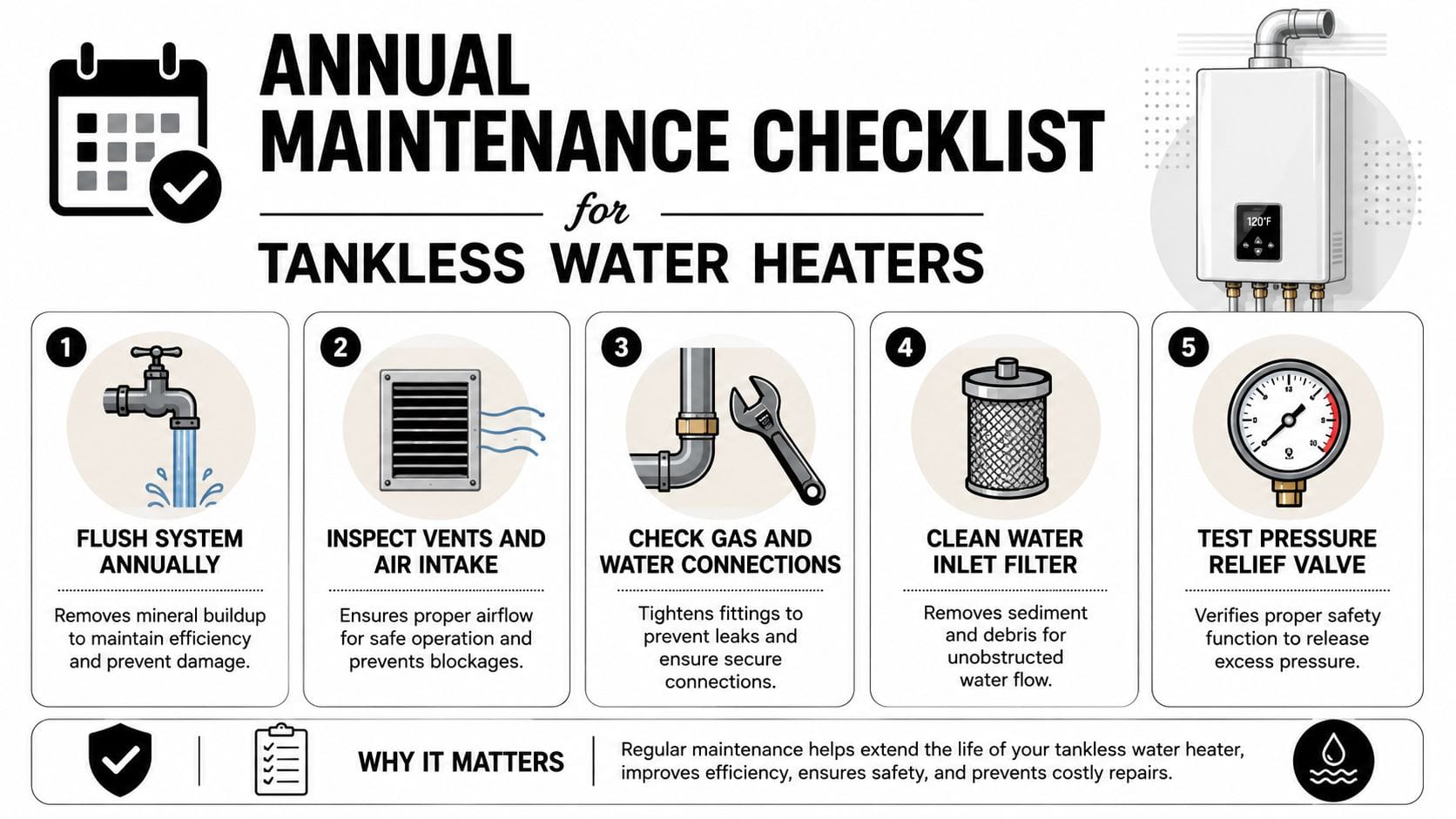
What a proper maintenance visit should include
A proper service visit is methodical. It is not just flushing solution through the unit and pressing reset.
- Descaling the heat exchanger: Mineral buildup reduces heat transfer and can trigger overheating, flow problems, or inconsistent outlet temperature.
- Cleaning the inlet water filter: A clogged screen can cause low flow and nuisance shutdowns that look like bigger mechanical faults.
- Checking burner performance and flame quality: Irregular flame can point to combustion problems that should be handled by a licensed professional.
- Inspecting venting and air intake: Blocked, damaged, or poorly connected venting can create safety risks, not just performance issues.
- Reviewing pressure relief, valves, and visible piping: Small leaks, corrosion, or isolation valve problems are easier to fix before they turn into a no-hot-water call.
Homeowners can still do a few safe checks between service visits. Watch for slower hot-water delivery, listen for unusual fan or ignition noise, look for drips under the unit, and clean any exterior air openings if the manufacturer allows it. For a basic home routine, this guide on how to maintain a water heater properly gives a useful starting point.
Leave the cabinet sealed unless the manufacturer specifically allows homeowner access. Gas connections, combustion components, venting corrections, electrical testing, and internal descaling setup should be done by someone qualified to work on the appliance.
In practice, annual maintenance saves money by catching the small stuff first. A dirty filter is a service item. Scale buildup caught early is often manageable. A venting defect found during inspection can be corrected before it causes repeated shutdowns or unsafe operation.
I see this often in Burnaby, Vancouver, and the North Shore. One household books routine service and gets a straightforward cleaning, inspection, and minor adjustment. Another waits until the unit is locking out, the hot water is unstable, and multiple symptoms have piled up. The second call usually takes longer to diagnose and has a much higher chance of involving stressed internal parts.
Tankless systems are efficient, but they are not maintenance-free. That matters even more in homes dealing with mineral buildup, high usage, or older venting setups.
If your tankless unit is giving you cold showers, unstable temperatures, leaks, or repeated shutdowns, a careful diagnosis matters more than a fast guess. Encano Plumbing & Drainage Ltd. provides tank and tankless water heater service across Vancouver and nearby communities, including repair, maintenance, and emergency plumbing support. If you're not sure whether your issue is a simple maintenance problem or a safety-critical repair, book a professional inspection before the problem gets more expensive or less safe.