

If you're dealing with morning shower traffic, a tank water heater usually makes itself known at the worst time. One person is rinsing off, the dishwasher is running, someone starts laundry, and suddenly the last person in line gets lukewarm water. In Greater Vancouver, that problem often shows up in older detached homes, tight condo utility closets, and rental units where the existing tank is past its best years.
A tankless system changes the way hot water is delivered. Instead of storing a fixed amount and reheating it all day, it heats water only when you open a tap. For many local homeowners, that's where tankless water heater benefits begin. Lower operating costs, more usable space, longer service life, and less worry about a failing tank sitting in a closet or mechanical room.
For strata managers and landlords, the conversation gets even more practical. Peak demand, tenant complaints, maintenance planning, and water waste all matter just as much as efficiency. The right setup can solve real building problems, not just trim a utility bill.
Table of Contents
- Tired of Cold Showers? An Introduction to Tankless Water Heaters
- How On-Demand Hot Water Works
- Unpacking the Financial Benefits Energy and Cost Savings
- Built to Last Lifespan and Day-to-Day Reliability
- Reclaim Your Space Compact Size and Installation Flexibility
- Key Advantages for Strata Managers and Landlords
- Is a Tankless Water Heater Right for You?
- Making the Switch in Greater Vancouver
Tired of Cold Showers? An Introduction to Tankless Water Heaters
A traditional tank heater does one job in a very old-fashioned way. It stores a set volume of hot water, keeps reheating it, and hopes demand doesn't outrun supply. That works until two showers overlap, guests stay over, or a family starts using more hot water than the tank can recover.
A tankless water heater takes a different approach. It heats water on demand, so the system isn't waiting with a full tank in the background. For the homeowner, that usually means steadier comfort and less wasted energy. For a landlord or strata manager, it can also mean fewer complaints tied to timing, storage space, or an aging tank nearing failure.
Practical rule: Tankless works best when the unit is sized correctly for how the home or building actually uses hot water, not just for the square footage on paper.
In Greater Vancouver, that sizing step matters. Condo layouts are tight, many homes have limited mechanical space, and incoming water temperatures are cooler for much of the year. A good tankless installation has to match local conditions, appliance load, and daily usage patterns. When it does, the upgrade can feel less like a luxury and more like fixing a long-standing weak point in the plumbing system.
How On-Demand Hot Water Works
A lot of homeowners hear "tankless" and assume it's complicated. The operating idea is simple.
Tank versus tankless in plain language
A tank water heater is like keeping a big thermos of coffee warm all day. Even when nobody pours a cup, the system still spends energy maintaining temperature. A tankless unit is closer to an espresso machine. You ask for hot water, the unit fires up, and it heats the water as it passes through.
Here's the basic sequence:
- You open a hot tap. That could be a shower valve, kitchen faucet, or washing machine call.
- A flow sensor detects movement. The unit recognises that hot water is being requested.
- The heat exchanger activates. In a gas model, the burner ignites. In an electric model, heating elements energise.
- Water heats as it travels through the unit. It isn't sitting in storage first.
- Hot water goes to the fixture. When the tap closes, the heating stops.
That stop-and-start cycle is the whole advantage. The system works when you need it, then stops when you don't.
Why standby heat loss matters
The biggest efficiency difference comes from standby heat loss. With a tank heater, stored water cools over time, even with insulation. The heater then has to reheat that stored volume, whether anyone is showering or not.
A tankless unit avoids that specific waste because there is no reservoir sitting hot in the background. That's why homeowners often notice the value first on utility bills and daily comfort, not just on spec sheets.
A practical example from local work would be a Vancouver condo owner with a water heater in a hallway closet. The tank takes up the lower half of the closet and cycles on and off all day. After replacing it with a wall-mounted tankless unit, the owner gains storage and no longer has a large vessel reheating water overnight when nobody is using it.
A tankless heater doesn't create unlimited capacity from nowhere. It creates continuous hot water within the flow rate the unit was designed to handle.
That's the trade-off many sales pages gloss over. If the unit is undersized, performance suffers during simultaneous use. If it's selected properly, the system feels perfect.
Unpacking the Financial Benefits Energy and Cost Savings
The strongest case for tankless isn't just that it feels modern. It's that the numbers can support the upgrade when the home is a good candidate.
Start with the visual summary below.
What the efficiency numbers actually mean
For homes using 41 gallons or less of hot water daily, tankless water heaters are 24% to 34% more energy-efficient than conventional tank models, according to U.S. Department of Energy figures cited by Major Energy. The same source says a gas-powered tankless system can lower annual energy costs by about $100, which adds up to over $2,000 across a 20-year lifespan.
For higher-use homes, the gain narrows, but it doesn't disappear. In practical terms, that means the economics often look strongest in homes that use hot water steadily but don't constantly overwhelm the system.
A lot of Greater Vancouver homeowners ask whether those savings are enough to justify the higher installation cost. The honest answer is that it depends on the job. If the house already has a suitable gas setup and venting path, the financial picture is more favourable. If the home needs major infrastructure changes, the payback takes longer.
For a closer look at what affects the upfront side of the equation, it's worth reviewing tankless water heater installation costs.
A short comparison makes the trade-offs easier to see.
Tank vs. Tankless Water Heater At a Glance
| Feature | Traditional Tank Heater | Tankless Water Heater |
|---|---|---|
| Heating method | Stores and reheats a full tank | Heats water on demand |
| Energy use | Loses heat while water sits in storage | Avoids standby heat loss |
| Annual operating savings | Baseline | Gas units can save about $100 annually in qualifying lower-use homes |
| Lifespan | Shorter replacement cycle | Longer service life |
| Space use | Floor-standing and bulky | Wall-mounted and compact |
| Upfront cost | Usually lower | Usually higher |
A video can help if you want to see the concept in action.
A practical Greater Vancouver example
Take a Surrey family with an older gas tank heater that's still working but struggling during busy mornings. If that household falls into the lower daily-use range, the efficiency gain can be meaningful over time, not dramatic in a single month, but noticeable over the service life of the equipment.
In real jobs, I tell homeowners to think about three separate buckets of value:
- Monthly utility relief: Lower operating cost matters most when energy prices stay stubbornly high.
- Longer replacement cycle: You may avoid buying another water heater as soon as you would with a tank.
- Less wasted space: In smaller homes and condos, recovered storage has practical value even if it doesn't show up on a utility bill.
The financial case is strongest when all three line up.
Built to Last Lifespan and Day-to-Day Reliability
A lot of Greater Vancouver homeowners ask the wrong first question. They ask how much a tankless unit might save on the monthly bill. A better question is how often they want to replace equipment, deal with leaks, and book emergency access in a condo or rental.
Why the service life is often better
The U.S. Department of Energy notes that tankless water heaters can last about 20 years, while storage water heaters last 10 to 15 years in many cases, according to the U.S. Department of Energy water heating guide. In practical terms, that can mean one replacement over a long ownership period instead of two.
That matters here because replacement costs in Metro Vancouver are rarely limited to the heater itself. Labour, venting updates, permits, access rules in multi-unit buildings, and disposal all add up. In a strata building, even getting the old tank out and coordinating shutoffs can become part of the bill.
Part of the lifespan difference comes down to how the equipment is built and used. A tank heater stores water around the clock, and the tank shell lives with constant heating cycles and internal corrosion risk. A tankless unit avoids keeping a large vessel of hot water sitting in place all day.
Reliability in real homes, rentals, and strata units
Day-to-day reliability is not only about whether you have hot water this morning. It is also about what happens when the unit ages.
A tank stores a large volume of water. If the tank body lets go, that water can end up on the floor fast. In a detached home, that might mean damage in a utility room or basement. In a condo closet, it can mean drywall, flooring, and units below are suddenly part of the problem.
For landlords and strata managers, that risk profile matters just as much as energy performance. One failed tank in a Burnaby high-rise or Richmond townhouse complex can trigger restoration work, insurance claims, resident complaints, and scheduling headaches that cost far more than routine maintenance.
Tankless systems are not maintenance-free. In our area, regular service matters, especially where scale buildup affects heat exchangers and where manufacturers require flushing to protect warranty coverage. Gas models also depend on correct venting, combustion setup, and annual inspection if you want the unit to stay reliable.
That is the honest trade-off. A tankless system usually rewards good installation and regular servicing with a longer working life and less flood risk from stored water. For owners planning to stay put, and for rental properties where avoidable water damage is expensive, those are practical advantages, not brochure claims.
Reclaim Your Space Compact Size and Installation Flexibility
One of the most immediate tankless water heater benefits has nothing to do with utility bills. You get your space back.
A better fit for tighter homes
In many Vancouver condos and townhouses, the water heater sits in a laundry closet, storage nook, or narrow mechanical area that was never generous to begin with. A traditional tank takes up floor space and dictates how the rest of that area can be used.
A tankless unit mounts on the wall and clears the floor below it. That can turn a cramped closet into a more useful storage area for cleaning supplies, shelving, or access to other plumbing and electrical components.
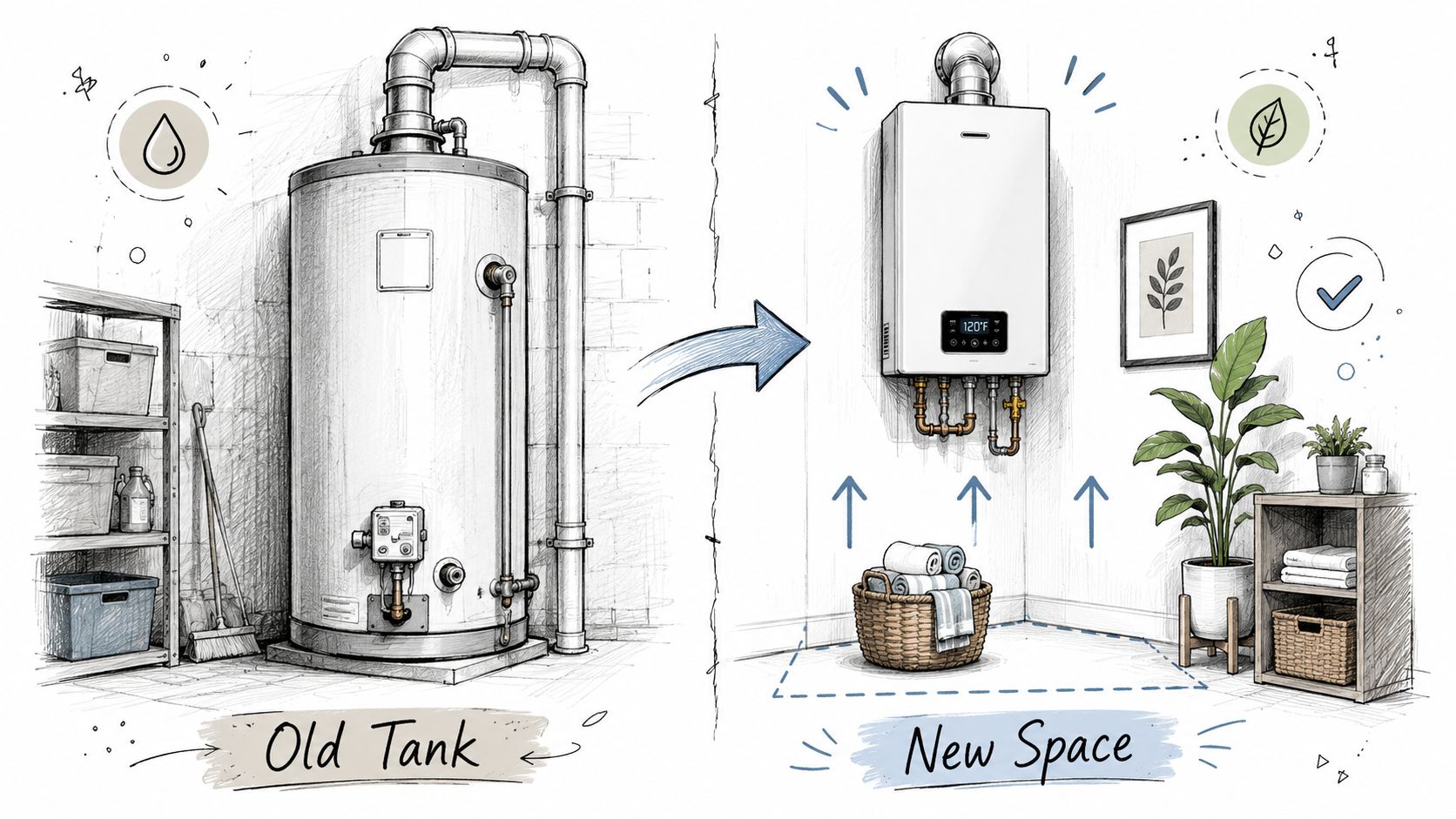
A practical example is a Richmond townhouse owner with a tank heater beside the washer and dryer. The old setup forces everything else around the tank. After changing to a wall-mounted unit, the lower area becomes usable for storage bins and better access around the laundry appliances. That's a straightforward quality-of-life improvement.
Installation options that suit local layouts
Trade-offs matter. Tankless units are flexible, but they aren't magic. The available venting route, fuel type, service access, wall strength, and clearance still have to suit the appliance.
What tends to work well:
- Condos with tight mechanical closets: Wall mounting can make a small area feel less crowded.
- Townhouses with awkward utility rooms: Relocating or tightening the installation footprint can free up floor area.
- Detached homes with renovation plans: If walls are already open, routing venting or utilities is often easier.
What doesn't always work as cleanly:
- Homes with difficult vent runs: Installation can become more complex.
- Spaces with poor service access: A compact unit still needs room for maintenance.
- Older properties with infrastructure constraints: Upgrades may be needed before tankless makes sense.
The key is to treat space savings as a real benefit, but not the only factor. A beautiful compact installation still has to be serviceable and correctly vented.
Key Advantages for Strata Managers and Landlords
A tenant in Burnaby reports weak hot water at 7:30 a.m. Another unit in the same building complains ten minutes later. For strata managers and landlords, that pattern usually points to a system issue, not a one-off service call. Tankless can help, but in multi-unit properties the benefit comes from better planning, fewer repeat complaints, and tighter control over operating costs.
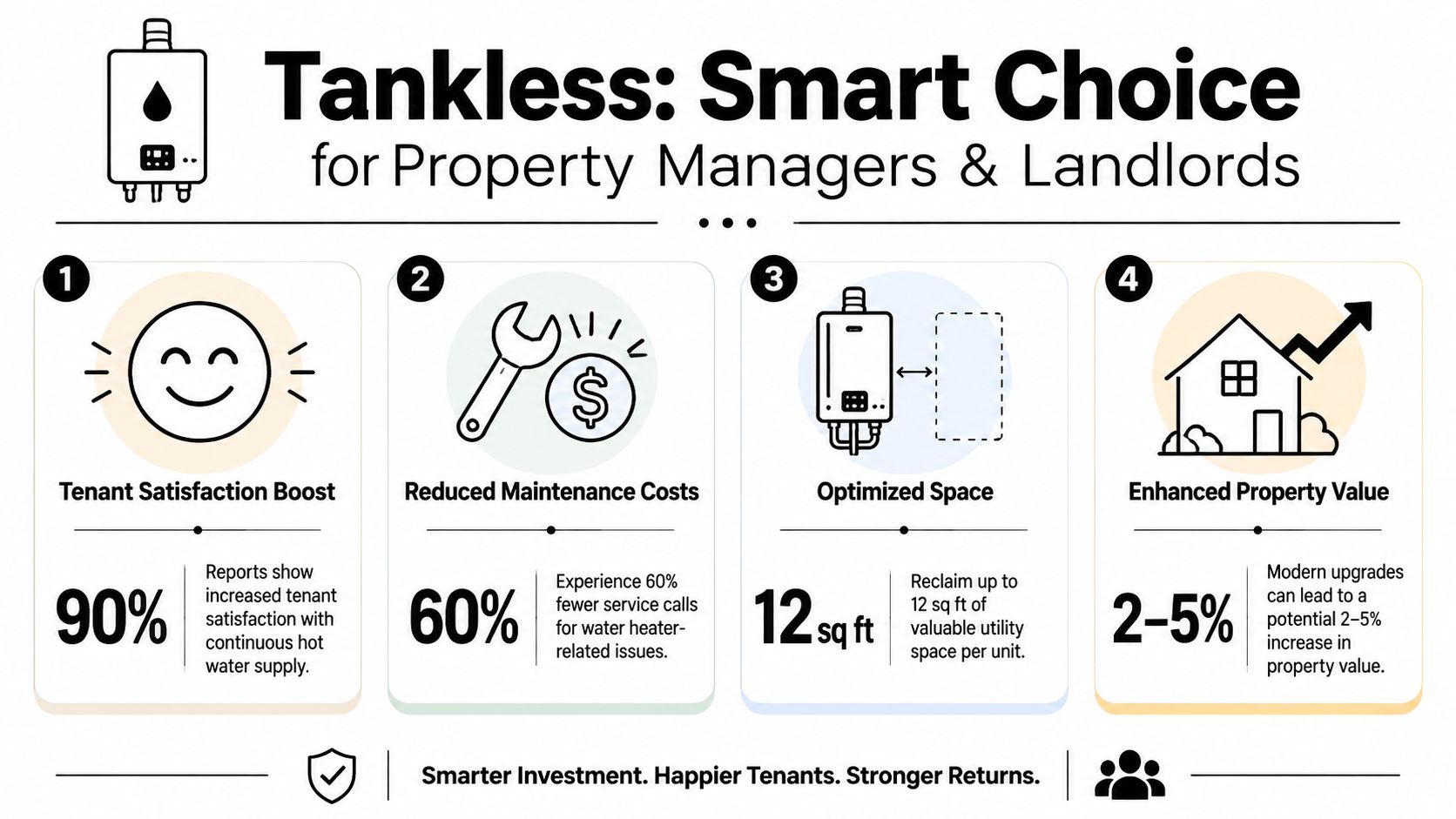
Managing simultaneous demand in multi-unit buildings
Peak demand is usually the first problem to solve. In condos, rentals, and mixed-use buildings across Greater Vancouver, hot water trouble tends to show up during the same windows every day. Morning shower periods and evening kitchen use put pressure on undersized or poorly configured systems fast.
The main decision is system layout. Some properties work better with a distributed tankless setup, where individual suites or smaller groups of units have dedicated equipment. Others are better served by a central tankless plant designed around actual peak use.
That choice affects day-to-day operations.
A strata manager in Vancouver or Coquitlam should usually look at three things first:
- Whether complaints cluster at certain hours: That often points to a demand bottleneck rather than a single failing appliance.
- Whether suite-by-suite equipment is practical: Distributed systems can give residents more control, but they also add access, service, and replacement coordination across many units.
- Whether central service is easier to manage: One equipment room is simpler for maintenance scheduling, but only if the capacity, recirculation, and controls match the building's real usage pattern.
In older buildings, the right answer is not always tankless in every unit. Gas capacity, venting routes, electrical service, and service access can limit the options. I have seen projects where a central upgrade made more sense than dozens of smaller installs, and others where unit-based systems reduced complaint volume because one problem no longer affected an entire stack.
A tankless system in a strata building should be selected as part of a demand plan, not just installed as a like-for-like replacement.
If you're comparing system types before budgeting a retrofit, this guide on traditional vs. tankless water heaters for different property setups gives a useful baseline.
Reducing waste and service friction in rentals
Landlords usually focus on utility bills first, but the practical benefit often shows up in tenant management. Long waits for hot water lead to nuisance complaints, extra tap run time, and more wear on resident relationships, especially in buildings with older distribution layouts.
A better-designed tankless system can reduce those issues, particularly when the upgrade also addresses pipe runs, controls, or recirculation. The unit itself is only part of the result. If the building layout is poor, changing the heater alone will not fix every delay at the tap.
That trade-off matters in Greater Vancouver, where water costs, energy costs, and maintenance access all affect the numbers. For landlords with multiple suites, fewer hot water complaints and more predictable service scheduling can be just as valuable as lower consumption. For strata councils, lower flood risk from aging tanks is often part of the discussion too, especially in condo buildings where one leak can affect several homes at once.
A Surrey landlord with several rental units might see the benefit most clearly in turnover and maintenance. If tenants stop reporting inconsistent hot water and the property no longer relies on aging tanks nearing failure, operations get simpler. That is a practical gain, not just a marketing claim.
Is a Tankless Water Heater Right for You?
A tankless unit is a strong fit for many Greater Vancouver homes, but only when the house, the demand pattern, and the installation conditions line up.
In practice, the first question is not brand or rebate. It is whether the system can deliver the hot water your home needs during its busiest 30 minutes of the day. A Yaletown condo with one bathroom and limited storage has very different requirements than a detached Surrey house with two teens, back-to-back showers, and laundry running on weekends.
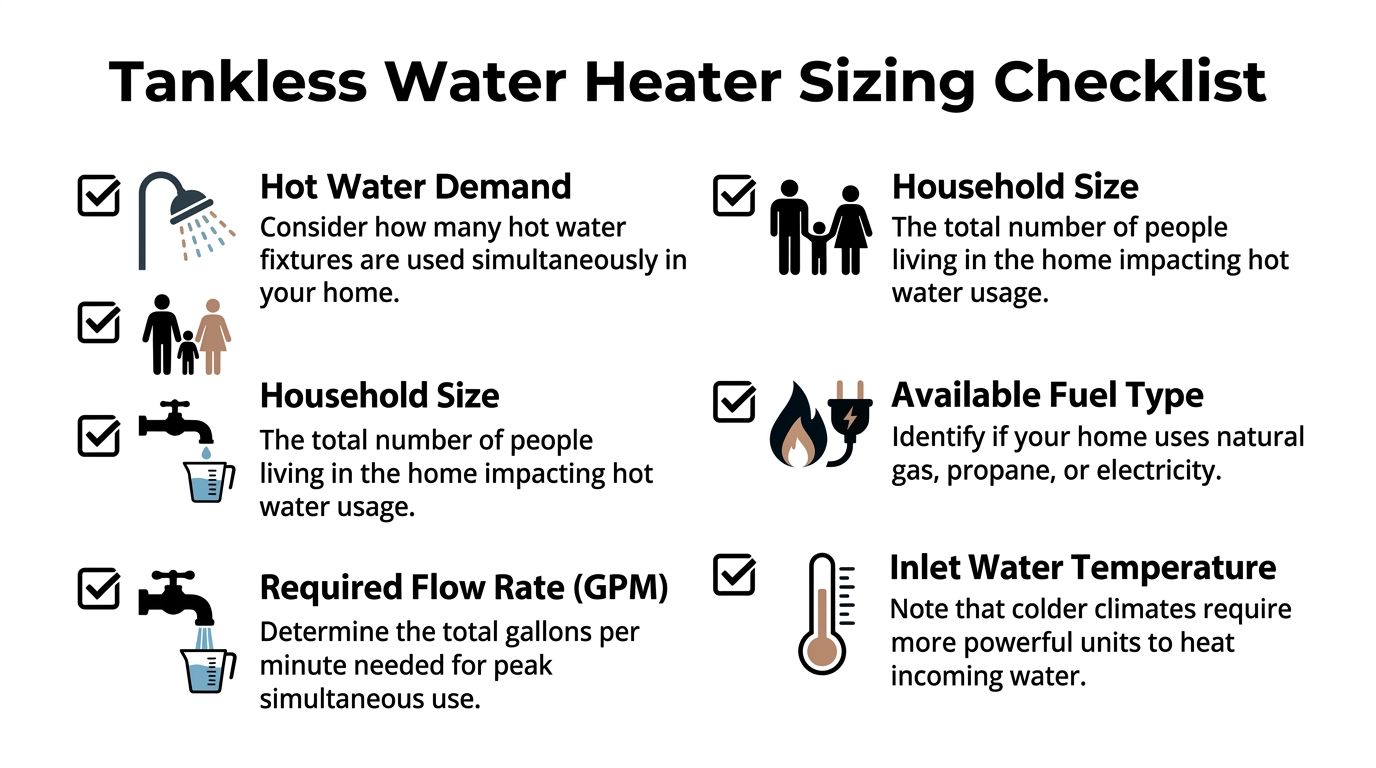
A simple sizing checklist
Before choosing a model, check these five points:
- How many fixtures run at once: Overlapping showers, laundry, and dishwashing drive sizing.
- Who lives in the home: Peak demand matters more than headcount alone.
- What fuel is available: Gas and electric tankless units each have limits depending on the property.
- How cold the incoming water is: Lower inlet temperatures require more heating capacity.
- Where the heater will go: Access, venting, clearances, and future service space all need to be workable.
If you want a broader side-by-side comparison first, this guide comparing traditional and tankless water heaters gives a useful baseline.
When tankless is the better fit
Tankless usually makes sense when an older water heater is nearing the end of its life, floor space is tight, or the current setup cannot keep up with real household demand. That is common in Vancouver-area condos, laneway homes, and smaller mechanical rooms where every square foot matters.
It can also be a good operational choice for landlords and strata managers. A wall-mounted unit removes the risk that comes with an aging storage tank sitting over finished flooring or beside shared walls. In multi-unit properties, that risk calculation matters as much as utility savings.
A typical local example is a Burnaby family with an old tank in a hall closet, limited storage, and recurring hot water shortages on busy mornings. In that case, tankless solves more than one problem at once.
When a tank heater may still make sense
I still recommend high-efficiency tank models on some jobs.
That usually happens in four situations:
- Upfront cost is the main decision point. Tankless installation often costs more, especially if gas line, venting, or electrical upgrades are required.
- The property cannot support the upgrade easily. Some condos have venting restrictions, limited service access, or electrical capacity issues that change the math.
- Hot water use is modest and predictable. A smaller household with steady habits may do just fine with a well-sized tank.
- Maintenance is likely to be ignored. Tankless systems need periodic descaling and annual service checks, particularly in areas where water conditions can shorten component life.
The right answer depends on the building.
If the goal is the lowest install cost today, a tank may be the better call. If the goal is to free up space, reduce long-term replacement cycles, and better match hot water production to actual demand, tankless often earns its keep over time.
Making the Switch in Greater Vancouver
A lot of Greater Vancouver homeowners start looking at tankless after the same kind of week. The old tank is taking up half a closet, hot water runs short on a busy morning, and the replacement quote raises the bigger question of whether it makes sense to upgrade instead of swapping like for like.
That decision is rarely about energy savings alone.
Around Vancouver, Burnaby, Richmond, and nearby cities, value often comes from matching the system to the building. In a condo, getting back storage space can matter as much as utility costs. In a rental property, reducing flood risk from an aging tank and improving turnover appeal can carry real financial value. For strata managers, the question often comes down to service access, venting rules, and whether the building can support several units upgrading without creating new gas or electrical issues.
Costs still decide plenty of jobs. Tankless units usually cost more to install, and that gap widens if the work needs gas line changes, new venting, condensate handling, or panel upgrades for an electric model. Any rebate or incentive should be checked at the time of quoting because local programs and eligibility can change.
If you are weighing an electric option, this guide to electric tankless water heater installation lays out the main sizing and service questions to ask before approving the work.
The best next step is a site assessment that looks at demand, fuel type, venting, electrical capacity, and the building's layout. That is where the answer gets practical. Some homes and suites are strong tankless candidates. Others are better served by a high-efficiency tank because the upgrade cost, service limits, or usage pattern do not justify the switch.
If you're in Vancouver, Richmond, Burnaby, New Westminster, Delta, Surrey, or nearby communities, Encano Plumbing & Drainage Ltd. can assess your current setup and recommend the right water heater solution for your home or building. Whether you're replacing an ageing tank, planning a condo upgrade, or reviewing options for a strata property, their team can walk you through trade-offs and install a system that fits the space, demand, and budget.