
If you're pricing a tankless upgrade in Greater Vancouver, the all-in installation costs of a tankless water heater typically land around $3,500 to $7,000+. Online national estimates often show lower base ranges such as $1,404 to $3,899 installed, but local retrofit work often pushes Vancouver projects well beyond that starting point.
That gap is what catches most homeowners off guard. The unit itself usually isn't the part that blows up the quote. In Vancouver, Richmond, Burnaby, and older parts of the Lower Mainland, price drivers are the house, the existing gas and venting setup, access to the install area, and whether the new system can be made code-compliant without opening up more work.
A lot of people start this process the same way. The old tank is leaking, it's slow to recover, or it's reached an age where replacement can't be put off any longer. Then they look up tankless pricing online and see a wide spread that doesn't explain why one quote looks reasonable and another is much higher. That's usually because generic calculators don't account for the hidden retrofit work common in local homes.
Table of Contents
- Is a Tankless Water Heater the Right Choice for You?
- Breaking Down Your Tankless Installation Quote
- Why Vancouver Installation Costs Are Different
- Uncovering Hidden Costs and Additional Fees
- The Long-Term Value Tankless vs Tank Heaters
- How to Save on Your Tankless Water Heater Installation
- Getting an Accurate and Trustworthy Quote from Encano
- Frequently Asked Questions About Tankless Heaters
Is a Tankless Water Heater the Right Choice for You?
If your current tank water heater is near the end, tankless is usually the alternative people ask about first. It takes up less space, delivers hot water on demand, and can be a smart long-term fit for homeowners who plan to stay put. But the installation costs of tankless water heater systems are where the decision gets more complicated.
The biggest mistake I see is comparing a basic tank replacement to a tankless conversion as if they're the same job. They aren't. A tank swap is often straightforward. A tankless upgrade is often a retrofit, and retrofit work means the existing gas line, venting path, electrical supply, wall location, and drainage all need to be checked before anyone can price it accurately.
For local homeowners, the useful range isn't the low national number they find first. In Greater Vancouver, a realistic all-in budget is often $3,500 to $7,000+ once the actual house conditions are included. That's especially true in older detached homes, homes with finished basements, and strata properties where vent routing and approvals can affect the scope.
A tankless system makes the most sense when a few conditions line up:
- You plan to keep the home for years: The long service life matters more when you're not moving soon.
- Your current setup can support the conversion: If gas, venting, and access are workable, the quote stays more manageable.
- You want to free up space: This matters in mechanical rooms, small utility closets, and compact layouts.
- Your hot water use is consistent: Families that use hot water daily tend to see the value more clearly.
For a side-by-side overview of system fit, this guide on traditional vs tankless water heaters is a useful starting point.
Practical rule: If you're only looking for the cheapest way to restore hot water today, a standard tank often wins. If you're looking at ownership over many years, tankless deserves a serious look.
Breaking Down Your Tankless Installation Quote
A good quote shouldn't be one big number with no explanation. It should show where the money is going and what work is included. Most tankless installs break into three parts: the appliance, the labour, and the supporting materials needed to make the system work properly and pass inspection.
The three parts of the bill
Nationally, tankless water heater installations commonly range from $1,404 to $3,899, with labour alone averaging $600 to $1,850 per job, and added materials such as piping and insulation often costing about $10 per linear foot according to Angi's tankless installation cost guide. That gives a baseline, but it still doesn't show why one home stays near the low end and another climbs much higher.
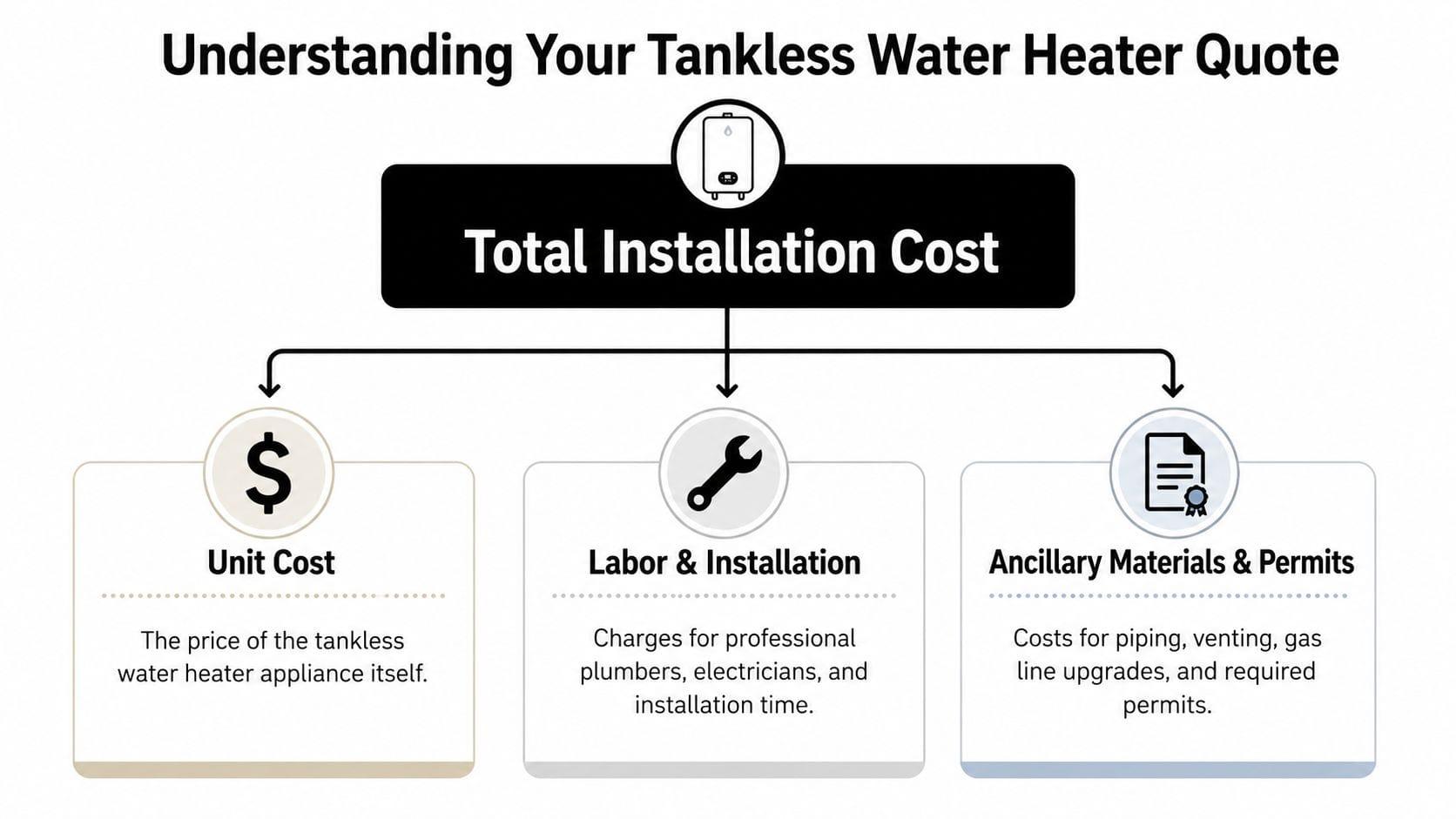
Here's how to read the quote line by line:
- Unit cost: This is the tankless heater itself. Brand, output, fuel type, and whether it's a condensing model affect the equipment price.
- Labour and installation: This covers removal of the old heater, mounting the new unit, making water and fuel connections, testing, commissioning, and cleanup.
- Ancillary materials and permits: Many homeowners are surprised by these costs. It can include venting parts, new shutoffs, condensate handling, fittings, valves, insulation, electrical work, and permit-related items.
A practical example of how quotes change
Take a common local scenario. A homeowner replaces an older tank in a detached Vancouver house and wants a natural gas tankless unit mounted in roughly the same area. If the gas line is already adequate, the vent route is short and direct, and the electrical connection for controls is simple, the quote is far more predictable.
Now change one thing. The existing gas line is undersized for the new appliance. That "simple" replacement now includes gas-line work, extra fittings, more labour, and likely more coordination. Change a second thing. The vent path has to be rerouted through a finished area or around framing obstacles. The quote moves again.
A tankless quote is rarely expensive because of one dramatic item. It usually rises because several smaller scope changes stack up at once.
That's why line-item detail matters. If the estimate only says "install tankless heater" without calling out venting, gas sizing, electrical, disposal, and permit assumptions, it isn't complete enough to trust.
Why Vancouver Installation Costs Are Different
In British Columbia's Lower Mainland, quote variability is substantial. National estimates of $2,791 to $3,236 often miss the local conditions that determine the final price, especially in older Vancouver and Richmond housing where gas-line upsizing, venting modifications, and electrical upgrades are common, as noted by Homewyse's tankless hot water heater cost page.
Older homes change the scope fast
A lot of Greater Vancouver homes weren't built with tankless systems in mind. They were built around storage tanks. That matters because a tankless gas unit has a very different demand profile. The plumbing may be fine, but the fuel supply often isn't. If the existing line can't support the appliance, it has to be upgraded. That can mean opening access points, rerouting pipe, or changing the installation location.
Venting is the next issue. Older houses often don't offer a clean, direct path for modern venting. Finished basements, tight utility areas, additions built after the original house, and awkward framing can all complicate the route. In practical terms, the unit may fit on the wall, but getting the vent where it needs to go is what determines whether the job is straightforward or not.
Electrical catches people off guard too. Even gas-fired tankless systems often need electrical supply for ignition and controls. In some homes, that's simple. In others, the nearest suitable power source isn't where the appliance needs it.
Strata, laneway, and access issues
Detached homes aren't the only challenge. Condos, townhomes, laneway homes, and strata-managed properties introduce a different set of cost drivers.
- Strata approval: Penetrations for venting or changes to common building systems may need approval before work can proceed.
- Restricted access: Tight mechanical rooms, parkade routing, limited service hours, or booking requirements can add labour time.
- Shared infrastructure: Multi-unit buildings can limit what can be changed without affecting other suites or common systems.
For homeowners considering electric systems instead of gas, this overview of electric tankless water heater installation helps explain where that route can simplify the job and where it can create a different kind of upgrade issue.
Local reality: In Vancouver, the house usually prices the job as much as the heater does.
Uncovering Hidden Costs and Additional Fees
Even when the core install is priced correctly, there are still add-ons that don't always make it into the first casual conversation. These aren't shady charges. They're the practical parts of doing the work properly.

The costs people forget to ask about
The first hidden cost is often permits and inspection-related work. Gas appliance installs usually need to meet municipal and code requirements. A proper quote should account for that process instead of treating it like an afterthought.
Then there's removal and disposal of the old tank. In some homes, that part is easy. In others, the old heater is in a cramped crawlspace, tucked behind finished framing, or difficult to remove without extra handling.
A few other items can appear depending on the property:
- Water shutoff upgrades: Older shutoffs sometimes don't operate cleanly and need to be replaced during the install.
- Drainage adjustments: Condensing equipment may require drainage planning that the old tank didn't.
- Wall or mounting preparation: Some locations need backing, rework, or minor changes before the new unit can be safely mounted.
- Water quality protection: In areas with mineral-heavy water, owners may choose treatment equipment to protect the heat exchanger and reduce scale buildup.
Fuel choice changes the hidden work
Fuel type affects the secondary costs as much as the main ones. Electric tankless units often install in the $800 to $1,500 range because they avoid gas hookups and venting, while natural gas systems average $1,000 to $1,500 plus the added cost of venting and gas line compliance according to Cyclone Plumbing's tankless installation cost breakdown.
That doesn't mean electric is automatically cheaper in every local home. It means the cost stack shifts. With gas, the extras often show up in combustion and venting requirements. With electric, the concern moves toward panel capacity and circuit planning.
A simple practical example: a Richmond homeowner may choose gas tankless because the home already has gas service, but then discover the vent path is the expensive part. Another homeowner may choose electric to avoid venting entirely, then find the panel doesn't have the capacity they hoped for. Different fuel. Different hidden costs.
A short visual explanation helps clarify what homeowners should expect before approving the work.
The Long-Term Value Tankless vs Tank Heaters
Upfront price matters, but it isn't the whole decision. Tankless systems are usually easier to justify when you compare ownership over time instead of only looking at installation day.
Tankless water heaters are commonly estimated to last 15 to 20 years, while traditional tank heaters are usually estimated at 8 to 12 years. The same cost analyses also estimate annual energy savings of about $150 to $200, which helps offset the higher upfront spend over the life of the unit, according to C&C Air's tankless vs tank cost comparison.
Lifecycle comparison
| Metric | Tankless Water Heater | Traditional Tank Heater |
|---|---|---|
| Typical installed cost direction | Higher upfront | Lower upfront |
| Estimated lifespan | 15 to 20 years | 8 to 12 years |
| Estimated annual energy impact | May save about $150 to $200 per year | Higher operating cost relative to tankless |
| Replacement cycle over long ownership | Fewer replacements likely | More frequent replacement likely |
| Best fit | Long-term ownership, retrofit-friendly homes | Lowest upfront cost, simpler swap jobs |
That table is why the installation costs of tankless water heater systems shouldn't be judged only on day one. If you expect to stay in the home, the longer lifespan changes the math.
A practical ownership example
Say a Vancouver family plans to remain in the same house for many years. They receive one quote for a standard tank replacement and another for a tankless upgrade. The tank quote is easier to accept immediately because the upfront cost is lower.
But long-term ownership changes the conversation. A tankless system may avoid an extra replacement cycle during the same ownership period, and the lower annual energy use can gradually recover part of the difference. That doesn't make tankless the right answer in every house, but it does explain why many owners choose it even when the initial quote is higher.
If you're comparing replacement paths, this page on water heater replacement cost can help frame the broader budget decision.
Tankless usually wins on lifespan and operating efficiency. Tank usually wins on initial spend and installation simplicity.
How to Save on Your Tankless Water Heater Installation
There are smart ways to control cost. Most of them have nothing to do with choosing the cheapest contractor. The best savings usually come from reducing avoidable scope, choosing the right unit size, and checking incentive options before the job is booked.
Ways to control the quote without cutting corners
Start with the basics that move the number:
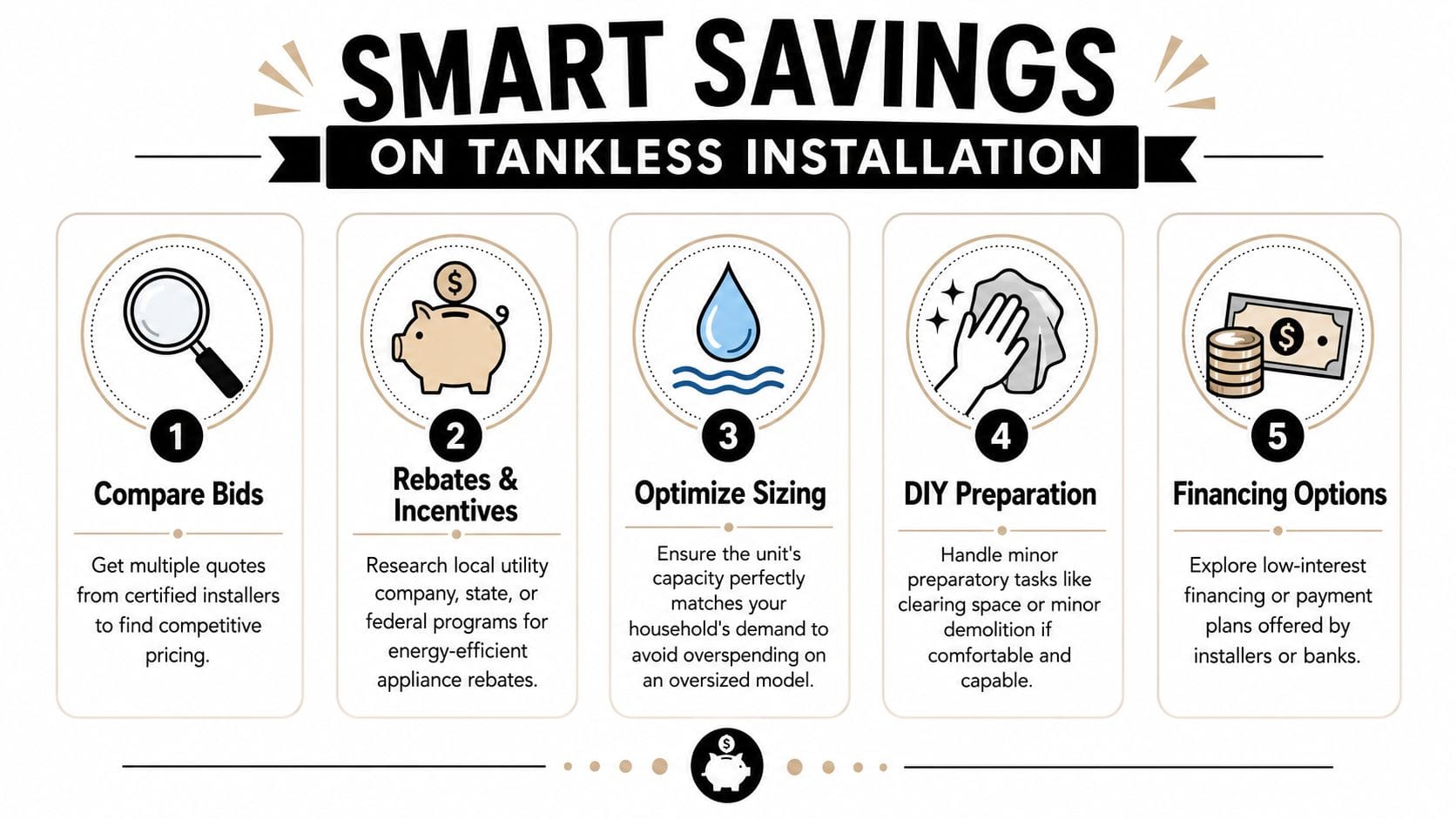
- Compare detailed quotes: Ask each installer to break out appliance, venting, gas work, electrical, disposal, and permit assumptions. A lower total isn't useful if key work has been left vague.
- Size the unit properly: Oversizing a tankless system can waste money up front. Undersizing creates performance complaints later.
- Prepare the area: Clear storage, improve access, and make sure the installer can reach the work zone without delays.
- Ask about current promotions: Manufacturer offers and seasonal specials can sometimes reduce equipment cost.
- Look into financing and rebates: For some homeowners, spreading the cost matters more than shaving the last bit off the headline price.
If you're exploring rebates in British Columbia, check the current program terms directly with the relevant provider before making a purchase. Programs change, and eligibility often depends on the equipment type, property type, and installation details. The same goes for financing. It can make a solid upgrade manageable, but only if the monthly structure fits your budget.
One more practical point. Don't try to "save money" by skipping the site assessment. That's where the major cost drivers are found. A rough phone estimate is fine for a ballpark. It's not enough to approve a real conversion.
Getting an Accurate and Trustworthy Quote from Encano
A reliable quote starts on site, not over text message and not from a one-size-fits-all web calculator. For tankless work in Greater Vancouver, someone needs to look at the existing heater location, fuel source, vent path, service access, and the general condition of the home's plumbing and mechanical setup.
The fastest way to get a trustworthy number is to have the key details ready before the visit.
What to have ready before the visit
This information helps the assessment go much faster:
- Home type: Detached house, townhome, condo, laneway home, or commercial unit.
- Current system: Tank or tankless, plus fuel type if you know it.
- Location of the heater: Basement, garage, closet, utility room, crawlspace, or rooftop mechanical area.
- Hot water demand: Number of bathrooms, major fixtures, and whether multiple showers run at the same time.
- Building constraints: Strata rules, access restrictions, parking limitations, or booking windows for service work.
- Known issues: Past venting problems, electrical concerns, water quality issues, or previous gas work.
A strong quote should clearly state what is included, what assumptions were made, and what conditions could change the price. If venting, gas upgrades, or electrical work are listed as possible extras, ask exactly what would trigger them. That isn't being difficult. That's how you avoid a bad surprise after the wall unit is already on order.
The best contractors don't try to force tankless into every situation. If a standard tank replacement is the better fit for your property, budget, or building restrictions, that should be said plainly.
Frequently Asked Questions About Tankless Heaters
Can a condo use a tankless unit?
Sometimes, yes. Sometimes, no. The unit itself isn't the only issue. Condos often run into venting restrictions, strata approval requirements, access limitations, or shared building-system constraints. In many suites, the practical barrier isn't the heater. It's whether the building will allow the supporting work.
How long does installation take?
That depends on whether it's a simple replacement or a true conversion. A straightforward setup with good access and minimal changes moves much faster than a project that needs gas-line work, electrical changes, new vent routing, or coordination with a strata. The time on site is driven by the scope, not by the label "tankless."
What maintenance does a tankless heater need?
Tankless systems need routine maintenance if you want them to perform properly over the long term. Descaling is a common part of that conversation, especially where water conditions encourage mineral buildup. The exact service schedule depends on water quality, usage, and the manufacturer's requirements.
Is tankless worth it for a smaller household?
It can be. A smaller household may still want tankless for space savings, longer service life, or the convenience of on-demand hot water. But if your main priority is the lowest possible replacement cost, a standard tank can still be the more practical choice.
Why do online estimates feel so far off?
Because most of them price the appliance category, not the actual retrofit. They don't know your gas line size, your vent path, your panel condition, your wall access, or your strata rules. That's why two neighbours can both ask for "tankless" and receive very different quotes.
Ask for a quote that explains the house, not just the heater.
If you're ready for a real answer instead of a generic estimate, Encano Plumbing & Drainage Ltd. can assess your current setup and provide a clear, no-obligation quote for a tankless upgrade in Vancouver, Richmond, Burnaby, Surrey, and surrounding areas.