In Greater Vancouver, a full Poly B replacement usually costs $6,000 to $15,000, with smaller homes often landing around $6,000 to $8,000 and more complex multi-level or heritage homes reaching $13,000 to $18,000+ based on home size, bathroom count, and how hard the pipes are to access. If your home has more bathrooms, finished walls and ceilings, or tricky plumbing runs, the final number can move up quickly.
If you're reading this, there's a good chance something has already pushed Poly B from a vague future concern into an immediate one. Maybe your insurer flagged it at renewal. Maybe a home inspector pointed out the grey piping. Maybe you've had one small leak and now you're wondering what the full replacement bill looks like, not just the plumbing portion, but the drywall, permits, patching, and all the disruption that comes with opening walls in a lived-in Vancouver home.
That concern is justified. The biggest mistake homeowners make with Poly B isn't waiting a few weeks to book the work. It's budgeting for pipes only and getting blindsided by the full project cost after the quote starts breaking out restoration, access work, and finishing. A realistic budget has to include the whole job from shutoff to cleanup.
Table of Contents
- Why Vancouver Homeowners Must Address Poly B Piping
- The Itemized Breakdown of Poly B Replacement Costs
- Real Vancouver Repipe Cost Examples
- The Repipe Process Timeline and Disruption
- Financing, Insurance, and Maximizing Your Investment
- Your Checklist for Hiring the Right Vancouver Plumber
Why Vancouver Homeowners Must Address Poly B Piping
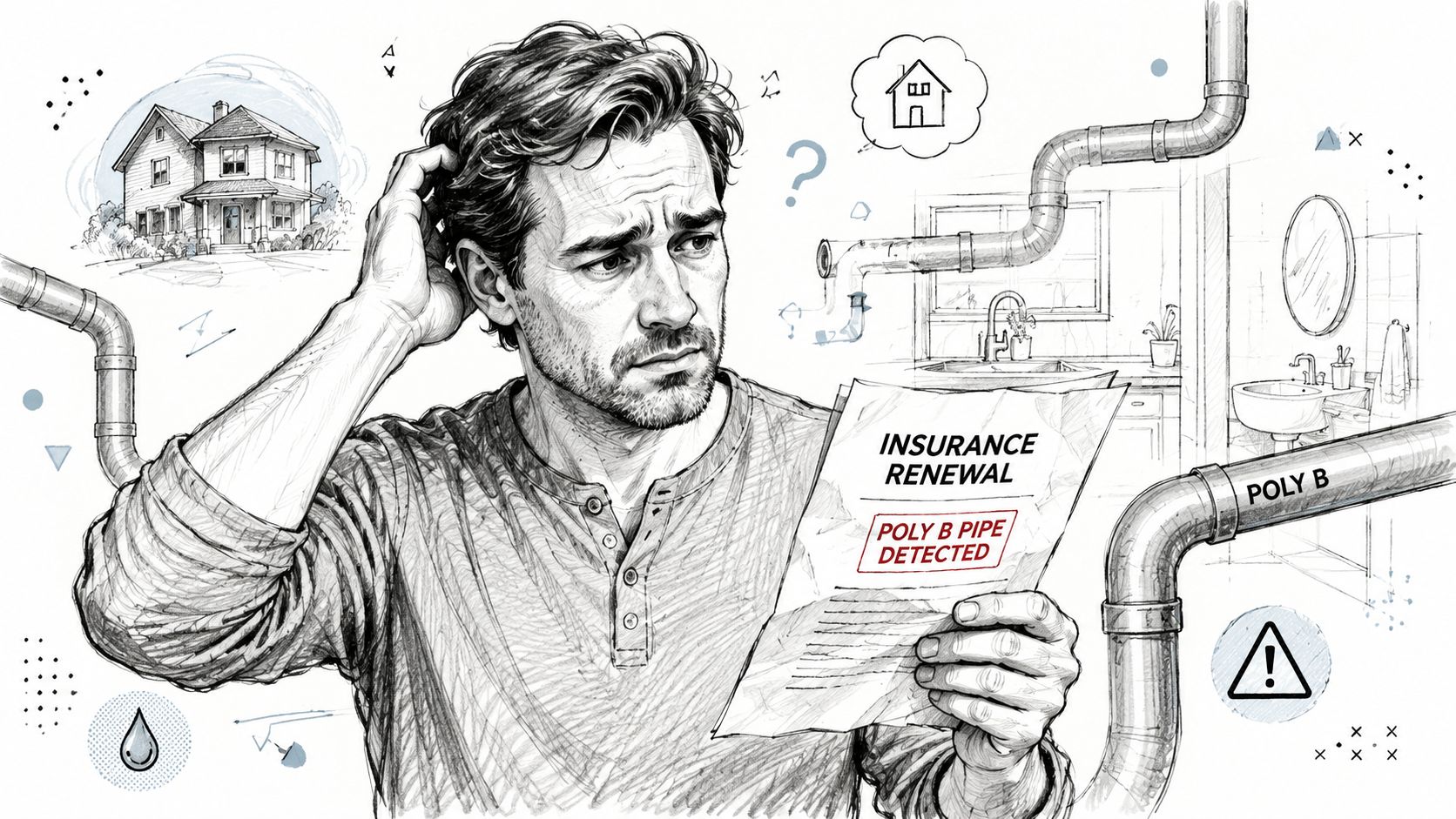
A common Vancouver scenario goes like this. You are renewing insurance, preparing to sell, or opening a wall for a renovation, and suddenly Poly B shows up in the conversation. At that point, the pressure is real because the problem is no longer theoretical. It is attached to your home, your budget, and the risk of water damage behind finished walls.
Poly B, short for polybutylene, was widely used in homes built from the late 1970s through the 1990s because it was cheaper and easier to install than copper. Over time, it became known for premature failure, especially at fittings and in hidden runs. The Government of Canada's consumer information on polybutylene piping outlines the long-standing concerns around these systems and why homeowners still deal with them today.
Why Poly B became a problem in BC homes
The main issue is not age alone. It is where the failures tend to happen.
In many Vancouver houses, the first sign is not a dripping pipe under a sink. It is staining on a ceiling, swollen baseboards, damp drywall, or flooring that starts to lift. By the time you can see it, water may already have travelled through insulation, wall cavities, and finished spaces.
That is what makes Poly B expensive. The plumbing repair is only one part of the bill. Homeowners also face emergency shut-off work, drying equipment, drywall opening and patching, paint repairs, and sometimes temporary accommodation if the damage is widespread. A lot of online guides skip over those costs, but they are often what turn a manageable project into a financial shock.
Practical rule: Once Poly B has been identified in a Vancouver home, get a replacement quote before you are forced into an emergency claim with restoration costs attached.
Why replacement is usually the practical choice
Spot repairs can make sense for a single damaged section of modern plumbing. Poly B is different because one leak rarely means one weak point. It usually means the system is aging as a whole, and every section you do not replace stays in service inside walls and ceilings.
That is why many homeowners end up comparing the cost of a planned repipe against the cost of waiting. Planned work gives you control over access, scheduling, patching, permits, and cleanup. Emergency work usually does not. If you are weighing pipe repair versus full pipe replacement, Poly B is one of the clearest cases where partial fixes often delay the bigger decision without removing the bigger risk.
There is also the insurance and resale side. Insurers, buyers, and home inspectors in Vancouver know what Poly B is. Even before a leak happens, it can affect underwriting, buyer confidence, and negotiations. Once the system has been fully replaced and the work is documented properly, that concern is largely removed.
For homeowners, that peace of mind matters. So does having a realistic budget from the start, including the plumbing work and the restoration work that often follows access cuts.
The Itemized Breakdown of Poly B Replacement Costs
A lot of quotes sound lower than the actual project cost because they describe the plumbing scope, not the whole-house scope. That's where homeowners get frustrated. They expect one number and end up discovering separate charges for access cuts, patching, permits, and paint touch-ups.
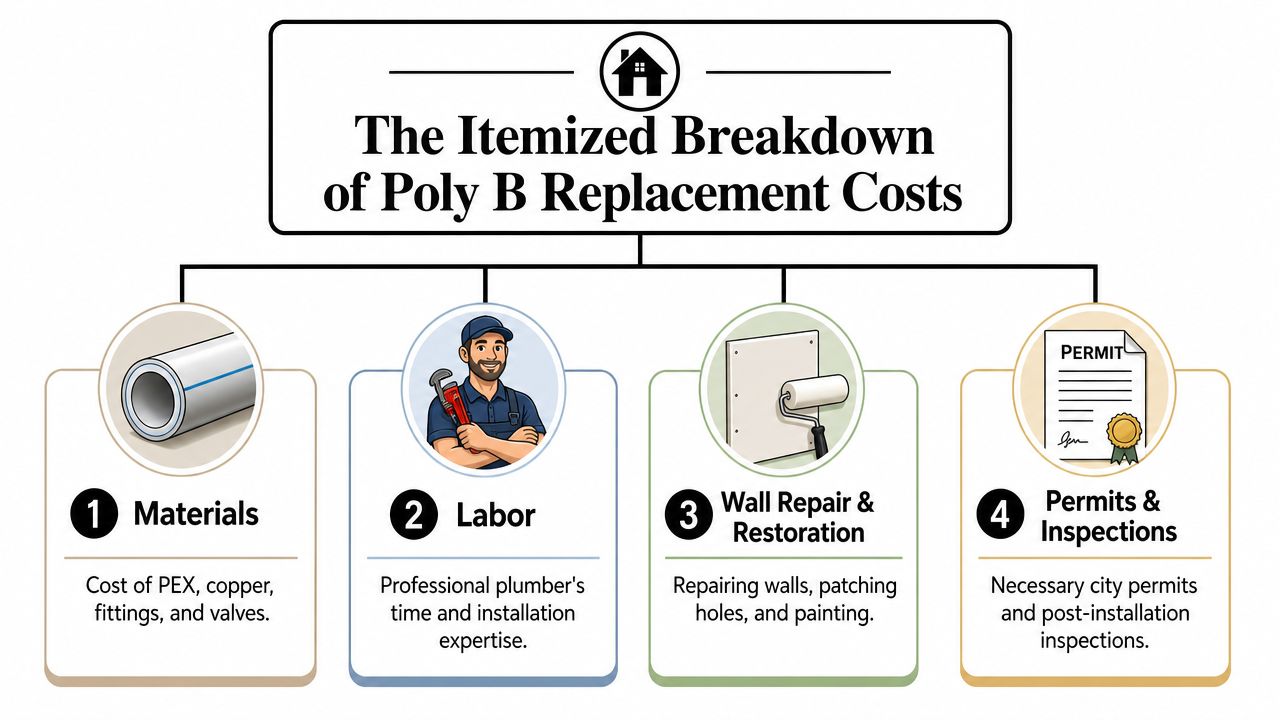
The cleaner way to evaluate a Poly B pipe replacement cost is to break it into four buckets: materials, labour, permits and inspections, and wall repair or restoration.
Materials change the budget fast
Material selection makes a visible difference to the quote. In BC, the cost of replacement material designation can shift the total substantially, with plastic fittings costing $1,500 to $8,000 and copper fittings ranging from $2,500 to $15,000 for the same Poly B replacement project (BC Poly B replacement material cost breakdown).
In most homes, PEX is the practical modern replacement. It's flexible, it allows cleaner routing through framing cavities, and it usually keeps labour and material costs more manageable than copper. If you want a closer look at that option, this overview of PEX tubing installation helps explain why it's so commonly used in repipes.
Copper still has a place, especially where homeowners prefer it or the project scope makes sense for it. But if your main concern is controlling the full budget while replacing all Poly B properly, PEX is often the easier path.
| Cost area | What affects it most | Why it changes the total |
|---|---|---|
| Materials | PEX vs copper, fittings, valves | Higher-end material choices raise supply costs |
| Labour | Access difficulty, storeys, fixture count | More cuts and longer runs mean more crew time |
| Permits & inspections | Municipality and project scope | Required approvals add administrative cost |
| Restoration | Drywall cuts, patching, paint | Finished homes cost more to put back neatly |
Labour permits and restoration are where quotes separate
Labour depends on access. A home with open basement ceilings and simple runs is a different job from a finished two-storey house with plumbing behind tiled walls, soffits, and ceilings. Every extra opening, every awkward route, and every protected finish adds time.
Permits matter too. In Vancouver, Burnaby, Richmond, and nearby municipalities, proper permitting and inspection aren't paperwork you should try to dodge. They protect you by making sure the repipe is documented and completed to code.
Then there's the part many low quotes skim over: restoration.
A plumbing quote that doesn't clearly say who handles drywall, patching, and paint isn't complete enough to compare.
If the crew cuts access holes and leaves you to find a drywall contractor afterwards, your total project cost isn't the plumbing number on the first page. It's that number plus whatever it takes to close the house back up properly. For homeowners living in the space during the work, that difference matters almost as much as the piping itself.
Real Vancouver Repipe Cost Examples
Top-line ranges help, but most homeowners want to know what a property like theirs might cost. That's the useful way to think about Poly B pipe replacement cost. Not as an abstract average, but as a project tied to your layout, bathrooms, access points, and how much restoration the home will need afterwards.
In Vancouver and the Greater Vancouver region, full Poly B replacement in a typical home generally ranges from $6,000 to $15,000, with smaller ranch-style homes often around $6,000 to $8,000 and multi-level or heritage homes reaching $13,000 to $18,000+. The same local guide gives two helpful examples: a 2,100 sq ft two-storey home with 3 bathrooms was fully repiped in under five days for $11,800, while a 950 sq ft downtown condo with easier access was retrofitted for $6,900 (Greater Vancouver Poly B replacement price guide).
What different property types usually look like
The table below gives a practical way to compare common property types across Greater Vancouver.
| Property Type | Typical Size / Layout | Estimated Cost Range | Key Cost Factors |
|---|---|---|---|
| Downtown condo | Around 950 sq ft, simpler fixture layout | Around the lower end of local pricing | Easier access, fewer bathrooms, shorter runs |
| Townhouse in a strata complex | Multi-level layout, shared walls, multiple wet areas | Middle of the range in many projects | Vertical runs, access coordination, wall restoration |
| Single-family home | Around 2,100 to 2,600 sq ft, more fixtures | Mid to upper range depending on finish level | Bathroom count, ceiling cuts, finished spaces, exterior hose bibs |
| Heritage or custom home | Larger or more complex layout | Higher-end local pricing | Tight access, older finishes, extra restoration scope |
A strata townhouse often surprises owners because the square footage doesn't tell the full story. The plumbing may run vertically through more than one level, and access can involve tight utility chases, finished stair walls, and coordination with strata rules about work hours and common areas. That's why a townhouse can cost more than expected even when it isn't a large detached home.
If you're dealing with a multi-unit building or shared ownership setup, this example of a strata repiping project gives useful context on the extra planning involved.
A practical example of why layout matters
A condo owner may see a number near the lower end because there are fewer fixtures and the pipe runs are shorter. A detached home with three bathrooms, outdoor faucets, and finished ceilings is a different animal. The plumber isn't just replacing lines. The crew is opening strategic access points, routing new piping through occupied rooms, protecting finishes, reconnecting fixtures, and coordinating the house so water service is restored with as little chaos as possible.
If two homes have similar square footage but one has harder wall access and more bathrooms, the more complex home will usually be the more expensive repipe.
This is why the same city can produce very different quotes. Home size matters, but bathroom count and accessibility often swing the final number just as much.
The Repipe Process Timeline and Disruption
You get the quote, then the true worry hits. How many days will the house feel upside down, how long will the water be off, and what will this add to the final bill once the walls are patched and painted? Those are the right questions to ask, because the disruption is tied directly to cost.
A well-run repipe is controlled work. It is still noisy and invasive, but it should not feel chaotic. The goal is simple: open only what we need, replace the Poly B properly, test everything, and get the home back to normal without dragging the job out.
What happens inside the home during the work
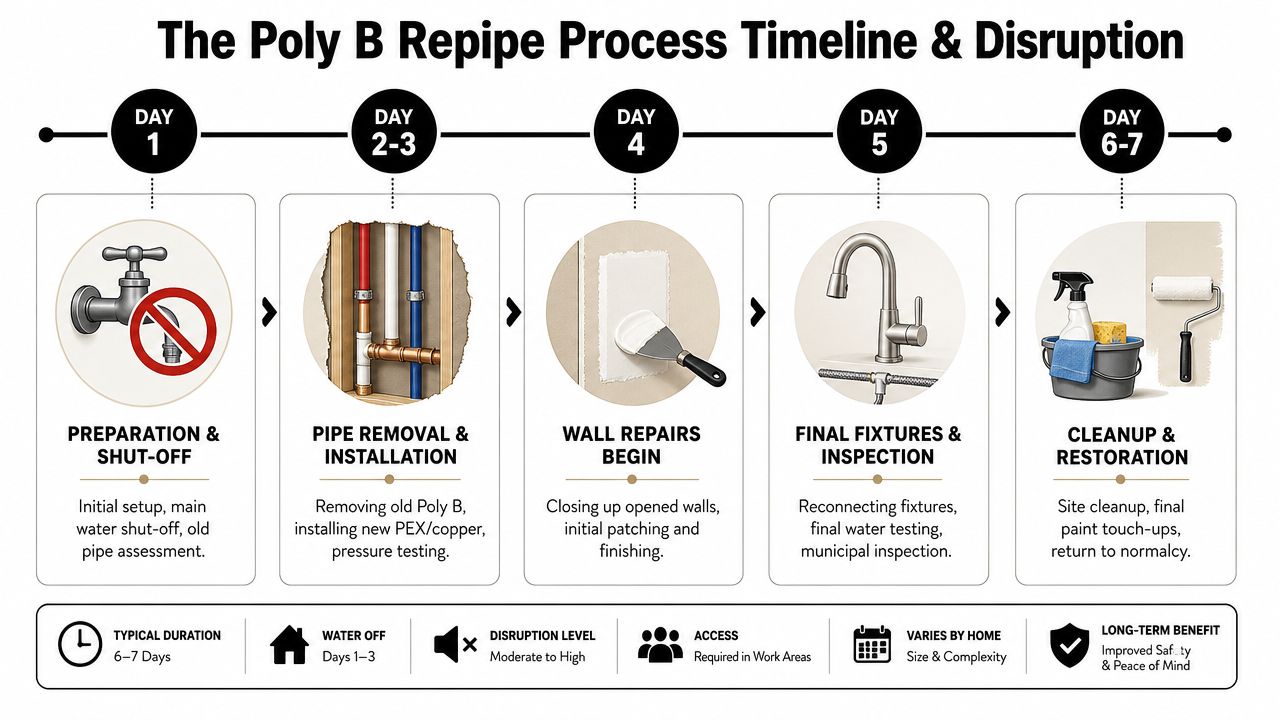
Day 1 is setup and access. Floors are protected, shutoffs are checked, fixture locations are confirmed, and the crew marks the wall and ceiling openings needed to run the new lines. In a finished Vancouver home, those openings matter. They affect labor, patching, paint touch-ups, and how quickly the house feels livable again.
Days 2 and 3 are usually the heaviest plumbing days. The old Poly B is isolated, new PEX or copper lines are run, and the crew works room by room through bathrooms, kitchen areas, laundry spaces, and mechanical zones. This is the loudest part of the project, and it is often when homeowners realize the repipe invoice is only part of the total cost. Access cuts, drywall patching, texture matching, and cleanup all follow the plumbing work.
A useful visual makes the sequence easier to picture:
By Day 4, the new system is pressure tested, fixtures are reconnected, and any required permit or inspection steps are handled. Some homes move through this stage quickly. Others take longer because older houses, tight chases, or finished basements leave fewer clean access routes.
Day 5 and beyond is where restoration starts to show up on the budget. Plumbers may be finished or close to it, but the project is not done until wall openings are patched, surfaces are prepared, and the home is cleaned up enough for normal use. If painting crews, drywall finishers, or asbestos testing are needed, the calendar can stretch even when the plumbing itself went smoothly.
How to make the week easier on your household
The biggest mistake homeowners make is budgeting for pipe replacement and forgetting the rest of the project. In Vancouver, the stress usually comes from the combined effect of plumbing work, drywall repair, permit costs, repainting, and a few days of reduced access to bathrooms or kitchens. A practical overview from the Government of Canada on home insurance and water damage helps explain why insurers pay close attention to plumbing risk, but from the homeowner side the immediate issue is simpler. Restoring the house after the repipe is often where the overlooked costs show up.
That is why the disruption piece matters. If a contractor promises a very low number without explaining access cuts and restoration, the quote may be incomplete.
A few steps make the week easier:
- Clear work zones before the crew arrives so bathrooms, sink cabinets, laundry areas, and the mechanical room are accessible from the start.
- Ask for a day-by-day water plan so you know when shutoffs will happen and which fixtures will stay usable.
- Move fragile items and dust-sensitive belongings out of adjacent rooms, especially near vanity walls, kitchen backsplashes, and ceiling access points.
- Plan around kids, pets, and work-from-home schedules because noise and foot traffic are predictable parts of the job.
- Confirm who handles patching and painting before work begins. Some plumbing companies include basic patch coordination, and some stop at the pipe work.
The least disruptive repipe is the one that is properly planned. Homeowners can live through a few days of noise and limited water. Surprise drywall bills, vague timelines, and unfinished restoration are what make the job feel harder than it needed to be.
Financing, Insurance, and Maximizing Your Investment
A Poly B repipe is expensive. There's no sense pretending otherwise. But the financial picture gets clearer when you compare the invoice against what you're removing from the home's risk profile.
In Richmond and Greater Vancouver, the total cost to replace aging Poly-B plumbing typically ranges from $6,000 to $25,000, with average single-family homes spending $12,000 to $18,000 for a full repipe. That same regional breakdown notes home-size brackets such as 1 to 2 baths at $6,000 to $10,000, 3 baths at $12,000 to $18,000, and custom builds at $20,000 to $25,000+ (Richmond and Greater Vancouver Poly-B replacement cost range).
Why the financial case is bigger than the invoice
The return isn't only about avoiding future leaks. It also sits in three practical outcomes:
- Insurance stability because the home is easier to insure once the flagged piping is gone.
- Stronger resale position because buyers and inspectors won't treat the plumbing as an unresolved liability.
- Better planning control because you choose the timing instead of reacting to an emergency.
For landlords and homeowners preparing to sell, that control matters. Planned work is almost always easier to manage than sudden water damage, emergency drying, insurance calls, and unplanned restoration.
How homeowners usually approach the budget
Paying for a repipe isn't done happily. It's done strategically.
Some use available equity. Some coordinate the repipe with other interior work so drywall and paint can be handled efficiently. Others stage related improvements after the piping is done, keeping the critical plumbing work first and cosmetic upgrades later.
What's important is to budget from the full-scope number, not the lowest plumbing-only figure you hear first.
| Budget question | Better way to think about it |
|---|---|
| Can I wait? | Maybe briefly, but once Poly B is confirmed, delay keeps the risk active |
| Should I choose the cheapest quote? | Only if it clearly includes restoration, permits, and full scope |
| Is this an upgrade or a repair? | Functionally, it's both. It removes a known failure point and restores confidence in the home |
If the budget feels heavy, that reaction is normal. But so is the relief homeowners feel once the work is done, the walls are closed, and the insurance conversation changes.
Your Checklist for Hiring the Right Vancouver Plumber
The contractor you hire affects more than workmanship. They affect how many walls get opened, how clean the house stays, how clearly the quote is written, and whether the job closes out properly with permits and documentation.
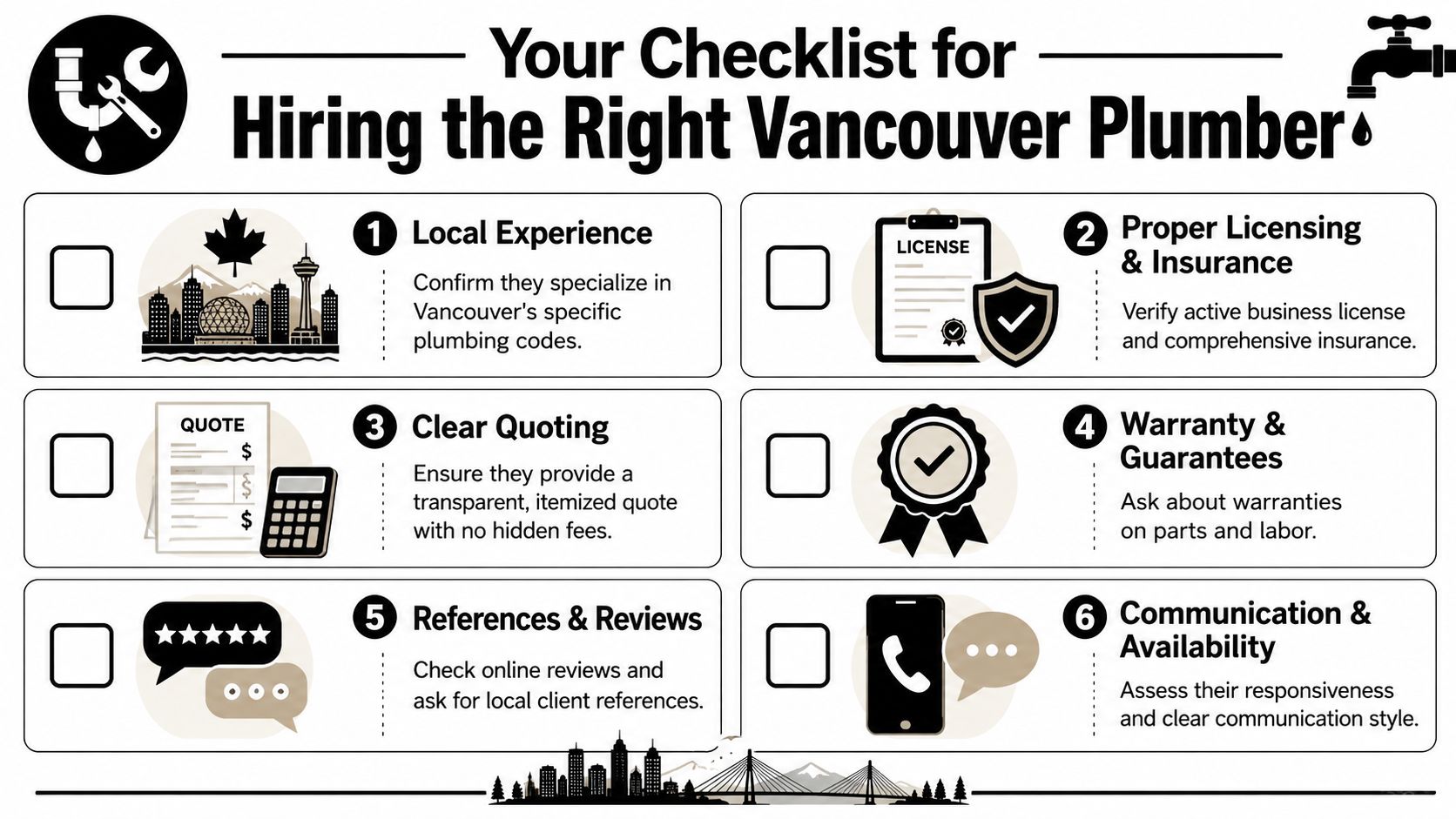
This is the short list I'd use before signing anything.
What to confirm before you sign
- Local Poly B experience matters because Vancouver-area homes, strata rules, and municipal expectations create challenges that general plumbing experience alone doesn't cover.
- Licensing and insurance should be easy for the contractor to confirm. If that conversation gets vague, move on.
- Permit handling should be included in the discussion early. You shouldn't have to chase the city yourself after the fact.
- Restoration scope must be clear. Ask who cuts, who patches, who paints, and whether that work is included or excluded.
Ask the contractor to walk you through the quote room by room. That simple conversation exposes vague assumptions quickly.
What a strong quote should make obvious
A good quote doesn't hide behind a single lump sum. It should make clear:
- What piping is being replaced so you know whether the proposal is a full repipe or a partial fix.
- Which material is being installed because PEX and copper affect both cost and workflow.
- How access and repairs are handled including drywall openings and basic restoration.
- What the expected disruption looks like so you can plan around shutoffs and room access.
- What paperwork you receive at completion for your records, insurer, buyer, or strata.
The cheapest-looking number on page one often becomes the most expensive project by the end if it excludes what the homeowner assumed was included. Clarity is worth paying attention to.
If you need a clear, itemised quote for a Poly B repipe in Vancouver, Richmond, Burnaby, Surrey, Delta, or nearby communities, Encano Plumbing & Drainage Ltd. can help you understand the full project cost before work starts, including the plumbing scope, access requirements, and what restoration will be needed to put your home back together properly.