

In Vancouver, the typical professional toilet repair cost runs $199 to $426, while a simple DIY fix can be as low as $10 to $50 for parts. If the problem is minor, that gap matters. If it involves a leak at the base, emergency service, or strata compliance work, the final bill can climb quickly.
Common reasons for looking this up include hearing a toilet run when nobody has used it, spotting water around the base, or dealing with a bowl that won't flush properly. The worry is usually the same. Is this a cheap internal repair, or the start of a much bigger problem?
In Vancouver, that answer depends less on the toilet itself and more on what's happening underneath it, when you need the repair, and whether you're in a detached home or a strata building. A basic flapper or fill valve job is one thing. A wax seal reset, flange issue, or after-hours call is something else entirely. That's where online estimators often miss the mark for local homeowners and property managers.
Table of Contents
- Understanding Your Toilet Repair Cost in Vancouver
- Common Toilet Repairs and Their Price Ranges
- Key Factors That Influence Your Final Bill
- DIY Repair vs Hiring a Professional Plumber
- Deciding Between Toilet Repair and Replacement
- Your Trusted Partner for Toilet Repairs in Vancouver
Understanding Your Toilet Repair Cost in Vancouver
A toilet that starts running at 11 p.m. can turn into a much more expensive call by morning, especially in a Vancouver condo where water alarms, strata rules, and after-hours rates all come into play. The repair itself may be simple. The final bill often is not.
The biggest mistake homeowners make is pricing the part instead of the job. A flapper or fill valve is cheap. Diagnosis, travel, labour minimums, fixture removal, and cleanup are what shape the invoice. In houses, that usually means checking whether the problem stays inside the tank. In strata buildings, it can also mean access coordination, shutoff procedures, and repairs that need to meet building requirements before the plumber leaves.
That is why toilet repair costs in Vancouver can swing from a routine service call to a much higher total once the toilet has to come off the floor. Local Greater Vancouver plumbing repair cost benchmarks also reflect that spread, especially once labour and service conditions are factored in.
Why Vancouver quotes often surprise homeowners
A toilet that “just leaks” can involve very different work:
- Internal tank repair such as a flapper, fill valve, or supply line issue
- Base leak investigation where the seal, flange, or toilet stability needs to be checked
- Removal and reset work if the bowl has to be lifted to fix the actual problem
- Strata-related requirements if building management wants specific shutoff, access, or documentation procedures followed
In my experience, the hidden cost usually shows up when water is found at the base. Homeowners often expect a quick tank repair, but base moisture can point to a failed wax ring, a loose toilet, or movement that has been going on for months. That changes the labour, the materials, and sometimes the scope of the job.
A common Vancouver-area example is a toilet that refills every few minutes overnight. If the issue is limited to a worn tank component, the repair is usually straightforward. If the toilet also rocks slightly, has old caulking, or has stained flooring around the base, the plumber may need to pull and reset it. In a strata unit, there can also be an added layer of approval or compliance work that online cost calculators usually miss.
Emergency timing changes the price fast too. A homeowner who waits until regular business hours may pay for a standard repair visit. A homeowner who calls during an active leak on a weekend or late at night often pays a premium before the actual repair even starts. I tell clients to learn where the fixture shutoff is before they need it, because that one step can be the difference between a scheduled repair and an emergency callout.
Common Toilet Repairs and Their Price Ranges
A toilet can sound like it has one clear problem and still bill out as a different repair once a plumber tests it. A weak flush may come from a worn flapper or fill valve. A slow refill may point to tired tank components. A leak can start in the tank, the supply line, or the shutoff.
For Vancouver homeowners, the useful question is not just “what part failed?” It is “how much labour does this repair take, and does the building add any extra steps?” In detached homes, many toilet repairs stay in the lower end of the range. In strata units, access rules, booking windows, and documentation can push a routine visit higher than online estimators suggest.
Local benchmark pricing puts many standard toilet repairs in the $150 to $400 range. More involved work can climb well past that, especially if the toilet has to be removed, parts are corroded, or a crack is found during inspection, based on Vancouver plumbing pricing benchmarks.
What a fair repair quote usually looks like
| Common Repair | DIY Parts Cost (Approx.) | Professional Repair Cost (Incl. Labour) |
|---|---|---|
| Flapper replacement | $10 to $50 | Usually falls within the local minor repair range of $150 to $400 |
| Fill valve replacement | $10 to $50 | Around $139 on average |
| Fill valve + flapper minor rebuild | $10 to $50 | Around $241 on average |
| Wax ring reset for leak at base | $10 to $50 | Often starts around $223 for a standard reset |
| More complex repair such as cracked tank or major leak issue | $10 to $50 for basic parts only, if applicable | Often lands in the $700 to $1,000 range |
The parts are usually the cheap part. Labour, diagnosis, and access are what change the bill.
A flapper or fill valve job is often straightforward if the shutoff works, the tank bolts come apart cleanly, and the toilet has standard replacement parts. Older toilets can take longer. Some off-brand models use awkward internals that do not match what a plumber carries on the truck, which can turn one visit into two.
Supply line and shutoff issues are another cost area homeowners miss. If the toilet repair starts with a failed fill valve but the fixture stop no longer closes fully, the safe repair may include replacing that shutoff or supply line first. In Vancouver condos, that can matter because a seized stop valve turns a simple tank repair into a job that may need building coordination.
A practical example
A homeowner reports that the toilet keeps running and the water bill jumped. If testing shows the problem is only inside the tank, the repair is usually a minor rebuild and the cost stays controlled. If the shutoff valve is frozen, the supply line is corroded, or the tank bolts snap during disassembly, the quote changes because the job changed.
The same thing happens with hairline cracks. A toilet may still flush, but a cracked tank or bowl moves the work out of repair territory fast. At that point, spending several hundred dollars on labour and parts for an aging fixture often makes less sense than replacing it.
Part quality also affects long-term cost. Better flappers, fill valves, and braided supply lines usually cost more up front, but they reduce repeat visits. Cheap tank parts can solve the noise or running water for now. They also fail sooner, especially in older bathrooms where the shutoff, supply connection, and mounting hardware are already at the end of their service life.
If a toilet runs, hisses, or refills on its own every few minutes, book it before it becomes an after-hours call. The repair itself may stay minor, but the timing premium in Vancouver often does more damage to the bill than the part replacement.
Key Factors That Influence Your Final Bill
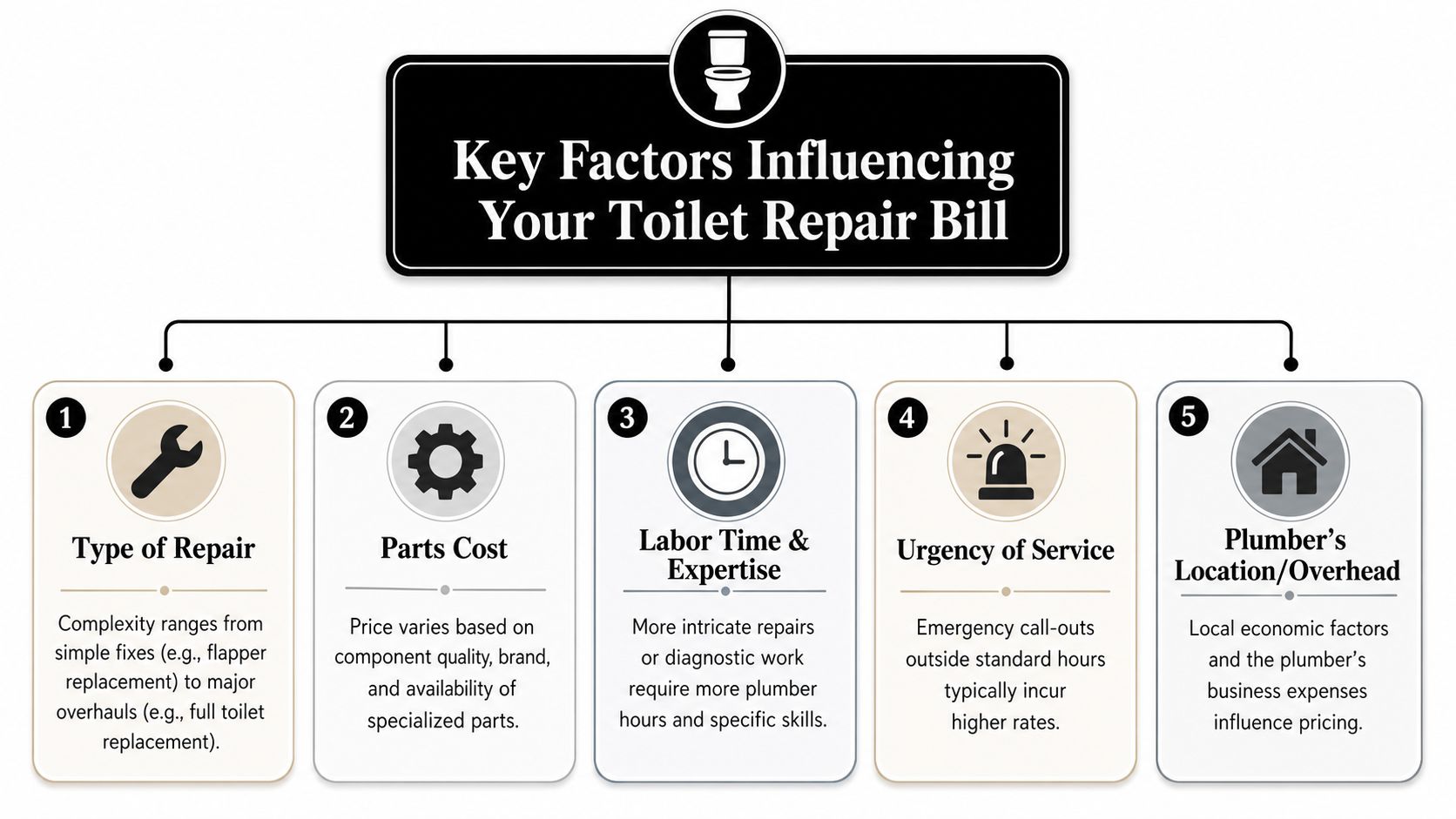
A toilet that starts leaking at 9 p.m. in a detached house is one kind of repair. The same leak in a Vancouver condo with a unit below it is a different billing situation entirely. The symptom may look identical, but the final invoice often changes because of timing, access, and building rules that only show up once the work starts.
Timing changes the price fast
In Vancouver, after-hours plumbing is where small toilet problems become expensive calls. Evening, weekend, and holiday service usually carries a clear premium, and that premium can outweigh the actual repair if the fix itself is simple.
Toilet failures rarely happen at convenient times. A running toilet may be manageable until morning if the shutoff works and no water is escaping the fixture. A base leak in an upper-floor bathroom is different, especially in a strata building where water can affect another unit, trigger an emergency response, and create pressure to approve work immediately.
That is one of the most overlooked local costs. Homeowners often compare part prices online and miss the labour premium tied to the clock, not the repair itself.
Hidden work that appears once the toilet is removed
The second major cost driver is what shows up after the bowl comes off. Until then, some problems are educated guesses.
Common additions include:
- A damaged or rusted flange that cannot hold the toilet securely
- A failed seal that has already let moisture into the subfloor
- Compliance-related upgrades in some condos and strata-managed buildings
- Extra labour for tight access behind the toilet or in small bathrooms
Vancouver-area repairs often differ from generic online estimates. In older condos in Vancouver, Burnaby, and Richmond, a toilet reset can uncover flange damage, floor softness, or sealing details that need to be corrected before the toilet goes back in. In strata properties, the repair may also need to meet building-specific requirements, not just the homeowner's budget.
Ask one direct question before approving the work: does the quote assume the flange, floor, and shutoff are all serviceable once the toilet is lifted?
Building type and access also affect labour
A main-floor toilet in a detached house is usually faster to deal with than a back-to-wall toilet in a condo powder room with limited clearance. Parking, elevator access, site rules, and booking windows can all add time in multi-unit buildings. Strata managers know this already. Homeowners often do not see it until the appointment is underway.
Access issues also overlap with diagnosis. A toilet that seems like a simple clog may need a closer look if there is a recurring slow drain, movement at the base, or signs of a branch-line problem. In those cases, it helps to understand what causes toilets to drain slowly before assuming the repair will stay limited to the fixture.
Watch for this line item: In a strata building, ask whether the price includes possible flange repair, reset work, and any building-required sealing or compliance upgrades. If it does not, the bill can change after removal.
Internal tank repairs are usually the most predictable jobs. Removal and reset work is where costs spread out, because the condition of the flange, fasteners, floor, and access all affect the labour required.
DIY Repair vs Hiring a Professional Plumber
A Vancouver homeowner can replace a flapper for the cost of a part and 20 minutes of time. The same homeowner can also turn a small base leak into a damaged bathroom floor by pulling the toilet without checking the flange, bolt condition, or shutoff first. Such is the DIY trade-off.
For simple tank repairs, doing it yourself often makes sense. For anything that involves lifting the toilet, tracing an active leak, or working in a condo or strata building, the risk goes up fast. The labour charge is only part of what you are paying for with a plumber. You are also paying for correct diagnosis, a proper reset, and fewer surprises after the toilet is back in service.
When DIY makes sense
DIY is usually reasonable when the problem is easy to identify and stays inside the tank or at the supply connection.
Good candidates include:
- A worn flapper causing the toilet to run
- A fill valve replacement when the symptom is clear and the shutoff valve works
- A supply line replacement if the connection is accessible and there is no sign of corrosion at the valve
- A minor slow-flush or slow-drain issue that is not tied to repeat backups, floor leakage, or a branch-line problem. If that symptom keeps returning, it helps to read more about common causes of a toilet draining slowly before treating it as a small fixture repair
This kind of work is usually about swapping a known part, testing it, and watching for leaks.
When hiring a plumber is the cheaper decision
DIY savings disappear when the problem is uncertain or the repair has to be perfect on the first attempt.
A loose toilet is a good example. Homeowners often assume it just needs a new wax ring. Sometimes that is true. Sometimes the flange is broken, the bolts have failed, the floor is soft around the base, or the toilet was never secured properly in the first place. Once the bowl comes up, the scope can change.
That matters more in Vancouver condos and strata buildings. If the repair involves removal and reset work, building access rules, booking windows, and cleanup expectations can add pressure to get it right in one visit. In some buildings, the work also has to meet strata-specific requirements for sealing, shutoffs, or related upgrades that are not obvious until the fixture is removed.
If there is water at the base, movement in the bowl, or any doubt about where the leak starts, professional diagnosis usually costs less than guessing.
Hiring a plumber also makes sense when:
- The toilet rocks or shifts
- Water shows up around the base
- The shutoff valve does not fully close
- The same clog or leak keeps coming back
- The toilet is in a strata unit where a mistake could affect the suite below
A good service call should leave you with a clear answer on what failed, what was replaced, and whether any hidden issues were found once the toilet was lifted. That is what protects you from paying twice.
Deciding Between Toilet Repair and Replacement
A homeowner calls after the second toilet repair in a year. The flapper was replaced once. The fill valve was replaced later. Now there is water at the base, and the toilet still does not flush well. At that point, the question is no longer "Can it be repaired?" It is "Does another repair make financial sense?"
The answer usually comes down to total spend, risk, and what is likely to fail next. In Vancouver, that calculation is not just about the toilet itself. Condo access rules, emergency timing, disposal, and strata-driven upgrade requirements can push a simple decision into a more expensive one.
When repair is still the better move
Repair is usually the right call when the problem is isolated and the toilet has good years left in it.
That often includes:
- A newer toilet with a failed fill valve, flapper, or handle
- One clear leak source with no sign of damage to flooring or ceilings below
- A toilet that sits solidly, flushes properly, and does not show cracks in the bowl or tank
- A situation where the fixture is in good condition and replacement would not solve any bigger performance issue
In those cases, putting money into a targeted repair is reasonable. A straightforward internal repair costs much less than a full replacement, and you keep the scope controlled.
When replacement makes more sense
Replacement starts to win when the toilet has multiple problems at once or the next repair is unlikely to be the last. A toilet with base leakage, weak flushing, recurring clogs, or hairline cracks is a different conversation from one with a worn flapper.
I usually tell homeowners to compare the repair quote against the installed cost of a new standard toilet, then ask one practical question. If this repair works, will the toilet likely stay trouble-free, or will another service call follow soon after?
Common replacement triggers include:
- Repeat repairs within a short period
- Cracks in the tank or bowl
- Chronic poor flushing or frequent clogging
- An unstable toilet combined with ageing internal parts
- Water damage concerns in a strata unit, where one leak can turn into a much larger claim
There is also a Vancouver-specific cost issue that online estimators often miss. Once a toilet is removed, some jobs need more than a basic reset. You may find a damaged flange, an old shutoff that should be changed, or a supply line that is better replaced while access is open. In strata buildings, management may also require specific shutoffs, sealing methods, booking windows, or proof the work meets building standards. Those items can turn a borderline repair into a sensible replacement.
If the toilet also needs a rough-in change or a different layout, that is no longer a simple swap. It becomes plumbing alteration work, and the budget rises quickly.
For a clearer checklist, review these signs it's time to replace your toilet.
Your Trusted Partner for Toilet Repairs in Vancouver
A toilet leak at 10 p.m. in a Vancouver condo is rarely just a toilet problem. It can mean an emergency callout, a worried downstairs neighbour, and a strata manager asking for details before the work is even finished.
Good service starts with a proper diagnosis and a quote that matches the actual job. In Vancouver, that means looking past the obvious symptom. A running toilet may only need an internal part. A leak at the base may involve the wax seal, flange condition, floor stability, or moisture that has already reached the ceiling below. In strata buildings, access rules, shutoff requirements, and after-hours approvals can add cost that online repair calculators usually miss.
I treat toilet calls as risk-control work as much as plumbing work. The goal is to stop the immediate problem, protect the bathroom floor, and avoid a second visit for something that should have been caught the first time.
What good service should look like
A reliable plumber should give you:
- A clear explanation of the failure so you know whether the issue is in the tank, at the base, or below the toilet
- A quote that states what is included especially if the job may change once the toilet is lifted
- Parts that suit the job such as braided stainless supply lines, quality fill valves, or a new shutoff if the old one is stiff or leaking
- Testing before sign-off with the toilet flushed, the base checked, and the area left clean and dry
That standard matters most on urgent calls. Emergency service in the Vancouver area often carries a noticeable premium, so rushed work is expensive work if the repair fails and the toilet has to be pulled again.
For a closer look at how proper toilet work is handled in the field, this video is worth watching.
A trustworthy plumbing company should also be direct about limits. If the flange is broken, the subfloor is soft, or strata requires a specific repair standard, the right answer may cost more than a quick patch. That honesty saves money compared with a cheap first visit that does not solve the problem.
If you need a clear diagnosis, transparent pricing, or urgent help with a leaking or running toilet, contact Encano Plumbing & Drainage Ltd.. They serve Vancouver, Richmond, Surrey, and nearby communities with scheduled service and 24/7 emergency plumbing support.