

A straightforward gas line repair in BC may cost about $150, while a buried-line repair can reach $2,000 or more. Permit fees alone can add $66 to $270, depending on the work and the municipality.
You may be sitting at the kitchen table with two quotes that both say “gas line repair”, one for $180 and another for $2,400. That spread doesn't automatically mean one contractor is overcharging. The scope may range from replacing an accessible appliance connector to excavating a buried line, arranging inspections, and restoring a finished yard.
In Greater Vancouver, the final gas line repair cost usually comes from four separate buckets: labour, materials, access, and permitting. The contractor controls much of the first three, but city and Technical Safety BC fees are regulated line items. The gas line installation guidance from Encano is useful background, but the estimate in front of you still needs to show exactly what work is included.
Table of Contents
- Why Gas Line Repair Costs Vary So Widely
- The Four Cost Drivers Behind Every Gas Line Repair
- Trenching Versus Trenchless Methods Compared
- BC Permit and Inspection Fees Most Homeowners Miss
- Three Realistic Gas Line Repair Cost Scenarios
- How to Get an Accurate Quote and Avoid Surprise Charges
- Putting It All Together Before You Sign
Why Gas Line Repair Costs Vary So Widely
The first step is to stop treating a gas line problem as a per-foot calculation. A leaking connector behind a water heater might be accessible from the front of the appliance, or it might sit behind drywall, inside a cabinet, or in a cramped mechanical room. The repair itself may be similar, but the time required to isolate the fault, expose the pipe, test the system, and complete the work can be very different.
The four buckets on the invoice
Labour covers the gas fitter's travel, diagnosis, preparation, repair, pressure testing, and cleanup. A small job can still carry a service-call minimum because the contractor has to send a qualified person, bring testing equipment, and make the installation safe.
Materials may include a connector, shutoff valve, brass fittings, black iron pipe, CSST, a sediment trap, or replacement fasteners. The part that failed may be inexpensive, while the surrounding components need to be brought into compliant condition.
Access becomes expensive when the pipe is concealed or buried. Opening and repairing drywall, moving appliances, cutting through concrete, or digging beside landscaping all add work that isn't represented by the length of the replacement pipe.
Permitting is separate again. In jurisdictions such as Vancouver, Technical Safety BC and local municipalities charge according to the work category. A contractor can include those fees in the invoice, but can't decide that the authority's charge is lower.
Practical rule: Ask the contractor to separate the repair price from permit and inspection charges. You should be able to see which amount pays for labour and materials, and which amount goes to the authority having jurisdiction.
A quote that looks high may include excavation, restoration, utility coordination, and testing. A quote that looks unusually low may cover only the visible repair and exclude the permit, access work, or follow-up inspection. Read the scope before comparing totals.
The Four Cost Drivers Behind Every Gas Line Repair
A useful estimate names each cost driver instead of hiding everything under “gas line repair”. The exact balance changes with the property, but the logic stays consistent.
Labour is more than time at the pipe
Diagnostic work can involve a visual inspection, leak detection, isolation of appliances, and a pressure test. The contractor may need to determine whether the leak is at an appliance connector, a valve, an exposed branch line, or a concealed section. Apprentice assistance, a higher-class gas fitter, urgent attendance, and work outside normal hours can all change the labour line.
A short repair may therefore take less physical work than the administration and testing around it. The contractor's quote should say whether labour is charged hourly or as a fixed amount, and whether travel or a service call is included.
Materials depend on the repair method
An appliance-side repair might need a listed connector and a compatible shutoff. A repipe can require rigid black iron pipe, CSST, threaded fittings, a sediment trap, supports, and alterations to the appliance connection. Material choices also depend on where the line runs and what the existing installation allows.
The cheapest material isn't automatically the appropriate material. A qualified fitter needs to match the piping system, appliance, location, support method, and testing requirements.
Access can outweigh the pipe itself
An exposed line in an unfinished utility room is usually easier to reach than a line below a finished basement or beneath a concrete patio. Crawlspaces create their own challenges, particularly when the fitter needs to work around insulation, ducts, or low clearance.
For buried work, the contractor must account for excavation and reinstatement. Landscaping, pavers, concrete, and narrow side yards each create different restoration requirements.
Permitting is a distinct invoice line
BC fees vary by authority and scope. Technical Safety BC lists a $164 homeowner permit for installing or replacing one or two appliances, including venting and gas piping, while a homeowner permit for gas piping without appliances is $66. For contractor-filed permits, the same schedule lists $116 for one or two appliances and $210 for gas piping without appliances. These figures come from the Technical Safety BC 2026 homeowner fee schedule.
Vancouver's by-law lists $270 for one, two, or three appliances, $85.40 for each additional appliance, and $63.80 for each replacement water heater, range, furnace, or boiler. Where no appliance is included, the first 60 metres of piping costs $270, with additional sections charged separately under the schedule, as shown in the City of Vancouver gas fitting by-law.
These charges don't disappear because the repair is small. They need to be identified before you compare one quote with another.
Trenching Versus Trenchless Methods Compared
A buried gas line replacement presents a choice between exposing the route with an open trench and using a trenchless method such as directional boring or pipe bursting. The right option depends less on a slogan than on the lot. A paved driveway, mature landscaping, utility congestion, and available entry and exit points can change the practical answer.
The table below uses the planning ranges supplied for a typical Greater Vancouver run of 20 to 40 feet. These are working estimates for comparing methods, not a guaranteed quotation.
| Factor | Open Trench | Trenchless (Bore/Burst) |
|---|---|---|
| Indicative installation cost | $80 to $150 per linear foot | $150 to $300 per linear foot |
| Surface disruption | Excavation across the route, followed by restoration | Smaller entry and exit areas, with less disturbance along the route |
| Timeline | Usually longer where concrete, pavers, or landscaping need removal and reinstatement | Often faster on finished or landscaped lots when site conditions allow |
| Main requirements | Excavator or hand digging, safe access, spoil management, and restoration | Suitable entry and exit pits, a clear bore path, and confirmed utility locations |
| Best-fit lot | Open soil with straightforward access and inexpensive restoration | Paved, landscaped, or difficult-to-restore surfaces with a workable bore path |
Open trenching often has the lower direct installation price, but restoration can narrow the difference. A concrete patio, retaining feature, or carefully planted side yard may make surface disruption more expensive than the excavation itself.
Trenchless work protects more of the surface, but it isn't a shortcut around site preparation. The crew still needs to establish pits, confirm the route, and manage the possibility of difficult soil or unexpected obstructions. A quote that promises trenchless work without describing those conditions isn't complete. The practical considerations are similar to those discussed in Encano's trenchless service explanation, although gas piping requires its own qualified design, installation, and testing process.
Ask this before signing: Does the price include restoration, or does it stop when the new pipe passes its pressure test?
The permit and inspection requirements still apply whichever installation method is selected. Trenchless construction reduces surface damage, but it doesn't remove the regulatory side of the project.
BC Permit and Inspection Fees Most Homeowners Miss
The permit line is where many homeowners discover that the contractor's price and the city's price are different things. A contractor may apply for the permit, collect the charge, and arrange access for inspection, but the municipality or Technical Safety BC sets its own fee schedule.
What the authority may charge
Vancouver's schedule distinguishes between appliance work, replacement appliances, and piping without appliances. A single replacement water heater has a $63.80 replacement fee, while a new piping installation without appliances starts with a $270 charge for the first 60 metres, according to the City of Vancouver gas fitting by-law.
Technical Safety BC uses a separate structure. Its 2026 schedule lists $164 for a homeowner installing or replacing one or two appliances with associated venting and gas piping, and $66 for homeowner gas piping work without appliances. Contractor-filed amounts differ, so the invoice should identify who filed the permit.
North Vancouver also uses appliance bands. Its by-law lists $150 for one or two appliances, then $78 per appliance in the next range, with lower per-appliance charges in higher ranges. It also lists $71 for venting or gas piping without appliances. A small multifamily project involving five appliances would therefore have a listed permit calculation of $384, before other project charges, based on the schedule in the City of North Vancouver fees and charges by-law.
| Authority | Small alteration (connector/appliance) | Water heater re-pipe | Buried service-line repair | Notes |
|---|---|---|---|---|
| Vancouver | $63.80 for a replacement appliance category, or $270 for piping without appliances | $63.80 replacement fee where the work fits that category | Piping category begins at $270 for the first 60 metres | Scope determines the applicable charge |
| Technical Safety BC | $164 for a homeowner permit covering one or two appliances, or $66 for piping without appliances | Depends on whether the work is filed as appliance replacement, piping, or both | Piping-only homeowner fee is $66 under the listed category | Contractor-filed fees are different |
| North Vancouver | $150 for one or two appliances, or $71 for piping without appliances | Appliance count and scope determine the charge | Piping-only work is listed at $71 | Appliance bands apply to larger installations |
A $300 connector swap can therefore have a permit charge that represents a meaningful part of the total. A $1,100 water heater re-pipe may include a replacement or appliance permit, plus labour and materials. A $3,500 buried repair may carry a smaller proportional permit line, while excavation, access, testing, and restoration dominate the contractor's portion. Those are invoice examples, not claims that every project at those totals will receive the same fee.
The gas line inspection information from Encano can help homeowners understand why testing and inspection belong in the conversation. Ask for the permit number, filing authority, inspection arrangements, and any utility coordination as separate written items.
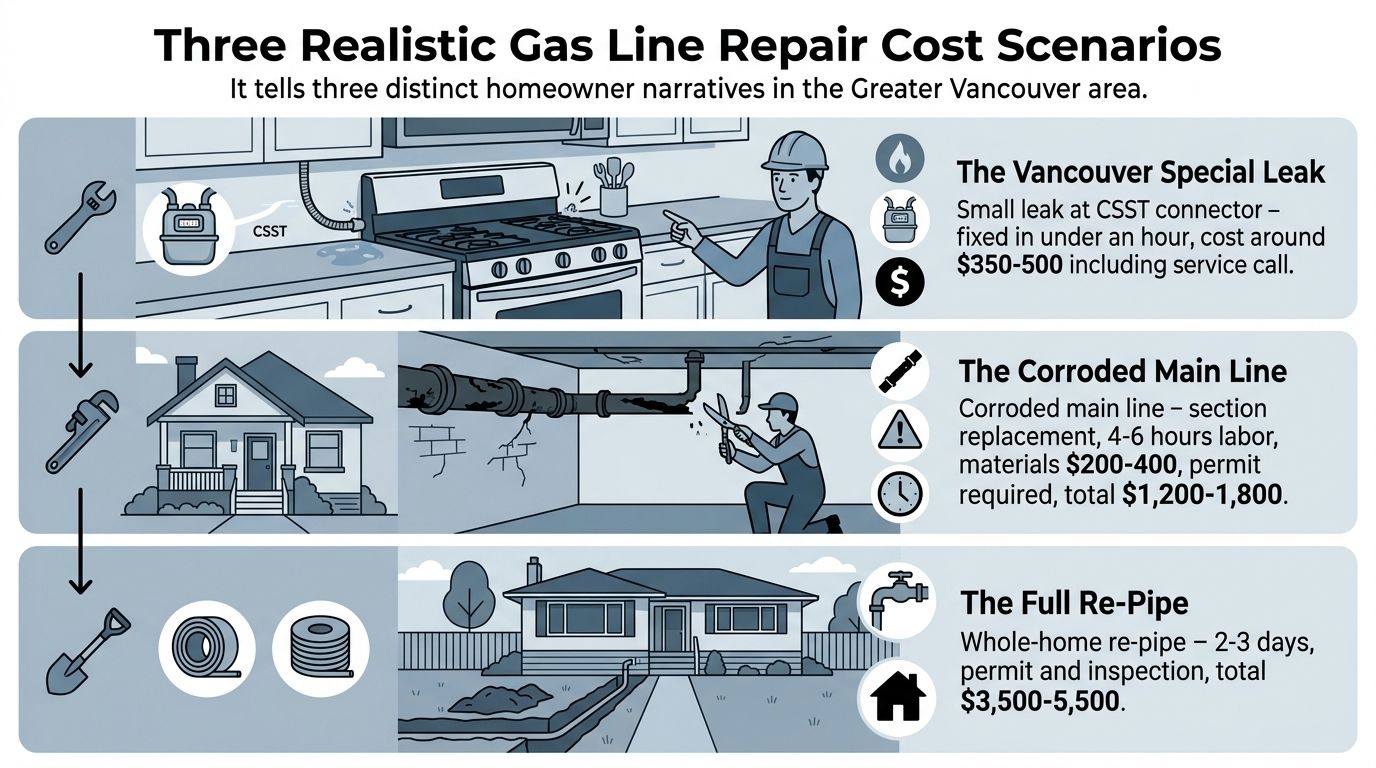
Three Realistic Gas Line Repair Cost Scenarios
The following examples show how scope changes the bill in the Greater Vancouver service area. They're practical illustrations, not fixed prices, and the permit lines must be checked against the current authority schedule.
Scenario one, the Vancouver Special leak
A homeowner notices a gas odour near a 12-year-old gas range in a Vancouver Special. The gas fitter finds a leaking CSST flex connector behind the appliance, isolates the range, replaces the connector, checks the shutoff, and tests the connection. The repair takes under an hour, but the service call, diagnostic work, materials, and permit still matter.
A realistic mini-invoice might read:
- Labour and service attendance: approximately $250 to $350
- Connector and small fittings: included in the itemised materials line
- Permit: the applicable Vancouver appliance or replacement category
- Inspection: listed separately if charged
- Illustrative total: approximately $350 to $500, matching the supplied scenario range
The low physical complexity doesn't mean the contractor can skip safe isolation and testing.
Scenario two, the North Vancouver water heater change
In North Vancouver, an older bungalow has an atmospheric water heater that needs replacement. The new power-vent unit requires changes to the gas connection and venting, and the existing gallery piping needs to be brought into the current installation requirements. The work takes longer because the fitter is changing both the appliance connection and the surrounding pipework, then arranging the required inspection.
The itemised invoice should identify:
- Labour: appliance removal, repiping, installation, testing, and cleanup
- Materials: new appliance connection, piping, fittings, venting components, and supports
- Permit: North Vancouver's appliance-based fee, with the first two appliances listed at $150 under the by-law
- Inspection: shown separately if applicable
- Total: driven by the new appliance, repiping, access, and compliance scope rather than the water heater alone
Scenario three, the Burnaby buried service line
A Burnaby homeowner has a corroded buried line between the meter and the house. An open trench crosses a side yard, so the estimate must account for excavation, pipe replacement, pressure testing, soil handling, and restoration. The ownership boundary at the meter becomes critical before any digging begins.
A useful mini-invoice format is:
- Labour: excavation, gas fitting, testing, and backfill
- Materials: approved replacement pipe, fittings, tracer or support components where required
- Permit and inspection: municipality-controlled charges, listed independently
- Restoration: landscaping or hardscape reinstatement, either included or excluded in writing
- Utility coordination: identified separately if the meter or service line requires FortisBC involvement
FortisBC states that it owns meters and service lines, and repairs those components at no cost to customers, but it doesn't repair privately owned gas piping inside homes or businesses. If a homeowner damages a FortisBC-owned service line while digging, FortisBC says the customer may be responsible for the resulting repair. Confirm the boundary before excavation through FortisBC's gas odour and ownership guidance.
How to Get an Accurate Quote and Avoid Surprise Charges
A good quote lets you compare contractors without guessing what has been omitted. Give every gas fitter the same information, including the appliance involved, the location of the line, whether the pipe is exposed or buried, and any recent utility or inspection notice.
Ask for these items in writing:
- Credentials: Request the BC Gas Fitter Class A or B contractor number and ask about the contractor's Technical Safety BC account status.
- Labour and materials: Require separate lines for labour hours or fixed labour, pipe, fittings, connectors, valves, and other materials.
- Permit and inspection: Confirm the filing authority, permit amount, permit number, and who will arrange inspection.
- Pricing method: Ask whether the estimate is fixed-price or time-and-materials, and identify the approval process for extra work.
- Utility boundary: Confirm who schedules any FortisBC shut-off and reconnect, and whether a reconnect charge could apply.
- Excavation conditions: For a trenchless proposal, ask for a soil-condition contingency, utility-location plan, entry and exit pit requirements, and restoration responsibility.
The contractor controls diagnosis, workmanship, labour organisation, and material selection within the approved scope. The city controls its permit schedule, inspection process, and local requirements. FortisBC controls its own meter and service-line procedures.
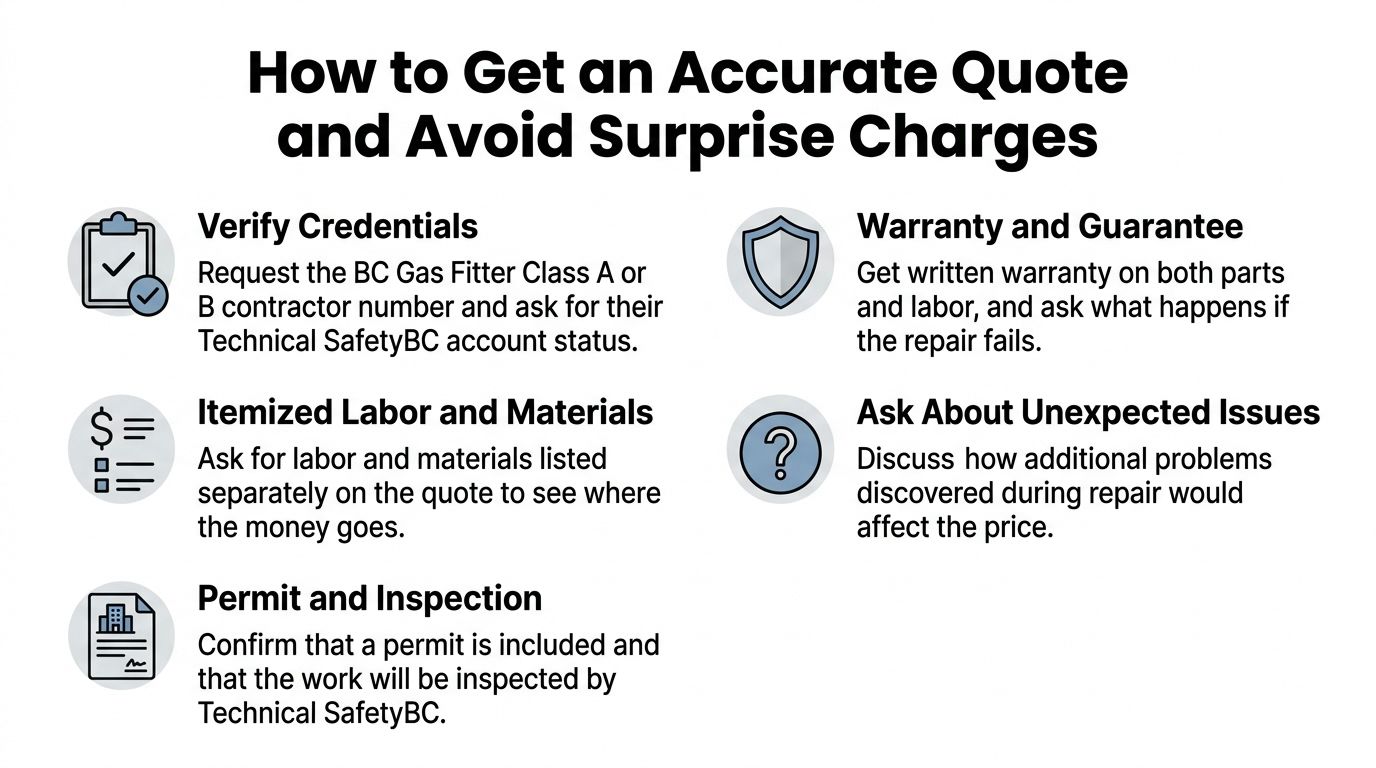
A quote that says “repair gas line” leaves too much unresolved. The useful version states what was found, what will be replaced, how the system will be tested, which permit applies, and what happens if concealed damage appears after access work begins.
Putting It All Together Before You Sign
Use one decision rule for any gas line estimate: approve the work only when labour, materials, permitting, access, and any emergency premium are visible as separate cost areas.
The broad BC range, from about $150 for a simple appliance-level repair to $2,000 or more for buried-line work, reflects scope rather than one universal contractor markup. A connector repair, water heater repipe, and excavated service-line replacement require different tools, time, access, and approvals.
Before signing, verify four points:
- Labour is separated from materials.
- The permit fee matches the municipality or Technical Safety BC category.
- The line's ownership at the meter has been confirmed.
- The trenching or trenchless method, restoration, testing, and contingencies are written down.
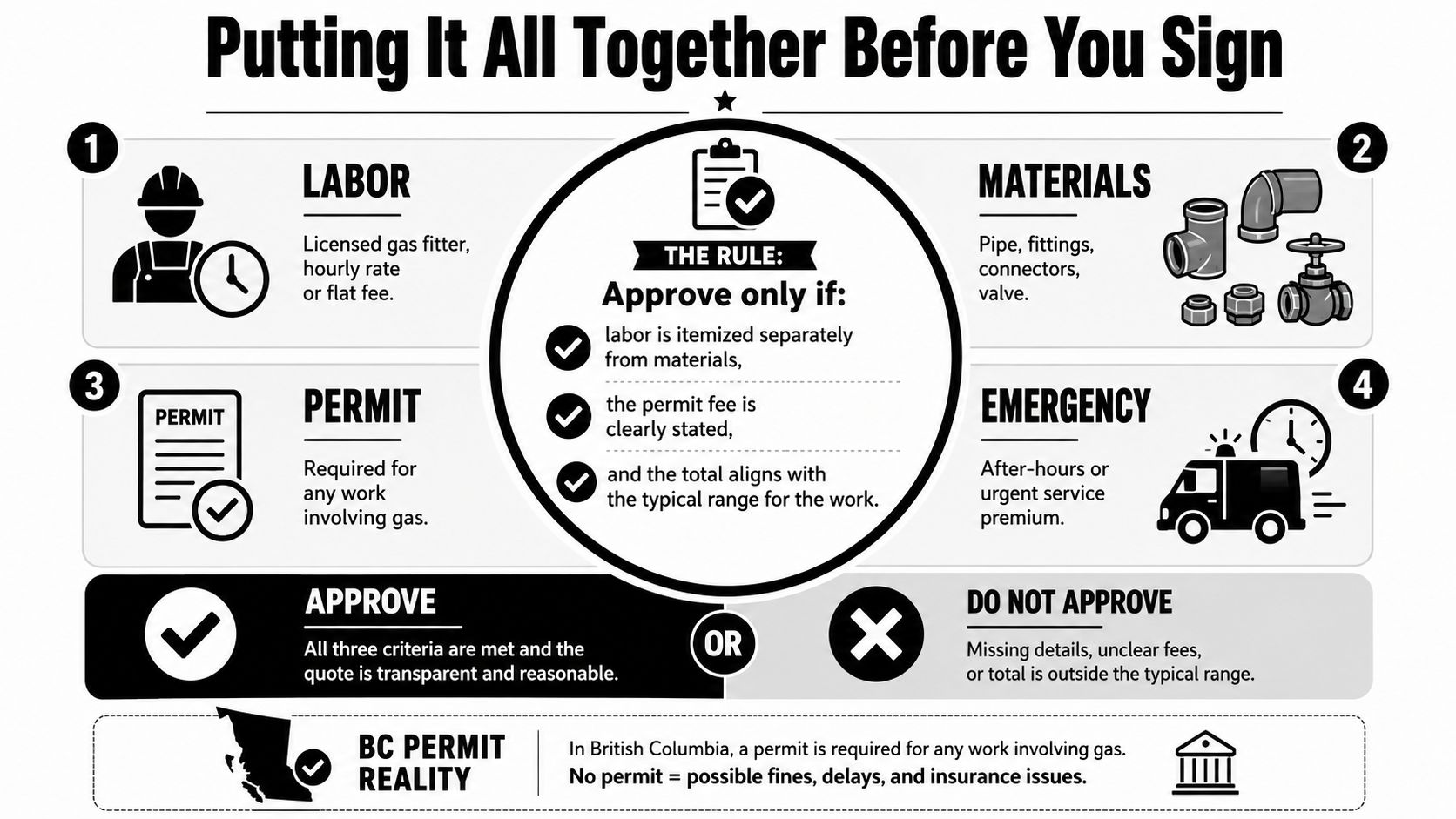
Request a written, line-itemised quote from a qualified gas fitter before work begins. Have the contractor separate contractor charges from city and Technical Safety BC fees, and flag the FortisBC ownership boundary before anyone digs or alters the service connection.
Encano Plumbing & Drainage Ltd. provides gas line inspection, appliance-side gas service, leak diagnosis, and repair across Vancouver and nearby Greater Vancouver communities. For a clear scope, permit discussion, and practical repair plan, visit Encano Plumbing & Drainage Ltd. to book service.