
A sewage backup rarely arrives at a convenient time. You may be standing in the basement of an older Vancouver home, watching dirty water rise through the floor drain after heavy rain, while trying to decide whether tree roots, a collapsed pipe, or a municipal blockage caused it. A snake may restore flow, but it won't necessarily explain why the line failed.
A plumber with camera can inspect the inside of the sewer lateral before anyone starts digging. The recording can show the defect, measure the camera's distance from the access point, and, with a locator, identify where the problem sits beneath the yard, driveway, or floor. That changes the conversation from “we think the pipe is blocked” to “the video shows an offset joint at this location.”
Table of Contents
- Why a Plumber With Camera Changes the Way Drain Problems Get Solved
- How a Sewer Camera Inspection Actually Works
- Camera Inspection Versus Blind Diagnostics
- What the Camera Usually Finds Inside a Sewer Line
- A Real Example of a Pre-Purchase Sewer Scope
- How Much a Camera Inspection Costs in Greater Vancouver
- When a Camera Is Not Enough and What Comes Next
- Booking a Plumber With Camera in Your Area
Why a Plumber With Camera Changes the Way Drain Problems Get Solved
A 1960s Vancouver Special in Killarney is a good example. After a period of intense rain, sewage backs up through the basement floor drain. The homeowner has three plausible explanations: roots have entered the lateral, an older clay section has collapsed, or the blockage sits on the city side of the connection.
Blind snaking may clear the immediate obstruction, but the homeowner still won't know which explanation is correct. A camera inspection puts eyes inside the line, usually from an accessible cleanout toward the property line. The operator can see whether the pipe is open, narrowed by roots, cracked, offset, or holding standing water.
From reaction to evidence
A drain cable is a treatment tool. A sewer camera is a diagnostic tool. Those jobs overlap, but they aren't interchangeable.
With a recorded inspection, the technician can pause at a defect, note the distance counter, and use a sonde locator to trace the camera's position above ground. The result is a usable record for deciding whether the next step is cleaning, spot repair, trenchless rehabilitation, or excavation.
Practical rule: If a blockage keeps returning, clearing the symptom without inspecting the line leaves the main question unanswered.
Greater Vancouver properties often contain transitions between older clay or concrete laterals, newer PVC tie-ins, and shared connections. Ground movement, mature trees, and different pipe materials can make a short visible section look healthy while a hidden joint causes repeated trouble.
Vancouver's rules show why this documentation matters. When an applicant wants to use an existing public sewer connection, the city requires a video inspection and associated report from a PACP/LACP certified contractor. If defects are found, the connection can be considered unsuitable. Private plumbing companies may clean and inspect the connection from a home to the sewer main, while the city or its agents handle excavation or repair of the city portion in the right-of-way. See the City of Vancouver sewer and watercourse requirements for the regulated distinction.
The camera doesn't repair the pipe. It tells you what you're repairing, where it is, and whether digging is justified.
How a Sewer Camera Inspection Actually Works
A residential sewer scope follows a fairly simple sequence, but the quality of the result depends on the equipment and the operator's control.
Step 1, find a workable access point
The technician starts with the main outside cleanout, often a two-way fitting near the house. If that access point is buried, damaged, or missing, the camera may need to enter through a pulled toilet, a floor drain, or a roof stack. The access route affects how far the camera can travel and which bends it can traverse.
Step 2, send the camera through the line
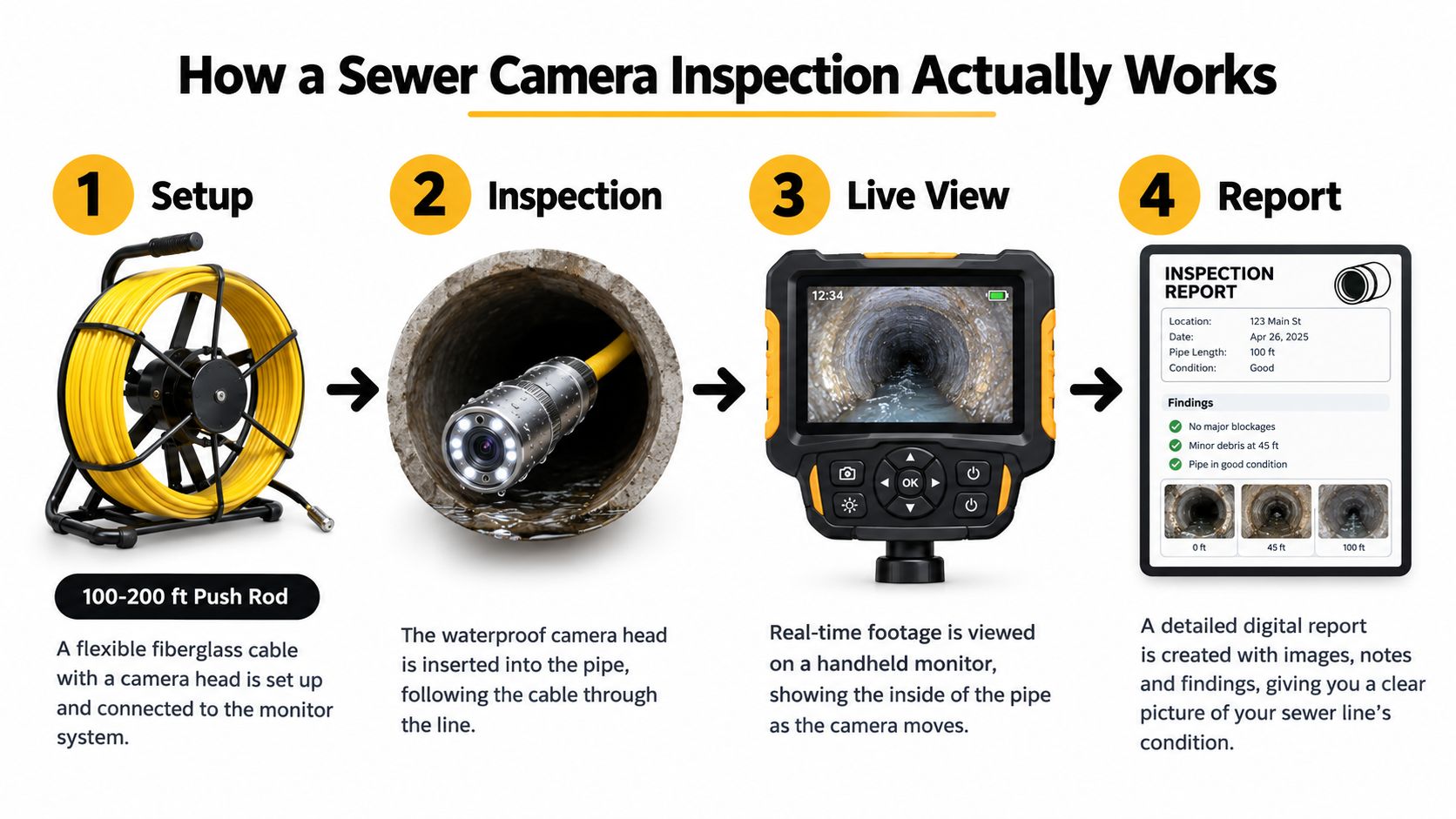
A push rod reel carries a flexible fiberglass cable, commonly 100 to 200 feet, with a waterproof, self-levelling colour camera head. The head sends live footage to a monitor while the operator feeds it through the pipe.
The easiest analogy is a small flashlight travelling through a dark garden hose while a friend above follows a beeper buried in the lawn. The camera illuminates the pipe, and the locator sonde transmits a signal that the technician follows with a handheld wand.
Step 3, record the route and defects
The monitor displays the live image, while a distance counter marks how far the camera has travelled. A careful operator slows down at fittings, joints, transitions, and suspected defects instead of rushing past them.
The camera system may record MP4 footage, allowing the homeowner, strata manager, insurer, or repair contractor to review the same evidence. A locator can add surface marks showing the depth and position of a defect, which is especially useful before excavation.
Step 4, interpret the footage
A useful inspection doesn't end with a video file. The technician should explain what the camera saw, what it couldn't see, and whether the finding points toward cleaning, monitoring, repair, or replacement.
Municipal and institutional specifications illustrate the difference between casual footage and controlled CCTV work. Vancouver contract operators must hold current NASSCO PACP certification, while technical requirements address resolution, waterproofing, lighting, and recording standards. UBC specifications call for a pan-and-tilt camera with 360° panning and 270° tilt, an inclinometer for pipe slope, colour imagery, and controlled travel speeds including 0.1 m/s for pipes under 200 mm. Review the UBC CCTV pipeline inspection specification for the engineering benchmark.
A home inspection won't usually need every institutional feature, but the principle carries over. Clear footage, controlled movement, distance data, and a report produce a decision record, not just a blurry video.
Camera Inspection Versus Blind Diagnostics
Homeowners usually face one of three paths when a sewer line acts up. A technician can snake it without looking inside, excavate based on symptoms, or inspect first and choose the repair from the evidence.
The first option is often sensible for a simple, isolated clog. It becomes weaker when several fixtures back up, the same blockage returns, or the property has an older lateral. A cable may open a passage through roots or paper, but it can't show whether the pipe wall is cracked or whether a belly will collect debris again.
Exploratory excavation has the opposite problem. It exposes the pipe, but the crew has to guess where to dig unless the defect has already been located. Landscaping, concrete, and driveways can be disturbed before anyone confirms that the selected section contains the cause.
Side-by-side comparison
| Method | What It Tells You | Typical Cost (CAD) | Yard Damage | Time to Real Answer |
|---|---|---|---|---|
| Blind snaking | Whether a cable can restore flow | Not established by the verified data | Usually none at the start | Fast answer about flow, limited answer about cause |
| Exploratory excavation | What is visible in the opened section | Not established by the verified data | High potential for disturbance | Depends on whether the first dig reaches the defect |
| Camera inspection | The visible condition and location of defects | Not established by the verified data | None for the inspection itself | A recorded diagnostic answer during the visit |
The comparison is deliberately honest about price. No verified source here establishes a dependable Canadian dollar range for blind snaking or exploratory excavation, so quoting one would create false precision. The same caution applies to claims that a scope “always” saves money.
A camera can still protect your budget in practical ways. It may prevent digging in the wrong place, show that cleaning is sufficient, or reveal a structural problem that makes repeated snaking poor value. The recording can also help when a homeowner discusses responsibility with a strata, insurer, or the City of Vancouver.
Metro Vancouver's municipal requirements reinforce the value of a documented inspection. In some approval situations, the footage and report are part of the record, rather than an informal opinion from a service visit.
A clear diagnosis doesn't guarantee a cheap repair. It does reduce the chance of paying for the wrong one.
What the Camera Usually Finds Inside a Sewer Line
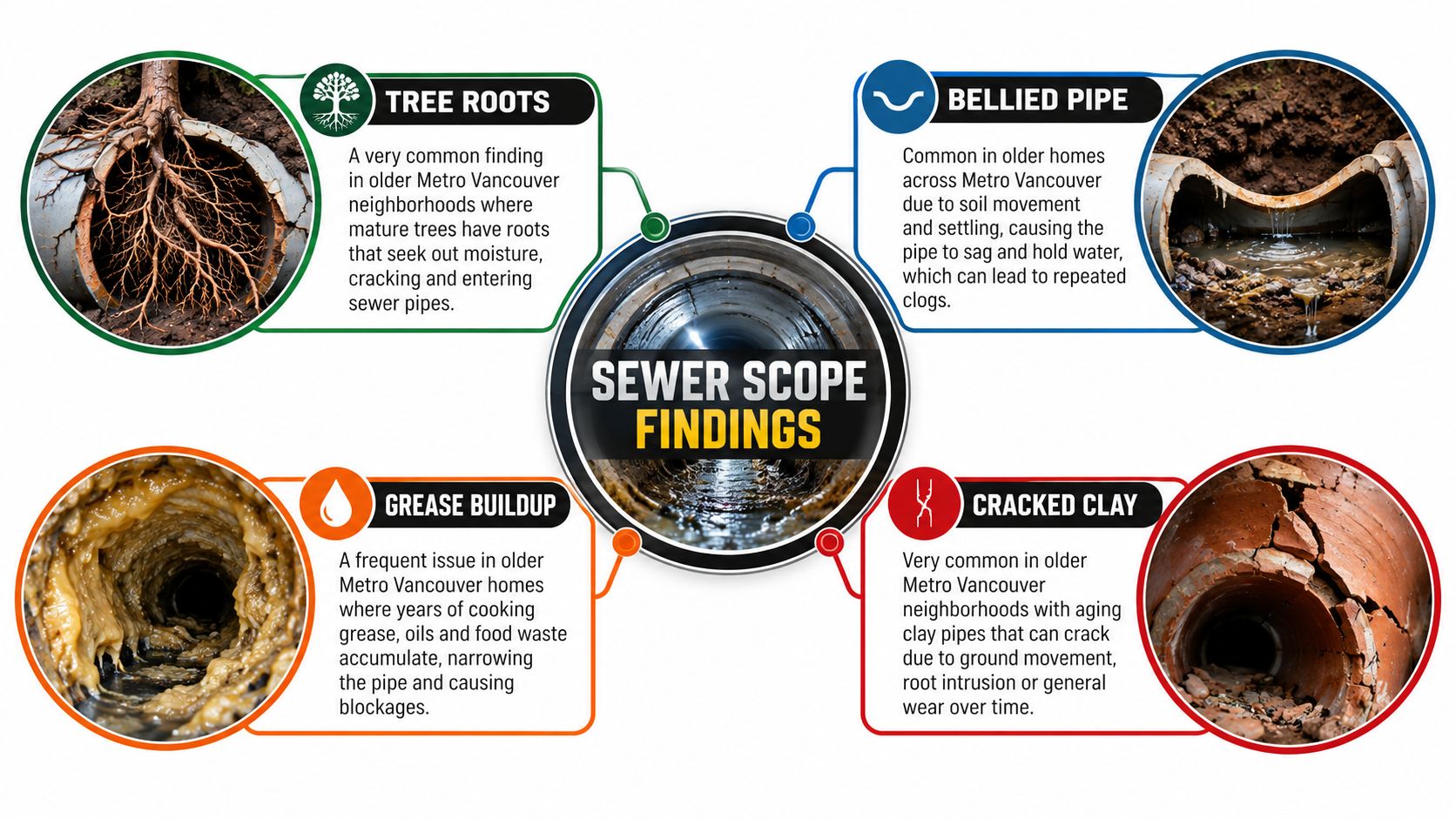
A sewer camera doesn't label every problem automatically. The operator interprets the shape, movement, pipe material, flow, and location together. Four findings appear often enough in Greater Vancouver homes to deserve careful explanation.
Tree roots
Roots commonly enter through joints or small cracks, especially where older clay laterals run near mature maples, cedars, or other established planting. On screen, fine roots can look like hair across the lens. Larger intrusions form a mat that catches paper, wipes, and grease.
Hydro-jetting or mechanical root cutting may restore the opening. The lasting recommendation depends on the entry point and pipe condition. A recurring intrusion may call for a spot repair or lining rather than repeated cleaning.
Cracks and offset joints
A crack can appear as a dark line across the pipe wall. An offset joint looks like one section has shifted, leaving a lip or uneven opening. These defects often deserve attention at transitions between materials or where settlement has disturbed the trench.
The operator should record the distance and, when needed, locate the defect from the surface. A small, isolated failure may suit spot repair. A longer damaged run may lead to trenchless rehabilitation or replacement.
Bellies and sags
A belly is a section that has dropped below the intended grade. The camera may enter standing water and struggle to move beyond it. That pool can collect solids even when the rest of the pipe looks open.
Cleaning won't correct the lost slope. Regrading or replacing the affected section may be necessary, although the decision depends on the length, depth, access, and frequency of symptoms.
Grease and heavy buildup
Grease can coat the inside of a kitchen line with a dark, tarlike layer. The pipe's effective opening becomes smaller, so ordinary flow carries less waste before the line slows.
Hydro-jetting is often the relevant cleaning method, followed by another camera pass to check the result. A camera can't tell you that grease is the only cause if the line also contains a crack or sag, so the operator should keep inspecting after the obstruction is cleared.
The useful question isn't “What did the camera find?” Ask, “What does this finding change about the repair decision?”
A Real Example of a Pre-Purchase Sewer Scope
Consider a buyer under contract on a 1980s two-storey townhouse in Richmond. The inspection window is seven days, the strata documents mention shared laterals, and a large maple grows near the front of the property. The buyer wants more than a general home inspection because the private sewer lateral is underground and outside the normal field of view.
A technician finds the main cleanout and runs the camera from the base of the stack toward the property line. The inspection produces roughly 40 metres of high-resolution video. At the 9-metre mark, the footage shows roots entering at an older joint. Farther along, the camera passes through a shallow belly beneath the driveway, while the connection toward the municipal side appears intact and clear.
The inspection doesn't turn every finding into an emergency. The root intrusion is flagged as a near-term concern because it can collect waste and restrict flow. The shallow belly is recorded as a monitoring item, with its significance depending on symptoms and future changes.
What the buyer receives
The buyer receives a USB recording, distance and location notes, and a written report. Those documents give the buyer something specific to discuss with the seller and strata, rather than relying on a vague statement that the sewer “looks old.”
The seller agrees to credit part of the hydro-jetting and spot repair, and the transaction closes on schedule. The scope hasn't guaranteed that the line will never fail. It has made the known condition visible and helped the buyer decide with fewer unknowns.
A sewer lateral is separate from a general home inspection, which is why a dedicated scope can matter during a purchase. The Greater Vancouver sewer line inspection guide for home purchases explains that distinction in practical terms.
For a buyer, the strongest report answers four questions:
- Where is the finding? Distance from the access point and surface location matter.
- What is it? Roots, a crack, a belly, buildup, or an uncertain view should be identified plainly.
- How urgent is it? Near-term repair, monitoring, and immediate blockage response aren't the same.
- What would change the recommendation? Recurring backups, failed cleaning, or worsening footage may require a new decision.
How Much a Camera Inspection Costs in Greater Vancouver
Cost transparency is harder than it should be because “camera inspection” can describe very different jobs. A single accessible cleanout is a simpler visit than inspecting separate branches, pulling a toilet, locating a defect, or responding after hours.
The available regional guidance identifies access, line length, the number of lines, and the need for a locator as important pricing variables. It also highlights a practical gap in Canadian service content, many pages explain the process without clearly explaining what the homeowner receives for the fee. See this Greater Vancouver sewer line camera inspection cost guide for the local budgeting discussion.
What moves the quote
A usable cleanout keeps the visit straightforward. If the cleanout is buried, blocked, or absent, the technician may need to remove a toilet or use another access point. A long run to the property line takes more time to inspect carefully, particularly if the operator must pause at multiple fittings or defects.
A second line also changes the job. A kitchen branch, separate stack, or shared drainage arrangement may require another access point and a separate camera run. If excavation planning is possible, a locator adds value because the contractor can mark the suspected defect above ground instead of describing its position only by camera distance.
Urgent service carries its own scheduling and access considerations. Ask whether the quoted inspection includes the recording, written notes, locating, and any cleaning needed to make the pipe visible.
A useful quote format
| Service | Typical Price Range (CAD) | What's Included |
|---|---|---|
| Standard residential sewer scope | Not established by the verified data | Confirm whether one cleanout, recording, and written summary are included |
| Inspection through two access points | Not established by the verified data | Confirm whether both lines receive separate footage and notes |
| Locator work | Not established by the verified data | Confirm whether the surface position and depth are marked |
| Urgent or after-hours inspection | Not established by the verified data | Confirm the inspection fee separately from clearing or repair |
The table avoids invented dollar ranges. A contractor should provide a line-item quote rather than hiding access work, locating, cleaning, or report preparation inside an unclear “camera fee.”
Bundling hydro-jetting with a camera can make operational sense when buildup prevents a useful view. The technician can clean the line, run the camera again, and give you a before-and-after record. That doesn't mean every backup needs both services, so ask what the first inspection can establish.
When a Camera Is Not Enough and What Comes Next
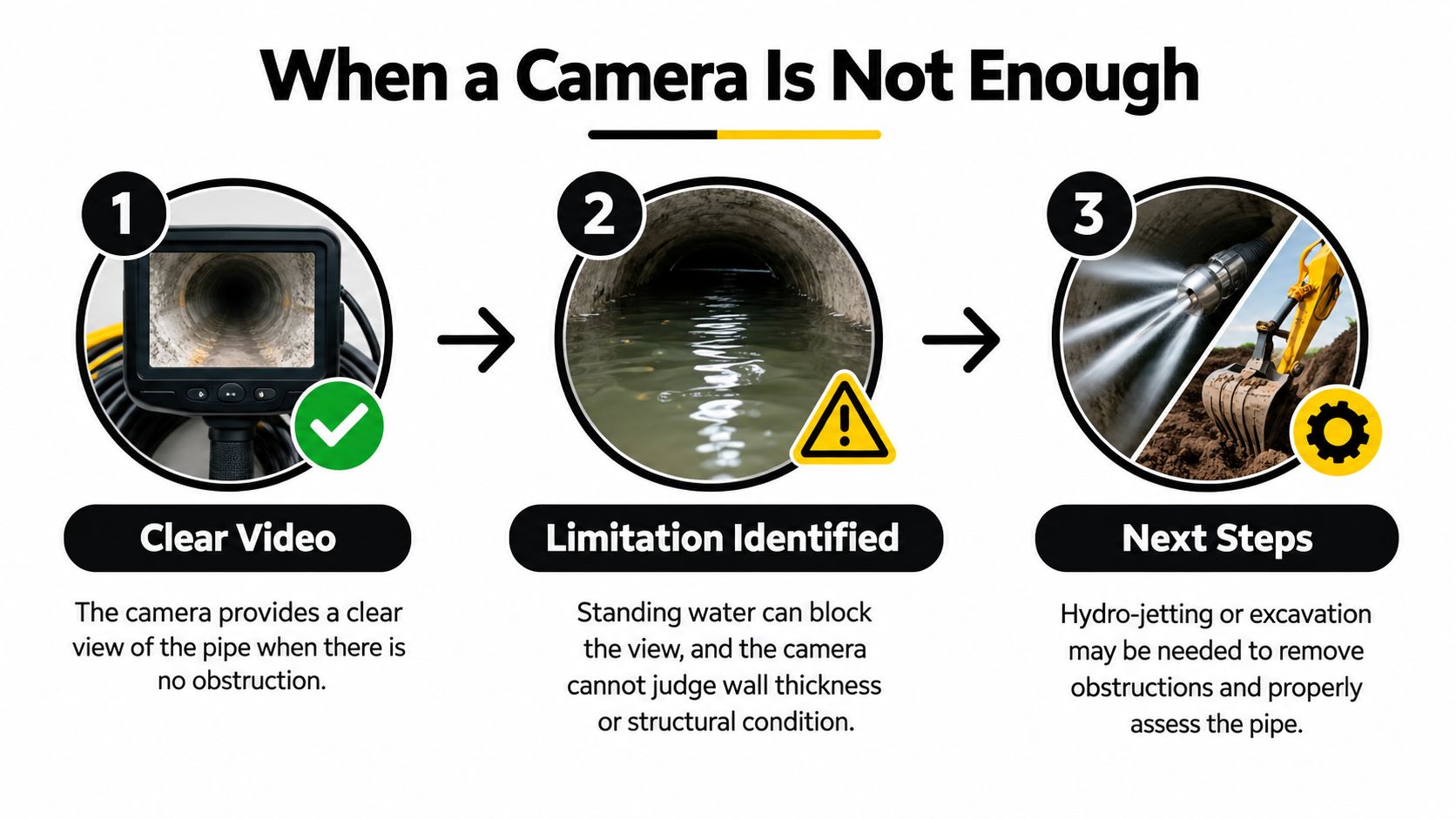
A sewer camera answers one question well: what the lens can see along the pipe. It cannot see through standing water, measure wall thickness, or identify the exact point above ground without a locator. A clear recording is evidence, not a complete diagnosis.
The inspection may also end before the problem does. A grease cap can block the camera, a collapsed clay tile can stop the head at the failure, and a dropped joint can prevent access to the section beyond it. In each case, the footage shows where visibility ends, not that the unseen pipe is sound.
Match the next test to the unanswered question
Leakage calls for a different check than a blockage. A pressure or hydrostatic test can help determine whether the line holds water. If the camera stops at a defect, a sonde locator can mark the camera head's position before anyone excavates.
Smoke testing examines another part of the system. It can reveal illegal connections, vent leaks, or pathways that a camera inside the main line cannot show. For cast iron stacks, ultrasonic thickness gauging provides information about wall condition that ordinary video cannot capture.
Municipal sewer programs use CCTV as a decision-support tool for gravity sewer condition assessment. The Metro Vancouver and UBC condition-assessment research describes visual CCTV, structured grading, and inspection planning. A residential scope follows the same practical logic on a smaller scale: inspect, record, identify uncertainty, then choose the test or repair that answers it.
Questions worth asking before approving work
- What did the camera fail to see? Ask whether water, debris, collapse, or limited access blocked the view.
- Was the line cleaned first? Hydro-jetting may be needed before buildup can be separated from actual pipe damage.
- Was the defect located from the surface? Camera distance alone does not mark the ground.
- What material is visible? Clay, concrete, PVC, ABS, and cast iron create different repair expectations.
- What confirms the recommendation? Ask whether pressure testing, smoke testing, sonar, or thickness gauging fits the unanswered question.
- Will there be a return inspection? Post-cleaning or post-repair footage can show whether the work produced the intended result.
A short damaged section may suit a spot repair. A longer damaged run may lead to trenchless rehabilitation or replacement, as explained in this guide to trenchless sewer repairs. The honest conclusion may be that the camera provides only a partial answer. That is more useful than treating an obstructed view as proof that the rest of the line is sound.
Booking a Plumber With Camera in Your Area
Start by asking what equipment the contractor will bring. A professional sewer scope normally uses a flexible push rod, a waterproof self-levelling camera head, recording capability, and, where location matters, a sonde locator. A cheap handheld borescope can inspect a short visible drain, but it may not travel through a residential lateral or create a useful record for repair planning.
Before the appointment, clear access to the main cleanout and move stored items away from the work area. Write down which fixtures gurgle, drain slowly, or back up, and have past repair invoices available. Those details help the technician compare today's footage with earlier symptoms instead of treating the visit as an isolated event.
What a proper service record should contain
A homeowner should leave the appointment knowing what was inspected and what remains uncertain. Ask for:
- A digital recording: The file should cover the route, not only the most dramatic defect.
- Time-stamped still images: Each important finding should be easy to locate in the video.
- Distance notes: The report should state the camera distance from the access point.
- Material and condition observations: The technician should identify visible transitions, roots, cracks, offsets, bellies, and buildup.
- A locator map when needed: If excavation is possible, ask for the surface position and depth of the suspected defect.
- A next-step recommendation: Cleaning, monitoring, spot repair, trenchless work, and replacement have different implications.
Municipal-grade work shows why these details matter. Vancouver requirements refer to PACP certification and defined video standards, while the city's plumbing guidance says contractors can provide video inspection of water pipes with photos or a DVD as a record. West Vancouver's sewerage bylaw also uses video inspection in specified service-connection situations, including connections less than 40 years old with an inspection chamber and new connections for service connections 40 years old or older. The City of Vancouver plumbing and drain repair guidance provides the regional context.
For residential work, you don't necessarily need a municipal crawler system. You do need a technician who can produce footage clear enough to support a decision, explain the limits of the inspection, and follow up when the finding becomes a repair. Encano Plumbing & Drainage Ltd. offers residential sewer and drain camera inspections across Vancouver, Burnaby, Richmond, Surrey, and the North Shore, with follow-up support for sewer cleaning, repair, and trenchless replacement.
If sewage is backing up, don't authorize excavation based only on a symptom. Clear the cleanout, document the fixture behaviour, and ask for a recorded inspection with defect distances and a clear explanation of what the camera could and couldn't see.
Encano Plumbing & Drainage Ltd. provides residential sewer camera inspections, drain cleaning, sewer repairs, and trenchless replacement support across Greater Vancouver. Visit Encano Plumbing & Drainage Ltd. to arrange an inspection and turn an uncertain sewer problem into a documented repair plan.