
A sewer scope typically costs a few hundred dollars, yet it can expose a lateral replacement costing $8,000 to $20,000, making it one of the highest-value due-diligence steps for a buyer of an older home in Greater Vancouver. If you're buying in Vancouver, Richmond, Burnaby, New Westminster, Delta, or Surrey, book the camera before you remove your inspection conditions.
You've probably already walked through the house, checked the furnace, opened cabinets, and watched every toilet flush. The property looks clean, the yard is attractive, and the offer deadline is closing in. That's exactly when buyers talk themselves out of looking underground.
I've seen buyers focus on paint, flooring, and minor electrical items while ignoring the private sewer lateral, the pipe that can turn a comfortable purchase into an excavation project. A general home inspection usually doesn't evaluate that buried line, so a dedicated camera inspection gives you information the standard inspection can't provide. BC sewer-scope guidance specifically recommends considering a camera scope for homes built before 1990 or properties where the sewer line's age is unknown.
Table of Contents
- A Buyer's First Look at the Sewer Line
- How a Sewer Scope Works
- Common Defects and What They Really Mean
- Timing, Access, and Cost in Greater Vancouver
- Turning the Report Into Negotiation Advantage
- Local Rules and Compliance You Should Not Skip
- Red Flags, Smart Questions, and a Buyer's Checklist
- The One Decision That Protects the Deal
A Buyer's First Look at the Sewer Line
A young couple bought a charming 1958 bungalow with a mature garden and wide driveway. The drains worked during the showing, and the general inspection found no active backup, so they waived the sewer scope. Three weeks after closing, the clay lateral collapsed beneath the driveway. Emergency excavation cost $14,000.
The failure was hidden, not unforeseeable. The house was older, the pipe material was unknown, and nobody had viewed the line. Their mistake was buying an underground system without documenting its condition before removing their protection under the purchase agreement.
What the camera actually inspects
A sewer scope is a dedicated video inspection of the private lateral, the underground pipe running from the house to the municipal connection or septic tank. A technician reaches it through a cleanout and records the interior as the camera travels through the pipe. It is separate from a general home inspection. Regional BC inspection guidance notes that an accessible cleanout can allow the camera to document the underground line, with written findings and video evidence for repair planning or negotiation.
The camera does not inspect every drain inside the walls, certify the municipal sewer main, or replace hydrostatic or pressure testing. Its job is narrower and practical: document the private lateral's condition, identify defects, and show their location.
Practical rule: On an older property, especially one with mature trees, treat the lateral as a major asset component, not as an optional plumbing extra.
Older homes deserve closer attention because the line may be clay, concrete, Orangeburg, cast iron, or another material with limited service history. A pipe can carry water normally during a showing while roots, displaced joints, fractures, or a developing collapse remain beneath the lawn or driveway. Do not count on a warranty or insurance policy to solve an underground problem that existed before you owned the home. Confirm coverage and exclusions in writing instead of treating them as part of your purchase plan.
Use the report as both a diagnostic record and a compliance document. Before closing in BC, give the seller the findings, video, defect location, and contractor estimate. Ask for a repair, a credit, or a price reduction, and put the agreed remedy in writing. A scope left in a drawer has little financial value. A documented defect tied to a clear term in the agreement can protect the deal.
How a Sewer Scope Works
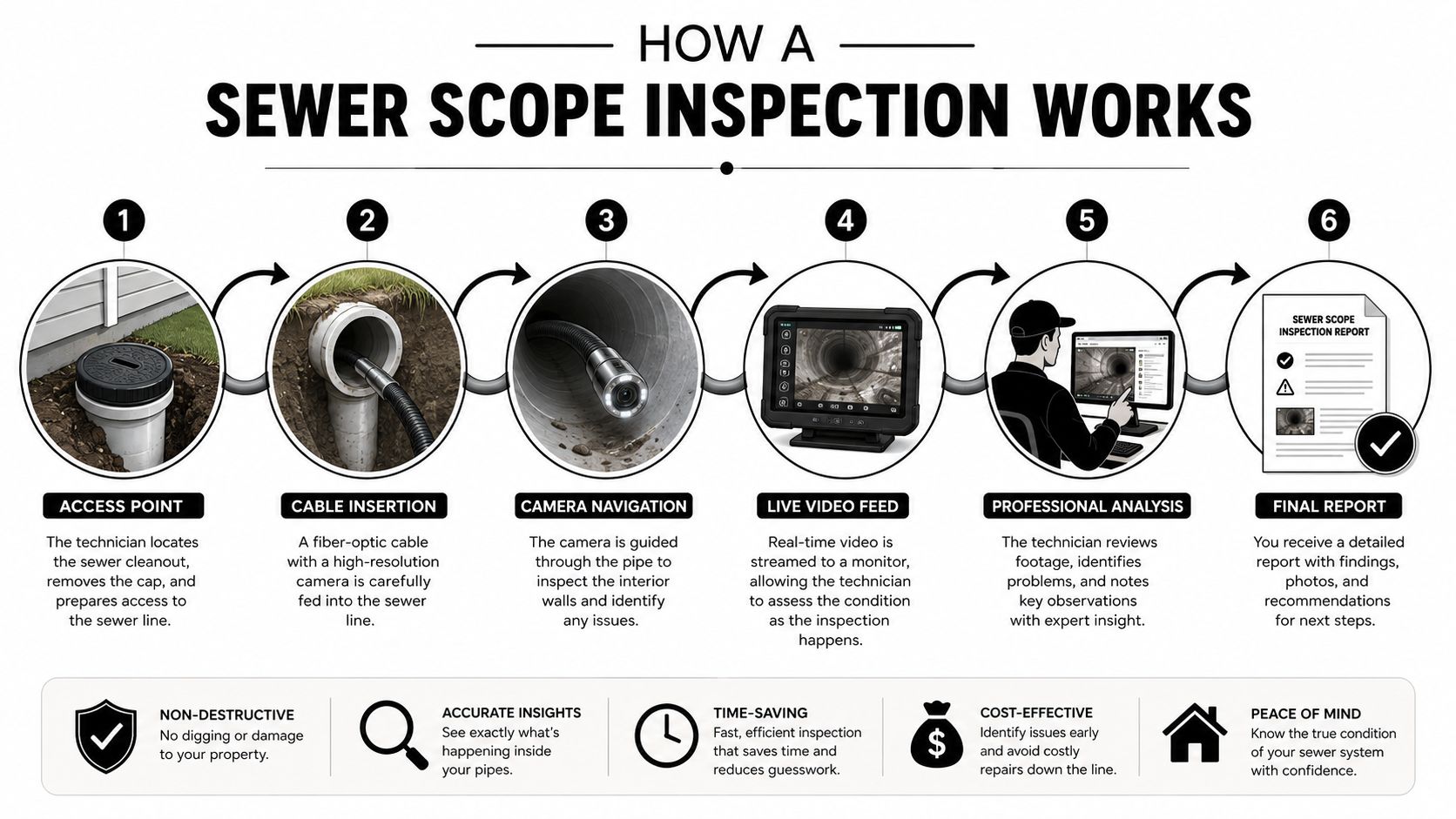
A sewer scope shows the condition of the private lateral, from the access point toward the property line or septic tank. The technician feeds a flexible push rod with a waterproof camera through the pipe while watching the live image on a monitor. The inspection does not cover every drain inside the walls, certify the municipal sewer main, or replace pressure testing. It documents the lateral's condition, defects, and location.
Starting at the cleanout
The first task is access. The technician locates the exterior cleanout, removes its cap, and confirms whether the camera can travel through the line. The cleanout may sit in the yard, near the foundation, at the property line, or beneath a deck. If it is blocked or missing, the technician should record that limitation rather than present an incomplete inspection as a clear result.
The camera head is usually self-levelling, keeping the image oriented as it moves. A transmitter lets the operator locate the camera from the surface and mark the depth of a suspected defect. That mark gives an excavator a defined area for repair, lining, or replacement.
What the camera inspects
The operator examines water movement, joint alignment, pipe material, transitions such as clay to PVC or Orangeburg to ABS, root entry, infiltration, standing water, and changes in shape. The report should state whether the camera reached the expected endpoint and identify any portion of the lateral that remained unviewed.
Ask the technician to pause at each significant finding and explain its location. A root mass near the house carries different repair implications from a collapse beneath a driveway. The video supplies evidence. The measured location connects that evidence to a contractor's estimate and to your purchase decision.
Turning footage into a usable report
A useful report links timestamps and distance-counter readings to still frames and written observations. It should identify the defect, show where it appears, and recommend monitoring, repair, or replacement. Request the original video, not only a verbal summary.
Review the footage with your agent and the contractor preparing an estimate. Encano's drain camera inspection service explains how camera equipment can identify hidden drain and sewer conditions without immediate excavation.
For a buyer, the report is both a diagnostic record and a compliance document. Before closing in BC, give the seller the findings, video, defect location, and estimate. Ask for a repair, credit, or price reduction, then put the remedy in writing. In a CA jurisdiction, the process and disclosure requirements can differ, so confirm the applicable local rules instead of assuming the BC approach transfers. A scope left in a drawer has little financial value. A documented defect tied to a clear contract term can protect the deal.
Here's the visual sequence a buyer should expect:
For a visual demonstration of the camera process, review this sewer inspection video:
Common Defects and What They Really Mean
A sewer camera report records conditions, not a simple pass-or-fail result. Judge each finding by its severity, position, likelihood of returning, and available repair method. On Greater Vancouver properties, five defects deserve the closest review.
Roots are a symptom, not a complete diagnosis
Fine feeder roots commonly enter through joints or small openings. Mechanical cutting can restore flow, while chemical treatment may slow regrowth. Neither removes the weakness that allowed entry. A short-term root service can cost $400 to $1,200, and recurring intrusion may justify a durable lining solution.
Roots under a lawn do not automatically end the deal. Roots combined with an offset, crack, or deteriorated pipe are a different matter. The line may continue admitting water and roots, so ask for a repair estimate and a written remedy before closing.
Offsets and fractures affect flow and structure
An offset means pipe sections have shifted out of alignment, leaving a lip that catches waste. Minor movement may be monitored, but a significant offset can require excavation or a cured-in-place liner. Typical Vancouver-lot costs are $3,500 to $8,000.
Cracks range from hairline defects to broken sections. The decision depends on the crack's length, depth, access, leakage, and effect on flow. A spot excavation commonly falls in the $2,000 to $6,000 range. Get the defect location marked, not merely described as “down the line.”
Bellies and collapses change the purchase equation
A belly is a settled section where water and solids remain trapped. That condition increases the chance of recurring blockages. Treat a meaningful belly as a watch-and-replace issue, not a routine patch, particularly when the pipe has lost its grade over distance.
Partial or full collapse demands a firm response. Older clay or Orangeburg lines can lose their shape and carry waste poorly. Replacement typically ranges from $8,000 to $20,000, depending on depth, surface obstacles, and pavement restoration.
| Defect | What It Means | Typical Cost (Vancouver lot) |
|---|---|---|
| Root intrusion | Roots have entered through joints or openings and may return after cleaning | $400 to $1,200 for short-term service |
| Offset | Pipe sections have shifted and create a catching lip | $3,500 to $8,000 for major repair or lining |
| Crack or fracture | The pipe wall is damaged, with severity ranging from minor to structural | $2,000 to $6,000 for a spot dig |
| Belly | A settled section holds water and solids | Often monitor and plan replacement |
| Partial or full collapse | The pipe has lost structural integrity or flow capacity | $8,000 to $20,000 for replacement |
Use the video, defect distance, and estimate when negotiating. For a lining-specific perspective, review sewer lining repair options and ask whether lining addresses the entire lateral or only a local defect. Put the requested repair, credit, or price reduction into the purchase documents. That turns the scope into evidence for the transaction, rather than a report left in a drawer.
Timing, Access, and Cost in Greater Vancouver
Book the sewer scope immediately after your offer is accepted. Do not wait for the general home inspection. The condition period may leave little time to arrange estimates, request repairs, or renegotiate. In Greater Vancouver, coordinate entry early with the seller, listing agent, or tenant, then confirm when the technician can access the cleanout.
Locate the cleanout before the appointment. A cap beneath a deck, behind dense landscaping, or near the property line can delay the inspection or prevent a full camera pass. Mature trees deserve attention because their roots can affect the lateral, while heavy landscaping can make surface locating and repair planning more difficult.
What buyers should budget
A residential sewer scope in Greater Vancouver typically costs $250 to $450. The written report and video are often delivered the same day or within 24 hours. Treat both as transaction records. They document what the technician inspected, where a defect appears, and what remains unknown.
| Service Item | Typical Range (CAD) | When It's Needed |
|---|---|---|
| Standard sewer camera scope | $250 to $450 | First inspection of the private lateral |
| Cleanout locating | $50 to $150 add-on | The access point is buried, hidden, or difficult to identify |
| Hydrostatic pressure testing | $50 to $150 add-on | You need a separate pressure-based assessment |
| Second camera pass | $50 to $150 add-on | The lateral is long or the first pass doesn't show enough |
Weather usually does not stop camera work, but heavy rain can make water movement harder to interpret. Ask the technician whether conditions support a useful inspection. A low-cost appointment is wasted if the footage cannot establish the line's condition.
If the lateral is long, access is poor, or an obstruction stops the first pass, require the report to state exactly which sections were not inspected. That limitation matters during negotiations and can also matter when confirming whether proposed work meets local requirements. Use the video, defect location, and written estimates to request a repair, credit, or price reduction in the purchase documents.
For replacement planning, review trenchless sewer line replacement costs, then obtain property-specific estimates. Depth, surface restoration, access, and municipal requirements control the final cost.
Turning the Report Into Negotiation Advantage
A sewer scope earns financial value only when its findings become a specific request. “Sewer concerns” gives the seller little to answer. “The video shows a full collapse beneath the driveway, and two contractors estimate replacement at a stated amount” identifies the defect, location, and expected cost.
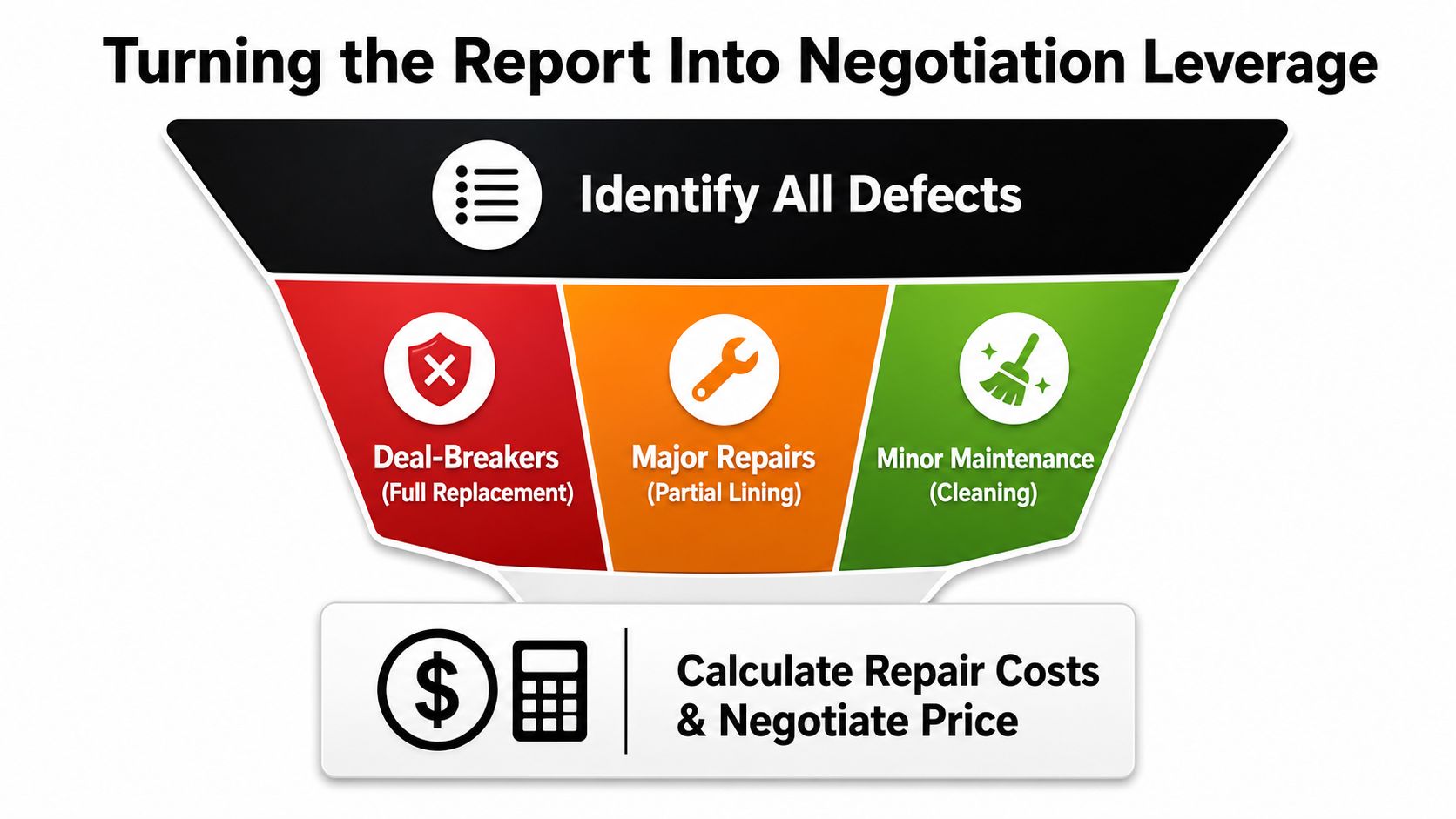
Sort findings by consequence
Use three categories:
- Deal-breakers: A full collapse, a major offset beneath a driveway, or a defect involving unacceptable repair and access risk may justify walking away under your conditions.
- Negotiable repairs: Moderate root intrusion, a single belly, or a minor crack can support a credit, price reduction, or seller-managed repair.
- Acceptable maintenance: Minor buildup or a limited issue without structural concern may be reasonable to accept and monitor.
Do not ask the seller to correct every mark on the video. Focus on defects affecting function, structural integrity, legal compliance, or immediate ownership cost. The report should serve as both a diagnostic record and supporting documentation for the purchase decision.
Put a price beside the problem
For a significant finding, obtain two or three contractor estimates before replying to the seller. A replacement proposal for $15,000 becomes easier to assess when one quote and several comparable job estimates confirm the required access and restoration work. Your request should reflect the actual repair scope, not an inflated allowance.
Suppose the video shows a collapse beneath the driveway and the contractor prices replacement at $12,000. Request a $12,000 credit toward lateral replacement, require the seller to complete the work before closing through a licensed plumber, or seek a price reduction reflecting the same repair burden. State the selected outcome in writing, including who performs the work and what documentation must be delivered.
Seller-managed work gives you less control over the contractor and repair method. A credit lets you choose the plumber after closing, but you carry the short-term risk until completion. If the seller performs the repair, require invoices, permits, warranties, and a post-repair camera inspection.
A clean scope also helps in a multiple-offer situation by giving you evidence that the underground lateral has been reviewed, reducing one major uncertainty without increasing your offer price. Keep the report, footage, estimates, and agreed remedy in the negotiation file. A sewer inspection that sits in a drawer cannot protect the deal.
Local Rules and Compliance You Should Not Skip
British Columbia and California treat sewer laterals differently. In BC, the buyer generally drives the investigation during due diligence. A camera report helps you understand condition, but it isn't automatically the same thing as a municipal compliance certificate.
Before conditions expire, ask your plumber and agent whether the property has a history of lateral repairs, permits, cross-connections, or unusual drainage arrangements. If the line is touched, repair permits and current plumbing standards may apply. Confirm whether the property uses a combined or separated sewer system, and ask whether sump pumps or roof drains connect improperly to the sanitary lateral.
California may make the report part of the sale
California buyers can't assume a sewer scope is merely an optional add-on. In Vallejo, the buyer, seller, or realtor can hire a private contractor, but the entire lateral must be video-inspected by a licensed contractor. The report and footage must be delivered at least 10 days before escrow closes. Exemptions apply when the lateral was installed or replaced under permit within the last 10 years, and condos and mobile homes in parks are exempt. These requirements are described in the California city sewer requirements document.
Santa Cruz County places the initial responsibility on the seller. The seller must arrange a licensed-plumber video inspection and complete repairs the county requires before close of escrow. The plumber must request a no-cost Sanitary Sewer Connection Permit for required repairs, after which the county inspects the repaired lateral before stamping compliance. Exemptions can apply where HOA governing documents assign repair responsibility differently or where the full lateral is under 20 years old, according to the Santa Cruz County lateral program FAQs.
Morgan Hill uses an age-based rule. Private lateral inspections are required for properties more than 15 years old, while homes completed in 2010 or later are exempt. A 2008-built single-family home falls inside the requirement, while a 2010-built home doesn't, as stated by Morgan Hill's property-sale inspection rules.
| Factor | British Columbia | California (select cities) |
|---|---|---|
| Who usually initiates the scope | Buyer during due diligence | Rules may assign the task to the seller, buyer, or an approved contractor |
| Main purpose | Diagnose condition and support negotiation | Diagnose condition and, in some cities, document legal compliance |
| Timing | Before inspection conditions expire | May be tied to escrow or title transfer deadlines |
| Repair responsibility | Confirm through the contract, permits, and municipal records | Some programs require repairs before closing |
| Exemptions | Check local municipal requirements and property records | Can depend on pipe age, permits, HOA rules, or property type |
The key question is simple: are you buying a condition report, a compliance document, or both? Ask the municipality before you treat the camera footage as sufficient.
Red Flags, Smart Questions, and a Buyer's Checklist
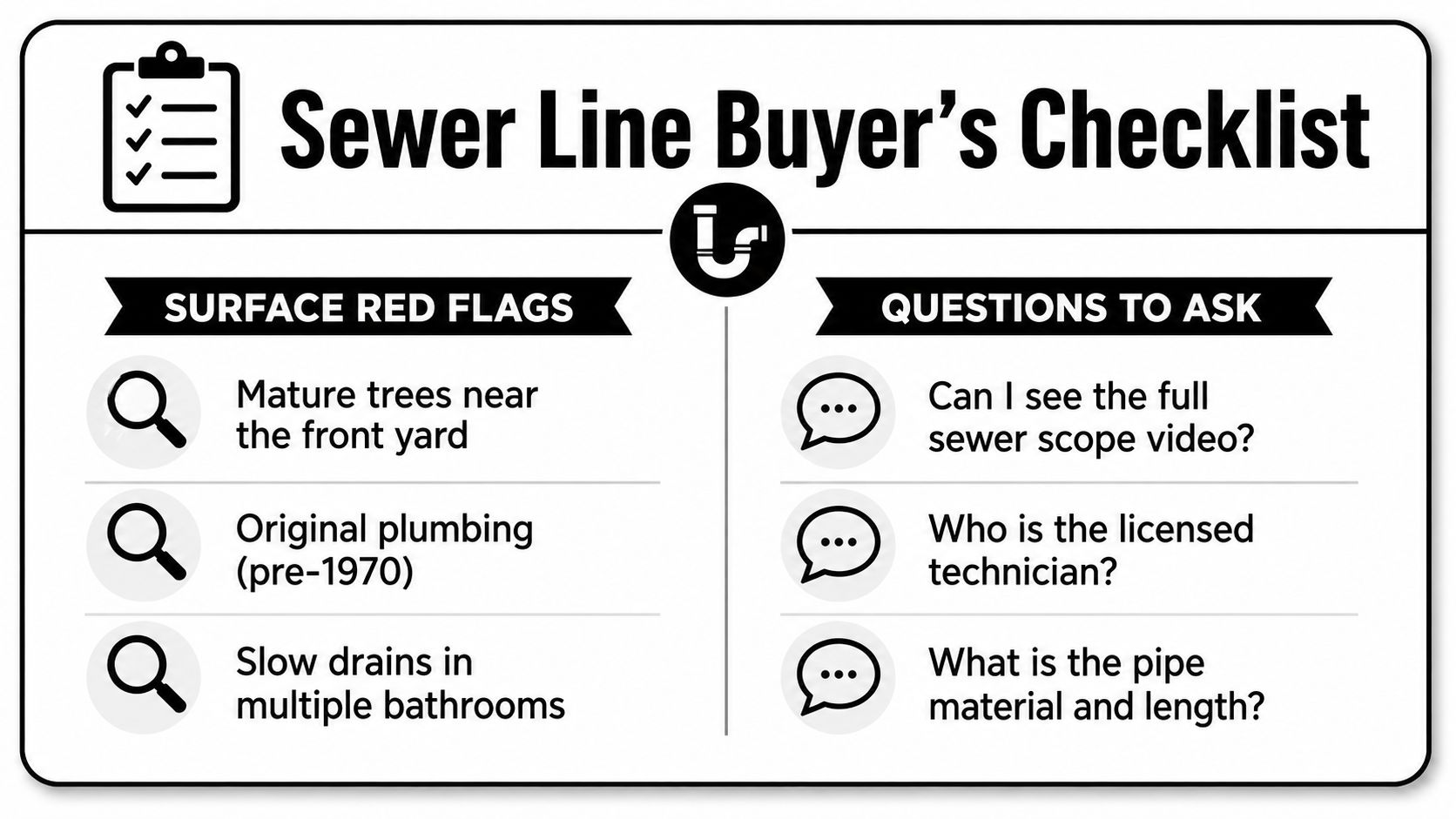
Keep this list on your phone during the showing. A sewer scope becomes urgent when the property presents visible risk or a vague repair history.
Surface clues that deserve a direct question
- Mature trees near the front yard: Ask where the lateral runs and whether the seller has records of root cutting or recurring blockages.
- Older clay or concrete piping: Ask whether the seller knows the pipe material, installation history, and location of previous repairs.
- Slow drains in multiple bathrooms: Ask whether the home has experienced backups, drain cleaning, or plumbing service calls.
- Recent landscaping across the likely sewer path: Ask whether the work disturbed, covered, or altered access to the cleanout.
- Past sewer work without clear permits: Ask for invoices, permits, contractor details, and any post-repair video.
A seller's statement that “everything drains fine” doesn't show the condition of the buried lateral. It only describes recent use.
Before you remove conditions
Run through this short checklist:
- Qualified technician: Confirm that a licensed sewer contractor performed the scope.
- Complete footage: Receive and personally review the video from access point toward the municipal connection or septic tank.
- Matching report: Check that the written report identifies the same defects visible in the footage.
- Repair pricing: Obtain estimates for any structural defect, not just a verbal opinion.
- Municipal status: Check permits, compliance requirements, and any local point-of-sale program.
- Negotiation plan: Decide whether you want a credit, price reduction, seller-paid repair, or withdrawal under your conditions.
Don't let an inspector's short summary replace the original evidence. If the camera stopped early, the line was full of water, or the cleanout didn't provide a complete path, treat the report as limited and ask what additional access is needed.
The One Decision That Protects the Deal
The buyer controls the most important step. Book the scope, read the footage, price the defects, and negotiate before the inspection contingency expires.
Skipping the scope on an older home is one of the costliest regrets a buyer can create. The hidden lateral may be fine, but you won't know that because the toilets flush during a showing. A clean report has value too. It removes a major uncertainty, strengthens your confidence at closing, and gives you a clearer basis for deciding what the property is worth.
Treat a sewer scope as standard due diligence in Greater Vancouver, alongside the general home inspection and strata document review. You're not paying to create a problem. You're paying to find out whether the underground system deserves a place in the purchase price.
If you're buying in Vancouver, Richmond, Burnaby, New Westminster, Delta, or Surrey, Encano Plumbing & Drainage Ltd. offers sewer camera inspections that document blockages, cracks, root intrusion, and pipe deterioration without unnecessary digging. Send the inspection report and video before removing conditions, and ask for a clear assessment of the repair or replacement path.