

A heat pump water heater itself might cost a few thousand dollars, but the true installed cost in British Columbia usually runs higher once electrical work, permits, condensate drainage, and site-specific labour are included. Provincial rebates can materially reduce that upfront investment, with a $1,000 standard rebate and up to $2,500 for income-qualified customers in the applicable BC Hydro programme.
You're probably looking at the replacement because the existing tank is aging, the hot water has become unreliable, or you're tired of paying to heat water with gas or electric resistance. Then an online search gives you a neat equipment price, while a local quote includes wiring, breaker capacity, drainage, removal, commissioning, and permit-related work. The gap feels unreasonable until you understand what you're buying.
For a Greater Vancouver home, the right question isn't “What does the tank cost?” It's “What will the complete project cost after the house is ready for it and every eligible incentive is applied?”
Table of Contents
- The Reality of Heat Pump Water Heater Pricing
- Site Factors That Drive Installation Costs
- Navigating BC Rebates and Federal Incentives
- Comparing Heat Pump Technology to Conventional Tanks
- Calculating Long Term Operating Savings and ROI
- Preparing Your Home for a Professional Quote
- Securing Expert Installation with Encano Plumbing
The Reality of Heat Pump Water Heater Pricing
A homeowner in Richmond recently described the common budgeting problem: the online price looked manageable, but the contractor's installed quote was substantially higher. The water heater wasn't the only item on the invoice. The quote also accounted for electrical capacity, connection work, condensate management, removal of the old tank, labour, and the practical limitations of a compact utility room.
That's normal. A heat pump water heater, or HPWH, is an integrated mechanical and electrical upgrade, not just a taller version of a conventional tank. It extracts heat from surrounding air and transfers that heat into the water, so the installation needs suitable airflow, a reliable electrical supply, and a place for the condensate it produces.
Generic home improvement articles often blur together equipment pricing and installed pricing. That makes the advertised “average” almost useless for a Vancouver-area homeowner. A like-for-like replacement in a prepared space is a different job from a gas-to-electric conversion in a basement with a crowded electrical panel.
The sticker price is only one line item
A professional quote should separate the equipment from the work required to put it into service. Ask whether the price includes:
- Removal and disposal: The existing tank must be drained, disconnected, removed, and disposed of safely.
- Electrical connection: A new circuit, breaker, conduit, disconnect, or panel work may be necessary.
- Plumbing modifications: Existing water lines may not align with the new tank's connections.
- Condensate drainage: The unit needs a suitable route for condensate, particularly in a basement or utility closet.
- Permits and inspection coordination: Local requirements can affect both the schedule and the total price.
- Commissioning: Settings, operating mode, temperature, leak checks, and drainage should be verified before the installer leaves.
The water heater replacement cost guide is useful background, but HPWH projects deserve a more detailed site assessment than a basic tank swap.
Practical rule: Treat the equipment price as the starting point, not the project budget.
A practical Greater Vancouver example
Suppose a homeowner replaces an electric storage tank in the same location. The plumbing may be straightforward, and the existing electrical setup may already support the new equipment. That's the closest thing to a simple installation.
A gas replacement is different. The gas appliance must be disconnected properly, the gas line addressed, and the home may need a new electrical circuit. If the panel can't accept the load, the electrician may need to modify or upgrade it. The final heat pump water heater cost is therefore determined by the home's infrastructure, not by the product label alone.
Site Factors That Drive Installation Costs
For Greater Vancouver homeowners, the quoted unit price is only the starting point. Installation scope determines the final bill. A straightforward electric-tank replacement usually creates the fewest complications. A gas conversion adds fuel-line and electrical work. Limited panel capacity can turn either project into a larger renovation.
California pricing shows how quickly the scope can change. A simple electric replacement is listed at about $2,800 to $4,800 installed. A gas conversion requiring electrical work is about $4,300 to $6,500, while a gas-to-HPWH conversion with a panel upgrade can reach $6,000 to $8,000 or more, according to this California heat pump water heater cost breakdown. These figures are not Greater Vancouver quotes, but they make one point clear: electrical capacity and site conditions often matter more than the tank itself.
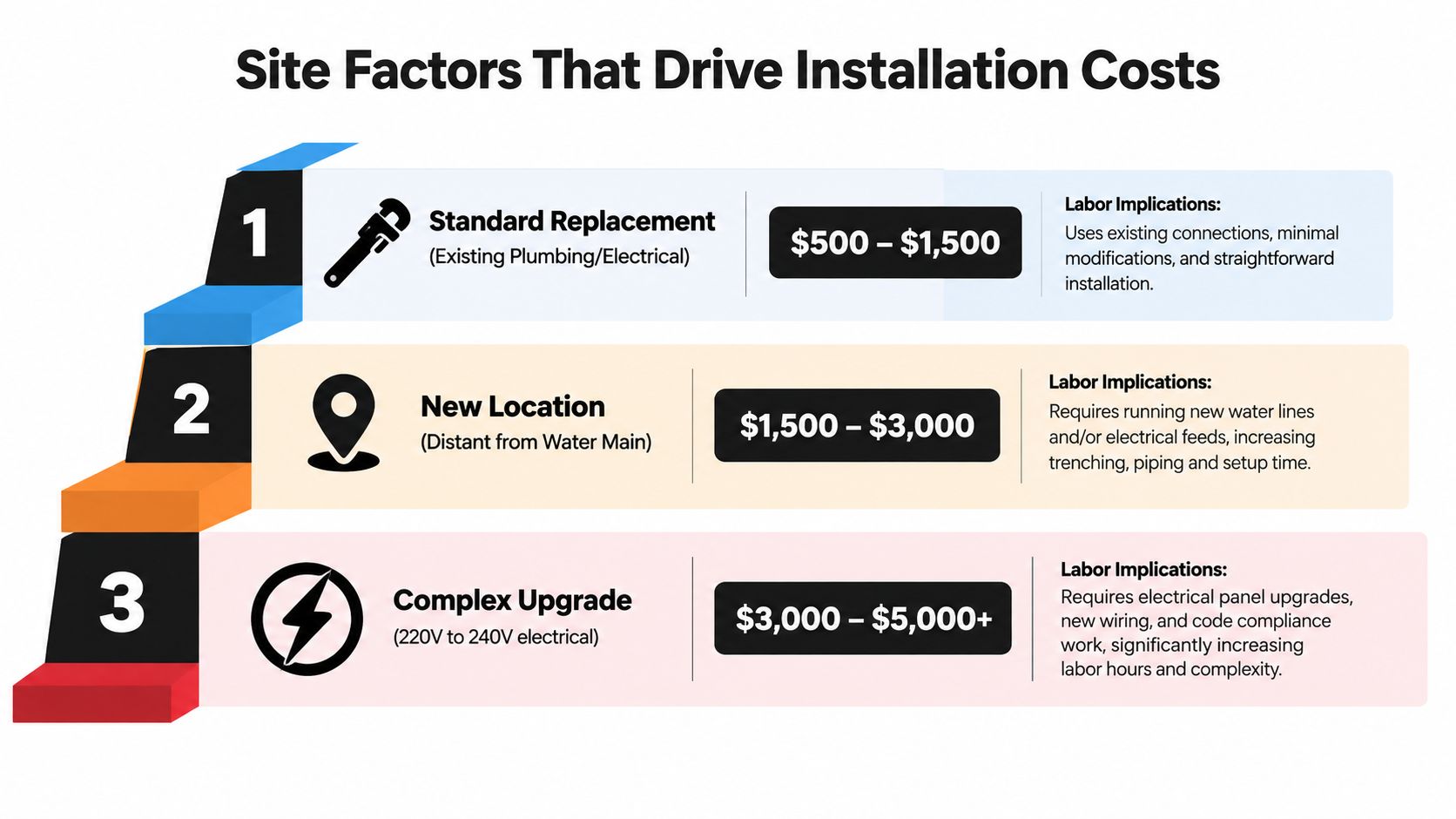
Level one, a prepared electric replacement
The simplest installation replaces an electric storage tank in the same location. Nearby water lines, a suitable floor, adequate air volume, and available panel capacity keep the work focused.
The contractor still needs to verify clearances, filter access, service space, drainage, and the unit's dimensions. A tight closet can add carpentry, relocation, or ventilation work even when the electrical supply is ready.
Level two, a gas-to-electric conversion
A gas replacement involves more than capping the line and connecting a new appliance. The contractor must arrange a safe gas disconnection, confirm the termination, install the electrical supply, and provide a condensate drainage route.
The old location may also depend on combustion ventilation. A heat pump water heater has different airflow requirements. In a small closet, restricted air volume can reduce performance. Near finished living areas, account for operating noise and the cool air discharged by the unit before choosing the final location.
Level three, limited panel capacity
Panel capacity produces some of the largest unexpected costs. Older homes may have no spare breaker spaces or little remaining capacity after electric heating, an electric vehicle charger, a suite, or other major loads.
Have a qualified electrician assess the service and panel before ordering equipment. An improvised connection is unsafe and may fail local requirements. A proper assessment identifies whether the project needs circuit work, load management, or a panel upgrade, allowing the contractor to price the installation accurately.
BC Hydro's water heater renovation programme may reduce the gross project cost for eligible homeowners. Confirm the current rules, equipment requirements, and application process before signing a contract, because rebate terms can change. The rebate decision belongs in the project budget, but it should not replace a complete electrical and site assessment.
Navigating BC Rebates and Federal Incentives
Start with the installed price, then subtract only incentives you can verify. An online unit price says little about the final bill for a Greater Vancouver home. Electrical work, a gas-to-electric conversion, permits, removal, and commissioning can change the homeowner's contribution substantially.
Confirm the programme before choosing equipment
Identify the existing water heater first. Replacing an electric storage tank may follow different rules from converting a gas system. Confirm the model's eligibility before ordering, and keep the invoice, serial number, product documentation, proof of payment, and installation records.
Income qualification can change the result. BC Hydro lists different support levels for standard and income-qualified residential customers. Check its official heat pump water heater rebate information before signing. Verify the current eligibility rules, income thresholds, eligible model list, utility territory, and application deadline, because programme details can change.
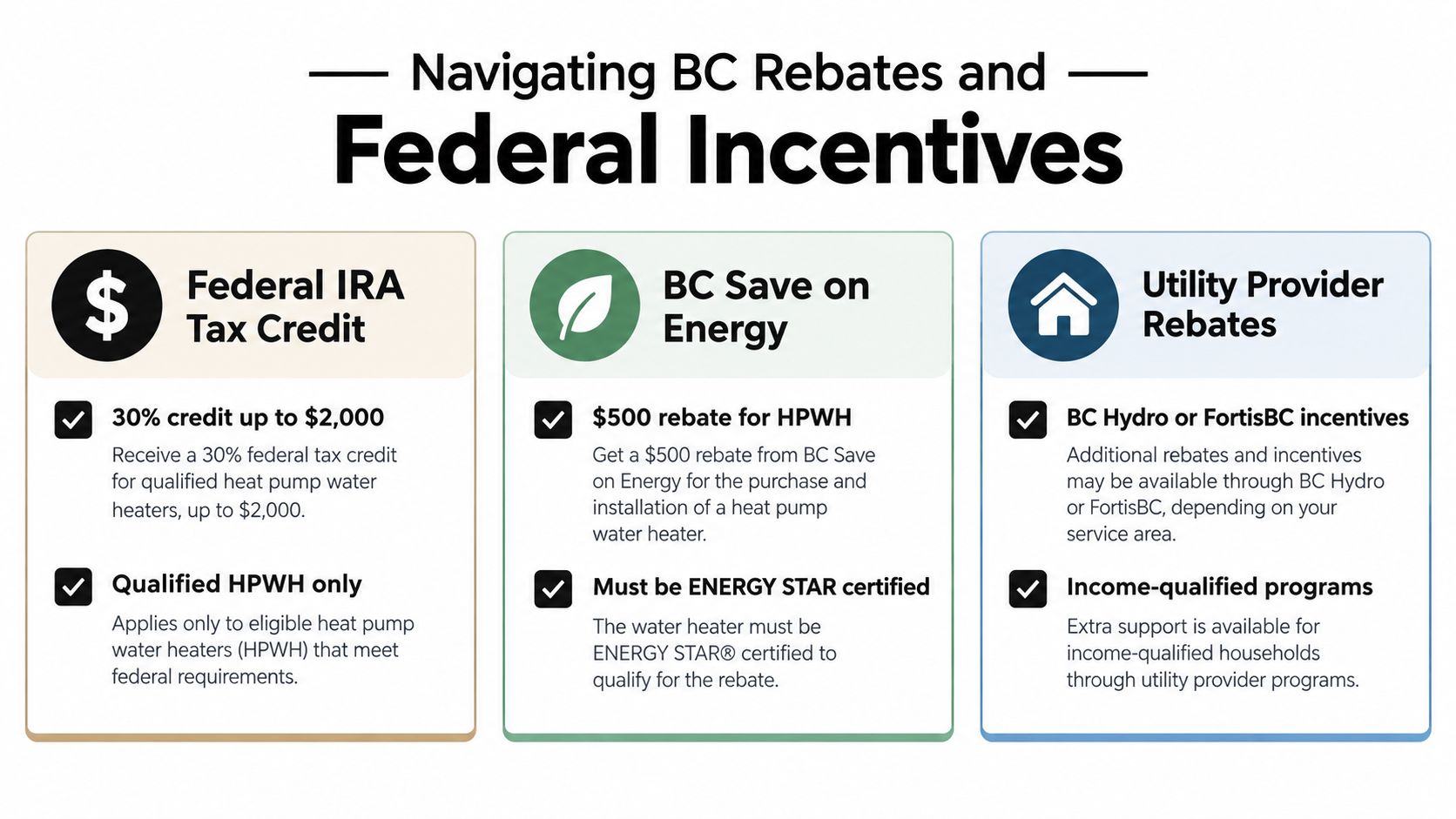
Use the infographic as a visual overview only. Its incentive labels do not replace the current requirements published by the applicable programme provider.
Calculate the homeowner's real contribution
Ask for these figures in writing:
- Gross installed quote. Include plumbing, electrical work, permits, removal, and commissioning.
- Existing fuel and conversion scope. A gas replacement can involve disconnection and electrical changes that an electric-tank replacement may not need.
- Confirmed eligibility. Separate approved incentives from possible or pending support.
- Utility territory. BC Hydro and FortisBC customers may face different programme conditions.
- Application timing. Confirm whether pre-approval, reservations, or completion deadlines apply before work starts.
- Required documents. Store invoices, model information, payment records, and completion paperwork.
Do not assume incentives stack automatically. A programme may require a specific model or replacement scenario, and starting work before approval can jeopardize an application.
For broader guidance on energy-efficient water heaters, compare operating requirements as well as purchase price.
A federal incentive may apply in some circumstances, but eligibility and availability depend on the property and installation date. Require the contractor to show gross cost, confirmed rebates, pending incentives, and estimated homeowner balance as separate lines. That format exposes the true out-of-pocket cost before you approve the work.
Comparing Heat Pump Technology to Conventional Tanks
A HPWH makes the most sense when the home has suitable space, a practical electrical route, and a household that uses enough hot water to benefit from efficient operation. A conventional tank can still be the better fit when the installation location is extremely tight, the electrical upgrade is disproportionate, or rapid recovery matters more than efficiency.
| Feature | Heat Pump, HPWH | Conventional Gas | Electric Resistance |
|---|---|---|---|
| Heating method | Moves heat from surrounding air into the tank | Burns gas to heat water | Uses electric resistance elements |
| Efficiency | Generally the most efficient of the three options | Can provide strong recovery, but depends on gas appliance and venting | Simple technology with higher electricity use than a HPWH |
| Recovery | Can be slower in heat-pump-only mode, with hybrid or resistance modes available on some models | Usually fast recovery | Resistance elements provide familiar recovery performance |
| Installation needs | Electricity, airflow, condensate drainage, service clearance | Gas connection, combustion ventilation, venting, and safe exhaust | Electrical supply and plumbing connections |
| Space considerations | Needs adequate air volume and maintenance access | Needs safe venting and combustion clearances | Usually has fewer airflow requirements |
| Sound | Produces a low mechanical hum | Burner and venting noise may be noticeable | Usually quiet during operation |
| Best fit | Homeowners prioritising efficient operation and long-term value | Homes with suitable gas infrastructure and high recovery demands | Straightforward replacements where a HPWH retrofit isn't practical |
Space and temperature matter
A HPWH pulls heat from the air around it. In a cold, unheated garage or crawlspace, the unit may have less useful heat available and may rely more often on supplemental electric operation. In a basement, it can cool and dehumidify the surrounding air, which may be helpful in a damp area but uncomfortable if the space is already cool.
Airflow is just as important as tank location. A unit wedged into a tight closet may not perform as intended, and the installer needs room to access filters, controls, connections, and the condensate drain. Some installations may require ducting or grilles to manage intake and discharge air.
Match the recovery profile to the household
A single occupant with modest hot-water use has a different requirement from a busy household with several back-to-back showers, frequent laundry, and a large soaking tub. A HPWH with a hybrid operating mode can provide flexibility, but the household should understand that faster recovery may use more electric resistance heating.
Gas tanks still have a practical advantage for rapid recovery in some homes. Electric resistance tanks remain familiar and comparatively simple. The best technology is the one that fits the building, electrical infrastructure, available incentives, and actual hot-water pattern.
Installer's advice: Don't choose a HPWH from the brochure alone. Choose it after someone has checked the room, the panel, the drain route, and your household's peak demand.
Calculating Long Term Operating Savings and ROI
A HPWH earns its keep through operation, not through the initial purchase. The economics improve when the household uses substantial hot water, the unit can operate efficiently in its location, and the homeowner remains in the property long enough to benefit from lower energy consumption.
The calculation should begin with the incremental installed cost. Compare the complete HPWH quote with the complete cost of the conventional alternative, then subtract confirmed rebates. Don't compare a tank-only retail price with a fully permitted HPWH installation.
The chart illustrates a hypothetical comparison rather than verified local household billing data. For a real calculation, use your utility bills and the selected unit's performance information.
Use your own load profile
Your household's usage drives the result. Consider:
- Occupancy: More residents generally create greater hot-water demand.
- Timing: Concentrated morning and evening use affects recovery requirements.
- Fixtures: Large tubs, multiple showers, and high-flow fixtures increase demand.
- Appliances: A dishwasher and clothes washer add hot-water consumption.
- Location: A cold or poorly ventilated room may reduce the practical benefit.
- Operating mode: Hybrid or electric modes can trade efficiency for faster recovery.
A contractor can estimate whether the selected tank size and operating mode suit that pattern. A smaller household may value lower operating expense and quiet operation. A larger household may prefer a model with stronger recovery flexibility, even if it occasionally uses resistance elements.
A sound payback method
Use this formula:
Payback period = net additional installed cost ÷ estimated annual energy savings
The result is only as reliable as the inputs. Use actual electricity and gas bills where possible, account for the current water heater's condition, and avoid promising a fixed payback before the site and usage pattern are known.
California programme data shows why the net cost deserves careful attention. The Silicon Valley Clean Energy HPWH information describes pre-rebate installed costs around $6,300 to $7,300 for a 65-gallon unit with a 240-volt circuit and permits, with post-rebate costs ranging from $0 to $4,300 and income-qualified households potentially paying $0. That range is not a BC quote, but it proves the central point: incentive eligibility and electrical scope can matter more than the appliance price.
Preparing Your Home for a Professional Quote
A good quote starts with good information. You don't need to diagnose the installation, but you can collect the details that let a contractor identify obvious scope issues before arriving.
Gather the equipment details
Find the current tank's rating plate and photograph it. The installer needs the fuel type, capacity, age, manufacturer, model, and connection arrangement. Take wide photos showing the surrounding walls, floor, pipes, gas line, electrical panel, drain, and access path.
Also photograph the route from the entrance to the utility area. Narrow stairs, low ceilings, finished flooring, or a long carry can affect removal and delivery planning.
Check the electrical situation safely
Look at the panel without removing its cover. Photograph the breaker layout and note whether there are open spaces, but don't assume an open space means the panel has adequate capacity.
Record large electrical loads such as electric baseboard heating, an electric vehicle charger, a heat pump, a suite, or workshop equipment. An electrician should make the final determination. Homeowners shouldn't install breakers, alter wiring, or use extension cords for a permanent water heater connection.
Measure the installation space
Measure the tank height, width, and depth, then measure doorways, stairs, and the final placement area. Leave room for:
- Air movement: The heat pump section needs adequate surrounding air.
- Service access: Filters, controls, and connections must remain reachable.
- Condensate drainage: The drain route should be practical and protected from freezing.
- Leak protection: The tank should sit on a suitable surface with appropriate drainage or protection.
- Noise control: Avoid placing the unit directly beside a bedroom or quiet living area when another location works better.
For a strata property, check bylaws and notify the property manager before ordering equipment. Confirm whether the work affects common electrical infrastructure, shared mechanical rooms, exterior penetrations, or fire separations. Ask who handles permits and whether the quote includes inspection coordination.
Before the site visit: Send the contractor photographs, tank information, panel images, measurements, and your expected hot-water demand. A detailed brief produces a more useful quote than “replace my water heater.”
Securing Expert Installation with Encano Plumbing
The contractor matters because the project crosses several trades and compliance requirements. A plumbing company may handle the water connections and tank removal, while electrical work requires appropriate coordination. Gas disconnection, condensate drainage, permits, and commissioning must all be treated as part of one project.
For a Greater Vancouver homeowner, choose a contractor who will explain the scope before recommending a product. The right conversation covers the existing fuel, panel capacity, room temperature, airflow, noise, drain route, access, household demand, available rebates, and the consequences of choosing a different location.
A credible quote should make exclusions visible. Ask whether the price includes removal, electrical coordination, permit costs, gas-line work, drain installation, start-up, and follow-up service. If the contractor can't explain what happens when the panel is full or the drain route is difficult, the quote isn't complete.
Encano Plumbing & Drainage Ltd. is a family-owned contractor serving Vancouver, Richmond, Burnaby, New Westminster, Delta, Surrey, and nearby communities. The team provides plumbing, heating, gas, drainage, HVAC, water heater installation, and maintenance services, with 24/7 emergency response and scheduled service for residential, commercial, and government buildings.
For homeowners comparing options, expert water heater installation in Vancouver should mean more than placing a tank and leaving. It means a properly assessed installation, transparent pricing, safe workmanship, and a clear explanation of how the system will operate after the upgrade.
A HPWH can be a strong long-term choice, but only when the home can support it and the quote reflects the actual work. Get the site assessment before choosing the model, confirm incentives before authorising the job, and judge the investment on net installed cost and expected use rather than the online equipment price.
Encano Plumbing & Drainage Ltd. can assess your existing tank, electrical and plumbing conditions, condensate route, and conversion requirements before recommending a heat pump water heater. Visit Encano Plumbing & Drainage Ltd. to book a consultation for your Vancouver, Richmond, Burnaby, or Greater Vancouver home.