
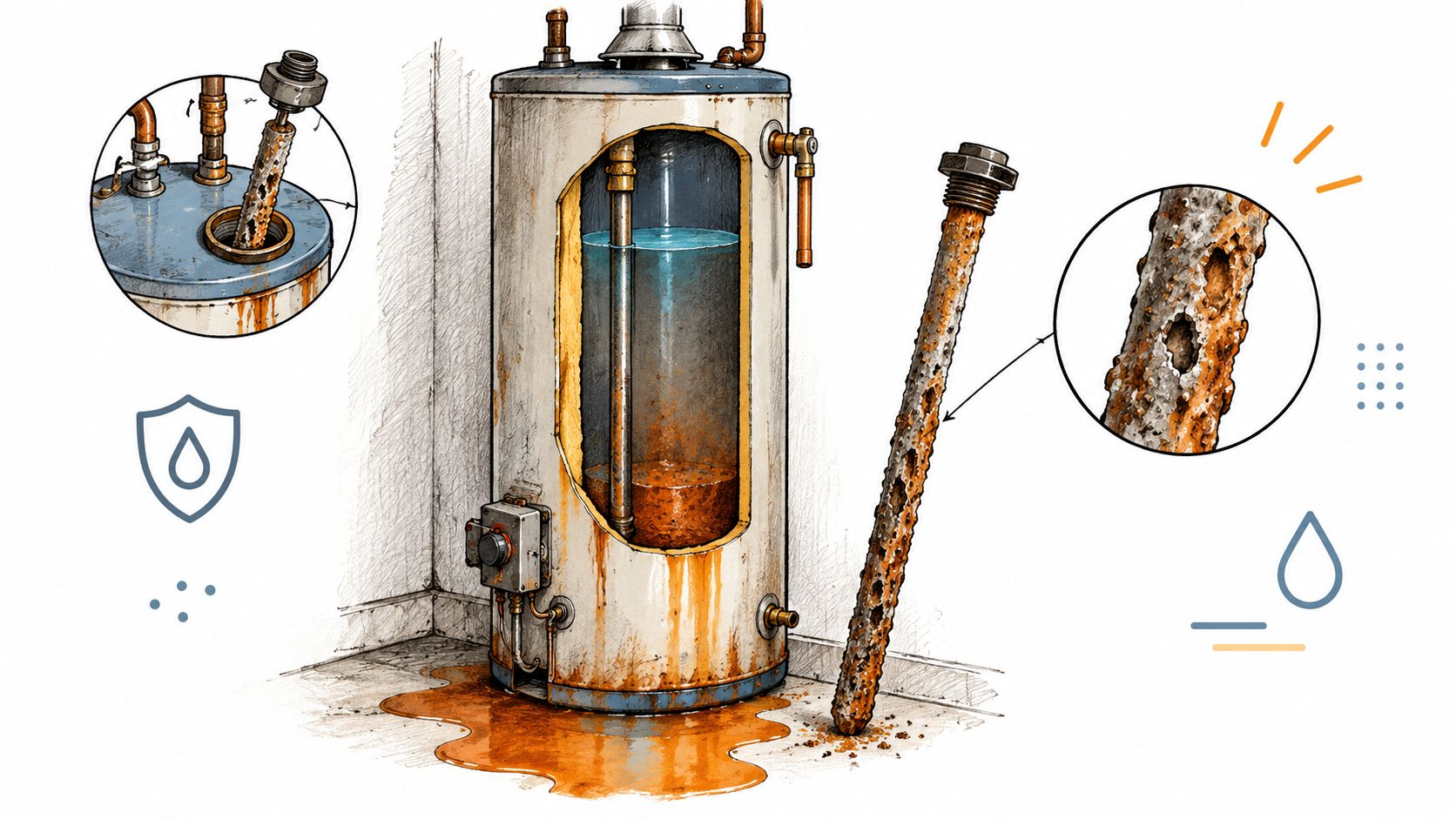
You wake up, step into the utility room, and find a shallow puddle around the base of your hot water tank. The water has a rusty tint. Your first thought is probably that the tank has just reached the end of its life, but the failure may have started much earlier with a small component most homeowners never see.
That component is the sacrificial anode rod. It sits inside the tank and gradually corrodes so the steel tank doesn't have to. For homeowners in Vancouver, Richmond, Burnaby, and the wider Greater Vancouver area, checking the rod according to its condition, rather than relying on a generic replacement date, is one of the more practical ways to reduce the risk of premature tank failure.
Table of Contents
- The Hidden Component Saving Your Water Heater
- How Sacrificial Corrosion Protects Steel Tanks
- Choosing the Right Anode Rod Material
- Inspection Timelines and Water Chemistry Impacts
- Visual Inspection Checklist and Depletion Signs
- Why Professional Replacement Is the Safest Route
- Building a Long-Term Water Heater Care Plan
The Hidden Component Saving Your Water Heater
A tank can look perfectly normal from the outside while corrosion is developing inside. The anode rod is usually threaded into the top of the tank, sometimes beneath a hex-shaped plug and sometimes combined with another tank connection. You won't know whether it's still protecting the steel until a technician removes and examines it.
Why tank age isn't the whole story
The rod is a consumable component, not a permanent feature of the heater. It slowly gives up its material to protect the tank, and its service life depends on water chemistry, temperature, usage, and the condition of the system around it.
A house with a water softener may consume a magnesium rod much faster than a similar house using untreated municipal water. A strata building can also complicate maintenance because tanks may be installed in tight closets, grouped in mechanical rooms, or connected to shared plumbing arrangements that make access difficult.
Practical rule: A water heater hasn't necessarily been maintained just because it still produces hot water. The anode rod may already be depleted while the tank continues operating normally.
Consider a practical example. A homeowner in Richmond has a storage tank that still delivers hot water, but the rod hasn't been inspected since installation. The tank may not leak today, yet the steel lining could be exposed to corrosion because the rod has already lost much of its protective material. Pulling the rod during a planned service visit can reveal whether the tank is still worth protecting or whether replacement planning should begin.
The key decision isn't, “How old is my heater?” It's, “How much of the rod remains, and what conditions are consuming it?” That shift makes maintenance more useful than guessing from a calendar.
How Sacrificial Corrosion Protects Steel Tanks
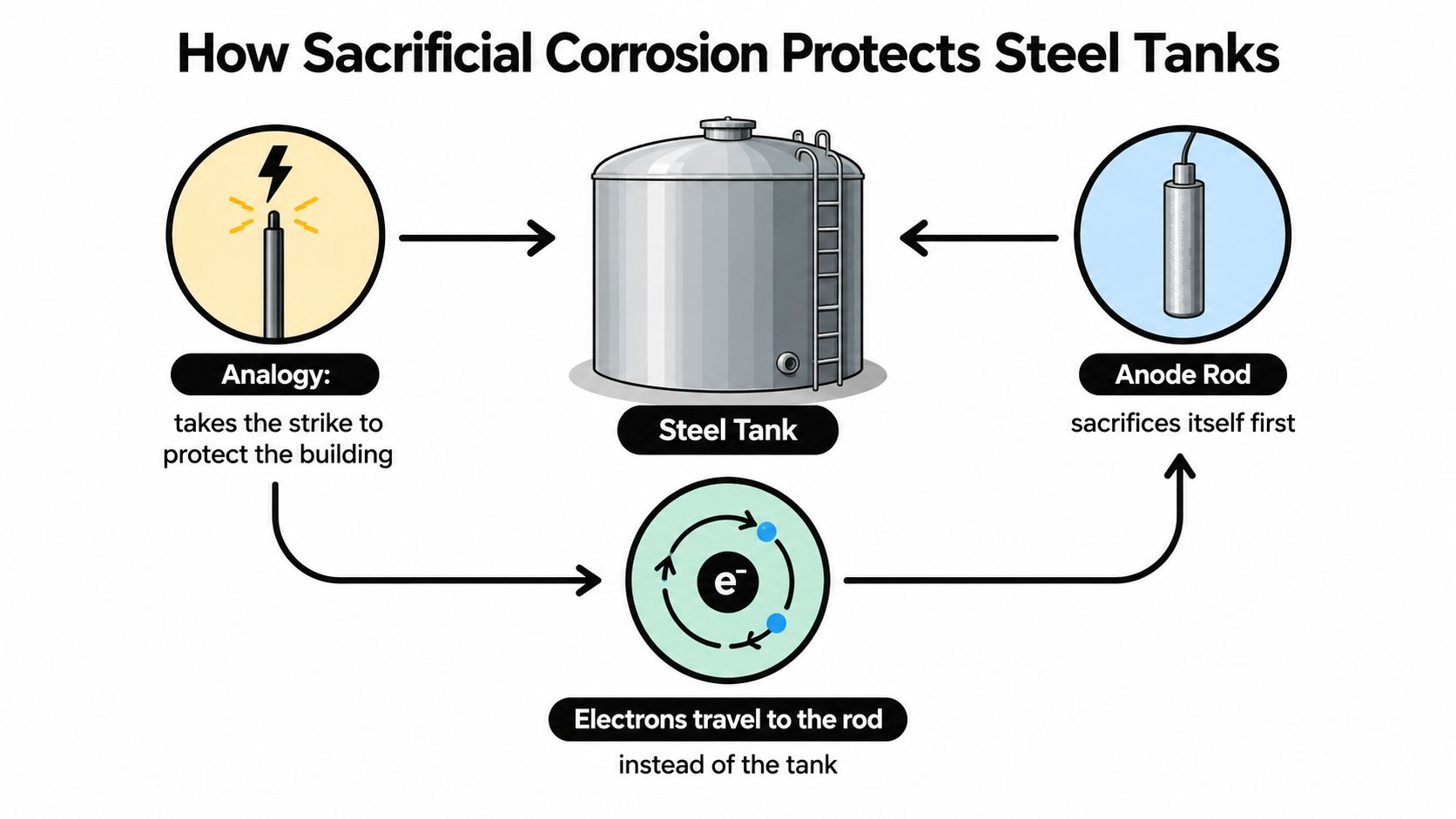
Think of the anode rod as a lightning rod inside the water heater. A lightning rod gives electrical energy a preferred path so a building is less likely to take the direct strike. The anode rod provides a preferred corrosion path inside the tank.
The tank contains water, steel, and a metal rod with a more readily consumed material, commonly magnesium or aluminium. As electrochemical reactions occur, the rod oxidizes and releases electrons. Those electrons help protect the steel tank, while the rod itself becomes thinner, pitted, and eventually ineffective.
The protection happens in stages
Water creates the environment. Hot water and dissolved minerals allow electrochemical activity to take place inside the steel tank.
The rod becomes the preferred target. The sacrificial material reacts before the tank's steel does, much like a designated shield taking damage intended for a more valuable structure.
The rod loses its substance. Corrosion doesn't mean the rod has failed immediately. A worn rod has often been doing its job. The problem begins when too little material remains to protect the tank effectively.
The tank becomes more exposed. Once the rod is heavily depleted, the steel tank can become the part that corrodes. Internal attack may continue unnoticed until rusty water, a leak, or a sudden tank failure appears.
The rod doesn't “clean” the water, and it won't repair steel that has already corroded through. It also isn't a substitute for a correctly installed temperature and pressure relief system, proper drainage, or routine tank maintenance. Its job is narrower and very important: it controls corrosion before the tank wall becomes the sacrificial surface.
This is why removing a degraded rod and leaving the opening capped isn't a complete repair. The tank needs a suitable replacement or a properly selected powered system. A technician also needs to assess whether the old rod is seized, bent, or difficult to remove without damaging the tank connection.
A rod that has become rough and narrow isn't necessarily evidence of poor workmanship. It may be evidence that the component has absorbed the corrosive work it was designed to handle. The service decision is whether enough material remains, not whether the rod looks new.
Choosing the Right Anode Rod Material
A replacement rod should match the water heater, water chemistry, available clearance, and the problem being addressed. Magnesium, aluminium, and powered titanium systems each suit different conditions. The most expensive option is not automatically the right one, and a thicker-looking rod does not prove better protection.
| Rod Type | Best For | Lifespan | Odor Risk |
|---|---|---|---|
| Magnesium | Many standard residential tanks with compatible water conditions | Condition-dependent, inspect rather than assume | Can contribute to sulfur odours in some water conditions |
| Aluminium | Some systems where a more durable passive rod is preferred | Condition-dependent | May be considered where magnesium-related odour is a concern |
| Powered titanium | Tanks where conventional rods wear quickly or recurring odour is a problem | Designed to avoid sacrificial depletion, but still requires system checks | Often selected to address recurring sulfur odour concerns |
Magnesium remains the normal starting point
Magnesium is a common first choice because it sacrifices readily and can provide strong corrosion protection when matched to the tank and water. The trade-off is faster wear in softened or chemically aggressive water. Water softeners can be particularly hard on the rod, so a Greater Vancouver homeowner should not judge suitability only by the municipal supply.
Some homes also develop a rotten-egg odour when water chemistry and bacteria interact with a magnesium rod. The smell does not automatically mean the tank is unsafe, and changing the rod without assessing the water may only provide temporary relief. The tank, water source, and anode material should be considered together.
Aluminium can suit a different water profile
Aluminium can be a practical passive alternative in some hard-water applications or where a technician wants different wear characteristics. It may also be considered when magnesium-related odour is a recurring concern. Compatibility with the tank and water conditions matters more than the purchase price or the rod's appearance.
Strata plumbing adds another complication. Units in the same building may have different tank models, ages, usage patterns, and softening arrangements. Replacing every rod with the same material is therefore a shortcut, not a maintenance plan.
Powered systems change the maintenance trade-off
A powered titanium system uses a small electrical current instead of sacrificing a metal rod. Canadian product information identifies titanium with mixed metal oxide powered systems as an option for corrosion control. Common systems use a 3/4-inch NPT thread, regular 110V power, and very low operating demand, including 12V to 24V output at about 0.005A to 0.015A, depending on the model. Canadian replacement-rod specifications also identify common passive rods as 32 inches long for standard residential tanks up to about 182 L.
Powered systems can suit tanks where magnesium rods repeatedly disappear, odour returns, or access makes replacement disruptive. They still require correct installation and system checks. Before choosing one, verify the thread, tank capacity, outlet, clearance, and tank condition. A professional can also determine whether a passive rod remains the better fit for the home.
Inspection Timelines and Water Chemistry Impacts
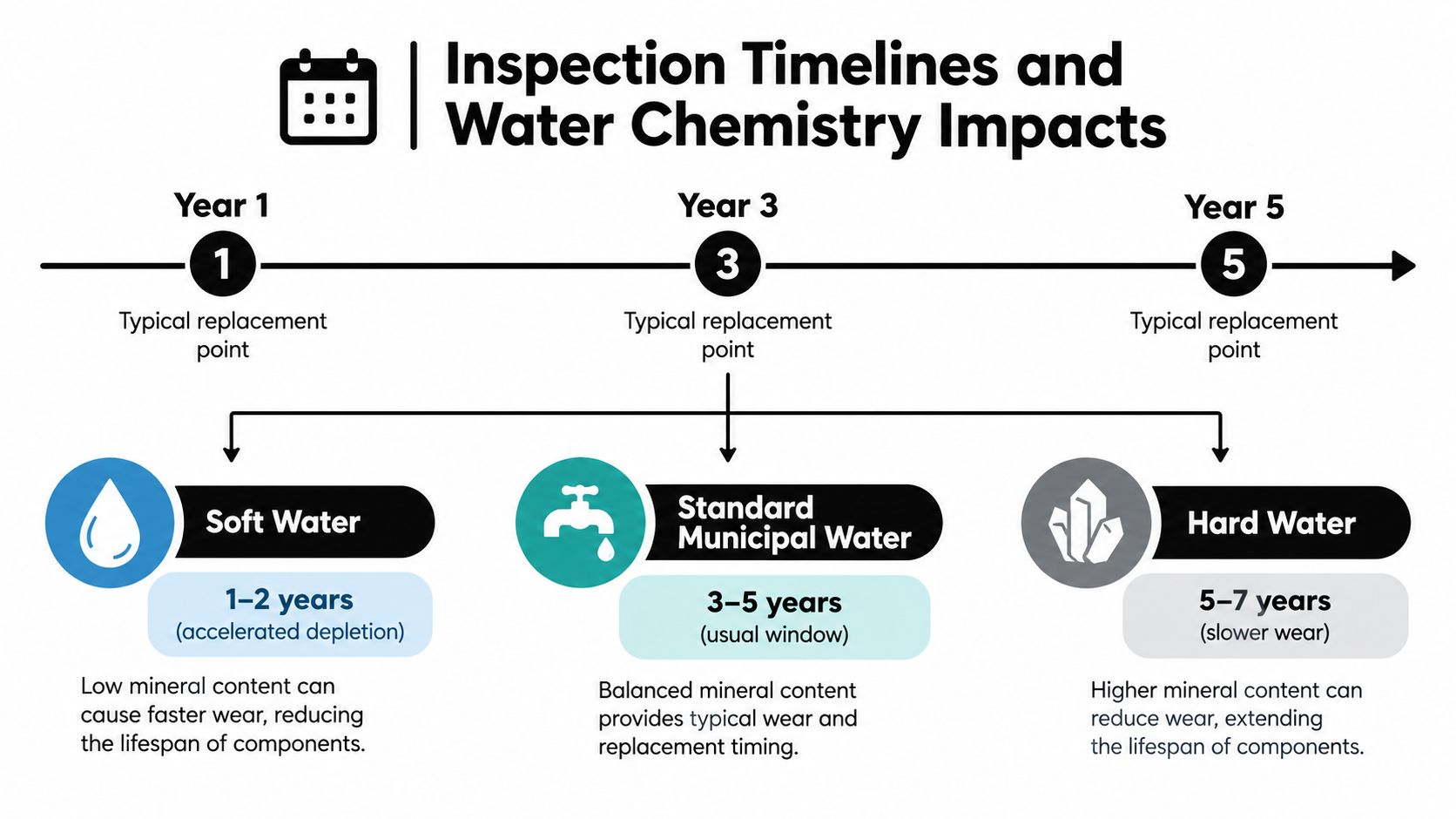
A fixed replacement rule can mislead Greater Vancouver homeowners. General trade guidance commonly places inspection somewhere between every 2 and 5 years, with many rods needing replacement around every 3 to 5 years. In harder-water or softened-water conditions, some recommendations shorten that interval to about 2 to 3 years. California-focused anode-rod guidance supports the broader point that the rod is a consumable part whose condition matters more than an arbitrary date.
Softened water deserves special attention. Water-softening equipment can make the sacrificial rod corrode faster, so a homeowner shouldn't assume that a standard inspection interval applies just because the municipal supply is otherwise familiar. California Energy Commission material recommends inspecting storage-water-heater anodes every two years, with more frequent checks where softened water is present because softened water can corrode the rod faster. The Commission's maintenance guidance provides a useful condition-based framework for local service planning.
A schedule that reflects the home
Use the calendar as a prompt to inspect, not as proof that replacement is due.
Unsoftened household water: Start with a planned inspection cycle rather than waiting for a leak. A rod may last longer or wear sooner depending on the actual water chemistry and hot-water demand.
A home with a water softener: Arrange an earlier inspection than the generic multi-year advice. The rod may be substantially depleted before a homeowner notices any performance change.
A strata or rental property: Record each tank's model, installation date, rod material, and inspection result. Shared maintenance programs work better when they track actual condition instead of treating every suite as identical.
A tank with odour or rusty water: Don't extend the interval just because the heater still works. Arrange an inspection and determine whether the rod, water chemistry, sediment, or tank condition is responsible.
Tank flushing is part of the wider maintenance picture, particularly where sediment is present. A homeowner can review the practical process in this guide to flushing a water heater, but flushing doesn't replace anode inspection. Draining sediment and checking the corrosion-control component solve different maintenance problems.
Water conditions vary across the region, and household plumbing changes them further. A softener, recirculation system, high occupancy, or heavy hot-water demand can make a condition report more valuable than a generic “replace every few years” instruction.
Visual Inspection Checklist and Depletion Signs
An anode rod should be judged by what remains, not by whether it has any visible metal left at all. A technician normally isolates the water heater, relieves pressure, drains enough water for safe removal, and examines the rod after extracting it from the top of the tank.
The most important thresholds are specific. Replacement is recommended when more than 6 inches of bare core wire is visible, when the rod has lost more than half of its original diameter, or when heavy pitting is present. California corrosion-control guidance identifies those conditions as signs that the rod has lost too much protective material.
What the inspection should establish
Confirm the rod's identity and position. The technician should verify whether the part is a dedicated anode or a combination anode and hot-water outlet. That affects removal and replacement planning.
Look for exposed core wire. A long section of bare wire means the sacrificial covering has been consumed. More than 6 inches of exposed core wire is a replacement condition under the cited California guidance.
Compare the remaining diameter. If the rod has lost more than half of its original diameter, it should be replaced. A rod can retain its overall length while losing most of the material that made it useful.
Assess pitting and scale. Heavy pitting can leave weak sections that break during removal or provide too little consistent protection. Hard scale can also hide how much material has disappeared.
Check the tank opening and threads. Corrosion around the fitting, seized threads, or restricted overhead clearance can turn a straightforward replacement into a job requiring specialized tools and careful extraction.
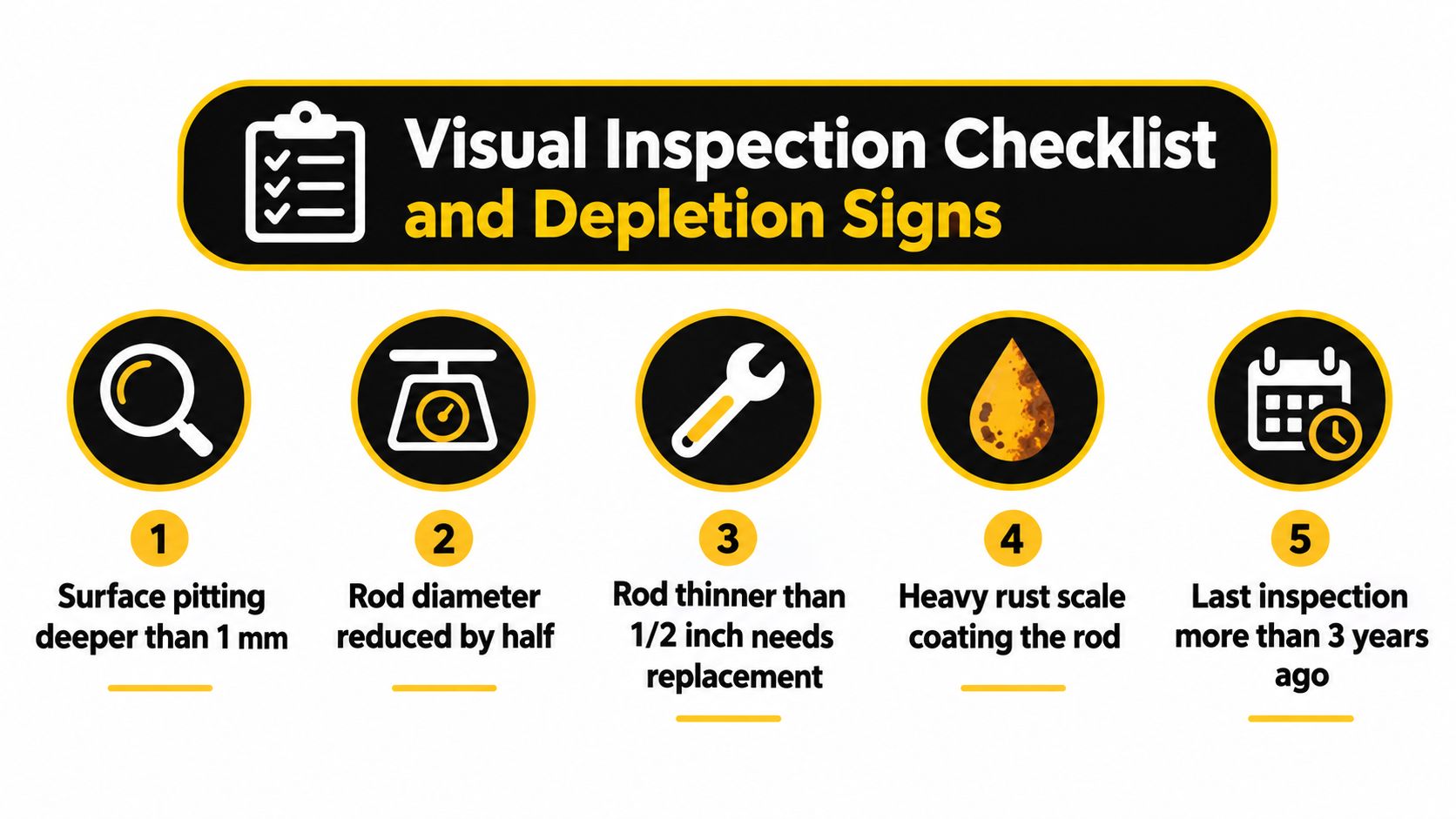
A practical example is a rod that appears intact at the top but has severe pitting through its lower portion. That rod shouldn't be approved just because it still looks long. The visible condition at the thinnest and most damaged areas tells the technician whether the tank still has meaningful corrosion protection.
Don't pull the rod casually from a full tank. The component may be difficult to remove, and water pressure, electrical power, gas-fired equipment, and overhead clearance all need to be handled safely.
Why Professional Replacement Is the Safest Route
Removing an old anode rod can demand significant torque, particularly when corrosion has bonded the fitting to the tank. In a cramped utility closet, a long breaker bar can strike nearby piping or damage the tank connection. A seized rod may bend, snap, or need to be removed in sections.
A glass-lined steel tank can tolerate normal service, but it is still vulnerable to careless removal. Excessive force, cross-threading, or a poorly supported tool can create a leak around the tank opening. If the tank has already suffered corrosion, aggressive extraction may expose a weak area that was not leaking before the work began.
The installation details matter
Before ordering a replacement, a plumber should verify several points:
Thread type: The new rod must match the tank connection. Thread size and fitting style vary by heater, so the installed tank should be checked before any part is purchased.
Tank capacity and rod length: A standard-length rod may not fit below a low ceiling or inside a confined closet. A flexible or segmented rod can suit restricted access, but only if it matches the heater and provides the intended protection.
Tank type and connection: Some anodes install independently, while others are combined with another connection. The replacement must preserve the tank's designed plumbing arrangement rather than forcing an incompatible fitting.
Power access: A powered anode needs suitable electrical access and safe cable routing. The outlet, cord, and surrounding area must be protected from moisture and physical damage.
Pressure and drainage controls: The water supply, electrical or gas source, drain route, and temperature and pressure relief arrangement all need to be controlled before service. Review the water heater pressure relief valve as part of the same safety check.
Greater Vancouver homes can add access and water-chemistry complications. A softener can accelerate anode consumption, so the replacement interval should follow the rod's observed condition rather than a generic calendar. Strata buildings also create shared shutoff, drainage, and mechanical-room issues. Confirming which valve controls the suite and whether neighbouring units share equipment prevents an avoidable service problem.
DIY makes less sense in a tight strata installation
A homeowner may own the correct socket and still lack enough overhead clearance to turn it safely. A licensed plumber can identify the heater configuration, isolate the correct services, protect nearby piping, extract the old rod, install a compatible replacement, and test for leaks before leaving.
Professional replacement also provides a practical decision point. If the tank connection is badly damaged or the tank wall is already compromised, a new rod may not justify the risk and cost of installation. The technician can explain whether the work is a preventative repair or whether the heater has entered replacement territory.
Building a Long-Term Water Heater Care Plan
Good water heater maintenance is organised around condition, access, and consequence. The anode rod deserves a place on the same property checklist as leak detection, tank flushing, relief-valve checks, and records of previous repairs.
Start with a baseline inspection. Record the tank manufacturer, model, capacity, installation date if known, rod material, visible depletion, water-softener status, and any odour or rusty-water complaints. For a strata or rental portfolio, keep that information by suite or mechanical-room location so a property manager can identify patterns instead of scheduling every tank blindly.
A workable maintenance routine
At each planned service visit: Look for leaks, corrosion at fittings, unusual water colour, odour complaints, and access problems around the tank.
At the anode inspection: Photograph or document the rod's condition, including exposed core wire, diameter loss, pitting, and the condition of the threaded opening.
After water-treatment changes: Reassess the schedule if a softener is installed, adjusted, bypassed, or removed. The water chemistry affecting the rod has changed.
For older tanks: Combine the anode assessment with replacement planning. A new rod can protect a serviceable tank, but it can't reverse a tank wall that has already failed.
For commercial and strata buildings: Use consistent records, identify tanks with accelerated wear, and budget planned service before a leak creates an emergency.
A condition-based plan also prevents two common mistakes. Replacing a healthy rod unnecessarily wastes a service opportunity, while ignoring a depleted rod because the tank still heats water leaves the most important corrosion-control decision unresolved.
For homeowners considering repair, replacement, or broader hot-water work, water heater service information can help frame the next step. The right action may be a rod replacement, a powered-anode retrofit, a tank flush, or a full water heater assessment, depending on what the inspection finds.
Encano Plumbing & Drainage Ltd. provides water heater inspection, maintenance, repair, and installation services for homeowners, strata properties, and commercial buildings across Greater Vancouver. If your anode rod hasn't been checked, your tank has a water-softener connection, or you're seeing rusty water or recurring odour, visit Encano Plumbing & Drainage Ltd. to arrange a professional assessment.