

A toilet that runs through the night, rocks slightly at the base, or needs two flushes to clear the bowl is more than a bathroom nuisance. It can signal wasted water, a failing component, a poor fixture choice, or a drainage problem that will eventually create a service call. In Greater Vancouver homes and buildings, replacing the toilet can solve one part of the problem, but choosing a fixture by its lowest advertised water volume often creates another.
A well-selected low-flow toilet should do two jobs at once. It should reduce water use, and it should remove waste reliably in a single flush. For homeowners, landlords, strata councils, and facility managers, the practical question isn't just how little water the toilet uses. It's whether the toilet, the building's supply, and the drainage system work well together over years of daily use.
Table of Contents
- Understanding Low Flow Toilets and Water Waste
- Navigating BC Plumbing Standards and Flush Volumes
- Evaluating Flush Performance with MaP Testing
- Planning Strata and Commercial Retrofit Projects
- Solving Maintenance and Clogging Concerns
- Maximizing Rebates and Long-Term Financial Returns
- Executing a Professional Toilet Installation
Understanding Low Flow Toilets and Water Waste
A homeowner notices the problem first in the morning. The toilet tank keeps refilling, the handle needs to be held down, or the bowl clears only after a second flush. In a strata building, the same issue appears as repeated maintenance requests, residents keeping plungers beside the toilet, and a property manager trying to determine whether the fixture or the drain line is responsible.
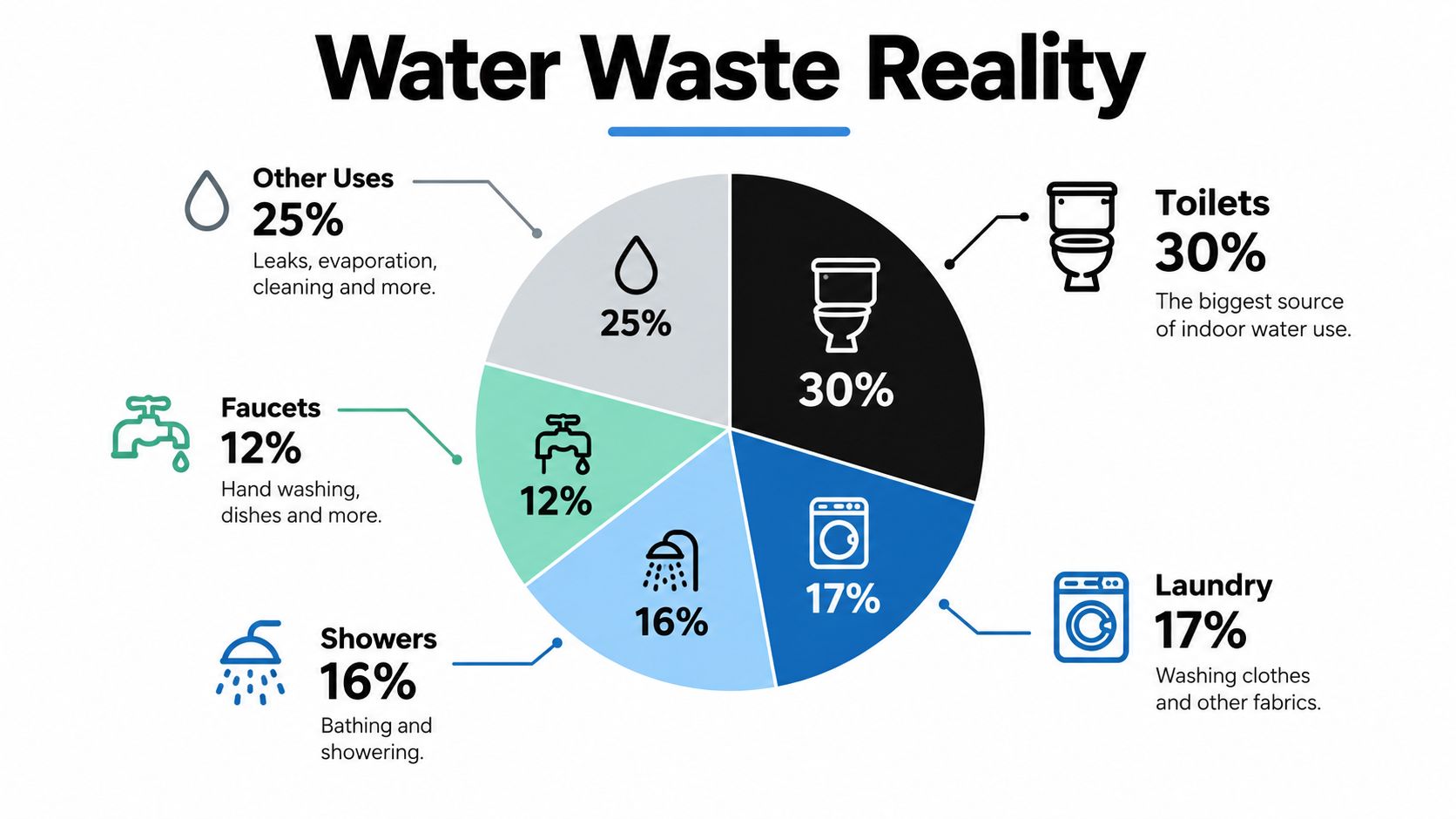
Toilets are especially significant in buildings because they account for an estimated 28% to 40% of indoor water use, according to California Energy Commission efficiency documentation. That makes toilet replacement a meaningful conservation project, not just a cosmetic bathroom upgrade.
What low-flow actually means
Older gravity-fed toilets often depended on a large tank volume to create enough force to move waste. The basic mechanism is straightforward. A handle lifts a flapper or another flush valve, tank water enters the bowl, and the resulting flow carries waste through the trapway and into the building drain.
Modern low-flow toilets use less water, but their performance depends more heavily on bowl geometry, trapway design, flush-valve engineering, and the way water enters the bowl. Some use a conventional gravity tank, while pressure-assisted models store air pressure to produce a sharper flush. Dual-flush models provide a reduced flush for liquid waste and a larger flush for solid waste.
The important distinction is between water volume and usable flushing performance. A toilet that uses very little water but leaves waste behind can prompt repeat flushing. In that situation, the nominal saving disappears in everyday use, while the owner still carries the inconvenience of a poorly matched fixture.
Practical rule: Treat “low flow” as a starting description, not a performance guarantee. Look for the fixture's tested waste-removal results before you buy.
Why older fixtures still matter
California's standards illustrate how far toilet efficiency has moved. Before 1970, many toilets used at least 6 gallons per flush, and California required toilets sold in the state to use no more than 3.5 gallons per flush beginning January 1, 1978. Those state standards later helped establish nationwide efficiency requirements through the federal Energy Policy Act of 1992.
California's current high-efficiency benchmark is 1.28 gallons per flush. A compliant modern toilet can therefore use roughly 64% less water per flush than a 3.5-gallon model and about 79% less than a 6-gallon model, based on the same California efficiency reference linked above.
For a Vancouver property, the lesson isn't that a California rule applies directly to a BC installation. The lesson is that fixture standards have pushed manufacturers to achieve reliable flushing with substantially less water. Property owners can read more practical conservation guidance through water conservation tips for plumbing systems, but the purchase decision should still be based on local requirements and independently published performance data.
Navigating BC Plumbing Standards and Flush Volumes
The first buying mistake I see is comparing a Canadian toilet marked in litres per flush with an American product listed in gallons per flush, then assuming the smaller-looking number is automatically better. For a BC installation, the useful figure is the toilet's effective flush volume in LPF, supported by the correct certification and plumbing-code compliance.
In British Columbia, the practical specification for a new low-flow toilet is an effective flush volume of no more than 4.8 litres per flush, while the older ultra-low-flush benchmark is approximately 6 LPF, as described in Capital Regional District guidance on washroom water use. A fixture marketed as “low flow” may still use the older benchmark, so the label alone isn't enough.
Read the toilet, not just the box
Before approving a fixture for a house, rental, strata suite, or commercial washroom, check the marking inside the tank or under the lid. The identification should show the flush volume and relevant certification information. Keep a photograph of that marking with the project records, especially when a building is being upgraded in phases.
For a conventional single-flush toilet, the marked volume is relatively easy to interpret. A dual-flush model requires more care because it has a reduced flush and a full flush. The effective volume is based on a composite average of two reduced flushes and one full flush, rather than the full-flush button alone.
California code material gives a useful example of the calculation. A dual-flush toilet with two 0.8-gallon reduced flushes and one 1.6-gallon full flush has an effective volume of 1.07 gallons per flush, calculated as (0.8 + 0.8 + 1.6) ÷ 3. The example is from Los Angeles Department of Water and Power plumbing-code information, and it shows why buyers should check the certified effective volume instead of judging the fixture by its larger button.
Compare like with like
A property manager evaluating products for Greater Vancouver should record four details for every candidate:
- Effective flush volume: Confirm the LPF marking and whether the figure applies to a single-flush or dual-flush calculation.
- Certification: Verify that the model meets the applicable BC Plumbing Code requirements and carries the required efficiency listing.
- Replacement parts: Check that fill valves, flush valves, seals, and buttons can be sourced locally.
- Installation fit: Confirm the rough-in, bowl projection, seat height, supply connection, and clearance before ordering a bulk shipment.
The best specification is not the smallest number printed in the catalogue. It's the lowest compliant volume that still provides the waste-removal performance, serviceability, and physical fit the building needs.
Evaluating Flush Performance with MaP Testing
Flush reliability is where low-flow toilets separate themselves from one another. Two models can use a similar amount of water and behave very differently in a family bathroom, a rental suite, or a busy staff washroom.
MaP, or Maximum Performance, testing measures the grams of simulated solid waste a toilet removes in one flush. The test material includes soybean paste and toilet paper. That gives buyers a more useful comparison than tank size, water-surface marketing, or a vague claim about a “powerful flush.”
Canadian municipal guidance identifies 350 grams as a practical minimum for most household needs, while higher results provide more tolerance for heavy use, long branch drains, and multi-user facilities. The testing method and thresholds are explained in high-efficiency and high-performance toilet guidance.
A practical comparison
The table below is a screening tool, not a substitute for checking the specific model's published listing.
| Performance Tier | Max Flush Volume | MaP Score, Waste Removed | Best Application |
|---|---|---|---|
| BC-compliant HET | 4.8 LPF or less | At least 350 grams is a practical household minimum | Homes, suites, and ordinary residential bathrooms |
| Higher-capacity HET | 4.8 LPF or less | Above the practical household minimum | Family homes, rentals, and shared washrooms where tolerance matters |
| MaP Premium | 4.0 LPF or less | At least 600 grams | High-use bathrooms, demanding residential applications, and multi-user facilities |
A model with a high MaP score has more margin when users place more paper in the bowl, when several people use the washroom in succession, or when the drainage layout isn't especially forgiving. That doesn't make it immune to blockages. It does make the fixture a more sensible candidate for a building where repeat complaints cost more than the initial price difference.
Selection principle: Choose a BC-compliant HET at 4.8 LPF or less, then compare published MaP results. Don't select solely by tank size or purchase price.
Why the lowest volume can lose
A very low flush volume looks attractive on a product sheet. If the bowl needs a second flush several times a day, however, the actual water use moves in the wrong direction. The same problem appears when a weak toilet leaves residue, encourages users to hold the handle down, or causes maintenance staff to investigate complaints that are really caused by poor waste removal.
For demanding applications, MaP Premium provides a stronger benchmark, with an effective flush volume of 4.0 LPF or less combined with removal of at least 600 grams. That combination matters in older multifamily buildings and commercial properties because the fixture needs both efficiency and a useful performance buffer.
Gravity models are often appropriate where quiet operation and ordinary residential use matter. Pressure-assisted toilets may offer a more forceful flush, but the operating noise can be unwelcome near bedrooms or offices. Dual-flush models can reduce water use for suitable liquid-waste flushes, but the mechanism adds components that must remain adjusted and serviceable.
Planning Strata and Commercial Retrofit Projects
A building-wide toilet replacement is a logistics project before it's a plumbing project. The council or facilities team needs a fixture schedule, access plan, resident notice, contingency allowance, and a clear answer to a basic question: can the existing drainage system support the selected toilet without creating repeat service calls?
A single detached home may be handled in one visit. A multi-unit building requires coordination around suite access, elevator bookings, water isolation, vulnerable residents, commercial operating hours, and the discovery of damaged flanges or leaking shut-off valves. The right product still matters, but a good project plan protects the building from unnecessary disruption.
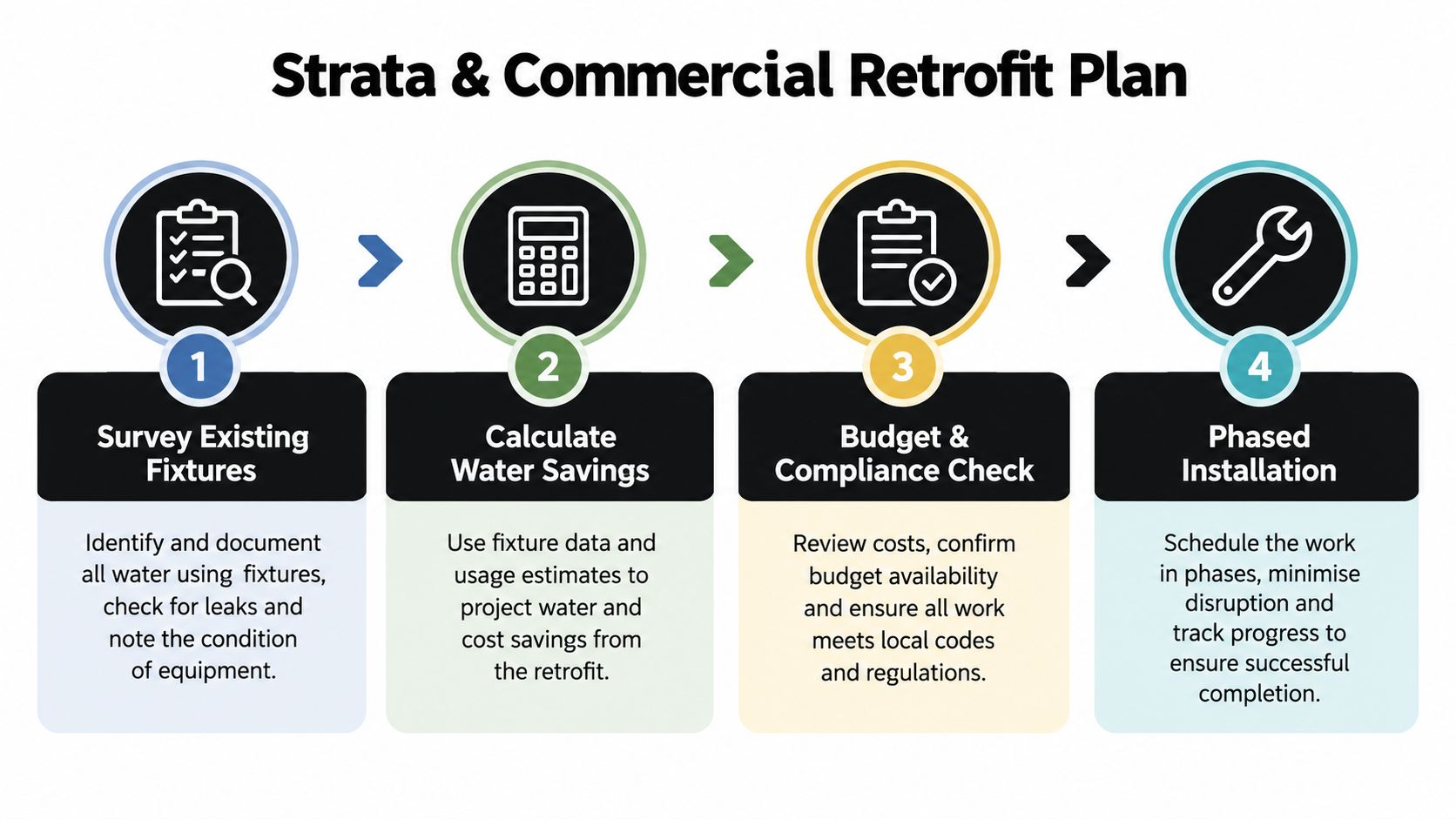
Four steps for a controlled retrofit
Survey existing fixtures. Record the make, model, flush volume, rough-in, visible leaks, bowl condition, shut-off operation, and any history of blockages. Photograph the tank markings rather than relying on a resident's description.
Inspect the drainage context. Ask whether the building has cast iron branch lines, low-slope piping, recurring stoppages, or a known sewer-line defect. A new toilet can't correct a damaged or poorly graded drain.
Calculate the project case. Use actual occupancy and fixture counts, not just the number of suites. A California water-use analysis estimated that a person flushes approximately 4.8 times per day, and replacing an existing average 2.8-gallon flush with a 1.28-gallon model was estimated to save about 7.3 gallons per person per day, as reported in the NRDC analysis of California urban water solutions. The underlying figures are California estimates, but the method is useful for building a BC project: measure current use, model the replacement, and account for repeat flushing.
Install in phases. Begin with a representative group of suites or washrooms. Track fit, resident feedback, flush performance, and service issues before committing to every floor. Keep spare valves and seals available so a minor parts issue doesn't delay the whole programme.
Use occupancy, not suite count
At larger properties, the savings can scale quickly. A 100-resident building could theoretically reduce toilet water consumption by about 730 gallons per day, or 266,450 gallons per year, assuming the usage pattern remains constant, according to the same California analysis.
That example should be treated as a planning model, not a promise for a BC utility bill. It also shows why a building operator should count residents, staff, visitors, and public washroom traffic separately. A lightly occupied office and a full residential building may have the same number of toilets but very different operating patterns.
Before ordering, approve a written fixture standard. It should specify the maximum LPF, minimum acceptable MaP result, rough-in and dimensional requirements, approved colours, seat compatibility, parts availability, and the process for handling concealed flange or drain defects discovered during installation.
Solving Maintenance and Clogging Concerns
Low-flow toilets don't clog just because they use less water. They clog when the fixture, the installation, the building drain, and user behaviour don't work together.
A toilet may struggle because the trapway is poorly designed, the flush valve doesn't open fully, the water level is set incorrectly, or the supply line can't refill the tank properly. The building side can be just as important. A low-slope branch, damaged cast iron, a partial obstruction, or a root-intruded sewer line can make a replacement toilet appear weak even when the fixture is operating correctly.
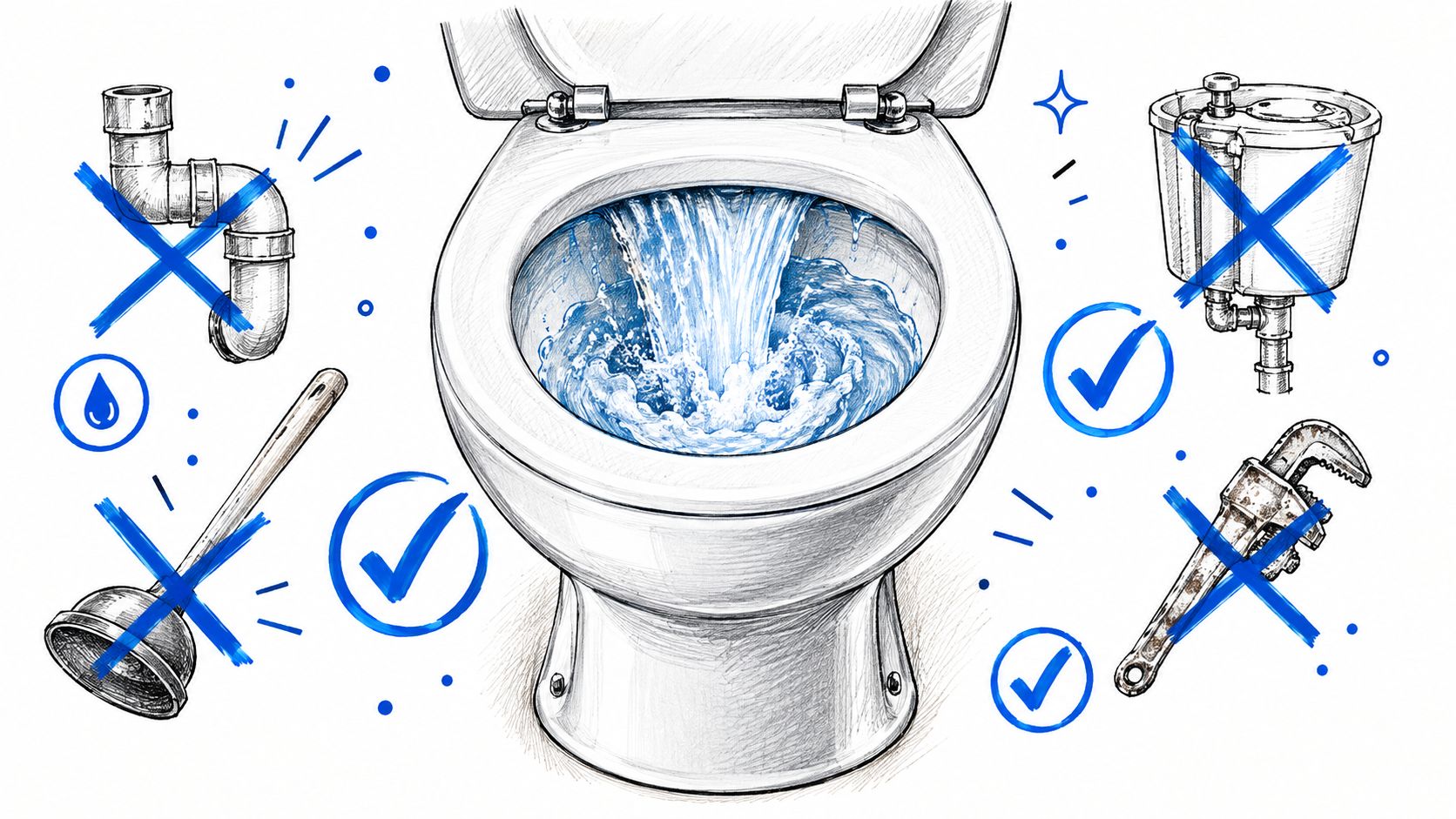
Separate fixture faults from drain faults
Start with the pattern of the complaint. One toilet that flushes poorly may need a flapper, fill-valve, flush-valve, or supply adjustment. Several fixtures that drain slowly, gurgle, or back up around the same time point more strongly toward a branch or main-drain issue.
Non-flushable wipes are another common cause of trouble. Products that feel disposable can catch in bends, accumulate at partial restrictions, and create a blockage farther along the line. A building operator should address the user behaviour without assuming that changing every toilet will solve the problem.
For a slow-draining toilet, toilet drain cleaning and troubleshooting guidance can help identify whether the immediate symptom is a local obstruction or part of a wider drainage concern.
Test the installation before blaming the model
A proper installation includes a stable flange, a sound seal, a correctly connected supply, a level bowl, and a tank adjusted to the manufacturer's specification. The installer should run repeated test flushes, inspect for leaks, confirm that the bowl refills correctly, and check that the shut-off valve operates without seepage.
A toilet that needs plunging immediately after installation deserves investigation. Replacing it with another low-flow model without checking the branch drain usually wastes time. In older buildings, a camera inspection may reveal that the actual problem sits beyond the fixture.
For property managers, record each repeat call by suite, toilet model, symptom, and likely cause. That history helps distinguish a bad batch of components from a recurring pipe problem and supports a better replacement decision at the next capital-planning meeting.
Maximizing Rebates and Long-Term Financial Returns
The financial case for a low-flow toilet has three parts: the fixture and installation cost, the reduction in water and sewer demand, and the maintenance consequences of choosing a poor performer. Rebates can improve the first part, but they don't make an unsuitable toilet a good investment.
California programmes show why the details matter. California Water Service requires toilets in its MaP Premium rebate category to remove at least 600 grams in one flush, according to its water conservation rebate information. That requirement reinforces a useful principle for BC buyers too. Efficiency should be paired with tested performance, not treated as a replacement for it.
Read the eligibility rules before purchase
Rebate programmes can limit eligible models, replacement conditions, installation dates, account types, and required documents. A property owner who buys first and checks later may discover that the fixture doesn't qualify, the old toilet doesn't meet the replacement rule, or the application lacks a receipt and installation record.
California's market data also illustrates the equity problem. A study summarised by Plumbing Manufacturers International found that residential penetration of toilets using 1.28 gallons per flush or less was 22.0% to 25.9% across five surveyed regions, and 19.6% to 22.2% in disadvantaged communities. The same analysis estimated that replacing 469,000 toilets using at least 3.5 gallons per flush in disadvantaged communities could save 3.2 billion gallons over three to five years, as reported in the legacy-product replacement analysis.
Those figures identify a practical barrier that Canadian building owners also recognise. Renters may pay the water bill while landlords control the fixture, or landlords may pay for the replacement while tenants receive most of the immediate benefit. Strata councils must also work within budgets, access rules, and owner approval processes.
Build a simple project calculation
Fresno defines a qualifying HET as a WaterSense model using 1.28 gallons per flush or less, replacing a toilet manufactured before 1992 that uses more than 1.6 gallons per flush. The city states that a 1.28-gpf toilet uses 20% less water than the federal 1.6-gpf standard, offers a rebate of up to $105, and allows up to three rebates per qualifying account, according to its municipal water rebate programme.
A practical example from that programme compares three 1.6-gpf toilets replaced with 1.28-gpf models. If each toilet is flushed five times daily, the household saves approximately 1,752 gallons annually, before considering additional savings from replacing older fixtures that use substantially more than 1.6 gpf.
For a BC project, use the same logic without importing California eligibility rules. List the installed cost, expected water reduction, available local incentive, service-part cost, and the likely consequence of repeat flushing. The cheapest toilet on the invoice may not be the lowest-cost option for the building.
Executing a Professional Toilet Installation
A high-performing toilet can still fail if the flange is damaged, the seal is poorly seated, the supply line is restricted, or the tank components aren't adjusted correctly. Professional installation should begin with a review of the existing fixture and, where symptoms justify it, a video inspection of the branch or sewer line.
The contractor should verify the rough-in and clearances, remove the old toilet without damaging the finished floor, inspect the flange, install a suitable seal, connect the supply, level and secure the bowl, and test for leaks. The final check should include several flushes, proper tank refill, stable bowl water, shut-off operation, and clean caulking where appropriate.
For homeowners comparing labour and materials, this toilet installation cost guide for homeowners provides useful planning context. A strata or commercial project also needs a written scope covering suite access, disposal, fixture specifications, restoration, testing, and warranty handling.
Don't treat a building-wide retrofit as a row of unrelated DIY replacements. A licensed local contractor can identify whether the problem is the toilet, the water supply, the flange, or the drainage system before the building commits to a product that performs poorly in its existing infrastructure.
Encano Plumbing & Drainage Ltd. installs modern high-efficiency and dual-flush toilets for residential, strata, commercial, and government properties, with assessment, drain diagnosis, installation, and repair support. Visit Encano Plumbing & Drainage Ltd. to arrange a practical toilet and drainage assessment in Greater Vancouver and choose a fixture that balances water savings with dependable flushing.