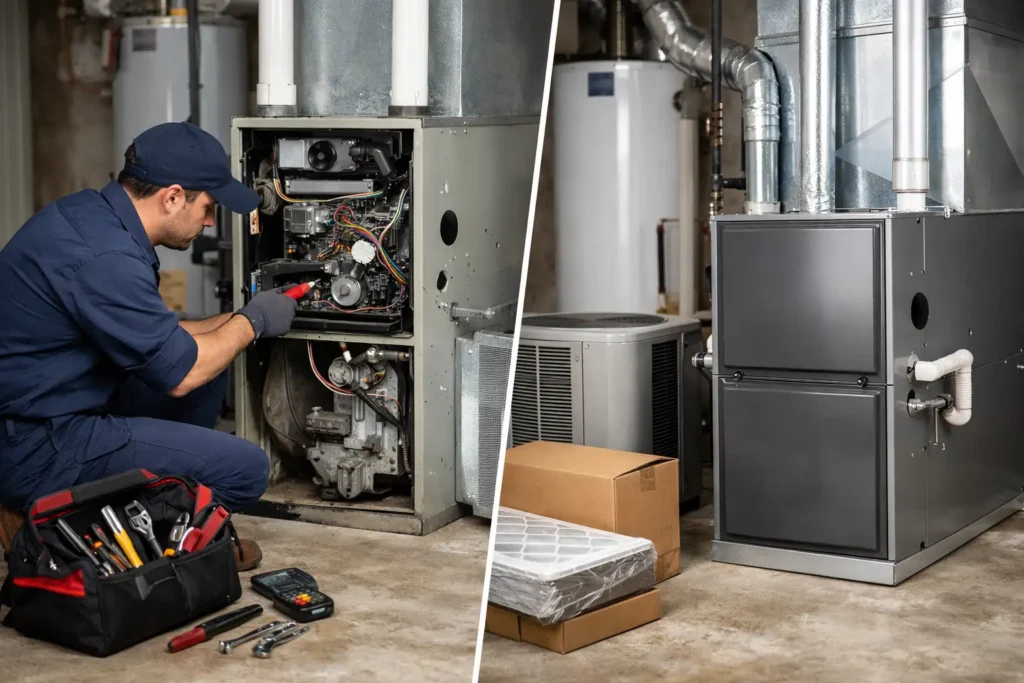
A furnace rarely fails at a convenient time. It starts with a room that never quite warms up, a new rattling sound, or a utility bill that climbs without a clear reason. Furnace repair vs replacement becomes a real decision when the heat is unreliable, but the right answer is not always “buy new” or “keep fixing it.” It depends on the furnace’s condition, the type of problem, and what the repair will truly cost over the next few years.
For homeowners, landlords, and property managers, the goal is simple: restore safe, dependable heat without spending more than necessary. A qualified heating professional can inspect the system, explain what has failed, and give you a clear estimate for both repair and replacement options.
Start With Safety, Not Cost
Before comparing prices, rule out safety concerns. A furnace that produces a gas smell, triggers a carbon monoxide alarm, has visible soot around the unit, repeatedly shuts down, or causes headaches and nausea indoors needs immediate professional attention. Turn the system off if it is safe to do so, leave the area if you suspect a gas leak or carbon monoxide issue, and contact the appropriate emergency service or qualified gas technician.
A cracked heat exchanger is one of the most serious findings. In many cases, this component cannot be repaired safely or economically, especially on an older furnace. Replacement is often the sensible path because the heat exchanger is central to how a gas furnace operates.
Electrical issues, damaged venting, failed safety controls, and combustion problems also require trained diagnosis. Replacing a part without identifying the source of the problem can lead to another breakdown and leave occupants without heat again.
When Furnace Repair Makes Good Sense
Repair is usually the practical option when the furnace is relatively young, has been maintained, and needs a straightforward part replacement. Many common failures do not mean the entire system is at the end of its service life.
A dirty flame sensor, worn igniter, failing capacitor, faulty thermostat, clogged condensate drain, or blower motor issue may be repairable at a reasonable cost. These parts can cause frustrating symptoms, including short cycling, no heat, weak airflow, or a furnace that starts but does not stay running. A proper service visit should include testing the system after the repair rather than simply swapping a part and leaving.
As a general guideline, a well-maintained furnace under 10 years old is often worth repairing unless the issue is unusually major. Many furnaces can last 15 to 20 years, although real lifespan depends on installation quality, maintenance history, usage, and whether the equipment was correctly sized for the property.
Repair can also be the better choice if a replacement would create unnecessary disruption. For example, a rental property with a newer furnace may only need a quick repair to restore heat for tenants. In that situation, replacing the whole system may add cost without providing meaningful value.
Signs Replacement May Be the Better Investment
An older furnace that needs frequent service can become expensive even when each individual repair seems manageable. The problem is not just the latest invoice. It is the pattern of repeat calls, lost heat, rising operating costs, and the chance of an inconvenient failure during a cold spell.
Replacement deserves serious consideration when the furnace is 15 years or older and has a major component failure. That is particularly true for problems involving the heat exchanger, control board, inducer motor, or blower assembly, where repair costs can be substantial. Parts for older models may also be discontinued or difficult to source, extending downtime for a home or building.
Watch for these warning signs:
- Repairs are becoming more frequent from season to season.
- Heating bills are rising despite similar thermostat settings and weather.
- Some rooms are too warm while others remain cold.
- The furnace runs for long periods, short cycles, or makes unusual banging, squealing, or rumbling sounds.
- The unit needs a costly repair that approaches a significant portion of a new system’s price.
A new furnace can offer better efficiency, more consistent comfort, quieter operation, and manufacturer warranty coverage. However, higher efficiency only delivers its full benefit when the equipment is correctly sized and installed. An oversized furnace can short cycle, while an undersized unit may struggle to keep up on the coldest days.
Use the Repair Cost Rule Carefully
You may hear the “50 percent rule”: if a repair costs half as much as a replacement, replace the furnace. It is a useful starting point, but it is not a complete decision tool.
A $1,500 repair on a 17-year-old furnace may not make sense if the unit has already needed several repairs and has poor efficiency. On the other hand, a $1,000 repair on an 8-year-old furnace may be entirely reasonable if the system is otherwise in good condition and the repair includes a meaningful parts warranty.
Ask these questions before deciding:
How old is the furnace?
Age matters because major parts wear out over time. An older unit may continue operating after one repair, but another component could fail soon after. A newer unit with a single isolated issue usually has more useful life left.
What exactly failed?
Do not settle for “it needs a repair.” Ask which part failed, why it failed, whether related components show wear, and whether the issue could recur. A clear explanation helps you compare repair and replacement with confidence.
What is the repair history?
Keep records of service calls when possible. If the furnace has required multiple repairs in the last two or three years, the total cost and inconvenience may point toward replacement.
Will a new furnace solve comfort problems?
Not every cold room is a furnace problem. Duct leaks, poor airflow, insulation gaps, blocked vents, thermostat placement, and return-air issues can all affect comfort. Replacing the furnace without assessing the full heating system may not fix uneven temperatures.
Efficiency Matters, But It Is Not the Only Factor
Older furnaces are often less efficient than current high-efficiency models. Their annual fuel utilization efficiency, or AFUE, measures how much fuel is converted to usable heat. A higher rating can reduce fuel waste, but the best choice depends on your budget, home layout, and expected length of ownership.
For a homeowner planning to stay in the property for many years, a more efficient replacement may offer stronger long-term value. For a landlord or facility manager, reliable operation, available parts, warranty terms, and minimal tenant disruption may carry equal weight.
Do not choose based on efficiency ratings alone. Installation quality affects performance just as much. Proper venting, gas connections, drainage, airflow settings, thermostat compatibility, and commissioning are essential for safe and efficient operation.
Plan Before the Furnace Stops Working
The worst time to make a replacement decision is after the furnace quits during a cold night. Emergency conditions limit your options and can make it harder to compare equipment, warranties, and installation schedules.
If your furnace is aging but still running, schedule an inspection before heating season. A technician can check combustion, inspect the heat exchanger where accessible, test safety controls, clean key components, and identify parts nearing failure. That gives you time to budget and choose a replacement on your terms if one is needed.
For multi-unit buildings and commercial properties, planning matters even more. A heating outage can affect multiple occupants, create complaints, and disrupt operations. Maintaining service records and reviewing equipment condition annually helps property teams avoid preventable emergencies.
Get a Clear, Honest Recommendation
A trustworthy contractor should not pressure you into replacement when a safe, practical repair will do. They also should not recommend another temporary fix when the furnace has become unreliable, unsafe, or costly to maintain. Ask for a written explanation of the issue, repair estimate, replacement options, warranty details, and any work needed beyond the furnace itself.
Encano Plumbing & Drainage Ltd. helps homeowners and property managers in Vancouver and nearby areas assess heating issues with straightforward advice, professional workmanship, and transparent pricing. Whether the answer is a targeted repair or a planned replacement, the priority should be safe heat and a solution that fits the property.
If your furnace is making new noises, heating unevenly, or needing repairs more often, do not wait for a complete breakdown. A timely inspection can give you the information to make a calm, cost-conscious decision while your home or building is still warm.