You've noticed a faint odour near the furnace, or you've bought an older Vancouver home and the gas system is now on your mind. That's usually the point where people want a straight answer, not a lecture, and a proper gas line inspection gives you that answer with evidence instead of guesswork. In Greater Vancouver, the key issue is often not just whether a line looks old, it's who owns which part of the system, what needs testing, and what has to happen before anyone covers walls, shuts off service, or signs off on work.
Table of Contents
- Why a Professional Gas Line Inspection Is Essential
- Understanding Your Responsibilities vs The Utility Company
- Warning Signs Your Gas Lines Need Immediate Attention
- The Step by Step Gas Line Inspection Process
- When and How Often Should You Get an Inspection
- Gas Line Inspection Costs and Vancouver Codes
- How to Hire a Licensed Technician and Next Steps
Why a Professional Gas Line Inspection Is Essential
A homeowner in Vancouver often calls after a smell in the basement, a renovation delay, or a worried spouse asking whether the old piping behind the drywall is still safe. That concern is reasonable. Gas systems don't give much warning when something is wrong, and a professional inspection is one of the few ways to check the system before a small defect becomes a bigger problem.
A good inspection is not a box-ticking exercise. It is a preventive safety check, a compliance step, and a practical way to understand the condition of the piping, fittings, and appliances in the home. That matters in dense residential areas, older houses, and strata buildings where access, buried runs, and shared spaces can make simple visual checks incomplete.
Practical rule: if you can't clearly identify the line, the owner, and the access point, you don't yet know enough about the gas system.
Systematic inspection programmes have already shown why this matters. A New York gas service-line inspection programme ordered in 2017 had, by July 30, 2024, led to the discovery of over 30,000 leaks made safe (New York regulators' report). That figure is outside British Columbia, but it's a useful reminder that inspection finds hidden defects people don't see day to day.
For Vancouver homeowners, the takeaway is simple. A professional inspection helps confirm whether the system is intact, whether the right party is responsible for the right section, and whether any further testing or repair is needed. It also gives strata councils and property managers a cleaner paper trail when access, repairs, or insurance questions come up.
Understanding Your Responsibilities vs The Utility Company
The first mistake many owners make is assuming the utility is responsible for the whole gas system. In British Columbia, FortisBC states that it inspects and maintains the gas meter, while customers are responsible for their own gas piping and appliances (FortisBC responsibility guidance). That division matters more than is commonly understood, especially in strata buildings and properties with buried lines or mixed indoor and outdoor runs.
Think of it the same way you'd think about water service. The utility handles the line and equipment up to a certain point, then the owner takes over inside the property boundary. With gas, the handoff point is often the meter. After that, the inspection responsibility shifts to the homeowner, strata, landlord, or building operator depending on the setup.
What belongs to the utility
The utility typically handles the meter and the service side leading to it. If a problem appears at the meter, or the issue involves utility-owned equipment, that's a utility call. If you're not sure where the boundary sits, don't guess. Ask before anyone starts opening walls or excavating.
What belongs to the owner
Everything after the meter is the owner's problem to maintain, inspect, and repair. That includes piping to furnaces, fireplaces, water heaters, BBQ lines, detached garages, and appliance connectors. In a strata, that also means the person managing the building has to know which lines are common property and which ones sit with an individual unit.
If the meter is the utility's checkpoint, the piping after it is your responsibility to keep accessible, documented, and safe.
That's why a licensed technician like Encano will usually begin by tracing the ownership boundary before touching test equipment. It keeps the work focused on the right system and avoids confusion when multiple parties need access or a shutoff. For many property owners, the most useful question isn't “Do I have a gas problem?” It's “Whose section of the system am I looking at, and who has to act on it?”
Warning Signs Your Gas Lines Need Immediate Attention
Some signs demand attention before any scheduled inspection. A rotten egg smell, hissing near a pipe or appliance, or an appliance that won't operate correctly can all point to a leak or another fault in the system. If you notice any of these, don't flip switches, don't use electronics, and don't try to locate the problem by testing fixtures one by one.
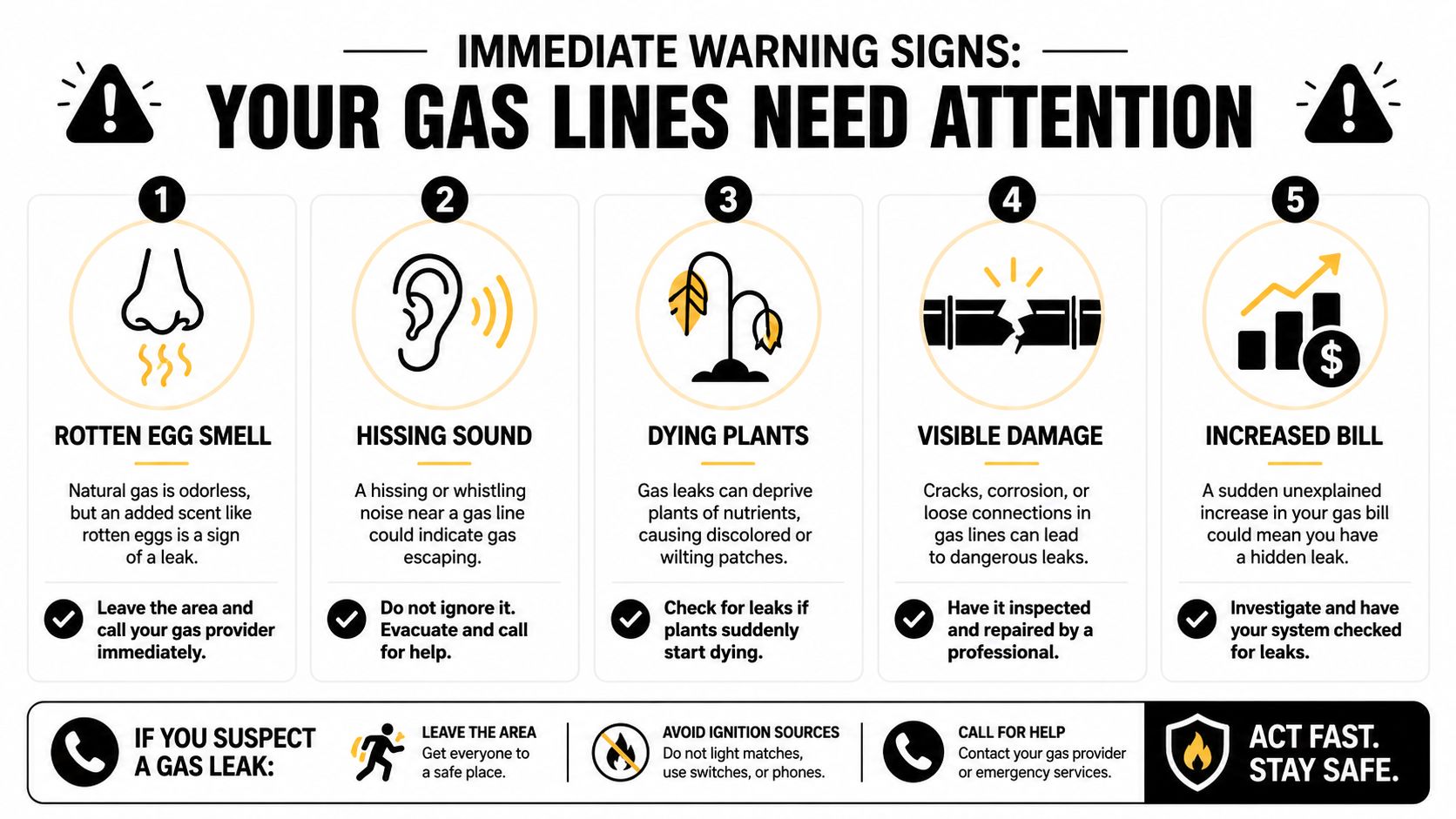
The most common red flags usually fall into a few groups. A smell, which may indicate gas has escaped and the odourant is doing its job. A sound, which often suggests gas is moving through a damaged fitting or crack. Physical damage, such as corrosion, impact marks, or disturbed soil around a buried line. Plant stress, where vegetation along a buried route looks unhealthy compared with the surrounding area. Appliance trouble, such as poor ignition or inconsistent operation, which can indicate a supply problem rather than a fault in the appliance itself.
What to do first
Leave the area immediately if the smell is strong or getting worse. From a safe distance, contact emergency services and the utility, then wait for qualified personnel to assess the situation. Don't re-enter until you're told the area is safe.
For homeowners who want repair context after an urgent callout, the gas leak repair service information for Vancouver is a useful place to understand the kind of follow-up work that may be needed once the source is located.
A buried line can be especially tricky because the visible signs may be subtle. A patch of stressed vegetation or disturbed ground may be the only clue before someone opens the area and confirms the fault. In those cases, speed matters more than certainty, and the safest response is to assume the problem is real until a licensed technician clears it.
The Step by Step Gas Line Inspection Process
A proper inspection starts before any tools come out. The technician asks what changed, whether there's been renovation work, when the system was last serviced, and whether any part of the line is buried, concealed, or hard to access. That first conversation matters because it determines whether a standard visual check is enough or whether the job needs testing and diagnostic equipment.
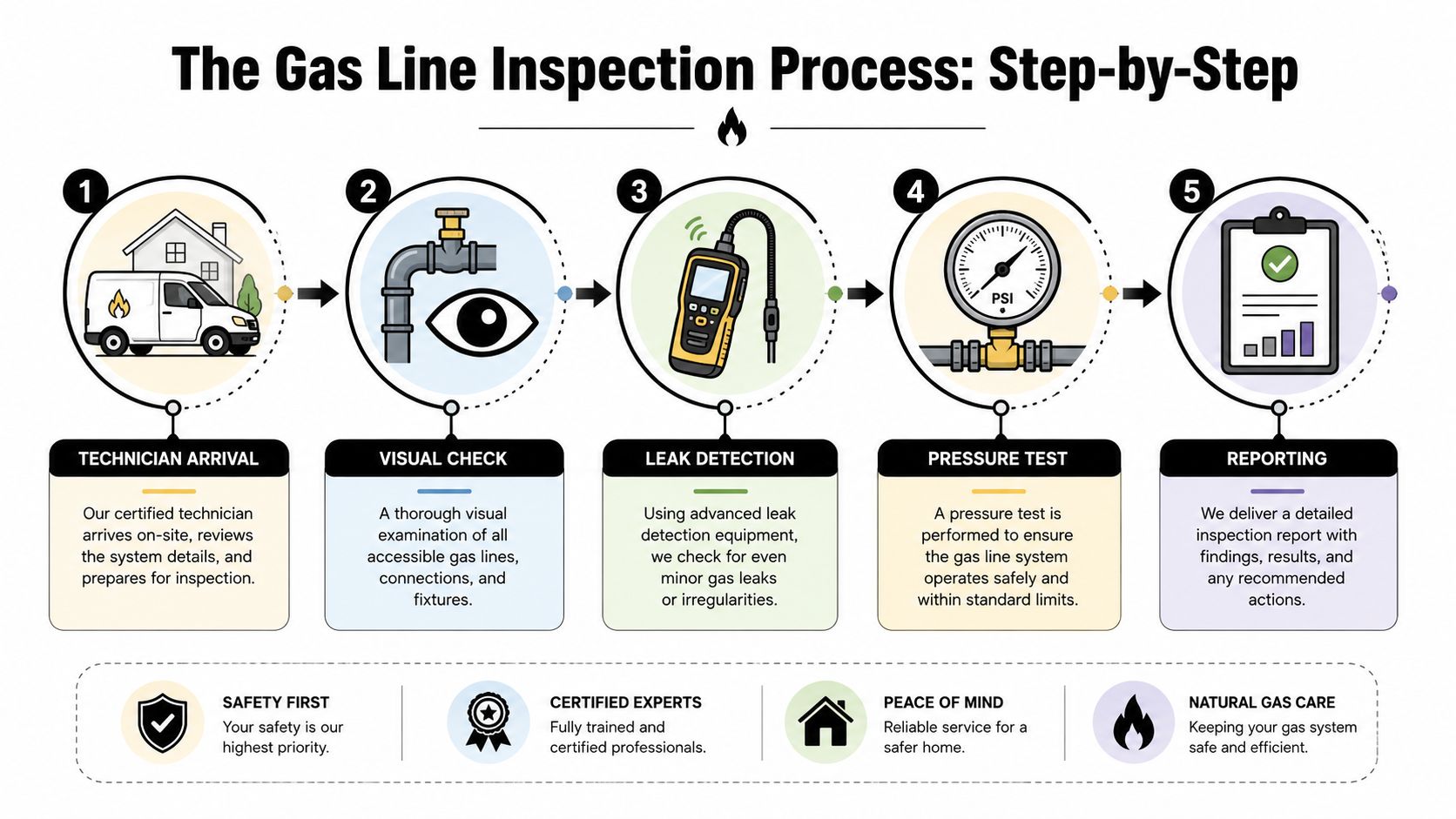
Here's how the work usually unfolds in the field.
Arrival and visible survey
The technician begins with the meter, exposed piping, shutoff valves, appliance connections, and any visible joints. I'd expect a careful look at support, corrosion, routing, and whether anything has been altered without leaving access for later testing. If the system is crowded behind finishes or partially buried, that becomes part of the assessment rather than a side note.
Leak detection and pressure testing
Next comes testing. On an intact accessible system, a technician can check for leaks with electronic detectors and pressure-based methods. For aging or buried systems where visual checks are limited, more specialised methods may be needed, including in-line inspection or ultrasonic sensing (US Department of Energy on difficult-to-inspect pipelines). The important point is that some systems can't be judged safely by sight alone.
Appliance and connector review
The technician checks connectors, shutoffs, and appliance tie-ins to make sure the whole path from the meter to the appliance makes sense. A line can look fine at a glance but still fail at a fitting, connector, or hidden transition. That's where many homeowner assumptions break down.
Reporting and next steps
The final step is documentation. A clean report should tell you what was inspected, what couldn't be inspected, what passed, and what needs repair or further testing. If the system is partially inaccessible, that needs to be written clearly so no one mistakes an incomplete look for a full clearance.
When and How Often Should You Get an Inspection
A gas system shouldn't be treated like a one-time install and forgotten. Federal performance data show that from 2010 to 2013, over 205,000 miles of US gas pipelines were assessed (PHMSA pipeline performance measures). That kind of recurring assessment reflects the reality of gas infrastructure, it needs ongoing attention, not a single sign-off.
For Vancouver properties, the timing usually comes down to two questions. Is there a reason to inspect now, and is the property old enough or complex enough that waiting creates avoidable risk? Older housing stock, concealed piping, buried runs, and strata layouts all make the case for proactive checks stronger.
Common reasons to book sooner
- Before buying or selling: Buyers want clarity, and sellers need fewer surprises at subject removal or closing.
- After renovations: Any work near piping, walls, ceilings, or buried services can change what needs to be tested.
- After seismic movement or nearby excavation: Shifts in the ground or impact to buried lines should trigger a fresh look.
- When symptoms appear: Smells, noises, appliance issues, or unexplained shutdowns shouldn't wait for a routine date.
A gas line that hasn't been examined in years isn't “fine” just because nothing obvious has happened.
For many homes, a regular inspection cycle is the most practical way to stay ahead of corrosion, poor access, and undocumented changes. That's especially true in dense neighbourhoods where a line can run through finished spaces, crawlspaces, or detached structures that rarely get a careful look. The point isn't to inspect constantly. It's to inspect often enough that the system's condition stays known instead of assumed.
Gas Line Inspection Costs and Vancouver Codes
Cost depends on access, size, and complexity. A small accessible home with a few appliances is simpler to inspect than a strata property with multiple units, buried segments, or a line that disappears behind finished surfaces. In practice, the primary cost factor is often time spent tracing the system safely and confirming that the line is testable.
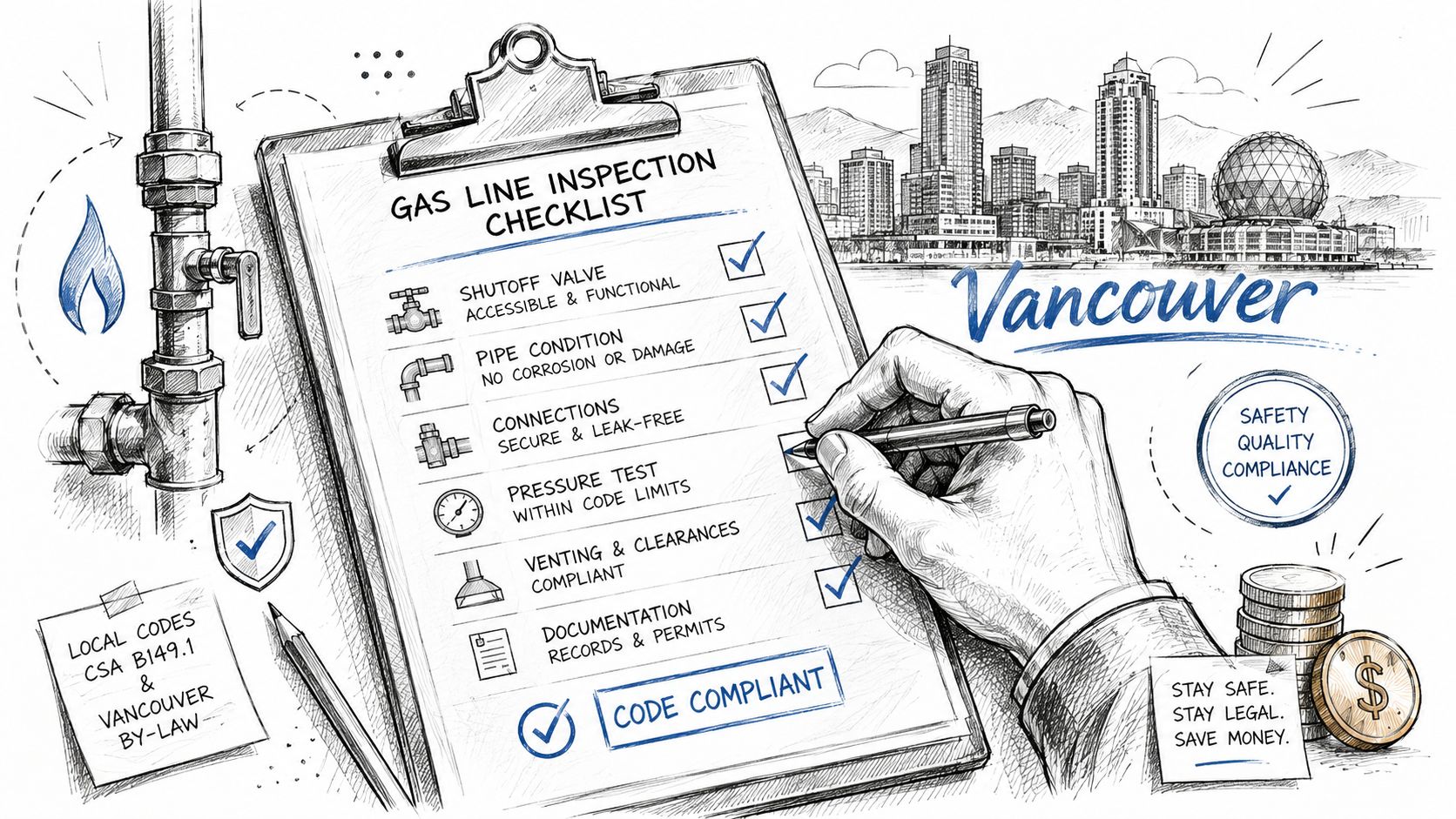
There's also a code angle that owners shouldn't ignore. In California, inline inspection specifications used by the CPUC require tool systems to detect and size metal loss anomalies at 10% of wall thickness and greater, and dents of 2% of diameter and greater (CPUC specification). That's not a British Columbia rule, but it shows the level of precision modern inspection standards are built around. In older or hidden systems, small defects can matter.
What usually affects the scope
- Property layout: More floors, detached structures, and buried runs mean more time tracing the system.
- Access: Finished walls, ceiling spaces, and locked mechanical rooms slow the job down.
- Number of appliances: Every appliance connector and shutoff needs a look.
- Documentation history: Missing records usually mean more verifying on site.
For new or altered gas piping work, many jurisdictions require multiple inspections, including a rough inspection before walls are covered. Contra Costa County's residential gas piping guidance says the rough inspection should happen when the new lines are installed, before walls are covered and before connection is made to the gas service (Contra Costa County guidance). That same logic matters here in Vancouver, because once the wall is closed, the line is harder to verify without opening it again.
If you're comparing service options or want to understand local code-driven work more thoroughly, the BC gas code resource can help frame what compliant work looks like on the ground.
How to Hire a Licensed Technician and Next Steps
A homeowner in Vancouver who is hiring for gas work should start with the basics. A qualified gas technician should explain what they will test before they begin, then walk you through what they found after the inspection. Ask to see their Technical Safety BC gas fitter licence, confirm liability coverage, and check recent reviews for punctuality, cleanup, and clear communication. If the technician cannot explain the handoff point between FortisBC's equipment and the owner's piping, keep looking.
A screening call should cover a few practical points:
- What parts of the system will you inspect? Confirm whether the job includes the meter area, connectors, appliances, and buried or concealed lines.
- How will you test it? Ask for a plain explanation of pressure testing, leak detection, and any special method needed for sections that are hard to reach.
- What happens if you find a fault? A good technician should explain repair options without making promises they cannot stand behind.
- Will I get a written report? You should, especially if the property is in strata, if insurance records matter, or if a sale is being considered.
If a contractor only talks about replacing parts and never mentions testing, documentation, or access, that is a warning sign.
For homeowners and strata managers, the split in responsibility matters. FortisBC handles the utility side up to the point where the property owner's piping begins, while the owner or strata is responsible for the piping, fittings, and appliances on the property side. That distinction affects who arranges the inspection, who approves repairs, and what records should stay with the building file.
If the inspection points to repair work, the next step should be based on the actual finding, not a guess. A loose fitting, a damaged connector, or a section that needs more than a visual check may call for gas line repair or, in some cases, a broader gas line installation plan if the existing piping cannot be brought back to a compliant condition. A technician should explain the trade-off between repairing a local defect and replacing a section that is no longer practical to verify safely.
One practical option for homeowners who want gas work handled by a local plumbing and gas contractor is Encano Plumbing & Drainage Ltd., which provides gas line repair and related plumbing services in Vancouver and nearby communities. That kind of service is most useful when the inspection turns up a loose fitting, a damaged connector, or a section that needs more than a quick visual check.
If the system passes, keep the report and note the date in your records. If the technician finds a minor issue, book the repair quickly and have the affected section tested again. If the inspection reveals a larger problem or an inaccessible run that cannot be verified, do not treat it as a cosmetic issue. Get a clear repair plan and written documentation before anyone closes the area back up.
If you are ready to get a gas system checked in Vancouver or the surrounding area, visit Encano Plumbing & Drainage Ltd. to arrange service, ask about inspection and repair options, and get clear documentation before small concerns turn into bigger ones.