
You go down to the basement after a week of steady rain. The air feels damp. Cardboard smells off. A faint musty odour hangs near the wall behind the storage shelves. Nothing looks dramatic yet, but you can tell something isn't right.
That's often how foundation drainage problems start in Vancouver. Not with a flood, but with small warnings that show up during long wet stretches, after snowmelt, or when the soil around the house stays saturated for days. Homeowners in Richmond, Burnaby, Delta, and older parts of Vancouver see this all the time, especially in homes with aging perimeter drains or heavy, slow-draining soil.
A weeping tile system is the quiet drainage network that helps keep that water from building up against your foundation. If you've ever wondered how do weeping tiles work, the short answer is simple. They collect groundwater beside the footing and move it to a safer discharge point before that water can press against your basement wall and floor.
The longer answer matters, especially here. Vancouver's rain, clay-like soils, and older housing stock create exactly the conditions that test a drainage system. If your house has sewer odours along with dampness, it's also worth understanding why a sewer smell in the house can point to a deeper drainage or venting issue.
Table of Contents
- That Musty Smell A Familiar Vancouver Problem
- What Is a Weeping Tile System
- The Complete Drainage Process Step by Step
- Interior vs Exterior Weeping Tile Systems
- Common Failure Signs and Maintenance Tips
- Weeping Tiles in Vancouver Costs Lifespan and Professional Advice
That Musty Smell A Familiar Vancouver Problem
A lot of people first notice the problem by smell. The basement doesn't look flooded, but it feels cooler, heavier, and slightly earthy. Then they spot a darker patch near the base of a wall, or a white chalky residue on concrete, or they realise the dehumidifier has been working harder than usual.
In Greater Vancouver, that pattern makes sense. We get long rainy periods, high groundwater in some neighbourhoods, and soils that don't always let water move away quickly. Water builds up outside the foundation, and that creates hydrostatic pressure. The easiest way to think about it is this. Wet soil acts like a sponge being pressed against your basement wall. The more water trapped there, the more force pushes inward.
That pressure doesn't need a big crack to cause trouble. Water will look for tiny openings, porous concrete, wall-floor joints, and old weak points around the footing. That's why a basement can smell damp before you ever see standing water.
What homeowners usually miss
People often focus on what they can see inside. They scrub the wall, repaint the drywall, or run a fan. Those steps may help the symptom, but they don't remove the water outside the house.
A weeping tile system solves the problem at the source. It gives groundwater an easier path than your foundation.
Water doesn't need to “burst in” to damage a basement. Slow seepage over time is enough to create odour, staining, and material breakdown.
Why this matters more here
Older Vancouver-area homes are especially vulnerable because many were built with drainage materials and layouts that don't perform as well under today's conditions. Some systems are partially clogged. Some have collapsed sections. Some are still connected in ways that don't handle heavy storms properly.
If your basement feels musty every winter, the issue usually isn't random. It's often a sign that groundwater isn't being collected and redirected the way it should be.
What Is a Weeping Tile System
A weeping tile system is the drain line that protects the buried part of your house. It runs around the foundation near the footing and collects groundwater before that water has time to sit against the concrete.
The name throws people off. Modern weeping tile is usually perforated plastic or PVC pipe, not ceramic tile. The old name stayed, even though the material changed.
An underground gutter around the house
A weeping tile system works like a gutter for your foundation. Roof gutters catch water at the edge of the roof and send it to a downspout. Weeping tiles catch water in the soil at the base of the house and send it to a safe outlet before that water can linger beside the wall.
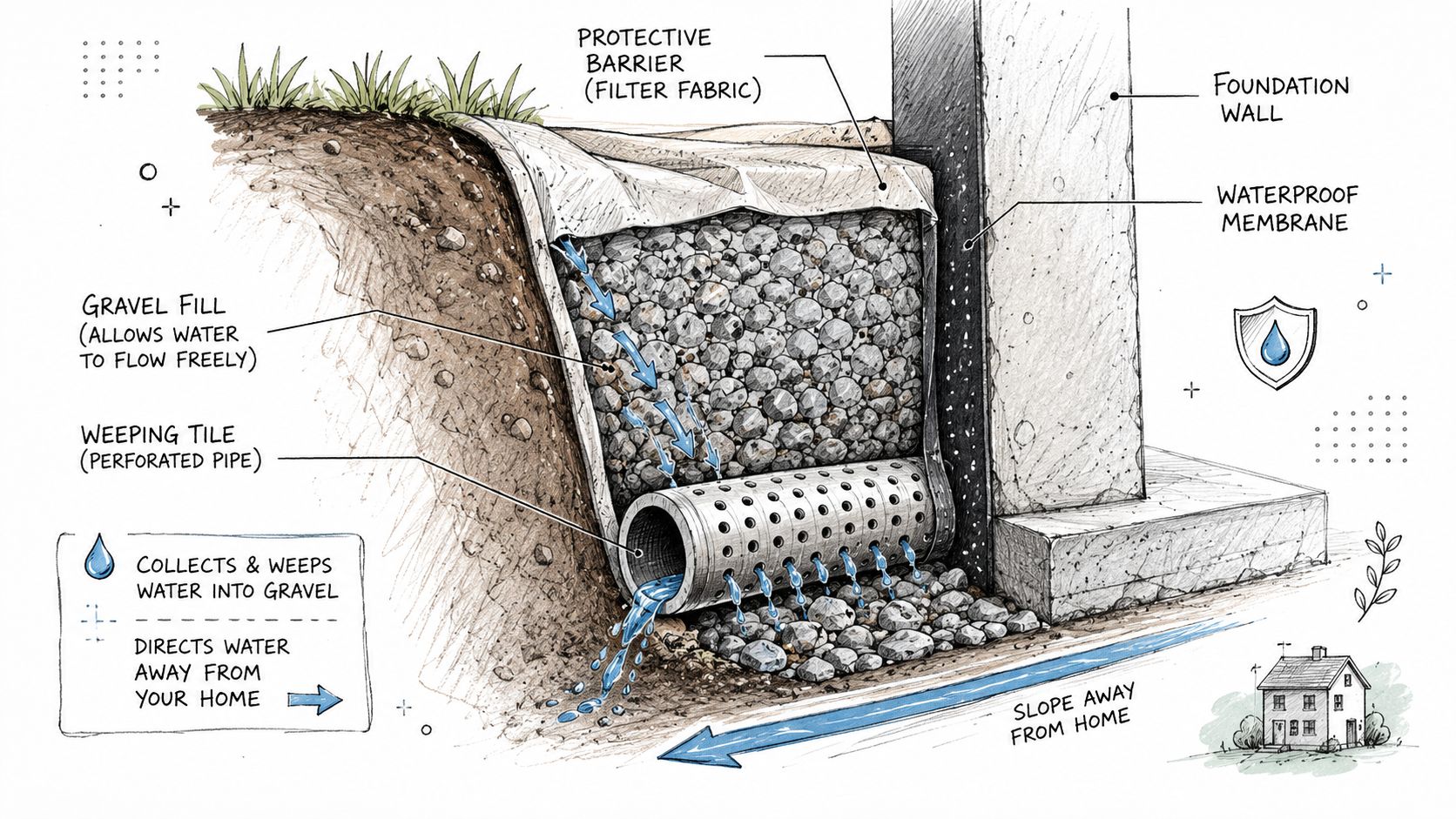
A proper system is a group of parts that work together, not just a pipe in the ground:
- Perforated pipe collects water along the footing.
- Clean gravel creates an easier path for water to reach the pipe.
- Filter fabric helps keep silt and fine soil from washing in.
- A discharge point carries the water to a storm connection or sump system.
That gravel layer matters a lot in Vancouver. Our soil often has a heavy, clay-like character, so water moves through it slowly. Gravel gives water a path with less resistance, which is one reason a good perimeter drain can make such a noticeable difference during a long stretch of rain.
Why location and condition matter in Vancouver
In the Lower Mainland, the system has to deal with more than one wet day. It has to keep working through weeks of rain, saturated ground, and older foundations that may already have small weak points. Many houses built decades ago still have aging perimeter drains, and some have sections blocked by silt, crushed by settlement, or invaded by roots.
Older homes can also have legacy clay or concrete drain materials that do not hold up as well as modern pipe. If you are not sure what is around your footing, a drain camera inspection of the perimeter drainage line can show whether the pipe is open, clogged, cracked, or collapsed.
Practical rule: If an older Vancouver home smells musty through the rainy season, the weeping tile system deserves a closer look, even if you have never seen standing water.
The Complete Drainage Process Step by Step
On a wet Vancouver week, the ground around your house can stay saturated for days. Water keeps soaking down through the soil, and if it has nowhere easier to go, it starts pushing against the foundation wall. Weeping tile solves that by giving groundwater a lower-resistance path before that pressure turns into seepage, damp air, or a stained basement wall.
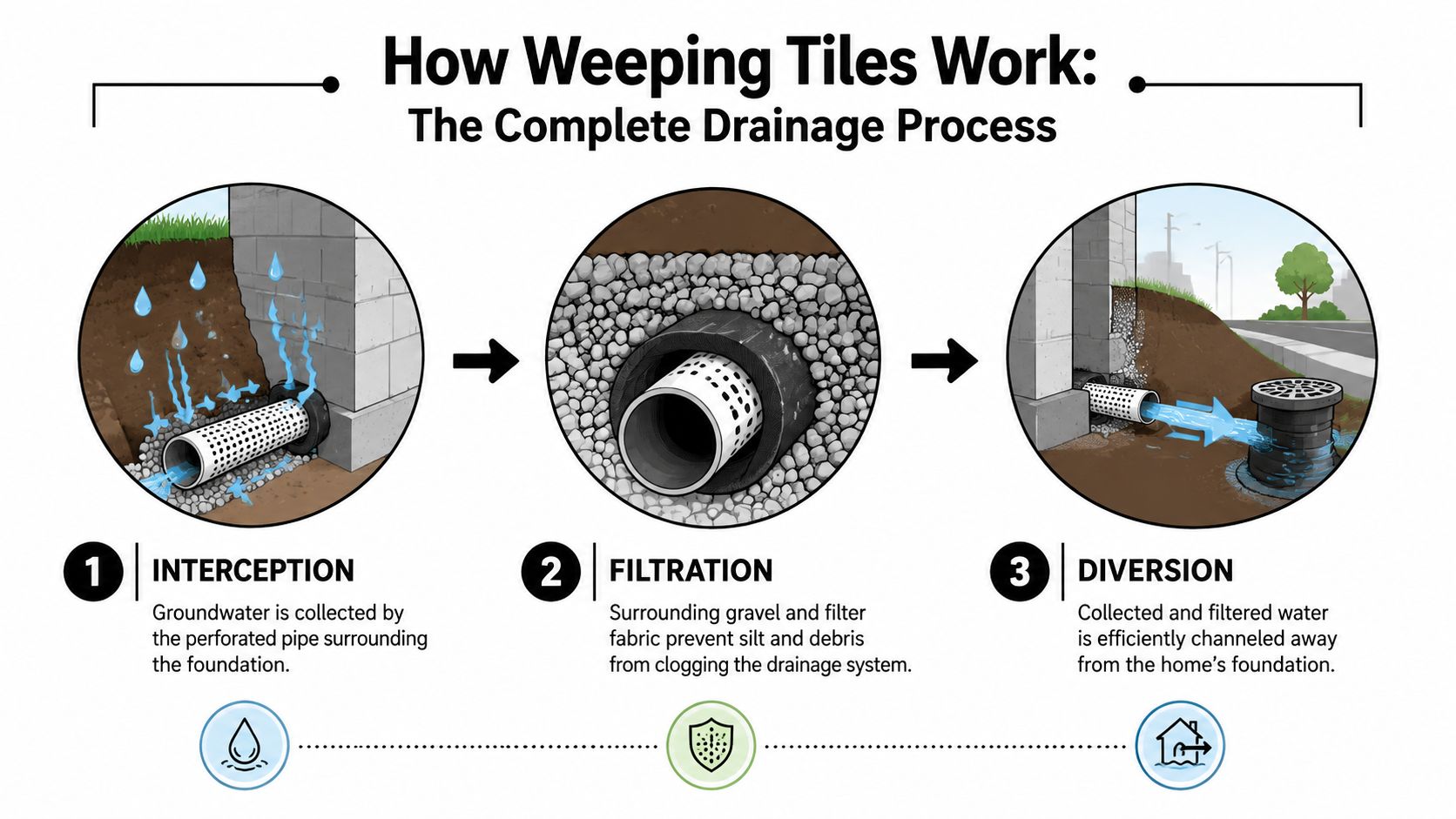
The process is easiest to follow in three stages. Water is collected near the footing, kept clear of clogging material, and then carried to a safe exit point away from the house.
Interception
Rainwater and groundwater move downward until they reach the soil beside the foundation footing. In Vancouver-area clay-like soils, that movement is slow, so water tends to build up and linger. That lingering water creates hydrostatic pressure, which works like a heavy wet blanket pressing against the wall. The longer the soil stays saturated, the more that pressure builds.
The gravel around the pipe changes the route. Water moves through clean gravel much more easily than through dense native soil, so it drops into that gravel bed instead of staying packed against the concrete. From there, it enters the perforated pipe and begins to travel around the foundation.
That first step matters most during long rainy stretches, not just one hard storm.
Filtration
A weeping tile system only works if water gets in and soil stays out. That is why proper installation includes washed gravel and filter fabric around the pipe. The gravel creates open space for water to move. The fabric slows the entry of silt and fine particles that would otherwise wash into the line and settle there.
This is a common trouble spot in older Vancouver homes. Fine sediment from clay-heavy soil can gradually fill the voids around the pipe or collect inside low spots. From the surface, the system may look intact. Underground, it may already be partway blocked.
If a basement smells damp every winter or one corner of the slab stays cold and wet, a drain camera inspection of the perimeter drainage line is often the clearest way to see whether the pipe is open, silted up, cracked, or holding standing water.
Diversion
Once water enters the pipe, slope takes over. The line is installed to carry water toward a discharge point, usually a storm connection or a sump pit, depending on the house and the site conditions.
A simple analogy helps here. The pipe works like a shallow gutter buried beside the footing. If that gutter has the right pitch, water keeps moving. If parts of it settle flat or dip the wrong way, water slows down, sediment drops out, and the drain starts losing capacity.
That is one reason older perimeter drains in the Lower Mainland often struggle during extended rain. Even if the pipe has not fully collapsed, years of settlement can leave sections that no longer drain properly. A standard reference for residential perimeter drain layout, bedding, and slope is outlined in this perimeter drain overview.
The goal is simple. Give groundwater an easier path than your foundation wall.
A short demonstration can help if you prefer seeing the concept in action.
Why installation details matter in Vancouver homes
In local soil conditions, small installation mistakes do not stay small for long. A pipe set without enough gravel, fabric, or consistent slope may still collect some water at first, but performance drops as sediment builds and wet seasons repeat.
That is especially true around older houses in Vancouver, Burnaby, and New Westminster, where aging foundations and decades-old drain systems are already working against heavy rainfall. A weeping tile system does its job, underground, and out of sight. When it is installed properly, that silence is exactly what you want.
Interior vs Exterior Weeping Tile Systems
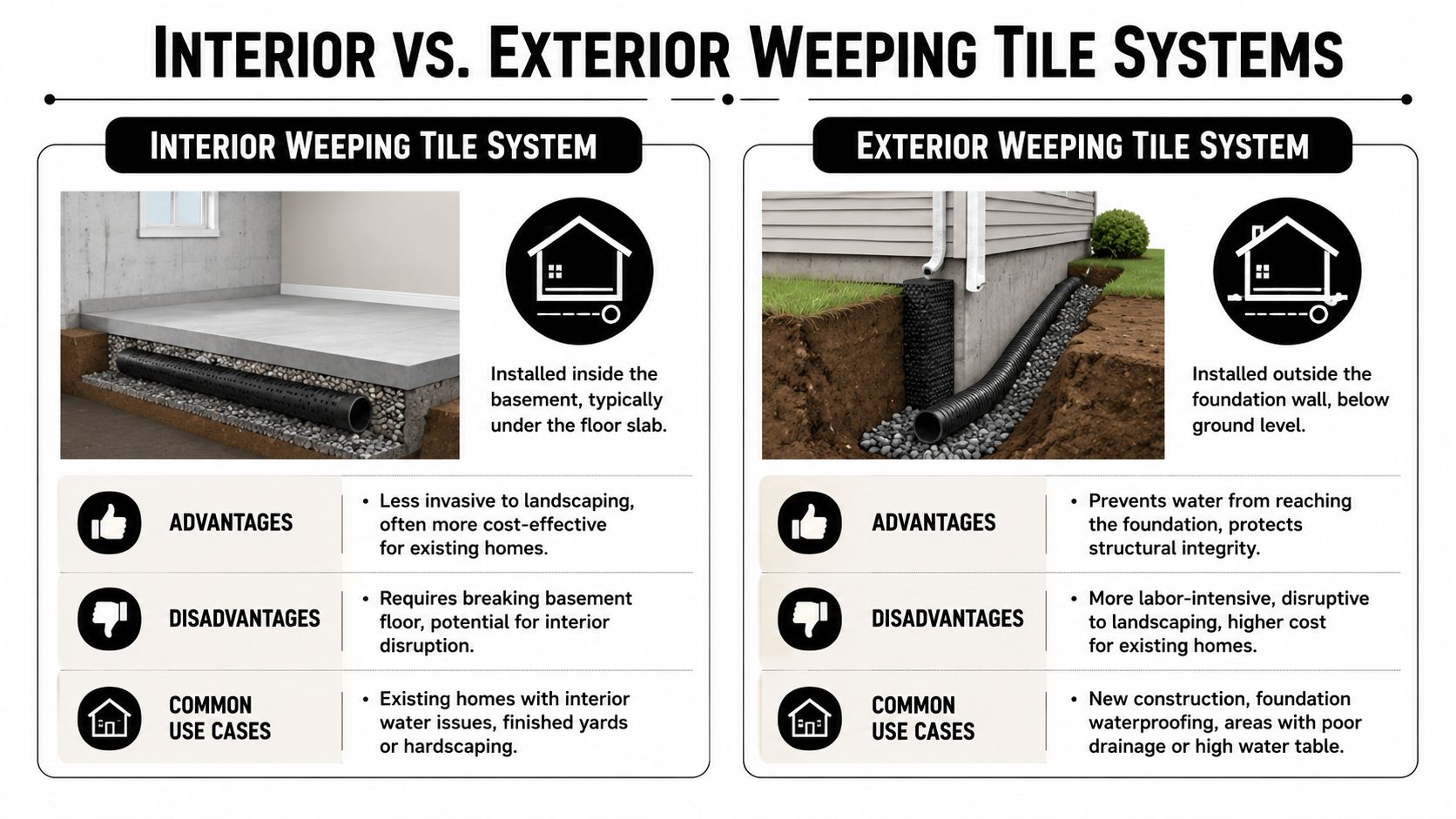
Homeowners usually hear about two types of systems. One is installed outside the foundation. The other is installed from inside the basement. Both manage groundwater, but they do it at different points in the problem.
How they differ in real homes
An exterior system is the traditional approach. Contractors excavate along the outside of the foundation, install or replace the perimeter drain near the footing, and usually combine that work with waterproofing or foundation protection measures. This method intercepts water before it reaches the wall.
An interior system is usually a retrofit option. Contractors remove a strip of basement slab along the inside perimeter, install a drain channel or perforated pipe beside the footing, and direct that water to a sump pit. This doesn't stop water from reaching the exterior wall, but it manages the water before it rises into the living space.
That distinction matters. Exterior work is often the more complete solution when access is possible. Interior work is often the more practical solution when the yard, driveway, neighbouring property line, or finished landscaping makes full excavation difficult.
In older Vancouver basements, the best answer often depends less on theory and more on access, building layout, and where the water is actually entering.
A practical example helps ground this. In Richmond, a homeowner with a sump pump installed weeping tile around the foundation perimeter at footing height. Rainwater flowed through the gravel-filled trench, entered the 4-inch pipe through the weep holes, and was pumped out during heavy storms, preventing basement flooding, as shown in this Richmond weeping tile example.
Interior vs. Exterior Weeping Tile Comparison
| Factor | Exterior System | Interior System |
|---|---|---|
| Location | Installed outside the foundation wall | Installed inside the basement, usually under the slab edge |
| Main function | Stops groundwater before it reaches the foundation wall | Collects water after it reaches the inside footing area |
| Disruption | Excavation affects landscaping, walks, patios, and access | Requires breaking concrete inside the basement |
| Best fit | New construction, major exterior work, or full perimeter replacement | Existing homes where excavation is difficult or too disruptive |
| Moisture control | Better for reducing outside pressure on the wall itself | Better for managing seepage at the wall-floor joint |
| Typical discharge | Storm connection or sump setup, depending on property | Usually a sump pit and pump system |
Homeowners often ask which one is “better.” The honest answer is that each solves a different version of the same drainage problem. The right choice depends on the building, not just the product.
Common Failure Signs and Maintenance Tips
In Vancouver, a perimeter drain rarely fails all at once. More often, it falls behind during a long stretch of rain, and the house starts sending small warnings. One wet corner in the basement. A stale smell that gets stronger in November. A sump pump that seems to run forever during one storm, then stays strangely quiet in the next.
Those clues matter because our local conditions put extra strain on older drainage systems. Heavy winter rain keeps soil wet for long periods. Clay-heavy ground drains slowly, more like a soaked sponge than a pile of sand. In many older Vancouver homes, the original perimeter drains are also decades old, so even a partly blocked line can show up indoors.
Signs the system may be struggling
Look for patterns that return during wet weather, especially if they show up in the same area of the house.
- Musty odour in the basement means moisture is lingering instead of drying out normally.
- Water staining near the bottom of walls often points to seepage near the footing area.
- White powder on concrete or masonry means water is moving through the wall and leaving minerals behind.
- Pooling water near the foundation after rain suggests surface water is not getting away from the house fast enough.
- A sump pump that runs constantly, or never seems to get water when the soil is soaked can signal a drainage problem that needs inspection.
A common trouble spot is clogging. A weeping tile line needs gravel around it so water can filter through while finer soil stays out. Without that buffer, mud and silt can wash into the pipe over time and restrict flow. In Vancouver-area clay soils, that problem shows up faster because the soil holds water and packs tightly around the drain.
Hydrostatic pressure is part of the story too. Wet soil beside the foundation works like a heavy, waterlogged blanket pushing against the wall. If the drain line is slow or blocked, that pressure has nowhere to go, so water looks for the next easiest path. That is often a crack, a wall-floor joint, or a porous section of concrete.
If water starts rising around floor drains or lower fixtures during storms, review common basement drain backup warning signs. Sometimes perimeter drainage problems and building drain problems show up at the same time, especially in older homes.
Simple maintenance that helps
You cannot fully service a buried perimeter drain from the lawn or driveway, but you can reduce how much water reaches it.
- Keep gutters clear. Overflowing gutters dump roof water right beside the foundation.
- Check where downspouts discharge. Water should leave the area around the house, not soak into the footing zone.
- Maintain positive grading. The ground should slope away from the house so rainwater does not settle beside the wall.
- Watch problem spots after storms. If one corner stays wet longer than the rest, that area deserves closer attention.
- Be careful with roots near older homes. Trees and large shrubs can interfere with aging drain lines.
These steps help the system keep up. They do not repair a crushed pipe, a disconnected section, or a line packed with silt. But in a Vancouver winter, reducing even part of the water load around the house can make the difference between a dry basement and recurring seepage.
Weeping Tiles in Vancouver Costs Lifespan and Professional Advice
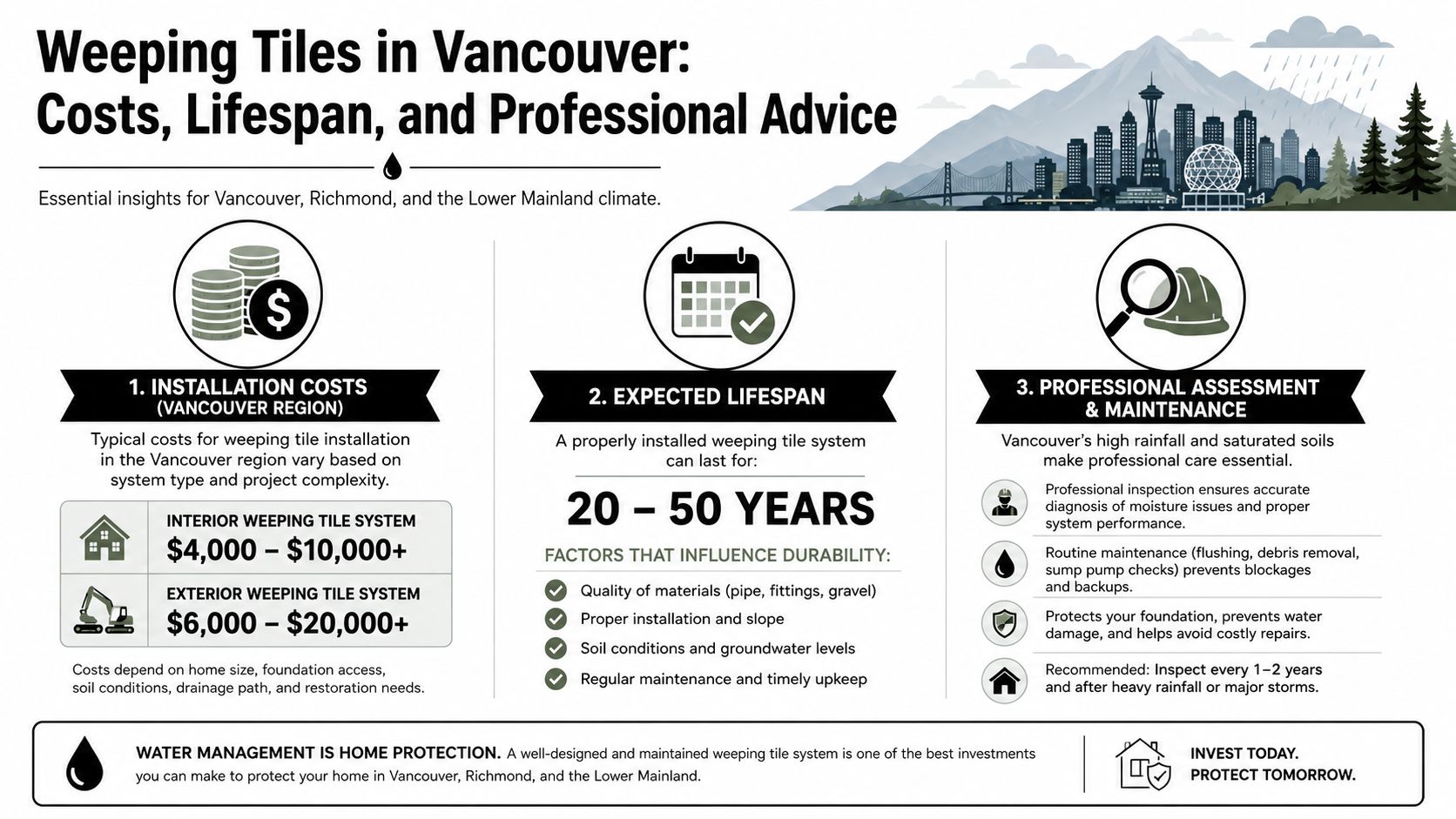
A perimeter drain in Vancouver lives a harder life than the same system in a drier city. Long wet seasons keep the soil around the foundation heavy and saturated, and many older homes still rely on drain materials that were installed decades ago. In clay-like soil, water also moves slowly, so it can sit against the foundation longer after a storm. That gives an aging weeping tile system less room for error.
What Vancouver conditions do to aging drains
Older clay or concrete perimeter drains often lose performance gradually. Homeowners do not always see one dramatic failure. More often, the drain still works a little, but not fast enough for a heavy stretch of Vancouver rain.
A simple way to picture it is a straw buried in wet sand. If the straw is cracked, flattened, or partly packed with silt, water can still enter, but the flow slows down. Around a foundation, that slowdown matters. The soil stays wet longer, pressure builds beside the wall, and small defects in concrete become more likely to seep.
That pattern shows up often in Vancouver, Burnaby, New Westminster, Richmond, and other areas with older housing stock. Houses built many years ago may have original perimeter drains near the end of their useful life, especially if roots, settlement, or fine soil have worked their way into the line.
Cost is the question homeowners usually ask next. The honest answer is that pricing depends on the house and the site. Depth of the footing, access around the home, interior finishes, landscaping, driveway removal, discharge location, and whether you need a spot repair or full replacement all affect the scope. Exterior work usually means more excavation and more disruption outside. Interior work can avoid digging up the yard, but it still involves breaking concrete and restoring the basement afterward.
That is why a proper inspection matters before anyone talks numbers with confidence.
When to stop guessing and bring in a pro
Some checks are practical for a homeowner. You can watch how the basement behaves during and after a storm, note whether one wall always smells damp, and pay attention to how quickly the area dries out once the rain stops.
A professional should get involved when the pattern keeps repeating.
Call a drainage professional when:
- Water shows up during multiple storms, even if it seems minor
- The basement keeps smelling damp after cleaning and dehumidifying
- Your home likely has original clay or concrete perimeter drains
- A sump pump is running often but groundwater still seems to collect
- You need to confirm where the system discharges and whether that connection is correct
Discharge matters more than many homeowners realize. If the drain sends water to the wrong place, or if an older connection no longer matches current standards, the system may struggle even when the pipe itself is still partly open. The climate adaptation example on disconnecting weeping tiles shows how correcting that path can reduce flood risk during major rain events.
For Vancouver-area homes, the practical advice is simple. If basement moisture keeps returning, treat the perimeter drain like any other aging part of the house. It can be inspected, tested, scoped, and assessed against the conditions on your property, especially the local soil, rainfall, and age of the home.