
Modern trenchless sewer repairs are designed to last 50 to 100 years, although the realistic range depends heavily on whether you're comparing CIPP lining or pipe bursting. Liners often sit near the lower end of that range, while pipe bursting can last longer because it installs a new pipe.
You're probably asking because a sewer problem has stopped being an occasional nuisance. Perhaps the drains keep slowing down, roots return after cleaning, or a camera inspection has revealed cracks beneath a lawn, driveway, or patio. The contractor's quote may promise decades of service, but a long service-life estimate isn't the same thing as a guarantee that every part of the job will perform for that long.
The useful question isn't “How long does trenchless sewer repair last?” It's which material was installed, how well was it installed, and what conditions will surround it for decades? Soil movement, root intrusion, the strength of the existing pipe, and the wording of the warranty all matter.
Table of Contents
- Understanding Typical Lifespan Ranges
- Comparing CIPP Lining and Pipe Bursting Longevity
- Factors That Influence How Long Your Repair Lasts
- Reading Between the Lines of Warranties
- Making the Case for Trenchless Over Traditional Repair
- Maintaining Your Trenchless Sewer Line
Understanding Typical Lifespan Ranges
A homeowner with a broken sewer line often hears two confident answers: “the repair will last 50 years” or “it can last 100 years.” Both may describe legitimate expectations, but neither answer means much until you know which trenchless method the contractor is recommending.
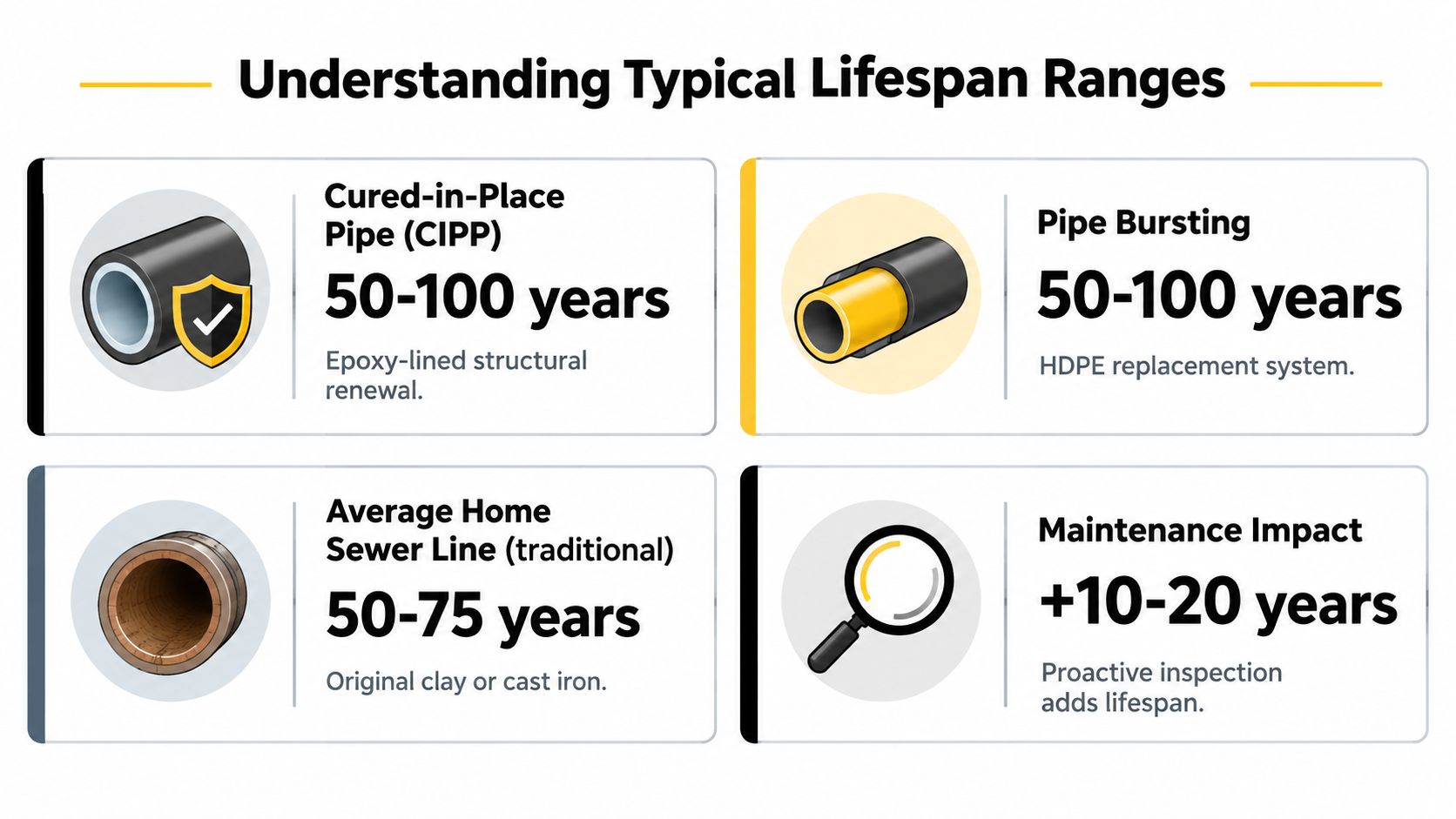
California-focused plumbing guidance commonly places trenchless sewer repair in the 50-to-100-year range. That range includes cured-in-place pipe, or CIPP, lining, and pipe bursting. The same guidance explains that liners often last around 50 years, while pipe bursting may last longer because the process installs a brand-new pipe rather than rehabilitating the old one. See the California overview of trenchless sewer replacement lifespan for that distinction.
What the range means in practice
Suppose a camera shows an older clay line with root intrusion, but the pipe still holds its shape. A contractor may recommend CIPP because the existing pipe can serve as a host for a resin liner. The liner creates a smooth interior and seals vulnerable openings without removing the original route.
A different property may have a severely deteriorated line that no longer provides a dependable host. Pipe bursting could be more appropriate because it breaks apart the old pipe while pulling a new pipe into position. The surface disruption remains limited, but the long-term result is a replacement system rather than an internal lining.
The headline number is therefore a starting point, not a promise. A healthy repair is one where the method matches the pipe's condition, the installation follows the manufacturer's requirements, and the contractor documents the finished work.
Practical rule: Treat “50 to 100 years” as a service-life benchmark. Ask what makes your property more likely to fall near one end of the range.
Traditional sewer lines also have their own expected lifespan, but comparing an original clay or cast-iron pipe with a modern rehabilitation system isn't an apples-to-apples exercise. The existing pipe's age and condition mainly determine whether CIPP is suitable or whether replacement is the safer path.
Comparing CIPP Lining and Pipe Bursting Longevity
CIPP lining and pipe bursting both avoid the long open trench associated with conventional excavation, but they solve different structural problems.
With CIPP, a flexible, resin-coated liner enters the existing sewer pipe. Equipment expands the liner against the host pipe, and the resin cures into a hardened, jointless interior. The finished liner depends on the host pipe for alignment and access during installation, so the original pipe must retain enough structural integrity to support the process.
California rehabilitation guidance places structural liner ratings at 50 to 75 years, while the National Association of Sewer Service Companies guidance on pipe rehabilitation states that a properly designed, installed, and tested CIPP renewed lateral has a minimum life expectancy of 50 years. Together, these figures create a practical benchmark. Modern CIPP systems are designed to last at least five decades and may last substantially longer when the installation and site conditions are favourable.
Pipe bursting works differently. A bursting head fractures or displaces the old pipe while pulling a new pipe, commonly HDPE, through the established route. The new pipe doesn't rely on the old pipe's remaining wall strength in the same way a liner does. That can make bursting the stronger candidate when the host pipe is too deteriorated for lining, provided the route, access, surrounding utilities, and soil conditions allow it.
The decision depends on the host pipe
A liner is often a good fit when the old line is cracked, corroded, leaking, or affected by roots but remains substantially intact. It can preserve the existing alignment and create a smooth passageway with fewer openings for roots to exploit. You can review a practical explanation of sewer lining repair and its installation considerations before comparing contractor proposals.
Pipe bursting deserves closer attention when the old pipe has widespread structural deterioration or repeated failures. Because the process draws in a new pipe, it can remove more of the old system's limitations. It still isn't automatically superior. A bursting project can encounter restrictions from nearby utilities, narrow access, unusual pipe alignment, or ground conditions.
| Question | CIPP lining | Pipe bursting |
|---|---|---|
| What stays in place? | The original pipe remains as the host. | The old pipe is displaced or fractured. |
| Best starting condition | A host pipe that still holds its shape. | A route suitable for pulling in a replacement pipe. |
| Main long-term consideration | Liner design, curing, and host-pipe integrity. | New-pipe quality, installation, and site suitability. |
| Root protection | A smooth, jointless interior can close former entry points. | A new pipe can reduce reliance on damaged original joints. |
A camera inspection should support the recommendation. Without it, the contractor is guessing about the very condition that separates a sound lining project from an unsuitable one.
Factors That Influence How Long Your Repair Lasts
The material is only one part of the lifespan equation. A properly selected liner or replacement pipe can still underperform if the installation team misses defects, ignores soil movement, or fails to address the reason roots entered the line.
Start with the existing pipe. CIPP needs a host that can accept and support the liner. A collapsed, badly misaligned, or severely distorted section may require a different approach. Pipe bursting can replace more of the old line, but it still needs a workable route and sufficient access.
Conditions worth checking before approval
- Host-pipe integrity: Ask whether the camera inspection shows a continuous route, open passage, and enough remaining shape for lining.
- Root intrusion: Roots usually enter through cracks, joints, or separations. Cleaning removes the immediate obstruction, but sealing the entry point is what addresses the pathway.
- Soil movement: Shifting or settling ground can place stress on buried infrastructure. Ask the contractor how the proposed method suits the soil around your property.
- Installation controls: Cleaning, sizing, resin curing, testing, and post-installation inspection affect whether the finished repair matches its design.
- Climate and pipe material: CIPP service-life estimates depend partly on the pipe material and climate. Canadian National Research Council material discussed in this trenchless versus traditional sewer repair explanation notes that CIPP rehabilitation restores structural integrity and extends service life, with CIPP commonly cited as adding about 50 years, including considerations relevant to cold climates such as British Columbia.
The inspection should also identify damage outside the section being repaired. A liner may correct defects within its length, but it can't fix an unrelated sag, displaced connection, or damaged lateral beyond the repair area.
A sewer camera inspection before trenchless repair gives you a record of the pipe's condition before work begins. Request the video, the location of defects, and the contractor's explanation of why CIPP or bursting suits the evidence.
The following video can help you visualise how trenchless work differs from open excavation:
Reading Between the Lines of Warranties
A service-life estimate describes how long the pipe or liner is designed to perform under suitable conditions. A warranty describes what the contractor or manufacturer agrees to cover, under specified terms. Those are separate promises, and homeowners often discover the difference only after a problem appears.
One California-focused source points out that trenchless marketing commonly uses broad claims such as 50+ years or 50 to 100 years, while giving less attention to premature failure and workmanship. Warranty language varies widely. One Bay Area provider advertises a 20-year materials-and-labour guarantee, other California pages promote lifetime or 50-year claims, and industry commentary says workmanship warranties are often only 1 to 5 years, even when material warranties last much longer. These examples are discussed in the California trenchless sewer repair warranty overview.
Compare the promise with the protection
| Term in a quote | What it usually addresses | What you should clarify |
|---|---|---|
| Material warranty | The liner, resin system, or replacement pipe. | Who honours it, and what exclusions apply? |
| Workmanship warranty | Installation-related defects. | How long does coverage last, and what counts as defective work? |
| Service-life rating | Expected performance under design conditions. | Is it a rating, a guarantee, or both? |
| Written warranty | The enforceable terms of the agreement. | Does it cover labour, access, excavation, testing, and restoration? |
The gap matters because a liner may remain sound while a connection, end seal, or installation detail causes trouble. Conversely, a site problem such as movement or a defect outside the lined area may fall outside the contractor's responsibility.
Ask for the warranty before signing, not after the crew leaves. Look for the covered length, materials, labour, exclusions, maintenance obligations, claim process, and whether future owners can use the coverage. If the salesperson says “lifetime,” ask whose lifetime, what components it covers, and whether the promise appears in the contract.
Ask this directly: “If the line fails, who pays for diagnosis, access, labour, and restoration?”
A long material rating can still be valuable, but it shouldn't replace a clear installation agreement. The best quote explains both the expected service life and the practical remedy if the work doesn't perform as specified.
Making the Case for Trenchless Over Traditional Repair
A homeowner with an older clay sewer line, recurring root intrusion, and established landscaping faces two different kinds of disruption. Traditional excavation exposes the pipe directly and may be the sounder choice if the line has collapsed, shifted severely, or follows a route trenchless equipment cannot reach.
Trenchless repair makes sense when the pipe and property meet the method's requirements. CIPP can rehabilitate a structurally intact line beneath lawns, paving, gardens, or patios. Pipe bursting can install a new pipe along a usable route while limiting how much surface the crew must open.
Durability is only one part of value
If the clay pipe still holds its shape, CIPP can preserve the existing route, seal vulnerable entry points, and extend useful service without excavating the entire line. Northern California guidance rates the finished liner at 40 to 50 years under normal conditions. That is more conservative than the 50-to-75-year structural ratings cited earlier, because the host pipe, soil movement, installation quality, and other site conditions affect the result. The comparison of trenchless sewer repair and traditional repair in Northern California explains why the existing pipe's structural integrity matters.
The value of trenchless work comes from matching durable material to a suitable property. Our comparison of trenchless sewer replacement versus digging explains the trade-off in surface disruption. Less excavation can protect landscaping and hardscaping, but it does not replace a proper diagnosis. A no-dig method applied to the wrong pipe can lead to a harder repair later.
Use the inspection report to compare methods rather than accepting a generic sales pitch:
- Pipe condition: Is lining realistic, or does the old line require replacement?
- Route and access: Can equipment follow the existing path safely?
- Surface restoration: What would excavation disturb?
- Long-term responsibility: How will material and workmanship concerns be handled?
- Connections and defects: Does the proposal address laterals, ends, and damage beyond the main section?
The right decision may involve trenchless work, excavation, or both. The least disruptive option is useful only when it also delivers a technically sound repair.
Maintaining Your Trenchless Sewer Line
Your repair needs sensible care after installation. A smooth liner or new replacement pipe can reduce recurring trouble, but household habits, tree growth, and unaddressed defects can still affect the wider sewer system.
A California-facing plumbing source states that properly installed CIPP liners are rated for 50 years or more and that their smooth, jointless interiors remove gaps roots previously exploited. For a property in Richmond or Vancouver with repeated root clogs, that design can reduce recurring intrusion points compared with repeated snaking or isolated spot repairs. The CIPP liner guidance on root intrusion provides that practical context.
Keep the system observable
Watch changes in drainage. A new pattern of slow drains, gurgling, odours, or backups deserves attention. Several fixtures behaving poorly at once can indicate a main-line issue rather than an isolated sink clog.
Manage roots around the route. Know where the sewer line runs before planting or removing major vegetation. If roots caused the original failure, ask a qualified professional about a safe long-term plan rather than relying on repeated emergency clearing.
Be careful with chemical products. Harsh drain chemicals can damage plumbing components and don't correct a structural defect. Use only products and treatments recommended for your system, and ask before applying anything marketed as a root solution.
Keep records for the next inspection
Save the pre-repair and post-repair camera footage, the invoice, the product information, and the written warranty. Those records help a future plumber distinguish a problem in the repaired section from a defect elsewhere.
Don't flush items that don't break down readily, and keep grease and heavy debris out of the drainage system. If a technician recommends cleaning or inspection, follow the advice in writing so maintenance doesn't accidentally conflict with warranty terms.
The goal isn't to make the pipe last forever. It's to protect the installation, catch changes early, and give the repaired system the conditions it needs to approach its intended service life.
Encano Plumbing & Drainage Ltd. provides camera-based sewer inspections, trenchless sewer line repair, and replacement planning for homeowners and property managers in Vancouver, Richmond, and nearby communities. Visit Encano Plumbing & Drainage Ltd. to arrange an assessment and get a repair recommendation based on your pipe condition, site access, and long-term maintenance needs.