
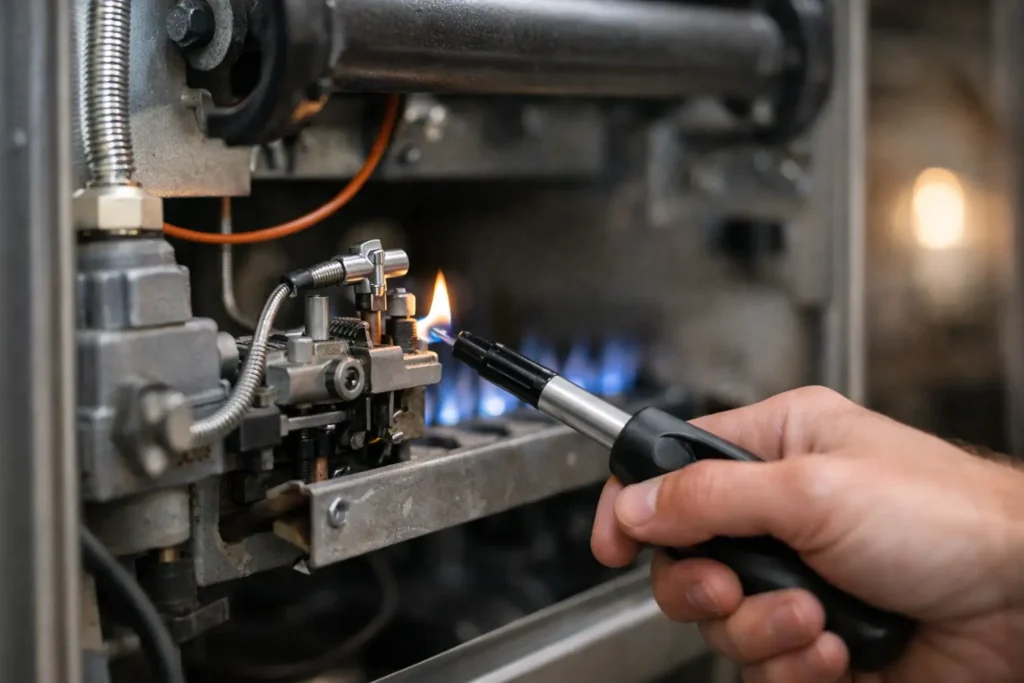
A furnace that will not start on a cold morning can quickly make a home or building uncomfortable. If your unit has a standing pilot light, knowing how to relight gas furnace pilot equipment safely may restore your heat in a few minutes. But gas appliances are not a place to guess. The right process depends on your furnace model, and a gas smell, repeated failure, or signs of damage mean it is time to stop and call a qualified heating technician.
Before touching the controls, confirm that your furnace actually uses a pilot light. Many furnaces installed in the last few decades use electronic ignition instead. They do not have a pilot to relight manually, and repeatedly resetting them can hide a problem that needs service.
First, Confirm You Have a Standing Pilot Furnace
Look through the furnace access panel or check the manufacturer label and owner’s manual. A standing-pilot furnace usually has a small, continuously burning blue flame near the burner assembly. Its gas control valve commonly has settings marked OFF, PILOT, and ON.
An electronic-ignition furnace may have a hot-surface igniter or a spark ignition system. It often has no visible pilot flame and no PILOT setting on the gas valve. If that is what you have, do not try to light the burners with a match or lighter. Turn the thermostat up, check that the furnace switch and breaker are on, and arrange service if it will not ignite.
Older standing-pilot furnaces are still found in some homes, rental properties, and commercial spaces around Vancouver and nearby communities. They can be dependable, but age makes regular inspection especially worthwhile. A pilot that goes out once after a gas interruption may be simple to relight. One that repeatedly goes out is sending a signal that should not be ignored.
Safety Checks Before You Relight a Gas Furnace Pilot
Start by setting the thermostat to its lowest setting or turning it off. This prevents the furnace from calling for heat while you are working near the burner compartment. Make sure the area around the furnace is clear of paint, gasoline, cardboard, cleaning products, and stored items.
Then pause and check for the smell of gas. Natural gas is treated with an odorant that many people describe as rotten eggs or sulfur. If you smell gas, hear a hissing sound, or suspect a leak, do not light the pilot.
Leave the building immediately. Do not operate light switches, use a phone inside, start a vehicle nearby, or create any spark or flame. Once you are safely away from the property, contact the gas utility’s emergency line or emergency services as appropriate. A licensed gas technician should inspect the system before it is used again.
If there is no gas odor and the furnace appears intact, follow the lighting directions printed on the furnace itself or in its manual. Those instructions take priority because the exact button, dial, and ignition method varies by manufacturer.
How to Relight Gas Furnace Pilot Step by Step
The general procedure for many standing-pilot furnaces is straightforward, but work slowly and do not force any control.
1. Locate the gas control and pilot assembly
Remove the furnace access panel if necessary. Find the gas control valve near the burners. You may see a knob or dial labeled OFF, PILOT, and ON, along with a red or black push button for a piezo igniter. The pilot assembly is a small metal tube near the burners, often with a thermocouple positioned beside it.
Use a flashlight if you need better visibility. Do not use an open flame to look inside the furnace.
2. Turn the gas control to OFF
Turn the control knob to OFF. Some knobs need to be pushed in slightly before they will turn. Once it is off, wait at least five minutes. This waiting period gives any unburned gas time to dissipate.
If you smell gas while waiting or when you open the compartment, stop immediately and follow the gas-leak safety steps above.
3. Turn the knob to PILOT and hold it down
After the five-minute wait, turn the knob to PILOT. Press and hold the knob down. Holding it opens a small amount of gas flow to the pilot burner.
Keep holding the control throughout the next step. Releasing it too soon is one of the most common reasons a newly lit pilot goes out.
4. Ignite the pilot flame
If your furnace has a built-in igniter button, press it while continuing to hold the pilot control down. You may hear a clicking sound. Watch the pilot assembly for a small, steady blue flame.
Some older furnaces require a long fireplace match or long-neck lighter, but only use one if the manufacturer’s instructions specifically say to do so. Never improvise with a standard match, paper, or lighter held close to the burners. If the furnace has no clear lighting instructions, call a professional instead of taking chances.
5. Keep holding the control for 30 to 60 seconds
Once the pilot is lit, continue holding the knob for about 30 to 60 seconds. This warms the thermocouple, a safety sensor that confirms a flame is present. When the thermocouple is warm enough, it allows the pilot gas valve to remain open.
Release the knob slowly. The flame should stay on. If it goes out, repeat the full process once, including turning the gas back to OFF and waiting five minutes. Do not keep trying over and over. Two unsuccessful attempts are enough reason to schedule a service call.
6. Turn the control to ON and test the furnace
When the pilot remains lit, turn the gas control from PILOT to ON. Reinstall the access panel, then set the thermostat several degrees above the room temperature. The main burners should light after the normal startup sequence, and warm air should begin moving through the vents shortly afterward.
Watch and listen from a safe distance. A normal burner flame is mostly blue and steady. Yellow flames, popping sounds, soot, delayed ignition, or a burner that cycles on and off are not normal. Turn the furnace off and have it inspected.
Why the Pilot Light Keeps Going Out
Relighting the pilot fixes the immediate problem, but it does not always fix the cause. A pilot may go out because of a brief gas supply interruption or a strong draft near an older furnace. More often, the issue is a dirty pilot opening, a weak thermocouple, a failing gas valve, poor combustion air, or a venting problem.
A dirty pilot flame may look weak, yellow, or unstable instead of crisp and blue. In that situation, the thermocouple may not receive enough heat to keep the gas valve open. Cleaning and adjustment should be handled by a qualified technician because burner components, gas pressure, and combustion safety all matter.
For landlords and property managers, repeated pilot outages are worth addressing promptly. A temporary relight can become a no-heat call after hours, and an aging furnace can create comfort, reliability, and safety concerns for occupants. Preventive maintenance is generally less disruptive than waiting for a complete heating failure.
When You Should Call for Furnace Service
Do not continue troubleshooting if you smell gas, see soot, notice corrosion around the venting, or cannot keep the pilot lit after a careful attempt. You should also call for service if the pilot is yellow, the burners do not ignite after the pilot lights, carbon monoxide alarms activate, or anyone in the building experiences headache, dizziness, nausea, or unusual fatigue.
Carbon monoxide has no smell or color. Every home with gas-burning appliances should have working carbon monoxide alarms, ideally near sleeping areas and according to local requirements. If an alarm sounds, get everyone outside and contact emergency help from a safe location.
A licensed heating and gas professional can test the thermocouple, inspect the pilot assembly, verify gas pressure, check venting, and confirm that the furnace is operating safely. Encano Plumbing & Drainage Ltd. provides practical heating and gas support for property owners who need a clear answer and reliable repair, not guesswork.
If your pilot relights and stays steady, keep the furnace area clean, replace the air filter on schedule, and arrange routine service before the next cold spell. A small flame may look simple, but it is part of a system that deserves careful attention.