

A hidden leak usually doesn't announce itself with a burst pipe. In Vancouver, it often starts with something smaller and more unsettling. A soft drip you hear at night. A patch of flooring that feels a bit warmer or softer. A ceiling stain in a condo where nobody is sure whether the water is coming from your unit, the one above, or a pipe in the common wall.
That uncertainty is what makes leaks stressful. People worry they'll need to open every wall, pull up flooring, or start expensive repairs before they even know what's wrong. In practice, professional leak detection services are meant to do the opposite. They narrow the problem down, reduce guesswork, and help you make a repair decision based on evidence instead of panic.
That matters more now than it used to. The leak detection market was valued at about USD 4.58 billion in 2023 and is projected to reach USD 7.26 billion by 2032, according to market data on leak detection growth. For homeowners and strata councils in BC, that growth reflects something practical. More properties now rely on advanced diagnostics to limit damage and downtime in dense housing and commercial buildings.
Table of Contents
- That Unsettling Feeling A Hidden Leak in Your Vancouver Home
- Telltale Signs You Need Leak Detection Services
- How Professionals Find Leaks The Diagnostic Toolkit
- The Leak Detection Process What to Expect During a Service Call
- Understanding Leak Detection Costs in Greater Vancouver
- From Detection to Repair Common Fixes and Next Steps
- Choosing Your Vancouver Leak Detection Expert
That Unsettling Feeling A Hidden Leak in Your Vancouver Home
A hidden leak is hard on people because it creates two problems at once. You may have water where it shouldn't be, and you may have no clear idea where it started. In an older Vancouver house, that might mean water travelling along framing and showing up far from the failed pipe. In a Burnaby condo, it might mean one unit sees ceiling damage while the actual issue sits behind a bathroom wall in the suite above.
Why hidden leaks feel worse than obvious plumbing problems
When a kitchen tap is leaking, the fix is usually visible. Hidden leaks don't give you that advantage. They leave clues instead of answers.
Common ones include:
- A stain that grows slowly: A pale ring on drywall or a ceiling tile often points to a steady moisture source rather than a one-time spill.
- A musty smell that returns: If the room smells damp even after cleaning and drying, water may still be getting into the wall, floor, or cabinet cavity.
- A sound with no obvious source: Dripping, hissing, or a faint rushing noise when fixtures are off can mean pressurised water is escaping somewhere out of sight.
Practical rule: The smaller the visible symptom, the more important it is to locate the source properly. Minor staining can come from a leak that has been active for a long time.
A common Vancouver example
A typical call starts with something that seems minor. A homeowner in East Vancouver notices the laminate floor near the dishwasher edge is beginning to curl. They wipe it up, run a shorter cycle next time, and hope it was a one-off. A week later, the floor still feels slightly soft underfoot.
That's where leak detection services earn their keep. Instead of removing cabinets and flooring based on guesswork, a technician starts by isolating likely causes. Is it the dishwasher supply line, the drain connection, the shutoff, or moisture wicking from another area entirely? In a rainy region like Greater Vancouver, people also need to separate plumbing leaks from building-envelope moisture. Those are very different problems, and confusing one for the other wastes time and money.
The goal is simple. Find the source with as little disruption as possible, then repair only what needs repair.
Telltale Signs You Need Leak Detection Services
Some leaks are dramatic. Most aren't. The ones that cause the most frustration are the slow leaks that hide in walls, under floors, or behind fixtures until the signs start stacking up.
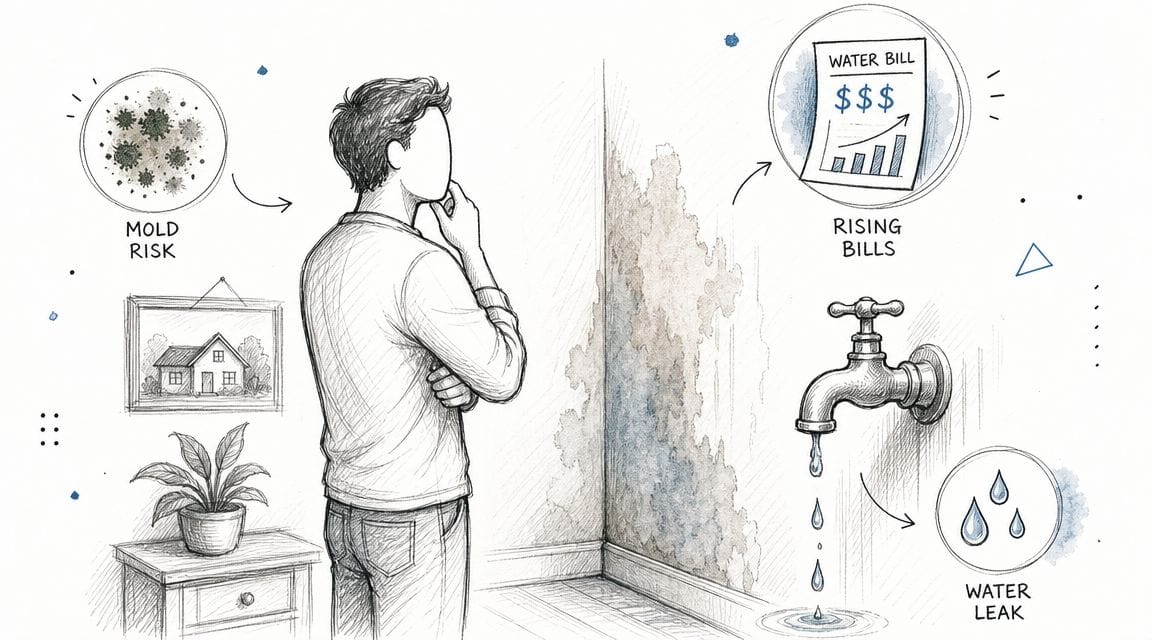
If you're trying to sort normal household wear from a plumbing issue, it helps to group the clues into what you can see, hear, and measure. If you want a homeowner-friendly checklist, this guide on how to spot hidden plumbing leaks in your home is a useful companion.
What you can see
Visual signs are often subtle first.
- Peeling paint or bubbling drywall: In a Vancouver basement suite or a Surrey townhouse laundry room, paint that lifts near the baseboard often means moisture is rising from inside the wall.
- One stained area, not a whole surface: A single discoloured ceiling tile in a Burnaby high-rise usually points to a specific path of water travel, not general humidity.
- Warped trim or flooring: If only one plank area near a fridge, dishwasher, or bathroom vanity starts swelling, suspect a localised leak before blaming age.
A practical example. If the cabinet under a bathroom sink looks dry at first glance but the toe-kick is swollen, the leak may be small and intermittent. It could happen only when the sink drains, not when the tap runs.
What you can hear
Sound matters more than most homeowners realise.
You may hear:
- A faint drip inside the wall: This is common behind shower valves, toilet supplies, or washing machine boxes.
- A hiss when no fixture is on: In a pressurised system, that can be water escaping through a pinhole or loose joint.
- Pipe noise that doesn't match use: If you hear movement or humming long after everyone has finished using water, something may still be flowing.
If the house is quiet late at night and you still hear water, trust that clue. Plumbing systems are noisy for a reason.
What you can measure
Simple homeowner checks can help before a service call.
Try these:
- Check the water meter: Turn off taps, appliances, and irrigation, then watch the meter. If it continues moving, water is likely going somewhere.
- Compare your bill to your normal pattern: A sudden unexplained jump matters most when your household habits haven't changed.
- Notice fixture behaviour: Toilets that refill on their own or pressure that changes without explanation can point to ongoing loss.
A Richmond homeowner might notice no visible leak at all, but the meter keeps creeping when the home is quiet. That's often the moment to stop guessing and book proper detection.
How Professionals Find Leaks The Diagnostic Toolkit
Modern leak detection services are part listening job, part inspection job, and part elimination process. A good technician doesn't start by opening walls. They start by asking what kind of leak is most likely, then choosing the least destructive tool that can prove it.
This visual overview helps show how the main methods differ.
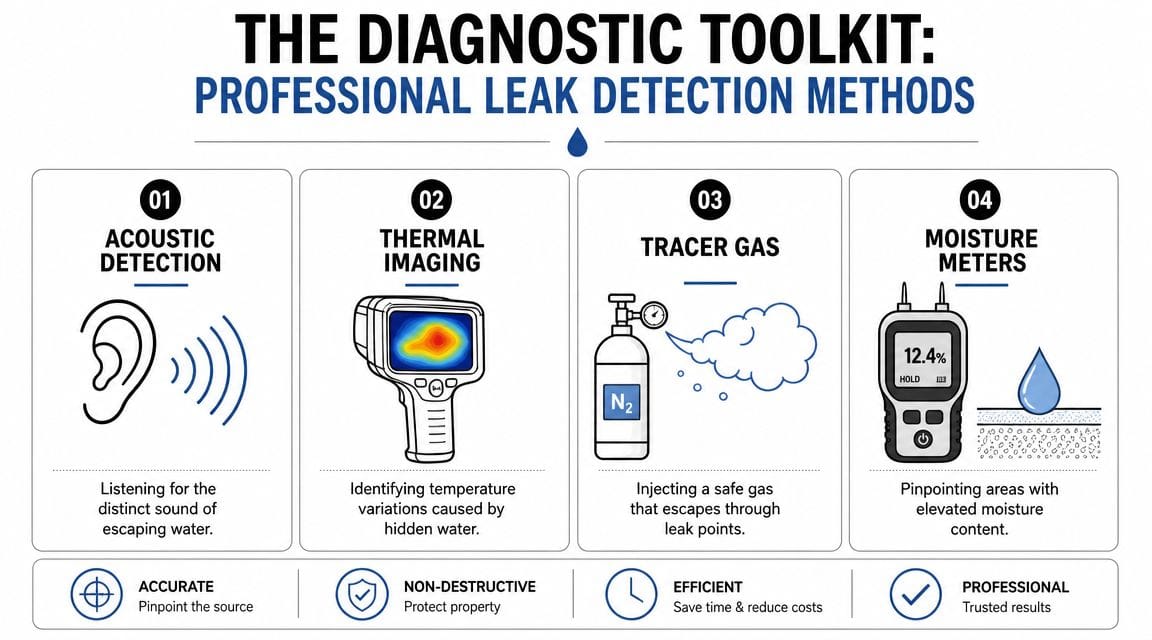
Acoustic tools listen before anyone cuts
Acoustic detection is the pipe system's version of a stethoscope. Escaping pressurised water makes a distinct sound, and trained techs use listening devices and correlators to narrow down where that sound is strongest.
This isn't guesswork. Professional acoustic correlators can estimate a leak's position by measuring the time delay of the leak sound between two sensors, and advanced in-pipe acoustic devices can identify leaks as small as 0.1 L/min on main water lines, according to technical guidance on acoustic leak detection.
That matters in real homes because a small leak behind a wall may not leave obvious damage right away. The sound can reveal it before demolition does.
For a closer look at the tools behind this work, see the advanced technology behind modern leak detection.
Thermal cameras moisture meters and drain cameras
Thermal imaging works like a weather map for walls and floors. It doesn't see water directly. It sees temperature differences that may indicate moisture, cooling, or unusual flow patterns. In practical terms, it helps a technician decide where to look harder and where not to cut.
Moisture meters then confirm whether a material is wet. That's important because a cold patch alone can be misleading near exterior walls, tile, or concrete.
Drain cameras solve a different problem. They act like a scout in a pipe. If the issue involves a sewer, drain, or suspect branch line, a camera can find cracks, offsets, root intrusion, or a break without excavating first.
A practical example. In a downtown condo, a bathroom ceiling stain may look like a supply leak, but a camera inspection can show the problem is from a drain connection above that leaks only when the shower is used.
Here's a short video that shows the kind of non-invasive approach homeowners are often looking for before any repair starts.
Tracer gas when water won't reveal itself
Tracer gas is useful when a line can be isolated but the water leak itself is hard to pinpoint. A harmless gas is introduced into the pipe. It escapes through the failure point, and the detector reads its presence above the surface.
This method can help with buried or concealed lines where sound is hard to interpret because of slab, fill, or background noise.
The best leak detection tool isn't the fanciest one. It's the one that answers the right question without causing unnecessary damage.
Leak Detection Methods at a Glance
| Method | How It Works | Best For Finding |
|---|---|---|
| Acoustic detection | Listens for the sound of escaping pressurised water and compares signal strength | Hidden supply leaks in walls, floors, and service lines |
| Thermal imaging | Reads temperature differences that may indicate moisture or active flow | Wet wall cavities, floor heating concerns, moisture patterns |
| Moisture meter | Measures moisture content in materials | Confirming wet drywall, trim, flooring, and sub-surfaces |
| Video camera inspection | Sends a camera through drain or sewer lines | Drain leaks, breaks, blockages, and damaged sewer sections |
| Tracer gas | Introduces gas into an isolated line and detects where it escapes | Hard-to-find leaks in buried or concealed piping |
The Leak Detection Process What to Expect During a Service Call
Customers are less worried about the technology than the uncertainty. They want to know what will happen when the technician arrives, how intrusive it'll be, and whether they'll get a clear answer or just a vague suspicion.
The process is usually more methodical than people expect.
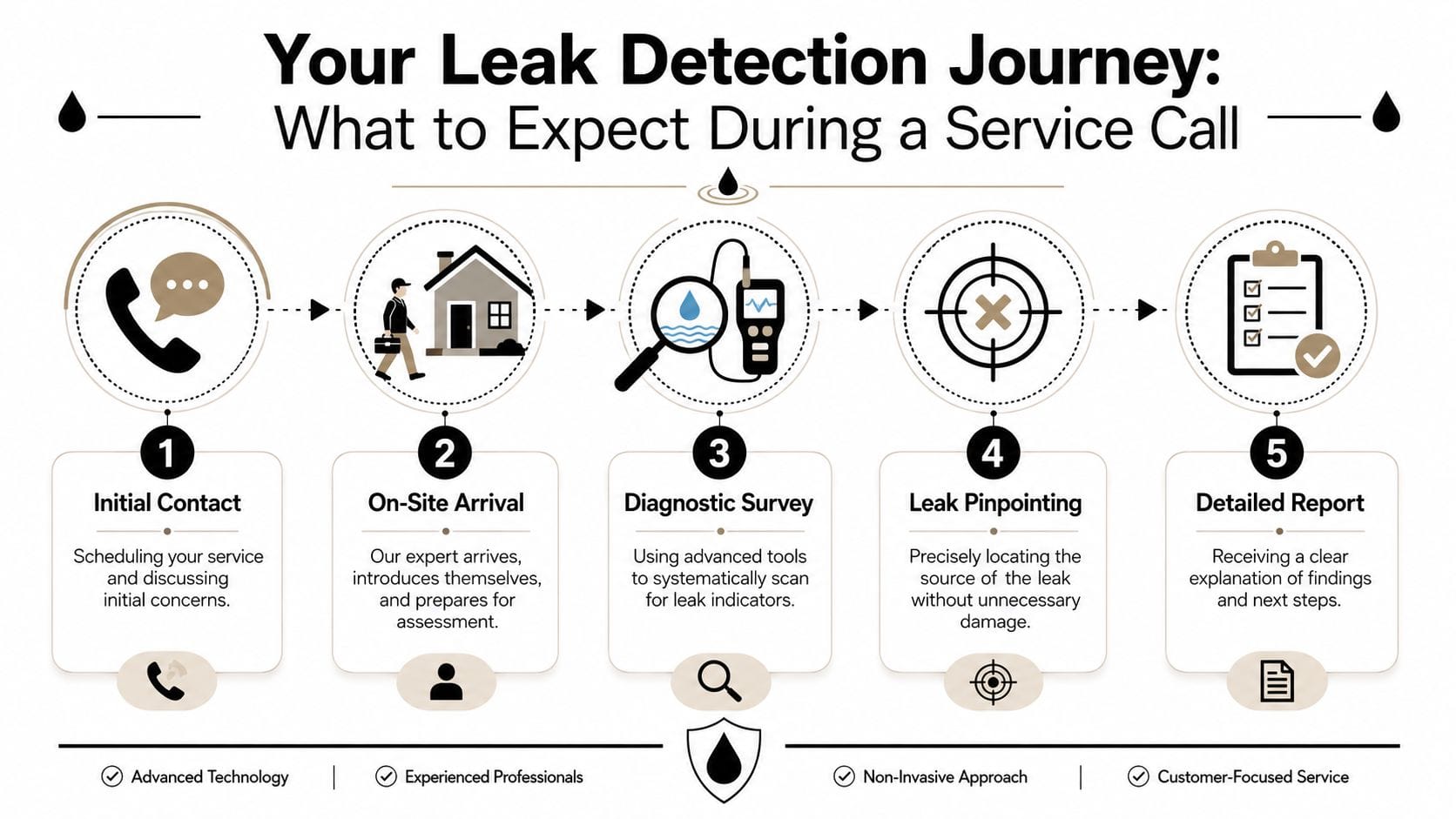
From the first call to the first inspection
A proper service call starts before anyone steps through the door. The office or dispatcher should ask where the sign of leaking appears, when it happens, whether it affects hot or cold water use, and whether the building is a house, condo, or commercial unit.
When the technician arrives, the first stage is usually visual. They're looking for patterns, not just damage. Where is the staining? Which fixtures are nearby? Does the problem appear only when a fixture drains, only under pressure, or all the time?
In a multi-level condo in downtown Vancouver, for example, the technician may need to identify whether the source is in the affected unit, the one above, or a shared line path. That can change the whole approach.
How a technician narrows it down
Good leak detection is systematic. The technician may isolate fixtures, test pressure behaviour, use acoustic equipment in specific areas, and confirm moisture rather than relying on one clue.
A typical sequence looks like this:
- Interview and symptom review: What you noticed, when it started, and what has changed.
- Visual and moisture assessment: Walls, ceilings, cabinets, flooring, fixture areas.
- Targeted testing: Running or isolating certain fixtures to reproduce the problem.
- Tool deployment: Acoustic, thermal, camera, or other methods depending on the likely source.
- Pinpoint and explain: Marking the likely location and outlining repair options.
One practical example. In a condo with water staining in a hallway ceiling, the technician may first rule out roof or exterior moisture, then test the bathroom group above, then use moisture readings and acoustic checks to narrow the issue to a toilet seal or tub waste line instead of opening the entire ceiling.
The final step matters as much as the search itself. You should come away knowing where the leak is most likely located, what level of access is needed, and whether the next move is plumbing repair, building-envelope review, or additional drain investigation. A company such as Encano Plumbing & Drainage Ltd. can handle both the diagnostic stage and the repair stage, which often helps avoid handoff confusion when the location has already been confirmed.
Understanding Leak Detection Costs in Greater Vancouver
Leak detection is a diagnostic service. It isn't the same thing as the repair itself, and treating it as “just part of plumbing” is where many homeowners get frustrated. You're paying for time, judgment, specialised tools, and a process designed to avoid unnecessary opening and guesswork.
What you are paying for
The value is precision.
If someone cuts into a wall in the wrong place, you still have the leak and now you also have patching, drying, and restoration to deal with. If someone pinpoints the issue first, the repair scope is usually smaller, faster, and easier to manage.
That's why leak detection often makes financial sense even before repair starts. In California, the Department of Water Resources funded free leak-detection surveys for small water systems, as described in California's leak-detection survey programme. The practical takeaway isn't about homeowners getting free service in BC. It's that the cost of finding leaks early is widely treated as worthwhile compared with the cost of ongoing water loss and damage.
Paying for detection first often means paying for less demolition later.
What usually changes the price
There isn't one flat answer because the work can vary a lot from one property to another.
The main factors are usually:
- Accessibility: A leak in an unfinished basement ceiling is easier to assess than one under tile, slab, or built-in millwork.
- Building type: A detached house is different from a tower with multiple affected units, strata access rules, and shared piping paths.
- Type of suspected leak: Pressurised water line leaks, drain leaks, sewer issues, and irrigation leaks don't all require the same method.
- Time required to isolate the problem: Some leaks show themselves quickly. Others need fixture-by-fixture testing.
- Technology needed for confidence: A visual review alone may not be enough. Acoustic, camera, moisture, or tracer methods add clarity.
If you're also budgeting for the next step, this page on what plumbing repair cost can involve can help frame the difference between diagnosis and the actual fix.
The practical way to look at cost is this. Detection should either reduce repair scope, reduce restoration scope, or give you enough confidence to avoid doing the wrong work first. If it does one of those, it's earning its keep.
From Detection to Repair Common Fixes and Next Steps
Once the leak is located, the whole job changes. You're no longer paying people to search. You're paying them to solve a confirmed problem.
Targeted repairs are the real payoff
A precise location usually means less disruption. If the leak is tracked to one valve body behind a shower wall, access may be limited to one controlled opening on the best side for repair. If the issue is traced to a small section of copper under flooring, the repair may involve lifting a limited area rather than disturbing the whole room.
That's the practical win. Detection turns a vague problem into a specific repair plan.
Typical fixes after the leak is confirmed
Common next steps include:
- Replacing a failed section of pipe: Often needed where corrosion, pinholes, or a damaged joint caused the leak.
- Repairing a fixture connection: Toilet seals, supply lines, shutoffs, trap assemblies, and appliance connections are frequent culprits.
- Fixing a drain or waste fitting: These leaks may appear only when water is actively draining.
- Opening and restoring one targeted area: Sometimes a small drywall cut is the right answer once the location is known.
A good example is a slab-adjacent or floor-level leak that seems widespread at first. Once the source is pinpointed, the repair may only require a small access point and a local pipe repair, not broad demolition.
If one team handles both detection and repair, the handoff tends to be cleaner. The person quoting the fix already understands where the leak is, what access is needed, and what was ruled out.
Choosing Your Vancouver Leak Detection Expert
Hiring for leak detection isn't only about finding a plumber. It's about finding someone who can diagnose carefully under uncertainty, especially in a region with older homes, renovated suites, concrete towers, laneway houses, and mixed plumbing materials across one property portfolio.

What to check before you book
Use a simple checklist:
- Licensing and insurance: Make sure the company is properly set up to work in occupied residential or commercial spaces.
- Real diagnostic tools: Ask whether they use acoustic equipment, moisture meters, thermal tools, and drain cameras where appropriate.
- Experience with your building type: A technician who understands Vancouver condos, older character homes, and strata processes will usually work more efficiently.
- Clear explanation of findings: You should get a practical explanation, not just “we think it's somewhere in this area.”
- Availability for urgent situations: Hidden leaks don't always wait for business hours.
Why strata and commercial properties need a different mindset
For multi-unit buildings, one leak can affect several occupants at once. That's why many property managers are looking beyond emergency response alone. Broader service descriptions in the industry now include smart water monitoring, reflecting a shift from reactive repair to ongoing prevention, especially for strata councils and commercial buildings where one hidden leak can affect many residents or businesses, as noted in this overview of smart water monitoring in leak detection services.
That doesn't mean every property needs permanent monitoring. It does mean strata councils should ask a bigger question after an incident. Was this a one-time failure, or is the building telling us it needs earlier warning next time?
If you're dealing with a suspicious stain, a meter that won't settle, or a leak affecting multiple units, Encano Plumbing & Drainage Ltd. handles leak detection and repair across Vancouver, Richmond, Burnaby, Surrey, New Westminster, Delta, and nearby communities. The useful first step is simple. Describe what you're seeing, when it happens, and what part of the property is affected. From there, the right diagnostic path becomes much clearer.