You turn on the shower, wait for the water to warm, and expect the familiar routine: the tank has already heated a reserve, so hot water is ready to travel through the pipes. A tankless system changes that sequence. It doesn't keep a large supply hot all day. Instead, it wakes up when water starts moving, heats that water as it passes through, and shuts down when the tap closes.
That difference explains both the appeal and the possible surprises. A properly sized unit can provide continuous hot water during normal demand, use less space, and avoid the energy required to maintain a hot tank. But small flow rates, simultaneous showers, gas supply, venting, electrical requirements, and water quality all affect performance.
If you're comparing systems for a Vancouver, Richmond, Burnaby, or Greater Vancouver home, understanding the sequence matters more than memorising product features. This guide follows the water from your tap to the heat exchanger, explains how sensors and controls regulate temperature, then connects that operation to sizing, efficiency, maintenance, and the realities of rebates in British Columbia. You can also review the practical benefits of a tankless water heater before deciding whether the technology fits your property.
Table of Contents
- Introduction to On Demand Hot Water at Home
- How a Tankless Water Heater Works Step by Step
- Inside the System Key Components That Make It Work
- Sizing Your Tankless System for Real Household Demand
- Energy Efficiency and What It Means for Your Bills
- Installation Maintenance and Everyday Use Tips
- Is Tankless Right for Your Home Final Takeaways
Introduction to On Demand Hot Water at Home
A traditional tank behaves like a thermos with a heater attached. It stores hot water, and the burner or element periodically reheats it so the supply remains ready. That convenience comes with a cost, because the system must keep the stored water warm even while everyone is asleep, away, or finished showering.
A tankless unit works more like a responsive kettle installed in the water line. It doesn't boil a batch and wait. It senses a demand signal, applies heat to the moving water, and sends the result to the fixture. Instantaneous water heaters, also called tankless or on-demand units in California, can use natural gas, electricity, or propane, and they don't store heated water in a tank, as described in this technical overview of tankless operation.
What changes during a morning shower
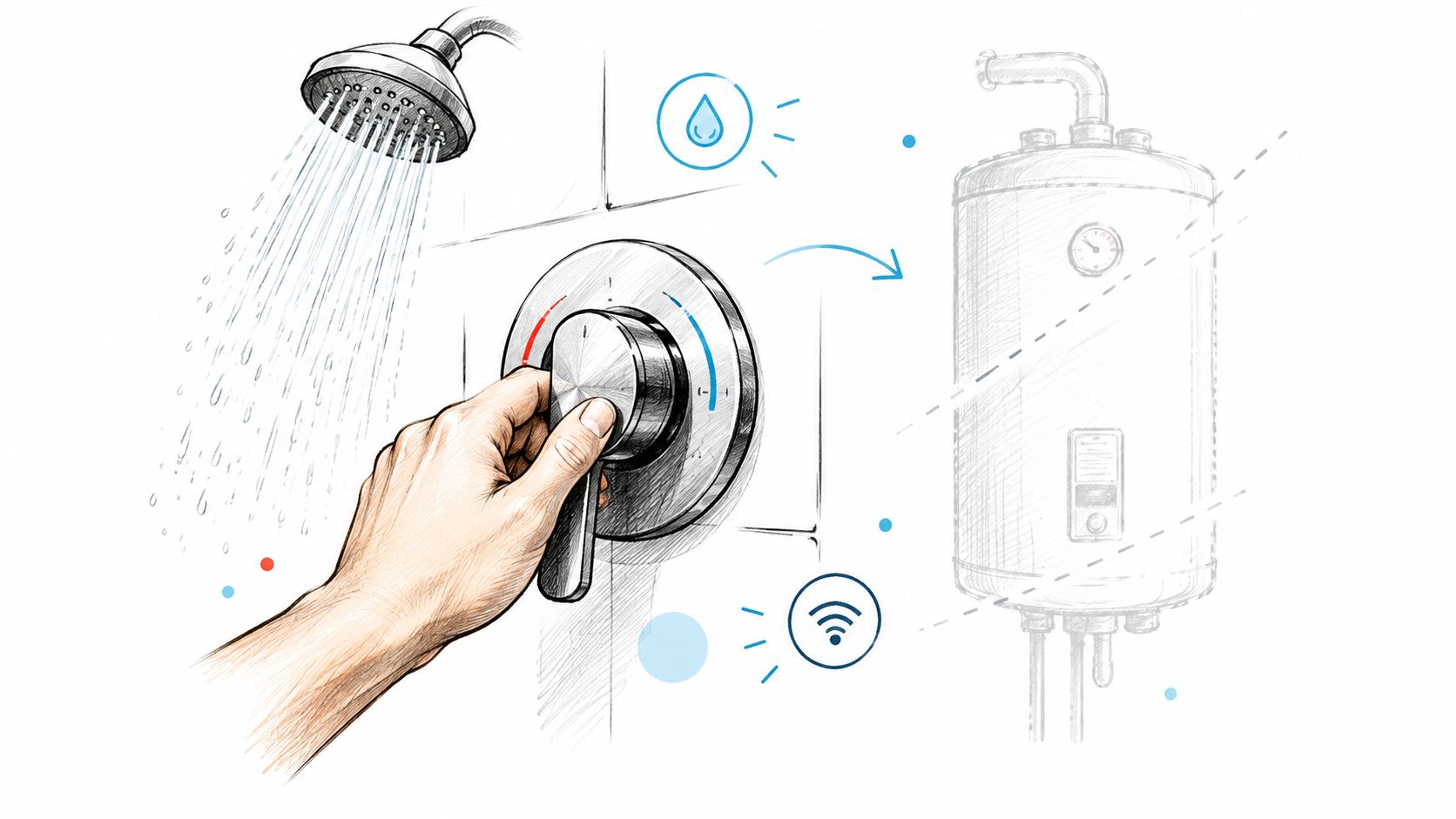
Suppose a homeowner opens the shower handle at 7 a.m. Cold water enters the heater. A flow sensor detects movement, the controls activate the burner or electric elements, and water passes through a heat exchanger where it absorbs energy. The unit keeps adjusting its output while the shower runs, rather than drawing from a tank that can eventually become depleted.
That doesn't mean hot water appears at the showerhead instantly. Water already sitting in the pipe between the heater and the shower still has to leave first. The tankless unit begins heating when flow starts, but delivery time also depends on the plumbing distance and the fixture itself.
Practical rule: “On demand” describes when heating begins. It doesn't guarantee zero waiting time at the tap.
The most important question behind “tankless water heater how does it work” is therefore simple: what causes the heater to fire, and how does it know how much heat to provide? The answer involves a chain of flow detection, electronic control, heat transfer, temperature sensing, and output modulation. Once that chain makes sense, sizing and efficiency become much easier to judge.
How a Tankless Water Heater Works Step by Step
The complete cycle starts with an action you control, opening a hot-water tap. That creates a sequence of cause and effect rather than a stored-water release.
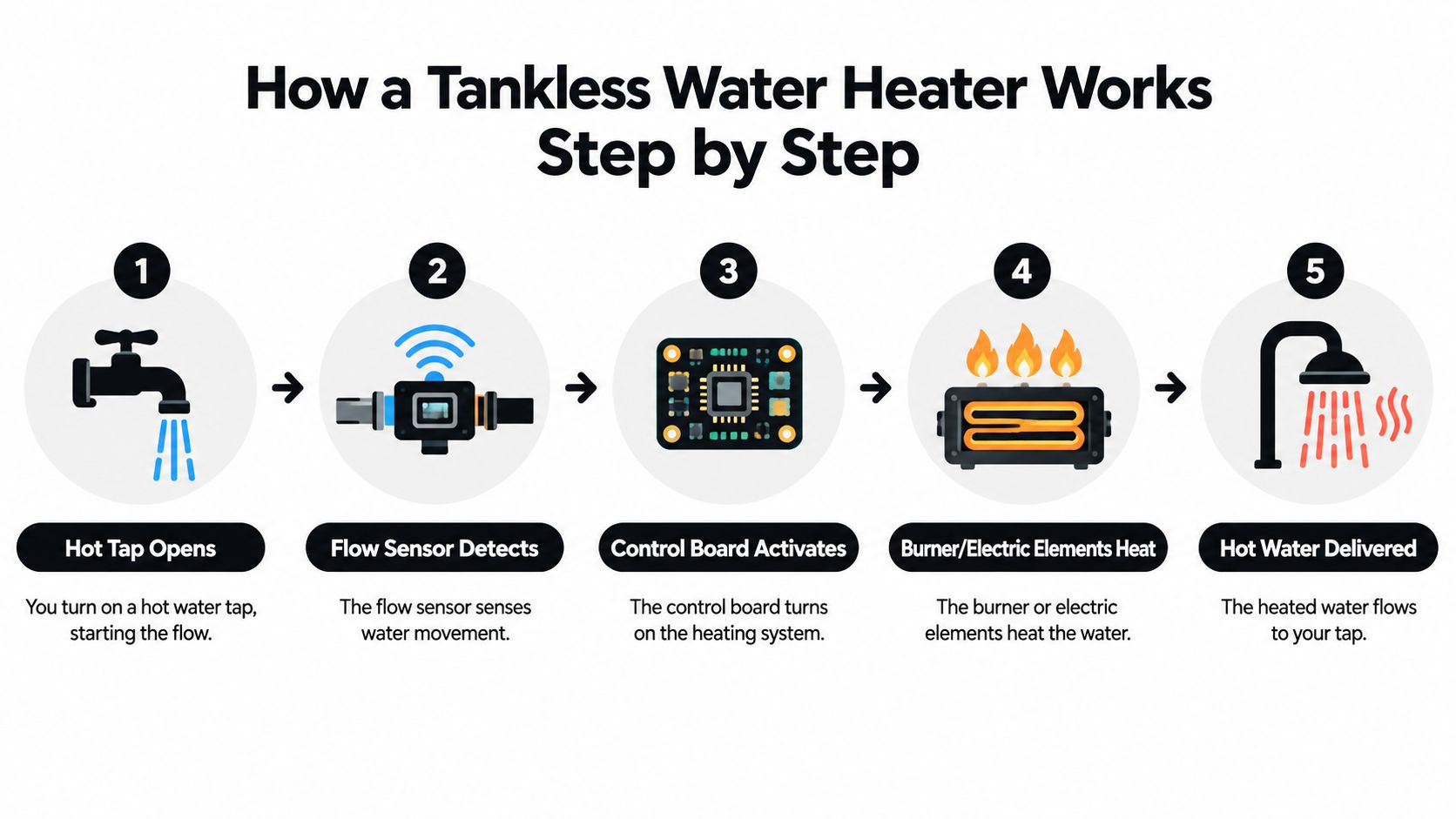
1. A fixture opens
When you open a shower, sink, or other hot-water fixture, pressure pushes cold water into the tankless unit. The heater doesn't need to search for stored hot water because there isn't a reserve tank supplying the fixture.
2. The flow sensor detects movement
Water movement turns on the system's demand signal. The sensor measures enough flow to tell the controls that a fixture is asking for heated water. Very small draws can fall below the activation threshold, which is why a barely open tap may behave differently from a shower.
3. The control board starts the heating sequence
The control board receives the flow signal and checks the operating conditions. On a gas model, it manages ignition and burner operation. On an electric model, it directs power to the heating elements. Safety sensors also monitor the process so the unit can stop if conditions move outside its operating range.
4. Heat transfers into the moving water
The water travels through passages in a heat exchanger. A gas burner heats the exchanger from outside the water passages, while electric elements transfer heat directly through the heater assembly. The unit raises the water temperature while it flows, instead of maintaining a hot volume between uses.
5. The heater sends hot water to the fixture
The heated water leaves the unit and travels through the hot-water line. The control system continues watching flow and temperature, adjusting the heat input as demand changes. When you close the tap, flow stops, the controls shut down the heating process, and the unit waits for the next request.
A California Energy Commission guide describes the same operating principle: a flow sensor triggers on-demand heating, eliminating the standby loss associated with keeping 40 to 50 gallons hot in a storage tank. That California water-heating guidance also illustrates why a household that showers in the morning and leaves the home afterward doesn't need to pay for a tank to remain hot during the empty hours.
Watch the sequence here:
The central idea is continuous flow. The heater applies energy only as water passes through it, but its ability to maintain the selected temperature depends on flow rate, incoming water temperature, and the total demand created by fixtures running at the same time.
Inside the System Key Components That Make It Work
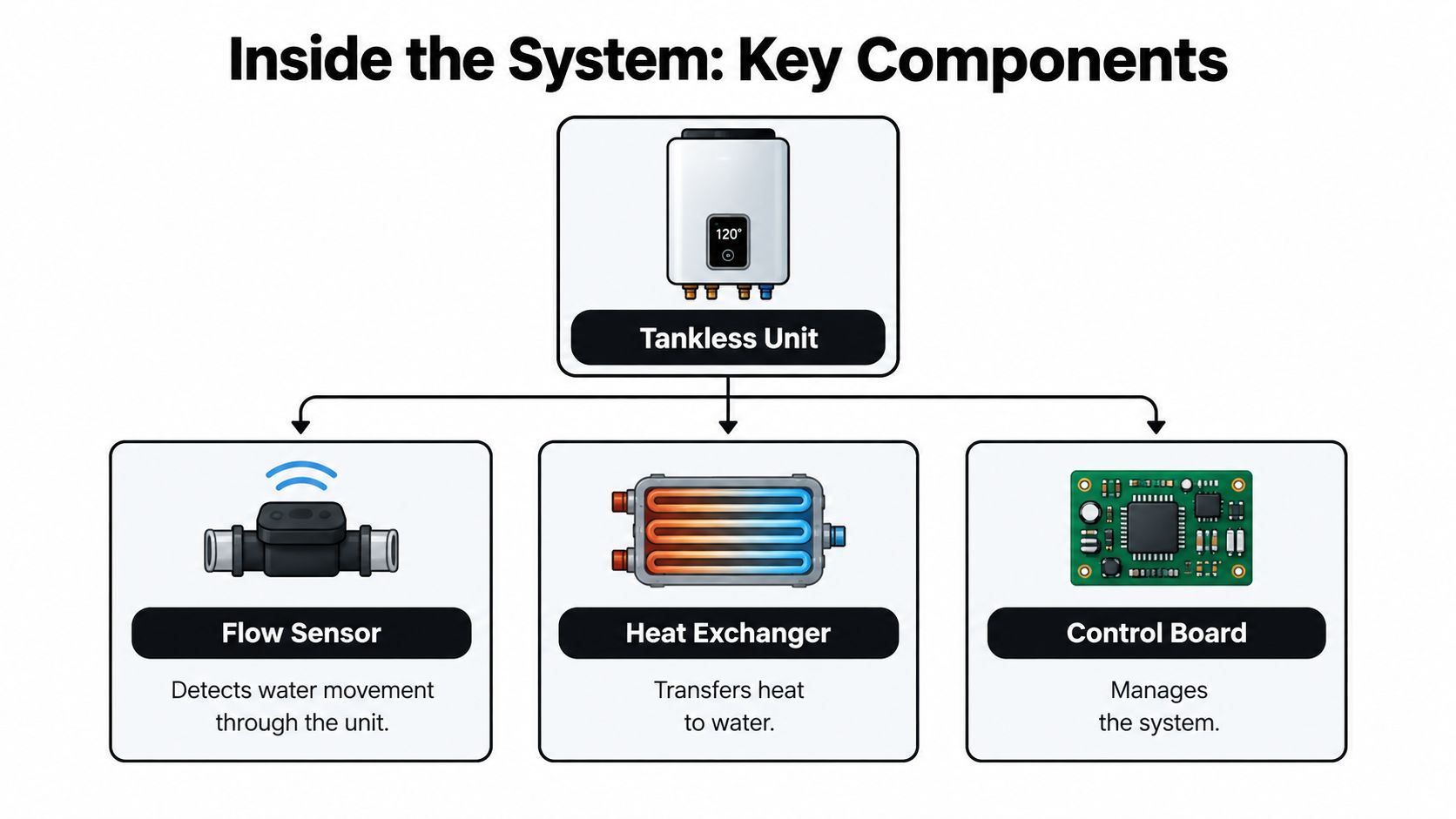
The outside of a tankless water heater may look like a compact cabinet, but several components coordinate every hot-water event. Each part has a distinct job in the chain.
The sensor starts the request
The flow sensor is the trigger. It detects water movement and tells the control board that a fixture is open. Residential tankless gas units typically activate at about 0.5 gallons per minute, according to this description of tankless heater operation. A low-flow bathroom faucet may not send enough water through the unit, while a shower that reaches roughly half a gallon per minute can start the heating cycle.
The control board then coordinates ignition, valve position, element operation, and safety checks. It doesn't switch the heater on at one fixed power level. It responds to the measured conditions so the unit can produce the heat the water needs.
The heat exchanger transfers energy
The heat exchanger is where the water gains temperature. On a gas model, the burner produces heat beneath or around the exchanger's water passages. On an electric model, heating elements provide the energy without combustion.
Condensing gas models add a secondary heat exchanger. That component captures additional heat from flue gases before they leave through the venting system, allowing the heater to recover energy that a conventional non-condensing arrangement would discharge.
Modulation keeps the output steady
A modulating gas valve changes the burner input instead of leaving the flame fully on throughout the draw. Temperature sensors compare the water conditions with the selected setpoint, and the controls adjust the flame or element output accordingly. The usual set output range is 105°F to 125°F, as noted in the same residential tankless heater reference.
Venting has a separate role on gas systems. Combustion needs a controlled air supply, and exhaust gases must leave the building safely. The installation must therefore account for the appliance design, vent route, termination, gas connection, condensate handling where applicable, and local requirements. A review of tankless water heater venting can help clarify why replacing a tank isn't always a simple appliance swap.
The heater can only regulate what the sensors can measure. Clean water passages, correct flow, reliable temperature readings, and compliant venting all support stable operation.
Sizing Your Tankless System for Real Household Demand
A morning shower starts a chain reaction. Opening the tap sends water through the heater, where a flow sensor detects movement and signals the controls to fire and modulate the heat source. Sizing determines whether that chain can keep up when other fixtures open at the same time.
A tankless heater is sized by flow rate, not storage volume. List the hot-water fixtures that may run together, add their gallons per minute, and compare the total with the heater's rated output at the needed temperature rise. California sizing guidance commonly uses 1.8 GPM as the cap for showerheads and kitchen faucets, while a California-focused guide estimates that many Orange County homes need about 3.6 to 5.6 GPM. These figures appear in this tankless sizing guide.
A practical demand calculation
Suppose two showers and a kitchen faucet operate during the morning rush. If each fixture approaches the cited 1.8 GPM limit, the combined demand can reach 5.4 GPM. The heater must supply that flow while also raising incoming water to the selected outlet temperature. A unit may meet the flow requirement in mild conditions yet deliver less at a higher temperature rise, so its tested capacity matters.
The goal is a realistic peak, not every fixture in the house at once. Two showers, handwashing, and kitchen use create a different design target from a household where occupants stagger hot-water use.
| Simultaneous Use Scenario | Total GPM Needed | What It Means for Sizing |
|---|---|---|
| One shower | Fixture flow determines demand | A smaller unit may work if its output matches the shower's flow and temperature rise |
| One shower and one kitchen faucet | Add both fixture flows | Match the combined demand, not only the largest individual fixture |
| Two showers and a kitchen faucet | Can approach 5.4 GPM when each fixture is near 1.8 GPM, based on the California sizing guidance cited above | Choose a unit that can maintain temperature at the combined peak |
| Several fixtures plus an appliance | Add the actual simultaneous hot-water flows | A professional assessment may identify the need for higher capacity or a different arrangement |
An undersized heater can seem perfectly adequate when one person showers alone. Open another tap, and the flow sensor calls for more output. If the burner or elements have reached their limit, the water temperature may drop, or the household may need to stagger its use. Accurate peak-flow planning connects the tap-level demand to the heater's real heating capacity.
Energy Efficiency and What It Means for Your Bills
Tankless efficiency starts with the absence of standby heating. A storage heater repeatedly adds heat to water that is already hot because the tank and surrounding connections gradually lose warmth. A tankless unit remains off between demands, so it avoids that particular holding loss.
Canada primarily benchmarks water heaters using energy factor, or EF. Natural Resources Canada reports that gas-fired tankless models typically range from EF 0.64 to 0.98, with an average around 0.85. Gas-fired storage tank heaters range from EF 0.53 to 0.70, with an average around 0.62, according to the Natural Resources Canada water-heater guide.
Reading the ratings correctly
A higher EF indicates that more of the input energy becomes useful hot water under the rating method. It doesn't predict an identical bill for every home, because household demand, water temperature, fixture use, fuel prices, and installation all affect the result.
The same NRCan guide states that ENERGY STAR certified tankless water heaters use about 30% less energy than standard storage tank models on average. That is an average comparison, not a promise that every replacement will produce the same household reduction.
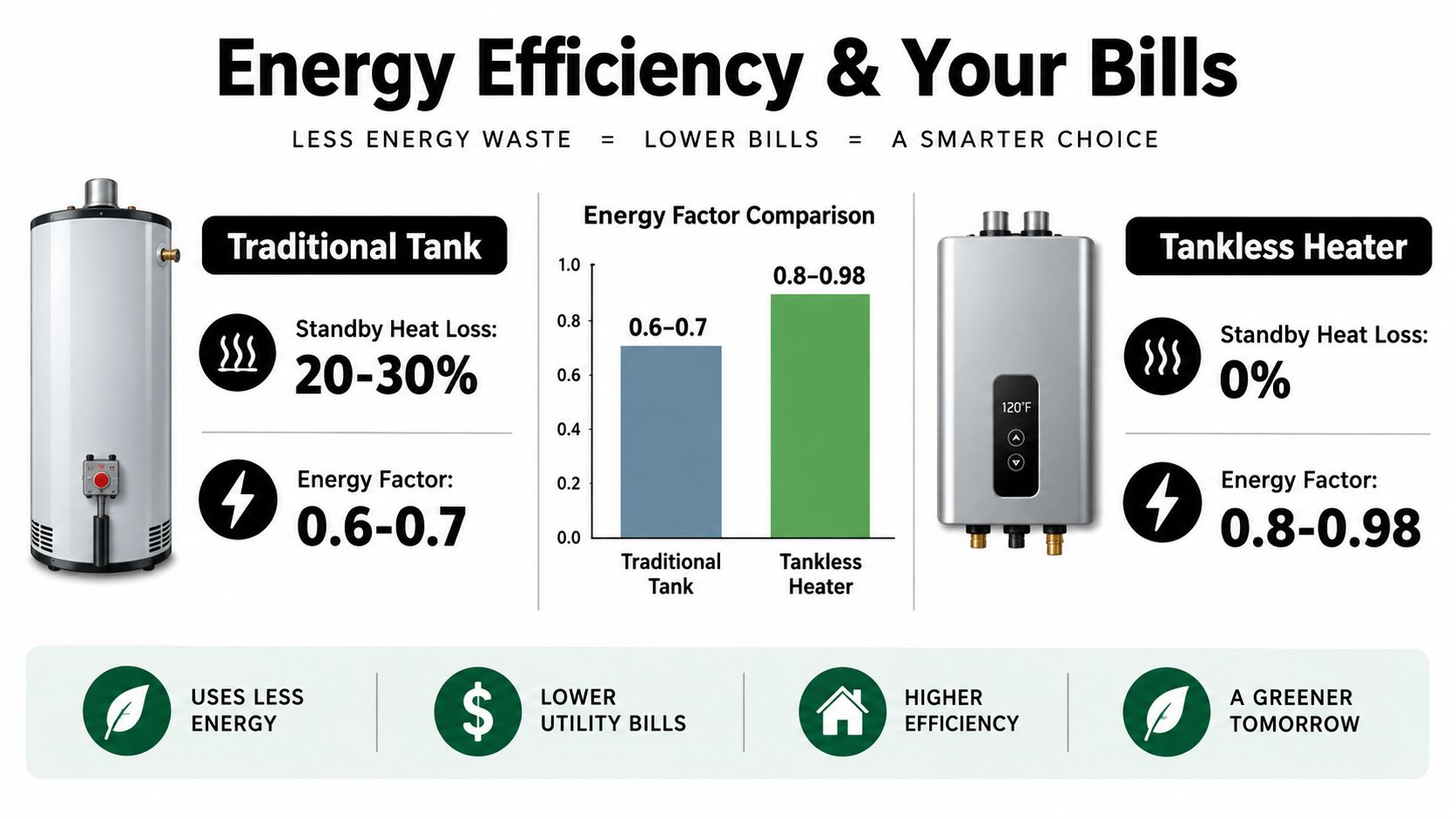
Usage pattern matters just as much as the rating. Canadian coverage indicates that low-usage homes may save 24% to 34%, while high-usage homes may see about 8% to 14% energy savings, as discussed in this British Columbia water-heater rebate and efficiency overview. Those ranges help explain why a small household with long periods between hot-water events may experience a different outcome from a busy home with frequent, high-volume draws.
Bill-reading advice: Compare the equipment's rating with your actual usage pattern. Efficiency improves the heating process, but it doesn't remove the energy required to heat a large amount of water.
Another rating system may appear on product literature. The California Energy Commission guide lists instantaneous gas water heaters under two gallons at a minimum UEF of 0.80 to 0.81, depending on draw pattern, while larger instantaneous units retain a 0.81 floor across the listed draw patterns. Those ratings use a different method from EF, so homeowners shouldn't compare the labels as though they're interchangeable.
Installation Maintenance and Everyday Use Tips
Tankless operation depends on more than the cabinet on the wall. Gas models require suitable gas delivery and compliant venting. Electric models may require adequate electrical capacity. Both types need correct water connections, safe clearances, controls, and a design that matches the home's demand.
Water quality also affects the heat exchanger. Mineral deposits can narrow passages and reduce heat transfer, which may lead to temperature fluctuation, lower flow, or fault codes. A qualified technician can determine whether the system needs flushing or descaling and how often that work makes sense for the property.
A practical ownership checklist
- Confirm the installation path: Review gas-line capacity or electrical supply, venting, condensate requirements where applicable, water connections, access, and permits before selecting the unit.
- Protect the water passages: Ask about filtration and descaling if the home has mineral-heavy water or recurring scale.
- Watch small draws: An ETCC feasibility assessment found that tankless gas heaters in PG&E territory typically need about 0.5 to 0.75 GPM before the burner fires. Very small draws may not trigger combustion, while flow above the threshold starts on-demand heating and avoids tank cycling losses, as explained in the ETCC tankless feasibility assessment.
- Keep service access clear: Technicians need room to inspect filters, sensors, connections, venting, and the heat exchanger.
- Respond to symptoms early: Fluctuating temperature, reduced flow, delayed delivery, or repeated shutdowns deserve diagnosis rather than repeated resets.
Daily use can expose the flow threshold. A faucet opened only slightly may produce a weak demand signal. If the water turns cold during a low-flow task, the issue may be that the flow is below the appliance's activation requirement, not that the heater has run out of hot water.
For a Greater Vancouver installation or service visit, Encano Plumbing & Drainage Ltd. assesses tank and tankless water heaters, handles installation and maintenance, and can review sizing, gas-line, venting, electrical, permit, and service requirements for residential, strata, and commercial properties.
Is Tankless Right for Your Home Final Takeaways
A tankless water heater often suits a home that values compact equipment, on-demand heating, and reduced standby loss. It can support a continuous supply within its rated flow and temperature capacity, but “continuous” doesn't mean unlimited flow. Two showers and a kitchen tap still create a combined demand that the unit must be sized to handle.
The technology may be less attractive when the installation requires major gas, venting, or electrical changes, when the household regularly exceeds one unit's practical output, or when a low-flow fixture repeatedly falls below the activation threshold. A storage or hybrid arrangement may better match a property where peak demand, existing infrastructure, or budget constraints outweigh the space and efficiency advantages.
British Columbia homeowners should also check incentives before treating a rebate as part of the financial calculation. Current coverage has shifted toward heat-pump water heaters, while gas tankless units are often excluded from broad CleanBC incentives, according to this British Columbia rebate information. That can make a heat-pump alternative more financially compelling in some situations, even when tankless operation remains mechanically attractive.
Use the traditional versus tankless comparison as a starting point, then have a qualified professional calculate simultaneous GPM demand and inspect the existing service connections. The right choice depends on how your household uses hot water, not just on whether the unit has a tank.
Encano Plumbing & Drainage Ltd. can assess your current water heater, size a tankless replacement, and plan the gas, venting, electrical, permit, and maintenance requirements for your home or property. Visit Encano Plumbing & Drainage Ltd. to arrange an installation assessment, repair, or scheduled maintenance service in Greater Vancouver.