

You wake up in Richmond, turn on the shower, and get lukewarm water. Or you run the dishwasher before opening your café and hear the burner attempt to start without producing enough hot water. A water heater rarely fails at a convenient time, but the first symptom doesn't always mean you need a new unit.
In Greater Vancouver, the right answer depends on more than the tank's label. Fuel type, venting, water quality, electrical capacity, condensate drainage, seismic restraint, building type, and local permit requirements can all change the scope of a water heater service. A proper pre-service assessment is often more valuable than replacing a part immediately, because it shows whether the equipment can be repaired safely and whether a replacement will fit the building.
Table of Contents
- What a Water Heater Service Actually Includes
- What a Technician Checks During an Inspection
- Tank vs Tankless Water Heaters in Vancouver Homes
- Annual Maintenance Checklist and Recommended Frequency
- Warning Signs That Point to Repair or Replacement
- Emergency Steps When a Water Heater Fails
- Typical Costs for Service, Repair, and Replacement
- Choosing a Trusted Local Service Provider
What a Water Heater Service Actually Includes
A Richmond homeowner with a leaking tank may call expecting a quick valve repair. During the visit, a plumber might find that the valve is sound, but the tank base is corroded, the relief discharge is poorly arranged, and the unit isn't adequately restrained. Repairing one visible symptom would leave the homeowner with the larger failure still waiting to happen.
That's why a professional water heater service starts with assessment rather than a wrench. The technician identifies the unit's age, fuel type, venting arrangement, installation location, water-quality history, controls, clearances, and evidence of previous repairs. The result should be a written explanation of what's safe to repair, what needs monitoring, and what would justify replacement.
Five parts of a useful service visit
- Inspection report: The report should record leaks, corrosion, connections, venting, safety controls, temperature settings, electrical or gas concerns, and any code-related issue that affects the recommendation.
- Routine maintenance: Depending on the equipment, this can include flushing sediment, checking the anode rod, testing the temperature and pressure relief valve, inspecting burners or elements, and checking expansion control.
- Targeted repair: A faulty thermocouple, igniter, relief valve, fitting, thermostat, or element may be replaceable without disturbing the tank.
- Replacement assessment: A tank with internal corrosion or a persistent leak usually calls for replacement rather than another patch. Equipment selection must reflect demand and installation conditions.
- Commissioning: After work, the technician should verify operation, temperature, safety devices, connections, clearances, drainage, and the absence of leaks.
California's seismic requirements illustrate why commissioning and documentation matter in another regulatory setting. The California Seismic Safety Commission guidance on water-heater bracing requires new or replacement units sold and installed in the state to be braced, anchored, or strapped against earthquake movement. The local Greater Vancouver requirements differ, but the practical lesson is relevant: a replacement isn't complete until the surrounding installation is safe and compliant.
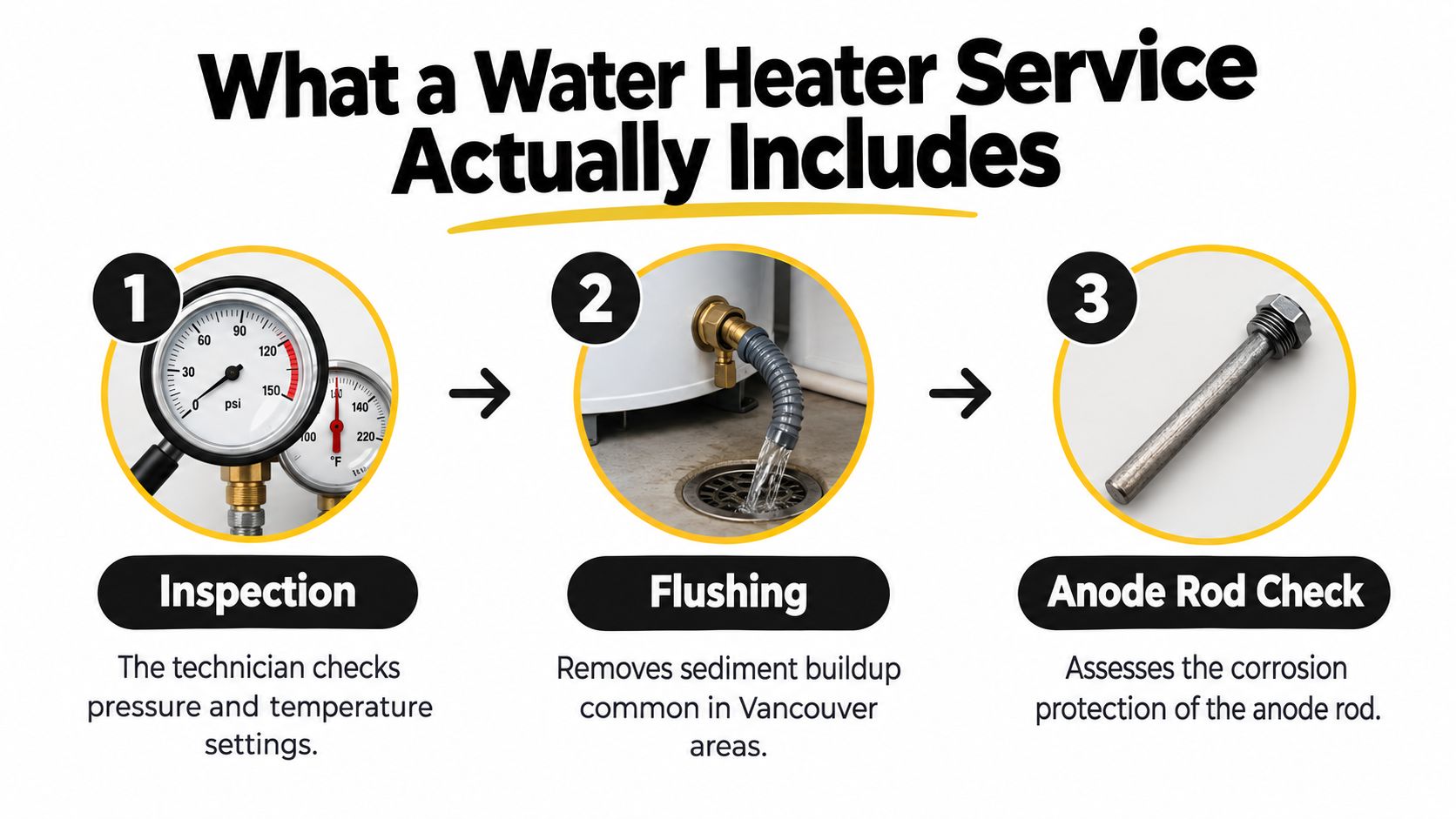
Practical rule: Ask for the scope before work begins. One visit can include inspection, maintenance, repair, and commissioning, so a vague “service” price doesn't tell you what will actually be done.
Hard-water conditions and mineral-heavy supply can increase sediment and scale inside tanks and heat exchangers. That makes maintenance more important in parts of Burnaby, Surrey, and the North Shore, especially where a unit already shows rumbling, restricted flow, or repeated recovery problems.
What a Technician Checks During an Inspection
A proper inspection follows the path of water, fuel, combustion, electricity, and pressure. It isn't a quick glance at the tank label.
Start with combustion and water control
For an atmospheric gas unit, the technician examines the draft hood and vent connector for corrosion, obstruction, poor slope, or signs of backdrafting. The purpose is safety. Combustion products must leave the building through the intended vent path rather than spill into the room.
The cold-water shutoff, hot-water outlet, and temperature and pressure relief valve come next. The technician checks whether each valve operates correctly and whether the relief discharge pipe terminates safely near the floor, rather than ending where released hot water could injure someone or damage the building. Homeowners can learn more about the role of this safety device through this guide to the water-heater pressure relief valve.
Check the heat source and the tank interior
On a gas unit, the thermocouple or flame sensor must respond correctly, and the burner should ignite without delayed ignition, soot, or unstable flame behaviour. Power-vented units need an igniter and fan inspection. Electric tanks require element and thermostat checks, with resistance measurements where appropriate.
A technician may drain a small amount of water to assess sediment load and clarity. Cloudy water, mineral particles, or heavy deposits can explain noise, slow recovery, and reduced heat transfer. A tankless system receives a different examination, including inlet filtration, heat-exchanger scale, combustion sensors, vent termination, and condensate handling.
Finish with structural and pressure checks
The inspection also covers the anode rod, fittings, bonding and grounding, expansion tank pressure, visible weeping, and the stability of the unit. In California, the commission's guidance specifically connects bracing to structural wall framing rather than drywall or inadequate piping connections. That principle reinforces a broader service standard: safety components must be attached and supported for their intended purpose.
The technician should explain each finding in plain language. A corroded fitting may be a repair. A tank leaking from its body is a replacement issue. Sediment may call for flushing, while a damaged heat exchanger may make continued operation uneconomic.
Tank vs Tankless Water Heaters in Vancouver Homes
A conventional storage tank keeps a reserve of heated water. A tankless system heats water as it passes through the heat exchanger. Neither option wins in every Vancouver building, because the installation often determines whether the equipment performs as promised.
Tanks usually cost less to install, are familiar to most service technicians, and handle simultaneous draws without relying on the unit to activate at exactly the right flow rate. They do occupy floor space, lose heat while storing water, and need suitable drainage and clearance. A tank can also struggle when several showers, a dishwasher, and a laundry load arrive close together.
Tankless equipment provides continuous hot water while demand continues, but it isn't limitless in practical terms. Flow and incoming water temperature affect output. The unit may need a larger gas supply, dedicated venting, condensate management, electrical power, and regular descaling where mineral deposits accumulate.
| Factor | Conventional Tank | Tankless (On-Demand) |
|---|---|---|
| Upfront work | Usually simpler when replacing an existing tank | May require gas, venting, electrical, and condensate changes |
| Hot-water pattern | Strong for normal household draws and simultaneous use | Strong for extended demand when correctly sized |
| Space | Requires floor space, pan, and drainage | Frees floor space but needs service access |
| Maintenance | Flushing, relief-valve checks, anode inspection, and leak checks | Heat-exchanger flushing, filter cleaning, vent checks, and condensate inspection |
| Local fit | Often practical in older homes with existing connections | Works best when the building can support the venting and utility requirements |
| Best match | A straightforward replacement or budget-conscious project | A long-term upgrade, suite addition, or high-demand application |
Older Vancouver Specials and many Kitsilano heritage homes can have limited routes for direct-vent equipment. Newer Langley and Coquitlam construction may offer more flexibility, but the actual gas line, vent route, electrical service, and drainage still need inspection.
A small café, salon, or basement suite can expose the difference quickly. A storage tank may recover too slowly during overlapping demand, while an undersized tankless unit may restrict flow or fail to maintain the desired temperature. The traditional versus tankless water-heater comparison is useful as a starting point, but a site assessment should decide the final configuration.
Annual Maintenance Checklist and Recommended Frequency
A maintenance plan should match the equipment and the water conditions. A homeowner can watch for visible changes, but gas, electrical, combustion, and pressure work belongs with a qualified technician.
What to watch between visits
Inspect the area around the heater regularly. Look for moisture at the fittings, tank base, drain valve, relief discharge, and nearby floor. Check for unusual sounds, changes in hot-water output, and signs that the unit is cycling differently from normal.
Keep the area clear and make sure vents, air openings, and access panels aren't blocked. Don't adjust gas controls, open electrical compartments, or test a relief valve casually. A valve that fails to reseat can create a leak, and a combustion problem can create a serious indoor-air hazard.
What belongs on the service schedule
A full service should address the following:
- Tank sediment: Flush the tank when deposits, noise, water-quality history, or manufacturer guidance indicate a need. Sediment can reduce heat transfer and accelerate damage.
- Anode protection: Inspect the anode rod on a planned maintenance cycle. Replacing a depleted rod can protect the tank, but it isn't a cure for a tank that is already leaking through its body.
- Relief protection: A technician should test the temperature and pressure relief valve and verify that its discharge piping is safe.
- Combustion equipment: Gas connections, burner operation, flame sensors, igniters, draft, and venting require qualified inspection.
- Tankless components: Descale the heat exchanger, clean the inlet filter, inspect vent terminations, and verify condensate drainage.
- Expansion control: Confirm that the expansion tank has suitable pressure and that the system isn't developing excessive pressure.
The right frequency depends on water quality, demand, equipment type, and warranty conditions. Homes with mineral-heavy water or heavy simultaneous use generally need closer attention than lightly occupied homes with clean supply conditions.
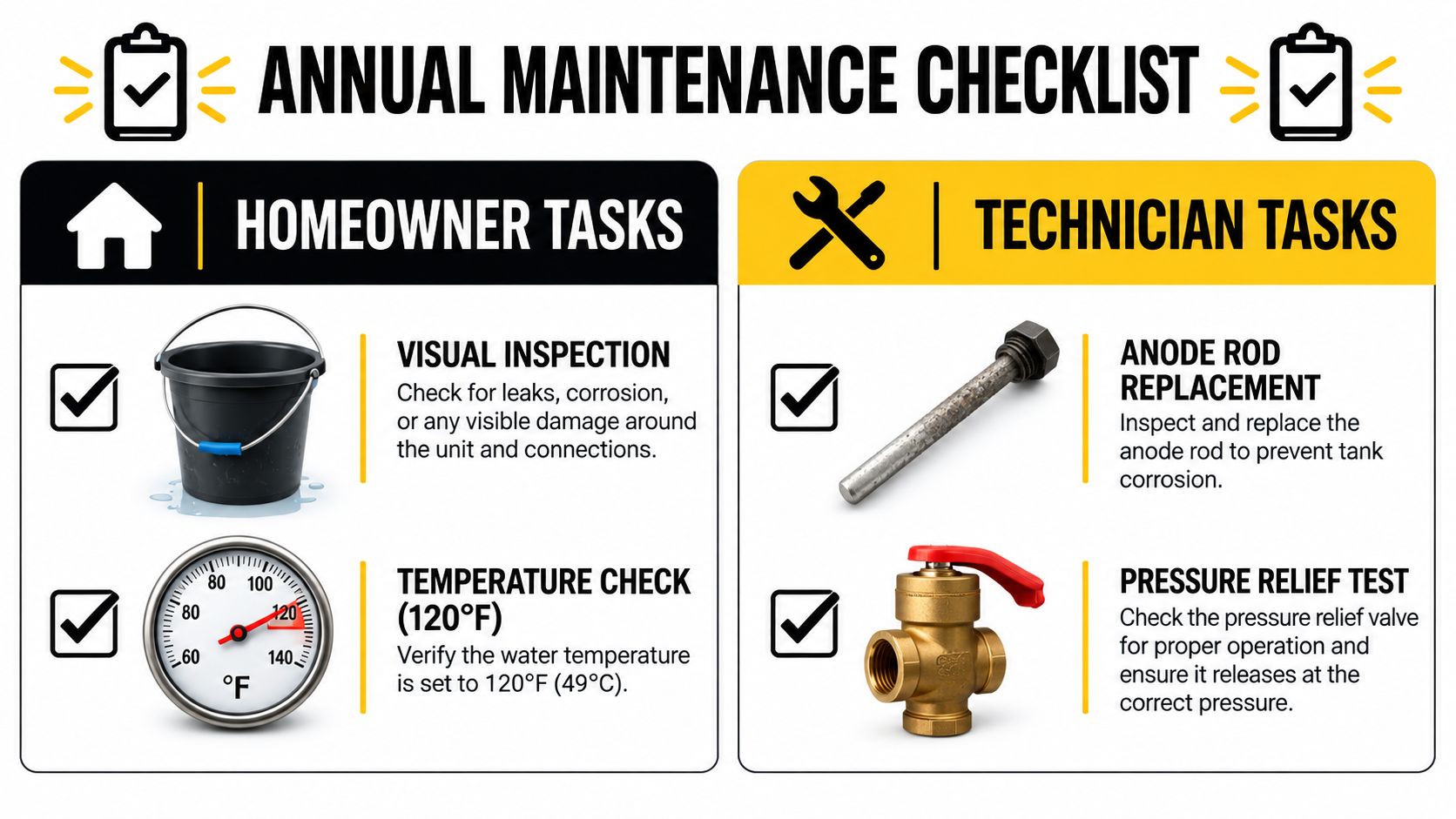
Use a written service record. The water-heater flushing guide can help you understand the process, but a full flush isn't always harmless on an old, neglected tank. Sediment can conceal a weak area, and disturbing a failing valve can turn a maintenance visit into an emergency repair.
Warning Signs That Point to Repair or Replacement
A water heater's symptoms tell you where to investigate, but they don't always identify the final solution. Lukewarm water may come from a thermostat, element, burner, dip tube, scale, or undersized system. A technician needs to test the cause before recommending equipment.
| Warning Sign | Likely Cause | Recommended Action |
|---|---|---|
| Lukewarm or inconsistent water | Failed thermostat, element, burner component, dip tube, scale, or insufficient recovery | Diagnose controls and demand before repairing or resizing |
| Rumbling or popping | Sediment collecting around the heat source | Assess sediment and flush if the tank is sound |
| Rusty or metallic-smelling hot water | Anode depletion, internal corrosion, or piping corrosion | Inspect the anode and tank; replace if the body is deteriorating |
| Moisture at a fitting | Loose or corroded connection, valve, or pipe | Repair the connection if the tank itself is sound |
| Leak from the tank base or body | Internal tank failure | Plan replacement rather than repeated patching |
| Pilot or ignition failure | Thermocouple, flame sensor, igniter, burner, venting, or control fault | Test the safety sequence and replace the failed component |
| Higher energy use without changed demand | Scale, insulation loss, failing controls, or poor system fit | Service the unit and review equipment efficiency and operating conditions |
A four-year-old unit with a failed thermocouple may be a straightforward repair if the tank is dry and structurally sound. A twelve-year-old tank with a slow leak from the body is a different decision. Repairing an external fitting may buy time, but repairing a corroded tank shell isn't a reliable long-term strategy.
Age alone doesn't decide the outcome. A well-maintained unit in a clean installation can outperform a newer heater exposed to heavy scale, poor venting, or excessive demand. Repeated repairs, declining output, visible corrosion, and an installation that no longer meets the building's needs are stronger reasons to plan replacement.
California's current efficiency framework shows why replacement selection requires more than tank size. The California Energy Commission's 2025 Energy Code update addresses heat-pump water-heater installation provisions, first-hour performance, ventilation, backup heat in certain installations, condensate disposal, and available space. A high-efficiency unit can still disappoint if those conditions are ignored.
Emergency Steps When a Water Heater Fails
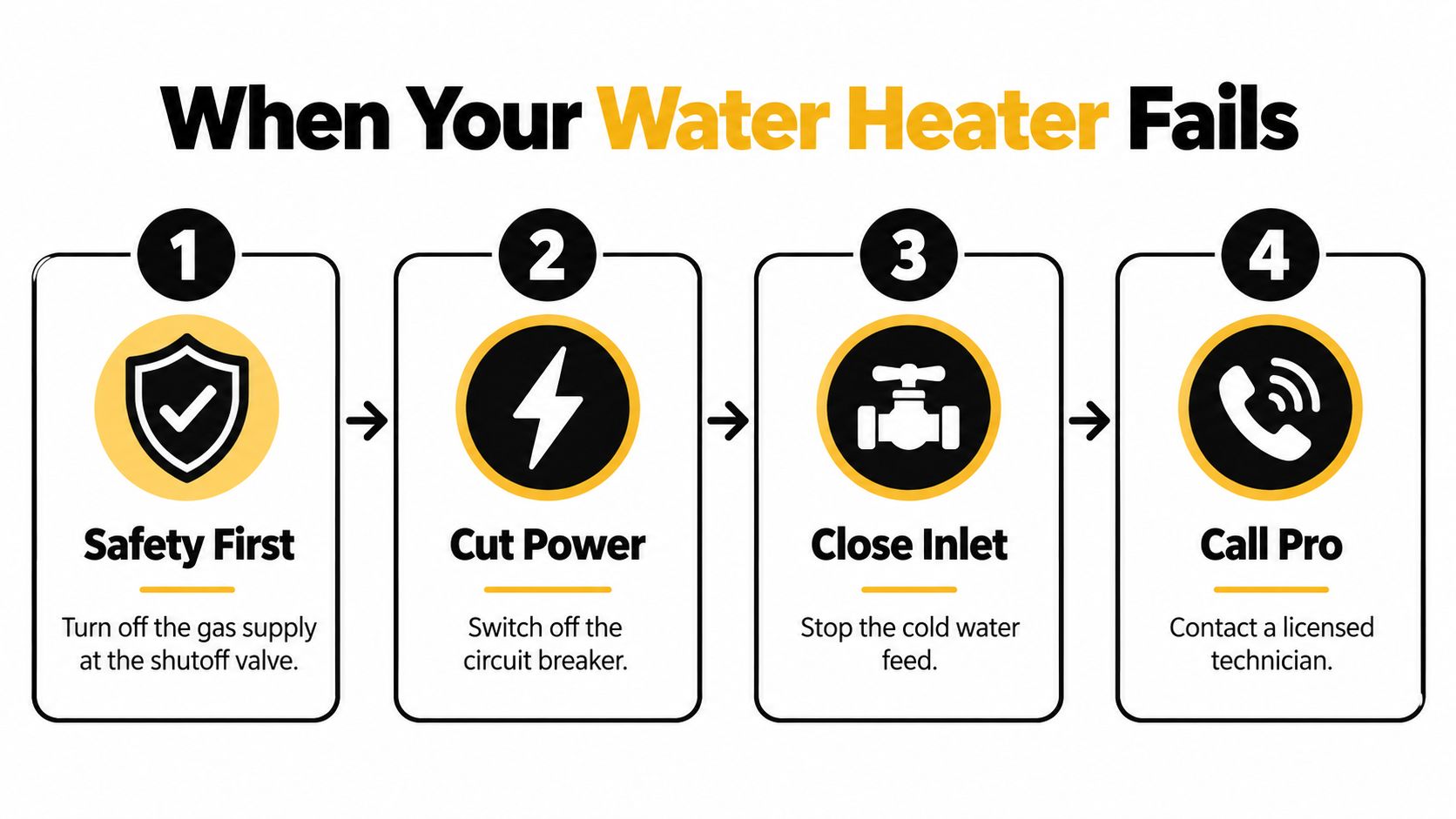
Water and electricity, or water and gas, create a situation where speed matters, but rushing into the equipment room can make things worse. Keep people away from hot discharge, standing water near electrical components, and any area where gas may be present.
- Remove the energy source. Turn off the gas supply at the appliance shutoff for a gas unit. For an electric heater, switch off the correct breaker. Don't touch electrical components if water is present around the connections.
- Close the cold-water inlet. This stops the tank from continuing to feed a leak. If the heater shutoff won't close, use the building's main water shutoff.
- Reduce pressure carefully. Open a hot-water tap away from the heater. If the tank is overheating, a technician should address the temperature and pressure relief condition. Don't cap, block, or permanently disable a relief valve.
- Contain the water. Move belongings away, use towels or a wet vacuum where safe, and protect flooring from continuing damage. Don't enter deep standing water near electrical equipment.
- Call emergency service when the risk is active. Flooding, a gas smell, sparking components, a tank that is rapidly discharging, or a relief valve that stays open requires prompt professional attention.
If you smell gas, leave the area and contact the appropriate emergency service from a safe location. Don't operate switches or create an ignition source.
Before the technician arrives, photograph the equipment label, leak location, shutoff position, visible damage, and affected flooring. Note when the problem began, whether hot water stopped suddenly, and whether any breaker, pilot, or error message changed. This record helps with insurance discussions and gives the plumber a clearer starting point.
The following video provides a visual reminder of the immediate shutdown sequence:
Typical Costs for Service, Repair, and Replacement
A trustworthy water-heater quote in Greater Vancouver shouldn't rely on a single attractive number. The final cost depends on the equipment, access, parts, permit requirements, disposal, urgency, and whether the existing installation can support the replacement.
Because those variables differ substantially between a condo, a Richmond house, a basement suite, and a commercial kitchen, a technician should inspect before promising a fixed total. A basic assessment is usually less involved than a repair that requires draining the tank, and a standard replacement is different again from a tankless conversion involving venting, gas capacity, electrical work, and condensate management.
| Service Type | Typical Range (CAD) | Main Cost Drivers |
|---|---|---|
| Inspection and tune-up | Varies by equipment and scope | Access, combustion testing, flushing, safety checks, and documentation |
| Mid-life repair | Varies by fault and parts | Anode rod, relief valve, thermocouple, igniter, element, fitting, and labour time |
| Standard tank replacement | Varies by capacity and installation | Equipment, access, pan and drainage, connections, permits, disposal, and commissioning |
| Tankless replacement or conversion | Varies widely | Gas-line sizing, venting, electrical supply, condensate handling, descaling, and wall or cabinet modifications |
What changes the quote locally
The City of Vancouver's rules are especially important. The Vancouver Municipal Code plumbing and mechanical provisions generally require approval before regulated plumbing, gas, mechanical, or related work is installed, altered, repaired, replaced, or enlarged. A central domestic-hot-water project may also require documentation of peak heat demand and review under the city's energy utility requirements.
Municipal requirements aren't identical across Vancouver, Richmond, Surrey, and other communities. Older Vancouver Specials and Kitsilano heritage homes may add labour because access and vent routes are difficult. Mineral-heavy conditions in Burnaby and Surrey can add descaling or flushing work. Brand tier, warranty terms, electrical upgrades, and emergency timing also affect the total.
Ask the provider to separate labour, parts, permits, disposal, testing, and warranty coverage. A quote that hides these categories makes it hard to compare options or understand why a lower equipment price may lead to more installation work.
Choosing a Trusted Local Service Provider
The safest choice is a provider that diagnoses the installation, not one that quotes a replacement from a photograph. Before booking, ask who will perform the work, what qualifications apply to gas service, and whether the company carries current liability insurance and WCB coverage.
For gas work, verify the technician's applicable gas-fitter certification and the company's registration requirements. Confirm municipal business licensing, especially if the work involves a permit, inspection, or commercial building. A written quote should identify the proposed equipment, labour, parts, permits, disposal, warranty terms, commissioning, and any work excluded from the price.
Questions that reveal service quality
- Assessment first: Will the technician inspect water demand, venting, water quality, clearances, electrical capacity, condensate routing, and code compliance before recommending equipment?
- Permit responsibility: Will the company pull the required permit and arrange inspection, or must the homeowner manage that process?
- Emergency coverage: Is there 24/7 assistance for no hot water, active leaks, gas concerns, and unsafe relief-valve conditions?
- Neighbourhood familiarity: Does the team regularly work across North Vancouver, Vancouver, Richmond, Burnaby, Surrey, and Langley?
- Building awareness: Can the provider work with strata procedures, access restrictions, mechanical-room documentation, and commercial scheduling?
Local housing details matter. Older galvanized piping in Marpole can change how a replacement behaves, while newer condos may require coordination with strata management before a shutoff or equipment change. A company familiar with these constraints is more likely to identify downstream work before the installation begins.
British Columbia's Energy Step Code also changes the context for new construction and some larger projects. The provincial Energy Step Code framework treats energy performance as part of the building's overall design. A multi-unit project may therefore need modelling and documentation for its domestic-hot-water system rather than relying only on a consumer efficiency label.
The pre-service assessment remains the most useful filter. It should leave you with a clear choice between repair, maintenance, replacement, or further investigation, along with the safety and permit steps required for the work.
Encano Plumbing & Drainage Ltd. provides scheduled and 24/7 emergency water heater service across Greater Vancouver, including inspection, repair, maintenance, and tank or tankless replacement. Visit Encano Plumbing & Drainage Ltd. to arrange an assessment that accounts for your equipment, building, water quality, and local requirements.