
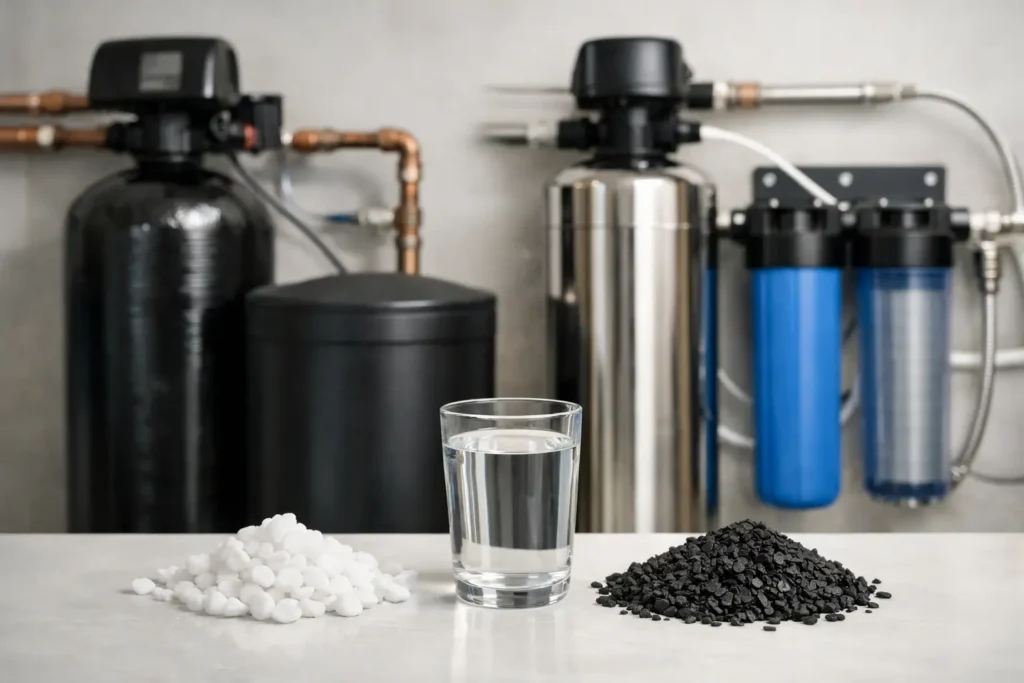
If white scale keeps forming around faucets, your dishwasher leaves spots on glasses, or your tap water has an odor you do not enjoy, it is easy to assume one system will fix everything. The water softener versus filtration decision is not that simple. These systems solve different problems, and choosing the wrong one can leave you paying for equipment that does not address the issue you actually have.
For homeowners, landlords, and property managers, the best starting point is not a product. It is understanding what is in the water, what is happening to the plumbing fixtures, and whether the concern is about protecting pipes, improving taste, or both.
Water Softener Versus Filtration: The Core Difference
A water softener is built to reduce hardness minerals, primarily calcium and magnesium. These naturally occurring minerals are not usually a health concern, but they can create scale inside water heaters, pipes, showerheads, appliances, and fixtures. Scale is the hard, chalky buildup often seen on glass shower doors, faucet aerators, and kettles.
Most conventional softeners use ion exchange. Water passes through resin beads that trade calcium and magnesium for sodium or potassium. The result is softer water that lathers more easily with soap and is less likely to form mineral deposits.
A water filtration system is designed to remove or reduce other unwanted materials. Depending on the filter type, it may address sediment, chlorine, certain chemicals, unpleasant taste or odor, lead, bacteria, or other contaminants. Filtration is a broad category, not one single technology.
Put simply, a softener treats hardness. A filter treats selected contaminants or water-quality concerns. A softener does not automatically make water safer to drink, and a basic carbon filter will not remove the hardness minerals responsible for scale.
When a Water Softener Makes Sense
A softener is most useful when hard water is causing visible or expensive problems. Common signs include recurring scale on fixtures, stiff laundry, dry-feeling skin after bathing, cloudy glassware, reduced shower pressure from clogged showerheads, and frequent buildup in coffee makers or humidifiers.
Hard water can also affect equipment you cannot easily see. Mineral scale on heating elements and inside tank-style water heaters can reduce efficiency over time. In a multi-unit property or commercial setting, widespread scale may contribute to higher maintenance needs for faucets, valves, dishwashers, water heaters, and other water-using equipment.
That said, a softener is not automatically necessary in every home. Water conditions differ by source, neighborhood, building plumbing, and treatment history. Much of the Greater Vancouver area is known for relatively soft municipal water, so a whole-home softener may not be the practical answer for every local property. Older building piping, private water supplies, or specific fixture issues can still justify testing before making a decision.
There are also trade-offs. Traditional softeners need salt or potassium replenishment, periodic maintenance, a drain connection for regeneration, and enough room for the equipment. They can add a small amount of sodium to the water. Households on sodium-restricted diets may prefer to discuss potassium-based regeneration or keep an unsoftened cold-water line for drinking and cooking.
When Filtration Is the Better Choice
Filtration is usually the right direction when the main concern is what the water tastes, smells, or contains rather than the amount of mineral scale it leaves behind. A filter can be installed at one faucet for drinking water or at the point where water enters the building for broader treatment.
A basic sediment filter captures particles such as sand, rust, and debris. It can be helpful in older plumbing systems or properties with visible particles in the water. Activated carbon filtration is commonly used to improve taste and reduce chlorine odor. Many homeowners choose it because water that smells or tastes better is easier to drink and cook with.
More specialized systems may be appropriate for a verified concern. Reverse osmosis systems can reduce a wide range of dissolved substances at a dedicated drinking-water tap. Ultraviolet treatment may be considered for private water sources where microbial safety is a concern. Filters certified for lead reduction can be useful when testing, plumbing age, or local guidance points to a potential lead issue.
The key word is verified. No filter removes everything, and every filter has limits. Installing a system based only on a neighbor’s recommendation can lead to unnecessary cost or false confidence. Water testing and a clear review of the system’s performance claims should guide the choice.
Why Some Homes Need Both
A softener and a filtration system can work together, but they should be selected for separate reasons. For example, a home with genuinely hard water and strong chlorine taste may benefit from a whole-home softener paired with a carbon filter. A property with hard water and a concern about drinking-water quality may use softening for the plumbing system and reverse osmosis at the kitchen sink.
The order of installation matters. In many setups, sediment filtration comes first to protect the softener from debris. The softener may follow, with specialized drinking-water filtration installed at a separate point of use. The right layout depends on the equipment, water test results, available drain and electrical connections, and the building’s plumbing configuration.
For landlords and facility operators, it is also worth separating tenant comfort from equipment protection. A whole-building solution can reduce maintenance concerns, while a point-of-use filter can address drinking water at a kitchen, staff room, or tenant space without treating every gallon used for toilets, laundry, or irrigation.
Do Not Diagnose Water Problems by Appearance Alone
Scale is a strong clue that hardness may be present, but not all white residue has the same cause. A metallic taste may come from plumbing components rather than the incoming water supply. Brown water can be sediment, corrosion, or disturbance in the water line. A sulfur-like odor needs a different investigation than a chlorine odor.
A proper water assessment should consider hardness, pH, total dissolved solids, chlorine, iron, manganese, and any contaminants relevant to the property and water source. If the building uses a private well or another non-municipal source, bacterial testing may also be necessary. If there is a sudden change in color, smell, pressure, or taste, treat it as a plumbing issue worth checking promptly rather than trying random filters.
This approach is especially valuable in older homes and commercial buildings. Aging supply lines, corroded fixtures, failing water heaters, and cross-connections can create symptoms that a new filter will not solve. A licensed plumber can help determine whether the problem starts with the incoming water, the treatment equipment, or the plumbing system itself.
Maintenance Is Part of the Cost
Water treatment equipment only works as intended when it is maintained. Filter cartridges eventually fill up and need replacement. Carbon media has a service life. Reverse osmosis systems need scheduled filter and membrane changes. Softener salt must be kept at the proper level, and the brine tank and resin system may need service over time.
Skipping maintenance can reduce water flow, allow taste or odor issues to return, and create sanitation concerns in neglected equipment. Before choosing a system, ask how often it needs service, whether replacement parts are readily available, what the annual operating cost is, and whether the unit requires power or a drain connection.
For a rental property or business, choose equipment with a realistic maintenance plan. A sophisticated system is not a good value if nobody is assigned to change filters or monitor salt levels.
Choose the System That Solves the Actual Problem
Start with the symptom, then confirm it with testing or a professional assessment. If scale and appliance buildup are the concern, investigate hardness and consider a softener. If the issue is chlorine taste, sediment, odor, or a specific tested contaminant, select filtration designed for that concern. If both issues are present, a combined approach may be worthwhile.
The most helpful water treatment system is the one that fits your water, your plumbing, and your maintenance routine. Encano Plumbing & Drainage can help homeowners and property managers assess the practical options before installation, so the solution protects the property without adding unnecessary expense.
A clear water test and an honest look at your goals can turn a confusing purchase into a simple, long-term improvement for your home or building.