

The sound usually starts at the worst time. A steady drip after midnight, a damp bathmat in the morning, or a shower that suddenly goes lukewarm and weak when you're already running late.
That's how most plumbing repairs shower calls begin in Vancouver. The problem looks small from the outside, but a shower sits at the intersection of supply lines, drain lines, waterproofing, and often tile or strata walls. A simple fix might be a clogged showerhead or worn cartridge. A more serious one could be a leak travelling into a wall cavity or the unit below.
A practical example. In an older Burnaby house, a homeowner may notice water dripping from the showerhead long after the handle is off. In a Richmond condo, someone else may see no visible leak at all, just bubbling paint on the wall outside the bathroom. Those are two very different repair paths, even though both start with “my shower is leaking.”
Table of Contents
- Your Shower Is Acting Up Now What
- Tackling the Most Common Culprit Leaks
- Clearing Stubborn Shower Drain Clogs
- Solving Low Pressure and Diverter Problems
- When to Call a Vancouver Plumbing Pro
- Keeping Your Shower Healthy and Your Home Safe
Your Shower Is Acting Up Now What
If your shower is dripping, draining slowly, or losing pressure, the first job is to stay calm and pin down the symptom. Don't start tearing trim off the wall because a friend said “it's probably the cartridge.” A shower can fail in a few predictable ways, and the fix depends on which one you're seeing.
In Greater Vancouver, common shower repairs such as leaking valves or diverter failures average between CAD $450 and $1,200 per repair, and shower-related service calls represent 22% of residential plumbing emergencies. Those calls are tied closely to older homes, because 58% of the region's housing stock was built between 1970 and 1995, and hard water in nearby areas adds wear to fixtures and seals, according to Metro Vancouver shower repair data compiled here.
That local context matters. A newer condo with a cartridge valve often points to a trim-side repair. An older Vancouver special or Burnaby bungalow may have ageing shut-offs, brittle trim screws, or deeper corrosion behind the wall. Hard water also changes what “normal wear” looks like. A valve that should turn smoothly starts feeling gritty, and a showerhead that used to spray evenly begins pushing water sideways.
Don't guess from one symptom. A drip from the showerhead can come from the cartridge. Water on the floor can come from the door sweep, the drain flange, a cracked grout line, or a leak behind the wall.
Use this quick triage before you touch anything:
- Drip from the showerhead when off: Usually points to a worn cartridge or valve seal.
- Water at the base of the shower after use: Could be a drain seal, door leak, failed caulking, or pan issue.
- Weak flow from only the shower: Often mineral buildup in the showerhead or a failing balancing component.
- Slow draining water: Usually hair and soap near the trap, but sometimes a deeper line blockage.
A practical example. If the shower drips only after use and stops hours later, think pressure side first. If the floor gets wet only while someone is showering, think containment and drainage before you assume the supply piping is leaking.
Tackling the Most Common Culprit Leaks
Most shower leaks are not dramatic. They're annoying, persistent, and expensive if ignored. The common mistake is fixing the symptom you can see instead of the part that's worn out.
How to tell where the leak starts
Start with a simple test. Dry everything around the trim plate, tub spout if you have one, shower arm, and floor. Then turn the shower on and off while watching each point.
If water appears only at the showerhead after shutoff, the cartridge is the first suspect. In many post-1990 homes, cartridge-style valves are common, and when repaired correctly they have a 92% first-time success rate. The same data notes that 80% of these leaks come from degraded O-rings due to hard water, and over-torquing causes 15% of failures from cracked housings, based on Greater Vancouver shower faucet repair findings.
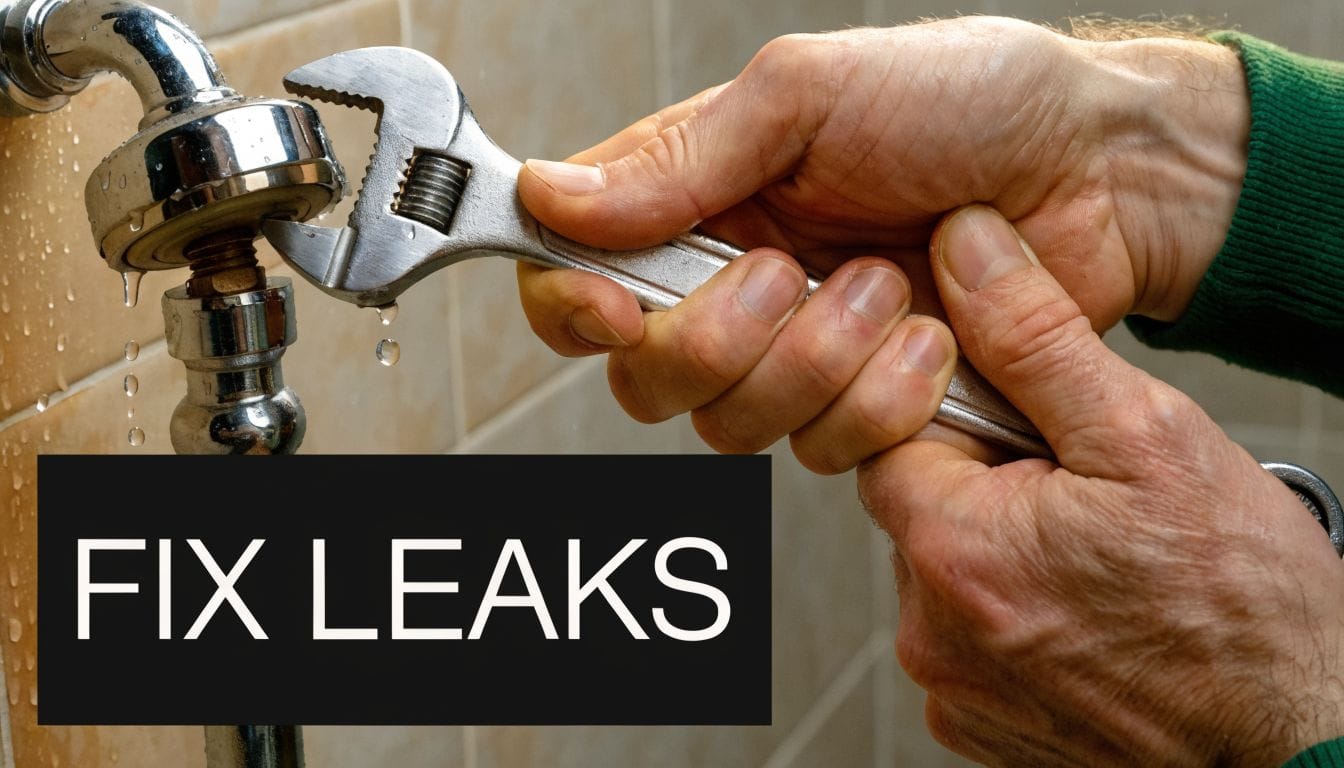
A practical example. In a lot of 1990s Burnaby bathrooms, a Moen-style cartridge is the trouble spot when the shower won't fully shut off. Homeowners often replace the handle first because it feels loose or stiff. That rarely solves the leak.
Practical rule: If the leak comes out of the showerhead itself when the valve is off, don't start with caulk, tape, or the shower arm. Start at the valve.
Tools you'll want
Cartridge puller if your valve is stuck
Screwdrivers
Adjustable wrench or socket set
Needle-nose pliers
Silicone plumber's grease
Rag and flashlight
The exact replacement cartridge for your valve model
Cartridge replacement that actually works
Shut off the main water supply first. In houses, that's straightforward. In condos, make sure you're allowed to isolate the unit, because some buildings have procedures for plumbing repairs shower work inside suites.
Remove the handle, trim plate, and retaining clip carefully. If screws are corroded, work slowly. Stripped trim screws turn a simple repair into a bigger one fast.
Pull the old cartridge straight out. Twisting too hard or prying against brass can damage the valve body. If it's stuck, use the proper puller instead of brute force.
Then compare old and new parts side by side. Match the length, tabs, and orientation. Lubricate the new O-rings lightly with silicone grease, not petroleum jelly, and seat the cartridge fully before reinstalling the clip and trim.
Test with the water back on. Look for dripping, stiffness, and temperature control issues. If the handle turns but hot and cold are reversed, the cartridge may be installed in the wrong orientation.
A few leak repairs are simpler:
- Leaking shower arm connection: Remove the arm, clean threads, re-seal, and reinstall without over-tightening.
- Leak at the escutcheon: The wall opening may be letting splash water in. Re-seal around trim if the valve itself is dry.
- Tub spout drip after diverter use: The diverter mechanism may be worn, not the main cartridge.
If you replace the cartridge and still hear water inside the wall, stop there. That's no longer a trim-side repair.
Clearing Stubborn Shower Drain Clogs
Drain problems feel more forgiving than leaks, so homeowners tend to experiment too much. That's where a minor hair clog turns into a damaged trap, a gouged drain body, or a chemical mess sitting in old ABS piping.
Start with the clog you can reach
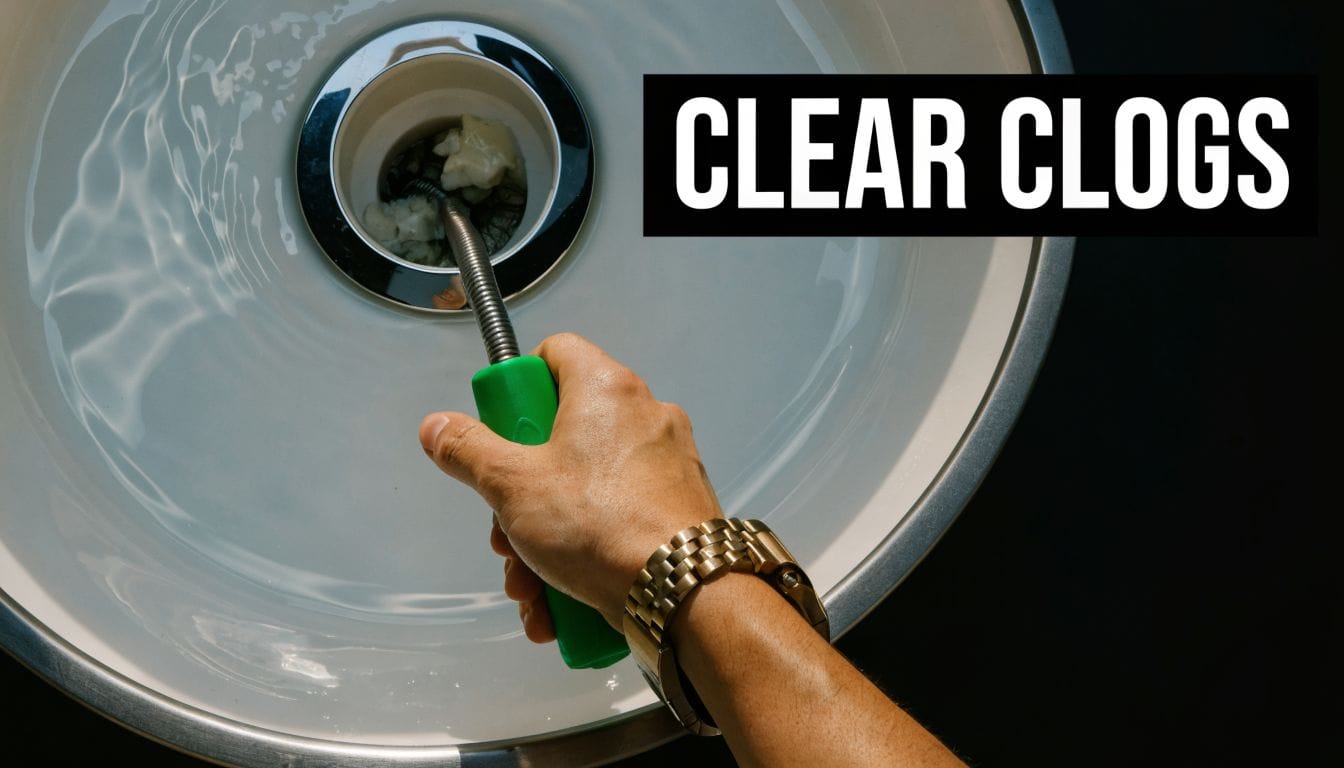
If the shower is draining slowly but not fully backed up, remove the drain cover first. Wear gloves and pull out the visible mat of hair and soap. It's unpleasant, but it solves a surprising number of shower problems.
The next sensible tool is a plastic hair snake. Feed it in gently, rotate a little, and pull straight back. Don't jam it hard into the line. In many homes, especially older ones, the first obstruction is close to the top of the trap.
A practical example. In a Surrey family bathroom, the drain may seem “randomly slow” for weeks. Once the cover comes off, there's often a thick plug of long hair wound around soap residue just below the opening. That's a DIY fix. No machine needed.
Try this order:
- Clear the cover and strainer: Remove visible debris by hand first.
- Use a plastic hair snake: Good for shallow buildup near the drain opening.
- Flush with hot water: Helps move loosened soap residue, but don't use boiling water on questionable older plastic fittings.
- Skip harsh drain chemicals: They can sit in the trap, attack older pipe materials, and create a hazard if a plumber has to open the line later.
In the Lower Mainland, P-trap clogs and flange failures are responsible for 58% of residential wastewater backups. On tougher blockages, professional 4,000 PSI hydro-jetting has an 87% success rate, and grease buildup accounts for 42% of cases. The same local data warns that chemical cleaners can damage older ABS pipes common in Surrey and Burnaby homes, as noted in this Lower Mainland drain repair reference.
When the blockage is farther down
If the shower backs up quickly, gurgles, or gets worse after you've cleared the top, the blockage may sit deeper in the trap arm or branch line. A hand auger can help, but only if you know when to stop. Force the cable through a fitting the wrong way and you can make things worse.
Watch for signs that this isn't a simple shower clog:
- Other fixtures are slow too: That suggests a larger drainage issue.
- You smell sewage: The trap seal may be compromised or the line may be backing up.
- The shower fills during laundry or sink use: Think shared drain problem, not just hair.
- The drain keeps re-clogging quickly: There may be buildup farther down the line or a slope problem.
A short visual helps if you want to see the basic cleaning motion before trying a manual tool:
If a shower drain improves for one day and then slows again, you probably poked a hole through buildup instead of removing it.
That's where professional cleaning changes the result. Snaking opens a path. Jetting scrubs the pipe wall. For older homes in Vancouver and Burnaby, that distinction matters.
Solving Low Pressure and Diverter Problems
Low pressure and diverter trouble are frustrating because the shower still “sort of works.” People live with it too long, then assume the fix must be behind the wall. Often it isn't.

Low pressure that feels worse every month
Start at the showerhead. In Greater Vancouver, 35% of homes in BC Hydro's residential audit program had inefficient showerheads wasting 12,000 gallons annually per household, and mineral buildup can restrict flow enough that the problem feels like low pressure even when the piping is fine, according to BC Hydro showerhead findings summarized here.
Unscrew the showerhead and inspect the spray face. If you see white crusting or blocked nozzles, soak it in vinegar and rinse it well. If flow improves with the showerhead removed, you've isolated the issue.
A practical example. In Richmond and Delta, homeowners often describe this as “the hot water pressure is bad.” Then the showerhead comes off and the flow from the arm is strong. The restriction was at the fixture, not in the wall.
Check these in order:
| Symptom | Likely cause | DIY or pro |
|---|---|---|
| Weak spray only at the showerhead | Mineral buildup in the head | DIY |
| Uneven spray pattern | Partially blocked nozzles | DIY |
| Weak flow after cartridge work | Debris lodged in valve or head | DIY first, then pro |
| Sudden major pressure loss | Supply issue or larger valve problem | Pro |
A diverter that won't fully switch
A tub-shower diverter should send most of the water upward when you pull the knob or operate the handle. If water keeps pouring from the tub spout while the shower runs weakly, the diverter isn't sealing properly.
Sometimes the fix is simple. Remove the tub spout or diverter trim, inspect the internal gate or O-ring, and replace the worn part with the correct kit for that model. Delta and Kohler assemblies are common examples where a small internal part causes a very annoying symptom.
Don't force decorative trim or spin a threaded spout the wrong way. Some slip-on spouts loosen with a set screw, while others thread off. Guess wrong and you can scar the finish or stress the copper stub-out.
A shower can have “low pressure” and a bad diverter at the same time. If the tub spout still gushes while the shower struggles, that isn't just a pressure issue.
If cleaning the showerhead doesn't help and the diverter still leaks by, the problem has moved beyond a quick cleaning job.
When to Call a Vancouver Plumbing Pro
Some shower issues are worth learning. Others are worth stopping immediately. The skill in plumbing repairs shower work isn't just knowing how to replace a part. It's knowing when not to keep going.
Problems that stop being a DIY job
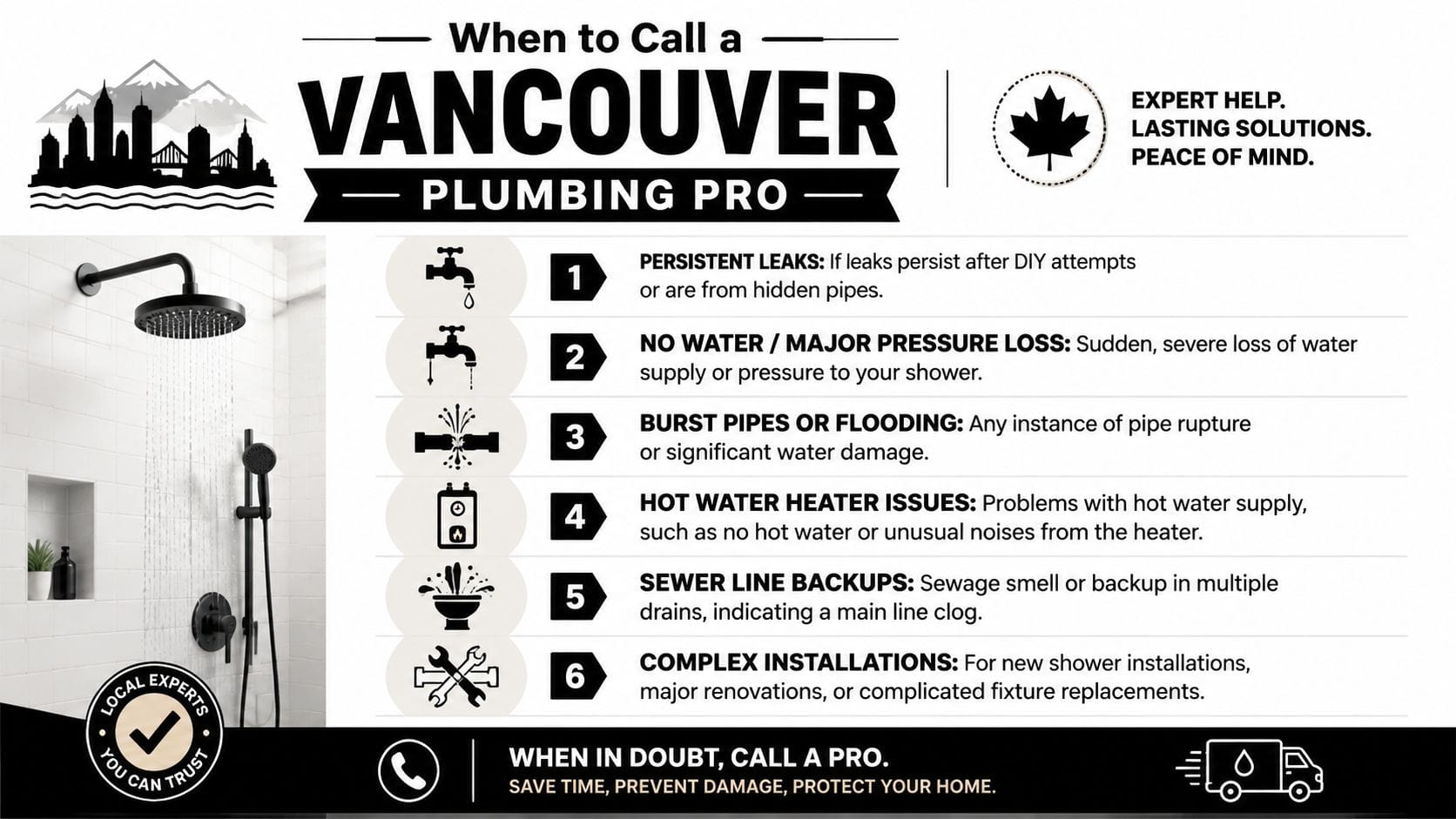
Call a plumber if you have any of these:
- Water sounds inside the wall after a repair: That can mean a hidden leak on the pressure side.
- Staining on ceilings or walls outside the shower: Water may be escaping the shower enclosure, drain, or supply piping.
- Sudden loss of hot water only at the shower after trim work: You may have debris in the valve or a balancing issue that needs proper diagnosis.
- A cracked valve body or broken trim screw in the wall: That often turns into opening the wall.
- Recurring drain backups affecting more than one fixture: That points to a branch or main line problem.
A practical example. You replace a shower cartridge in a Richmond condo, the drip stops, but you still hear a hiss behind the tile when the valve is on. That's a stop-and-call moment. The visible symptom changed, but the hidden leak risk didn't.
For a quick gut-check on what counts as urgent, this guide on what is considered emergency plumbing is a useful reference.
Why strata showers are different
A house gives you more freedom. A strata unit doesn't. In Greater Vancouver multi-unit buildings, plumbing emergencies account for 25% of residential water damage claims, and those costs are 40% higher than in single-family homes. Local strata managers increasingly use acoustic leak detection and trenchless epoxy relining because those methods can resolve 85% of corroded pipe issues without demolition, as described in this strata plumbing overview.
That matters if you own or manage a condo in Richmond or Burnaby. A small shower leak can affect shared walls, neighbouring units, insurance reporting, and access rules. DIY work that would be manageable in a detached house can become a much bigger problem in a tower or wood-frame strata building.
In a strata property, “I'll just open the wall and take a look” can create more trouble than the original leak.
If you suspect a shower pan leak, riser issue, or leak in a shared wall, get the building involved early. Even when the repair itself is simple, the reporting and access side usually isn't.
What a pro does differently
Professional diagnosis isn't just about having stronger tools. It's about narrowing the failure point before anything gets cut open.
Here's what usually separates a solid service call from guesswork:
- Targeted leak detection: Acoustic tools help trace hidden water movement without opening tile first.
- Valve identification: Plumbers match the exact cartridge, trim family, and failure mode before ordering parts.
- Drain confirmation: A camera or proper test can tell whether the shower clog is local or tied to a larger line issue.
- Repair containment: The goal is fixing the fault while disturbing as little finished surface as possible.
In older Vancouver and New Westminster homes, pipe material matters too. If a shower ties into ageing lines, brittle fittings, or previous handyman work, the “simple repair” can unravel fast once parts are disturbed. That's where experience saves money. Not because the repair is glamorous, but because someone knows what usually breaks next.
Keeping Your Shower Healthy and Your Home Safe
Most shower problems start small. A drip, a weak spray, a slow drain, a diverter that doesn't quite hold. Those are often manageable if you work in the right order and stop before a trim-side repair becomes a wall repair.
The safest approach is simple. Clean what you can see, replace straightforward wear parts carefully, and pay attention to what the symptom is telling you. If the leak is hidden, the drain problem spreads to other fixtures, or the shower sits in a strata building with shared risk, it's time to hand it off.
A practical example. Cleaning a scaled showerhead or pulling hair from a drain is a good Saturday job. Hearing water inside a condo wall after you've shut the shower off is not.
If you're in Vancouver, Richmond, Burnaby, New Westminster, Delta, Surrey, or nearby, quick action matters. Small shower issues have a way of becoming drywall, flooring, and insurance problems when they sit too long.
If your shower leak, clog, or pressure problem has gone past the DIY stage, book service with Encano Plumbing & Drainage Ltd.. Their team handles emergency and scheduled plumbing work across Greater Vancouver, including Vancouver, Richmond, Burnaby, New Westminster, Delta, and Surrey. If you need a proper diagnosis, a clean repair, or help fast when water is getting where it shouldn't, they're a reliable local call.
Prepared with Outrank tool