You wake up in Richmond to a cold house, the windows are damp, and the furnace is trying to start but never quite gets there. Or it starts, makes an ugly noise, then shuts itself off. That's the moment you go from mildly annoyed to properly worried.
A gas furnace problem feels urgent because it is. In Metro Vancouver, heat isn't a luxury during winter. It's basic protection for your home, your pipes, and everyone living inside. The good news is that some furnace failures are simple. The bad news is that some are safety issues, and homeowners often can't tell the difference at first glance.
Gas furnace repair works best when you follow a calm order. Start with the safe checks that cost nothing. Listen for clues. Watch for red flags. Then know when to stop and call a licensed gas fitter. In Richmond especially, where many homes have older gas equipment alongside newer electrification upgrades, the main decision often isn't just “How do I get heat back today?” It's also “Is this furnace still worth repairing?”
Table of Contents
- Your Furnace Stopped Working Now What
- Initial Troubleshooting You Can Do Safely
- Decoding Your Furnace's Strange Noises
- Red Flags That Demand a Call to a Licensed Gas Fitter
- A Pro's Diagnostic Process What We Check
- Gas Furnace Repair Costs in Metro Vancouver and When to Replace
- Keeping Your Home Warm and Safe Year-Round
Your Furnace Stopped Working Now What
The first job is simple. Don't panic and don't start taking panels off the furnace.
Most no-heat calls begin the same way. The thermostat is calling for heat, the house is cooling down fast, and the owner is already thinking the worst. Sometimes it is a failed part. Sometimes it's just a blocked filter, a switched-off service switch, or a thermostat issue. The right move is to rule out the safe basics before assuming the furnace is done.
Start with urgency, not guesswork
Treat the situation in this order:
- Check whether it's a comfort problem or a safety problem. If you smell gas, see soot, or your carbon monoxide alarm has gone off, stop there and move to emergency action.
- If there are no safety signs, do the homeowner-safe checks. Thermostat, filter, power, and visible furnace status.
- If the furnace still won't run properly, book a proper diagnosis. Gas heating faults often look similar from the outside.
A practical example. A Richmond homeowner may say, “The furnace is dead.” What that often means in reality is one of three things: the blower runs but there's no heat, the unit clicks but won't ignite, or it heats briefly and then trips out. Those are different faults, and each points to a different next step.
Practical rule: If the furnace issue involves gas smell, flame appearance, venting, soot, or carbon monoxide concerns, it's no longer a DIY problem.
What matters in Richmond and Vancouver homes
Local housing stock changes the conversation. In Richmond, Burnaby, and East Vancouver, there are plenty of homes with older ductwork, retrofit thermostats, and furnaces that have had years of stopgap repairs. That's why the same symptom can have two very different causes. A whistle might be a dirty filter in one house and a chronic duct restriction in another. A shutdown might be a minor control issue, or it might be a furnace protecting itself from unsafe operation.
The goal is to get your heat back safely, not just quickly. That starts with the checks you can do yourself.
Initial Troubleshooting You Can Do Safely
If there's no gas smell and no carbon monoxide alarm, start with the lowest-risk items. The most defensible diagnostic order for gas furnace repair is to verify the thermostat call for heat, check the air filter, confirm gas supply and pilot or ignition status, then inspect electrical supply and error codes before moving to component testing, as outlined in this furnace repair workflow guide. That same guide notes that replacing a dirty filter can restore airflow and save 5–15% on energy costs.
Check the thermostat first
Set the thermostat to Heat and raise the set temperature above the current room temperature. If it uses batteries, replace them. Dead or weak batteries can make the thermostat look alive while failing to send a proper call for heat.
Also check the schedule. A lot of “furnace failures” are really thermostat settings that got changed during a cold night, after a power interruption, or during a recent renovation.
Look for these clues:
- Blank display: The thermostat may have lost power or batteries.
- Display is on but no response: It may not be calling the furnace.
- Heat is selected but fan only runs: That points away from the thermostat and toward furnace controls, ignition, or safety lockout.
A simple example. A tenant complains there's no heat. The property manager arrives ready to book a repair. The thermostat is still set to an old weekday schedule and never called for morning heat.
Pull the filter before you do anything else
A blocked filter is one of the most common reasons a furnace shuts down or short cycles. Restricted airflow can overheat the unit and trigger safety limits.
Take the filter out and look at it in good light. If it's packed with dust, pet hair, or renovation debris, replace it. Don't just tap it clean and slide it back in.
A furnace that can't breathe won't run properly, even if every major part is still working.
A practical Richmond example. In one strata building, the complaint was “three suites have weak heat.” The actual problem was less dramatic. Two return filters were completely loaded up and airflow had collapsed. That isn't rare, especially after drywall work, flooring replacement, or long stretches without maintenance.
For cooling issues in the warmer months, many of the same airflow principles show up in air conditioning repair service calls, which is why filter condition matters year-round.
Here's a quick visual guide before you move on:
Confirm power and visible furnace status
Before assuming a failed part, check the basics around the furnace:
- Service switch: Furnaces often have a nearby switch that looks like a regular light switch. It may have been bumped off.
- Breaker panel: Reset a tripped breaker once. If it trips again, stop there.
- Furnace panel door: Some systems won't run if the access panel isn't seated properly.
- Status light or error code: Many furnaces show a blinking fault code through a small viewing port.
Then look and listen. Is the inducer motor starting? Do you hear clicking? Does the blower come on? Does it try to ignite and fail? That information matters when a technician arrives.
What you can check, and what you shouldn't
Safe homeowner checks include thermostat settings, filter replacement, breaker inspection, switch position, and visible status codes. What you should not do is start testing live voltage, opening gas connections, bypassing safety controls, or trying to clean burners and flame sensors without knowing the sequence and risks.
If the basics don't solve it, the next clues usually come from sound.
Decoding Your Furnace's Strange Noises
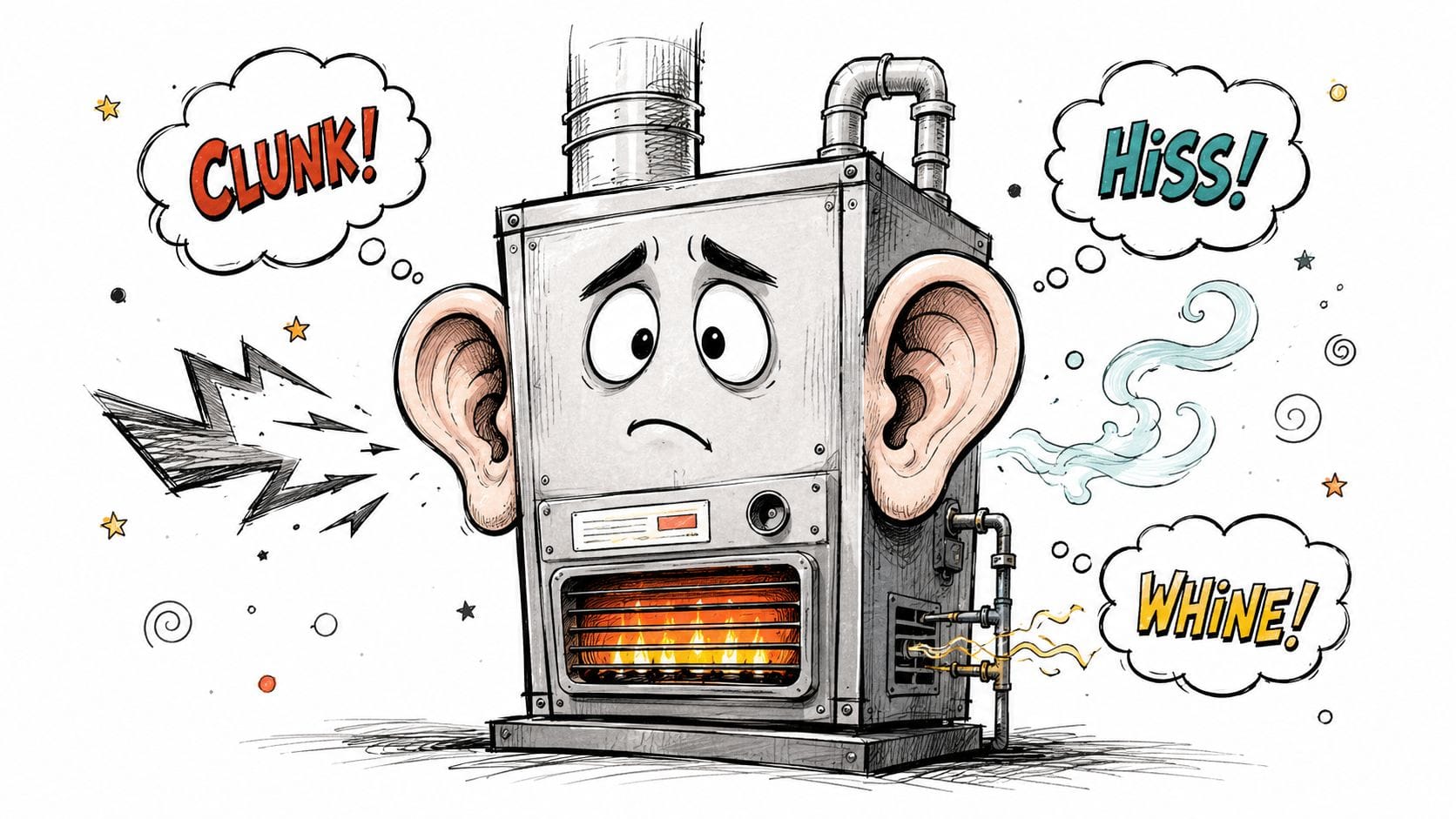
A noisy furnace is often more useful than a silent one. Sound tells you where in the operating sequence the problem is showing up. The trick is knowing which noises suggest a manageable airflow issue and which ones point to combustion or mechanical trouble.
The loud bang on startup
That sharp bang or boom when the furnace lights is a red flag. The usual concern is delayed ignition. Gas builds briefly before lighting, then ignites all at once instead of smoothly.
That's not a “watch it and see” issue. Repeated delayed ignition puts stress on the furnace and needs professional diagnosis. The cause can be related to ignition, burner condition, or gas delivery, but the safe response is the same. Turn the unit off and book service.
A practical example. If your furnace starts normally for weeks and then suddenly begins making one hard bang each cycle, don't keep running it through a cold spell hoping it settles down. It usually doesn't.
Whistling and rushing air
A whistle usually points to airflow restriction. Start with the filter, then check whether supply and return grilles are blocked by rugs, furniture, or closed doors. In some homes, the sound comes from undersized or poorly balanced ductwork, but that's not something a homeowner can diagnose accurately from the hallway.
Use this rule of thumb:
- Soft airflow hiss: Often normal.
- Sharp whistle at the return or filter slot: Check the filter first.
- Whistle that continues after a new filter: Call a technician to assess airflow and static pressure issues.
If a new filter changes the sound immediately, you've learned something useful. The furnace was struggling for air.
Scraping, screeching, and metal-on-metal sounds
A scraping or screeching sound usually means something mechanical is wrong in the blower assembly or motor area. That could be a loose wheel, a failing bearing, or another moving part that's no longer running true.
This is not the time to keep “testing” the furnace every hour. Mechanical faults tend to get more expensive when the system is forced to keep running.
Repeated clicking without ignition
Clicking tells you the furnace is trying to start. If it clicks repeatedly and never establishes heat, the problem is often somewhere in the ignition sequence or safety chain. A homeowner can note the pattern, but shouldn't try to force ignition or tamper with controls.
A useful way to think about noise is this:
| Noise | Most likely meaning | DIY or Pro |
|---|---|---|
| Bang on ignition | Delayed ignition or burner issue | Pro immediately |
| Whistle | Airflow restriction or duct issue | DIY first, then Pro if it continues |
| Scraping or screeching | Blower or motor problem | Pro |
| Repeated clicking | Ignition sequence fault | Pro |
Noise diagnosis isn't about naming the exact failed part from the kitchen. It's about deciding whether the furnace can wait, needs a filter and airflow check, or needs to be shut down.
Red Flags That Demand a Call to a Licensed Gas Fitter
Some furnace symptoms are not repair clues. They're stop signs.
In British Columbia, gas work is a regulated trade. Gasfitter Level B certification applies to work on most residential appliances up to 400,000 BTU/h, which is why gas furnace repair is not handyman work, as explained in this overview of gas furnace certification and service decisions. If the problem touches combustion, gas piping, venting, or safety controls, the right person is a licensed gas fitter.
If you smell gas, leave first
Natural gas is the clearest emergency. If you smell rotten eggs or suspect gas near the furnace:
- Do not use switches, plugs, or electronics inside the home.
- Do not try to relight anything.
- Do not stay inside to investigate further.
- Leave the building and call the gas utility and a licensed contractor from a safe location.
For local emergency context, homeowners dealing with suspected gas issues should treat it like a gas leak repair situation in Vancouver, not a routine heating service call.
This is not optional. A gas odour changes the entire job.
Combustion warning signs people miss
Not every dangerous furnace shows up as “no heat.” Some keep running while operating badly.
Call a licensed gas fitter if you notice:
- Visible soot around the furnace or venting: Soot suggests combustion or venting trouble.
- A yellow or unstable burner flame: Gas furnaces should not be left to run with suspicious flame behaviour.
- Excess moisture on windows with furnace issues: Sometimes that points to venting or combustion problems, especially when paired with poor furnace performance.
- A carbon monoxide alarm: Leave the home and treat it as an emergency.
A furnace can produce heat and still be unsafe.
Why BC licensing matters
People sometimes ask why they can replace a thermostat battery but can't “just swap a gas part.” The answer is that gas furnace components don't work in isolation. Ignition, gas flow, combustion air, venting, limit controls, and heat exchange all interact. A wrong repair can create a larger hazard than the original fault.
A practical example. A homeowner sees soot and assumes the furnace just needs cleaning. A licensed gas fitter sees soot and asks the right questions first: Is the vent blocked? Is combustion incomplete? Did a safety switch trip for a reason? Has the heat exchanger been compromised? Those are not cosmetic questions.
If any safety red flag is present, don't troubleshoot deeper. Shut the system down and call the right trade.
A Pro's Diagnostic Process What We Check
A proper furnace service call starts with one question. Is the unit failing, or is it protecting the house by shutting itself down?
That distinction changes the whole job. In Richmond and across Metro Vancouver, I see homeowners spend money on the wrong part because the furnace symptom looked simple from the outside. A board gets blamed when the actual problem is airflow. An igniter gets replaced when the fault began with pressure proving or venting. Good diagnosis prevents that kind of waste and checks whether the furnace is safe to put back into service.
The first stage is controlled diagnosis
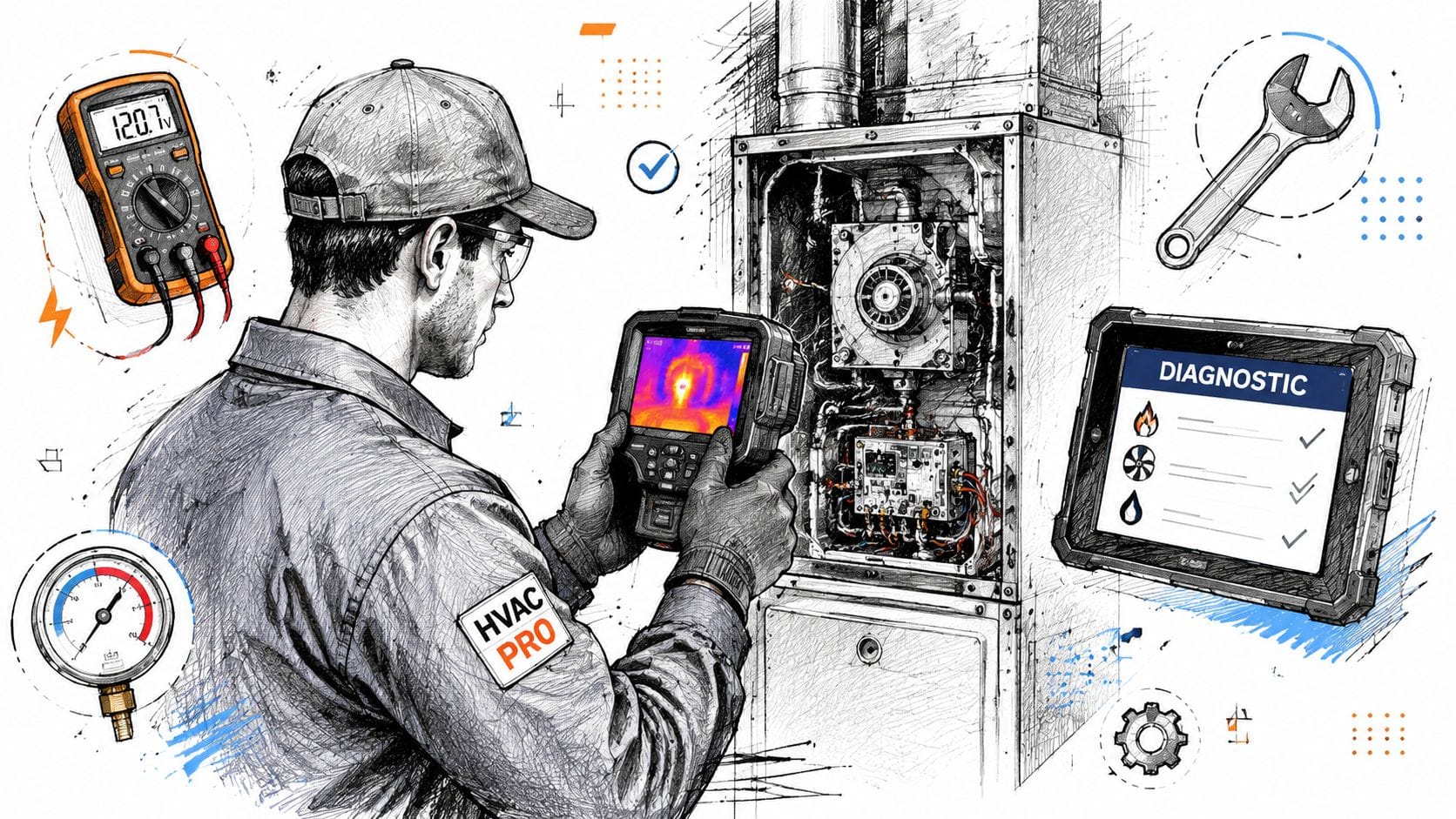
We start by watching the furnace try to run. Sequence matters. A trained gas fitter checks what happens first, what never happens, and what safety control stops the cycle.
Typical professional checks include:
- Electrical verification: line voltage, low voltage, board response, wiring condition, and stored fault codes
- Ignition sequence review: inducer start-up, pressure switch operation, igniter performance, burner light-off, and flame sensing
- Airflow assessment: filter condition, blower operation, temperature rise, duct restrictions, and signs of repeated limit trips
- Gas-side checks: gas valve response, manifold behaviour, and whether the control sequence matches the furnace design
- Venting and condensate checks on high-efficiency units: intake and exhaust condition, drain routing, and blockage or freeze-related issues that show up often in our wet coastal climate
Tools become critical at this stage. A multimeter helps isolate electrical faults. Temperature readings show whether the furnace is overheating. Combustion testing helps separate a performance complaint from a safety problem.
Heat exchanger screening and carbon monoxide risk
One check homeowners cannot do properly is heat exchanger screening. A licensed technician may run the blower without heat and use flame or smoke movement as a screening method, then verify concerns with an inspection camera before recommending major work, as shown in this heat exchanger diagnostic demonstration.
That matters for two reasons. A bad call on a heat exchanger can push a homeowner toward replacement before it is justified. Missing a real defect can leave an occupied home with a serious combustion hazard.
A screening test raises or lowers concern. It does not replace a qualified inspection and judgment call.
This part of the visit often gets skipped in generic homeowner advice. Swapping a part is only one piece of furnace repair. The technician also needs to confirm safe combustion, proper venting, normal safety control operation, and whether the repair makes financial sense on that specific unit in the Lower Mainland market.
One service option in the area is Encano Plumbing & Drainage Ltd., which provides heating and gas service in Greater Vancouver. Homeowners comparing repair against replacement can also review this guide on how much a new furnace costs in Metro Vancouver. The company name matters less than the license, gas certification, and whether the technician follows a real diagnostic process instead of guessing.
Why proper diagnosis saves money
Guessing gets expensive fast.
I have seen a restricted filter and weak blower performance mistaken for a failed control board. I have seen venting faults create nuisance shutdowns that led to unnecessary parts replacement. In Richmond, older furnaces in damp crawlspace or garage installations also need careful inspection for corrosion, condensate issues, and vent deterioration before anyone talks confidently about "just fixing the one bad part."
A sound diagnosis should answer four questions before repair approval:
- What failed
- Why it failed
- Whether the furnace is safe after repair
- Whether the repair is sensible compared with replacement
That last point matters more here than many homeowner articles admit. In Metro Vancouver, labour, parts availability, furnace age, and venting configuration all affect the repair-versus-replace decision. A licensed gas fitter should be able to explain the trade-off plainly, not just hand over a parts quote.
Gas Furnace Repair Costs in Metro Vancouver and When to Replace
Most homeowners don't ask about gas furnace repair because they're curious. They ask because they want to know whether they're looking at a reasonable fix or the start of throwing money at an aging system.
The honest answer is that cost depends on diagnosis, parts access, furnace condition, and whether the job is routine or emergency. It's still useful to think in categories rather than trying to guess an exact invoice from a symptom.
Estimated 2026 Gas Furnace Repair Costs in Greater Vancouver
| Common Repair | Estimated Cost Range (CAD) |
|---|---|
| Thermostat replacement or reconfiguration | Varies by model and wiring complexity |
| Flame sensor cleaning or replacement | Lower-cost repair in many cases |
| Hot surface igniter replacement | Lower-to-mid range repair |
| Pressure switch or limit control diagnosis and replacement | Mid-range depending on cause |
| Blower motor or inducer motor work | Higher-cost repair |
| Control board replacement | Higher-cost repair |
| Heat exchanger-related diagnosis or replacement decision | Often where replacement enters the conversation |
No precise local cost figures are listed here because exact amounts vary widely by equipment, access, urgency, and parts availability. If anyone gives you a firm price for a furnace repair without diagnosis, take that carefully.
When repair still makes sense
Repair is usually reasonable when the furnace is otherwise in solid condition, the fault is isolated, and the system has been operating safely and consistently. A simple ignition or control issue on a well-maintained furnace is very different from a furnace that has recurring faults, venting concerns, and a history of uneven heating.
A practical example. If your Richmond home has a furnace that's been reliable and the problem is a straightforward ignition-related repair, fixing it is often the sensible move. If the same furnace has had repeated shutdowns, airflow complaints, noisy operation, and now another major issue, repair starts looking less attractive.
When replacement deserves a serious look
A useful field rule is this: if a repair is going to cost more than 50% of what replacement would cost, start evaluating replacement seriously. That rule isn't a law, but it helps stop people from sinking money into a unit that's near the end of its practical life.
For BC homeowners, the decision is more complicated than it used to be. Changing utility costs from BC Hydro and FortisBC, along with CleanBC heat pump incentives, mean an older gas furnace may be less economical long-term even if the immediate repair seems manageable, as noted in this discussion of furnace replacement considerations.
That's why you should compare more than the repair bill:
- Short-term fix: What gets heat back today
- Remaining service value: Whether the furnace is likely to stay dependable
- Operating cost direction: How local electricity and gas pricing affect the next few years
- Upgrade path: Whether this is the right time to move toward a heat pump or dual-fuel setup
If you're trying to benchmark the larger purchase side, this guide on how much a new furnace costs is a useful companion.
A cheap repair on an inefficient, unreliable furnace can be the most expensive choice over time.
For many Metro Vancouver owners, the right answer isn't “always repair” or “always replace.” It's to repair when the furnace is still a sound asset, and replace when the repair only postpones a bigger decision by one winter.
Keeping Your Home Warm and Safe Year-Round
The safest approach to gas furnace repair is straightforward. Check the simple things you can verify safely. Stop immediately when the symptoms point to gas, combustion, venting, or carbon monoxide risk. Then get a licensed gas fitter involved before a small heating problem turns into a safety problem.
For day-to-day reliability, keep the routine simple:
- Change the filter regularly: A dirty filter causes avoidable airflow trouble.
- Keep the furnace area clear: Don't crowd it with storage, paint, or household items.
- Watch for changes: New noises, odd smells, short cycling, and weak airflow all matter.
- Check vents and grilles: Make sure supply and return air can move freely.
- Book annual professional service: A real maintenance visit should include safety checks, not just a quick wipe-down.
A furnace doesn't need attention every day. It does need the right attention at the right time.
If your furnace has stopped heating, is making concerning noises, or you want a licensed opinion on whether to repair or replace, Encano Plumbing & Drainage Ltd. handles heating and gas service across Richmond, Vancouver, Burnaby, Surrey, and nearby communities. Reach out for a proper diagnosis, especially if the issue involves ignition, venting, combustion safety, or an older furnace that may no longer make financial sense to keep repairing.