Your furnace usually doesn't quit at a convenient time. It stops on a wet Vancouver evening, the house starts cooling off fast, the kids are already in blankets, and you're standing by the thermostat hoping it's just a setting. Most homeowners I talk to are in the same state when they start searching for furnace repair in Vancouver. They want heat back on, they want to know if it's dangerous, and they want a straight answer on whether this is a simple fix or the start of a bigger expense.
Here's the good news. Most furnace failures follow a pattern. If you know what to check first, you can stay safe, avoid making the problem worse, and give the technician the details that speed up the repair. A calm, methodical approach matters more than guessing.
A practical example. A Vancouver homeowner hears the furnace start, the blower runs for a minute, then the system shuts off again. They assume the whole furnace is dead. In real life, that kind of call can be anything from a dirty filter to an ignition fault to a blocked condensate trap on a high-efficiency unit. The point is simple. Don't panic, and don't keep resetting it over and over. Start with safety, then troubleshooting, then a proper diagnosis.
Table of Contents
- Your Vancouver Furnace Repair Guide
- Signs Your Furnace Needs Immediate Repair
- What to Do Before You Call for Service
- Common Furnace Problems We Fix in Vancouver
- Repair Versus Replacement A Vancouver Homeowner Guide
- The Encano Repair Process What to Expect
- Vancouver Furnace Repair Costs and FAQs
Your Vancouver Furnace Repair Guide
A furnace breakdown in Vancouver rarely feels minor. The weather here gets into the house quickly because the cold is usually damp, and that damp chill makes a home feel uncomfortable fast. If you're a landlord or managing a rental, the stress is even higher because tenants aren't calling to chat. They need heat restored and they need a clear timeline.
One common situation goes like this. It's late, the furnace is running, but the air from the vents feels cool. The thermostat says one thing, the rooms feel like another, and every restart leaves you more unsure. That's when homeowners start doing random things. They flip breakers, crank the thermostat, pull panels off, and sometimes turn a manageable repair into a longer service call.
The right move is simpler. Treat the problem like a system fault, not a mystery. Check the safe basics first. If the unit still won't heat properly, call for proper diagnosis and keep the information organized. The make of the furnace, what the thermostat shows, whether the blower runs, whether you smell anything unusual, and whether the problem started suddenly all help.
If you need broader context on home heating and cooling systems, this Vancouver heating and cooling overview gives useful background. For the immediate problem, though, focus on restoring safe, steady heat.
Most furnace problems are fixable. The mistake is waiting too long when the warning signs are already obvious.
A practical example. If your furnace worked yesterday, starts today, but won't hold heat through a full cycle, I'd first suspect airflow, ignition, venting, or condensate issues before assuming the whole unit is finished. That's why a proper diagnostic matters. It isolates the failure instead of swapping parts blindly.
Signs Your Furnace Needs Immediate Repair
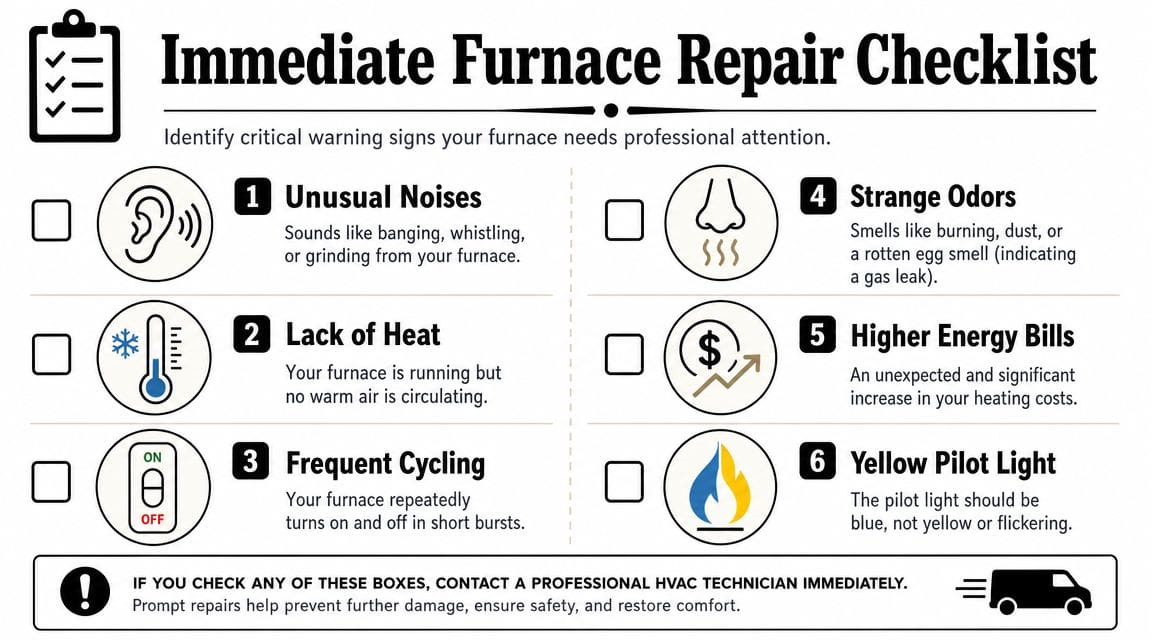
Some furnace issues can wait until morning. Some cannot. If you notice a strong odour, repeated shutdowns, no heat at all, or strange burner behaviour, stop treating it like a nuisance and treat it like an urgent repair.
Use this quick visual checklist first.
When a symptom becomes urgent
If the furnace is running but the house still isn't getting warm enough, don't shrug it off. In Vancouver, habitable rooms must be maintained at 18°C (65°F), and the standard is measured 3 feet above the floor, near the room centre and 2 feet in from exterior walls under the Vancouver heating requirement. For homeowners that means poor heat output needs real diagnosis. For landlords and property managers, it can become a compliance issue.
That's why “it's still kind of working” isn't good enough. A furnace that fires but can't deliver heat properly still has a problem.
Here are the warning signs I'd take seriously right away:
- No heat with the blower running: This often points to ignition, gas supply, flame sensing, or safety lockout issues.
- Short cycling: If the system starts and stops in bursts, it may be overheating, misreading temperature, or tripping a safety control.
- Banging, grinding, or whistling: Those sounds usually mean airflow restriction, a mechanical issue, or delayed ignition. None of those improve by waiting.
- Burning smell that doesn't clear: Dust burn-off at first startup is one thing. A persistent electrical or plastic smell is another.
- Rotten egg smell: Treat that as a gas emergency. Leave the area and call the gas utility and emergency services as needed.
- Pilot or flame looks wrong: A weak, unstable, or unusual flame needs a professional check.
What each warning sign usually means
A practical Vancouver example. A tenant tells the landlord, “The furnace is on, but the bedrooms are still cold.” That isn't enough information. The better questions are these: Are some vents weak? Does the blower keep stopping? Did the filter get changed recently? Is the unit venting properly? Is the furnace producing heat and losing it, or never producing enough heat to begin with?
This video helps homeowners understand the kinds of issues that show up during a furnace service call.
Practical rule: If the furnace smells wrong, sounds wrong, or can't keep the home warm, stop resetting it and get it checked.
Yellow or unstable flame, frequent restarts, and rooms that never reach set temperature all tell the same story. The furnace isn't operating normally. Whether the root cause is airflow, combustion, drainage, control failure, or venting, you want a licensed technician to test the system under load and confirm it can heat the home properly.
What to Do Before You Call for Service
You don't need to dismantle anything. You just need to rule out the simple faults safely. A lot of after-hours panic starts with a thermostat setting, a clogged filter, or a tripped breaker.
During a cold snap in Metro Vancouver, a furnace failure becomes a preparedness problem quickly. Guidance highlighted in BC winter outage and safety preparedness information stresses proper venting and carbon monoxide safety, especially when heating systems fail or are restarted. That matters most in homes with children, seniors, or tenants who can't wait in a cold unit for half a day.
Start with the safe checks
Go through these in order:
Thermostat setting
Make sure it's set to heat. Raise the setpoint enough to trigger a call for heat and listen for a response from the furnace.Filter condition
Pull the filter and look at it. If it's packed with dust, airflow drops, the furnace can overheat, and the system may shut itself down.Breaker and power switch
Check the electrical panel for a tripped breaker. Also look for the furnace service switch nearby. It sometimes gets turned off by accident.Vents and registers
Make sure supply vents aren't blocked by furniture, rugs, or boxes. Restricted airflow can mimic a bigger failure.Condensate area on high-efficiency systems
If you see obvious water around the unit, note it. Don't open up tubing or force anything loose, but tell the technician.
When to stop troubleshooting
There's a clear line. Don't cross it.
- If you smell gas, leave the area: Don't keep testing the unit.
- If you suspect venting or combustion trouble, stop resetting it: Repeated restart attempts can hide the symptom that the technician needs to see.
- If carbon monoxide alarms are involved, treat that as urgent: Get people out and follow emergency guidance.
- If the furnace starts then shuts down repeatedly, stop after basic checks: That pattern usually needs instruments and proper testing.
A practical example. Your thermostat calls for heat, the inducer starts, then the furnace shuts off before warm air reaches the rooms. You've checked the filter, the breaker, and the thermostat. That's the point to stop. You've done the right homeowner checks. Anything beyond that gets into ignition, pressure switch, control board, condensate, or venting territory.
Keep your notes ready when you call. Say what the furnace is doing, not what you think the part is. “It starts, runs for one minute, then shuts off,” is much more useful than “I think the sensor is bad.”
Common Furnace Problems We Fix in Vancouver
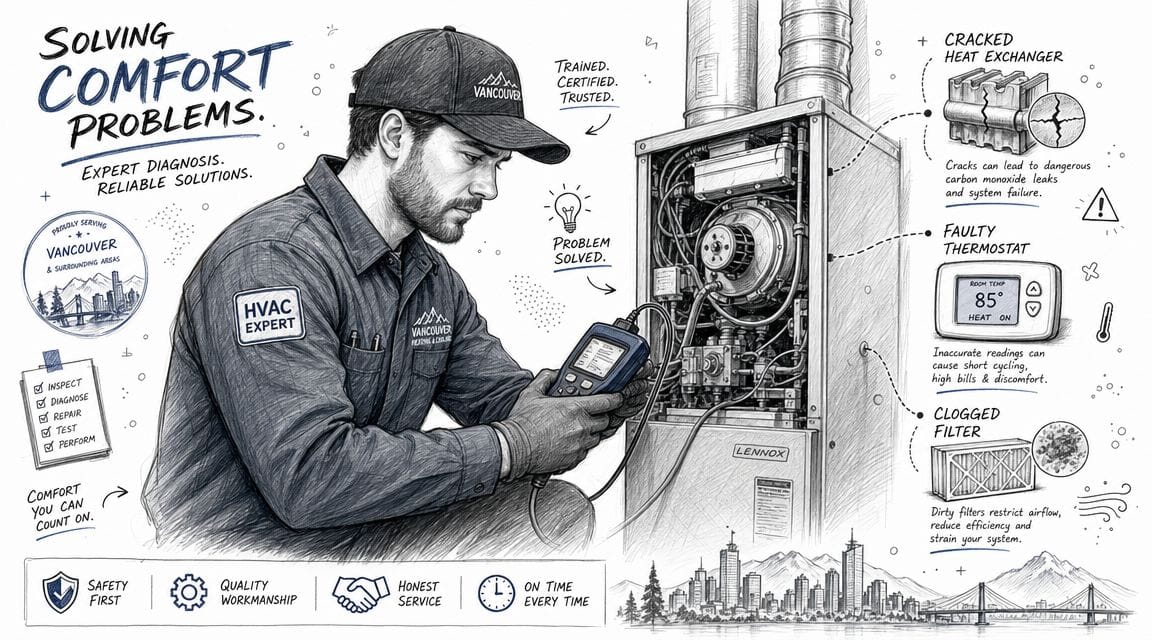
The symptom you notice is rarely the actual fault. Homeowners feel cold air, hear a noise, or see the furnace keep shutting off. The technician has to work backward from that symptom to the failed component, control issue, or installation problem.
The faults we see most often
Some problems are simple. Some are layered. These are the ones that show up again and again in furnace repair Vancouver calls.
Dirty or restrictive filters
This is the classic avoidable problem. Low airflow can overheat the furnace, trip safety limits, and make the system short cycle.Thermostat or control issues
Sometimes the furnace is fine and the control signal isn't. Loose connections, incorrect settings, or failing thermostat operation can make the system look dead or erratic.Ignition and flame-sensing problems
If the furnace starts but won't stay lit, flame proving may be failing. The unit often tries, shuts down, then retries.Blower and motor wear
A struggling blower can create weak airflow, overheating, noise, or poor heat delivery to far rooms.Limit switch trips
These are often symptoms, not root causes. If a safety control keeps opening, the underlying issue is usually airflow, heat buildup, or another fault upstream.
A practical example. A homeowner in Burnaby hears the furnace click on repeatedly, but only gets a short puff of warm air each time. They think the gas supply is cutting out. In many cases, the actual issue is restricted airflow causing the unit to overheat and shut itself down.
A Vancouver issue many homeowners miss
High-efficiency furnaces in this region often fail because of condensate trouble, not because the burner is ruined. UBC's technical requirements call for gravity drainage whenever possible, proper p-traps, and space for sloped condensate lines in UBC HVAC drainage guidance. That matters because a blocked trap, poor slope, or bad drainage path can shut down the whole unit even when the major components are still fine.
In Metro Vancouver's damp conditions, that's not a small detail. It's a common repair path.
A high-efficiency furnace can fail from a blocked condensate line while the heat exchanger, blower, and burner are still perfectly usable.
Here's a real-world style example. The homeowner reports, “The furnace works for a bit, then stops. We restarted it three times.” The technician checks the pressure and drainage side of the system and finds a clogged condensate trap. Clear the blockage, verify drainage, test the cycle, and the furnace returns to normal operation. That's exactly why guessing from symptoms wastes time.
If your system burns gas and you want model-specific service context, this gas furnace repair page is relevant. The key point is that proper diagnosis in Vancouver should always include airflow, combustion, venting, and condensate checks, not just visible parts swapping.
Repair Versus Replacement A Vancouver Homeowner Guide
Homeowners often find themselves in a quandary. The furnace can be repaired, but should it be? That's a different question, and it deserves a blunt answer.
In BC, space heating is the largest part of a home's energy use, so the repair decision has major financial weight. The underlying issue, as noted in this discussion of repair versus replacement thinking for furnace owners, is whether the repair is a short-term patch or a value-preserving choice when you consider local utility costs. That's the right way to look at it.
When repair still makes sense
Repair it if the unit is otherwise sound and the fault is isolated. That usually means the furnace has been reliable, the heat exchanger and core components are in good condition, and the problem is specific enough that a repair restores confidence.
Good repair candidates often look like this:
- One clear fault, one clear fix: Ignition problem, control issue, blower component, drainage issue.
- The system has been dependable: Not a string of nuisance calls every season.
- Heat delivery was good before this breakdown: The house stayed comfortable without constant thermostat battles.
- You need a practical short-term solution: This matters for occupied rentals or if you're planning other home upgrades soon.
A practical example. Your furnace has worked steadily, then suddenly stops because of a condensate-related shutdown on a high-efficiency unit. That's a repair case. The system may have years of usable life left once the drainage issue is corrected and tested properly.
When replacement is the smarter call
Replace it when the furnace has become a recurring liability. If the unit keeps failing, heats unevenly, or needs increasingly invasive work just to get through winter, you're not preserving value anymore. You're subsidising an unreliable machine.
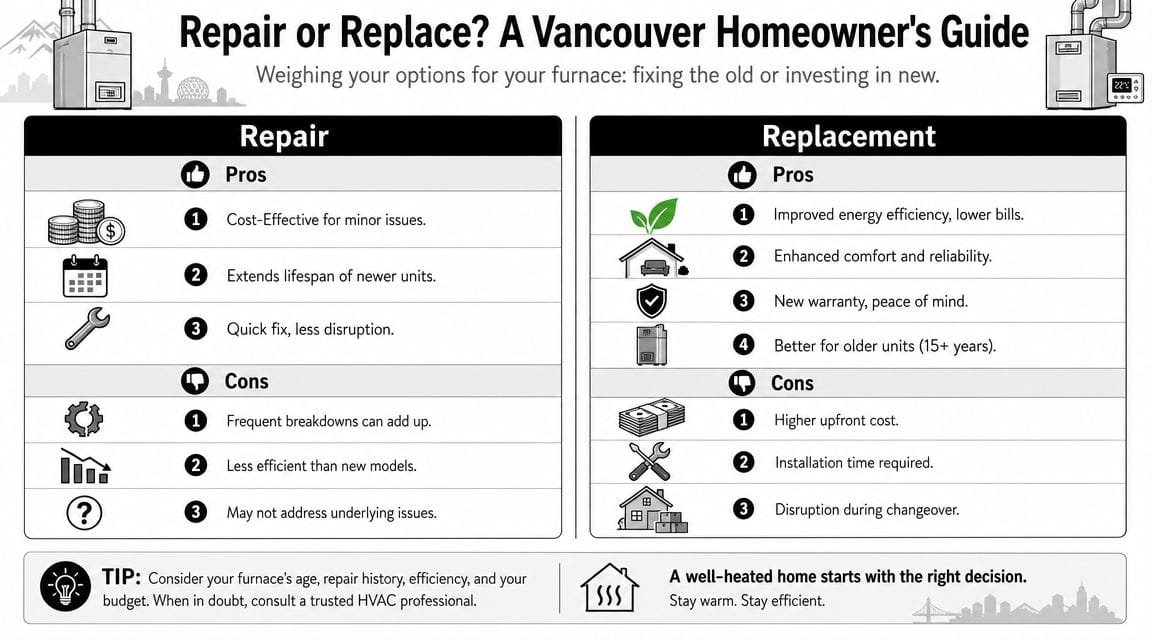
Landlords and strata managers should be even more decisive. Reliability matters because you're not just buying heat. You're buying fewer emergencies, less tenant disruption, and less risk of losing compliance during cold weather.
Here's the fast comparison.
| Factor | Consider Repairing If… | Consider Replacing If… |
|---|---|---|
| Breakdown pattern | This is an isolated problem | The same unit keeps failing |
| System confidence | You still trust it after repair | You expect another failure soon |
| Heat delivery | It heated the home properly before this issue | Rooms stay uneven or underheated |
| Budget logic | The repair restores usable life | Repairs feel like temporary patches |
| Property use | You can tolerate some risk | You need dependable heat for tenants or operations |
Straight advice: Don't put money into an old furnace just because it still turns on. Put money into the option that gives you dependable heat for the next heating season.
Another practical example. A homeowner has already paid for multiple service visits over recent winters, and the furnace still struggles to keep the house comfortable. Even if one more repair is technically possible, replacement is often the better financial decision because it stops the cycle of recurring calls and uncertain performance.
The Encano Repair Process What to Expect
A lot of the stress around furnace repair comes from not knowing what will happen after you call. Homeowners worry about delays, vague answers, and surprise charges. A proper service process should remove that uncertainty.
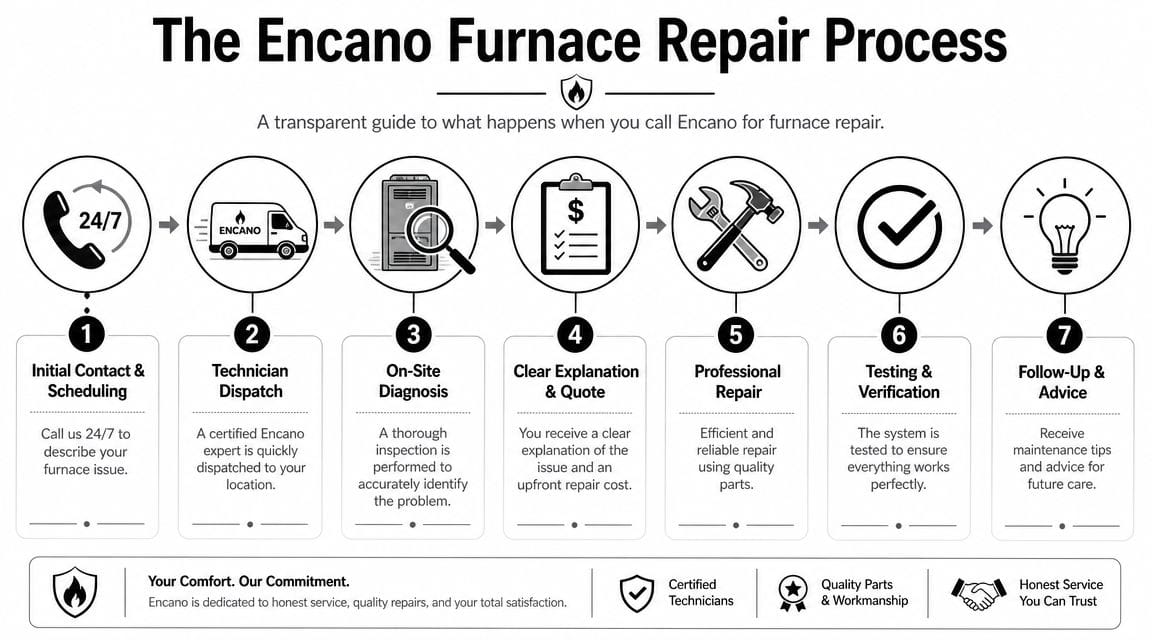
What happens from the first call
When you call for service, the useful information is simple. What the furnace is doing, when it stopped heating properly, whether there are unusual smells or noises, and whether anyone in the home has urgent comfort or health concerns.
If you're calling a local contractor such as Encano Plumbing & Drainage Ltd., the expectation should be straightforward communication, an appointment or dispatch window, and a technician who arrives ready to diagnose instead of guess. You shouldn't have to drag a clear explanation out of anyone.
A practical example. You report that the thermostat is on, the blower starts, but the house never warms up. That gives the technician a solid starting point before arrival and helps narrow the likely fault path.
What a proper repair visit should include
A professional furnace visit should follow a sequence like this:
Arrival and visual inspection
The technician checks the furnace, thermostat, venting area, drain setup if applicable, filter condition, and visible wiring or safety concerns.Diagnostic testing
This is the step that matters most. The technician verifies what the system is doing during an actual heat call instead of just looking at the unit while idle.Clear explanation before repair
You should hear what failed, why it failed, and whether the repair makes sense.Approval before work begins
No homeowner likes surprise billing. The scope and cost should be discussed before the repair starts.Post-repair verification
The furnace should be tested through operation, not just switched back on and abandoned.
If a technician can't explain the problem in plain language, keep asking questions. Furnace repair shouldn't sound like a secret.
The final part of the visit matters too. You should know what was repaired, what to watch for next, and whether there are any maintenance issues that need attention before they trigger another shutdown.
Vancouver Furnace Repair Costs and FAQs
What you can reasonably expect on cost
Repair pricing depends on the fault, the parts involved, access to the unit, and whether the call is urgent. I won't give you made-up ranges because that's how homeowners get misled online.
What I can tell you is this. In Vancouver, proactive annual furnace maintenance is advertised starting at $129 for a single forced-air furnace, and that service includes inspection, cleaning, filter replacement, thermostat calibration, and safety checks according to this Vancouver furnace maintenance pricing example. That's a useful benchmark because it shows how inexpensive routine care can be compared with emergency repair after a preventable failure.
The labour side of HVAC work also matters. Heating, air conditioning, and refrigeration mechanics and installers had a 2024 median wage of $59,810 per year and projected 8% employment growth from 2024 to 2034, with about 40,100 openings per year on average in the U.S. Bureau of Labor Statistics HVAC trade outlook. It's a U.S. benchmark, not a Vancouver-only figure, but it helps explain why qualified repair labour isn't bargain-basement work.
Common questions from Vancouver homeowners
Can I avoid some repairs with maintenance?
Yes. Dirty filters, neglected cleaning, drainage issues, and missed safety checks are common contributors to breakdowns.
How fast should I call if the furnace is still partly working?
Call sooner than you think. Partial heat often turns into no heat, and weak performance can signal a real safety or compliance problem.
Should I repair or replace?
If the fault is isolated and the furnace has been reliable, repair is often sensible. If the unit has become a repeat offender, replacement is usually the smarter spend.
What if I'm also pricing a new unit?
Use a service visit to get a proper diagnosis first, then compare that against your replacement options. This new furnace cost overview can help you frame the conversation.
If your heat is out, the safest move is a calm one. Shut the system down if you smell gas or suspect venting trouble, do the basic checks you can do safely, and then call Encano Plumbing & Drainage Ltd. for help. A reliable furnace solution is available 24/7, and the fastest way to lower stress is to get a proper diagnosis, clear repair options, and steady heat back in the home.