
A lot of boiler replacements in Metro Vancouver start the same way. It's a wet week, the house feels clammy instead of warm, and the old boiler that's limped through a few winters suddenly won't hold pressure, won't fire properly, or starts making noises you've never heard before. In a detached Vancouver home, that's stressful enough. In a Richmond townhouse or a Burnaby strata building, it can quickly turn into a coordination problem with tenants, neighbours, access, and approvals.
That's why boiler installation isn't just a matter of swapping one box for another. The right job starts with proper sizing, a realistic look at the home's pipework and electrical readiness, and local installation details that suit our climate. In Metro Vancouver, those details matter. A boiler that looks fine on paper can still perform poorly if the venting is wrong, the condensate line can freeze, or the installer sizes it around the old unit instead of the actual heating load.
Table of Contents
- Your Guide to Boiler Installation in Metro Vancouver
- Seven Signs Your Boiler Needs Replacing
- Choosing the Right Boiler for Your BC Home
- The Boiler Installation Process Step by Step
- Understanding Boiler Installation Costs in Metro Vancouver
- Permits Maintenance and Protecting Your Investment
- Your Next Step to a Warm and Efficient Home
Your Guide to Boiler Installation in Metro Vancouver
One of the most common situations is a homeowner who's been “getting one more season” out of an older boiler. It may still heat the house, but the comfort isn't right anymore. Upstairs rooms run hot, the main floor lags behind, domestic hot water feels inconsistent, and the mechanical room starts showing little warning signs like corrosion, staining, or frequent top-ups.
In Metro Vancouver, the decision often gets more complicated than people expect. A boiler replacement in a single-family house can involve vent routing, condensate drainage, control upgrades, and a check of the electrical panel. In a townhouse or apartment building, the same decision can involve resident notices, scheduled shutdowns, access to suites, strata approval, and planning around an aging central plant.
British Columbia has also changed the backdrop for this work. The province's move toward lower-carbon buildings through the BC Energy Step Code, introduced as a provincial framework in 2017, and the Zero Carbon Step Code, introduced in 2021, has increased demand for hydronic and high-efficiency boiler systems in many new and upgraded buildings, especially where hydronic distribution and domestic hot water integration are already part of the design, as described in this overview of boiler market trends and BC policy context.
A practical example: in an older Vancouver character home, a replacement might look straightforward until the site visit shows an undersized electrical panel and a poor condensate route. In a Richmond strata, the harder part may be scheduling the shutdown and access, not hanging the boiler itself.
Seven Signs Your Boiler Needs Replacing
A boiler rarely fails without warning. Most homeowners see a pattern first. The mistake is treating each symptom as a separate small repair when the system is really telling you the whole unit is near the end of useful service.

What homeowners usually notice first
Here are seven signs worth taking seriously.
It's making new noises
Clunking, whistling, banging, or a kettle-like rumble usually means something inside the system isn't moving heat and water the way it should. Sometimes that points to scale, trapped air, poor circulation, or heat stress in the exchanger.
Pressure keeps dropping
If you're topping up pressure again and again, there's a reason. It could be a leak, a faulty relief valve, an issue with the expansion side of the system, or a combination of small faults that add up to bigger reliability problems.
You've got leaks or staining
Active drips matter, but so do old rust marks, white mineral tracks, and dark stains under valves and fittings. Those signs often tell you water has been escaping for longer than you realised.
Rooms heat unevenly
When one area of the house gets hot and another stays cool, the problem isn't always the thermostat. Boilers near replacement age often show circulation and control issues that make the whole home feel unpredictable.
Practical rule: If the boiler works only after resets, pressure top-ups, or thermostat tricks, it's no longer working properly. It's being coaxed through the day.
When repair stops making sense
The remaining signs tend to show up once the system has already been struggling for a while.
Hot water has become inconsistent
If taps run hot then lukewarm, or recovery takes longer than it used to, the boiler may not be keeping up under normal household demand.Service calls are becoming routine
An occasional repair is normal. Repeated callouts for unrelated faults usually mean several parts are aging at the same time.The boiler smells, trips, or shuts down unexpectedly
Any unusual smell, repeated fault lockout, or irregular burner operation needs prompt professional attention. Even if the issue is repairable, frequent shutdowns are a sign the system is no longer dependable.
A simple example from the field: a Surrey homeowner might call about one leaking fitting, but on inspection the boiler also shows pressure instability, scaling noise, and an outdated vent layout. At that point, replacing a few parts may restore heat briefly, but it won't turn an exhausted system into a reliable one.
If you're seeing several of these signs together, replacement is usually the smarter conversation to have.
Choosing the Right Boiler for Your BC Home
The best boiler for your home isn't the one with the flashiest brochure. It's the one that matches the building, the number of bathrooms, the pipe layout, and how your household uses hot water.
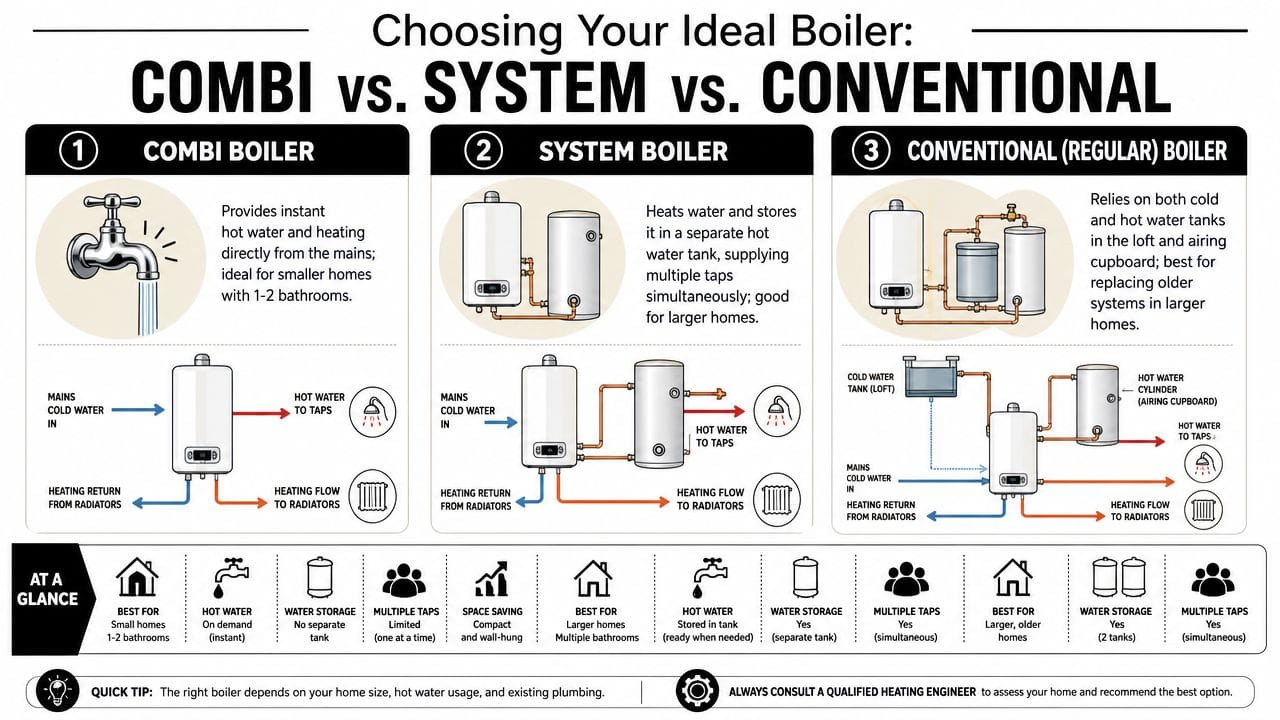
Combi system and conventional boilers in plain language
A combi boiler is the all-in-one option. It's a bit like a smartphone. One unit handles both space heating and domestic hot water directly, without a separate hot water cylinder. That can work well in smaller homes where space is tight and hot water demand is moderate.
A system boiler separates some of those jobs. This arrangement is similar to using dedicated devices instead of one all-in-one tool. The boiler heats the system, and hot water is stored in a separate cylinder. That's often a better fit for larger homes or households that need multiple taps or showers running at the same time.
A conventional boiler is usually found in older homes that already have a traditional arrangement with tanks and older distribution layouts. Replacing like-for-like can sometimes be practical when the rest of the house is built around that setup, but it's rarely the first choice for a modernised layout unless the property conditions really call for it.
A practical example: in a compact Vancouver bungalow with one main bath, a combi may fit well if the incoming water service and usage pattern support it. In a larger Richmond family home with several bathrooms and morning peak demand, a system boiler often gives steadier performance.
Boiler type comparison for Metro Vancouver homes
| Feature | Combi Boiler | System Boiler | Conventional Boiler |
|---|---|---|---|
| Space needed | Minimal, no separate hot water tank | Needs space for a cylinder | Needs the most space |
| Hot water delivery | On demand | Stored hot water available for higher simultaneous use | Works with traditional tank setup |
| Best fit | Smaller homes, suites, compact layouts | Larger homes, heavier family demand | Older homes with legacy heating layouts |
| Pipework changes | Can require more reworking in some retrofits | Moderate, depends on cylinder location | Often easier if replacing similar existing setup |
| Future flexibility | Good in the right house, but demand limits matter | Strong option where zoning and larger demand matter | Usually chosen when the existing house layout drives the decision |
For homeowners comparing options across heating systems more broadly, this overview of home heating and cooling choices is a useful starting point before you decide how a boiler fits into the bigger picture.
Why condensing usually makes the most sense
In British Columbia, the push for high-efficiency heating is driven by policy like the BC Energy Step Code and the CleanBC plan. These frameworks encourage the adoption of high-efficiency systems, like condensing boilers, during replacement cycles to reduce greenhouse-gas emissions. That makes your boiler choice not just a comfort decision, but a strategic upgrade aligned with provincial goals, as noted in this discussion of boiler trends and policy context.
That's why, in practice, a condensing boiler is usually the right starting point for a Metro Vancouver replacement discussion. The catch is that a condensing boiler only performs as intended when the system design supports it. Oversizing the boiler, leaving poor controls in place, or ignoring return-water temperatures can undercut the very efficiency you're paying for.
A good boiler choice matches the house first. Brand comes after that.
What works well:
- Load-based sizing instead of copying the old boiler nameplate.
- Controls that suit the household so the system isn't short-cycling.
- A realistic look at domestic hot water demand before choosing combi versus stored hot water.
What usually doesn't work:
- Picking by sticker price alone.
- Assuming newer always means simpler.
- Treating an older home's existing piping and controls as “close enough”.
The Boiler Installation Process Step by Step
A proper boiler installation should feel organised, not chaotic. The homeowner should know what's being changed, why it's being changed, and what needs to happen before the old unit comes off the wall.
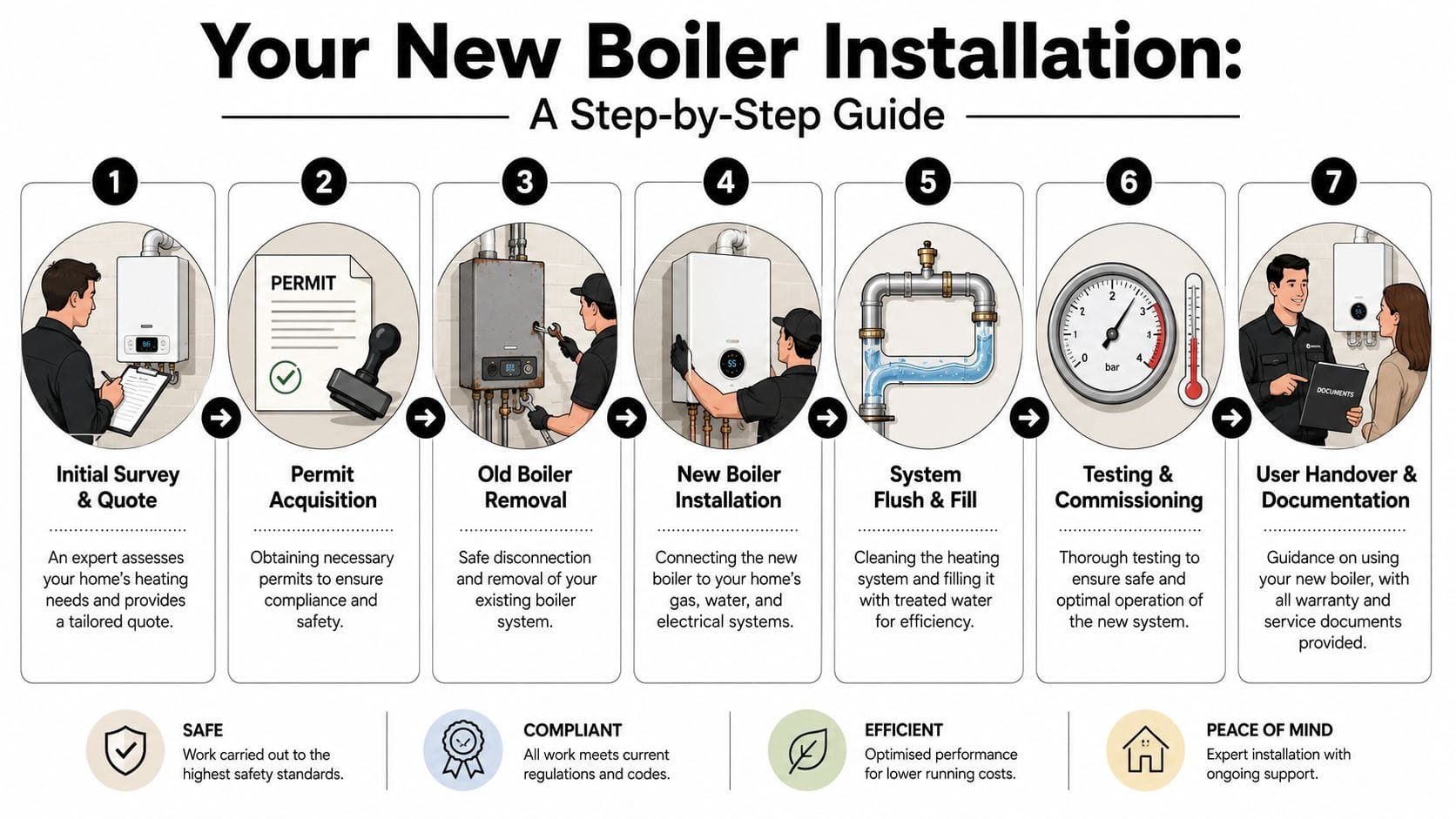
The survey before installation day
The first step is the site survey, during which the installer checks the heating load, distribution system, boiler location, venting path, drainage options, gas connection, controls, and service access. In older homes, this visit also reveals the surprises. Tight clearances, awkward pipe runs, patched wiring, or old valves that don't look bad until you touch them.
In British Columbia, proper condensing boiler installation should be based on the actual heating load, and sealed-combustion direct-vent installation is preferred whenever possible. Guidance also recommends at least a 20°F supply-to-return temperature difference under design conditions because lower return-water temperatures improve condensing performance. For cold-climate installation, intake and exhaust terminations should be above expected snow accumulation, and condensate needs an indoor drain or freeze-protected drain path, according to condensing boiler guidance from Building America and PNNL.
A practical example: in a 1980s Richmond house, the old boiler may have vented in a way that “worked” for years. That doesn't mean the new condensing unit should copy that setup. The new vent location has to suit the equipment and local winter conditions.
For homeowners who want to understand why sizing matters so much, this guide to checking heat loss in a house helps explain why a proper assessment beats guesswork.
Before the actual work starts, it helps to know what a professional install sequence looks like:
What happens on installation day
On installation day, the old boiler is isolated, drained, disconnected, and removed. If the replacement is like-for-like, this stage can be fairly direct. If the new system needs a different vent path, control layout, or piping arrangement, the work expands.
The new boiler is then mounted and connected to gas, water, venting, condensate, and electrical controls. This is also the point where good installers clean up pipework rather than burying problems behind the new appliance. If valves are seized, supports are poor, or access for future service is terrible, those issues should be addressed now.
What usually gets added or corrected during installation:
- Isolation and service valves so future maintenance doesn't become a major shutoff event.
- Control updates so the new boiler can operate properly with the home's heating zones.
- Drainage improvements for condensate routing in colder snaps.
- Pipe support and tidy routing so the finished work is serviceable, not just functional.
Commissioning for Vancouver conditions
Commissioning is where a boiler installation becomes a heating system instead of just a newly mounted appliance. The technician checks operation under load, verifies controls, confirms venting and drainage, and adjusts the system so the boiler can condense properly instead of short-cycling.
If the commissioning is rushed, the job may look finished while the performance problems are just getting started.
In Metro Vancouver, winter isn't severe every day, but freezing events do happen. That's why local commissioning details matter. A condensate line that's exposed in the wrong place, or a vent terminal set too low, can cause nuisance shutdowns exactly when you need heat.
A good handover should include a walkthrough of controls, pressure basics, what normal operation sounds like, and what faults should prompt a call.
Understanding Boiler Installation Costs in Metro Vancouver
The question most homeowners ask first is fair: what drives the final bill? The answer is rarely just the boiler itself. In Metro Vancouver, the actual cost of boiler installation comes from the combination of equipment, labour, venting, controls, pipework condition, access, and what gets uncovered once the job starts.
What changes the price
A straightforward replacement in an accessible mechanical space usually costs less than a conversion or relocation. If the new boiler can use the existing layout with only sensible updates, the work is simpler. If the old setup has poor piping, outdated controls, awkward vent routing, or code issues, the price rises because the scope rises.
Here are the main cost drivers contractors look at:
Boiler type
Combi, system, and conventional setups don't involve the same materials or labour.Location and access
A clean utility room is easier than a cramped crawlspace, rooftop room, or shared strata mechanical area.Venting and condensate work
Condensing boilers often need a different vent strategy than the old unit.System condition
Old valves, corroded fittings, weak pumps, or dirty loops add work that shouldn't be skipped.Control upgrades
New boilers often need better integration with thermostats, zoning, or hot water priority logic.
A practical example: a boiler in a detached Burnaby home may be easy to replace physically, but if the vent route crosses a finished area and the heating zones need control correction, the labour picture changes quickly.
Will an older home need an electrical upgrade
This is one of the most overlooked parts of the job in older Metro Vancouver housing stock. Many boiler guides talk about gas, venting, and plumbing but ignore whether the home's electrical service can properly support a modern high-efficiency system and future upgrades.
A key consideration for boiler installation in older Metro Vancouver homes is electrical readiness. Many boiler guides overlook whether the property's electrical service can support a modern high-efficiency system. With BC's push towards electrification, assessing panel capacity during a boiler replacement is an important part of future-proofing the home, especially in places like Richmond and Burnaby with varied housing ages, as discussed in this article on high-efficiency gas boiler installation considerations.
Questions worth asking during quoting:
- Is there proper dedicated power available for the new boiler and controls?
- Is the panel full or near full?
- Will this replacement affect future heat pump or hybrid planning?
- Does the home have backup power expectations that need to be discussed now?
For homeowners comparing major heating upgrade budgets, this article on what a new furnace can cost helps frame how equipment, labour, and hidden scope often interact across heating projects.
Strata and multi-unit replacement costs
Boiler installation in a strata or multi-unit property has a different cost structure even when the equipment is familiar. Labour may include resident communication, planned shutdown windows, access management, coordination with building staff, and phased work to reduce disruption.
Common multi-unit budget issues include:
- Shutdown planning that has to happen around occupant schedules.
- Permitting and approvals that move more slowly than a single-family job.
- Restricted access to mechanical rooms, suites, or service corridors.
- Existing building constraints where older plant rooms don't give trades much room to work.
That's why the cheapest quote in a strata setting can become the most expensive mistake. If the contractor hasn't priced the logistics, the building pays for the confusion later.
Permits Maintenance and Protecting Your Investment
A boiler installation is only complete when the work is approved, documented, and set up for years of reliable service. In Metro Vancouver, that matters as much as the equipment itself. A clean startup means very little if the permit record is missing, the venting was rushed, or an older electrical panel was never assessed before the new controls were added.
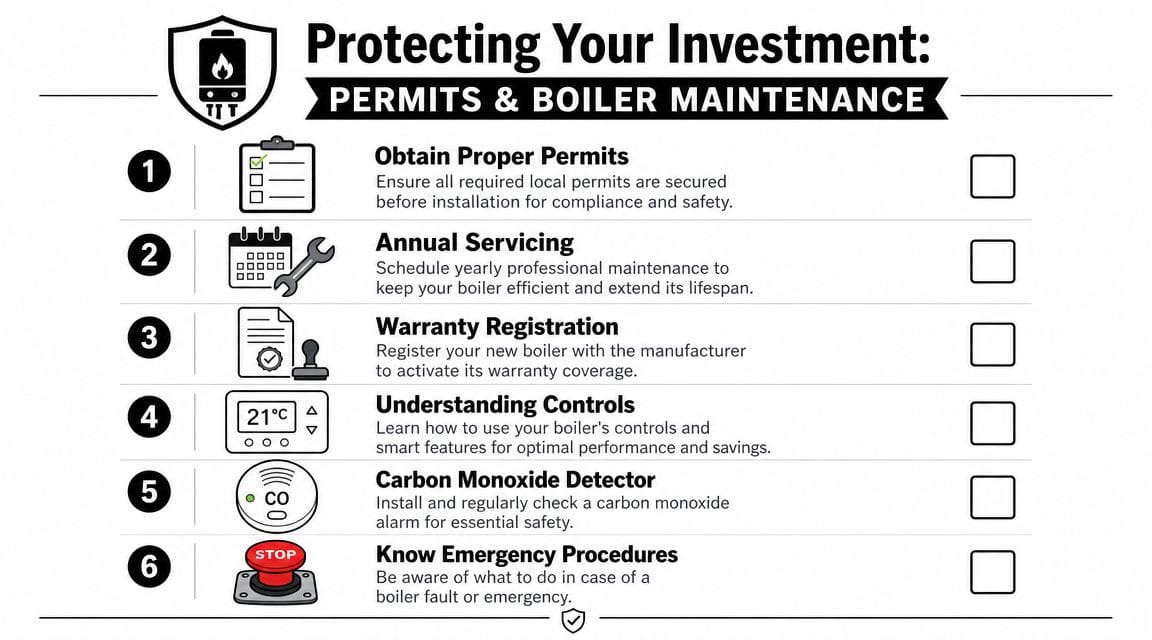
Why permits matter more than most homeowners think
Permits are the paper trail that shows the gas, venting, plumbing, and related work went through the proper process. If you sell the home later, deal with an insurance question, or need warranty support, that record can save a lot of trouble.
In older Vancouver houses, permits also force early attention to issues that get missed during rushed quoting. I see this with electrical capacity and control wiring. A new boiler may need updated wiring, a dedicated circuit, or room in the panel for controls and pumps. In a 1950s bungalow or a converted character home, that is not a small detail.
The stakes are even higher in strata and multi-unit buildings. Access approvals, shutdown scheduling, building management sign-off, and shared mechanical spaces all affect how the job is planned and inspected. If those steps are ignored, the building ends up dealing with delays, resident complaints, and change orders that should have been caught before installation day.
For higher-capacity systems, installation details inside the boiler room matter just as much as the permit itself. The ABMA boiler installation guide explains why pressure ratings, thermal expansion, pipe support, and nozzle loading need to be handled correctly to reduce stress and early equipment failure.
A contractor who avoids permits is raising a red flag.
Maintenance that protects the system
Even a well-installed boiler needs regular service. Annual maintenance helps catch common wear before it turns into a winter no-heat call, and that is especially important in our long damp heating season.
Good maintenance usually includes:
- Combustion and safety checks so the boiler is firing cleanly and operating within spec.
- Venting and condensate inspection because blocked drains, poor slope, and moisture issues are common service calls here.
- Pressure and expansion tank review to catch instability before it affects valves, pumps, or heat delivery.
- Control, thermostat, and circulation checks so comfort complaints do not turn into equipment strain.
- Visual inspection of piping and isolation points so future service is safer and less disruptive.
In multi-unit buildings, maintenance planning needs more coordination. Service access may require notice to residents, booking with building management, or scheduled entry into a shared mechanical room. In detached older homes, the weak point is often different. The boiler may be fine, but the panel, controls, or legacy wiring around the system can create nuisance shutdowns that look like boiler problems.
Skip service long enough and the system starts failing at the least convenient time.
Encano Plumbing & Drainage Ltd. handles boiler maintenance and related heating service work in Metro Vancouver for residential and multi-unit properties.
Questions to ask before you hire a contractor
Homeowners do not need to know every code detail. They do need clear answers.
Who is pulling the permit?
The answer should be specific, not vague.How are you sizing the boiler?
Replacing it with the same size is not a proper method on its own.What is your plan for venting and condensate?
These details affect reliability, service life, and code compliance.Have you checked the electrical panel and control requirements?
In older homes, this can change the scope and budget fast.If this is a strata or multi-unit property, who handles access, shutdown coordination, and building communication?
Those logistics should be priced and planned up front.What do I receive at handover?
Homeowners should get permit information, basic operating guidance, and service recommendations after the install.
Your Next Step to a Warm and Efficient Home
The right boiler installation solves more than a heat problem. It improves comfort, makes the system easier to live with, and reduces the chances of winter surprises. The key is matching the boiler to the building, not forcing the building to suit a boiler that looked good online.
For a Vancouver bungalow, that may mean a carefully sized condensing combi with a realistic look at hot water demand. For a Richmond family house, it may mean a system boiler with better zoning and stronger hot water delivery. For a Burnaby townhouse or larger strata building, the equipment choice may be only half the job. Access, shutdown planning, approvals, and future maintenance often matter just as much.
What works is a clear site survey, honest discussion of trade-offs, and installation details that suit Metro Vancouver conditions. What doesn't work is rushing the quote, guessing at sizing, or pretending older electrical and piping issues don't exist.
If your boiler is already showing failure signs, or you're planning ahead before the next cold stretch, the next smart step is a proper assessment of the system you have now and the one your property needs.
If you're planning boiler installation in Vancouver, Richmond, Burnaby, New Westminster, Delta, Surrey, or nearby areas, Encano Plumbing & Drainage Ltd. can arrange a site survey and quote for residential, strata, and commercial properties. A clear on-site review is the fastest way to sort out boiler type, venting, controls, access, and whether electrical or piping upgrades need to be addressed before work begins.