

You fill a glass from the kitchen tap, take a sip, and catch that faint swimming-pool note. Or you notice spots building up on a new black faucet, even though Metro Vancouver water has a strong reputation. In older parts of Vancouver, Burnaby, and Richmond, another concern often sits in the back of people's minds. What happened to the water after it left the treatment plant and travelled through the last stretch of pipe to the property?
That's where most filtration decisions start. Not with panic, and not with marketing claims about “purest water ever,” but with practical questions. Do you want better taste at the sink, protection for appliances, less chlorine in shower water, or a stronger barrier against dissolved contaminants from aging plumbing? If you're unsure what's in your water before choosing among water filtration system types, start with proper water quality testing guidance.
Table of Contents
- Why Vancouver Residents Consider Water Filtration
- Whole-House vs Point-of-Use Filtration
- The Core Water Filtration System Types
- Comparing Your Filtration Options Side-by-Side
- How to Choose the Right System for Your Property
- Installation and Maintenance with Encano Plumbing
- Frequently Asked Questions About Water Filtration
- Is water filtration really necessary in Metro Vancouver
- Will a whole-house system reduce water pressure
- Can I install an under-sink filter myself
- What's the best filtration type for chlorine taste
- When does reverse osmosis make more sense than carbon
- Is UV useful in a regular city-water home
- How often do filters need maintenance
Why Vancouver Residents Consider Water Filtration
Most Greater Vancouver properties don't need filtration because the municipal source is “bad.” They consider it because the water arriving at the tap isn't always the same as the water leaving the treatment plant. Treatment chemicals, building plumbing, fixture sensitivity, and a resident's own priorities all affect whether unfiltered tap water feels good enough for daily use.
A typical example is a Richmond homeowner who likes the safety of treated municipal water but doesn't like the chlorine smell in the first glass of the morning. Another is a Burnaby family in an older home that trusts the city supply but wants more control over what reaches the kitchen tap. A strata manager has a different problem altogether. Residents complain about taste, and the building also needs to protect valves, fixtures, and common-area equipment from avoidable wear.
Practical rule: In Vancouver-area plumbing, filtration is usually a last-mile decision. You're refining water for the property and the way people actually use it.
That distinction matters. Some people only care about drinking and cooking water. Others want every shower, laundry cycle, and appliance fill to start with cleaner water. Those are different jobs, and they lead to different system choices.
A good filtration plan usually starts with three plain questions:
- What bothers you today: Taste, odour, visible sediment, skin irritation, or concern about older pipes all point to different equipment.
- Where do you need treatment: One sink, one suite, one house, or a mixed-use building changes the layout.
- What are you trying to remove: Chlorine needs a different approach than sediment, dissolved metals, or microbes.
That's why sorting through water filtration system types by marketing category alone usually leads to the wrong purchase. “Premium,” “advanced,” and “7-stage” don't mean much if the system doesn't match the actual problem.
Whole-House vs Point-of-Use Filtration
The first decision isn't carbon versus RO or UV versus sediment. It's whole-house versus point-of-use.
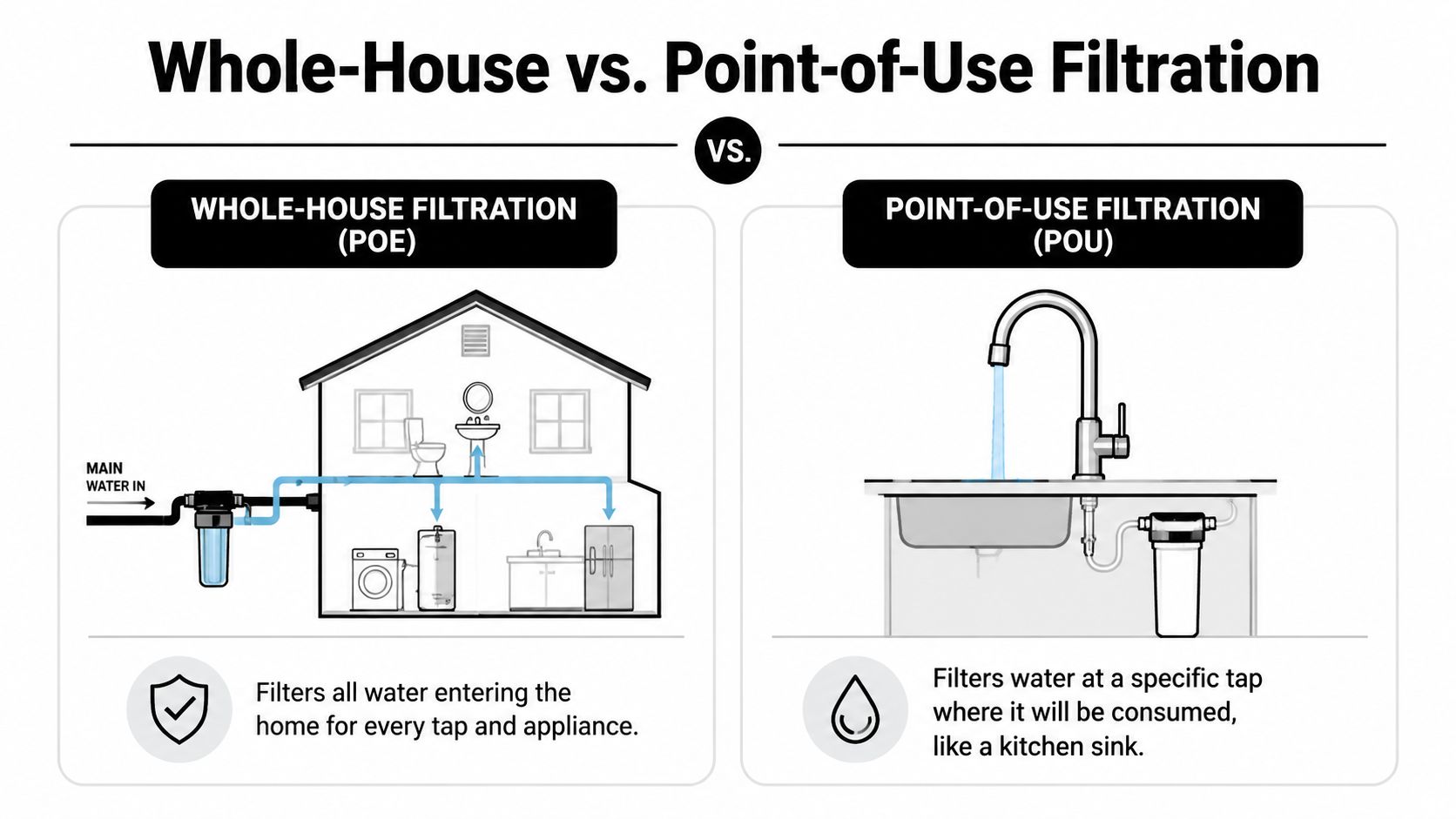
A whole-house system sits where water enters the building. Every tap, shower, toilet, appliance, and hose bib downstream gets treated water. A point-of-use system sits where you consume water, most often under the kitchen sink. If you're comparing sink-based options, this overview of under-sink water filter installation shows where these systems fit in a real plumbing layout.
Spot treatment versus full-property treatment
The easiest way to explain the difference is this. A point-of-use filter is like spot-cleaning a stain. A whole-house system is like washing the whole garment.
Point-of-use works when the concern is narrow and the drinking tap is the priority. That usually means better-tasting water, cleaner ice, and improved water for coffee, tea, and cooking. It's often the sensible choice when the rest of the home's water is acceptable and the budget is focused on the kitchen.
Whole-house filtration makes more sense when the issue affects daily living beyond drinking water. That includes chlorine smell in showers, sediment moving through old service lines, and protecting fixtures or water-using appliances.
What each option does well
Here's the practical split plumbers use on site:
- Whole-house filtration fits properties that need broad coverage: Better for shower water, laundry water, appliance protection, and reducing contaminants before they circulate through the building.
- Point-of-use filtration fits targeted quality upgrades: Better for drinking, cooking, ice makers, and situations where you want stronger purification at one tap.
- Combination setups often make the most sense: A sediment and carbon setup at the main line, plus reverse osmosis at the kitchen sink, is a common real-world pairing.
A lot of homeowners buy one system expecting it to solve every water issue in the house. That's usually where disappointment starts.
The trade-offs people miss
Whole-house systems need space, correct sizing, and proper bypass planning. If they're undersized, you'll feel it in flow and serviceability. Point-of-use systems are simpler and cheaper to isolate, but they don't help with shower water, scale on fixtures, or incoming sediment at the laundry and mechanical room.
For strata buildings and commercial units, the choice gets even more strategic. A whole-building system can improve consistency across many occupants, but a kitchen-specific or tenant-specific point-of-use setup may still be needed where water quality expectations are higher.
If you remember one thing, remember this. Point-of-use treats where you drink. Whole-house treats where you live.
The Core Water Filtration System Types
A Vancouver homeowner in a 1970s bungalow and a Richmond strata council are often shopping under the same label, "water filtration," but they usually need very different equipment. The useful way to sort the options is by what each system is built to remove, and what it will never do no matter how persuasive the box copy sounds.

Activated carbon for chlorine taste and odour
For Greater Vancouver municipal water, activated carbon is often the first filter type worth discussing. Metro Vancouver water is generally good quality, but chlorine disinfection still leaves some homes with a treated taste or smell, especially after water sits in the plumbing line or passes through older interior piping.
Carbon and carbon block filters are designed to reduce chlorine, taste, odour, and a range of organic compounds, depending on the cartridge and certification. Water Matters explains how drinking water filters are selected and what carbon filters are intended to reduce. In real homes, that usually translates into better tasting kitchen water and less chlorine smell at taps and showers if the system is installed at the right point.
That does not make carbon an all-purpose answer. It will not disinfect unsafe water. It also will not reliably remove every dissolved contaminant that concerns people in older properties.
For Vancouver-area owners, carbon makes the most sense when the complaint is practical and specific:
- Chlorine taste in drinking water
- Chlorine smell in showers or at bathroom taps
- Better tasting ice and cooking water
- A first treatment stage ahead of more specialized equipment
Reverse osmosis for dissolved contaminants
Reverse osmosis is a point-of-use tool for stronger reduction of dissolved contaminants. It is usually installed at a kitchen sink, bar sink, or dedicated drinking water tap, not across the whole building.
The membrane in an RO system handles a different job than carbon. It is used where the concern is no longer just taste and odour, but dissolved substances such as lead or other contaminants that can enter water through older plumbing components inside the property. That matters in parts of Vancouver, Burnaby, and New Westminster where aging homes still have older supply lines, legacy fittings, or plumbing that has been renovated in stages over decades.
RO has real trade-offs, and they matter in day-to-day use. Production is slower than a standard carbon filter. The unit needs space under the sink. It sends some water to drain during operation. Maintenance is more involved because pre-filters, post-filters, and eventually the membrane all need attention.
In practice, RO is usually the right fit for:
- Drinking and cooking water at one tap
- Occupants who want stronger contaminant reduction than carbon alone
- Homes with plumbing-related water quality concerns
- Small offices where staff care about drinking water quality, not whole-building treatment
The mistake I see is treating RO like a cure-all. It is a precision system for a limited use point. It will not protect a washing machine, improve shower water, or catch grit coming in from an older service line.
After the basics, it helps to see the systems in motion:
Ultraviolet purification for microbes
UV is disinfection equipment. It targets microorganisms by exposing water to UV-C light inside a treatment chamber. It does not remove sediment, chlorine, metals, or dissolved solids.
That makes UV a specialized choice in Greater Vancouver. On straight municipal water, it is usually not the first recommendation. It becomes more relevant on well-supplemented properties, mixed-source systems, rural-edge properties, or buildings that want an added microbial barrier for a specific risk profile.
The key installation point is simple. UV only works properly when the water reaching the chamber is clear enough for the light to penetrate. If sediment or turbidity is present, pre-filtration is part of the job, not an optional add-on.
For strata and commercial settings, UV can make sense where source conditions or risk tolerance justify it. For a typical detached home on Metro Vancouver municipal supply, carbon, sediment, or RO are more common starting points.
Sediment filters and specialty media
Sediment filters do basic but important work. They catch rust, silt, scale debris, and other particles before that material reaches fixtures or more expensive treatment stages. In Vancouver-area properties with older galvanized sections, aging building mains, or intermittent debris after utility work, this is often the filter that prevents nuisance problems.
Sediment filtration is also what keeps many multi-stage systems working properly over time. Without it, carbon cartridges load up faster, valves foul sooner, and UV performance can suffer.
For broader contaminant concerns, specialty media can be added based on the actual problem. The California State Water Resources Control Board device guidance outlines how different certified devices are matched to different contaminants, including the distinction between carbon treatment and systems certified for dissolved contaminants such as arsenic or nitrate. That is the practical lesson local owners need. Filter media has to match the target contaminant. One canister at the hardware store is not a treatment plan.
Ion exchange and softening systems also come up from time to time, especially where scale control is the goal. Those are conditioning systems, not direct substitutes for carbon, RO, UV, or sediment filtration.
The best setups in Greater Vancouver are usually layered. Sediment handles particles. Carbon handles chlorine and taste. RO handles drinking water at a specific tap when stronger reduction is needed. UV is added only when there is a real microbial reason for it. That is the difference between a system that looks good on paper and one that fits the property.
Comparing Your Filtration Options Side-by-Side
A Vancouver homeowner in a newer condo usually wants better-tasting drinking water. A strata in an older building may be dealing with sediment after pipe work or debris moving through aging mains. A small café may care less about shower water and more about protecting equipment and serving water that does not smell like chlorine. The right system changes with the property.
Here is the practical side-by-side view.
Water Filtration System Comparison for Greater Vancouver
| System Type | Removes | Best For | Initial Cost | Annual Maintenance |
|---|---|---|---|---|
| Activated Carbon | Chlorine, taste, odour, some VOCs and disinfection byproducts | Metro Vancouver properties on municipal water that want better taste and less chlorine smell at the tap or throughout the building | Moderate, depending on cartridge size, housing, and whether it is point-of-use or whole-house | Regular cartridge replacement |
| Reverse Osmosis | Dissolved contaminants that carbon does not reliably reduce on its own | Kitchen drinking water where stronger reduction is wanted, especially in homes with older interior plumbing or owners who want a dedicated drinking tap | Higher than basic carbon because it adds multiple stages, storage, and drain connections | Pre-filter, post-filter, and membrane replacement |
| UV | Microorganisms, if the water is already clear enough for UV to work properly | Well water, mixed-source properties, and buildings that need an added disinfection barrier rather than better taste | Varies with flow rate and chamber size | Annual lamp replacement and periodic sleeve service |
| Sediment | Rust, silt, sand, and debris | Older properties, strata mechanical rooms, and any multi-stage setup that needs upstream protection | Usually the lowest-cost starting point | Cartridge changes based on how dirty the incoming water is |
Cost stays qualitative here because installation conditions matter. A simple under-sink carbon unit in a Vancouver condo is one kind of job. A main-line filter in a North Van house with limited access at the water entry is another. In strata and commercial spaces, flow rate and service access often drive the budget more than the filter body itself.
The trade-offs are straightforward.
Carbon is usually the best first move for municipal water in Greater Vancouver. It addresses the complaint people notice first, chlorine taste and odour. It also works well for cooking, coffee, and ice. The limitation is scope. It is not the right answer when the concern is dissolved contaminants that need a different treatment method.
RO is the specialist. It belongs at a drinking-water tap, not as a default whole-building solution. It gives stronger reduction for dissolved contaminants, but it costs more, takes more room, and needs more maintenance discipline. For many Vancouver-area homes, that trade makes sense in the kitchen and nowhere else.
UV solves a different problem entirely. It does nothing for chlorine taste, rust, or sediment. It is chosen for microbial risk. On municipal water in most Greater Vancouver homes, that is usually not the first tool to reach for. On a property with a private source or a site-specific reason for extra disinfection, it can be the right add-on.
Sediment filtration is often the least glamorous part of the system and one of the most useful. In older buildings around Vancouver and Burnaby, or anywhere there is debris after utility work, it protects valves, cartridges, appliances, and downstream treatment equipment. If a property has visible particles or recurring cartridge fouling, sediment should be part of the conversation early.
At Encano Plumbing, this is usually how the comparison lands in real jobs. Carbon improves day-to-day water use. RO improves drinking water at one tap. Sediment protects the system. UV is only justified when the water source or risk profile calls for it.
Choose based on the actual water problem, the property layout, and the maintenance the owner will realistically keep up with.
How to Choose the Right System for Your Property
A Vancouver homeowner notices chlorine taste at the kitchen tap. A Burnaby strata council gets complaints after plumbing work stirs up debris in older lines. A café in Richmond keeps paying for scale and filter changes because the water treatment was chosen off a product sheet instead of the actual plumbing setup. Those are three different jobs, and they usually need three different answers.
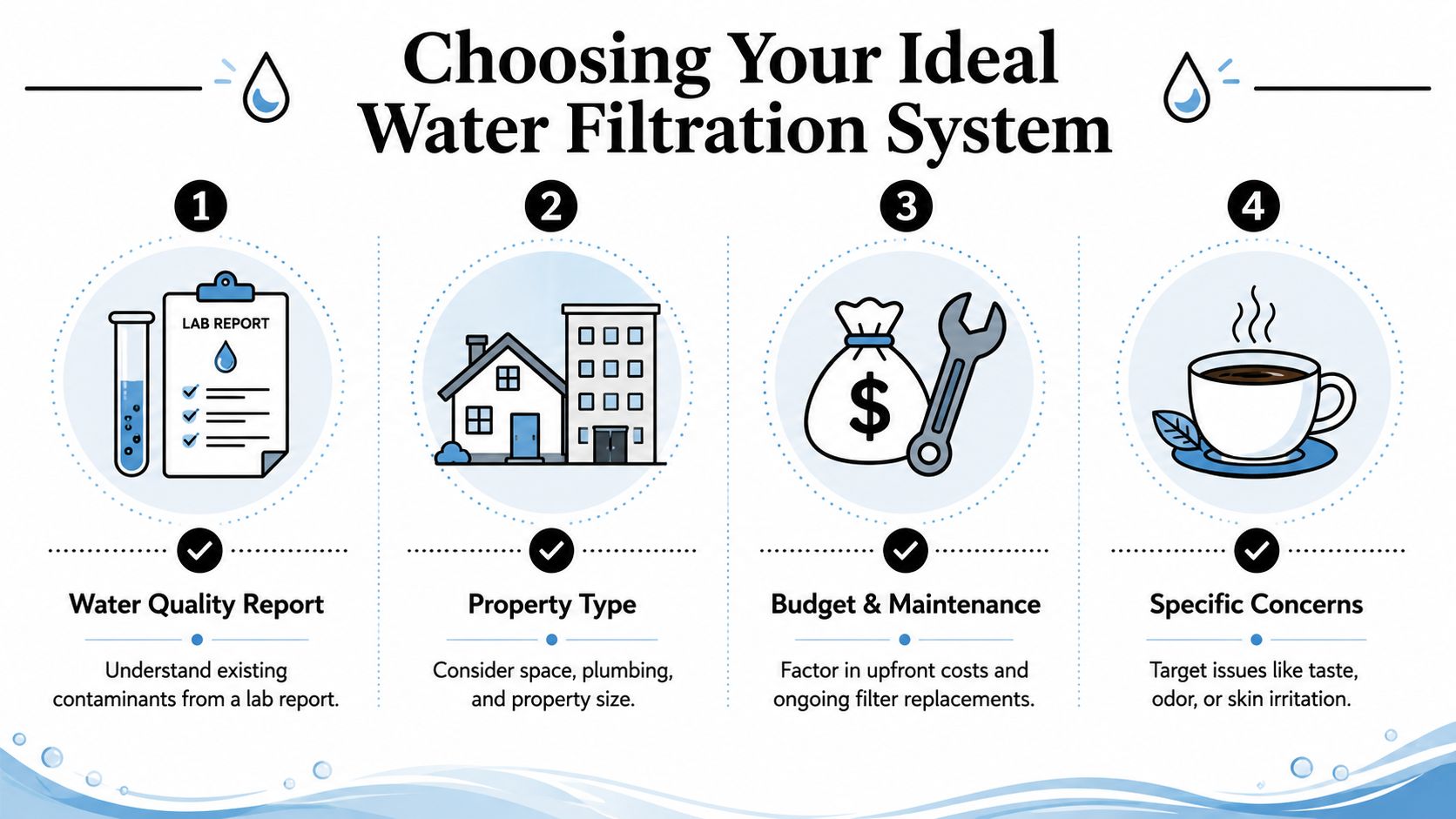
The right choice starts with three questions. Where is the problem showing up? What is in the water, or what is likely in the water given the source and the building condition? How much maintenance will the owner or manager realistically keep up with?
Homeowners
For a detached home or townhouse, start with the complaint, not the filter brand. If the issue is limited to drinking water, cooking, coffee, or ice, a point-of-use system usually makes more sense than filtering every litre entering the house. That keeps cost, maintenance, and space requirements under control.
An under-sink carbon filter is often the practical first step for Greater Vancouver homes on municipal supply. It improves taste and odour without adding the cost and slower production rate that come with RO. If the homeowner wants stronger treatment for dissolved contaminants at the kitchen tap, RO can be the better fit, but it needs room, a drain connection, and regular service.
Whole-house filtration earns its keep when the complaint shows up all over the property. Shower smell, sediment after utility work, frequent cartridge clogging, or a desire to protect appliances all point toward treatment at the main line.
A simple way to sort it out:
- Choose sink-level carbon for taste, odour, and better water for drinking and cooking.
- Choose sink-level RO when stronger reduction of dissolved contaminants matters more than speed, space, and upkeep.
- Choose a whole-house setup when the goal is to improve water at multiple fixtures or protect plumbing equipment across the property.
Strata managers
Strata filtration decisions are usually about consistency, access, liability, and the building's actual infrastructure. In Greater Vancouver, that often means accounting for aging internal piping, pressure conditions, and whether complaints are isolated to one stack, one suite, or the full building.
If a building is on standard municipal water, the first step is often pre-filtration for sediment and debris, especially in older properties where pipe condition affects what residents see at the tap. If the building has any supplementary non-municipal source, or another site-specific microbial concern, UV may need to be part of the treatment train, but only after proper pre-filtration. UV is not a catch-all. It depends on water clarity, power, and service discipline.
For strata properties, the process is usually more important than the product list:
- Confirm the water source and whether the issue is suite-specific or building-wide.
- Inspect the plumbing condition, especially if the building has older galvanized or mixed-material piping.
- Match the treatment to the actual risk, then plan for shutoffs, bypasses, and servicing access.
- If the installation affects shared systems, make sure the plumbing scope also addresses code-related items such as backflow preventer installation for multi-unit and commercial plumbing systems.
That approach avoids a common strata mistake. A council approves a system to solve taste complaints, but the underlying issue is debris from aging pipes, poor placement, or a maintenance plan nobody owns.
Small businesses
Small businesses should choose filtration based on operating cost and downtime, not marketing claims. A café may need better-tasting water at beverage stations and protection for equipment. A salon or clinic may care more about consistency and fixture protection. A small office may only need a drinking-water upgrade in the kitchenette.
The wrong system usually fails in predictable ways. It is undersized for peak demand. It is installed where cartridge changes disrupt business hours. Or it treats the wrong water problem entirely.
For many small commercial sites in Vancouver, Burnaby, and Richmond, the best result comes from tying the system to one business question: what is bad water costing the operation now? If the answer is poor beverage quality, start at the point of use. If the answer is equipment wear, clogged valves, or complaints across the unit, look at pre-filtration or a whole-unit setup. Encano Plumbing & Drainage Ltd. is often brought in at that stage to match the treatment equipment to the actual plumbing layout, service access, and fixture demand.
Installation and Maintenance with Encano Plumbing
A good filter installed badly turns into a plumbing problem. That's not dramatic. It's just what happens when a system is undersized, squeezed into the wrong location, installed without a bypass, or left without a maintenance plan.
What proper installation changes
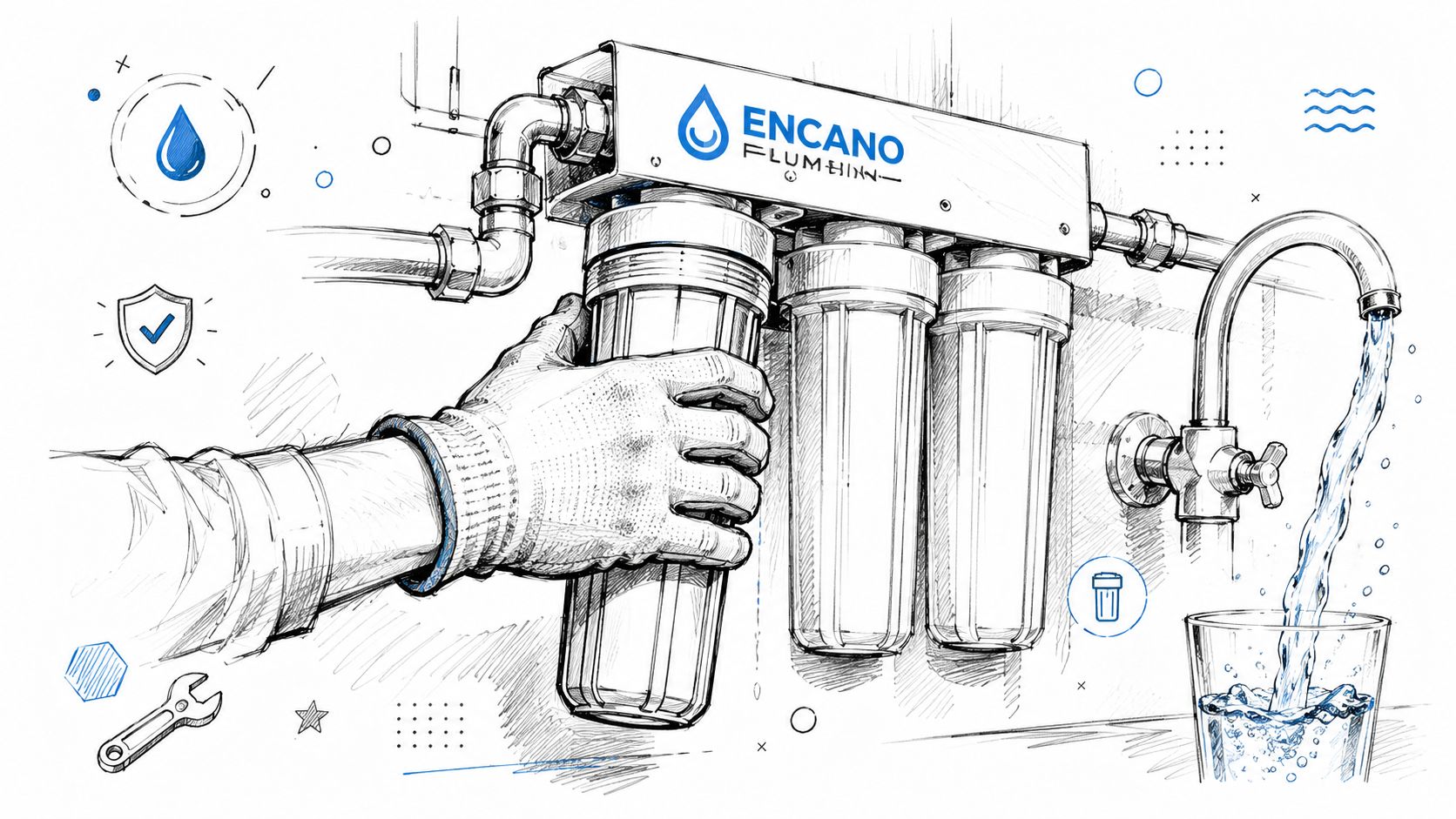
Professional installation isn't only about connecting pipes. It's about fitting the system to the property's actual flow, fixture demand, shutoff layout, and service access. In a detached house, that may mean choosing a better main-line location so cartridge changes don't become a half-day job. In a strata or small commercial unit, it may mean coordinating shutoffs, tenant impact, and code-aware backflow considerations such as those addressed in backflow preventer installation.
The most common installation issues are usually avoidable:
- Poor placement: Filters need clearance for servicing, not just enough room to squeeze them in.
- Bad sizing: Undersized housings and cartridges can affect usable flow.
- Missing isolation points: Shutoffs and bypasses matter when maintenance day comes.
- No thought for drain or power requirements: RO and UV systems often need more than a simple tee-off.
The cleanest install is the one that works well on day one and is still easy to service a year later.
What ongoing maintenance actually involves
Every filter system needs maintenance. The only difference is what kind.
Carbon and sediment cartridges need replacement. RO systems need scheduled attention to pre-filters, post-filters, and eventually the membrane. UV systems need lamp changes and routine checks to make sure the chamber and upstream filtration are still doing their part.
A realistic maintenance plan should answer four things:
- Who changes the filters
- How the replacement schedule is tracked
- Whether the property has access constraints
- What signs indicate the system needs service sooner
For homeowners, this can be as simple as annual scheduling plus cartridge reminders. For strata and commercial properties, it usually needs a more organised service record so no one is guessing what was changed and when.
Frequently Asked Questions About Water Filtration
Is water filtration really necessary in Metro Vancouver
Not always. A lot of people choose filtration for taste, odour, appliance protection, or peace of mind, not because the municipal source is poor. In this region, filtration is often about improving the water you use every day after it has travelled through the last stretch of plumbing to your property.
Will a whole-house system reduce water pressure
It can if the system is undersized or installed poorly. A properly selected and properly installed system should be matched to the property's flow demand. That's one reason sizing matters more than the product label.
Can I install an under-sink filter myself
Some homeowners can handle simpler units, but plumbing access, shutoff condition, drain requirements, and leak risk make this less straightforward than the box suggests. RO systems are especially easy to get wrong if the drain connection or dedicated faucet installation isn't done cleanly.
What's the best filtration type for chlorine taste
For typical municipal-water taste and odour complaints in Greater Vancouver, activated carbon or carbon block is usually the first thing to look at. That's the fix for many people who say the water tastes treated.
When does reverse osmosis make more sense than carbon
RO makes more sense when the goal is stronger removal of dissolved contaminants at a drinking-water tap. Carbon is often the quality-of-life upgrade. RO is the more targeted purity upgrade.
Is UV useful in a regular city-water home
Sometimes, but not usually as the first priority. UV is most useful when the property has a non-municipal component, a well supplement, or a specific microbial concern. It's not a substitute for carbon, sediment, or RO when those are the actual needs.
How often do filters need maintenance
That depends on the system type, water conditions, and how much water the property uses. Sediment and carbon stages need routine cartridge changes. RO systems need staged maintenance. UV systems need lamp replacement. A system without a service schedule won't keep performing the way it should.
If you want help sorting through water filtration system types for a home, strata building, or small business in Greater Vancouver, Encano Plumbing & Drainage Ltd. can review the plumbing layout, identify where filtration makes sense, and install a setup that matches the property instead of the marketing.