If you're managing a building in Vancouver or Richmond, this often starts the same way. A municipal notice lands in your inbox, or your annual inspection file shows a gap, and suddenly you're dealing with a device most owners never think about until compliance becomes urgent.
That's where backflow preventer installation stops being a plumbing line item and becomes a property management issue. On older Metro Vancouver sites, the challenge usually isn't understanding that you need a device. The challenge is figuring out where it can go, how it will be tested, and whether the installation will still make sense years from now when someone has to service it in a cramped mechanical room, tight side yard, or exposed outdoor location.
Table of Contents
- Why Backflow Prevention Is Non-Negotiable in Greater Vancouver
- Choosing the Right Backflow Preventer for Your Property
- Navigating Permits and Code in Vancouver and Richmond
- The Professional Installation and Testing Process
- Estimating Project Costs and Timelines
- Annual Maintenance and Hiring a Licensed Contractor
Why Backflow Prevention Is Non-Negotiable in Greater Vancouver
A strata manager gets a notice from the City after a routine review or tenant improvement. The property needs a backflow assembly installed, tested, or brought up to code. At that point, the question is not whether the issue matters. The question is how exposed the building already is, and how difficult the correction will be in a real Vancouver mechanical room.
Backflow is the reverse flow of water into the potable system. If pressure changes in the public main or within the building, water from an irrigation line, boiler system, commercial unit, or other connected source can move the wrong direction. That creates a direct cross-connection risk, which is why municipalities treat backflow prevention as a public health requirement.
In Greater Vancouver, the challenge is rarely just the device itself. The harder part is fitting the right protection into older buildings that were never laid out for current testing and access standards. East Vancouver mixed-use properties, older Richmond commercial sites, and strata buildings with pieced-together plumbing upgrades often have low ceilings, crowded service rooms, and very little wall space near the incoming water line. A code-compliant assembly still has to be reachable, testable, and serviceable years after the permit is closed.
Why cities and property managers take it seriously
From an operations standpoint, a bad installation creates recurring problems. If the assembly is tucked behind storage, installed in a narrow crawlspace, or placed where a tester cannot safely access the shutoffs and test cocks, the property ends up paying for that mistake every year in service time, failed inspections, and avoidable rework.
That is the part generic guides miss. On paper, a backflow preventer is one line item. On site, it affects shutdown planning, access, drainage, freeze protection, and future maintenance. In Vancouver, where many properties combine older infrastructure with newer tenant uses, those trade-offs matter more than the catalogue spec.
Practical rule: If a certified tester cannot reach the assembly safely with gauges and enough working room, the location was chosen for convenience, not for compliance.
Backflow control also sits within the larger condition of the building's water system. If a property is already dealing with discoloured water, aging fixtures, or concerns about system cleanliness after renovations, water quality testing for Vancouver properties often belongs in the same review.
A common Vancouver job-site example
Take an older mixed-use building in East Vancouver. The irrigation connection was added long after the base plumbing went in. The mechanical room is tight, the ceiling is low, and the side yard does not leave much room for an exterior enclosure. Installing a backflow assembly sounds straightforward until you account for orientation, clearance, drainage, shutoff access, and room for future testing.
That is why this work needs more than a basic valve swap mindset. The assembly protects the public water supply, and the installation has to keep working under municipal inspection, annual testing, and day-to-day building operations. In Greater Vancouver, where space constraints and older piping layouts are common, the long-term cost of ownership usually comes down to one decision made at the start. Put the device where it can be maintained.
Choosing the Right Backflow Preventer for Your Property
A property manager calls after a failed inspection and asks for "a backflow preventer" to be installed by the end of the week. On a real Vancouver site, that request is too broad to price properly and too vague to approve. The correct assembly depends on the hazard rating, the fixture or system it serves, and the conditions around the installation point.
That last part gets missed in generic guides.
In Greater Vancouver, older buildings often have low-clearance mechanical rooms, retrofitted irrigation lines, and service entries that were never designed for modern testing access. Choosing the right assembly means choosing a device that fits the risk and can still be tested, repaired, and shut down without turning a small plumbing job into a building disruption.
The three assemblies most managers deal with
The assemblies property managers see most often are the Double Check Valve Assembly (DCVA), Reduced Pressure Zone Assembly (RPZ), and Pressure Vacuum Breaker (PVB).
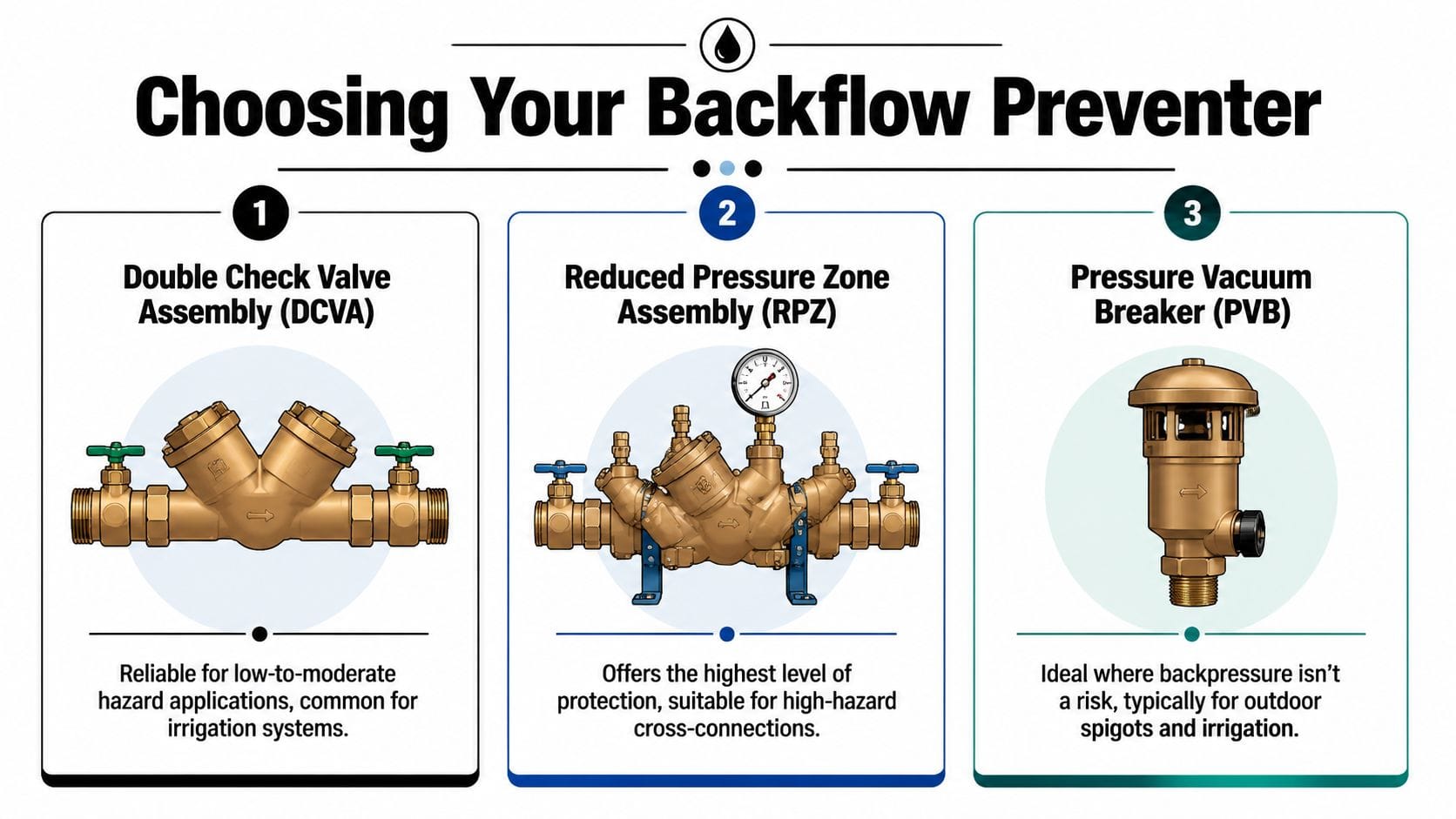
A DCVA is commonly used for low- to moderate-hazard applications. On many strata irrigation systems, that is the assembly managers ask about first. It can be a good fit where the connected use does not introduce a high health hazard, but approval still depends on the actual use and local code interpretation.
An RPZ is used where the cross-connection risk is higher and the consequence of contamination is more serious. Commercial kitchens, processing areas, and certain tenant improvements often fall into this category. An RPZ gives a higher level of protection, but it also demands more from the installation. It needs drainage planning, enough clearance for testing, and a location where discharge will not create a flooding or nuisance issue.
A PVB is common on simpler outdoor irrigation systems where backsiphonage is the concern and backpressure is not. It must be installed in the correct orientation, and that requirement alone can rule it out on cramped sites with low overhead clearance or awkward piping.
Backflow Preventer Types at a Glance
| Device Type | Common Use Case | Hazard Level | Key Feature |
|---|---|---|---|
| DCVA | Strata or residential irrigation systems | Low to moderate | Two check valves in one assembly |
| RPZ | Commercial kitchens, labs, higher-risk cross-connections | Higher hazard | Relief mechanism for stronger protection |
| PVB | Outdoor sprinkler lines and simpler irrigation layouts | Used where backpressure isn't the main risk | Atmospheric protection in an upright configuration |
The right assembly matches both the hazard and the site conditions. If either one is ignored, the problem usually shows up during inspection, testing, or the first service call.
Sizing and placement matter more than most owners expect
A lot of costly mistakes happen before the device is even ordered. Someone matches the assembly to the pipe size, picks the lowest-cost approved option, and assumes the job is settled. On older Vancouver properties, that shortcut causes pressure loss, awkward access, and expensive rework.
Guidance summarized by Pacific Backflow notes two points that matter in the field. Undersizing is a problem, and the assembly is often best placed close to the meter where the service can be controlled and tested more cleanly. You can review that discussion in Pacific Backflow's installation guidance.
Here is the trade-off I see all the time. A device installed deep inside a tenant space may look convenient during construction because there is open wall space and no excavation. Later, every annual test requires access coordination, every shutoff affects operations, and every repair takes longer than it should. On a Vancouver storefront or mixed-use building with a long run from the service entry, that decision can cost more over the life of the assembly than the original install saved.
Good selection is not just about the valve body. It is about hazard classification, orientation, drainage, clearance, service access, and how the building operates. On Greater Vancouver jobs, the assembly that works best on paper is not always the one that works best in the building.
Navigating Permits and Code in Vancouver and Richmond
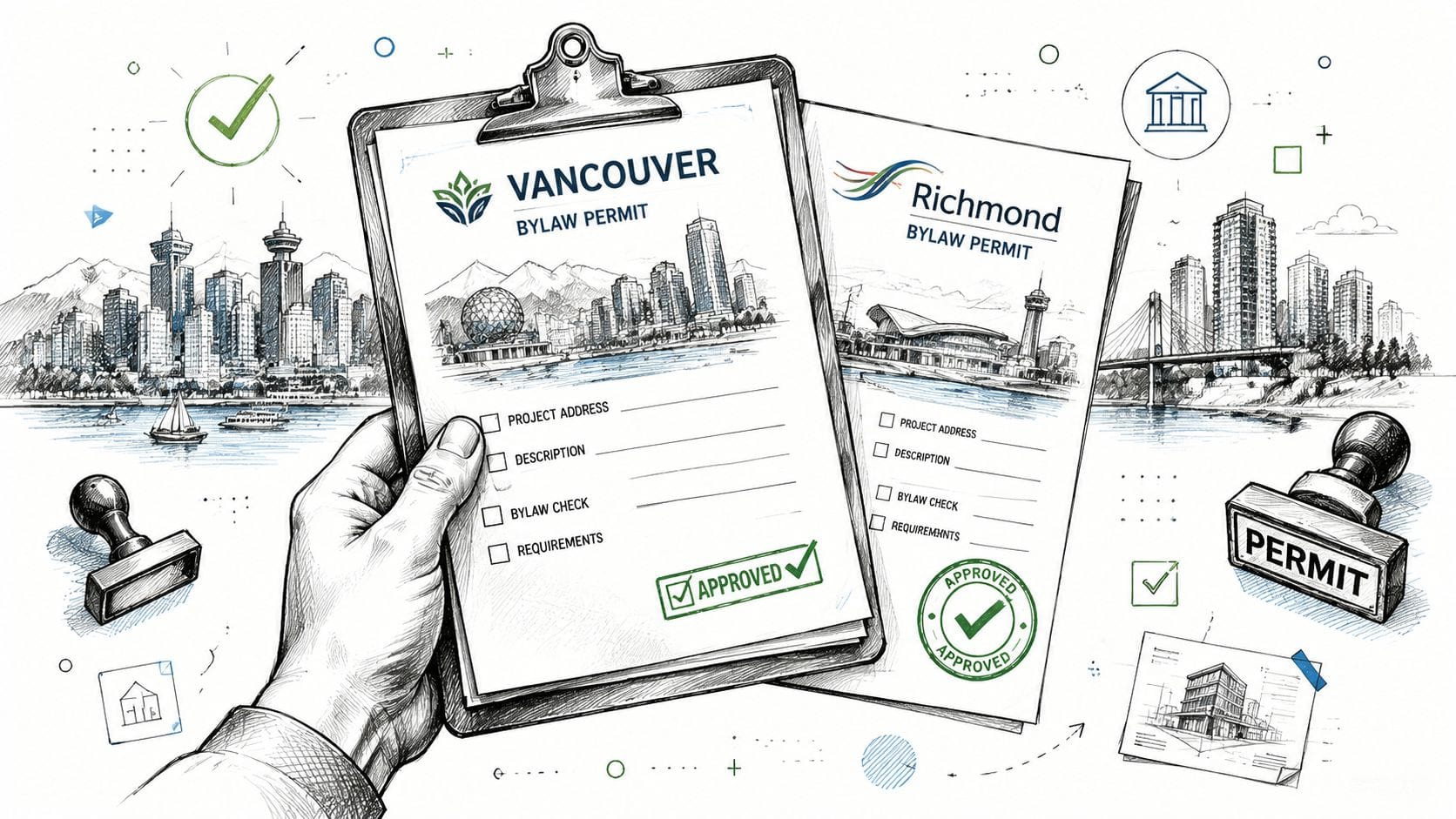
The permit side of this work frustrates owners because it doesn't care whether the device physically fits the pipe. It cares whether the whole installation is compliant. In Greater Vancouver, that's where many projects get slowed down.
A lot of generic guides skip the hard part. They explain what a backflow preventer does, then jump straight to installation. On real sites in Vancouver and Richmond, the issue is often the surrounding conditions: grade, drainage, access, freezing exposure, enclosure design, and whether the assembly ends up in a location that can still be serviced without tearing apart the site.
What trips up older properties
For Vancouver-area properties, the hard part is often not the device itself, but fitting it into tight sites, driveways, and below-grade utility areas while still meeting code. Standard-detail guidance stresses that a backflow assembly must not be subject to flooding and needs enough access and drainage for testing. It also points out a practical truth many owners learn too late: the cheapest-looking installation can become the most expensive if it creates ongoing access, freezing, or drainage problems. That guidance is outlined in Safe-T-Cover's backflow preventer standard details article.
This comes up constantly on older Richmond homes and older strata sites. The owner wants the device hidden. The available corner is below grade, behind a hedge, or beside a parking stall. That may solve the appearance issue, but it usually creates a compliance and maintenance problem.
In other jurisdictions, utility guidance also gives a useful picture of what inspectors look for. California-region guidance requires a backflow prevention assembly on the property side of and adjacent to the water meter or adjacent to the specified point of use, with a minimum clearance of 12 inches above grade and at least 12 inches of side clearance for repair and testing access. It also requires drainage to atmosphere, freeze protection, annual testing, and inspection or approval by the district. Those details are set out in MCWD's backflow preventer inspection and testing guidelines.
Questions to ask before the permit goes in
Before anyone files paperwork or cuts pipe, ask these questions:
- Where will the tester stand and connect equipment: If the answer is “we'll figure it out later,” stop there.
- How will discharge be handled: This matters especially for assemblies that can release water during operation or testing.
- What protects the device from freezing or flood exposure: Outdoor locations can work, but only if the enclosure and drainage are thought through.
- Will future shutoff, repair, and recertification be straightforward: A code-compliant install should still be practical after landscaping, fencing, and tenant use change around it.
A practical example is a Kerrisdale house with a front yard with cultivated features and limited side access. Installing the assembly near the meter may be right from a code and service standpoint, but the design may need a protected above-grade arrangement rather than a hidden low point in the garden bed. That decision affects whether the installation remains compliant year after year.
The Professional Installation and Testing Process
A crew arrives at an older Vancouver building, opens the mechanical room door, and finds the domestic line buried behind ductwork, shelving, and twenty years of added piping. That is a normal install condition here, not an exception. A proper backflow job starts with the site in front of you, because older infrastructure, tight service rooms, and municipal inspection requirements can force changes before a single pipe is cut.
The first check is practical. Confirm the approved location, device type, orientation, shutoff placement, and testing access against actual field conditions. Drawings are useful, but many Greater Vancouver retrofits reveal offset lines, abandoned valves, poor drainage, or clearance problems that do not show up on paper. If the assembly fits but cannot be tested, repaired, or isolated without turning the room upside down, the install is heading toward a callback.
What a proper install day looks like
A disciplined crew starts by isolating the water service, draining the section, and controlling the shutdown window. In occupied buildings, that means coordinating with tenants, building staff, or site operations so the interruption is short and predictable.
Site prep comes next. In a newer utility room, that may be simple access protection and layout work. In an older Vancouver or Richmond property, it often means clearing storage, exposing concealed piping, replacing seized valves, or revising the arrangement because the service line does not run where the file suggested.
Then the piping work begins. The line is cut, the assembly is installed in the correct flow direction, and the supports are set so the device is stable under service conditions and during testing. Tight spaces matter here. A clean-looking install that crowds the test cocks against a wall, a hot water line, or a bank of meters usually turns into a service problem later.
A better question is, “Can the next tester, repair technician, and inspector work on it here without a problem?”
That standard matters more than appearance. Good installation leaves room to operate shutoffs, remove check covers, connect a test kit, and handle discharge safely if the assembly relieves during operation or test. Property managers feel the cost difference later, during annual certification and repairs. For a sense of how access and repair complexity can change service costs over time, see this guide to plumbing repair cost factors.
What the final test is checking
The post-installation test confirms the assembly is working correctly and can be placed into service with proper documentation. The tester connects a calibrated kit to the test cocks, checks the internal checks and relief performance where applicable, and verifies the assembly responds as required.
For the property manager, that is the point that matters. Municipalities and water suppliers want a device that functions in the field and can be certified, not one that only looks correct on install day.
A common local problem is an exterior assembly placed where access seemed easy during construction but becomes difficult after bins, fencing, landscaping, or tenant use take over the space. The piping can be correct and still create a long-term maintenance issue if the tester cannot reach ports safely or the area ponds during heavy rain. Vancouver jobs fail on details like that more often than owners expect.
What quality workmanship looks like on a retrofit
On a retrofit, quality usually shows up in the details that reduce future labour and inspection trouble:
- Clear working access: Enough room to test, service, and replace parts without removing unrelated building items.
- Reachable shutoff valves: Isolation should be straightforward for the next service call, not dependent on moving storage or opening finished construction.
- A location that will stay usable: The assembly should still work for annual testing after tenant improvements, fencing changes, or vegetation growth.
- Proper support and layout: The device, valves, and adjacent piping should sit square, stable, and easy to understand for the next technician.
- A clean closeout: Test results, any required documentation, and site notes should be handed over so the building is ready for recertification and future service.
Local experience shows up in these choices. A company such as Encano Plumbing & Drainage Ltd. may be one option for Vancouver-area owners who need installation and service on occupied residential or commercial properties, but the standard should stay the same regardless of contractor: correct assembly, correct placement, and a layout that will still make sense years later.
Estimating Project Costs and Timelines
Most owners want one number. In practice, backflow preventer installation is a bundle of costs, not a single price tag.
According to Angi's 2026 backflow preventer installation pricing data, U.S. homeowners typically pay about $350 for parts and labour, with a broad range of $135 to $1,100 depending on device type, labour, and local conditions. The same source says testing commonly costs $70 to $90 per test, while repairs can run $50 to $100. Those figures are useful as a budget reference point, especially when owners assume the job ends once the assembly is installed.

What affects the final budget
Two projects can use similar devices and land in very different budget ranges.
The lower end usually applies when access is easy, the piping is straightforward, and the assembly can be installed without significant site modification. The higher end tends to show up when the installation is a retrofit in a difficult space, when drainage or enclosure work is needed, or when the original location idea turns out not to be compliant.
Owners should also think beyond installation day. Testing is recurring, and repairs are part of ownership. That's why chasing the cheapest quote can backfire if the contractor places the device in a spot that increases labour every year.
Cost reality: The install that looks cheaper on paper can cost more over time if every test, repair, or inspection becomes awkward.
If you're comparing plumbing budgets across other building work, it helps to use a broader benchmark for plumbing repair costs in Greater Vancouver so this item sits in the right context.
How to think about the timeline
Timelines depend on approvals, access, and whether the work is new construction or retrofit. The physical installation may be quick on a simple site, but the whole project includes review, scheduling, shutdown coordination, testing, and any inspection sign-off required by the municipality or water authority.
A practical example is a small Richmond retail unit. If the service room is accessible, the tenant can accommodate a brief shutdown, and the approved location is clear, the field work can move cleanly. On an older multi-unit property, the slower part is often reaching agreement on location, enclosure, drainage, and access.
That's why the right question isn't “How fast can you install it?” The right question is “How fast can we install it properly and get it to a serviceable, compliant state?”
Annual Maintenance and Hiring a Licensed Contractor
A backflow assembly isn't a fit-and-forget device. Once it's installed, it becomes part of your building's recurring compliance and maintenance workload.
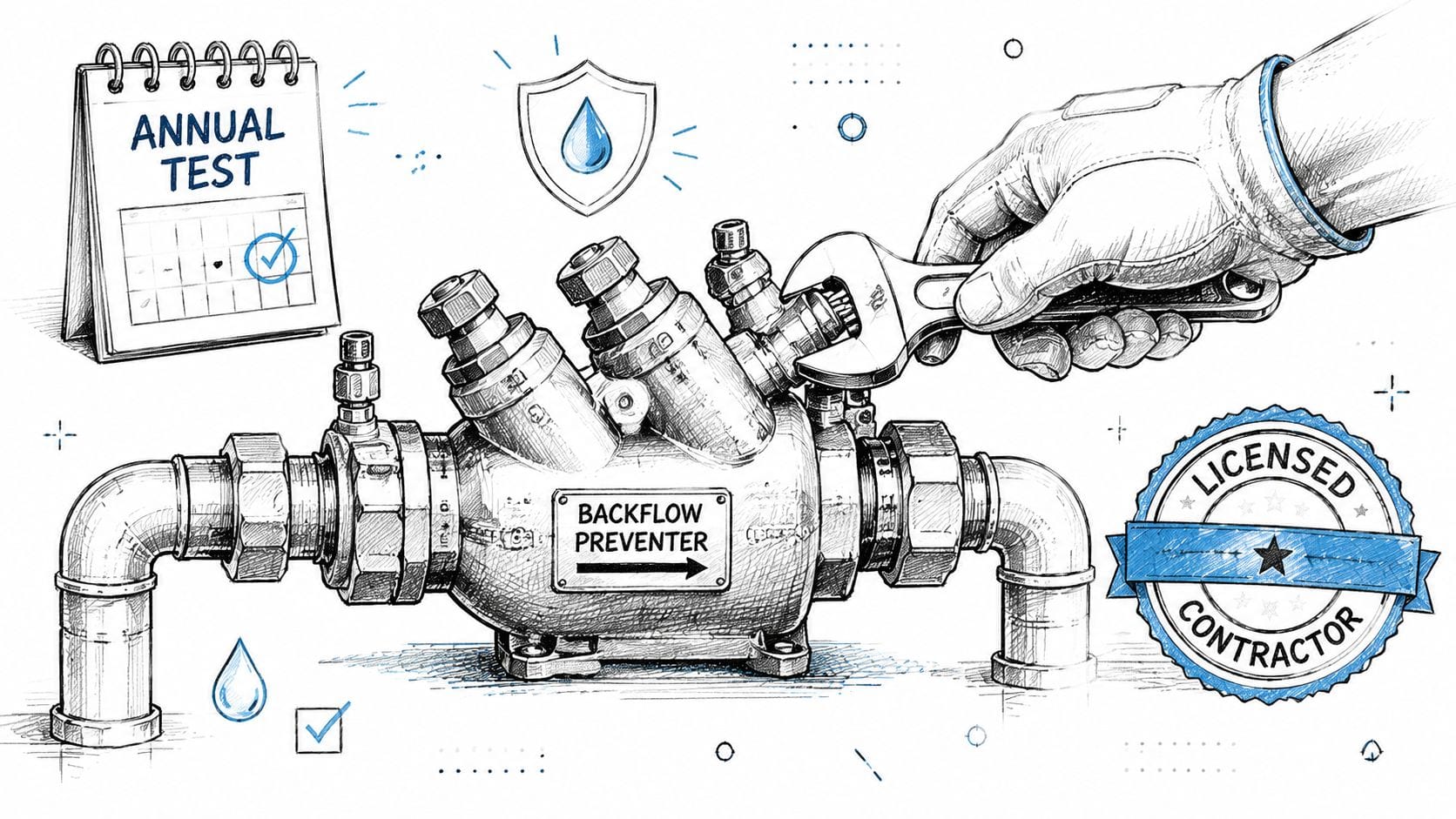
Why annual testing matters
Annual testing matters for one reason above all others. The assembly has to keep working under real conditions, not just look complete on a site walk.
Guidance used by water districts requires annual testing and inspection approval as part of ongoing compliance, and that matches what property managers already deal with in practice. Assemblies are mechanical devices. Internal components wear, shutoffs age, and site conditions change around the installation.
On Metro Vancouver properties, annual service also catches problems that basic walkthroughs miss. A once-clear assembly can become blocked by storage, landscaping, fencing changes, or tenant improvements. An outdoor enclosure that looked fine in summer may show drainage or freezing concerns in winter.
If your property already needs recurring certification support, Delta backflow testing service for local properties gives a practical example of the kind of ongoing testing arrangement many owners need.
What to look for in a contractor
The right contractor for backflow work should be able to do more than install pipe. They should understand compliance, testing access, and long-term serviceability.
Look for these basics:
- Proper licensing: The contractor should be qualified to perform the plumbing work involved.
- Backflow testing capability: Installation and certification often go hand in hand, and the contractor should understand both.
- Local municipal experience: Vancouver, Richmond, Burnaby, and nearby municipalities all expect compliant work, but site conditions and review expectations can vary.
- Clear documentation: You want records that make annual follow-up easier, not harder.
A practical example is a strata corporation that hires one crew to install the assembly and another later to test it. If the installer didn't leave enough working room, the tester inherits the problem. That's why it pays to use a contractor who thinks past handover day.
This video gives a useful visual sense of what service and inspection work can look like in the field.
Backflow work is one of those trades where the long-term result depends heavily on the original layout. If access, drainage, and protection were treated as extras, maintenance becomes harder every year.
A reliable contractor should talk to you plainly about placement, testability, shutdown planning, and future service. If those topics never come up during quoting, that's a warning sign.
If you need a compliant, serviceable backflow preventer installation for a home, strata, or commercial property, Encano Plumbing & Drainage Ltd. handles plumbing and drainage work across Vancouver, Richmond, Burnaby, Delta, Surrey, New Westminster, and nearby communities. For owners and managers, the practical value is straightforward: a contractor who can assess site constraints, install the correct assembly, and keep the system workable for future testing and maintenance.