

Your condo is too hot in August, too expensive to heat in January, and every practical solution seems to run into one wall. The strata. This is the main starting point for individuals looking at heat pumps for condos in Greater Vancouver.
A heat pump can solve two problems at once. It gives you cooling in summer and heating in winter from one system. But condo installations aren't house installations with smaller equipment. You're dealing with balcony space, exterior wall penetrations, noise rules, permits, common property, and building electrical capacity. In older buildings, one weak point can stop the whole job.
Most condo owners don't need another generic article telling them to “check with your strata.” They need a workable path. That means knowing which system type fits a condo, what documents a strata council usually wants, where projects get rejected, and how to avoid wasting money on quotes for a unit your building can't support.
Table of Contents
- Your All-in-One Solution for Condo Comfort
- Choosing the Right Heat Pump for Your Condo
- Navigating Strata and Condo Building Approvals
- Key Technical and Logistical Considerations
- Costs Rebates and Long-Term ROI
- Your Installation Checklist and Finding a Contractor
Your All-in-One Solution for Condo Comfort
If you've spent even one Vancouver heat wave sleeping beside a portable AC hose jammed into a half-open window, you already know why condo owners start looking at heat pumps. The same goes for winter if your suite relies on electric baseboards that leave one room stuffy and the next one cold. A properly selected heat pump gives you steady heating and cooling from one system, without the clunky stopgap feel of portable equipment.
For condos, that matters because space is tight and every piece of equipment has to earn its place. You usually don't have a mechanical room to waste. You may have one balcony, limited wall area, and neighbours close enough that noise and appearance matter. A heat pump works best when the design respects those limits from day one.
Why condo projects are different
Detached houses usually move faster because one owner makes the decision. Condo projects don't. The building exterior is involved, the electrical system may be shared in practical terms, and approvals often take longer than the actual installation.
The common obstacles look like this:
- Strata permission: The outdoor unit, line set, and wall penetration often affect common or limited common property.
- Electrical constraints: Older suites can have crowded panels, and some buildings need a broader load review before new equipment is added.
- Placement issues: Balconies, setbacks, airflow, and neighbour impact can limit where a unit can go.
- Cost allocation: Owners often pay for the in-suite work, while building-related upgrades can trigger debate about who covers what.
Practical rule: The best condo heat pump job starts with approval and feasibility, not with brand shopping.
A good process keeps you from paying for redesigns later. First confirm what your building will allow. Then confirm what your suite and building can support. Only after that should you lock in equipment and installation details.
Choosing the Right Heat Pump for Your Condo
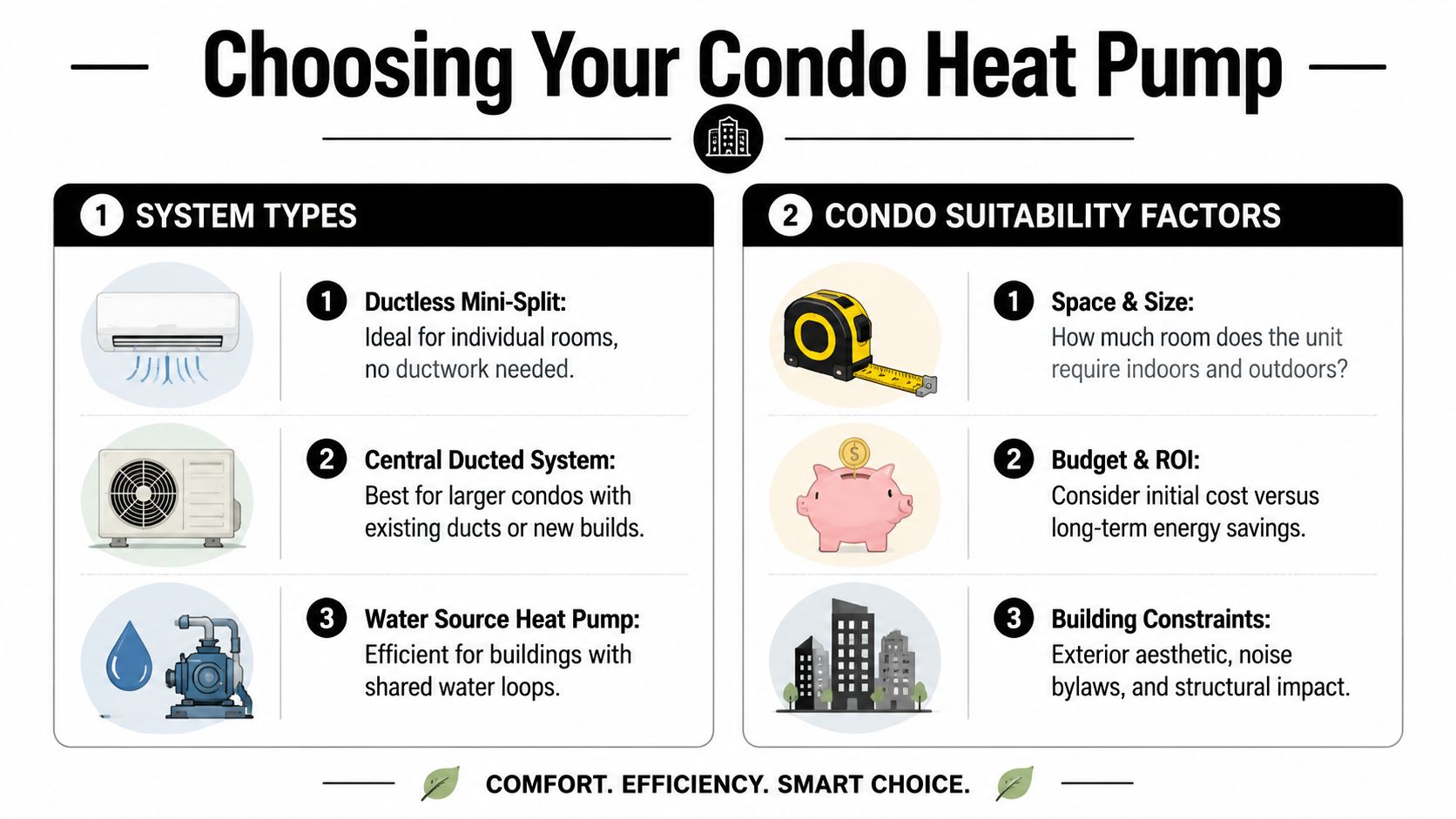
Not every heat pump belongs in a condo. The right system is the one that fits the building, the suite layout, the available electrical capacity, and the approval reality. In practice, most condo owners are choosing between a ductless mini-split and a small ducted setup, with some building-level systems sitting in a different category entirely.
The system most condo owners end up with
A ductless mini-split is usually the most practical answer for heat pumps for condos. You get a compact outdoor unit and one or more indoor heads mounted on the wall. No full duct network is needed, which makes it a better fit for buildings that were never designed for central air.
This setup works well when:
- The suite has no existing ductwork: That's common in many Vancouver-area condos with baseboard heating.
- Balcony or exterior placement is possible: You still need an approved location for the outdoor unit.
- You want targeted comfort: One head in the main living area can handle the space people use most.
A practical example. A roughly 700 square foot Yaletown apartment with electric baseboards and no ducts will usually lean toward a single-zone or multi-zone mini-split, depending on bedroom layout and whether the owner wants cooling only in the main area or throughout the suite.
When ducted makes sense
A small central ducted system can be the better tool when the condo already has usable ducting or enough concealed space for short duct runs. It gives a cleaner look because you avoid wall-mounted heads in the main living spaces.
That option makes more sense when:
- the suite is larger,
- there's an existing furnace or fan coil arrangement that can be sensibly retrofitted,
- the owner is willing to accept more invasive work.
For a larger Richmond penthouse around 1,500 square feet with existing ducts, a compact ducted heat pump may deliver better air distribution and a more finished appearance than multiple wall heads. The trade-off is installation complexity. Ceiling access, soffit work, condensate routing, and service access all need to be planned carefully.
Systems that usually belong at the building level
You'll also hear about air-to-water, water-source heat pumps, and VRF systems. These can be strong solutions in the right building, especially in new developments or major building-wide upgrades. They are usually not simple in-suite retrofit choices for one owner acting alone.
Here's the quick comparison:
| System type | Best fit in condos | Main advantage | Main limitation |
|---|---|---|---|
| Ductless mini-split | Existing suites without ducts | Easier retrofit path | Visible indoor heads |
| Small ducted heat pump | Larger suites with ducts or hidden space | Cleaner appearance | More invasive install |
| Water-source or air-to-water | Building-designed systems | Strong building integration | Usually not a solo owner retrofit |
| VRF | Newer or coordinated multi-unit projects | Flexible zoning | Complex and approval-heavy |
Choose the system that your building can actually approve and support. On condo jobs, the “best” equipment on paper often loses to the system that fits the real site conditions.
Navigating Strata and Condo Building Approvals
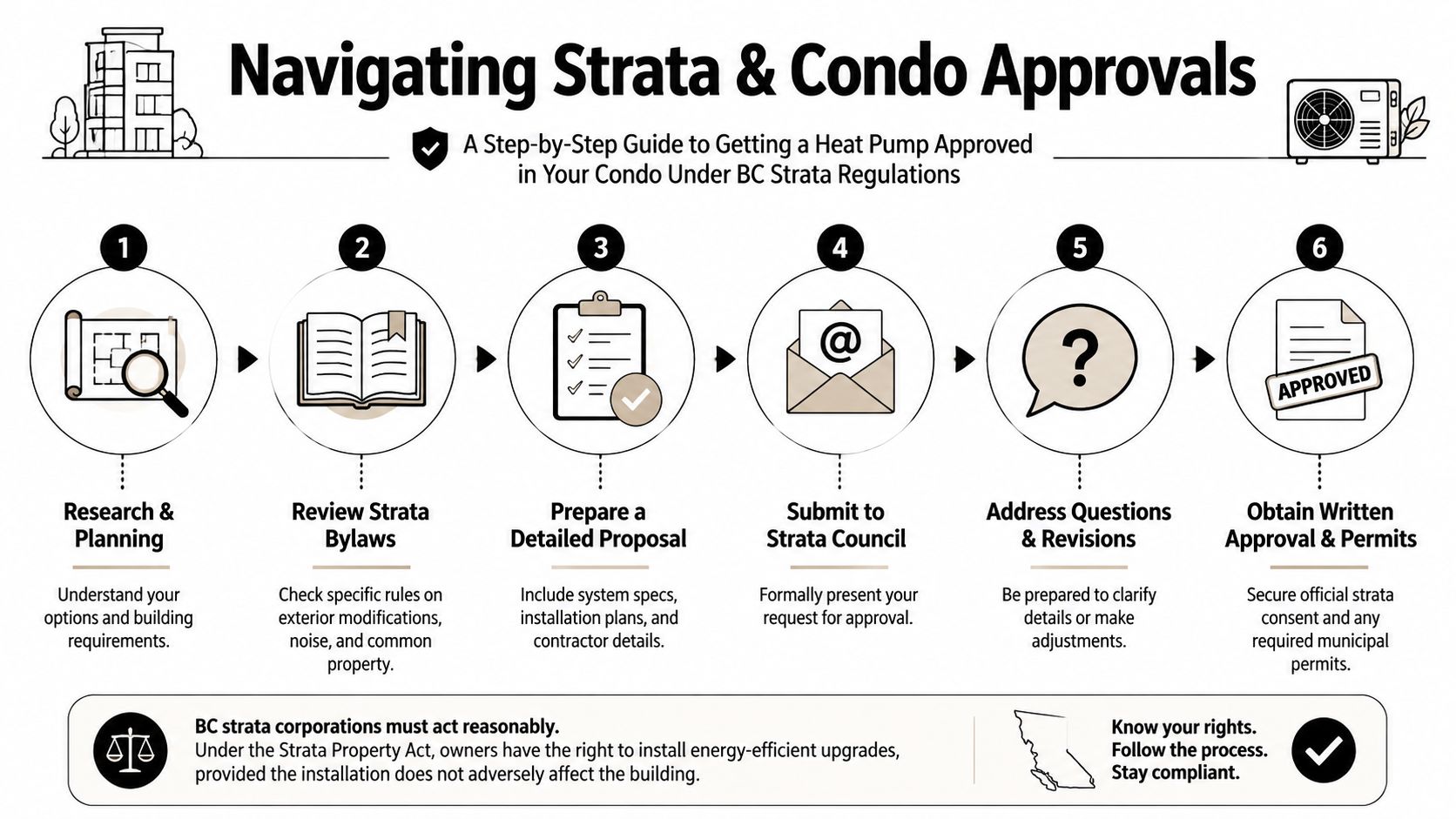
This is the part that decides whether the project moves or dies. In British Columbia, the approval process isn't a side task. It is the job before the job. If the outdoor unit touches appearance, common property, limited common property, noise, or the building envelope, strata will want details in writing.
Start with the building's bylaws and rules. Some stratas have specific language for air conditioners or heat pumps. Others have outdated wording that never anticipated modern mini-splits. Either way, you need the exact policy before you spend money on the wrong design.
What strata usually cares about
Strata councils rarely start with the same concern the owner has. The owner wants comfort. The strata wants to avoid complaints, envelope damage, electrical problems, and precedent that creates headaches later.
The main issues are usually:
Noise
They want to know how loud the outdoor unit is and whether it could disturb adjacent units or patios.Appearance
They'll ask where the equipment will sit, whether line covers are visible, and how the installation affects the exterior look of the building.Envelope integrity
Exterior wall penetrations raise water ingress concerns. This is a major issue in coastal BC.Electrical capacity
Some councils now ask for confirmation that the suite and building can safely support the added load.
A useful legal point matters here. The VISOA guidance on handling heat pump and air conditioner requests states that in British Columbia, strata corporations must grant written approval for owners to install heat pumps in their suites, and if a request is denied, the strata must provide a clear, evidence-based reason and offer an alternative proposal rather than a flat refusal.
That changes how owners should approach the conversation. You're not asking for a casual favour. You're submitting a proposal that should be assessed on actual building concerns.
Here's a good companion read on air conditioning for condos if you want more context on cooling-specific condo issues.
What to include in your application package
The strongest strata submissions are boring in the best way. They answer questions before the council has to ask them.
Include:
- Equipment specifications: Model details, dimensions, and manufacturer noise data.
- Site drawings: Show the exact outdoor unit location, line route, wall penetration, and condensate path.
- Contractor credentials: Licence, insurance, and scope of work.
- Electrical note: If available, include the electrical assessment or at least confirmation that one is part of the process.
- Finish details: Mounting method, vibration isolation, line hide colour, and how penetrations will be sealed.
After you have the package together, use a clean written submission. Don't rely on a verbal discussion in a hallway or at an annual general meeting.
A video overview can also help you understand how the approval process typically unfolds in practice:
A practical Vancouver example
Say you own a one-bedroom condo in Vancouver. Your balcony has room for a compact outdoor unit, but the strata worries about appearance and neighbour noise. A weak application says, “I want AC installed on the balcony.” That usually triggers delay.
A strong application says the outdoor unit will be mounted in a specific location, includes the decibel rating, shows the line routing, confirms licensed trades, and explains how the exterior penetration will be sealed and finished. If the council objects to one location, ask for the alternative placement they would accept in writing.
If strata denies the first proposal, focus on solving the stated concern. Don't argue in general terms. Revise the design around the actual objection.
Key Technical and Logistical Considerations
A lot of condo heat pump projects in Greater Vancouver do not fail because of the equipment. They fail because someone priced the job before checking the panel, the line route, the balcony rules, and who controls the exterior wall.
In the field, the technical review and the approval strategy have to happen together. If the proposed layout creates noise complaints, blocks service access, or triggers envelope concerns, strata will slow it down or reject it. Good planning solves that before the application goes in.
Electrical capacity comes first
The first hard checkpoint is electrical capacity. The Home Performance Stakeholder Council condo and apartment in-suite guidelines state that condo heat pump installations should start with a verified assessment of the suite panel and the building feeder, with heating and cooling loads reviewed at full rating because many suites can call for power at the same time during weather swings.
That assessment needs more than a quick look at the breaker panel. A proper review checks available breaker space, existing electric heat loads, disconnect requirements, wire size, and whether the building electrical infrastructure can absorb the added demand. In older Vancouver and Burnaby condos, the suite panel is often only part of the problem. The larger issue can be the shared building service.
Sometimes the solution is straightforward. A smaller ductless system may fit the available capacity. In other cases, the project needs load management, a panel change, or a building-level sign-off from the strata's electrician or engineer before anyone should order equipment.
If a contractor skips this step, the quote is incomplete.
Outdoor unit location affects approval, performance, and service
The outdoor unit location tends to become the main approval fight, even when the mechanical design is sound. Strata councils usually focus on three things first. Noise, appearance, and whether the unit changes common property.
A balcony corner that looks convenient can still be a bad choice. I have seen placements rejected because the discharge air bounced off a wall and raised sound at the neighbouring unit, because the service clearances were too tight, or because the condenser would have forced future technicians to work over a railing. Those are avoidable mistakes.
Use a simple screening test before settling on a location:
- Airflow: The unit needs clear intake and discharge space or capacity drops.
- Access: A technician has to be able to clean, test, and repair it safely.
- Noise path: Manufacturer sound ratings matter, but reflected sound and nighttime background noise matter too.
- Ownership and appearance: Balcony slabs, walls, railings, and exterior surfaces may be limited common property or common property, which affects what strata will approve.
For many condo owners, the best technical location is not the easiest approval location. That trade-off should be discussed early. If the quietest and most serviceable spot requires a more visible line set cover, it is usually better to deal with that in the application than to force the unit into a poor corner and fight complaints later.
For a broader overview of how these systems are set up in local homes and strata properties, see our guide to heating and cooling solutions for Vancouver-area properties.
Envelope work and in-suite routing
The hole through the wall is often treated like a minor detail. In condo work, it is one of the parts that gets reviewed most closely.
Refrigerant lines, control wire, and condensate piping all need a route that protects the building envelope and leaves a clean finish inside the suite. In concrete towers, core drilling location has to avoid structural and embedded building elements. In wood-frame buildings, the focus is usually on proper sealing, flashing, and keeping water out over the long term. Strata councils in BC are right to be cautious here because a bad penetration can turn into a building repair issue, not just an HVAC deficiency.
BC Hydro's condo and apartment heat pump rebate page also reflects that reality. The program requires strata approval and detailed installation information, including equipment specifications such as noise ratings and dimensions. In some buildings, the envelope details also need review by the building's consultant before approval is granted.
Condensate, drainage, and day-of-install access
These details do not sound exciting, but they stop a lot of condo installs.
Condensate has to drain to an acceptable location. It cannot drip onto a balcony below, stain the facade, or freeze into a slip hazard in winter. Line routing inside the suite also matters more than owners expect. Bulkheads, finished concrete, fire separation details, and limited ceiling space can all narrow the options quickly.
Then there is access. Elevator booking, parking for trades, protection for common areas, working-hour restrictions, and shut-down windows can add real friction to a one-day install. In some buildings, even bringing the outdoor unit through common property needs advance approval. The contractor should confirm those logistics before the install date is booked, not the night before.
The condo jobs that go smoothly usually have the same pattern. Electrical is checked early, the unit location is chosen with strata in mind, the penetration and drainage details are drawn clearly, and building access is arranged in writing. That is what keeps a heat pump project moving in a condo building.
Costs Rebates and Long-Term ROI
The price conversation for heat pumps for condos is where many owners get frustrated. The equipment may look similar to what a detached homeowner installs, but the condo context adds friction. Access can be harder, approvals take longer, and rebates don't always treat condo owners the same way they treat house owners.
What condo owners are really paying for
The visible line item is the heat pump system and labour. The less visible cost is the condo-specific work around it. That can include electrical changes, envelope review, balcony mounting details, permit handling, and multiple revisions to satisfy the building.
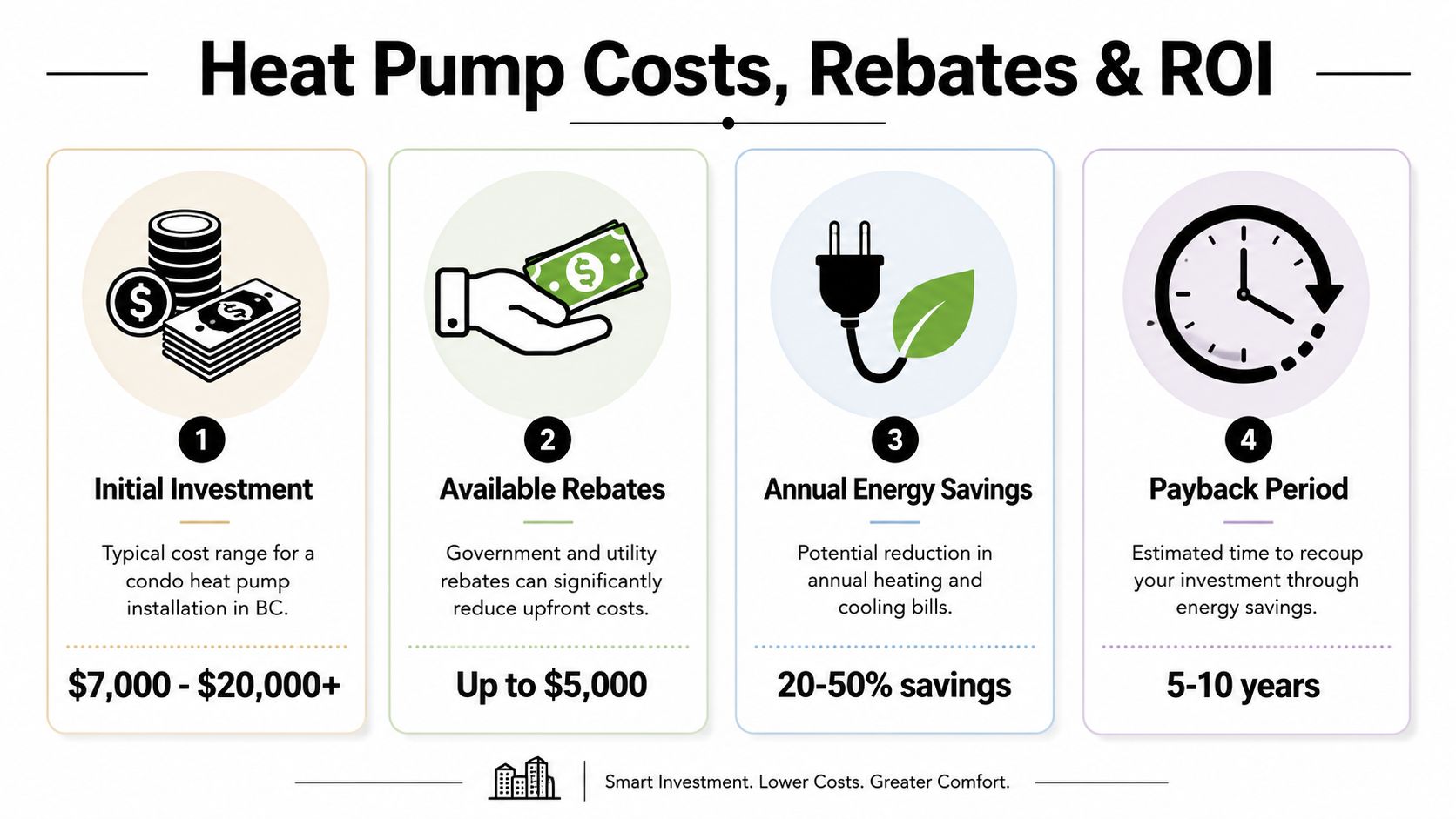
The Canadian Climate Institute discussion published in Frontiers in Energy Efficiency notes that in 2019, only 3.7% of single-attached homes in Canada had heat pumps, and it highlights a major disparity for multi-unit residents. In BC, condo owners might face $6,000 to $16,000 for a cold-climate unit, with BC Hydro rebates up to $2,250, while single-detached homeowners can receive up to $4,000. The same source notes that many multi-unit buildings are ineligible for certain federal rebates.
That gap is why some condo owners feel the economics are unfair. They're not imagining it.
Where rebates help and where they fall short
Rebates still matter. They just come with tighter conditions. For eligible condo programs in BC, the heat pump generally needs to meet minimum efficiency thresholds and must replace a primarily electric heating system to become the main heat source. That often means disconnecting existing baseboard heaters from the suite panel as part of the upgrade, not just adding cooling on top.
The practical lesson is simple. Before choosing a model, verify that the unit qualifies and that your suite's existing heating setup fits the program rules. Don't buy equipment first and ask rebate questions later.
There's also useful background on broader heating and cooling options for BC properties if you're comparing comfort upgrades rather than looking at the rebate in isolation.
How to think about return instead of chasing a quick payoff
Condo owners often want a precise payback number. In real projects, that number is hard to state because every building starts from a different place. Baseboards, layout, insulation, usage habits, and approval costs all change the outcome.
A better way to judge return is to weigh three things:
- Winter operating comfort: Heat feels more even than resistance heating in many suites.
- Summer liveability: For many owners, cooling is the deciding benefit.
- Resale appeal: Buyers increasingly notice whether a condo has proper cooling.
As of July 15, 2025, BC expanded rebates to include income-qualified renters and condo owners in buildings up to six storeys, with rebates up to $5,000, but strata corporations still retain final approval authority, according to this BC heat pump rebate update video. That's helpful progress, but it doesn't remove the building approval barrier.
The best financial decision is often the project that clears approval cleanly, uses qualifying equipment, and avoids expensive redesign after purchase.
Your Installation Checklist and Finding a Contractor
The installation day goes well only if the prep work was done properly. In Vancouver condos, the jobs that go sideways usually fail before anyone opens a toolbox. The approved unit does not match the ordered model, the electrician finds a panel problem late, or the installer arrives and learns the mounting location is different from what strata signed off on.
The pre-install checklist
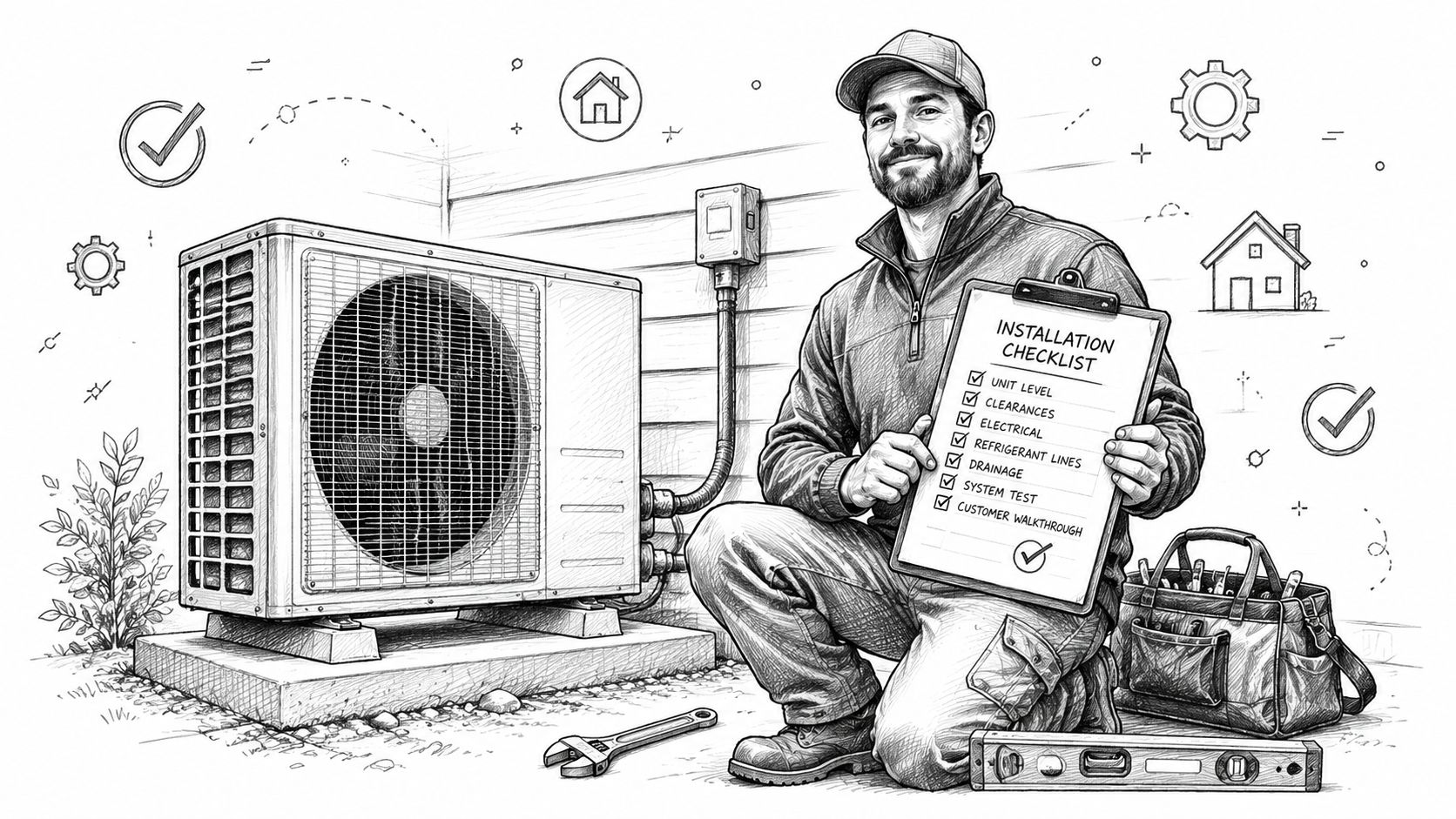
Before booking the work, make sure the paper side and the site side match each other. Condo heat pump installs often involve tight access, resident scheduling, exterior drilling, condensate routing, electrical review, and finish work that has to satisfy both the owner and the strata council.
Confirm these items in writing:
- Written strata approval: Approval should include the exact equipment, mounting location, line routing, and any noise or appearance conditions.
- Permit responsibility: The quote should state who pulls the mechanical permit, who pulls the electrical permit, and who books inspections if your municipality requires them.
- Final equipment model: The model numbers on the quote should match the model numbers in the approval package and rebate file.
- Electrical scope: Panel capacity, breaker space, disconnect location, and any upgrade work should be listed clearly.
- Access and protection: Elevator booking, parkade access, drywall protection, and cleanup expectations should be settled before install day.
- Condensate plan: The installer should explain where water will drain and how that route complies with building rules.
Unlike a detached house, condo work requires specific considerations. The technical install still matters, but approval compliance matters just as much. A clean installation that ignores the approved exterior location can still create problems for the owner later.
What to ask a contractor before signing
Ask questions that expose real condo experience. How many occupied strata buildings have you worked in across Vancouver, Burnaby, or Richmond? Who measures the suite and confirms the load before equipment is selected? Who prepares the wall penetration details and mounting plan for strata review? If the building electrical capacity is tight, what is your process for confirming that before equipment is ordered?
A contractor who knows condo projects should be able to explain trade-offs without guessing. For example, a smaller unit may clear electrical limits more easily but struggle in an exposed corner suite. A better mounting location for service access may be harder to get past council if it changes the building appearance. Good installers deal with those conflicts early.
It also helps if the company can speak plainly about mini-split installation in residential spaces and then apply that knowledge to condo restrictions such as access windows, common property rules, and resident notice requirements.
Look for a quote with model numbers, labour scope, permit details, warranty terms, and finishing work. If wall patching, electrical coordination, line cover, crane access, or disposal are missing, those costs often show up later as extras.
If a contractor avoids strata questions, treat that as a warning sign.
If you're planning a condo heat pump upgrade in Greater Vancouver and want help from a team that understands multi-unit buildings, permits, and the practicalities of strata work, contact Encano Plumbing & Drainage Ltd.. Their team handles plumbing, heating, gas, and HVAC work across Vancouver, Richmond, Burnaby, New Westminster, Delta, Surrey, and nearby communities, with practical support for projects that need to be done cleanly and in compliance.