

Your old tank is still making hot water, but it's noisy, inefficient, or close to the end. You've started hearing about heat pump water heaters from neighbours, rebate programs, and contractors, and now significant questions quickly appear. Will it fit, will it work in a Vancouver basement or utility room, what permits are involved, and what does a proper heat pump water heater installation entail?
Those are the right questions. In Greater Vancouver, these systems can work very well, but they are less forgiving than a standard electric tank. Space, airflow, condensate drainage, electrical capacity, and permit coordination all matter. A good install feels straightforward. A rushed install can leave you with noise, poor recovery, higher power use, and callbacks.
Table of Contents
- Is a Heat Pump Water Heater Right for Your Vancouver Home
- Navigating Rebates Permits and Costs in Greater Vancouver
- Core Installation Requirements Explained
- The Installation Process from Start to Finish
- Hiring a Qualified Contractor in Greater Vancouver
- Your Next Step Towards an Efficient Home
Is a Heat Pump Water Heater Right for Your Vancouver Home
A heat pump water heater makes sense when the house gives it the conditions it needs. The appeal is obvious. You get a much more efficient way to heat water than a standard electric tank. But the first decision isn't brand or rebates. It's whether the installation location can support the unit properly.
Start with the room, not the brochure
The biggest mistake is treating this like a simple tank swap. It often isn't. A critical technical requirement is at least 1,000 cubic feet of ambient air volume around the unit, and if the heater can't access that air, efficiency can drop enough that the backup electric elements do more of the work. In that case, energy consumption can rise by up to 40%, and the unit's Uniform Energy Factor can drop from 3.3+ to below 2.0. Poor airflow planning is also tied to approximately 35% of HPWH service calls in the Greater Vancouver region due to airflow starvation and compressor problems, as outlined in Rheem's installation guide for heat pump water heaters.
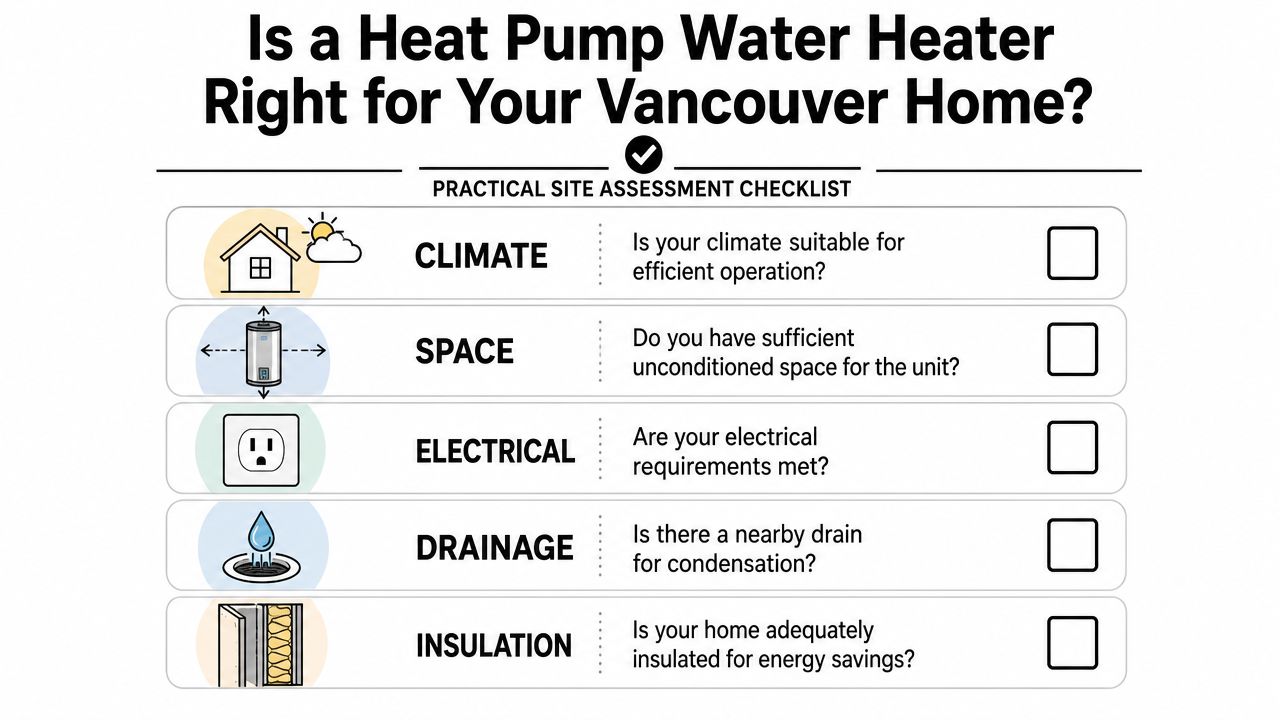
That matters in Vancouver because many homes don't have a generous mechanical room. You might have a tight basement corner, a small utility closet, or a laundry area carved into finished space. If the room is too small, the answer isn't always “no.” It may be “yes, but with ducting.” Intake and exhaust ducting can make an otherwise unsuitable location workable, provided it's designed to maintain airflow instead of choking the unit.
Practical rule: Measure the room first. Width, depth, ceiling height, door swing, and clearance around the unit matter before anyone talks about model choice.
A quick homeowner check helps:
- Air volume: Multiply room length by width by height. If the space is tight, ask whether ducting is realistic.
- Drainage: Look for a floor drain, laundry drain, or another approved condensate path nearby.
- Access: Confirm there's enough room to remove the old tank and bring the new one in without damaging finished walls or stairs.
- Location: Avoid placing the unit beside a bedroom wall or a quiet den if better options exist.
Think about household demand and daily use
Tank size isn't only about the number of people in the house. It's about when you use hot water. A family of four in a detached Kitsilano house with back-to-back showers, laundry in the morning, and a dishwasher cycle after breakfast has a different load pattern than a Richmond condo with staggered schedules.
A practical example. If two adults and two kids tend to shower within the same hour, the safer choice is usually to size for that peak window rather than average daily use. If the household spreads showers out and doesn't stack laundry and dishwashing at the same time, a smaller setup may still feel comfortable. Good installers ask about routine, not just occupancy.
Noise, drainage, and placement matter more than people expect
These units make sound. Not a shocking amount, but enough that placement affects satisfaction. In an unfinished basement, that's usually manageable. In a small enclosed room near living space, you'll notice it more. Placement also changes how cool air moves around the house, which can be useful in some areas and unwelcome in others.
A heat pump water heater should fit the house's layout, not just the plumbing connections that happen to be there.
Drainage is another common trip point. Heat pump water heaters create condensate, and that water has to go somewhere reliable. If a contractor hasn't talked about a condensate drain route, they haven't finished assessing the site.
Navigating Rebates Permits and Costs in Greater Vancouver
The upfront number for a heat pump water heater installation is usually what makes homeowners pause. That's reasonable. The unit costs more than a standard tank, and the job can include electrical work, drain changes, venting or ducting decisions, and permit time. The financial picture only makes sense when you look at the whole project.
Why the rebate conversation matters
British Columbia has seen strong adoption of heat pumps more broadly. The province says the number of households in B.C. with heat pumps has increased by approximately 80% since 2017, rising from an estimated 142,000 to 254,000 households, and the same provincial announcement says the CleanBC Better Homes Energy Savings Program offers rebates up to $16,000 for heat-pump upgrades. It also notes that families earning less than $87,350 annually can see their rebate increase from $9,500 to $16,000, with an additional $3,000 for northern B.C. residents switching from natural gas, propane, or oil to electric heat pumps, for a potential total of $24,000 when electrical service upgrades of up to $5,000 are included, according to the B.C. government's CleanBC update.
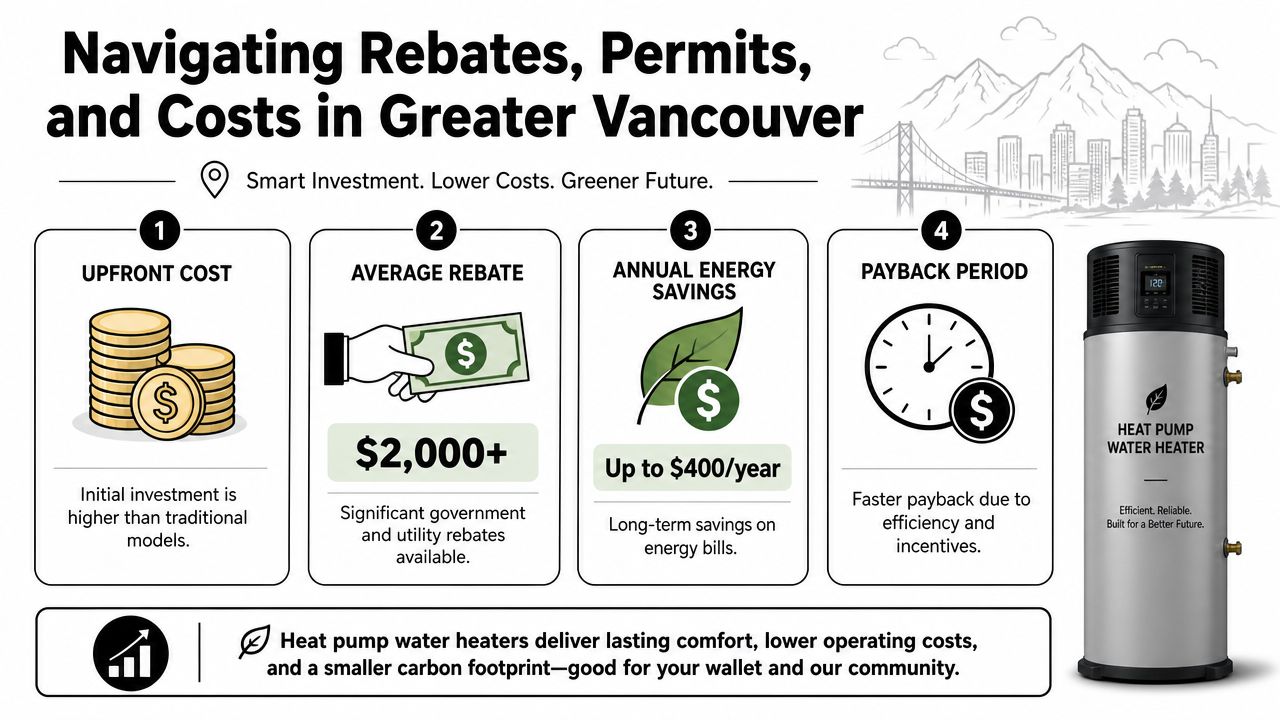
Those figures are broad heat-pump program figures, not a flat promise for every water-heater project. That's why homeowners need someone to sort the paperwork before purchase, not after. Eligibility depends on the exact upgrade path, income category where applicable, and whether electrical work is part of the scope.
A practical Vancouver budget example
Take a Burnaby homeowner replacing an aging electric tank. The quote may include the heat pump water heater itself, removal and disposal of the old tank, new shutoffs or supply lines, a condensate drain, mixing valve work, electrical coordination, permit fees, and any carpentry or access adjustments if the room is tight.
Here's a simple way to think about the budget.
| Item | Estimated Cost (CAD) |
|---|---|
| Heat pump water heater unit | Varies by model and capacity |
| Plumbing labour and materials | Varies by site conditions |
| Electrical work | Varies if new circuit or panel work is needed |
| Permit fees | Varies by municipality and scope |
| Drainage or ducting adjustments | Varies by room layout |
| Old tank removal and disposal | Varies by access and tank type |
For homeowners comparing options, it helps to review a local service overview that discusses Metro Vancouver water heater installation and rebate support alongside your quote so you can see where the installation scope often changes from one property to another.
Permits are part of the job, not an afterthought
Permits can be simple or annoying depending on the municipality and the exact work involved. A same-location replacement is usually more straightforward than moving the appliance, adding a new circuit, or changing surrounding plumbing. Once electrical scope expands, timelines can change quickly.
Good contractors don't wave this away. They identify whether the project needs plumbing permits, electrical permits, or both, and they build inspection timing into the schedule. If somebody says permits aren't worth worrying about, that's usually a sign they're pricing for speed rather than compliance.
Rebate paperwork and permit paperwork should be discussed before installation day. If they show up as a surprise, the planning wasn't complete.
Core Installation Requirements Explained
A proper heat pump water heater installation stands on three legs. Plumbing has to be clean and serviceable. Electrical has to match the equipment. Structural support and restraint have to protect the unit over time. If one leg is weak, the whole system suffers.
Plumbing details that affect performance
The water connections are only part of the plumbing work. A heat pump water heater also produces condensate, and that drain line has to be routed with care. If it's an afterthought, you end up with nuisance leaks, trapped water, or an ugly run across a floor that homeowners trip over or disconnect later.
Mixing valve planning matters too. Installers often set the unit for efficient operation and then manage delivery temperature safely through the system setup. That protects comfort at fixtures while keeping the water-heating side configured properly.
A practical example is a Vancouver basement with no drain directly beside the heater. In that case, the job might require a condensate pump or a carefully planned route to an approved drain point. The right answer depends on the room, not on a standard template.
Electrical readiness in older Vancouver homes
Many older homes were wired around the needs of a simpler tank. A modern heat pump water heater may still be very manageable electrically, but the electrician needs to confirm circuit capacity, breaker compatibility, disconnect requirements, and panel condition before the installation is booked.
That electrical review often finds one of three situations:
- Everything is ready: The existing arrangement supports the new appliance with minimal changes.
- A dedicated circuit is needed: Common in older homes with crowded panels or unclear legacy wiring.
- Panel work is the main issue: The water heater is fine, but the panel needs attention first.
If the installer hasn't coordinated with an electrician before installation day, the schedule is still tentative.
Structural and seismic details
A full tank is heavy, and the surface below it has to support that weight without settlement or rocking. In unfinished basements this is often straightforward. In utility platforms, older framed rooms, or renovation spaces, the base condition deserves a closer look.
Seismic restraint is one of those details homeowners rarely ask about until there's a problem. Installation best practices referenced by ENERGY STAR note that in California, heat pump water heaters in medium to high seismic zones require at least two 22-gauge straps with rubber standoffs to reduce vibration transfer and sound transmission. The same best-practice guidance also notes that domestic hot water pipes buried below grade should be installed in waterproof, noncrushable casing or sleeves, and that unsealed pipe insulation seams can reduce system efficiency by 15% to 20%, as described in ENERGY STAR heat pump water heater installation best practices.
That's U.S. guidance, but the lessons apply directly here. Vibration control matters in attached homes and strata buildings. Pipe insulation details matter because a premium water-heating system loses its edge if heat is bleeding off into cold surrounding space.
The Installation Process from Start to Finish
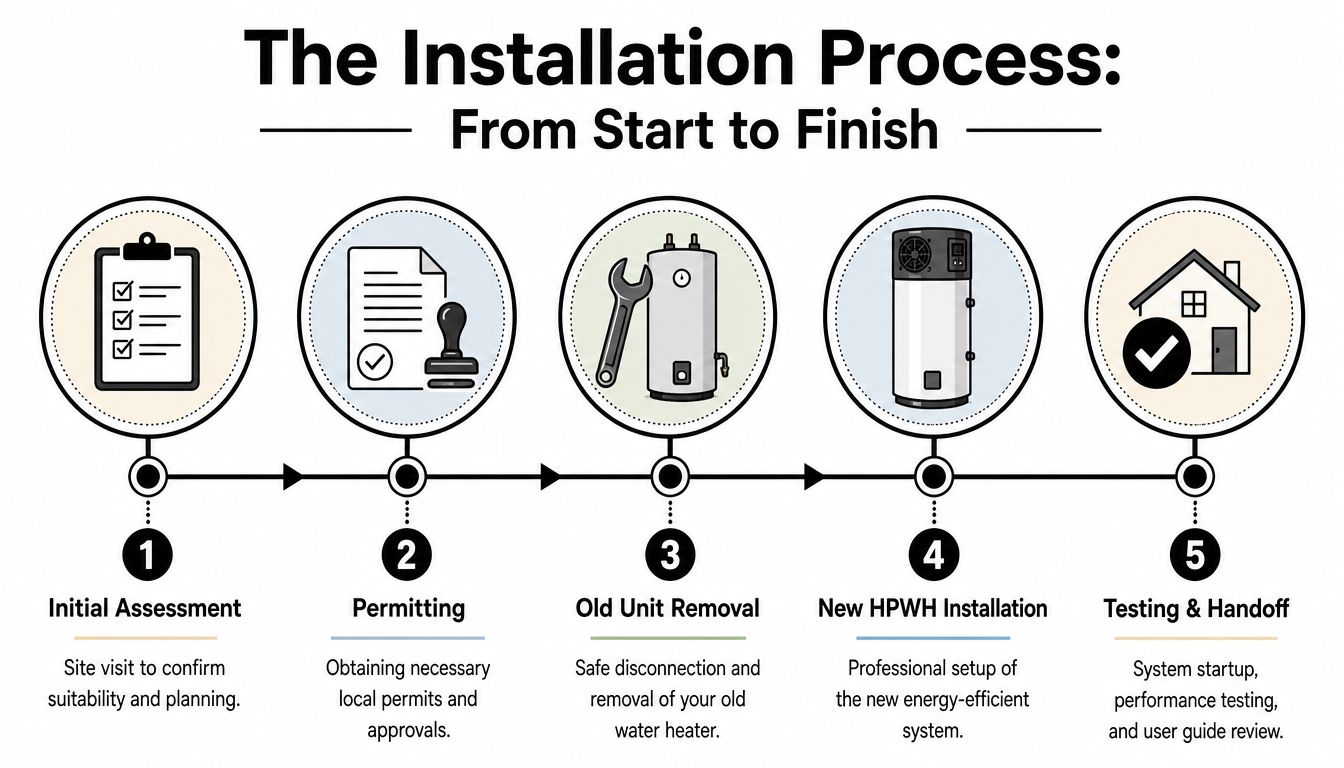
Most homeowners want the same thing on installation day. Clear timing, clean work, no surprises, and hot water back on as soon as possible. A professional heat pump water heater installation follows a predictable sequence, even when the property itself throws a few curveballs.
A quick visual helps before getting into the details.
What happens before tools come in
The best installs are mostly decided before arrival. The contractor confirms access, protects floors, isolates the work area, and verifies that the correct unit and materials are on site. If the project involves plumbing and electrical coordination, both trades need the same plan.
For homeowners who want a second plain-language overview of the sequence, this guide to water heater installation steps and planning is a useful companion to the site-specific assessment you receive from a contractor.
This short video also gives a useful visual sense of the equipment and setup involved.
Removal install and commissioning
The old tank is shut down, isolated, drained, and removed first. In some homes, removal is harder than installation because stairs, narrow doors, and finished walls limit movement. After that, the new unit is set in place with required clearances, and the plumbing connections are completed.
Then comes the detail work that separates a clean job from a callback job:
- Water piping: Connections are made, supported, and checked for alignment rather than forced into place.
- Condensate management: The drain route is secured and tested so it won't spill later.
- Air movement: If the room needs ducting, intake and exhaust paths are installed to avoid starving the unit.
- Electrical completion: Final hookup happens only after the appliance is physically and mechanically ready.
Programming matters too. A unit left in the wrong operating mode won't perform the way the homeowner expects. Commissioning includes startup, control settings, and confirmation that the heater is running in the intended mode for the household.
What gets checked before the job is done
The final stage is less dramatic, but it's where quality shows. The tank is filled, air is purged, fittings are checked, the condensate path is confirmed, and operation is observed. Homeowners should also get a simple handoff on maintenance, controls, and what normal sound and behaviour look like.
There's also a product-compliance layer worth knowing. Natural Resources Canada states that, as of January 1, 2026, household heat pump water heaters manufactured between 2026 and 2029 must meet a minimum Uniform Energy Factor of 2.0 for certain storage-volume and draw-pattern categories, and that by May 6, 2029 the requirement will increase to 2.30 for the same categories. The same regulation notes that energy efficiency reports are required from dealers before importing or trading these products inter-provincially, according to Natural Resources Canada's heat pump water heater regulations page.
That doesn't change the basic installation sequence, but it does affect product selection going forward. Homeowners should expect their installer to supply equipment that aligns with current and upcoming compliance requirements.
Hiring a Qualified Contractor in Greater Vancouver
Most of the disappointment people have with heat pump water heaters isn't about the technology itself. It's about poor planning, weak installation standards, or a contractor who treats a specialised appliance like a generic tank swap. The system can only perform as well as the install.
What a qualified installer should ask on day one
A good contractor starts with questions, not a rushed price. They should ask where the unit will go, how many people live in the home, when hot water use peaks, whether the room has enough air volume, where condensate can drain, and what the electrical panel looks like. If those questions don't come up, the quote is incomplete.
Experience with standard tanks isn't enough on its own. Heat pump water heaters involve airflow management, condensate handling, operating mode setup, and coordination between plumbing and electrical trades. That's closer to a hybrid mechanical project than a basic replacement.
Red flags that usually lead to bad installs
Some warning signs are easy to miss because they sound convenient.
- Vague scope: If the quote doesn't spell out electrical coordination, condensate drainage, permit handling, and disposal of the old unit, expect add-ons later.
- No site assessment: A phone-only price without room measurements or panel review is risky.
- Permit avoidance: If someone dismisses permits without explaining local requirements, that's not efficiency. It's exposure.
- One-size-fits-all model advice: Different homes need different tank capacities, locations, and ducting strategies.
- Pressure instead of explanation: Homeowners should get answers, options, and trade-offs. They shouldn't get cornered.
A practical example. In a strata building, a contractor who doesn't ask about noise transfer, access restrictions, booking windows, and drain routing probably hasn't done enough multi-unit work. Those details can delay or derail an otherwise good plan.
The shortlist that protects your investment
When you compare contractors, keep the checklist simple:
- Licensing and coverage: Confirm licensing, WorkSafeBC coverage, and liability insurance.
- Relevant experience: Ask how they approach airflow, condensate, and electrical coordination on heat pump water heater jobs specifically.
- Clear documentation: Look for an itemised quote and a written scope.
- Communication: You want straight answers about what works, what doesn't, and why.
- Broader mechanical knowledge: A contractor familiar with both plumbing and home comfort systems usually sees the room more clearly. This overview of heating and cooling services in Greater Vancouver gives a good sense of the broader skill set that helps on these projects.
The right contractor doesn't just install the unit. They reduce the chances of regret six months later.
Your Next Step Towards an Efficient Home
A heat pump water heater can be a smart upgrade for a Vancouver home, but only when the house, the installation plan, and the contractor all line up. The wins are real. Lower operating costs, better energy performance, and a more modern hot water system. The friction points are real too. Tight spaces, electrical constraints, permit timing, and noise or airflow issues if the room isn't assessed properly.
Three points matter most.
- Check suitability first: Room volume, drainage, access, and electrical readiness decide whether the project will go smoothly.
- Use every available program carefully: Rebates can change the economics, but only if the paperwork and eligibility are handled properly.
- Choose installation quality over shortcut pricing: The appliance is only half the job. Planning, setup, and commissioning make the difference.
If your current tank is aging, leaking, or expensive to run, this is the right time to get the site assessed properly. A good consultation should leave you with a clear answer on fit, scope, permit needs, and the likely path from old tank to finished installation.
If you're ready to explore a heat pump water heater installation for your home, Encano Plumbing & Drainage Ltd. can provide a professional assessment, explain the trade-offs clearly, and help you plan a compliant installation that fits your space, hot water demand, and budget.