

A single-zone mini-split in Greater Vancouver typically lands between $6,000 and $9,500 installed, while a multi-zone system usually starts around $10,000 and can reach $18,000 or more before rebates. If you're comparing quotes right now, that's the practical range most local homeowners should expect, not the overly broad national averages that miss Vancouver labour, condo access, and rebate details.
That price matters most when you're living the problem already. Maybe the house feels damp in winter, the upstairs gets stuffy in July, or your BC Hydro bill keeps climbing while electric baseboards still leave cold corners. In this market, the question isn't just what a mini-split costs. It's what configuration fits your home, how much of that quote is equipment versus labour, and whether rebates change the math enough to make the upgrade easier to justify.
Table of Contents
- Is a Mini Split Heat Pump Right for Your Vancouver Home
- The All-In Mini Split Heat Pump Cost Breakdown
- Key Factors That Drive Your Final Price
- Real-World Cost Examples in Greater Vancouver
- Maximizing Your Savings with Rebates and Low Running Costs
- Calculating Your Payback Period and Financing Options
- Your Next Steps to a Comfortable and Efficient Home
Is a Mini Split Heat Pump Right for Your Vancouver Home
A mini-split makes sense when your home needs targeted comfort instead of a one-size-fits-all heating system. That's common in Vancouver, Richmond, Burnaby, and nearby areas where many homes have electric baseboards, older additions, converted basements, or upper floors that never seem to match the temperature downstairs.
The appeal is straightforward. You get heating and cooling from one system, room-by-room control, and a cleaner look than portable heaters and window AC units. For many homeowners, the main hesitation is the upfront spend, especially when they're also thinking about electrical work, permits, and whether one indoor head will be enough.
Homes that usually benefit most
Mini-splits are often a strong fit for:
- Condos and townhomes: Especially where there's no ductwork and cooling matters more every summer.
- Older detached homes: Good for replacing or supplementing baseboards in the rooms you use most.
- Additions and renovated spaces: Useful when extending ductwork would be disruptive or poor value.
- Homes with uneven temperatures: A mini-split can solve the hot upstairs and chilly main floor problem better than turning up the thermostat alone.
If you're still early in the process, it helps to understand how a broader heating system installation approach works in local homes, because the best answer isn't always the biggest system. It's the right system in the right rooms.
Practical rule: If you only need to fix comfort in one main area, a single-zone setup is often the cleanest and most economical starting point.
When it may not be the best fit
Mini-splits aren't perfect for every house. Some homeowners don't like the look of wall-mounted indoor units. Others expect one small head to condition an entire chopped-up floor plan, which usually leads to disappointment. And if the home has major insulation or air leakage problems, the system may still work, but it won't perform as comfortably as it should.
That's why the best mini split heat pump cost conversation starts with the home itself, not the sticker price alone.
The All-In Mini Split Heat Pump Cost Breakdown
Most quotes make more sense once you split them into two buckets. First is equipment, meaning the outdoor unit and the indoor head or heads. Second is installation labour, which covers mounting, refrigerant lines, electrical connections, commissioning, and the jobsite realities that vary a lot across Greater Vancouver.
According to this Lower Mainland mini-split cost breakdown, the installed cost for a single-zone mini-split in Vancouver, Richmond, and Burnaby typically ranges from $3,500 to $8,000, with equipment at $1,500 to $3,000 and installation labour at $2,000 to $5,000.
Estimated Cost Breakdown Equipment vs Installation in Greater Vancouver
| System Type | Equipment Cost Range | Installation Labour Range | Total Estimated Cost Range |
|---|---|---|---|
| Single-zone mini-split | $1,500 to $3,000 | $2,000 to $5,000 | $3,500 to $8,000 |
| Multi-zone mini-split | $3,500 to $5,000 | Varies by layout and complexity | Often exceeds $8,000 and can reach $10,500+ |
That table gives you a baseline. In actual Vancouver-area quoting, single-zone jobs often end up above the low end because access, electrical work, and cold-climate equipment choices tend to push the total up. That's one reason practical local planning often lands closer to the $6,000 to $9,500 range for a straightforward single-zone installation.
What homeowners are really paying for
The equipment is only part of the value. Installation quality matters because mini-splits are sensitive to sizing, placement, line routing, drainage, and startup procedure. A cheaper quote can look attractive until it leaves you with a poorly located indoor head, visible line covers in the wrong place, or service access problems later.
A proper quote usually reflects work such as:
- Indoor and outdoor placement: The best locations aren't always the shortest or easiest ones.
- Line set routing: Longer or more concealed runs take more labour and materials.
- Electrical coordination: Some homes need circuit changes or panel work before the unit can be connected.
- Mounting and finishing: Wall bracket choice, pad location, and exterior finish quality all affect the final result.
A mini-split is one of those systems where the installation can matter as much as the brand badge on the box.
Why multi-zone pricing climbs fast
A lot of homeowners assume a second or third indoor head is a small add-on. It rarely is. Every extra head means more line routing, more wall work, more drainage planning, and more time to test and commission the system properly.
That's why the mini split heat pump cost jumps quickly once you move beyond a simple one-room application. A multi-zone quote is less like adding one more appliance and more like building a connected comfort system across different parts of the home.
Key Factors That Drive Your Final Price
A Vancouver special in East Van, a newer townhouse in Surrey, and a condo in Burnaby can all ask for "the same mini-split" and still land at very different prices. The gap usually comes from the home itself. Layout, access, electrical capacity, strata rules, and how much of the home you expect the system to handle all change the quote.
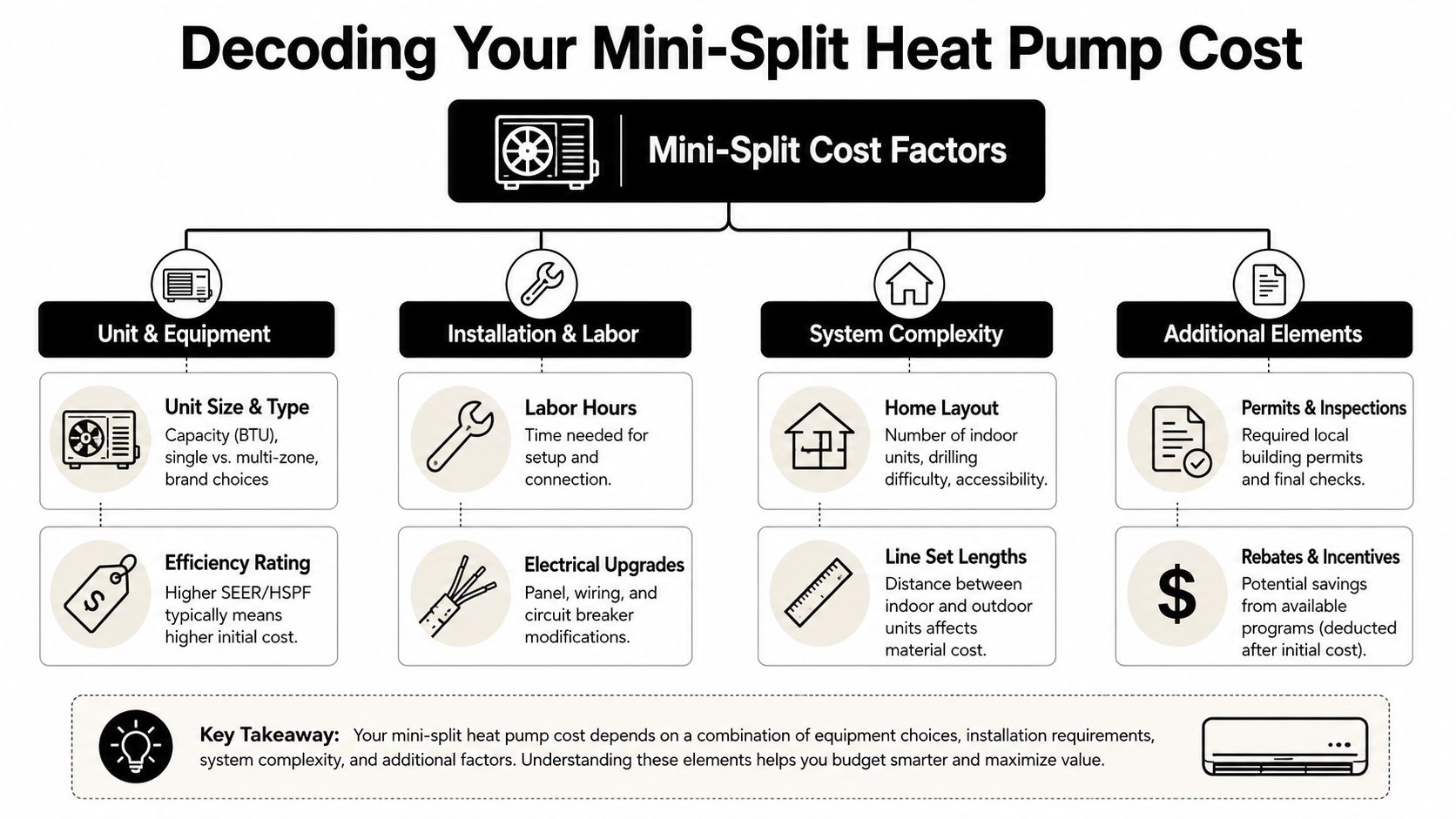
Number of zones and home layout
The jump from one indoor head to several is usually the biggest pricing shift.
A single-zone system is straightforward. One outdoor unit, one indoor head, one area to condition. Once a homeowner wants separate control for bedrooms, an upstairs level, or a back addition, the project gets more involved. Each head needs its own refrigerant piping, control wiring, condensate planning, mounting location, and commissioning time.
Layout matters as much as zone count. An open condo with one main living area is often simpler than an older character house with chopped-up rooms and limited wall space. In real jobs around Greater Vancouver, I often see homeowners focus on the number of heads, but the harder question is whether those heads can be placed where they will move air properly and still allow a clean install.
Equipment size and efficiency choices
Bigger equipment does not automatically mean better comfort. Oversized systems can short cycle, miss the humidity target in cooling season, and cost more than the home needs. Undersized systems leave cold spots and push the unit harder in winter.
Good sizing starts with the home, not a rule of thumb. Window area, insulation levels, ceiling height, sun exposure, and air leakage all affect the result. If you want a clearer idea of where your home is losing heat before you request quotes, review how to test your house for heat loss.
Efficiency level also changes the number. Cold-climate models usually cost more upfront than basic systems, but they make more sense in many Vancouver-area homes that want the mini-split to carry most of the heating load through winter rather than just provide shoulder-season comfort.
Labour difficulty and access
This is where local quoting gets real. Two similar systems can have very different labour costs because one is easy to install and the other fights the crew at every step.
Prices usually rise when the job includes:
- Long or awkward line runs: More piping, more covers, more labour, and often more visible finish work.
- Difficult exterior access: High walls, narrow side yards, roof work, or limited ladder setup slow everything down.
- Finished interior spaces: Fishing lines through completed walls and ceilings takes more care than a simple surface run.
- Condensate challenges: Water has to drain properly year-round, especially in basements, interior rooms, or condo applications.
- Electrical work: Some homes need a new circuit, breaker space, disconnect, or panel upgrade before the heat pump can be connected.
A cheap routing plan can cost you later. I would rather see a homeowner pay for a better line path and proper service access than save a bit upfront and end up with a head in the wrong spot or a drain problem behind finished drywall.
Permits, condo rules, and finish expectations
Soft costs are easy to miss when homeowners compare quotes. They still affect the final number.
In detached homes, permit requirements depend on the scope and the municipality. In condos, strata approval can add another layer entirely. Outdoor unit location, wall penetrations, working hours, crane or lift rules, and sound requirements can all shape the install plan. Those are common issues in Vancouver and nearby cities, and they can push a condo quote higher than a homeowner expects.
Finish level matters too. A basic install with exposed line cover is one price. Concealed routing, tighter exterior detailing, upgraded mounting choices, and more careful visual integration into the home take more labour. For many homeowners, that extra work is worth it because they will look at the system every day.
The final quote is built from these choices. That is why a local in-home assessment usually tells you more than any national average ever will.
Real-World Cost Examples in Greater Vancouver
A price range becomes useful when you can picture it in an actual home. The local benchmark is broad. The City of Vancouver mini-split consumer guide places ductless mini-split installation in Greater Vancouver at $6,000 to $18,000, depending on system size and efficiency, and gives a practical Richmond example of a single-head 12,000 BTU cold-climate mini-split at about $9,500 installed.
Yaletown condo with one main living area
A condo owner in Yaletown often wants cooling first and better winter efficiency second. In that setting, a single-zone mini-split can be a practical fit for the main living and dining area if the bedroom already stays manageable or the owner mainly wants relief in the space they use most.
A realistic expectation is that the installed cost will fall within the local single-zone range already discussed, with condo logistics often pushing the quote upward. Access rules, approved penetrations, noise requirements, and outdoor unit placement can all affect the number.
This type of project works best when expectations are realistic. One head can do a lot in an open plan. It won't behave like a central system in a suite with many closed doors.
Burnaby townhouse with two target areas
A Burnaby townhouse family often asks for one indoor head on the main floor and another in the primary bedroom. That's a classic two-zone request. It solves two different comfort problems at once, daytime living comfort and better sleeping conditions in summer.
In practice, this kind of setup usually lands in the lower to middle part of the broader Greater Vancouver multi-zone range when the line runs are straightforward. Costs rise if the installer has to work around finished walls, long exterior routing, or a difficult outdoor unit location.
A two-head system usually makes sense when the family truly uses two separate zones differently. It's harder to justify when one room just gets occasional use.
Surrey detached home upgrading from baseboards
A larger older house in Surrey often needs more planning. If the homeowner wants a three-zone system to replace the most expensive baseboard-heated areas, the quote usually reflects not just extra heads but also considerations related to an older building envelope, electrical coordination, and longer routing distances.
This is the kind of job where the mini split heat pump cost can move well into the upper end of the regional range, especially if the owner wants a cleaner finish and the system is expected to carry most of the winter heating load in those zones. The upside is that a targeted design can improve comfort dramatically without forcing a full whole-home duct retrofit.
A practical example homeowners can compare against
The Richmond example from the City guide is useful because it's concrete. A homeowner installing a single-head 12,000 BTU cold-climate mini-split would likely pay about $9,500 installed in this region. That's a good reminder that local pricing often sits above bare-bones internet averages once you account for professional installation, cold-climate equipment, and real Vancouver-area job conditions.
Maximizing Your Savings with Rebates and Low Running Costs
A lot of Vancouver homeowners get stuck on the first quote. Then they find out two neighbours paid very different net prices for similar mini-splits because they qualified for different rebate paths. That happens all the time here. The installed price matters, but the after-rebate cost is what decides whether the project makes financial sense.
The rebate paths that matter most locally
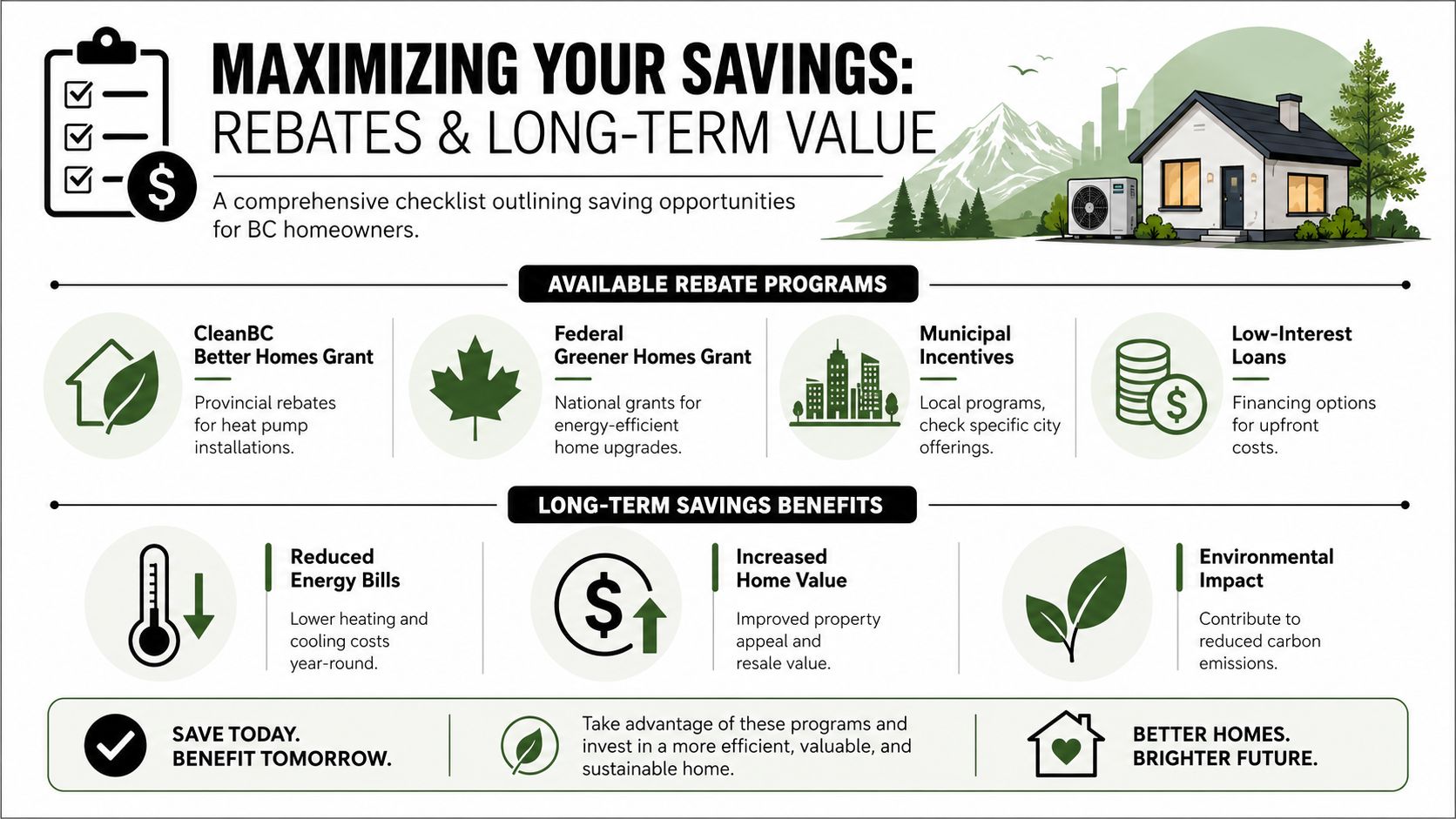
In Greater Vancouver, rebates are not one-size-fits-all. The biggest variable is usually the heating system you have now.
For standard mini-split installs in BC, this provincial cost and rebate overview points out an incentive many homeowners miss: the fossil fuel conversion bonus of $6,000 provincial plus $6,000 municipal for eligible homeowners upgrading from oil or propane. In the right house, that can push the net cost down to a level that looks nothing like the original quote.
Homeowners already heating with electricity are on a different path. BC Hydro's heat pump program information states that BC homes currently heated by electricity can access up to $4,000, and individual condo owners can receive up to $2,250 for qualifying energy-efficient heat pumps.
That distinction matters in Vancouver because a baseboard-heated condo, a gas-heated detached house, and an older oil-heated property can all see very different savings even if the equipment looks similar on paper.
Why Many Articles Miss the Full Savings Picture
Sticker price alone is a poor comparison.
What matters is what the mini-split is replacing, how many hours those rooms are heated, and whether you also need summer cooling. A homeowner replacing expensive electric resistance heat in a main living area usually has a stronger savings case than someone adding a unit mostly for a few hot weeks in July and August.
As noted earlier, local payback tends to look better when the system displaces baseboards in heavily used rooms. It is usually weaker when the unit is oversized for the actual usage or installed mainly for comfort in a lightly used space.
Worth checking carefully: Rebate eligibility often depends on the existing fuel source, the specific equipment, and who owns the property. A detached homeowner and a condo owner may not qualify the same way.
Running cost matters as much as purchase cost
A lower quote does not always mean a lower ownership cost.
In practice, homeowners usually see value from a mini-split in three areas:
- Lower heating costs if the system is offsetting electric baseboards or another expensive heat source in rooms used every day
- Cooling in summer without adding a separate portable or window AC later
- Better zone control so you are conditioning the spaces you occupy instead of overheating or overcooling the whole home
I tell homeowners to judge running cost and comfort together. A system that saves some electricity but leaves bedrooms uneven or the main floor stuffy is not a good result. If you are weighing a mini-split against other setups, it helps to compare heating and cooling options for local homes before choosing a rebate path based only on the biggest headline number.
A practical rebate example
A New Westminster condo owner who installs a qualifying high-efficiency mini-split and receives the $2,250 condo rebate could reduce an $8,500 project to $6,250, based on the BC Hydro program example in the linked guidance above.
That does not make every condo installation cheap. It does make the decision clearer. In this market, the strongest mini-split projects are usually the ones where the rebate is real, the displaced heating cost is high, and the homeowner plans to use the system often enough to benefit from both heating and cooling.
Calculating Your Payback Period and Financing Options
The cleanest way to judge a mini-split is to treat it like an investment in comfort with a measurable operating benefit. You don't need a complicated spreadsheet. You need a reasonable installed cost, a realistic rebate estimate, and an honest view of how much expensive heating or cooling you're replacing.
A simple payback framework
Start with this:
- Installed cost
- Minus rebates you qualify for
- Equals net project cost
- Compare that against your expected annual energy savings
If you're replacing electric baseboards in heavily used rooms, your savings case is usually stronger than if you're adding a mini-split mainly for occasional summer cooling.
Don't calculate payback from the best-case rebate you saw online. Calculate it from the rebate path that matches your home, fuel source, and ownership type.
Why quotes vary so much by head count
Local pricing can seem inconsistent until you look at the number of indoor heads and the labour around each one. This discussion of BC mini-split installation pricing reports common professional installation cost per indoor head in the $7,000 to $12,000 range, with some quotes averaging around $5,000 per unit depending on labour complexity and electrical requirements.
That doesn't mean every extra head costs one flat amount. It means each added zone changes the labour, materials, and routing demands enough that simplistic online calculators often understate the project cost.
Financing changes the decision for some households
Some homeowners can pay for the project outright. Many would rather preserve cash and spread the cost over time, especially if they're also handling insulation, windows, or panel upgrades. Financing can make sense when the monthly payment fits comfortably and the system solves a problem you feel every day, poor winter comfort, summer overheating, or both.
A practical way to think about it is this:
- If comfort is urgent: Financing may help you act sooner.
- If rebate timing is uncertain: Wait until eligibility is confirmed.
- If the quote includes major electrical work: Compare whether doing it now avoids repeated labour later.
The mini split heat pump cost is easier to live with when the project is sized properly and the budget plan is realistic from the start.
Your Next Steps to a Comfortable and Efficient Home
By this point, the pattern is clear. A mini-split isn't a fixed-price product. It's a system that has to match your layout, your heating source, your access conditions, and the way you use the home. In Greater Vancouver, a practical single-zone budget is usually $6,000 to $9,500, while multi-zone work commonly starts around $10,000 and can reach $18,000 or more before rebates.
The best next step is a proper site assessment. That means looking at the rooms that need help, checking where indoor and outdoor units can realistically go, reviewing the electrical side, and matching the layout to a sensible number of zones. Good planning avoids the two mistakes that cost homeowners the most: under-sizing the system and overbuilding it.
A solid quote should answer a few plain questions:
- What rooms will this system handle
- How many indoor heads are needed
- What finish level is included for line routing and mounting
- Which rebates appear realistic for this exact property
If you get those answers clearly, you'll be able to compare options without guessing what's hidden inside the price.
If you want a clear, no-pressure quote for your home, Encano Plumbing & Drainage Ltd. can assess your layout, explain your mini-split options, and help you understand the actual installed cost before you commit.