
A lot of heating replacements in Greater Vancouver start the same way. The house still warms up, but it takes longer. One bedroom stays chilly, the main floor feels stuffy, and the old furnace starts making a new noise every few days. Then a wet November week hits, and suddenly the question isn't “Should we replace it someday?” but “Can this thing make it through winter?”
That's the right time to look at heating system installation as a planned upgrade instead of an emergency purchase. In Vancouver, Richmond, Burnaby, and nearby cities, the best results usually come from stepping back and looking at the whole house. Not just the box in the mechanical room. Older homes often have heat loss issues, undersized returns, tired ductwork, or electrical limitations that shape what will work well.
A practical example: a homeowner in an older East Vancouver house may think they only need a new furnace because the current one is noisy. But once the site is checked properly, the bigger issue may be poor airflow to the upper floor and a service panel that changes the economics of switching to electric heat. That's why the replacement process needs to be grounded in local conditions, not generic product lists.
Table of Contents
- Is Your Heating System Ready for a Vancouver Winter
- Choosing Your Heating System for the BC Climate
- Decoding Installation Costs and Vancouver Rebates
- The Installation Process From Consultation to Completion
- How to Choose and Work With a Heating Professional
- Protecting Your Investment Maintenance and Safety
- Your Heating Installation Questions Answered
Is Your Heating System Ready for a Vancouver Winter
A failing heating system rarely quits politely. More often, it gives you a string of warnings first. The blower gets louder. The burners cycle oddly. The house takes longer to recover after the thermostat turns up. Utility bills creep higher, even though your habits haven't changed much.
In the Lower Mainland, damp cold makes those problems more noticeable. A home doesn't need Prairie-level temperatures to feel uncomfortable. If the air is cool and humid and your system is struggling, the whole house feels off.
The signs people usually notice first
Homeowners usually call after one of these starts happening consistently:
- Uneven rooms: Upstairs is warm, the back bedroom is cold, or the basement never feels right.
- Strange operating sounds: Rattling panels, harder starts, or air noise that wasn't there before.
- Frequent thermostat changes: Someone is always adjusting the temperature because comfort never settles.
- Rising operating cost: The system seems to run longer to do the same job.
- Short cycling or slow recovery: The heat turns on and off too often, or the home warms back up too slowly after nighttime setback.
A practical example is a Vancouver Special with an older furnace and original duct layout. The main floor may feel acceptable, but the bedrooms near the corners stay cool because the system was never balanced properly, and the equipment has lost performance over time. Replacing the unit without addressing airflow often leaves the same complaints in place.
Practical rule: If comfort problems show up in the same rooms every winter, the issue usually isn't just age. It's often a combination of equipment, duct layout, and heat loss.
Before choosing equipment, it helps to understand where the house is losing heat. A simple starting point is learning how to test your house for heat loss. That gives useful context for whether you need a different system, a better-sized system, or supporting upgrades around it.
Replacement is about more than avoiding a breakdown
A planned replacement gives you options that an emergency swap doesn't. You can compare gas and electric properly. You can check whether your panel can support a heat pump. You can look at duct changes, thermostat location, filtration, and whether cooling should be part of the same project.
That matters even more in older Greater Vancouver homes, where the heating appliance is only one part of the comfort picture. Good installation work solves the house you live in, not the house on the brochure.
Choosing Your Heating System for the BC Climate
The best heating system for a Greater Vancouver home depends less on marketing claims and more on three local realities. Our winters are relatively mild, many homes are older and retrofit-driven, and utility costs plus electrical capacity can change the math quickly.
What works well in the Lower Mainland
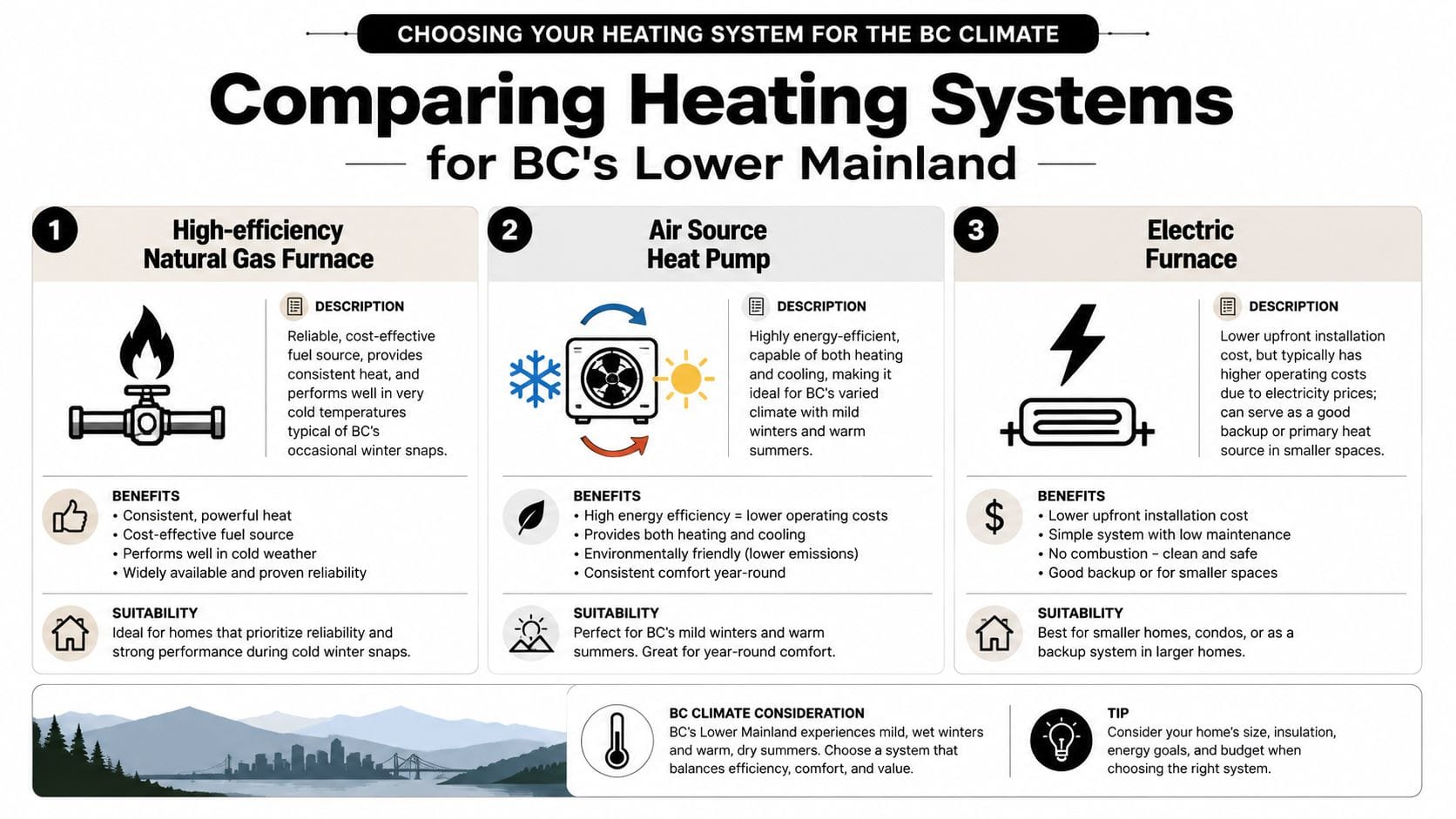
Three systems come up most often in local replacement projects.
High-efficiency natural gas furnaces still make sense for many houses that already have gas service, usable ductwork, and owners who want straightforward replacement with strong cold-weather output. They're familiar, fast-heating, and usually simpler to fit into a like-for-like retrofit.
Air-source heat pumps fit Metro Vancouver well because they provide both heating and cooling. That's a major benefit in homes that currently have heat but no summer cooling. The biggest catch is installation context. A heat pump may require duct changes, outdoor unit placement planning, condensate routing, and sometimes electrical work.
Electric furnaces are usually a narrower fit. They can work in smaller spaces, as backup heat, or where fuel options are limited. But operating cost is often the sticking point, so they need careful comparison before they become the default choice.
A practical comparison for local homes
A major local issue is that electrification isn't just an equipment choice. It's a house-capacity decision. Guidance focused on Metro Vancouver notes that homeowners replacing gas heat need to weigh electrical upgrade needs and local utility rates, especially in older single-family homes and strata properties where service upgrades can materially affect the project budget, as discussed in this Metro Vancouver electrification and operating-cost context.
A practical example: a Burnaby homeowner may want a heat pump for heating and cooling, which is reasonable. But if the existing panel is already tight and the house also needs an EV charger or induction range, the electrical side may become the decisive issue. In that case, comparing a heat pump, a gas furnace, and a dual-fuel setup is more useful than arguing in absolutes.
For homeowners looking at that middle-ground option, it helps to understand how a dual-fuel heat pump setup works. In some houses, that approach handles the electrification goal without forcing an all-or-nothing decision.
| System Type | Best For | Typical Installed Cost | Pro | Con |
|---|---|---|---|---|
| High-efficiency Natural Gas Furnace | Homes with existing gas service and usable ductwork | Varies by home, equipment, and retrofit complexity | Reliable heat and simpler replacement path in many existing homes | No built-in cooling |
| Air Source Heat Pump | Homes wanting heating and cooling in one system | Varies by equipment, electrical needs, and duct or line-set work | Efficient all-electric comfort with summer cooling | May require panel upgrades or more complex retrofit work |
| Electric Furnace | Smaller spaces or specific retrofit situations | Usually lower equipment-side entry point, but project-specific | Simpler equipment and no combustion | Higher operating-cost risk in many whole-home applications |
In Vancouver, the right choice is often the one that fits the house cleanly, not the one that sounds most advanced on paper.
If you're deciding between two systems, narrow the question to this: which option fits your current ductwork, electrical service, comfort goals, and likely years in the home? That usually gets you to a better answer than comparing brochure features alone.
Decoding Installation Costs and Vancouver Rebates
The price of a heating replacement is never just the equipment tag. Homeowners get surprised when a quote changes because of access, electrical work, duct revisions, permits, or disposal of the old system. That's normal. A clean, simple replacement in a newer mechanical room is one kind of job. A retrofit in an older Vancouver house is another.
What actually drives the final invoice
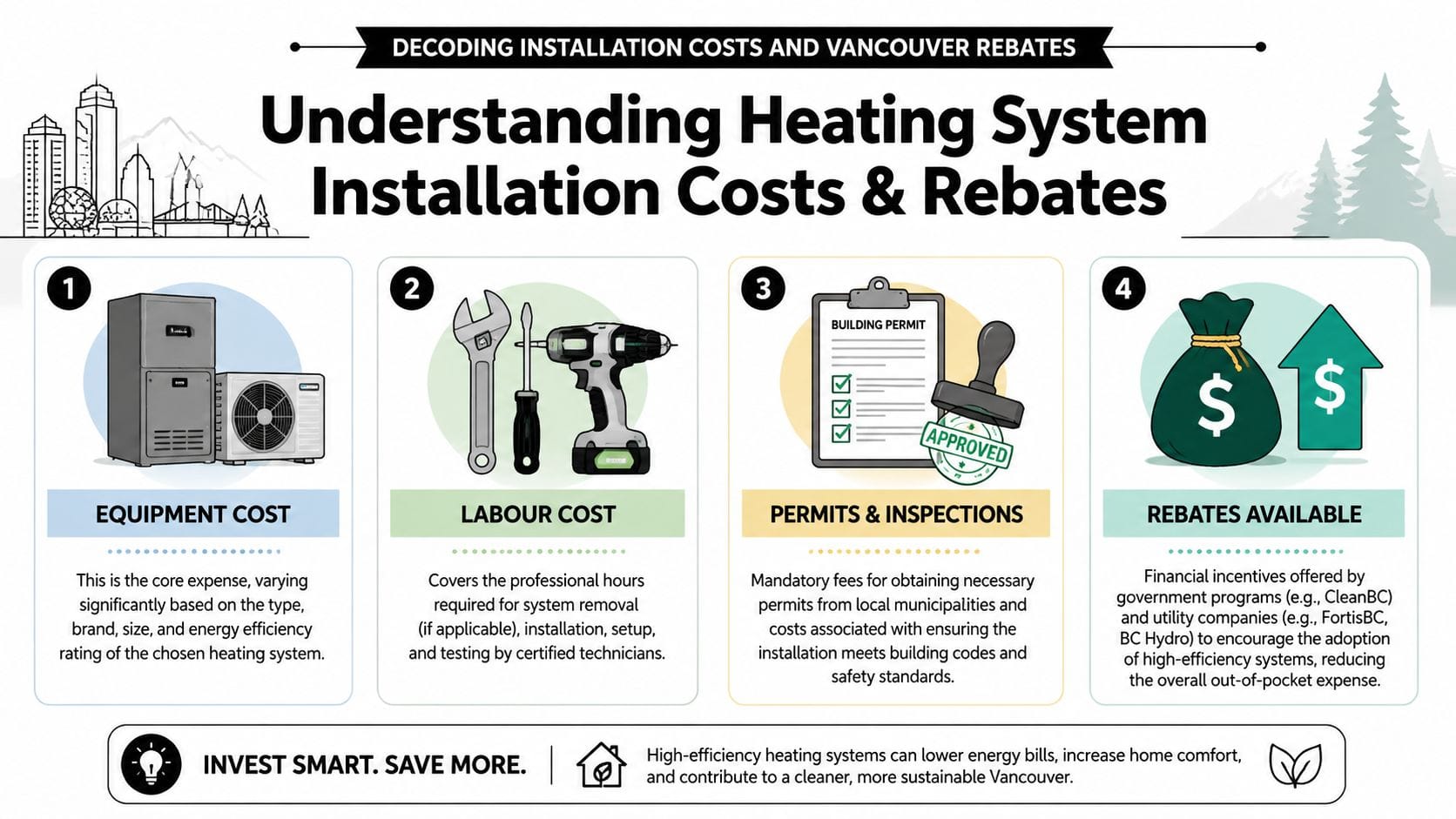
Four cost buckets show up on most projects.
- Equipment: Furnace, heat pump, air handler, boiler, controls, and any matched components.
- Labour: Removal, installation, startup, testing, and adjustments.
- Permits and inspections: Required municipal and safety compliance work.
- House-side upgrades: Duct modifications, venting, gas changes, drain work, pad or bracket work, and electrical upgrades where needed.
A practical example: two Richmond homes may choose the same heat pump model, but one quote ends up much higher because the outdoor unit needs a different mounting approach, the refrigerant routing is longer, and the electrical panel needs additional work. Same headline equipment. Different installation reality.
If you're trying to sanity-check quotes, this guide on how much a new furnace can cost is a useful starting point, especially for understanding what should and shouldn't be included.
How rebates fit into the decision
Rebates matter, but they shouldn't drive the entire project. The better approach is to ask whether the system still makes sense if the paperwork takes time, if program rules change, or if another required upgrade eats into the savings.
For local homeowners, rebate planning usually works best when you treat it as part of scope review:
- Check eligibility early: Some programs depend on equipment type, installer qualifications, or supporting upgrades.
- Match the rebate to the house: A heat pump rebate doesn't erase an expensive panel issue if the home isn't ready for the load.
- Confirm documentation requirements: Model numbers, invoices, commissioning details, and permit records often matter.
- Avoid “rebate-first” sizing decisions: Oversized or poorly matched systems still perform poorly, even with incentive money attached.
Good budgeting starts with the hard costs you know you'll have. Rebates should reduce a sound project, not justify a weak one.
Older homes make this even more important. Retrofit work can uncover venting changes, drainage updates, or hidden access issues that no rebate program covers. A realistic budget leaves room for the house to tell you what it needs once the work begins.
The Installation Process From Consultation to Completion
A professional heating system installation should feel organised, not chaotic. The process starts well before tools come out, and on older Lower Mainland homes, that early planning often determines whether the finished system performs smoothly or becomes a source of callbacks.
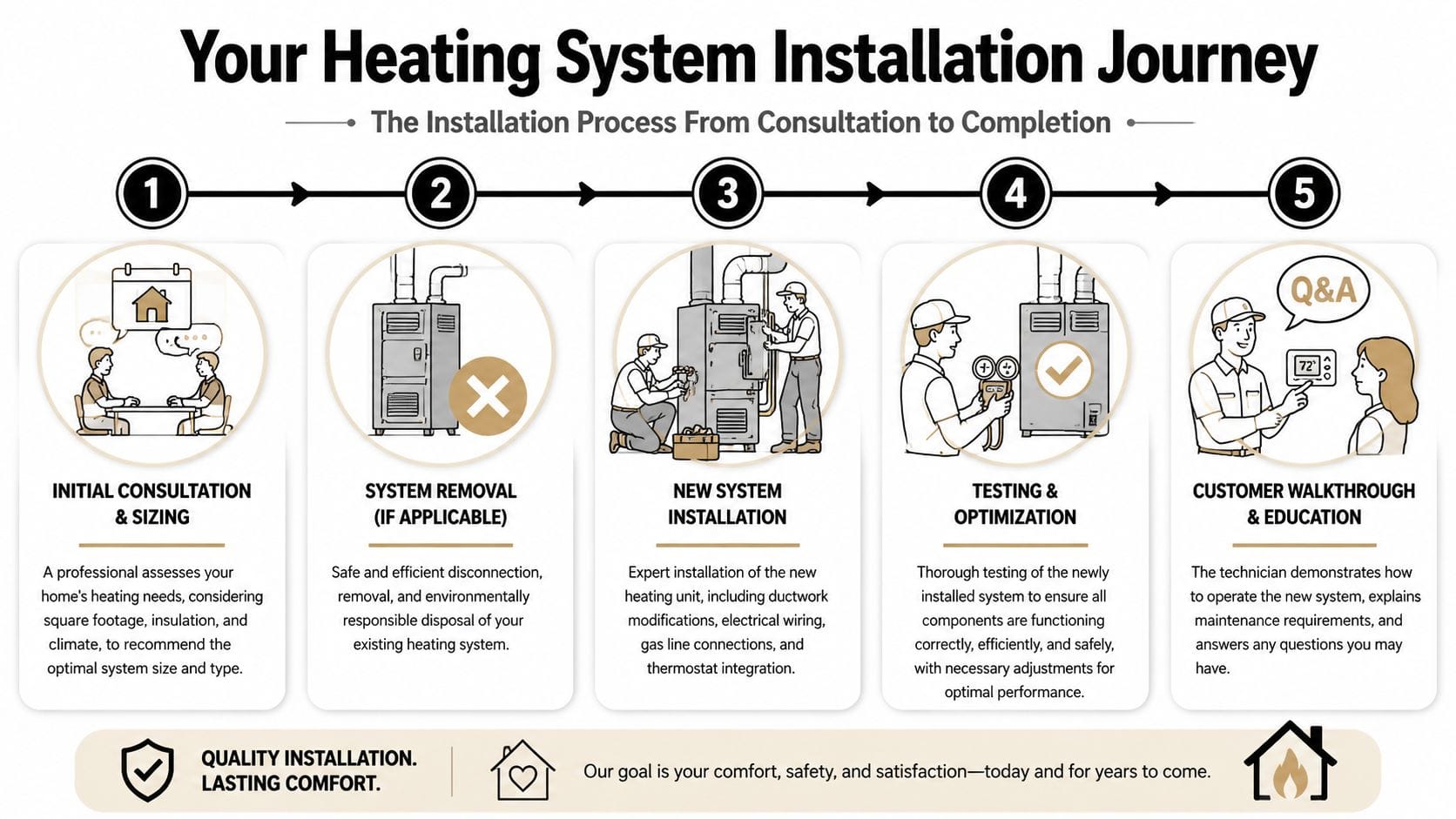
To make the workflow easier to picture, here's the typical sequence.
What happens before installation day
The first step is site assessment and sizing. That means looking at the house, not just reading the old unit's label. Square footage matters, but so do insulation quality, window condition, duct layout, and whether parts of the home have been finished or enclosed since the original system went in.
A practical example: in an older Burnaby house, the original furnace may have been selected for a draftier building envelope decades ago. Since then, the owner may have replaced windows, added attic insulation, and finished the basement. Dropping in the same size again can create poor cycling and less stable comfort.
After sizing comes project planning. That includes equipment placement, venting or line routing, electrical review, condensate drainage, thermostat strategy, and access protection inside the home. If the project includes a water-heating component, local safety details matter too. For heat pump water heater installation guidance, regional best practice stresses clear intake airflow, accessible service space, insulated hot-water piping, and at least two 22-gauge seismic straps in moderate-to-high seismic areas, as outlined in this installation guidance for airflow, piping, and seismic restraint.
How retrofit work is handled in older homes
Many online articles often present an overly tidy picture. Real retrofit work is rarely neat.
Older homes in Vancouver and surrounding cities often have tight utility rooms, odd framing, low basements, or finished spaces that limit access. Industry discussion around hydronic and baseboard installation repeatedly comes back to awkward geometry, unusual corners, and routing challenges in retrofit conditions, which is why a BC-specific discussion of odd-angle installation challenges is so relevant.
That shows up in everyday work:
- Mechanical room congestion: Water lines, drains, venting, and existing storage all compete for space.
- Awkward equipment paths: Some units can't be moved in or out without partial disassembly or careful route planning.
- Finished basements: Installers have to preserve ceilings and walls while still reaching critical runs.
- Vancouver Special layouts: Main-floor comfort and lower-level comfort often need different airflow thinking.
A practical example is a South Vancouver home where the old furnace sits under the stairs, the return drop is undersized, and the owner wants to add cooling. The successful job usually isn't the fastest one. It's the one that reworks the return path, protects nearby finishes, and chooses an equipment configuration that can be serviced later.
For some homeowners, seeing equipment anatomy helps before installation day. This short video is useful context.
Commissioning, safety, and handoff
Once the new system is in, the job still isn't done. Startup includes testing controls, checking airflow or hydronic circulation, confirming thermostat operation, and verifying that the equipment performs the way it was designed to.
The walkthrough matters too. Homeowners should know how to change filters, where shutoffs are, what normal sounds are, and when to call for service. If a contractor rushes out as soon as warm air starts blowing, that's not a complete installation.
How to Choose and Work With a Heating Professional
A lot of problems show up before the first tool comes out. In Greater Vancouver, the contractor choice often decides whether a retrofit goes smoothly or turns into added electrical work, permit delays, or a system that costs more to run than expected. That matters even more in older houses, where the heating decision is tied to panel capacity, duct limitations, and whether electrification makes financial sense under local hydro rates.

What to verify before you sign
Start with the contractor's process, not the sales pitch. A good heating professional asks questions that connect the equipment choice to the house you own.
That includes the basics:
- Licensing and trade scope: Confirm the company can legally handle the gas, electrical, and HVAC work your project needs.
- Insurance and WorkSafeBC coverage: If there is property damage or a worker injury, you want clear coverage in place.
- Retrofit experience in older homes: Installing in an older East Van house, a Richmond rancher, or a Vancouver Special is different from working in new construction with open access.
- Recent local reviews: Look for comments about communication, cleanliness, callbacks, and whether the comfort problem was solved.
Then look at how they assess the house. For example, if you are comparing a heat pump to a gas furnace, the contractor should be asking about your electrical panel, existing duct size, service access, and your utility priorities. Lower emissions sound good on paper, but the practical question is whether the home can support the equipment without a costly panel upgrade or major distribution changes. If a contractor skips those questions, the quote is incomplete.
A simple test helps. Ask what might complicate the job in your house. An experienced contractor usually has a clear answer.
What a good quote should include
A solid quote is specific enough that both sides know what is being installed, what is being changed, and what is not included. That protects the homeowner from surprise costs later.
Look for these items:
| Checklist Item | Why It Matters |
|---|---|
| Scope of work | Confirms what is being removed, installed, modified, and tested |
| Equipment details | Shows what models or system type are included |
| Permit responsibility | Clarifies who handles compliance and inspection coordination |
| Exclusions | Prevents disputes about electrical, drywall, or duct revisions later |
| Warranty terms | Separates manufacturer coverage from labour coverage |
Watch for missing details around electrical work. In this region, that is one of the biggest cost variables, especially on electrification projects. A quote can look competitive until you find out the panel work, circuit additions, or control upgrades were left out.
The same goes for duct modifications. Replacing a box is straightforward. Correcting poor airflow in an older home is not. If the contractor believes the return air is undersized, certain rooms need balancing, or the installation will require venting changes, that should appear in writing.
If a quote is vague, the homeowner usually pays for the missing detail later.
One local option homeowners may encounter is Encano Plumbing & Drainage Ltd., which provides heating service alongside plumbing, gas, and drainage work in Greater Vancouver. Regardless of company, the standard should be the same: clear scope, code-compliant work, permit responsibility, and recommendations that match the house instead of a generic equipment swap.
Protecting Your Investment Maintenance and Safety
A new system doesn't stay efficient just because it was installed properly. It needs basic care, and the good news is that most homeowners only need to stay on top of a few simple habits between professional service visits.
What you can handle yourself
Homeowner maintenance is mostly about airflow, visibility, and access.
- Check filters regularly: A clogged filter can reduce airflow and make the whole system work harder.
- Keep supply and return grilles clear: Furniture, rugs, and storage boxes often block the air path without anyone realising it.
- Keep outdoor equipment unobstructed: If you have a heat pump, don't let leaves, clutter, or overgrown plants crowd the unit.
- Watch for changes: New noises, longer run times, or uneven room temperatures are worth noting early.
A practical example: a homeowner installs a new ducted heat pump, then stores bins tightly around the indoor unit in the mechanical room. Service access gets worse, airflow around components is restricted, and routine maintenance becomes harder than it should be. The fix is simple, but the habit matters.
What should be left to a pro
Annual professional service is where safety and longevity get protected. For fuel-burning equipment, that includes combustion-related checks and venting review. For heat pumps, it includes electrical inspection, condensate review, control operation, and performance checks.
Homeowners should also stay alert to safety basics:
- Carbon monoxide detectors: Essential anywhere fuel-burning appliances are present.
- Seismic restraint awareness: In our region, anything tank-based or wall-mounted needs to remain secure.
- Clear working space: Don't crowd the equipment with paint, boxes, or household storage.
A well-installed system usually gives warnings before major failure. Routine service helps catch them while they're still manageable.
Your Heating Installation Questions Answered
Can a heat pump handle a Metro Vancouver winter
In many homes, yes. Metro Vancouver's climate is generally a strong fit for heat pumps, especially where homeowners also want cooling. The harder question isn't usually outdoor temperature alone. It's whether the house, ductwork, and electrical service support the system properly.
If your home is older, poorly insulated, or has difficult duct distribution, the answer may still be a heat pump, but only after the retrofit details are addressed. In some houses, a gas furnace remains the simpler replacement. In others, a hybrid approach makes more sense.
What if my older home has awkward access
That's common, not unusual. Retrofit-driven homes often have low basements, narrow side passages, finished ceilings, or mechanical rooms that were never designed for modern equipment layouts. Installers usually solve that with equipment planning, route control, selective disassembly, and careful protection of finished areas.
Hydronic systems add another layer. Guidance for radiant slab work notes that perimeter insulation extending 4 feet inward from the slab edge helps reduce downward heat migration, and full under-slab insulation may be needed when edge-only insulation isn't enough, according to this hydronic slab installation guidance. In practical terms, missing that detail can mean higher supply temperatures and longer runtimes later.
Should strata owners think differently than detached homeowners
Usually, yes. In strata settings, equipment changes may affect electrical capacity, sound expectations, penetrations, exterior placement, and building rules. Even when the suite owner pays for the work, approval and coordination can shape what's feasible.
That matters more as electrification expands. As a policy example, California has a statutory goal for heat pumps to be installed in at least 6 million homes by 2030 according to this electrification policy reference. That kind of policy direction affects codes, training, and long-term planning, and it's part of why strata councils and property managers are paying closer attention now.
Is it ever smart to replace only the heating side and ignore the rest
Sometimes, but only if the rest of the system is in good condition. If the ductwork leaks badly, the thermostat is poorly placed, or the home has major envelope weaknesses, replacing the appliance alone may leave you with a newer unit and the same comfort complaints.
A practical example is a house where the furnace fails, but the comfort problem is an underperforming return-air path to the second floor. The equipment swap gets the house warm again, but the upstairs still doesn't balance. That isn't a product failure. It's an incomplete project scope.
What should I ask at the estimate visit
Ask what the contractor is checking beyond the old unit. Good questions include whether the system is being sized for the current house, whether the ductwork is adequate, whether your panel can support electrification, what permit path applies, and what service access will look like after installation.
If they can answer those clearly, you're usually dealing with a more careful process.
If you're planning a heating replacement in Vancouver, Richmond, Burnaby, Surrey, or nearby communities, Encano Plumbing & Drainage Ltd. can help you review the practical options for your home, including retrofit constraints, gas versus electric trade-offs, and code-compliant installation planning.