
You're in the middle of a dinner rush, a sink starts draining slowly, and a sour smell drifts up from the floor drain. In a Vancouver kitchen or strata boiler room, that's usually not a “wait and see” problem. It's a grease trap warning, and the difference between a quick service call and a full shutdown often comes down to whether someone treats grease trap cleaning as routine maintenance or as compliance work.
For restaurant owners, strata managers, and small facility operators, the hard part isn't knowing that grease builds up. It's knowing when to act, what a proper clean entails, and how to handle waste and records without creating a new problem. In Vancouver and the wider Metro region, that matters because local wastewater control is tied to keeping fats, oils, and grease out of the public system, and the practical rules are stricter than many operators expect.
Table of Contents
- Your Guide to Grease Trap Health
- What Is a Grease Trap and How Does It Work
- Why Regular Cleaning Is Non-Negotiable
- Tell-Tale Signs Your Grease Trap Needs Service
- DIY Versus Professional Grease Trap Cleaning
- What to Expect During a Professional Cleaning
- Maintenance Schedules and Vancouver Regulations
- Grease Trap Cleaning FAQs
Your Guide to Grease Trap Health
A busy kitchen can look fine right up until it doesn't. One prep sink starts slowing down, then a dishwasher complains about standing water, and by closing time the drain smell has spread far enough that staff notice it before guests do. In my experience, that's the moment most owners start searching for a fix, when the better move would've been an earlier inspection and a documented clean.
A grease trap operates in the background until it fills past its safe working range. The trap only does its job when grease, solids, and wastewater are separated before they hit the sewer line. Once that separation starts failing, the symptoms show up as slow drains, odour, and eventually a backup that interrupts service and creates a cleanup nobody wants.
For Vancouver operators, the issue is that grease trap cleaning is tied to both function and compliance. The trap isn't just a plumbing component, it's part of the building's wastewater control system, and local expectations around cleaning, disposal, and recordkeeping are stricter than many first-time owners realise. A practical example is a small café that assumes low volume means low risk, then discovers that even modest daily output can still trigger service when buildup reaches the action point.
Practical rule: if staff can smell the trap before they can explain the last service date, the schedule is already too loose.
The safest approach is simple. Know what the trap is doing, measure the buildup instead of guessing, and treat every service as something you can document later if an inspector asks.
What Is a Grease Trap and How Does It Work
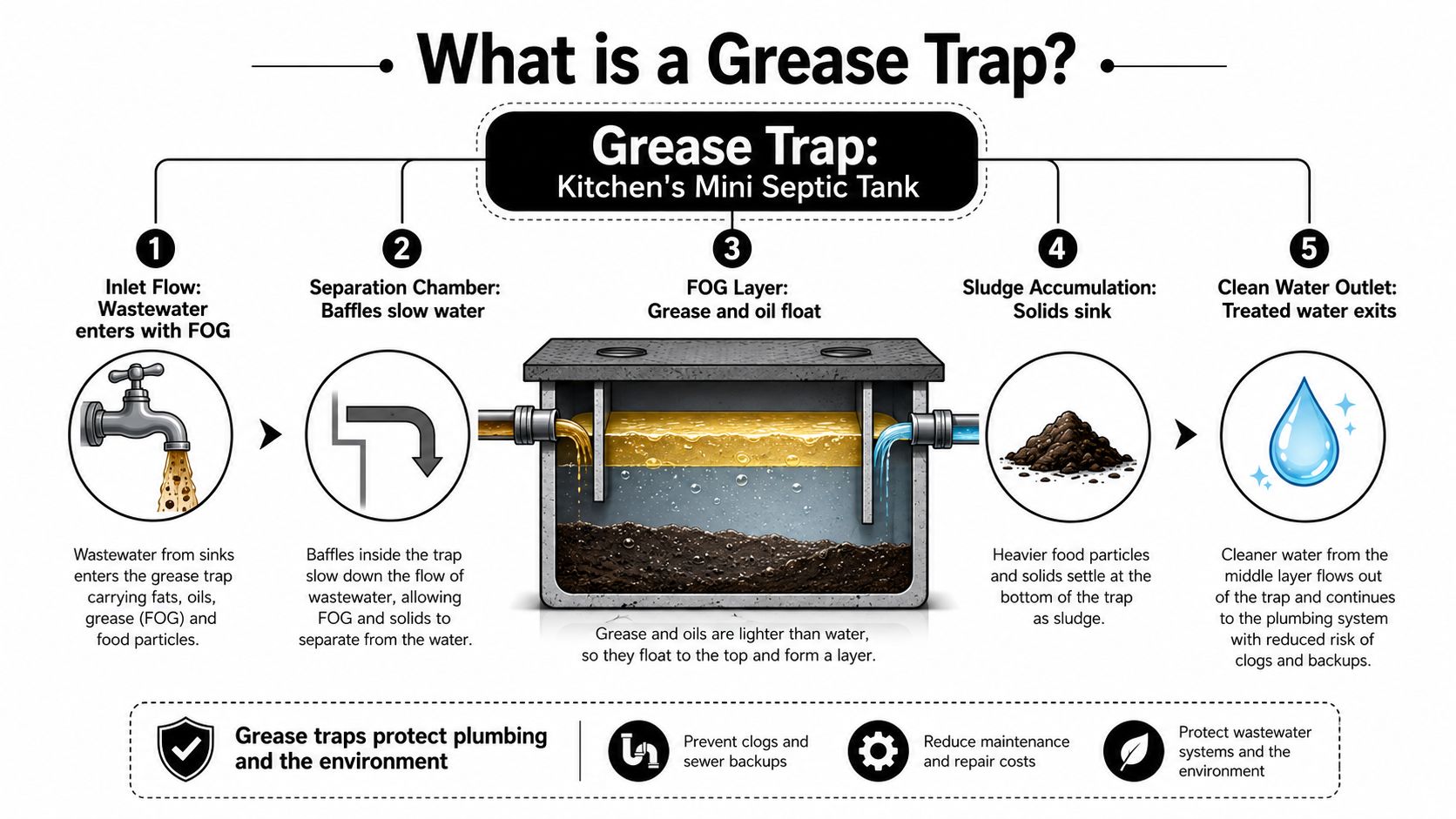
A grease trap is a separation device for kitchen wastewater. I explain it to new owners as a mini septic tank for the kitchen line, because it slows the water long enough for lighter fats and oils to rise, heavier solids to settle, and clearer water to leave through the outlet. That basic job is why the trap protects downstream piping and the municipal sewer system.
The parts that matter most
The inlet lets wastewater enter, but the baffles control the flow so grease can rise instead of being carried straight through. The outlet sits far enough below the surface to let the cleaned water escape while the floating layer stays behind. Solids collect at the bottom as sludge, which is why a trap that looks only partly full can already be failing if the settled layer is too deep.
The trap only separates waste properly when the flow path stays open and the water seal is restored after service.
That's why cleaning isn't just scooping out the top layer. A proper service removes the floating grease, the settled sludge, and any residue stuck to the walls or baffles, then refills the trap to its operating water level. If residue is left behind, it can seed new deposits fast and undo the work.
Why the design affects service timing
Because the trap depends on calm water and clean internal surfaces, its performance drops as buildup increases. Once grease thickens, separation gets worse and solids can start bypassing the unit. That's the point where a kitchen may still look operational, but the plumbing is already being pushed toward failure.
A practical example helps here. A restaurant with a shared prep sink, dish area, and floor drain might only notice one symptom at first, but the trap can be filling unevenly across those fixtures. Understanding the mechanics makes it easier to see why service intervals need to be based on what's collecting inside the unit, not on guesswork.
Why Regular Cleaning Is Non-Negotiable
The first reason is plumbing failure. A neglected trap doesn't just get messy, it stops separating waste effectively, and then grease and solids move into downstream piping where they narrow the line and foul the sewer connection. That's how a maintenance task becomes an emergency after hours, with drain cleaning, disruption to service, and avoidable repair work.
The second reason is health and sanitation. Grease buildup creates odours, attracts pests, and leaves kitchen staff working around a condition that no inspector or customer wants to see. If the trap overflows or backs up into a floor drain, you're no longer dealing with routine maintenance. You're dealing with a sanitation problem in a food-handling space.
The third reason is compliance. Grease trap cleaning is often mandated when the trap reaches 25% grease and solids depth. That 25% rule appears in plumbing and utility guidance as the point where maintenance becomes a requirement, not a choice, because the risk of sewer blockage rises as buildup increases (Boston Water and Sewer Commission commercial kitchen grease trap guidelines).
A practical example is a shared commercial kitchen in a mixed-use building. One tenant can be doing everything right at the sink, but if the interceptor isn't serviced on time, the whole building can feel the impact through odours, slow drainage, or a backup that reaches common areas. That's why building owners should treat the trap as shared infrastructure, not as an individual tenant's side task.
If you're already seeing slow drains or foul odours, don't wait for the problem to peak. An urgent follow-up through emergency drain cleaning is often cheaper than letting a blocked line turn into a service shutdown.
Tell-Tale Signs Your Grease Trap Needs Service
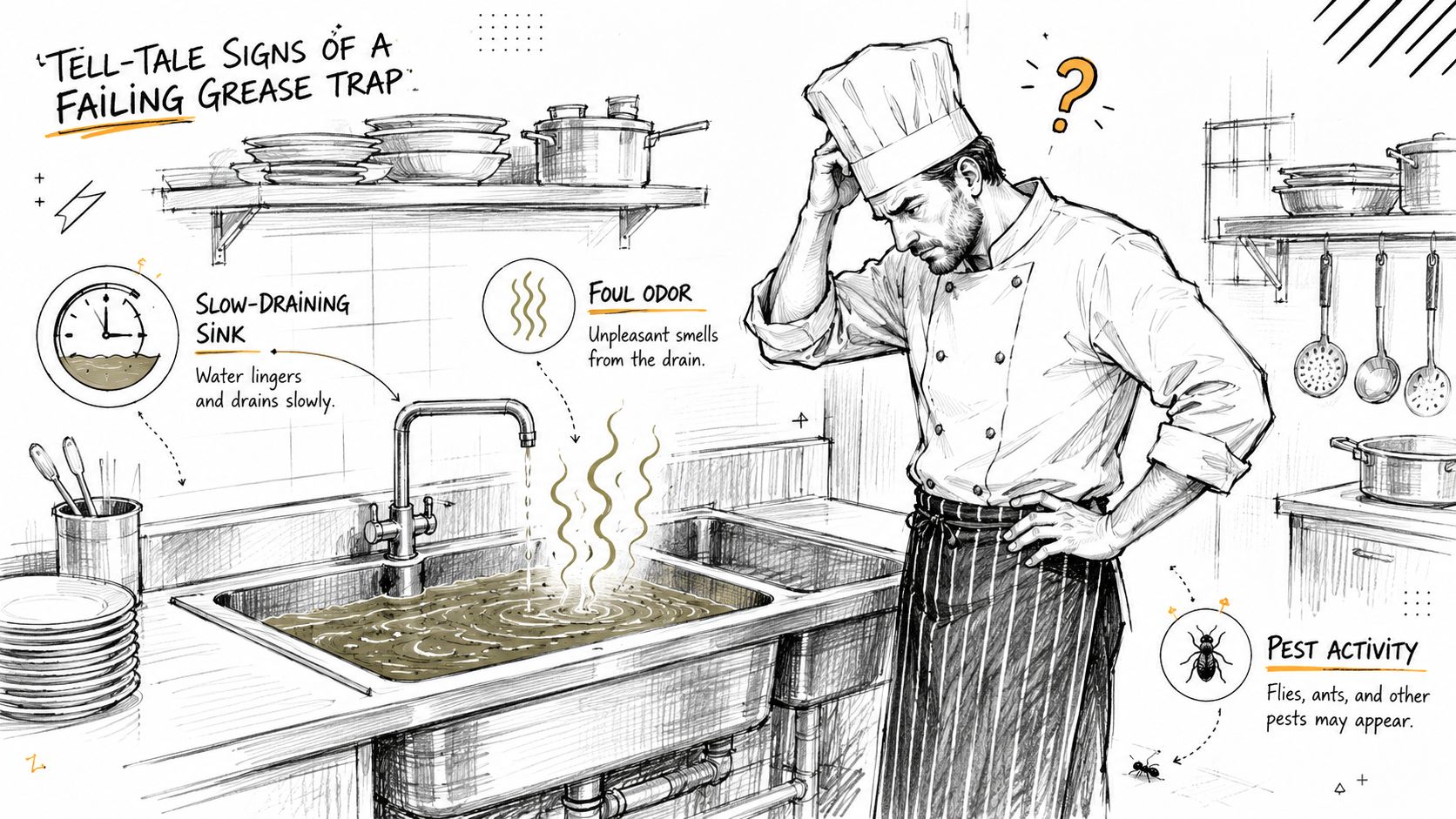
The early signs are usually subtle. Sinks take longer to empty, water gurgles after a fixture is used, or staff notice that one area of the kitchen smells off even after cleaning. Those are the warnings that the trap is losing capacity and the drainage path is starting to resist flow.
From nuisance to emergency
Foul odours are the next obvious step, especially smells that remind people of sewage or rotten eggs. At that point, the issue is no longer just the trap itself, it's the air and drainage conditions around it. You may also see grease film around sink edges, in floor drains, or at nearby access points where wastewater should be moving cleanly.
When the problem becomes serious, the symptoms stop being subtle. Water can back up through floor drains, and in some buildings the first visible sign is greasy water appearing where it shouldn't, often during heavy kitchen use or peak occupancy. If that happens, the system is already past the point where normal operations can absorb the load.
- Slow drainage: Water pools before clearing, which tells you the flow path is constricted.
- Gurgling sounds: Air is fighting for space in a line that's starting to clog.
- Persistent odours: Grease and solids are staying in the trap too long.
- Visible backup: Water or wastewater rises through floor drains or sink basins.
A practical example is a café that notices a prep sink draining normally in the morning but sluggishly after lunch service. That pattern often points to buildup that's not yet severe enough for a full blockage, but already serious enough to justify service before the problem compounds.
DIY Versus Professional Grease Trap Cleaning
DIY looks tempting when the trap is small and the budget is tight. A hand-scoop and a bucket can remove some waste, and for a very small under-sink unit that may feel manageable at first glance. The problem is that a partial clean often leaves sludge behind, which means the trap looks serviced but doesn't really reset.
Where DIY falls short
The biggest DIY mistake is stopping at the easy part. If the floating layer comes out but the bottom sludge, baffles, and walls stay dirty, the trap starts rebuilding immediately. That's not a theoretical concern, it's a common reason kitchens think they've “done maintenance” when they've only shifted waste around inside the unit.
The other issue is disposal. In Greater Vancouver, grease trap waste can't just go down another drain. It has to be handled by licensed haulers and taken to approved facilities, with records kept for compliance verification (Calgary municipal grease interceptor guidance). For many small operators, that's the point where the savings from DIY disappear, because the legal disposal step is the one not easily managed without specialized resources.
A professional service is different because it's built to clear the entire unit and leave a paper trail. That includes full evacuation, scraping the internal surfaces, checking the flow path, and documenting the work so the owner can prove maintenance happened on schedule. For strata councils, that documentation matters as much as the cleanout itself.
If you can't show where the waste went, you haven't finished the job.
For a deeper look at the equipment side, see drain camera inspection services. That's often the sensible next step when a trap problem may be tied to a downstream line issue.
| Factor | DIY Cleaning | Professional Service (Encano) |
|---|---|---|
| Initial cost | Lower upfront spend | Higher upfront spend |
| Cleaning depth | Often partial, especially without proper tools | Full removal of grease, sludge, and residue |
| Safety | Exposure to bacteria and foul waste | Controlled process with safer handling |
| Disposal | Hard to do legally and correctly | Proper disposal with documentation |
| Compliance | Records are often incomplete | Service records support inspections |
The decision rule that works
Use DIY only for the smallest, clearly manageable maintenance tasks where local disposal and documentation requirements are fully understood and handled. For restaurant kitchens, strata interceptors, and any shared system, professional service is usually the safer choice because it reduces legal risk and gives you proof of work. That's the practical line I'd draw for most Vancouver properties.
What to Expect During a Professional Cleaning
A proper service call usually starts with a quick assessment of the trap's condition and access. The technician checks the lid, the surrounding area, and whether the unit can be cleaned without creating a mess in the kitchen or mechanical space. Once the setup is clear, the work zone is contained so waste doesn't splash into walkways or food prep areas.
The actual cleanout process
The full cleanout should remove all accumulated material, not just what floats on top. Technical guidance says the service must include the floating grease, the settled sludge, and the residue on baffles and tank walls, then the trap should be refilled with water to restore the operational seal (Hong Kong Environmental Protection Department grease trap guidance).
That sequence matters because a half-cleaned trap can re-foul quickly. If hardened material is left on the walls or baffles, it gives new grease a surface to cling to, and the trap starts losing separation efficiency sooner than it should. A cleanout that ends without restoring the water level also leaves the system improperly sealed.
A professional visit should also include inspection of the inlet and outlet path. If those passages are partly obstructed, the trap may be cleaned but still not function correctly. That's one reason experienced operators ask for service records rather than just a verbal “it's done.”
What good documentation looks like
You should expect a dated record that states the trap was serviced, not just visited. That record becomes important during inspections and helps building managers compare actual buildup against service frequency over time. For a restaurant owner, that's practical evidence that the system is being maintained rather than guessed at.
A practical example is a strata building with one central interceptor serving multiple food tenants. A professional clean gives the council something concrete to keep on file, which is far more useful than trying to reconstruct dates from memory after an inspector asks for proof.
Maintenance Schedules and Vancouver Regulations
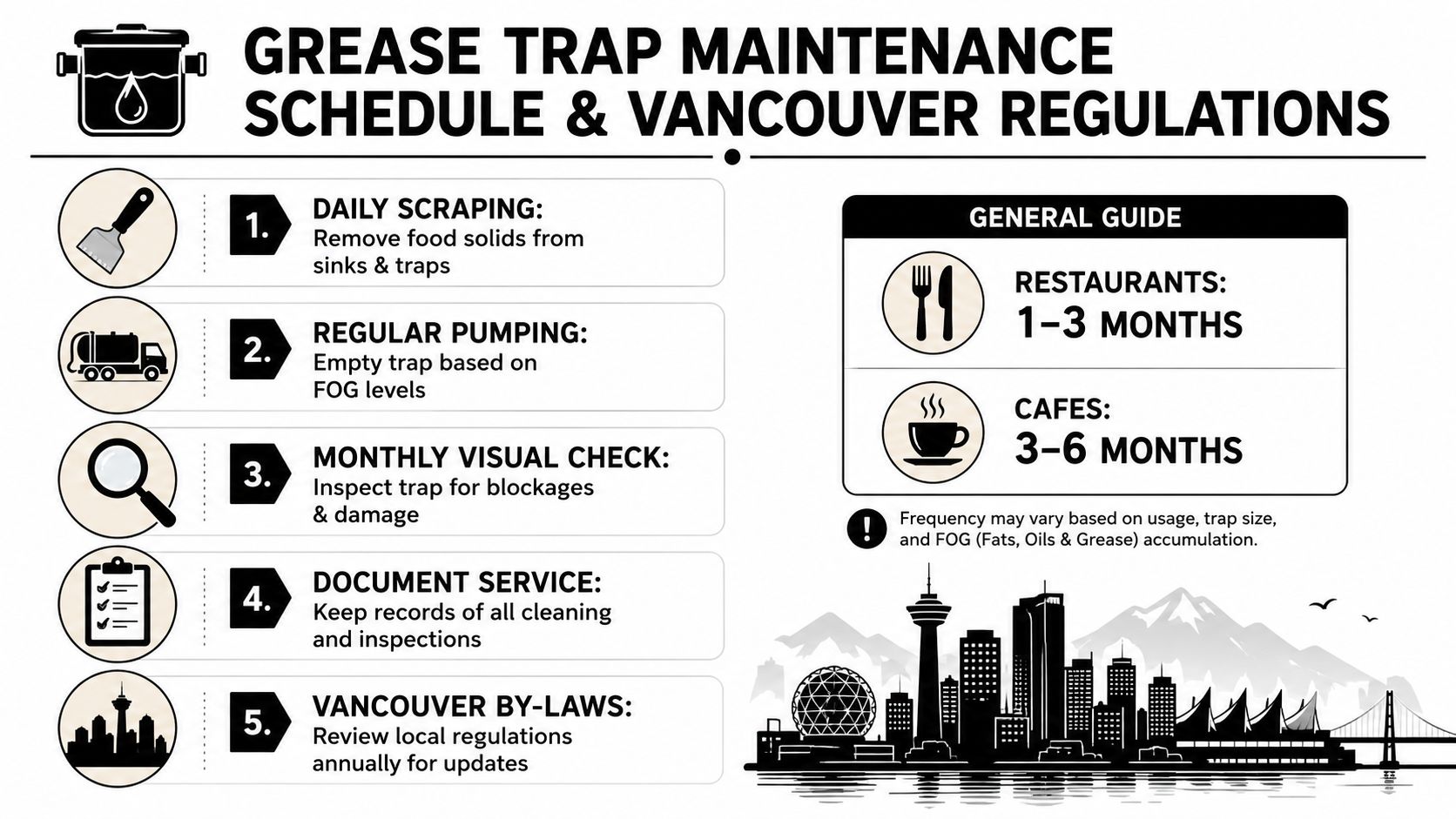
A schedule is a starting point, not the whole answer. For many restaurants, a 1 to 3 month rhythm is a reasonable planning guide, while lower-volume cafés may stretch longer, but only if the trap is still staying under its action threshold and the actual buildup supports that interval. The trap's condition should drive the schedule, not the calendar alone.
A simple checklist between pump-outs
- Daily scraping: Remove food solids from sinks and strainers before they reach the trap.
- Regular pumping: Empty the trap based on grease and solids levels, not on guesswork.
- Monthly visual check: Inspect for blockages, residue, and damage around lids and access points.
- Document service: Keep records of each cleaning, inspection, and disposal event.
- Review local rules: Recheck Vancouver-area by-laws and building requirements on a regular basis.
The practical point is that usage changes faster than people think. A seasonal restaurant, a mixed-use building, or a café with weekend spikes can fill a trap differently from one week to the next. Guidance from maintenance resources also notes that measuring actual grease and solids depth is more effective than relying only on a fixed calendar when output varies (Lawrence, Kansas interceptor maintenance tips).
A practical example is a small kitchen that runs light breakfast service most weekdays but handles heavy dinner traffic on weekends. The weekday pattern can hide buildup until the weekend load pushes the trap over its comfort zone. That's why the person managing the property should log what was removed and how the system behaved, then adjust the schedule if the trap keeps filling early.
For broader trade work and coordinated maintenance planning, commercial plumbing is often the service category that best matches interceptor work, especially for strata and multi-tenant properties.
Grease Trap Cleaning FAQs
Do homeowners in Vancouver have grease traps?
Some don't, but many kitchens still have a small interceptor or a line setup that benefits from grease control. If you're unsure, check the under-sink plumbing or ask a licensed plumber to identify the system before problems start.
Who's responsible in a strata building with restaurants?
The responsibility usually follows the shared system and the tenancy arrangement. If one central interceptor serves multiple units, the strata council and the commercial tenants both need to know who is scheduling service, who keeps the records, and who receives inspection notices.
How often should a trap be cleaned?
There isn't one answer that fits every property. The safe rule is to clean before buildup reaches the 25% action point, then adjust the interval based on actual usage and service logs rather than waiting for odours or backups.
Why do records matter so much?
Because inspections aren't just about whether the trap was cleaned, they're about whether you can prove it. Businesses must maintain service records and make them available for inspection, and repeated non-compliance can bring significant penalties that may climb from $500 to over $10,000 (California grease trap requirements summary).
What should I do before I call for service?
Stop using the affected fixtures as much as possible, note the symptoms, and check whether the issue is local to one drain or affecting multiple fixtures. That information helps the technician decide whether the problem is inside the trap, in the branch line, or farther downstream.
If you're dealing with slow drainage, odour, or a service record that's fallen behind, book a proper inspection and cleanout before the trap turns into a backup. For a Vancouver property, the cheapest fix is usually the one done before service stops, not after. A CTA for Encano Plumbing & Drainage Ltd..