You're in the middle of a heat wave, the lobby is warm, tenants are calling, and a rooftop unit is struggling just hard enough to keep everyone uncomfortable. Then the smoke rolls in, the filters load up, the airflow drops, and suddenly commercial HVAC service is no longer a maintenance line item. It's the difference between a building that stays operational and one that starts bleeding complaints, downtime, and avoidable risk.
For property managers in Metro Vancouver and across British Columbia, the job is bigger than keeping rooms cool. You're balancing occupant health, system reliability, and a regulatory direction that keeps pushing building owners toward cleaner, lower-carbon choices. That means the right service partner doesn't just fix equipment. They help you keep the building running, keep records clean, and make the next decision with fewer surprises.
Table of Contents
- Why Commercial HVAC Service Is a Business Continuity Issue
- What Commercial HVAC Service Actually Includes
- Understanding Commercial HVAC Costs and Value Drivers
- Commercial HVAC Maintenance Schedules and Checklists
- Resilience Planning for Smoke, Heat, and Compliance Risks
- How to Choose a Reliable Commercial HVAC Contractor
- Why Encano Is the Right Partner for Commercial HVAC Service
Why Commercial HVAC Service Is a Business Continuity Issue
A rooftop unit fails in July, the south-facing offices heat up fast, and every tenant who can still work from home starts asking why they should stay on site. Add wildfire smoke to that same day and the issue stops being about comfort. It becomes about air quality, occupancy, and keeping the building usable.
Commercial buildings do not get a pass when weather turns ugly. The U.S. Heating & Air-Conditioning Contractors industry was estimated at $159.4 billion in 2026 with about 120,000 businesses nationwide and a 2.6% CAGR from 2021 to 2026 IBISWorld. That scale matters because it shows how routine, recurring, and competitive commercial HVAC service has become. Owners are not dealing with an occasional fix, they are dealing with a service category that affects uptime every season.
The core job is keeping the building open
Treat HVAC like a background utility and tenants feel the failure first. Keep it in the same category as other critical building systems, because the consequences show up immediately. When the system goes down, you are dealing with complaints, safety concerns, and schedule disruption at the same time.
Practical rule: If an HVAC issue can empty offices, disrupt retail traffic, or create a tenant safety concern, it belongs in your continuity plan, not just in your maintenance budget.
Commercial HVAC service now covers more than repairs. The market definition includes installation, integration, scheduled maintenance, emergency repair, retrofit, and advisory work Mordor Intelligence. In practical terms, you are buying more than wrench work. You are buying help with uptime, lifecycle decisions, and system reliability.
Smoke events and heat waves change the service priority
British Columbia buildings are under more stress from smoke and heat. That changes what a good service call looks like. You are not only checking whether the equipment runs. You are checking whether it can hold airflow, protect occupied spaces, and keep working under pressure.
A small office tower in Burnaby with an aging rooftop unit may limp through a mild spring. The same unit can fail hard during a smoke event if filters load up, airflow drops, and nobody has a plan for fast response. A property manager who understands this does not wait for an emergency. They line up service before tenant complaints and comfort drift start turning into downtime.
BC-specific decarbonization compliance raises the stakes again. If your HVAC plan still assumes replacement decisions happen only after a breakdown, you are already behind. Service, controls, and retrofit planning need to account for emissions pressure, equipment life, and building use. That is the part generic HVAC advice misses, and it is where owners get stuck paying twice, once for emergency repairs and again for rushed compliance fixes.
What Commercial HVAC Service Actually Includes
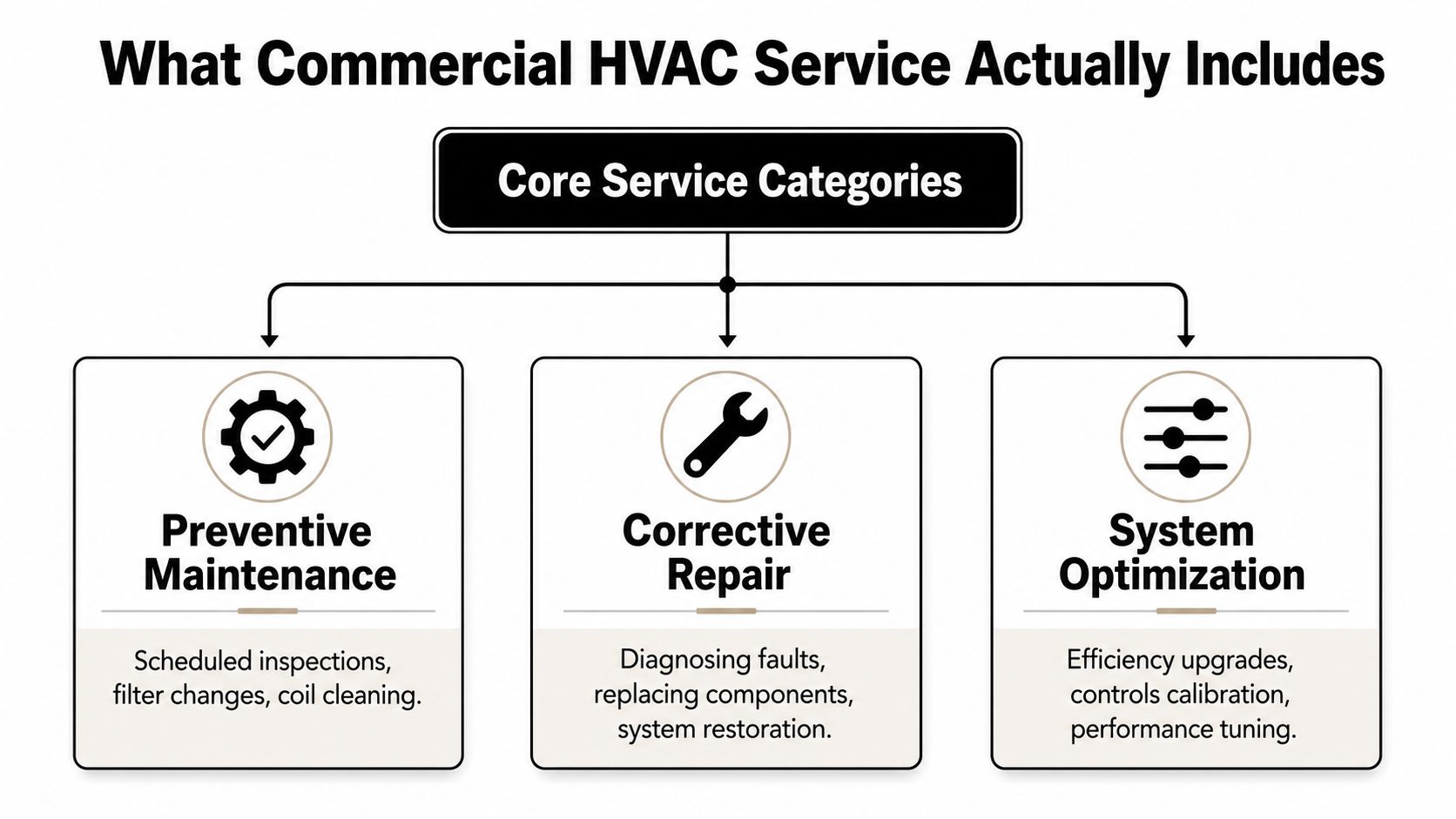
Commercial HVAC service is not one thing, and that's where owners get tripped up. A service visit might be a filter change, a fan motor replacement, a control calibration, or a full retrofit conversation about what the system should do next. If you do not separate those jobs, you end up comparing quotes that aren't comparable.
Preventive maintenance is the cheapest form of control
Preventive maintenance is the scheduled work that stops small issues from becoming service calls at the worst possible time. Think filters, coils, drains, belts, airflow checks, and basic condition checks. In a strata building, that may mean keeping common-area systems stable so the board isn't surprised by a midseason complaint spike. In a retail plaza, it may mean catching a clogged drain before water shows up near tenant stock.
Corrective repair is what happens after a fault
Corrective repair is diagnosis plus restoration. A technician finds the fault, replaces the failed component, and gets the system back online. That can be a relay, a contactor, a fan component, or a control issue. It's necessary work, but it's the most expensive way to run a building if it becomes your default mode.
System installation and optimisation are about the next decision
Installation is obvious, but optimisation gets ignored too often. It includes controls calibration, efficiency tuning, and retrofit decisions that help an older building keep up with modern demands. That matters in small commercial spaces because the building owner often needs the system to do more than it was originally designed to do.
Commercial systems are also tighter on performance expectations than many realize. AHRI's Quality Installation Specification says individual room airflows for commercial buildings must be within the greater of ±10% or 25 CFM, and total equipment capacity should fall between 95% and 115% of calculated system load for air conditioners and heat pumps AHRI. That's not trivia. It means a sloppy service job can show up later as comfort imbalance, wasted energy, and angry occupants.
A commercial contract should tell you exactly what gets inspected, what gets repaired, and what gets optimised. If it doesn't, you're buying ambiguity.
For a property manager, the practical split is simple. Preventive work protects uptime. Repair restores failed equipment. Optimisation helps the building perform better under real-world load. If you need a general sense of scope before comparing proposals, review a detailed commercial installation overview like this central air installation guide and then ask what parts of your building need service versus replacement.
Understanding Commercial HVAC Costs and Value Drivers
Commercial HVAC pricing looks messy because the bill is not just labour and parts. You are paying for the consequences of a decision made under pressure. A low-cost emergency repair can turn into a larger expense if it leads to repeat downtime, poor airflow, or a system that keeps failing under the same load.
The expensive part is usually the delay
The main cost drivers are easy to see once you look at them correctly. Labour rises when diagnostics take longer. Parts costs rise when a failure is left alone until it affects more components. Emergency fees are what you pay when the building forces your hand.
Deferred maintenance adds hidden costs that do not show up as a separate line item. You pay through higher utility use, shorter equipment life, and more emergency calls. In BC, that also means more pressure on aging equipment as smoke, heat waves, and tighter decarbonization expectations push systems harder than they were designed to run. The cheapest bid often becomes the most expensive plan.
The best value comes from reduced disruption
Commercial HVAC service creates value when it prevents downtime, not when it just closes a ticket. A good technician keeps systems running efficiently, catches small faults early, and avoids reactive work that turns into after-hours dispatch. That is where preventive care earns its keep.
Good commercial decisions are usually plain ones. Keep the system clean. Catch problems early. Do not wait for a failure to discover that a unit was already undersized for the building load or too inefficient for the compliance pressure ahead.
Repair, retrofit, or replace
That decision should be based on operating reality, not optimism. If the system is stable and the problem is isolated, repair may be the right call. If the building is struggling with controls, airflow, or efficiency, a retrofit is often the smarter move. If the unit keeps failing and the building cannot rely on it, replacement is the hard but sensible answer.
For a broader sense of how owners think through major mechanical spending, compare it with a local heating and cooling resource and then use that same discipline on your commercial asset. The question is never just what it costs today. The question is what it will cost the building over the next few seasons, especially when resilience and compliance both matter.
Commercial HVAC Maintenance Schedules and Checklists
A written maintenance plan is not filing cabinet material. It is the difference between controlled service and expensive surprise failures when staff changes, visits get missed, or contractors assume someone else handled the basics. ASHRAE 180 requires a written HVAC maintenance plan that is documented and followed, with equipment identified, responsibilities assigned, task frequencies defined, and records kept for work performed Facility Compliance Hub. If you cannot produce that file, the building is already operating on borrowed time.
Build the schedule around actual building conditions
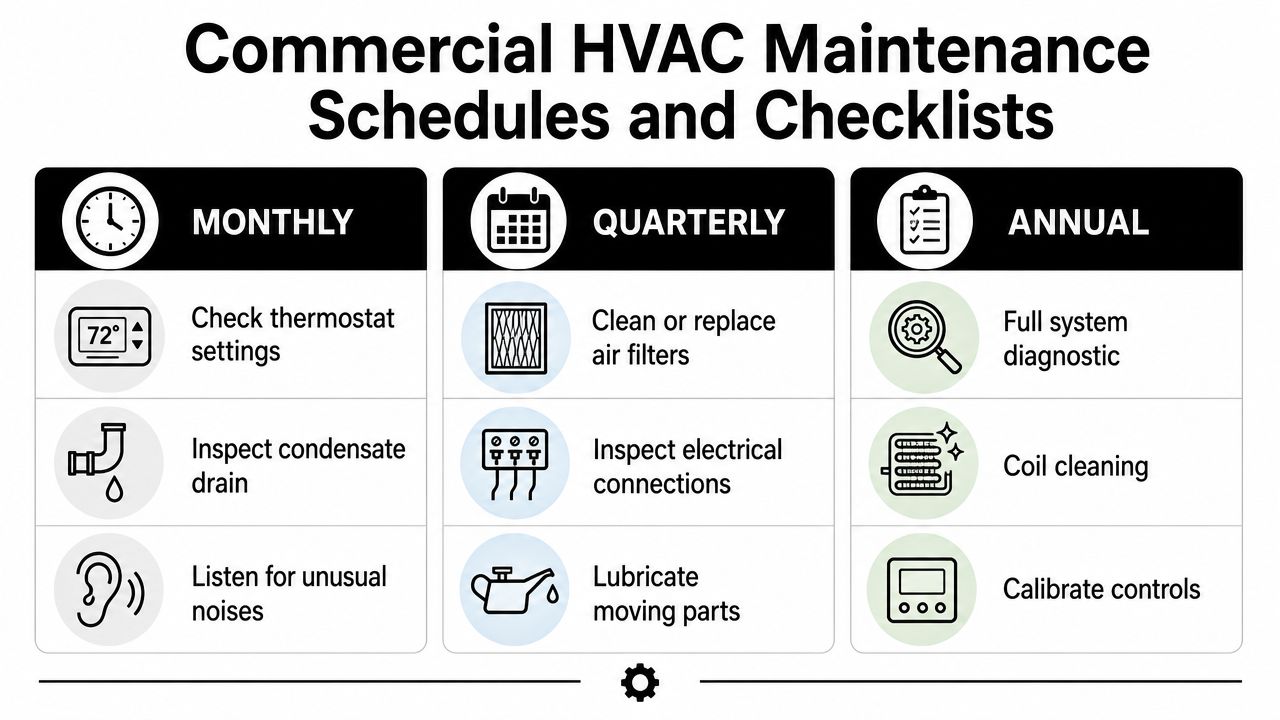
Start with the filter. In high-traffic buildings, dusty sites, or places that keep taking in smoke, filters often need attention every 30 to 90 days to protect airflow and keep the system from working harder than it should Stone Heat Air. That matters when outside air is dirty, a renovation is throwing dust around, or a wildfire season keeps loading the system with particulates.
Quarterly service is where weak points show up. Check electrical connections, confirm the controls are responding properly, inspect condensate behaviour, and look for airflow problems before they turn into complaints. Annual service needs a full diagnostic, coil cleaning, and control calibration. In larger buildings, or any building that cannot afford comfort swings, annual service is part of staying operational, not a nice-to-have.
Use a checklist that people can actually follow
A maintenance file only works if the team can use it without guessing. Keep the structure simple and specific.
- Equipment inventory: List every rooftop unit, fan, and major component so nothing falls through the cracks.
- Task frequency: Spell out monthly, quarterly, and annual items in plain language.
- Assigned responsibility: Name the contractor or in-house role accountable for each task.
- Recordkeeping: Log completion dates, findings, and corrective actions.
- Exception handling: Record smoke periods, construction events, or complaints that justify temporary changes.
That format matters because it keeps the building steady when conditions change. If smoke arrives in late summer, tighten filter checks right away. If a renovation starts pushing dust through the intake path, shorten replacement intervals instead of waiting for airflow to drop. If you need a practical reference for the cleaning side of that work, review ductwork cleaning resources and separate routine inspection from corrective cleaning in the schedule.
Practical rule: If your maintenance plan cannot survive a staff change, it is not a plan. It is a memory.
Resilience Planning for Smoke, Heat, and Compliance Risks
A lot of HVAC content still acts like the main goal is comfort. That mindset is too small for British Columbia. Smoke events, heat waves, and power interruptions create operational resilience problems, and those problems hit occupancy, indoor air quality, and tenant trust all at once.
Filtration is useful only if the system can handle it
ASHRAE's commercial guidance is blunt about the trade-off. When higher-efficiency filters are installed, the air-handling system and fans must still overcome the added pressure drop while keeping acceptable airflow ASHRAE Commercial Resources. That means you cannot just drop in a denser filter and call it improvement. You have to verify static pressure, fan capacity, and delivered airflow.
The same guidance also recommends keeping heating-water systems circulating and above 140°F, and not letting water temperature fall below 120°F, to reduce microbial risk ASHRAE Commercial Resources. For mixed-use and year-round occupied buildings, that's a service benchmark, not a luxury detail.
BC compliance changes the maintenance conversation
British Columbia is also pushing building owners toward decarbonisation and electrification. The CleanBC direction and the Zero-Emission HVAC and Water Heating Equipment standard are changing what a sensible upgrade looks like, especially when gas equipment nears end of life N3 Business. The wrong move is to wait until a rooftop unit dies and then make a rushed replacement choice without considering controls, backup needs, or future compliance exposure.
That's where property managers get squeezed. You may need to repair an existing system this year, but you also need to avoid stranding assets that no longer fit the building's long-term direction. The practical answer is to plan each failure in context. Ask what the building needs to stay functional this season, then ask whether the same decision still makes sense after the next policy or retrofit cycle.
Smoke resilience, heat resilience, and carbon compliance belong in the same conversation. If you separate them, you'll make the wrong purchase at the wrong time.
A Surrey strata property or a Vancouver office can use the same logic. During smoke events, tighten filtration and monitor airflow. During heat waves, check whether the system is meeting load. During planning cycles, decide whether repair, control retrofitting, or staged replacement gives you the least risk over the full building life.
How to Choose a Reliable Commercial HVAC Contractor
A commercial HVAC hire should start with risk, not price. If a contractor cannot explain airflow, service records, compliance duties, refrigerant handling, and how they protect occupied space during repairs, keep shopping.
Credentials matter because the work carries compliance risk
ASHRAE 180 calls for maintenance by qualified personnel, and commercial HVAC work should sit with licensed contractors who can also handle refrigerants correctly under EPA Section 608 certification. If they cannot show both, the building carries the risk.
Ask about code knowledge, recordkeeping, and response times. Commercial buildings live or die on documentation. A contractor who leaves vague notes or cannot explain what was done on a service call will make it harder to defend warranty claims, track repeat faults, or prove maintenance discipline during an audit.
Compare contractors on what they can prove
Use a practical filter.
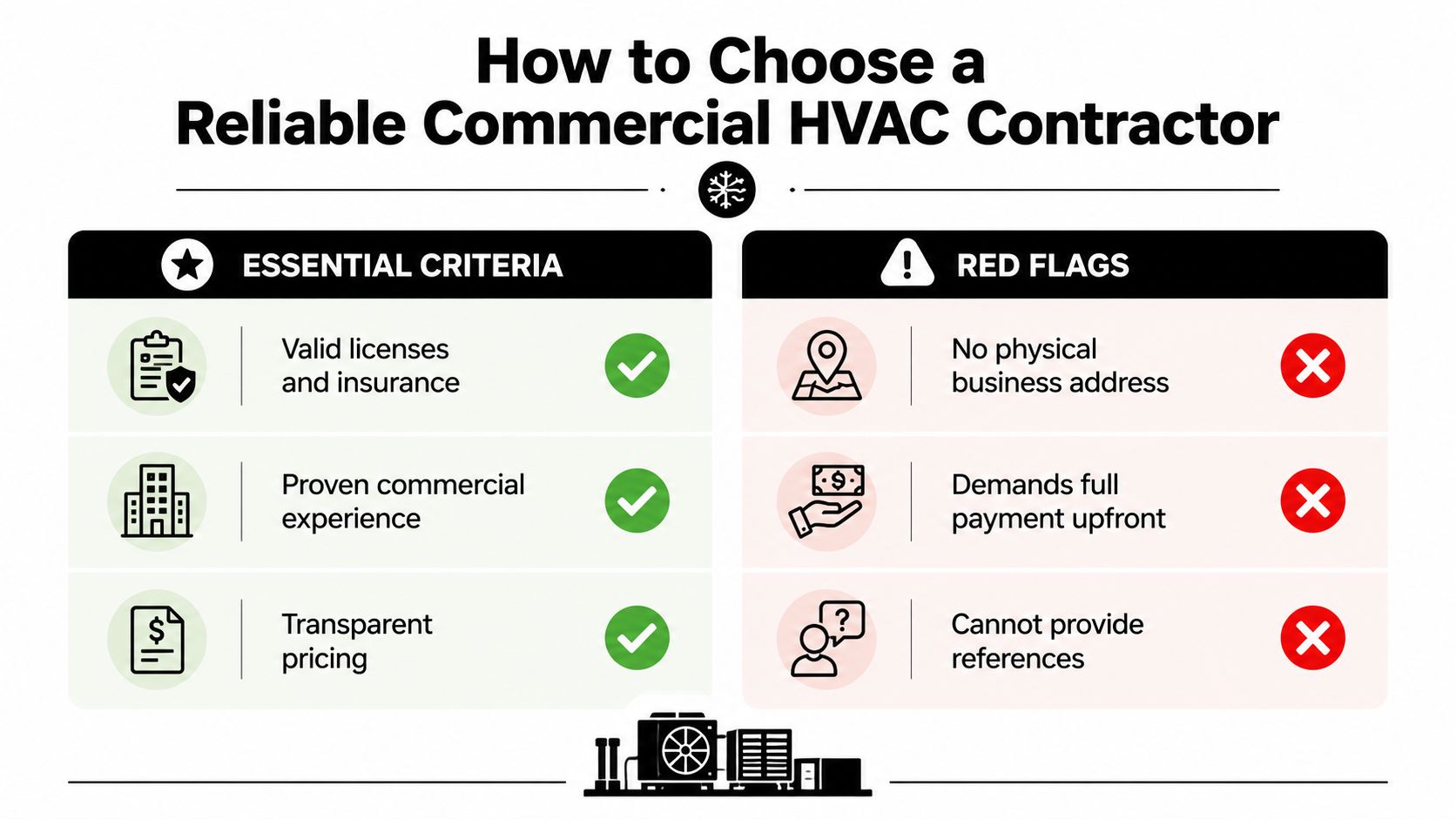
- Valid licences and insurance: No paperwork, no job.
- Proven commercial experience: Residential crews often miss controls, access limits, and tenant coordination.
- Transparent pricing: Scope should be clear before anyone rolls a truck.
- Detailed service records: If they do not document the work, they are not managing risk.
- Local references: Recent commercial clients tell you more than a polished brochure.
Red flags are easy to spot. A contractor with no physical business address, a demand for full payment before work starts, or no references is not offering a deal. That is a dispute waiting to happen.
Modern diagnostic tools also matter. Video inspection, acoustic leak detection, and controls data reduce guesswork and shorten downtime. For a practical look at service breadth and local support, review this heating and cooling overview and decide whether the contractor can handle routine upkeep, smoke-response adjustments, and emergency calls without improvising.
Why Encano Is the Right Partner for Commercial HVAC Service
Encano Plumbing & Drainage Ltd. is a practical fit when you need a local mechanical contractor that can cover heating, HVAC, and related building systems across Vancouver, Richmond, Burnaby, New Westminster, Delta, Surrey, and nearby communities. The company also provides 24/7 emergency response, which matters when a cooling issue, leak, or service failure can't wait until morning.
They work across residential, commercial, and government buildings, and they use modern diagnostic tools such as video inspection, acoustic leak detection, and high-pressure jetting where the job calls for it. For property managers, that combination is useful because it supports fast diagnosis, documented service, and fewer blind spots when a building needs both response and follow-up.
If you want a contractor that can handle the mechanical side of the problem with transparent pricing and a service model built around disruption control, Encano belongs on the shortlist. That's especially true when you're trying to keep a building compliant, occupied, and operational without turning every issue into a replacement conversation.
If you need commercial HVAC help that respects tenant downtime, compliance pressure, and the realities of BC buildings, contact Encano Plumbing & Drainage Ltd. for service or a consultation. They handle commercial mechanical work with 24/7 response and transparent pricing, so you can get a clear next step before the problem turns into lost uptime.