
Your water heater usually doesn't get attention until it starts dripping in the basement, runs cold halfway through a shower, or makes the BC Hydro bill feel harder to ignore. In Metro Vancouver, that moment often comes in an older Vancouver special with a cramped utility room, a Richmond family replacing a failed tank in winter, or a strata council staring at a stack of ageing units that all seem to be reaching the end at once.
The wrong replacement can lock you into higher operating costs, awkward installation work, and another service call sooner than you'd like. The right one can fit the space, match the building, and keep running without becoming a headache for years.
Table of Contents
- Why Vancouver Homeowners Are Rethinking Their Water Heater
- Understanding UEF and Energy Factor Ratings
- Comparing the Main Types of Energy Efficient Water Heaters
- Real Lifecycle Costs and Savings for BC Households
- BC Rebates and Incentives Worth Claiming
- Installation and Maintenance Considerations in Metro Vancouver
- Choosing the Right System for Your Home or Building
- Working With a Qualified Local Contractor
Why Vancouver Homeowners Are Rethinking Their Water Heater
A lot of homeowners don't start shopping for energy efficient water heaters because they're chasing a lifestyle upgrade. They start because the old tank is 15 years in, the basement is colder than the rest of the house, and the hot water bill doesn't look friendly anymore. In a Vancouver special, that usually means a tank tucked into a corner that's been losing heat for years while nobody thought much about it.
The pressure is practical, not theoretical
Metro Vancouver homes are running into the same mix of problems over and over. Electricity prices matter more when a system wastes energy every hour it sits there. Gas still has a place in some buildings, but the policy direction in BC is pushing harder toward electrification, especially in new construction and major replacements. California's standards have done the same thing in a different market, and ENERGY STAR notes that water heaters use about 12% to 15% of a home's energy and that high-efficiency models can use 10% to 50% less energy than standard models, with ENERGY STAR heat pump water heaters using about one-quarter of the energy of a standard model ENERGY STAR water heater overview.
That kind of gap changes the decision. A family in Richmond replacing a leaking tank mid-winter isn't just buying a box, they're choosing between another decade of operating cost, a different installation footprint, and the risk of having to do the job twice if the first choice doesn't suit the house. The same goes for a Burnaby strata replacing 30 units at once, where a “cheap and familiar” option can become expensive fast if it doesn't align with the building's long-term plan.
Practical rule: if the home is already tight on space, has a finished basement, or is moving toward electrification, the cheapest unit on the quote sheet is rarely the cheapest system over time.
What changes the discussion in Vancouver is the combination of climate, building stock, and policy. Older basements stay cool, utility rooms are often undersized, and newer projects face more pressure to avoid combustion equipment altogether. The rest of this article keeps those realities in view, so you can sort the true fit from the marketing language.
Understanding UEF and Energy Factor Ratings
Looking at the yellow label, nodding once, and moving on is a mistake. The rating tells you how much of the energy going into the water heater shows up as hot water, and in a cool Metro Vancouver basement, standby loss matters more than most homeowners realise.
What the numbers actually mean
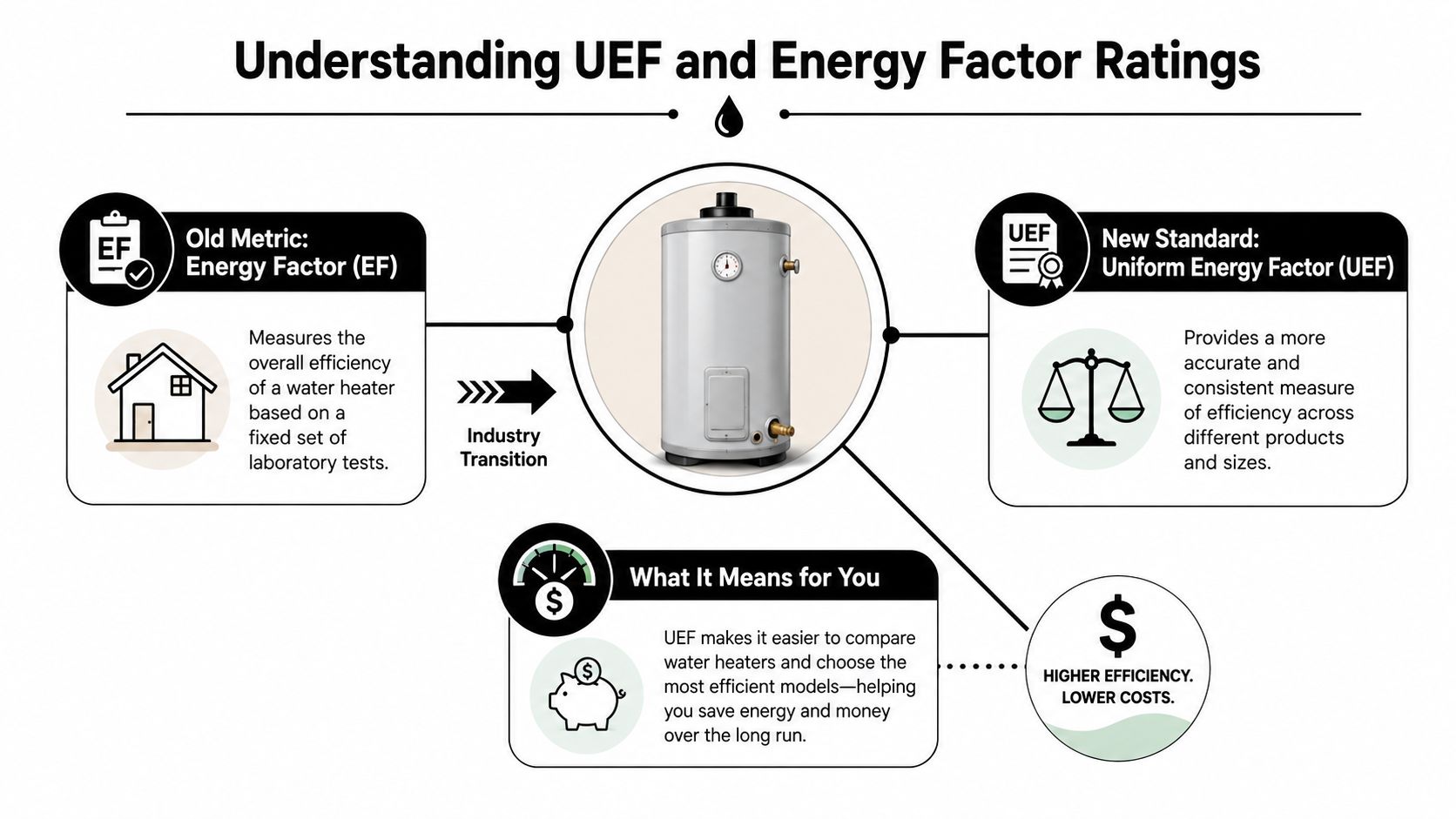
UEF, or Uniform Energy Factor, is the modern rating most homeowners will see on newer residential models. Energy Factor, or EF, is the older metric and is still used in some Canadian guidance for gas-fired storage units. Natural Resources Canada defines EF as the hot-water energy delivered divided by total energy input over a 24-hour period, and for electric storage models it points homeowners to standby loss in watts, where lower standby loss means less heat leaking out of the tank Natural Resources Canada water heater guide.
That matters in real life because the basement doesn't care what the brochure says. A tank that loses less heat overnight needs less energy to bring itself back up. Better insulation and jacket design reduce that waste, which is why the same style of tank can perform very differently depending on how it's built.
A simple way to read two similar models
If two electric tanks look almost identical on price, compare the UEF first. A model at 0.67 UEF and another at 0.93 UEF are not close performers, even if the cabinets look similar. The higher-rated unit is wasting less of the energy you pay for, which means the gap keeps showing up in the operating bill, not just on the spec sheet.
For gas units, the same logic applies through EF. A higher EF means more of the fuel you buy becomes usable hot water instead of disappearing up the flue or as standby loss. That's not an abstract technical detail, it's the difference between a system that just heats water and one that heats water with less ongoing cost.
A quick way to think about it is this, the label is not decoration. It's the clearest clue you get about how the heater will behave after the installer has left and the bill starts arriving.
Comparing the Main Types of Energy Efficient Water Heaters
The right heater depends on the building, the hot water pattern, and the limits on fuel, venting, drainage, and space. A condo, a family house, and a commercial kitchen all push the decision in different directions, and Metro Vancouver homes add their own constraints, especially in older Vancouver specials and strata buildings.
What each type does well
Conventional high-efficiency tanks are still the easiest swap in many homes. They store hot water, recover fairly quickly, and fit well where the plumbing was built around a tank from the start. They also avoid some of the installation headaches that come with other systems. The trade-off is standby loss, so the unit is only as efficient as its insulation, controls, and the way it is installed.
Tankless units heat water only when the tap opens. That makes them appealing where floor space is tight, especially in condos and smaller utility closets. The catch shows up when demand stacks up. Two showers, a dishwasher, and laundry all running at once can expose the limits of the equipment and the gas or electrical service feeding it. They can be a strong fit, but only in the right home.
Heat pump water heaters are often the best operating-cost option for Vancouver homes that have the room and the right conditions. They move heat instead of making it directly with resistance elements, which is why they use far less electricity in the right setup. The trade-offs are real. They need enough installation space, suitable room temperatures, condensate drainage, and a 240V electrical setup. In a cramped basement or a finished suite, that matters as much as the efficiency rating.
Solar thermal systems can work, but they remain a niche choice in local residential work. They depend on roof layout, collector exposure, and a homeowner who is prepared for a more complex system. In practice, that makes them a better discussion point for specific sites than a default recommendation for most houses.
Condensing gas heaters make sense in buildings with steady, higher demand. They recover heat from flue gases, which gives them a real efficiency edge, especially in commercial or multi-unit settings where hot water use is continuous. I would not put that same equipment into a small house that only sees short bursts of demand.
Where the fit breaks down
The air-sourced heat pump category is still the one I point to first in the right home, because it uses much less energy than direct electric storage or gas storage under comparable service conditions. That is also why the equipment is so sensitive to placement, airflow, and drainage. If those pieces are wrong, the efficiency claim does not help much in day-to-day use.
Condensing gas units are the opposite case. One commercial model lists gross thermal efficiency of 93% to 98%, NOx emissions as low as 32 to 40 mg/kWh, and 600 to 1,660 L/hr recovery depending on model and temperature rise Baxi condensing water heaters. That kind of performance belongs in a building with continuous demand and proper venting and condensate management, not in a small detached house that draws hot water in short bursts.
For homeowners trying to compare replacement options in BC, the system choice also affects the install budget, venting work, electrical upgrades, and service access. If you want a sense of how those pieces usually affect the bill, this breakdown of water heater replacement cost in Vancouver is a useful starting point.
| Type | Typical Efficiency | Best For | Watch Out For |
|---|---|---|---|
| High-efficiency tank | Better than standard storage, lower standby loss | Straightforward replacements in older homes | Still loses heat while sitting idle |
| Tankless | High on-demand efficiency | Small condos, limited floor space | Can struggle with simultaneous high demand |
| Heat pump | Very high operating efficiency | Homes with room, drainage, and 240V capacity | Needs suitable installation conditions |
| Solar thermal | Strong when site conditions are ideal | Homes with roof exposure and a long-term energy plan | Higher complexity and niche fit |
| Condensing gas | Very high gas-side efficiency | Commercial and multi-unit buildings | Condensate management and equipment complexity |
Practical rule: if the building has steady demand and room for proper venting and drainage, condensing gas earns its place. If the home is trying to cut operating cost in a basements-first Vancouver layout, heat pump usually deserves a hard look.
Real Lifecycle Costs and Savings for BC Households
Sticker price only covers the first decision. A heater that looks cheaper on the install quote can cost more every month afterward, especially in a Metro Vancouver home that runs hot water through the day and into winter.
The costs that stack up
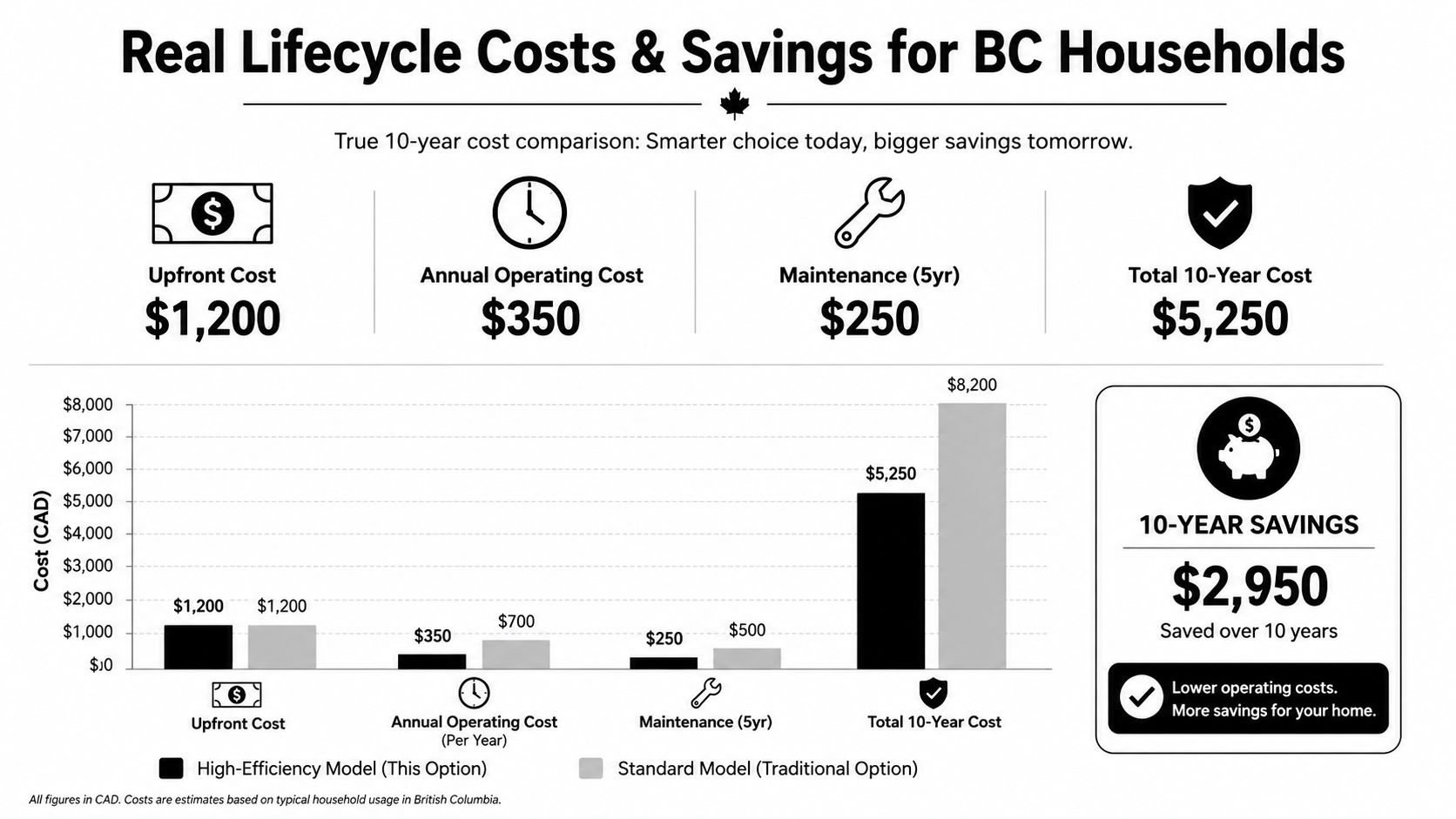
In a typical Vancouver-area household of four, hot-water use is not small. Natural Resources Canada says homes use about 75 litres of hot water every day Natural Resources Canada residential water heaters guide. That kind of demand makes operating cost matter just as much as purchase price, and in BC the gap between a basic replacement and a high-efficiency system shows up fast.
Heat pump water heaters usually come with a higher upfront bill because the equipment and installation take more planning. The trade-off is lower electricity use, which is why they often make sense over a longer service life in homes that can fit the unit, handle the drainage, and supply the right electrical capacity. Tankless gas units can still deliver good comfort, but if a household has modest peak demand and the unit spends long stretches sitting idle, the operating math does not always favour them the way sales pitches suggest.
The other cost people miss is damage after a failure. A tank that leaks in a finished basement can turn into flooring, drywall, and contents damage, not just an appliance swap. That is one reason warranty length matters, especially when you compare a basic tank with a better-built model that gives you a longer service window. For homeowners trying to budget the full job, a local water heater replacement cost in Vancouver overview helps show what usually lands on the invoice before rebates and energy savings are counted.
A practical Vancouver comparison
For a homeowner comparing a standard electric tank with a heat pump model, the operating gap is real. ENERGY STAR says a certified heat pump water heater can save a household of four about $600 per year on electric bills and more than $4,500 over its lifetime, while using roughly 70% less energy than a standard electric water heater ENERGY STAR heat pump water heater facts. That is the kind of difference that matters when electricity costs are already part of the monthly pressure, and when the home is planning around lower operating bills instead of just a lower install quote.
The U.S. Department of Energy says its new residential water-heater efficiency standards will save American households about $7.6 billion per year on energy and water bills DOE water-heater standards. For Metro Vancouver, the point is simple. The market is moving toward better-performing equipment, and the long-term cost of keeping an inefficient unit in place is harder to justify each year.
BC Rebates and Incentives Worth Claiming
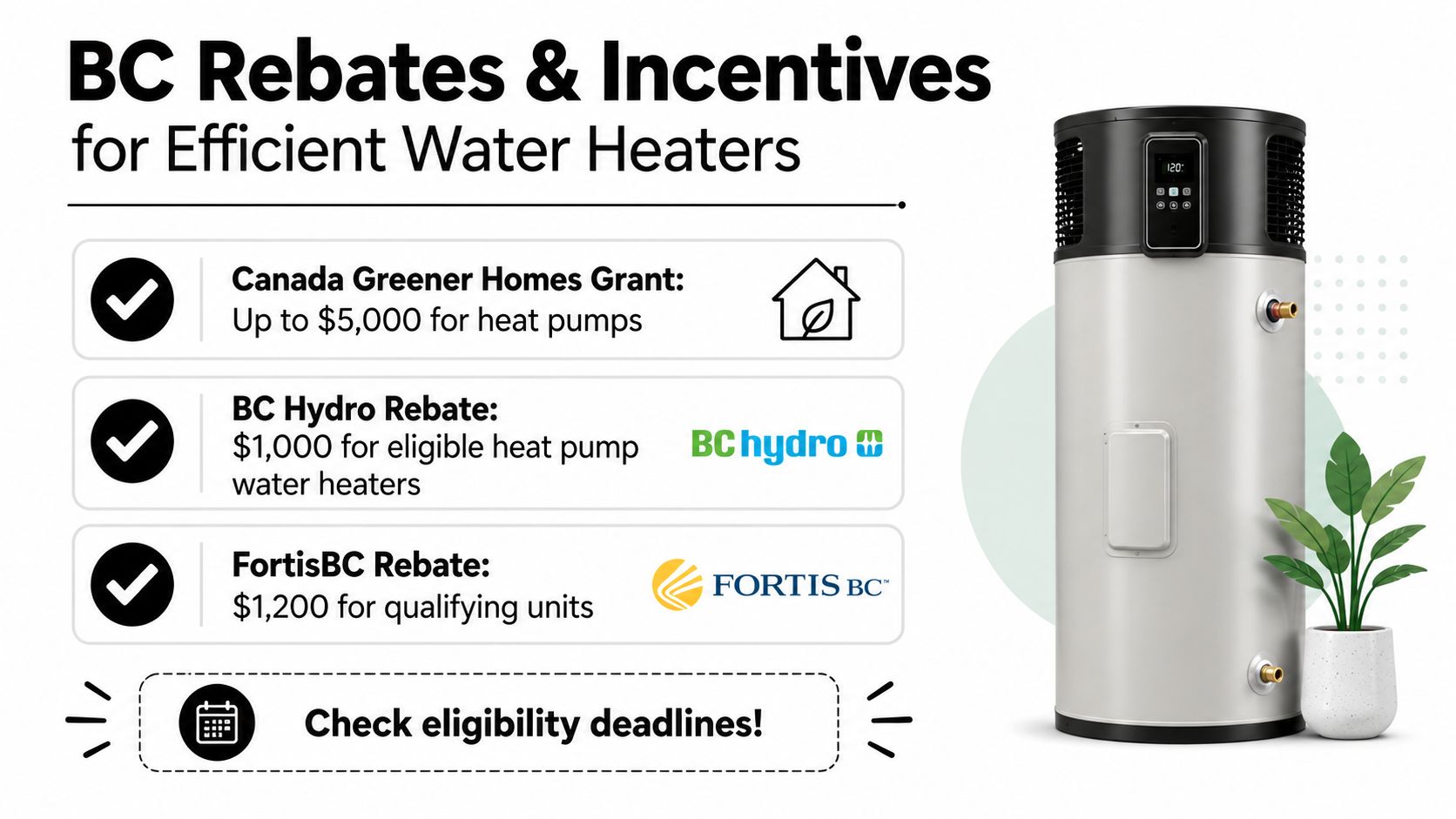
Rebates can change a decision from “maybe later” to “we should do this now.” In BC, that matters because a qualifying heat pump water heater can sometimes pick up more than one incentive path if the install and paperwork are done correctly.
What usually qualifies
The cleanest path is a heat pump installation that meets the program rules and is documented properly from the start. That generally means the product model has to qualify, the installer has to be licensed for the work being done, and the homeowner has to keep receipts, model numbers, and installation records in order. Miss one of those details and the claim can stall or get denied.
A practical Vancouver homeowner example is straightforward. A family replacing an older electric tank with a qualifying heat pump can often reduce the net out-of-pocket cost by combining a utility incentive with a federal grant where the rules allow it. The exact amount depends on eligibility and the program in force when the application is made, so the paperwork matters as much as the equipment choice.
The National Resources Canada and BC utility ecosystem also treats multi-unit buildings differently from single-family homes. In strata and condo settings, the funding path can change based on whether the unit is centralised or individual, and whether the building is replacing a common system or doing separate suite-by-suite work.
The mistakes that cost people money
The most common problem isn't the technology. It's the admin.
- Wrong model number on the invoice: if the paperwork doesn't match the qualifying unit, the application can be rejected.
- No dated photos before and after: some programs want evidence that the old unit was removed and the new one installed.
- Unclear contractor details: if the installer isn't properly licensed, the rebate process can get messy.
- Waiting too long to apply: deadlines and submission windows matter, and they change.
If the installer can't tell you which incentive the unit qualifies for, assume you'll be doing extra paperwork later.
For a local overview of the install side that ties directly into rebate eligibility, this heat pump water heater installation guide is useful for understanding what contractors look at before they submit anything.
Installation and Maintenance Considerations in Metro Vancouver
A water heater can look efficient on paper and still be a bad fit if the room around it can't support the equipment. In Metro Vancouver, the install details often decide the final answer.
The room has to fit the heater, not the other way around
Heat pump water heaters usually need a dedicated 240V circuit, enough surrounding air volume to work properly, and a route for condensate drainage. If the electrical panel is already crowded, that upgrade can matter as much as the heater itself. Gas units have their own constraints, especially in newer tight buildings where venting rules and combustion-air requirements are stricter than the old open-basement setups homeowners used to see.
Tanks still need proper seismic strapping and correct plumbing connections. That matters in BC because a “simple swap” can still fail inspection if the anchoring and venting aren't done properly. Condensing gas and heat pump models also produce condensate, so the installer has to plan for drainage instead of assuming there's a convenient floor drain nearby.
Maintenance is part of the efficiency
A good unit doesn't stay good by accident. Tanks need anode rod checks every few years, tankless systems need descaling, and heat pumps need filter cleaning to stay in their efficiency range. A missed service call can shorten life and push the unit out of its sweet spot, which is usually when homeowners start saying the heater “used to be fine.”
Practical rule: if a system needs a new install every time it's serviced because nobody can access the valve, drain, or filter, it's not really a low-maintenance setup.
Vancouver-area water is also moderately hard, which means mineral build-up can shorten tank life if it's ignored. That doesn't make one technology bad by itself, but it does make routine maintenance more than a polite suggestion. For a closer look at the install process itself, this water heater installation how-to resource shows why planning the service path matters before the old unit comes out.
The contractor who thinks ahead about drainage, panel load, venting, and service access usually leaves you with a heater that lasts longer and costs less to run.
Choosing the Right System for Your Home or Building
The right answer changes with the property. A single-family house, a strata building, and a small business don't need the same water-heating strategy, even if the old unit on the wall looks similar.
Three real Metro Vancouver scenarios
A Burnaby single-family home with a basement utility room and enough panel capacity is often a strong fit for a heat pump water heater. The house gets the operating savings, the basement installation usually makes sense, and the homeowner gets a clear path toward electrification.
A Richmond strata replacing a central system in a 40-unit building often leans the other way. If hot-water demand is steady and the building already has gas infrastructure or complex central plant needs, a condensing gas setup may be the more realistic technical fit, especially where recovery rate and system continuity matter more than single-unit footprint.
A New Westminster small business with daytime demand and regular usage often needs a system chosen for recovery and reliability, not just efficiency labels. That can make a high-efficiency tank or condensing gas unit a stronger operational choice than a residential-style heat pump.
The questions that narrow the list fast
Before calling for quotes, answer these:
- Fuel availability: is the building staying on gas, moving to electric, or split between the two?
- Electrical service size: is there room for a new 240V circuit?
- Space and access: can the unit fit without choking off service access?
- Peak demand: are showers, laundry, and kitchen loads overlapping often?
- Building type: is this a single home, a condo, or a central plant in a strata?
Encano Plumbing & Drainage Ltd. is one local option that handles water heater installation across Metro Vancouver, including tank, tankless, and heat pump work alongside the related plumbing and gas coordination that these projects usually need. For homeowners and strata managers, the value is not in a pile of brochure choices, it's in picking the one system that fits the property and the utility room that already exists.
Working With a Qualified Local Contractor
The cheapest quote is often the one that leaves out the details you end up paying for later. A proper installer should be able to show licensing, explain venting or electrical requirements clearly, and give you a line-item quote that makes the differences between models obvious.
What to ask before you sign
Ask whether the contractor has installed the exact technology you're buying, not just something similar. Ask who pulls the permit, who registers the warranty, and who files the rebate paperwork. If the answer is vague, expect the project to become your problem.
A good checklist is simple:
- Licensing and scope: plumbing, gas, and electrical coordination where required.
- Model-specific experience: tank, tankless, or heat pump, not just “water heaters”.
- Permit responsibility: who handles it and when.
- Rebate paperwork: who submits it, and what documents they need from you.
- Warranty registration: when it happens, and who confirms it's done.

A good contractor reduces your role from project manager to one informed approval before the work starts.
For Metro Vancouver homes, that's the difference between a smooth replacement and a series of avoidable call-backs. The contractor who can explain the install, the rebate path, and the maintenance plan in plain language is the one worth taking seriously.
If your water heater is ageing, loud, leaking, or just costing more than it should, Encano Plumbing & Drainage Ltd. can assess the space, recommend the right replacement, and handle installation for tank, tankless, and heat pump systems across Metro Vancouver. Visit Encano Plumbing & Drainage Ltd. to book a local assessment and get a clear plan before the next failure forces the decision for you.