
A tankless water heater installation in Greater Vancouver typically costs roughly $3,000 to $5,500 before rebates, with a qualifying FortisBC rebate potentially reducing the price by up to $1,000 for a condensing model. The final invoice depends less on the sticker price than on gas capacity, venting, winter performance, access, permits, and code-required upgrades.
You may be looking at a leaking tank, a renovation, or a household that keeps running out of hot water during the evening rush. Retail listings make the decision look simple: choose a wall-mounted heater, book an installation, and enjoy endless hot water. In practice, converting a storage tank system in a Vancouver, Richmond, or Burnaby home is a site-specific plumbing and gas project.
The useful question isn't only “how much is the heater?” It's how much will the complete system cost, what rebate applies, and will the selected unit deliver enough hot water on a cold winter morning?
Table of Contents
- What a Tankless Water Heater Actually Costs Installed
- Sizing Your Unit for Vancouver Winter Groundwater
- Installation Factors That Change the Final Price
- FortisBC Rebates and How They Lower Your Net Cost
- Operating Savings and Realistic Payback Timelines
- Maintenance Expectations and Long-Term Care
- Deciding If Tankless Is Right for Your Property
What a Tankless Water Heater Actually Costs Installed
For a typical Greater Vancouver conversion, $3,000 to $5,500 installed before rebates is a realistic planning range cited by California-focused cost summaries that also illustrate the same retrofit issue seen locally, namely that gas-line, venting, and code work can dominate the invoice. One installation-cost summary places installed projects around $1,400 to $3,900, while another California source gives a broader $3,000 to $5,500 range. Those figures aren't Vancouver quotes, but they demonstrate why a single headline price is unreliable for a conversion.
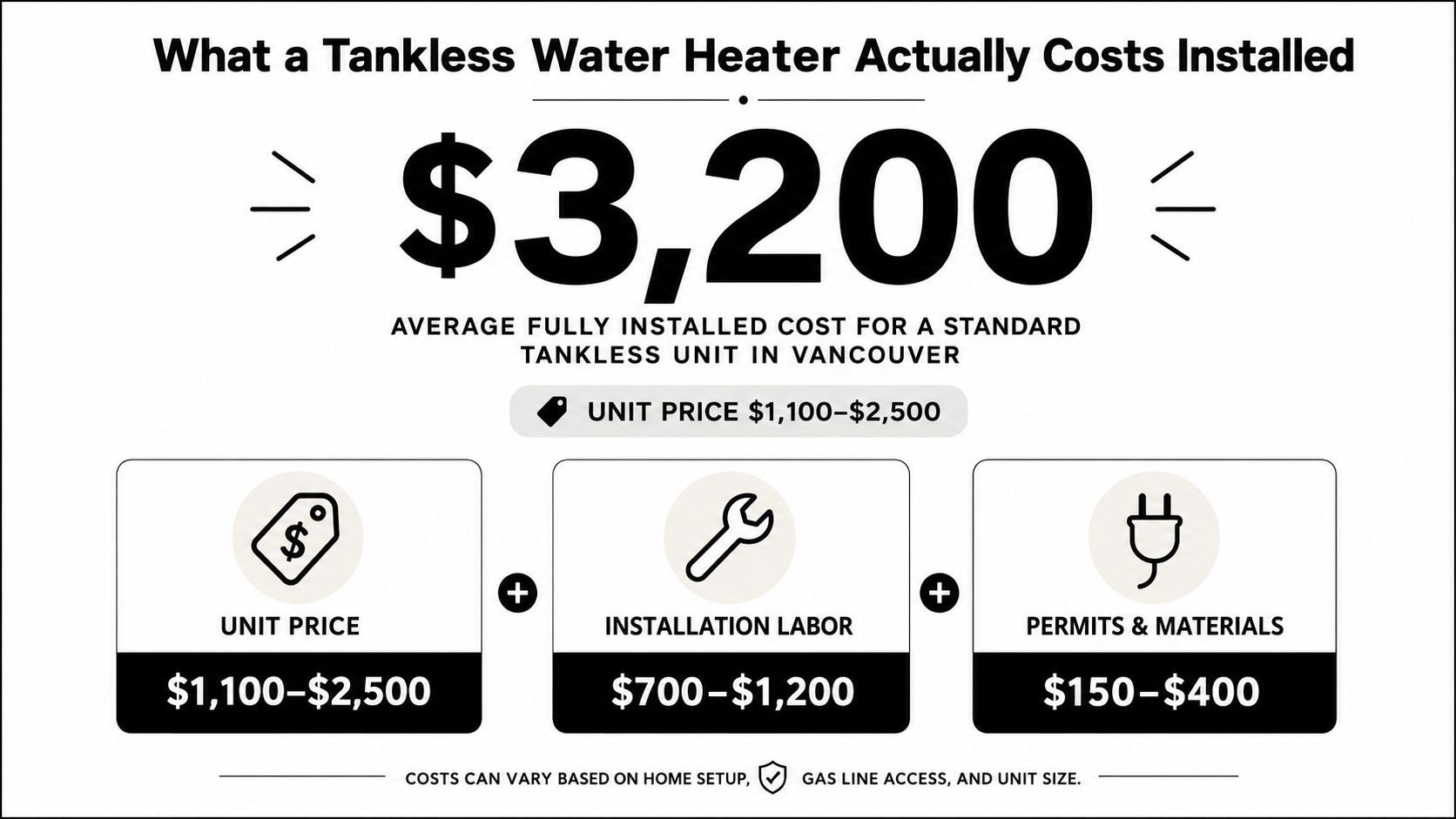
A newer home with an appropriately sized gas line, accessible connections, compliant drainage, and a suitable installation location may sit toward the lower end. An older property may need a larger gas line from the meter, new venting, electrical work for controls, condensate drainage, wall reinforcement, and municipal permits. The equipment is only one part of that scope.
What the invoice includes
A proper estimate should identify each of these items rather than burying them in a vague “installation” charge:
- The heater: A higher-capacity condensing gas unit generally costs more than a basic model, but the efficiency tier may affect rebate eligibility.
- Gas infrastructure: Tankless burners can require more gas capacity than the existing storage heater, especially when the pipe run is long or other appliances share the supply.
- Venting: The old tank vent often isn't suitable for the new appliance. The replacement may require a dedicated approved vent route and a different termination.
- Labour and access: Tight closets, finished walls, difficult attic routes, and long runs from the meter increase installation time.
- Permits and materials: Shutoff valves, isolation valves, fittings, drainage components, electrical connections, and inspection requirements all affect the total.
Practical rule: Compare quotes by installation scope, not by model name alone. Two contractors can quote different totals for the same heater because one has included the retrofit work and the other hasn't.
Homeowners researching water heater replacement cost should ask whether the quoted amount includes removal, permit handling, startup, commissioning, and any gas or venting modifications. A low equipment price doesn't help if the final work required to make the system safe and compliant appears later as a change order.
Sizing Your Unit for Vancouver Winter Groundwater
A Richmond home can have adequate hot water on a mild day and still struggle during a cold snap. The reason is the incoming groundwater temperature. A tankless heater must raise that water to the target delivery temperature while supplying the home's peak simultaneous flow. Storage-tank capacity is not a useful sizing shortcut.
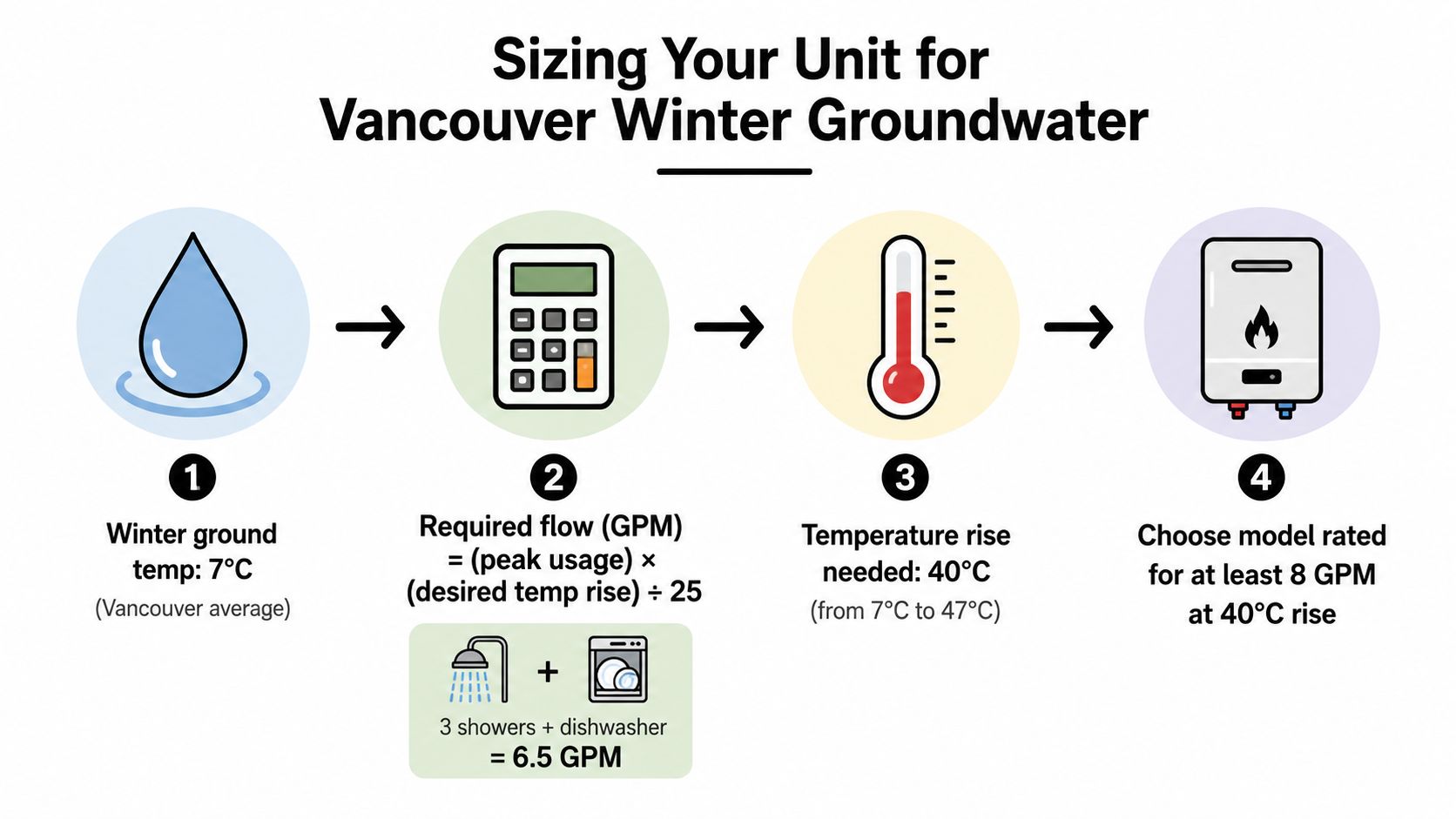
Start with three inputs: winter inlet temperature, desired outlet temperature, and the fixtures likely to operate together. Canadian guidance commonly uses winter groundwater near 5°C as a calculation baseline. With a target of 49°C, the heater must provide a 44°C temperature rise, as shown in this Canada-focused tankless sizing example. The model must deliver that rise at the household's maximum demand, not only at a warmer seasonal inlet temperature.
How the sizing check works
A plumber will usually:
- List simultaneous fixtures. Count showers, baths, kitchen taps, laundry equipment, and dishwashers that may run together.
- Estimate peak flow. Use the fixtures' actual flow requirements. The old tank's capacity does not establish the required tankless output.
- Calculate temperature rise. Subtract winter inlet temperature from the desired outlet temperature.
- Check the manufacturer's performance table. Confirm delivered flow at the required temperature rise.
- Account for household habits. A three-bathroom home with two active showers and a dishwasher needs more capacity than a home where occupants stagger use.
Consider two showers running in a Richmond house while the dishwasher draws hot water. A marginal unit may seem fine during mild weather. Colder winter groundwater increases the temperature rise, leaving the same appliance with less usable flow at the setpoint.
Undersizing usually appears under demand, when two showers, a dishwasher, and a washing machine compete for hot water.
The symptoms are familiar: water starts hot, then turns lukewarm, or the temperature shifts when another fixture opens. Larger households may need a higher-BTU condensing gas unit or a staged design. Recirculation can reduce waiting time at distant taps, but it cannot correct inadequate peak heating capacity.
For a visual explanation of flow, temperature rise, and appliance capacity, review this tankless sizing video before a site visit. The final selection should come from the model's technical data and an assessment of the home's actual demand.
Installation Factors That Change the Final Price
The biggest pricing mistakes happen when homeowners compare a straightforward replacement with a conversion that requires infrastructure work. In Greater Vancouver, the installation location and existing utilities often matter more than the brand printed on the front panel.
Gas line and venting
A high-output gas tankless heater may need a larger or longer gas supply than the old tank. If the meter is on the opposite side of the home, the installer may need to route new piping through a crawlspace, ceiling, or finished area. A relocated heater can also require additional water piping, shutoffs, condensate handling, and wall support.
Venting is another common surprise. A storage tank's existing vent may not suit a condensing tankless appliance, and the new system may require a dedicated approved route through an exterior wall. Tankless water heater venting guidance is useful background, but the appliance installation manual and local inspection requirements control the actual design.
Electrical, permits, and access
Gas models still need electricity for ignition, controls, and safety components. If there isn't a suitable receptacle nearby, electrical work becomes part of the project. Richmond, Burnaby, and Vancouver properties may also involve municipal permit and inspection steps, particularly where gas piping, venting, or structural changes are involved.
The table below is a budgeting guide, not a promise of fixed add-on prices. An installer needs to inspect the property before assigning a specific amount.
| Factor | When It Applies | Typical Impact on Cost |
|---|---|---|
| Gas-line upgrade | Existing pipe can't supply the selected heater at peak demand | Can move the project substantially above a basic swap |
| New venting | The old tank vent isn't approved for the tankless model | Adds materials, labour, and exterior termination work |
| Electrical connection | No suitable power is available near the heater | Adds wiring, receptacle, or related electrical work |
| Condensate drainage | A condensing unit produces condensate that needs compliant disposal | Adds drainage components and installation labour |
| Permit and inspection | Required for the property's gas, venting, or renovation scope | Adds administrative and municipal costs |
| Difficult access | Heater is in a tight closet, crawlspace, attic, or finished area | Increases labour and protection or restoration work |
| Relocation | The new heater moves closer to an exterior wall or utility connection | Adds water, gas, venting, and finishing work |
A quote should state whether the contractor will obtain permits, test the gas system, commission the heater, and explain operating controls. If those details are missing, the apparent low bid may exclude work another contractor has included.
FortisBC Rebates and How They Lower Your Net Cost
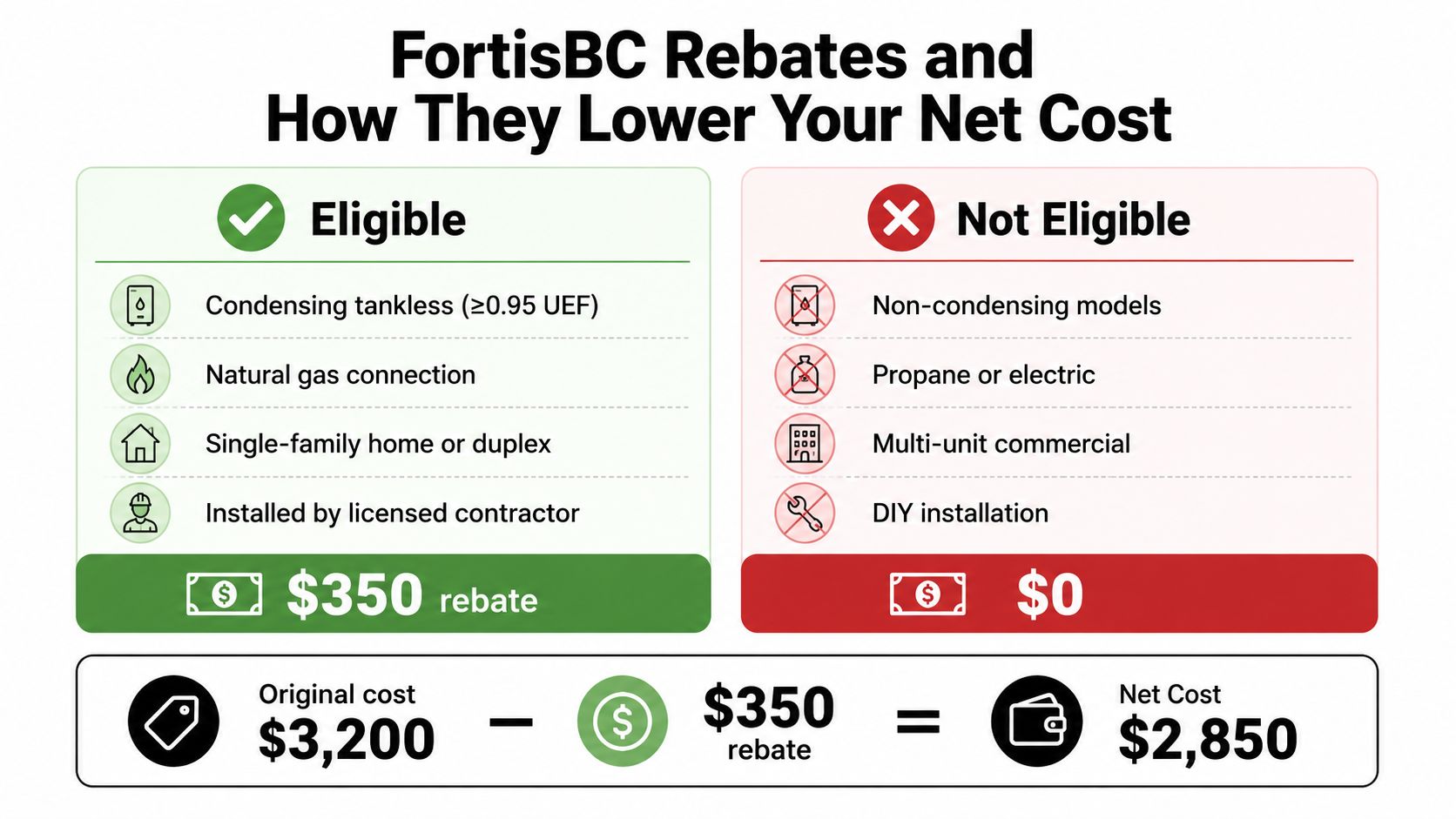
A rebate reduces the net installed cost only when the equipment and property meet FortisBC's programme rules. In British Columbia, a qualifying condensing tankless model replacing a natural-gas water heater may receive up to $1,000, according to this FortisBC rebate overview.
The rebate does not apply to every wall-mounted water heater. Fuel type, condensing design, efficiency rating, replacement conditions, contractor requirements, and property category can affect eligibility. Confirm the current terms with FortisBC before ordering equipment, since programme conditions and application procedures can change.
A net-cost example
Suppose a Vancouver household receives a $5,500 installed quote for a qualifying condensing tankless replacement. If the household receives the full $1,000 FortisBC rebate, the effective project cost falls to approximately $4,500, using the practical example in this BC rebate discussion.
That result depends on approved equipment, an eligible installation, and completed paperwork. The rebate also does not make a higher-priced installation automatically worthwhile. Compare the qualifying model, required upgrades, expected hot-water demand, and maintenance obligations before choosing a higher efficiency tier.
Multifamily and strata properties require separate checking. Eligibility may differ between individual units, common areas, and larger buildings. Before estimating payback, identify who owns the heater, who pays the gas bill, and whether FortisBC classifies the work as a single-family replacement or a multifamily installation.
Operating Savings and Realistic Payback Timelines
A tankless heater can reduce standby losses because it heats water only when a tap calls for it. In Greater Vancouver, the actual reduction depends on household demand, incoming groundwater temperature, fuel rates, set temperature, and the condition of the existing tank. This comparison of tankless and storage operating costs explains why savings tend to be more noticeable in homes that use hot water regularly rather than keeping a large volume heated between uses.
Winter groundwater temperatures matter. Colder incoming water means the burner must work harder to reach the same outlet temperature, so a household may save less than a similar home in a warmer climate. Showers, laundry, dishwashing, and the number of occupants also affect the result. There is no fixed monthly saving that applies to every Metro Vancouver property.
Estimate the payback from the premium
Calculate the tankless project cost after any confirmed FortisBC rebate, then subtract the cost of the tank option you would otherwise install. That difference is the premium you need to recover. Compare it with the annual reduction shown by your own gas bills and usage patterns. The result is a planning estimate, not a promise.
Payback is generally more favourable when the home has:
- High hot-water demand: Frequent showers and regular appliance use give the system more opportunity to avoid storage losses.
- Long-term occupancy: Owners who stay longer have more time to recover the installation premium through lower energy use.
- An older or poorly located tank: Replacing a tired unit before failure can avoid an emergency purchase and may reclaim useful space.
- Planned renovation work: Coordinating the heater with gas-line, venting, or finished-wall work can reduce the added disruption and labour.
The calculation changes sharply if the tankless installation needs a gas-line upgrade, new venting, electrical work, or other Vancouver-area code-related changes. Those costs can outweigh operating savings, even with a rebate. A high-efficiency storage tank may be the better financial choice for a lightly occupied home, a property likely to be sold soon, or any project where the retrofit premium is large. Look at the complete installed price, not the appliance sticker price, before deciding whether the upgrade will pay off.
Maintenance Expectations and Long-Term Care
A tankless water heater needs planned service. Mineral scale can collect on the heat exchanger, while a dirty inlet filter or blocked vent can reduce flow, affect combustion, and make the burner work harder. Water conditions that encourage buildup increase the chance of these problems, so the maintenance schedule should follow the appliance manual and the actual conditions at the property.
Service access should be confirmed before installation. California's 2022 water-heating code requires isolation valves for flushing on tankless units above 6.8 kBtu/h, as documented in the California Energy Commission water-heating code filing. Greater Vancouver installations are governed by British Columbia requirements and the manufacturer's instructions, but accessible isolation valves still make future flushing simpler. Confirm that they appear in the written quote rather than assuming they are included.
What routine service covers
A plumber will check the following items according to the manufacturer's instructions:
- The inlet filter: Remove and clean it when the manual requires, or sooner if hot-water flow drops.
- The heat exchanger: Flush and descale it when mineral buildup or the property's water conditions call for service.
- The isolation valves: Test that they operate properly, so flushing does not require shutting off water to the whole home.
- The vent termination: Look for blockage, damage, corrosion, or anything that could interfere with combustion or exhaust.
- The condensate path: On a condensing model, confirm that drainage remains open and correctly configured.
Keep the service history for warranty records and future troubleshooting. Fluctuating temperature, weaker flow, ignition faults, unusual burner noise, recurring error codes, or water around fittings warrant prompt diagnosis. Do not remove combustion components or bypass safety controls. Gas appliances require qualified service, especially when the fault involves ignition, venting, or combustion.
Routine care protects both performance and repair costs. A neglected scale or flow problem can develop into a heat-exchanger failure, turning a manageable service visit into a much larger bill.
Deciding If Tankless Is Right for Your Property
Tankless makes the strongest case when the property has suitable gas capacity, meaningful hot-water demand, and an owner who values continuous supply and lower standby use. Newer homes often have a simpler path because the utility layout and venting options are easier to assess, but an older home can still be a good candidate if the retrofit scope is understood before work starts.
A high-efficiency storage tank may be the better choice when the budget is tight, hot-water demand is modest, or the tankless conversion requires extensive gas, electrical, and venting work. The decision should also account for maintenance. If the property owner won't arrange flushing and filter checks, a less maintenance-sensitive system may create fewer long-term frustrations.
Use the property, not the sales pitch
Ask these questions during a site assessment:
- What is the peak simultaneous hot-water demand?
- Can the existing gas line supply the recommended model?
- Where will the vent terminate, and what wall or ceiling access is required?
- Does the unit need condensate drainage or electrical work?
- Which FortisBC rebate category applies to this property?
- What maintenance does the manufacturer require?
- What would the comparable high-efficiency tank installation cost?
For strata buildings and landlords, add ownership and billing questions. Determine whether the heater serves one dwelling or a shared system, who controls access for maintenance, and whether the incentive structure treats the property as multifamily. The lowest purchase price isn't necessarily the lowest operating or ownership cost.
Encano Plumbing & Drainage Ltd. provides tankless water heater installation, assessment, replacement, and maintenance services across Greater Vancouver. Homeowners and property managers can use its tankless water heater benefits guide as background, then request a site-specific comparison based on the home's gas supply, venting route, peak demand, and rebate eligibility.
Encano Plumbing & Drainage Ltd. can assess your existing water heater, size a tankless replacement for Greater Vancouver winter conditions, and identify gas-line, venting, electrical, permit, and maintenance requirements before installation. Visit Encano Plumbing & Drainage Ltd. to arrange a transparent quote for your Vancouver, Richmond, Burnaby, or surrounding-area property.