
You're halfway through a hot Vancouver afternoon when the indoor temperature starts climbing, the thermostat keeps calling for cooling, and the outdoor unit stays silent. In a strata, the same failure can affect several suites or a shared mechanical area, while a landlord may be trying to find a contractor before tenants lose patience. The right response depends on more than whether the system turns on. It depends on the equipment, the building, the permits, the refrigerant rules, and whether repair still makes sense.
British Columbia's cooling market has changed quickly. Homeowners who once relied on fans or portable units are now booking central air conditioning, ductless systems, and heat pumps. That growing installed base needs proper commissioning, seasonal maintenance, safe repairs, replacement planning, and technicians who understand local requirements.
Table of Contents
- Why Air Conditioning Services Matter More Than Ever in BC
- Types of Air Conditioning Services You Can Request
- Common AC Problems and Simple Troubleshooting Steps
- Expected Costs and Service Frequency for BC Homes
- How to Choose a Reliable Air Conditioning Provider
- Encano's Service Areas and 24/7 Emergency Response
- Frequently Asked Questions About AC Services
Why Air Conditioning Services Matter More Than Ever in BC
A Richmond homeowner may have bought a portable unit during a hot summer and later decided that temporary cooling wasn't enough. A Burnaby strata manager may now be responsible for equipment that was installed recently but has never received a proper seasonal inspection. In both situations, the first failure exposes the same problem: many people own cooling equipment without knowing what service it requires or which work needs approval.
BC Hydro reported that 34% of B.C. homes used air conditioning in 2018, compared with 10% in 2001, meaning household use had more than tripled in less than two decades. Its later 2025 bulletin said nearly 70% of British Columbians now have air conditioning at home, and about 40% of AC users bought their first unit between 2021 and 2025. Portable and window units remained the most common choice, at about 60%, while nearly 27% of AC-equipped households had invested in heat pumps. These figures are discussed in CBC's report on BC Hydro's air-conditioning findings.
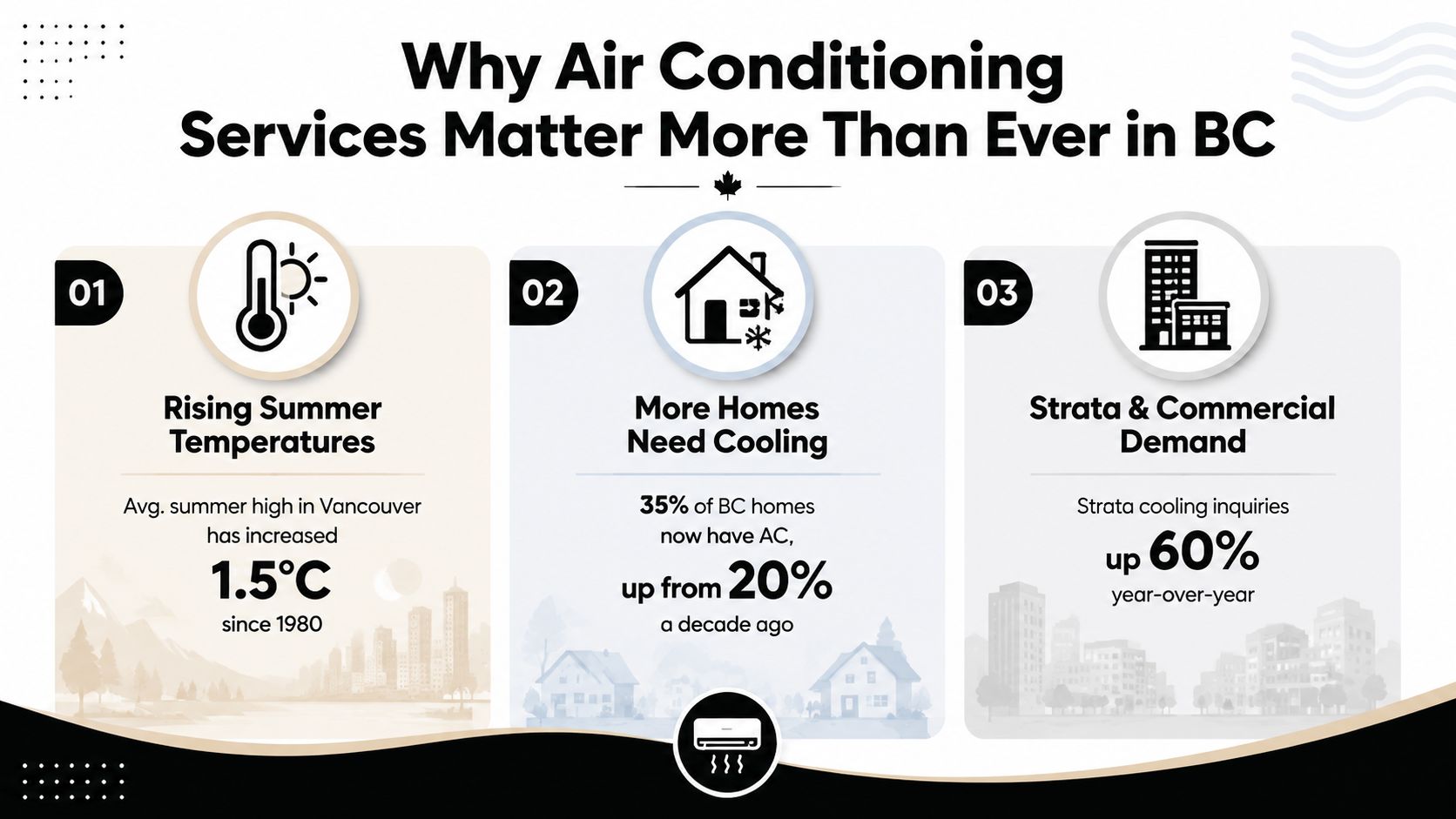
The provincial market still has a distinctive history. In 2003, 18% of B.C. households had air conditioning, compared with 45% nationally. By 2025, the national share was 68.3%, while British Columbia remained at 45.2%, the lowest among major regions, compared with 83.0% in Ontario, according to Natural Resources Canada's summary of Statistics Canada air-conditioning data. That catch-up pattern creates demand from first-time buyers, older installations, replacement projects, and efficiency-focused upgrades.
The service lesson for homeowners and stratas
Rapid adoption means a technician may be working on a portable unit in one home, a ductless mini-split in another, and a shared heat-pump system in a strata building. Those systems don't have the same maintenance needs, access requirements, electrical demands, or permitting path.
A homeowner who books only a refrigerant top-up may be treating a symptom. A strata manager who schedules replacement without checking mechanical and electrical permits may create avoidable delays. Good air conditioning services start with identifying the equipment and the building conditions before anyone recommends a repair.
Practical rule: A cooling system should be assessed as part of the property, not as an isolated appliance.
Types of Air Conditioning Services You Can Request
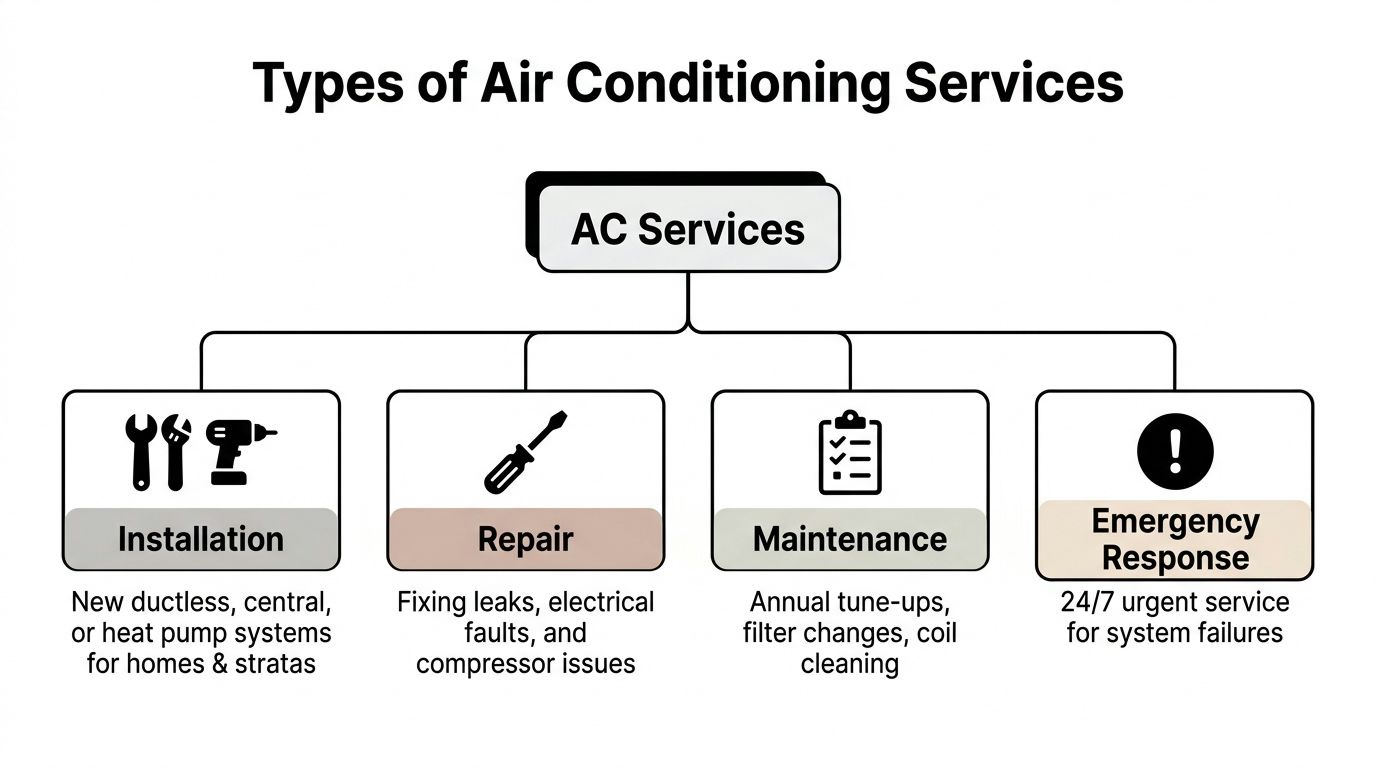
Most service calls fall into four categories. Choosing the right one helps the contractor arrive with the correct tools and gives you a clearer answer about urgency.
Installation and replacement
Installation is the right request when a home has no suitable cooling system, when an existing unit is beyond practical repair, or when the owner wants to change from separate heating and cooling equipment to a heat pump. A Richmond homeowner replacing electric baseboards with a qualifying heat pump should ask about electrical capacity, outdoor-unit placement, drainage, controls, noise, rebates, and permits before signing a contract.
For ductless equipment, the contractor should verify wall penetration, line-set routing, condensate drainage, indoor-unit placement, and outdoor clearances. Central air requires a closer look at duct sizing, return-air capacity, furnace compatibility, coil placement, and commissioning. A low price that ignores airflow or electrical work often becomes an expensive correction later. For background on planning a central system project, review this guide to the cost of installing central air.
Repair
Repair applies when the system runs but doesn't cool properly, trips a breaker, leaks water, makes an unfamiliar noise, or cycles abnormally. A Burnaby landlord dealing with warm air from a tenant's vents should report the symptom, the thermostat setting, whether the outdoor unit runs, and any visible icing or water. That information helps the technician separate airflow, electrical, drainage, and refrigeration problems.
A repair may involve a capacitor, contactor, blower motor, drain line, coil, fan, control board, or refrigerant leak. The technician should diagnose the cause rather than replace the first part associated with the symptom.
Maintenance
Maintenance is planned care for a functioning system. A useful visit includes filter and airflow checks, thermostat operation, electrical inspection, coil condition, condensate drainage, outdoor-unit condition, and a complete cooling cycle. For central air, Natural Resources Canada recommends annual servicing by a qualified HVAC contractor, because clean filters, coils, and ductwork support efficient operation and reduce runtime.
Emergency response
Emergency service is appropriate when cooling failure creates an immediate safety, property, or occupancy problem. A Surrey business with a failed rooftop unit after hours may need temporary measures, electrical isolation, condensate protection, and a repair decision rather than a routine tune-up. Emergency response doesn't always mean the complete repair happens immediately. A responsible technician first makes the system safe, identifies the failure, and explains what can be restored now versus scheduled later.
For homeowners considering ductless equipment, this mini-split installation resource can help frame the questions to ask before installation.
Common AC Problems and Simple Troubleshooting Steps
Start with the symptom, then check only what you can inspect safely. Homeowners can often identify a simple control or airflow issue, but refrigerant circuits and live electrical components require professional diagnosis.
If the air feels warm or airflow is weak
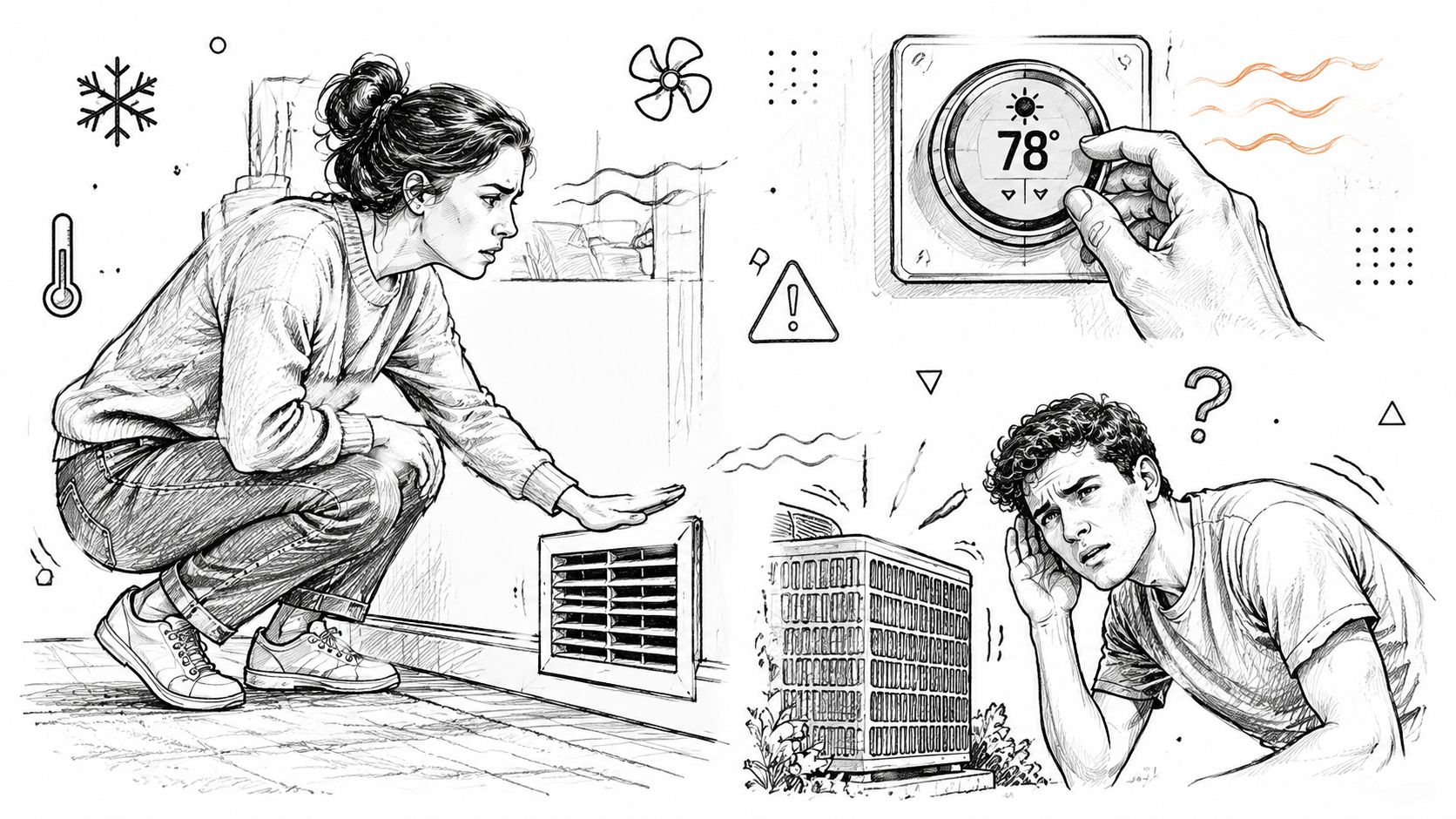
Check the thermostat mode, setpoint, fan setting, and power display first. If the thermostat appears normal, inspect the filter and replace it if it's visibly loaded with dust. Make sure supply registers and return grilles aren't blocked by furniture, rugs, or heavy curtains.
Next, look at the outdoor unit from a safe distance. Leaves, stored items, and overgrown plants can restrict airflow through the coil. Don't remove electrical covers, reach through the grille, or spray the unit while it's energized.
If the indoor fan runs but the outdoor unit doesn't, the problem may involve the breaker, contactor, capacitor, control wiring, or another component. Reset a tripped breaker only once. If it trips again, leave the system off and call a technician.
If the system is icing, leaking, or making noise
Visible frost on refrigerant lines or the indoor coil often indicates restricted airflow, a coil problem, or a refrigeration fault. Turn the cooling off and allow the coil to thaw. Continuing to run an iced system can worsen the failure and send meltwater into areas that weren't designed to handle it.
Water near the indoor unit can point to a blocked condensate drain, damaged pan, or drainage problem. A technician should inspect the drain and pan rather than just wiping up the water. Hissing, grinding, rattling, or a burning smell also moves the call beyond safe homeowner troubleshooting.
When energy use changes suddenly
A sudden increase in electricity use can result from poor airflow, dirty coils, incorrect refrigerant charge, failing motors, or a control problem. Compare the current comfort and operating pattern with normal behaviour, then record when the change started. That short history is more useful than asking a technician to “check everything” without details.
Refrigerant work isn't a DIY adjustment. A technician needs to locate and assess a leak, verify the charge, and confirm that the system can operate safely.
Expected Costs and Service Frequency for BC Homes
HVAC companies can't price every repair accurately over the phone. The final amount depends on system type, access, parts availability, the cause of failure, electrical work, duct modifications, equipment capacity, and whether permits are required. A rooftop unit, a concealed ducted system, and a single wall-mounted mini-split can all produce very different labour requirements.
A practical budget starts with the service scope rather than a universal price promise. A maintenance visit is usually narrower than a diagnostic repair. A replacement estimate should separate equipment, installation labour, electrical work, disposal, commissioning, permit administration, and any building coordination.
A planning table for recurring service
| Service Type | Recommended Frequency | What Is Included |
|---|---|---|
| Central air maintenance | Annually | Filter and airflow review, coil and ductwork condition, electrical components, condensate drainage, thermostat operation, and cooling-cycle testing |
| Ductless system maintenance | Seasonally or as advised for the equipment | Filter cleaning, indoor coil and blower inspection, outdoor coil review, drainage check, controls, and operating test |
| Repair diagnostic | When symptoms appear | Symptom review, electrical and mechanical testing, airflow assessment, refrigeration diagnosis where required, and written repair options |
| Installation or replacement assessment | Before equipment selection | Load and comfort discussion, equipment compatibility, placement, electrical requirements, permit review, and scope of work |
| Commercial or strata equipment review | Organised around building needs | Shared-equipment inspection, access planning, operating concerns, documentation, and coordination with property representatives |
For central systems, NRCan's ENERGY STAR information states that ENERGY STAR central air conditioners use 8% less energy on average than standard models. That figure applies to the product comparison described by NRCan, not to a guarantee for every home. Installation quality still matters. Poor airflow, dirty coils, incorrect charge, or undersized ductwork can undermine an efficient unit.
Repair, replace, or change technology
A repair makes sense when the equipment is otherwise sound, the failure is isolated, and compatible parts remain available. Replacement deserves serious consideration when failures recur, comfort remains uneven, or the system no longer fits the home's electrical, heating, or control requirements.
A heat-pump retrofit can change the decision because it provides cooling and heating in one system. In California, the 2025 Energy Efficiency Potential and Goals Study describes a reference scenario 6% to 11% higher than the 2023 goal, reflecting ongoing efficiency and electrification planning rather than a fixed service model. For BC homeowners, the local question is more practical: can the property support the equipment, what permits apply, and does the project qualify for available CleanBC support?
How to Choose a Reliable Air Conditioning Provider
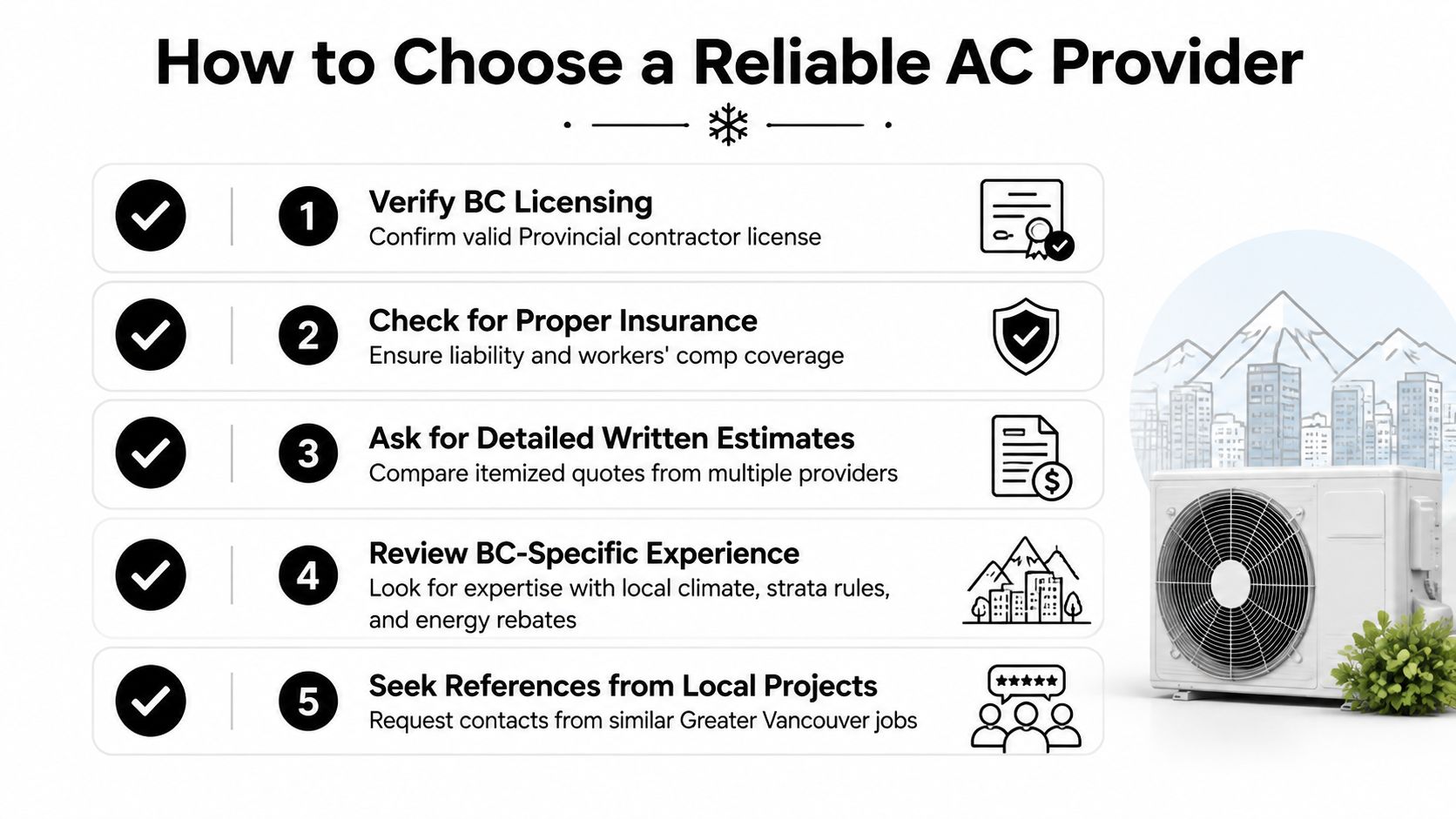
A reliable contractor should make compliance part of the estimate, not an afterthought. Ask who will handle the electrical permit, whether gas work is involved, how refrigerant will be managed, and which municipal approvals apply to the property.
Verify the work before comparing the price
Start with the contractor's qualifications and insurance. Then request a written scope that identifies the equipment, model, electrical changes, drainage, controls, commissioning, warranty responsibilities, and permits. An estimate that lists only “install AC” doesn't give you enough information to compare proposals.
For a heat-pump installation in BC, Technical Safety BC explains the permit requirements. Residential heat pumps are regulated equipment, and installation or upgrading usually requires an electrical permit plus a licensed electrical contractor. If a natural gas furnace or boiler is modified or removed, a gas permit is also required.
Check municipal and refrigerant compliance
The City of Vancouver requires a mechanical permit and an electrical permit for installing or replacing heating and cooling systems in new and existing buildings, effective July 1, 2022, as described in the Vancouver HVAC permitting guidance. A strata project may also need council approval, access coordination, engineering input, or building-envelope review.
Refrigerant handling has its own legal boundary. Under BC's Ozone Depleting Substances and Other Halocarbons Regulation, only an approved person may service air-conditioning or refrigeration equipment. A Surrey business owner shouldn't hire an unqualified person to top up a rooftop unit because the visit appears inexpensive.
Ask questions that expose weak proposals
- Diagnosis: Will you test airflow, electrical components, drainage, and refrigerant conditions before recommending a part?
- Permits: Which permits are required, and who applies for them?
- Scope: Does the quote include commissioning, cleanup, disposal, and documentation?
- Building experience: Have you worked with strata access rules and shared mechanical systems?
- Rebates: Will you identify eligibility without treating a potential rebate as guaranteed?
A contractor who avoids these questions may still be capable of a simple repair, but they shouldn't be your first choice for a retrofit or multi-unit project.
Encano's Service Areas and 24/7 Emergency Response
Greater Vancouver properties don't all need the same response. A homeowner in Richmond may need a scheduled heat-pump assessment, while a commercial facility in Surrey may need an urgent diagnosis after a rooftop cooling failure. A strata in New Westminster may require coordinated access, clear documentation, and a plan that limits disruption to residents.
Encano Plumbing & Drainage Ltd. serves Vancouver, Richmond, Burnaby, New Westminster, Delta, Surrey, and nearby communities with scheduled and emergency plumbing, heating, gas, drainage, and HVAC work. Its HVAC offering includes air conditioner maintenance, installation, repair, replacement, and emergency service. The company also works with residential, commercial, government, landlord, and strata customers.
What a practical service visit looks like
For a midnight no-cooling call, the first priority is safety and damage control. The technician can assess whether the system has an electrical fault, drainage issue, airflow restriction, or larger mechanical failure, then explain whether a temporary restoration is sensible or whether the property needs a scheduled repair.
For planned work, the process should be more deliberate. A technician reviews the existing equipment, access, electrical requirements, condensate routing, outdoor placement, and permit needs before recommending a replacement. Modern diagnostic tools, including video inspection, acoustic leak detection, and high-pressure jetting, are part of Encano's broader service toolkit, although an HVAC diagnosis still depends on the appropriate electrical, airflow, mechanical, and refrigeration tests.
Heat pumps and rebate planning
BC's CleanBC Better Homes and related programmes have been reported to provide up to $16,000 for eligible households, depending on income and equipment eligibility, according to this BC heat-pump rebate overview. That amount isn't automatic, and homeowners should confirm current programme rules before using a rebate in their budget.
A Richmond homeowner replacing electric baseboards with a qualifying heat pump could potentially combine available support rather than paying the full installation cost upfront. The contractor should still design the system around the home's heating load, electrical service, controls, noise constraints, and long-term maintenance needs.
For urgent cooling failures, homeowners and property managers can review Encano's AC emergency repair service and decide whether the situation requires immediate attendance or scheduled troubleshooting.
Frequently Asked Questions About AC Services
Can a gas furnace be replaced with a heat pump?
Often, yes, but the project needs a technical and regulatory review. The contractor must confirm electrical capacity, heat-pump sizing, duct compatibility, controls, outdoor placement, drainage, and what happens to the existing furnace. If the gas furnace or boiler is modified or removed, a gas permit is required, and the heat-pump work usually requires an electrical permit and a licensed electrical contractor under Technical Safety BC's heat-pump requirements.
A homeowner shouldn't assume that removing the furnace is always the best design. Some properties may benefit from a heat pump paired with existing backup heat, while others may need a complete change to the air-distribution and electrical setup.
Can I legally get a refrigerant top-up from anyone?
No. BC's halocarbon regulation requires an approved person to service air-conditioning and refrigeration equipment. A top-up without leak diagnosis may also leave the underlying problem unresolved. Ask the provider who will perform the work, what testing is included, and whether the technician is approved for the task.
Do portable and window units need professional servicing?
They still need care, even though many owners handle basic cleaning themselves. Keep filters clean, maintain clear airflow, inspect plugs and cords, and follow the manufacturer's instructions. If the unit leaks, smells burnt, trips power, or stops cooling, unplug it if safe and seek qualified service rather than opening the refrigeration circuit.
Portable and window units remain common in BC homes, as noted in the earlier BC Hydro findings. Their lower installation complexity doesn't remove the need for safe electrical use or responsible disposal.
What should a strata manager prepare before booking?
Collect the equipment details, suite or mechanical-room locations, access restrictions, recent service records, and any known water or electrical problems. Confirm whether the project affects common property, requires council approval, or needs municipal and electrical permits. A clear site plan helps the contractor separate individual-suite service from shared-building work.
When should I book maintenance?
Book it before the system is needed continuously, rather than waiting for a no-cooling call. For central air, NRCan recommends annual service by a qualified contractor, with attention to filters, coils, ductwork, efficiency, and runtime. A maintenance visit can't prevent every failure, but it gives the technician a chance to identify airflow, drainage, electrical, and operating issues while the system is still available for planned work.
Encano Plumbing & Drainage Ltd. provides scheduled air conditioning maintenance, installation, replacement, repair, and 24/7 emergency HVAC support across Greater Vancouver. Visit Encano Plumbing & Drainage Ltd. to request service for your home, strata, commercial property, or heat-pump project and discuss the permits, equipment, and next steps before work begins.