
It's a cold January morning in Vancouver, and the thermostat says 22°C, but the second-floor bedroom still feels chilly. The furnace is running, yet the airflow from the register feels weak. In the utility room, a Burnaby homeowner slides out the filter and finds a grey, matted rectangle packed with dust. That small component may explain more than the thermostat does.
A practical furnace filter replacement schedule starts with filter thickness, then adjusts for the way Lower Mainland homes operate. Coastal humidity, long heating runs, pets, renovation debris, and wildfire smoke can all change how quickly a filter loads up. The calendar gives you a starting point, but the filter itself tells you when airflow is beginning to suffer.
Table of Contents
- Why Your Furnace Filter Matters More Than You Think
- The Core Furnace Filter Replacement Schedule
- Choosing the Right Filter Type for Your Home
- Lower Mainland Factors That Shorten Filter Life
- How to Check and Replace a Furnace Filter
- Filter Schedules for Strata and Commercial Buildings
- Your Year-Round Furnace Filter Checklist
Why Your Furnace Filter Matters More Than You Think
A furnace filter sits in the return-air path. Before household air reaches sensitive furnace components and travels back through the duct system, the filter catches material such as dust, pet dander, pollen, construction debris, and fine particles from smoke. A clean filter allows the blower to move air through the system without unnecessary resistance.
That Burnaby filter had probably collected months of ordinary household debris, then held even more fine material during heavy heating use. As the media becomes packed, the blower has to pull harder. Air may reach some rooms more slowly, while the furnace can experience additional strain as it tries to move the volume of air its controls expect.
Practical rule: A filter that looks grey, matted, or visibly clogged deserves attention before the calendar says it is due.
Four problems caused by neglect
- Higher energy use: Restricted airflow makes the heating system work harder to circulate air.
- Shorter blower motor life: A blower operating against resistance can experience more mechanical and electrical stress.
- Weaker heat delivery: Less air reaches registers, so distant rooms may stay cool even when the thermostat is satisfied slowly.
- Poorer indoor air quality: During the Lower Mainland heating season, windows often stay closed. Dust and captured particles can then remain part of the indoor air problem if the filter is saturated or poorly fitted.
The filter also protects the furnace itself. Dust that passes around a damaged, loose, or overloaded filter can settle on the blower wheel and heat exchanger, while contaminated air can travel into ductwork. That's why a basic airflow problem can become an equipment-maintenance issue if nobody checks the filter.

The same principle matters beyond a detached home. Strata councils and facility managers in Vancouver deal with dust from shared corridors, parkades, tenant suites, and building work. A consistent residential filter habit becomes a larger maintenance discipline when many air-handling points operate across one property. If airflow behaviour is confusing, Encano's guide to airflow in a furnace provides useful context.
This guide uses a schedule suited to coastal conditions, renovation dust, and wildfire-smoke summers. It's more defensible than applying one generic North American interval to every Vancouver-area home.
The Core Furnace Filter Replacement Schedule
Start with the filter's thickness, not the package marketing. A thin filter has limited media surface area, so it fills sooner. A deeper filter contains more folded media inside the cabinet, giving dust more room to collect before airflow restriction becomes a concern.
Think of the filter as a ladder. A 1-inch filter is a short ladder with less room for accumulated debris. A 4-inch or 5-inch media filter is taller and offers more surface area, so its replacement interval can stretch when household conditions are ordinary.
Use the schedule as a starting ladder
- 1-inch filters: Plan on replacement every 1 to 3 months, based on filter type and conditions. Carrier's Canadian guidance places basic 1-inch filters at roughly 30 days to 3 months, depending on the manufacturer's directions. See Carrier's Canadian furnace filter guidance.
- 4-inch media filters: Regional Canadian guidance commonly places these at 3 to 6 months, while some household schedules extend toward 6 to 9 months when the system and filter manufacturer allow it. Inspect monthly.
- 5-inch media filters: These commonly last 6 to 12 months, subject to dust loading, runtime, and the manufacturer's instructions.
- High-MERV filters: A MERV 13 filter used for finer particle capture may need inspection and replacement on a 2 to 3 month pattern when it uses a 1-inch format. A higher rating doesn't automatically mean a longer life.
The familiar 90-day rule suits a standard 1-inch pleated filter under average use. It doesn't fit every home. A furnace that runs for long periods in winter moves more air through the filter, and a home with pets, renovation debris, or smoke exposure can load the media sooner.
For example, a 1,500-square-foot Vancouver special with one dog might check its filter at 60 days and replace it if the pleats are already loaded. A tight Tsawwassen townhouse without pets may approach 90 days, provided the monthly inspection still looks good.
| Filter Type | Thickness | MERV Rating | Replacement Interval | Best For |
|---|---|---|---|---|
| Fibreglass | 1 inch | Basic, often low-rated | About 30 days | Low-dust, low-sensitivity use |
| Pleated | 1 inch | Commonly MERV 8 to 11 | About 1 to 3 months | Most homes, adjusted for loading |
| Media | 4 inches | Often MERV 8 to 13 | About 3 to 6 months, sometimes longer by manufacturer guidance | Homes needing more capacity |
| Media | 5 inches | Often MERV 8 to 13 | About 6 to 12 months | Larger debris capacity and longer service intervals |
Make a monthly check the anchor. You don't have to replace a deep media filter every month, but you should look at it every month during heating season so a blocked filter doesn't remain hidden behind a long calendar interval.
Choosing the Right Filter Type for Your Home
The filter shelf at a Burnaby hardware store can make the choice seem harder than it is. You'll usually compare basic fibreglass, standard pleated, and deep-pleated media products. The right choice balances particle capture, airflow, cabinet space, and what the furnace can safely handle.
Three common choices
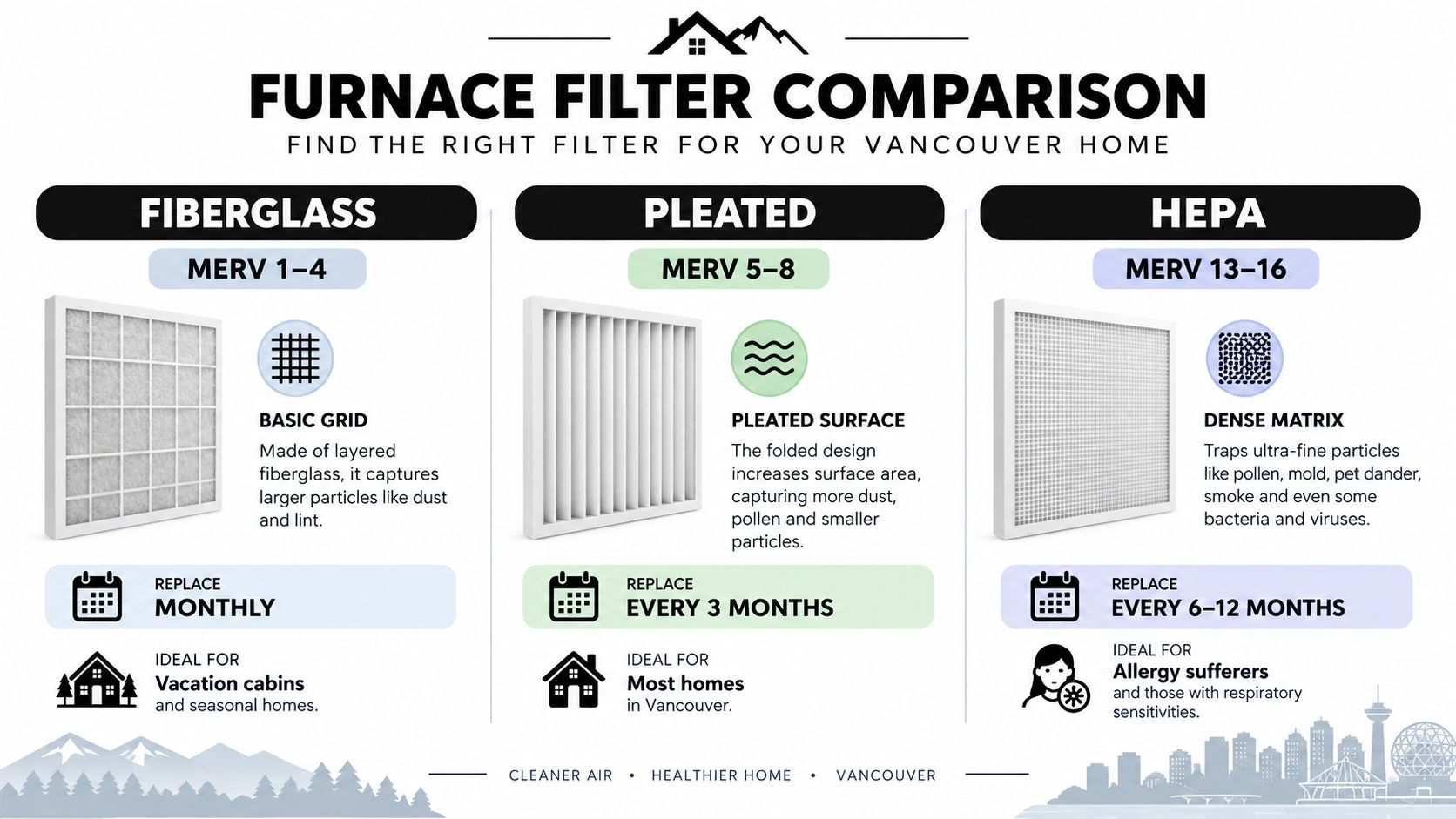
Fibreglass filters are the simple, low-resistance option. They're suited to situations where basic protection is the priority, such as a lightly used vacation cabin or a low-allergy household. A 1-inch fibreglass filter may need monthly replacement, so the lower purchase price doesn't remove the need for regular attention.
Standard pleated filters are the practical workhorse for many Metro Vancouver homes. Their folded surface captures more household dust than a basic flat fibreglass design, and 1-inch pleated filters generally follow a 1- to 3-month replacement pattern. A MERV 8 to 11 option can be a reasonable starting point, subject to the furnace manufacturer's requirements.
Deep-pleated media filters use a 4-inch or 5-inch cabinet depth to provide more collection area. They can suit allergy-sensitive households or homes concerned about wildfire smoke, but their denser media can also create more airflow resistance. A furnace must be able to handle the selected filter.
Match MERV to the equipment
MERV measures how effectively a filter captures particles. A Canada-focused Bryant guide recommends MERV 8 to 13 for most homes and warns that MERV 14 and higher is hospital-grade and may restrict airflow in standard residential systems. Read Bryant's Canadian furnace filter guidance before selecting a denser product.
Use the household situation as a practical filter:
- One cat and no allergies: A pleated MERV 8 filter can provide a sensible starting point, with inspection based on visible loading.
- A Port Moody family with asthma near forest fire zones: A MERV 13 media filter may offer stronger particle capture, but the furnace should be checked for compatibility.
- A new homeowner after a basement renovation: Use a suitable pleated filter and inspect it at 60 days or sooner while drywall and construction dust are still present.
Higher MERV isn't automatically better. If the filter makes airflow too restrictive, the furnace may lose the operating conditions it needs. Confirm the permitted filter specification in the equipment manual or with a qualified technician.
Lower Mainland Factors That Shorten Filter Life
A Vancouver-area schedule can change quickly because the air entering the system changes. Coastal humidity may cause dust to clump on filter media, while long winter runtime sends more indoor air through the filter. The result is a filter that can become restrictive before a standard calendar interval expires.
Start with the monthly inspection, then shorten the replacement interval when a clear trigger appears. A standard pleated filter scheduled for 90 days may need replacement at 60, 45, or 30 days depending on what the household is adding to the airstream. These are practical adjustments, not fixed guarantees.
Local triggers to watch
Coastal humidity can make collected dust feel heavier and more compact. In damp winters, a filter may show restricted passages even though it hasn't reached the nominal date.
Long furnace runtime matters during cold snaps. The longer the blower operates, the more air passes through the media. A filter used heavily through winter should be inspected monthly, not left untouched until spring.
Pets add dander and hair. A home with a cat or dog may move from a 90-day expectation toward a 60-day or 30-day replacement, depending on what the inspection shows.
Renovation dust can overwhelm a filter quickly. Drywall sanding, flooring work, and demolition debris justify an earlier check and often a mid-project replacement. For dust that has escaped into the system, review guidance on ductwork cleaning in Vancouver homes.
Wildfire smoke introduces fine particles that can load a higher-efficiency filter faster. During smoke events, check more often and follow the filter and furnace manufacturer's limits.
| Local Factor | Effect on Filter | Adjusted Interval |
|---|---|---|
| Damp winter conditions | Dust can clump and restrict passages sooner | Inspect monthly, replace when loaded |
| Heavy winter furnace use | More air moves through the filter | Consider 60 days or sooner rather than waiting for 90 |
| Pets | Dander and hair increase loading | Often 30 to 60 days for a 1-inch filter |
| Renovation dust | Fine debris can saturate media quickly | Check during work and replace at 30 to 60 days if needed |
| Wildfire smoke | Fine particles load filtration media | Inspect during and after smoke events, then replace when restricted |
The practical question isn't only, “How many days has it been?” Ask, “What has this filter been asked to capture since the last change?”
How to Check and Replace a Furnace Filter
A filter change is a manageable homeowner task when you treat it as a controlled inspection rather than a rushed pull-and-push job. Start by turning off the furnace at the thermostat, then switch off power at the furnace switch. This prevents the blower from starting while your hands are near the filter compartment.
Follow a safe replacement routine
- Find the filter location. Look at the return-air grille or the cabinet near the furnace. Some systems place the filter behind a large grille, while others use a slot inside the unit.
- Pull the old filter out slowly. Keep the loaded face upright so loose dust doesn't fall into the cabinet. Note the dimensions printed on the frame before disposing of it.
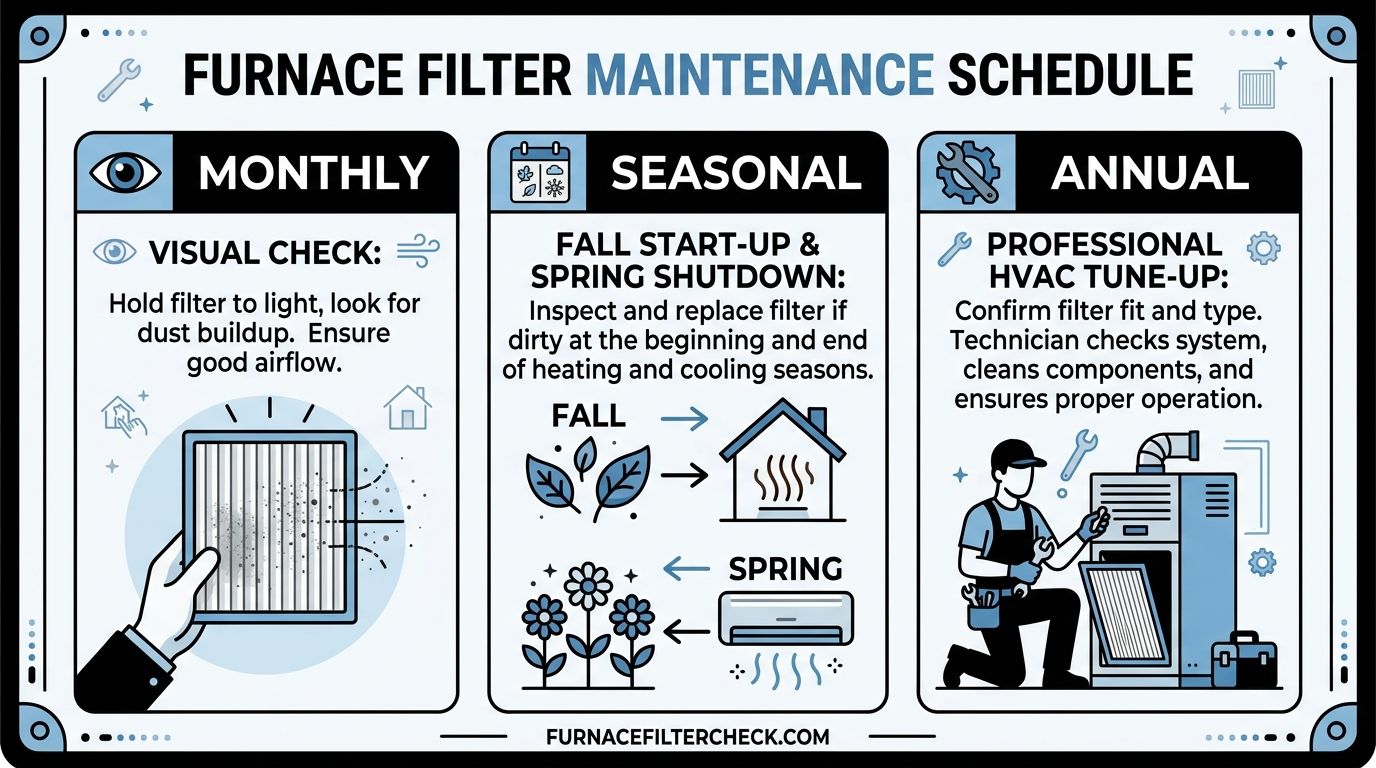
- Use the light test. Hold the filter toward a light source. If you can't see light through the pleats, or the media looks grey and matted, replacement is appropriate.
- Check the airflow arrow. Slide the new filter into position with the arrow pointing toward the furnace, in the direction of airflow. The filter should fit securely without collapsing or leaving obvious gaps.
- Clean the immediate area. Vacuum loose dust around the return grille and filter rack, but don't disturb wiring, burners, or other furnace components.
- Record the date. Write the installation date on the frame or reset the date marker. Keep the filter size nearby so the next purchase is straightforward.
- Restore power and listen. Turn the furnace back on and confirm a normal startup. Watch for unusual noise, persistent short cycling, or airflow that remains weak.
The light test is a guide, not a substitute for judgement. A filter can look acceptable from one angle yet show heavy loading across the main airflow path.
Make inspection a monthly habit
Choose a consistent day, such as the first of each month. Remove the filter, check its condition under light, look for damage around the frame, and inspect the slot for bypass gaps. If the filter is still serviceable, return it in the same airflow direction and note the inspection date.
Don't wash a disposable filter or force an incorrectly sized replacement. If the filter won't slide in smoothly, the arrow direction is unclear, or the cabinet has been modified, stop and get the system identified before operating it.
Filter Schedules for Strata and Commercial Buildings
A detached home has one filter location and one household dust profile. A strata complex may have suite-level furnaces, shared corridor equipment, parkade ventilation, rooftop units, or mechanical rooms serving several areas. Commercial premises add occupancy changes, tenant activities, after-hours operation, and different indoor air-quality expectations.
That variety makes informal maintenance unreliable. One tenant may replace a filter promptly, while another may not know where the filter sits. A rooftop unit may continue operating through extended hours, loading its media faster than a lightly used suite system. The property manager needs a documented programme that distinguishes equipment type and operating conditions instead of applying one date to every location.
Scale the home routine across the property
A workable programme assigns a replacement record to each relevant point:
- Per suite: Record filter size, MERV rating, installation date, and inspection result.
- Per mechanical room: Track shared equipment separately, including access requirements and operating hours.
- Per tenant or rooftop unit: Match the replacement interval to occupancy, dust-producing activity, and runtime.
- Per building cycle: Keep purchase specifications consistent so replacements don't introduce an unsuitable rating or size.
Higher-efficiency filters can support particle-control goals, but the equipment still needs adequate airflow. Facility staff should confirm the permitted MERV range for each furnace or air-handling unit rather than assuming that the densest available media is appropriate.
Encano's filter management work gives strata councils and commercial property managers a practical way to coordinate recurring inspections and replacements across Lower Mainland properties. A managed programme can keep filter grades, dates, access notes, and service records organised under one point of contact. That helps a manager see which units were serviced and which conditions require follow-up, rather than relying on scattered tenant reminders.
The residential lesson remains simple: inspect regularly, replace according to loading, and document the change. At building scale, documentation is what turns that habit into a dependable maintenance system.
Your Year-Round Furnace Filter Checklist
A useful checklist should fit on the utility-room wall and tell you what to do without making you calculate the schedule from scratch. Use the filter's thickness and manufacturer guidance as the baseline, then let visible loading and Lower Mainland conditions move the date earlier.
Monthly checks
- Inspect the media: Hold the filter up to a light and look for grey, compacted, or unevenly loaded pleats.
- Confirm the fit: Check that the frame sits securely and that the airflow arrow points toward the furnace.
- Look around the return: Vacuum loose dust around the grille and rack without opening combustion or electrical compartments.
- Notice comfort changes: Weak airflow, rooms that stop heating evenly, or unusual furnace cycling deserves attention.
Seasonal actions
October, before wetter weather: Clear leaves and debris from outdoor vents and nearby discharge areas. Check the filter before the furnace begins sustained winter operation.
December cold snaps: Perform a mid-winter inspection. If the furnace has been running heavily, a 1-inch filter may need a mid-season change even if the original installation seemed recent.
Before wildfire-smoke exposure: Confirm the filter type and MERV rating suit the equipment. A Canada-focused guide places MERV 8 to 13 within the usual residential range, while MERV 14 and higher can create airflow concerns in standard systems, as covered earlier.
May, before summer shutdown: Inspect the filter before the furnace rests. Replace a loaded filter so dust isn't left sitting in the system through the off-season.
Call a licensed HVAC technician when
- Mould is visible: Mould-like growth on filter media requires more than a routine replacement.
- Airflow stays weak: If a fresh, correctly installed filter doesn't restore airflow, another restriction or equipment fault may exist.
- The return duct shifts: A dislodged return duct can allow unfiltered air into the system and may need proper repair.
- There's a combustion concern: Unusual burner behaviour, odours, soot, or other combustion-side concerns aren't DIY filter tasks.
An annual professional review can confirm filter fit, equipment condition, and airflow requirements. Encano's information on furnace tune-ups can help homeowners understand where routine filter care ends and system servicing begins.
For strata councils and commercial managers, the same checklist becomes a recurring filter management programme across suites, mechanical rooms, and rooftop systems. Consistent dates and records keep a simple maintenance task from being forgotten.
Encano Plumbing & Drainage Ltd. offers HVAC support for furnace troubleshooting, filter-related airflow concerns, and scheduled maintenance for homes, strata properties, commercial premises, and government buildings across the Lower Mainland. If your filter is clean but rooms still aren't heating properly, visit Encano Plumbing & Drainage Ltd. to arrange professional help.